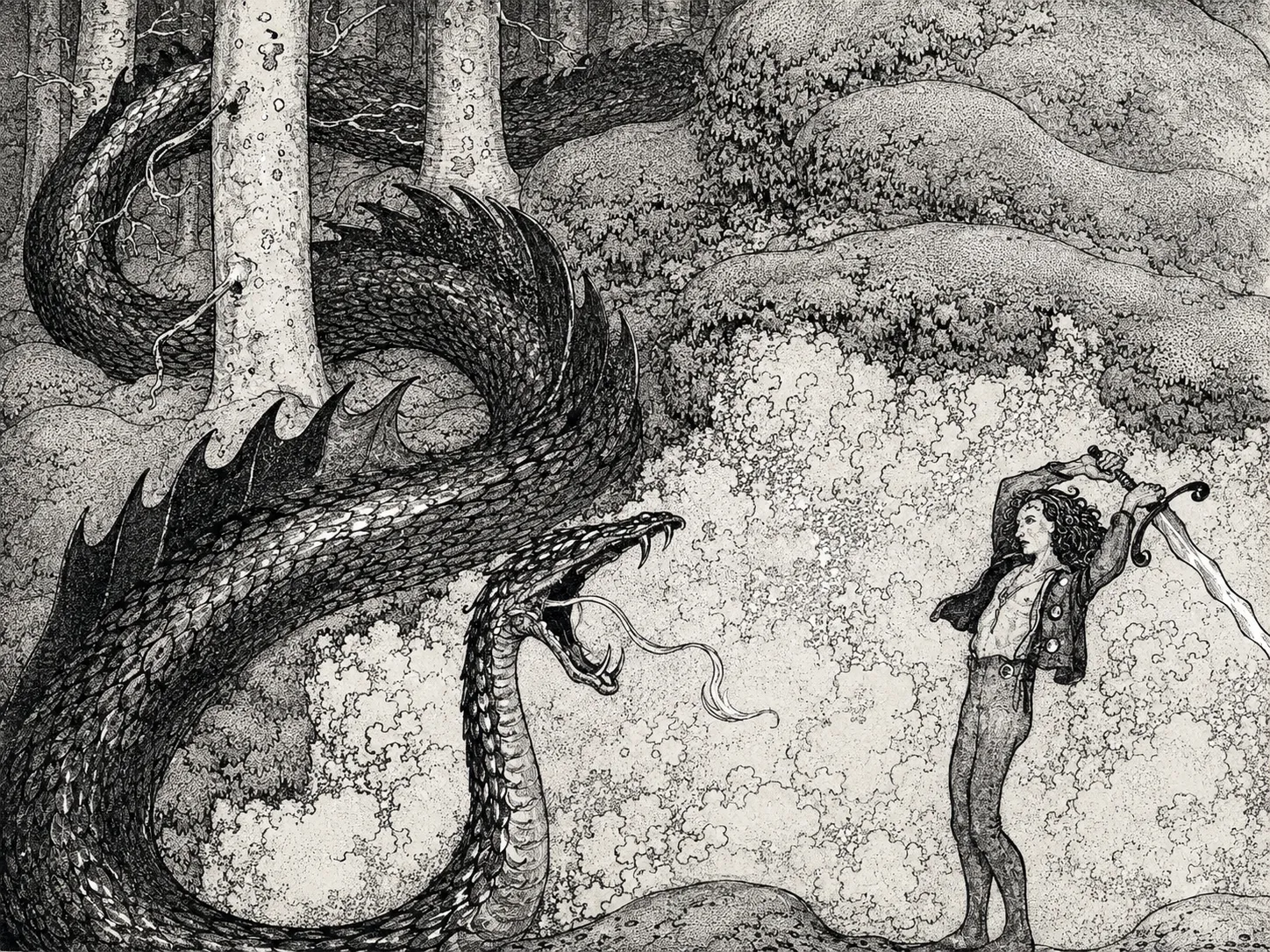
The Lindwurm is a class of snake-like dragon-beasts from the Germanic and Scandinavian mythology, encountered in texts ranging from the 13th-century Nibelungenlied to the Icelandic sagas, including the Völsunga saga and the Gesta Danorum.
Unlike the fire-breathing, winged dragons we often picture, the Lindwurm is more like a giant worm or serpent. It may have no limbs or just two arms, and it appears in forests or wrapped around towers. In some stories, it is not a monster but a cursed human trapped in a tough skin.
The Lindwurm appears in two main types of stories. In some, it is a dangerous predator. In others, it is a tragic prince who needs someone brave to help break his curse. The mix of fear and hidden humanity makes the Lindwurm one of the most complex figures in Northern European folklore.
Summary
Key Takeaways
| Attribute | Details |
|---|---|
| Names & Etymology | Lindwurm (German), Lindorm (Swedish/Danish), Linnormr (Old Norse), Lintwurm (Old High German). Literal translation: “Serpent-Serpent” — both elements independently mean “snake,” making it a medieval tautological compound. |
| Classification | Dragonkin / Serpentine Beast; in cursed-prince traditions, also classified as Enchanted Human. |
| Species | Reptilian (Serpentine Dragon-class) |
| Origin | Born from a broken ritual in fairy-tale traditions — a queen fails to follow a wise woman’s fertility instructions (e.g., eating an unpeeled onion), producing a serpent-child instead of a human one. In Alpine traditions, the creature is a natural disaster-beast that grew unchecked near rivers and marshes. |
| Earliest Record | 13th century — the term “lintrache” (lin-dragon) appears in the Middle High German Nibelungenlied; the creature appears as a narrative figure in Saxo Grammaticus’s Gesta Danorum (c. 1200 AD) in the Ragnar Lodbrok account. |
| Habitat | Deep forests among rock formations (Scandinavian tradition); river floodplains and marshes (Alpine/Austrian tradition). Geographically tied to Northern Germany, Scandinavia, and the Carinthian Alps of Austria. |
| Diet | Cattle (demands one ox per day in the Ragnar saga); human corpses (said to invade churchyards); human brides (in the Prince Lindworm tradition, devours two royal brides before being subdued). |
| Physical Details | Massive serpentine body, very dark with a lighter underside; either limbless or possessing two forelimbs only. Along the spine: fish-like dorsal fins or horse-like mane (called “manorm” in Swedish). Fully grown specimens described as extraordinarily long — capable of encircling a hall or tower entirely. |
| Strengths | Venomous bite or poison spit (a foul, milk-like blinding fluid in Swedish folklore; corrosive venom in the Norse sagas); immense constricting strength; supernatural growth-acceleration effect on whatever lies beneath it; near-immunity to conventional weapons in fairy tale variants (a cursed Lindwurm cannot be killed, only ritually transformed). |
| Weaknesses | Malevolent type: physical ingenuity over brute force — tar-and-sand-coated armor defeats venom; baited hooks exploit its appetite. Cursed type: a precise, sequential ritual — matched skin-shedding (one garment per skin), lye-whipping of exposed flesh, milk bathing, and physical embrace. Any deviation breaks the ritual’s power. |
| Warning | Avoid isolated forests, river marshes, and swampy lowlands in Northern Europe — particularly near large rock formations or flooded riverbanks. If a lindworm blocks your path, do not attempt to fight it head-on; its venom is a ranged weapon that conventional shields may not fully stop. Never accept “a small snake” as a gift. |
| Threat Level | Level 3 (Apex Predator) [See the Threat Level Guide] |
| Survival Odds | 35% (Your chances drop sharply if you approach it without knowing which of its two forms you’re dealing with — a cursed prince you must ritually unmake, or a predator you must out-engineer before it spits you blind.) |
Who or What Is the Lindwurm?
The Lindwurm is not just a single creature but a group of serpent-like monsters found in stories from Northern, Central, and Western Europe. The name changes by region: in Norse texts, it is called linnormr; in Old High German, lintwurm; and in modern Swedish and Danish, lindorm. The German name Lindwurm is the most familiar in Central Europe. It appears in the coat of arms of Klagenfurt, Austria, where the creature is part of the city’s founding legend.
What sets the Lindwurm apart from typical dragons is what it does not have. In most Scandinavian stories, it has no wings and does not breathe fire. The Swedish version even has no legs. Essentially, it is a huge serpent with goals beyond those of normal animals. Lindwurms eat cattle, invade graveyards to eat the dead, and sometimes demand human brides. They are very territorial, not just protecting their home but claiming everything around it.
Importantly, stories make a clear difference between the two kinds of Lindwurm. The first is a dangerous, man-eating monster that must be defeated with cleverness and bravery.
The second, mostly found in Scandinavian fairy tales, is a cursed prince stuck in a serpent’s body. He suffers, and his monstrous form is not his fault. This type cannot be killed but must be freed through a special ritual involving sacrifice and love. These are not just different versions of one story—they are two separate ways of seeing the creature.
Origins & Creation
The Lindwurm belongs to the broader category of Germanic serpent-monsters that predate Christianization, embedded in a worldview where immense snakes and snake-like dragons were bound to the structure of the world itself.
The most cosmologically significant of these is Níðhöggr, the corpse-gnawing serpent who chews ceaselessly at the roots of Yggdrasil, the World Tree, in the Poetic Edda. Níðhöggr is called a linnormr — a Lindwurm — in the eddic tradition, and his existence is not incidental to the cosmos; he is actively unraveling it. The association between Lindwurm-class serpents and cosmic destruction gave the creature its earliest cultural weight.
The Lindwurm’s origin in individual stories follows a consistent pattern of broken ritual. In the most widespread Scandinavian fairy tale cycle, a Lindwurm is born because a queen seeking to end her childlessness consults a wise woman, receives precise instructions, and fails to follow them completely — she eats a magical food item without performing the required preparatory step, such as peeling an onion or choosing only one of two offered items.
The consequence is that her firstborn child is a Lindwurm rather than a human prince. This is not an arbitrary curse; it mirrors an older Germanic logic in which the failure to observe ritual boundaries — particularly around birth, fertility, and boundary-crossing — produces monstrous offspring. The Lindwurm is born at the threshold between human intention and failed execution.
The creature is geographically anchored to specific regions. In Swedish folklore, Lindwurms are forest serpents native to the deep woods of Scandinavia, laying their eggs beneath the bark of linden trees (lind in Swedish) and retreating to piles of rocks once hatched. In the Alpine traditions of Austria and the broader Carinthian region, the Lindwurm is a river and marsh creature — a beast that floods precede and fear accompanies.
The 13th-century Austrian tale centered on Klagenfurt specifically links the Lindwurm to the swampy lowlands along the Glan and Wörth rivers, where periodic floods made a snake-like monster of the water an almost inevitable cultural invention. The city’s coat of arms, established by 1287, incorporates the Lindwurm alongside a silver tower on a red field, meaning the creature had already been absorbed into civic identity before the Renaissance fountain was ever commissioned.
The Lindwurm shares its northern European landscape with Jörmungandr, the Midgard Serpent of Norse mythology — a creature so vast it encircles the entire world.
While Jörmungandr operates on a cosmic scale, the Lindwurm operates on a human one, but both spring from the same cultural anxiety: the serpent as the thing that encircles, that traps, that the hero must face to prove his worth. Ragnar Sigurdsson’s Lindwurm does exactly this — it encircles Thora’s bower until a sufficiently clever and protected man arrives to kill it.
You may also enjoy:
Baykok: The Bone Demon That Targets Warriors
February 13, 2026
What Are the 14 Types of Hauntings? Everything You Need to Know
September 4, 2025
Samigina: The Demon Who Speaks With the Dead
August 27, 2025
Ronové in Demonology: Appearance, Powers, and Lore
August 27, 2025
Etymology
At its root, the word Lindwurm is a tautology. Both parts of the name mean almost the same thing, and for much of its history, people did not fully understand either part.
The second element, Wurm (German), derives from the Proto-Germanic *wurmaz, meaning “worm” or “serpent,” cognate with Old English wyrm (as in Beowulf’s dragon) and Latin vermis. In medieval Germanic usage, wurm did not mean the small earthworm of modern English; it meant any large, crawling, dangerous creature — a serpent, a dragon, a wyrm of the deep.
The first element, Lind (or lint in older forms), is where the etymology becomes genuinely strange. In Old High German, lind or lint was itself a word for “serpent” — making Lindwurm literally “serpent-serpent” or “snake-snake.”
This happened because the first element lind fell out of common usage and became opaque to speakers, so the word Wurm was added as an explanatory suffix to clarify what was being described. An Etymological Dictionary of the German Language from the 19th century notes that lind is “identical in meaning with the second [element], which is only an explanation of the obscure term Lind, which was no longer understood.”
The Proto-Germanic root of lind is thought to be *linþia-, which may mean “flexible” or “yielding.” It is related to Old English liðe (agile, gentle) and Old High German lindi (soft, mild), which means the creature’s name, essentially, describes how it moves—supple and flexible—rather than how it kills.
The word entered Old Norse as linnormr (“constrictor snake” or “ensnaring snake”), was adopted into Old Swedish as lindormber (modern Swedish lindorm), spread into Danish as lindorm, and first appeared in English as lintworm in 1423, according to the Oxford English Dictionary.
How to Pronounce Lindwurm
In English, Lindwurm is pronounced LIND-voorm, using a soft “v” for the German W, and the “u” sounds like “oo” in “boot.” The first part rhymes with “find.” In German, the stress is also on the first syllable: LIND-voorm. The Scandinavian lindorm is pronounced LIN-dorm, with a short “i” and the stress on the first syllable.
What Does the Lindwurm Look Like?
This is where folklore and popular culture differ a lot, and the original stories are much stranger than modern versions.
In modern fantasy games and films, the Lindwurm tends to appear as a two-legged, winged wyvern: a dramatic, upright beast with a barbed tail and reptilian armor.
The 16th-century Lindwurm fountain in Klagenfurt actually depicts a four-limbed, winged creature — but this was a Renaissance artistic choice, not a reflection of older source material. The Austrian sculptor, working with a genuine woolly rhinoceros skull discovered in a nearby quarry in 1335 as his anatomical reference, produced something that looks more like a heraldic invention than a creature from the sagas.
In Swedish folklore — the tradition with the deepest preserved folk-level descriptions — the Lindwurm has no limbs at all. It is a purely snake-like creature, very dark in color with a lighter underside, and along its spine it sports either fish-like dorsal fins or a horse-like mane.
The second feature gives it the regional nickname manorm — “mane snake” — which almost no popular source mentions. The creature is so large that it can become “extremely long” when fully grown, implying a size that dwarfs any ordinary serpent.
Its main weapon is not fire or a physical attack. Instead, it spits a foul, milk-like liquid at enemies, which can cause blindness if it touches them. This is not a fiery breath, but more like a strange biological weapon. The liquid looks like milk but is actually harmful.
In the saga tradition, the Lindwurm associated with Ragnar Lodbrok breathes or spits poison, not fire — and the narrative makes clear that this poison is strong enough that Ragnar needed tar-soaked, sand-rolled shaggy trousers to survive contact with it. The Lindwurm in the Prince Lindworm tale moans and writhes when forced to shed its skins, suggesting the skin is not freely discarded the way a snake’s is, but held in place by something — a curse that the skin is.
What Is the Difference Between a Lindwurm and a Dragon?
The difference between a Lindwurm and a dragon is more important than most people realize, and it is not just about their bodies.
A European dragon in classic stories, especially in medieval bestiaries and Arthurian legends, is seen as naturally evil. Its destructive nature is simply part of what it is. It hoards gold and burns villages just because it is a dragon. Its evil is part of its nature, not its story.
The Lindwurm, by contrast, exists in a tradition where the line between “monster” and “cursed human” is genuinely porous. In the dominant Scandinavian fairy tale cycle, the Lindwurm is not a monster that behaves like a monster — it is a prince who cannot become human without help. It speaks. It makes demands that follow social logic (it insists its brother cannot marry before it does). It experiences what the texts strongly imply is shame and suffering during the skin-shedding ritual. A dragon in the classical mold does none of these things.
Even the malevolent Lindwurm of the saga tradition — the one Ragnar kills — is less a creature of cosmic evil than an ecological disaster: it has grown too large, it has a woman hostage, it must be killed not with a magic sword but with tar-treated clothing and a well-aimed spear. The method is peasant ingenuity, not heroic destiny.
There is also a physical difference: a Lindwurm usually has no wings, unlike most European dragons, and often has no hind legs. It is a worm or serpent in the old sense—a large, crawling creature, not one that flies.
You may also enjoy:
The Complete List of All Haunted Places in Arizona
November 18, 2025
What Are the Teihiihan—the Cannibal Dwarves of the Great Plains?
November 4, 2025
Kikimora: The Nightmare-Weaving Spirit of Eastern Europe
September 11, 2025
The Demon Megaera: Serpents, Blood, and Divine Vengeance
September 1, 2025
Lindwurm Mythology
The narratives surrounding the Lindwurm are preserved across two primary textual traditions: the Old Norse sagas and eddic poetry compiled in Iceland primarily during the 13th and 14th centuries, and the Scandinavian fairy tale tradition documented by 19th-century folklorists. A third, parallel strand runs through the Alpine founding legends of German-speaking regions, particularly in Carinthia, Austria.
The Ragnar Lodbrok Account (Gesta Danorum / Völsunga Saga)
The story goes like this: Thora Borgarhjört, daughter of Earl Herrauðr of Götaland, receives a baby Lindwurm as a gift. The creature grows until it encircles her bower entirely, holding her hostage and demanding one full ox per day as tribute. Her father promises Thora’s hand in marriage to any man who can kill it. Many try. All die.
Ragnar Sigurdsson solves the problem not with superior strength but with superior problem-solving: he boils a pair of shaggy trousers and a coat in tar, then rolls himself in sand until every inch of his clothing is coated. The Lindwurm spits its venom; the shield and the tar-sand armor hold. Ragnar drives his spear through the creature’s heart, cuts off its head, and earns both the bride and the nickname “Lodbrok” — “hairy britches” — which he carried for the rest of his legendary life.
The narrative appears in multiple interlocking Old Norse texts: the Saga of Ragnar Lothbrok, the Tale of Ragnar’s Sons, the poem Krákumál, and the Saga of Bósi and Herraud — the last of which actually describes the origin of the Lindwurm egg before it was given to Thora.
What is important about the Ragnar account is that no magic is required and no divine blessing is invoked. The Lindwurm’s poison is a physical problem with a material solution. The creature is not supernatural in the cosmic sense; it is simply a biological threat that grew beyond control.
The Prince Lindworm Fairy Tale (Danish / Swedish)
While the Ragnar story presents a Lindwurm as a pure monster, a forgotten 19th-century Danish account collected in 1854 from a woman named Maren Mathisdatter in Fureby by Løkken — and later published in Axel Olrik’s Danske Sagn og Aeventyr fra Folkemunde (1913) — presents a radically different creature.
The tale, known as Kong Lindorm in Danish, opens with a queen who follows a wise woman’s instructions to eat two magical onions, but fails to peel the first. The consequence: her firstborn child is a Lindwurm, and her second is a perfect human boy.
When the human prince grows old enough to seek a bride, the Lindwurm — his older brother — insists that he must have a bride first, by the rules of birth order. Two royal brides are found and brought to him. Both are devoured.
Eventually, a shepherd’s daughter is sent to marry the beast, having first received counsel from the same wise woman who cursed the queen. The advice she receives is precise and ritualistic: wear as many shifts as you can, bring tubs of lye and fresh milk, and carry whips into the bridal chamber. When the Lindwurm orders her to shed a shift, she orders him to shed a skin. He says, each time, that no one has ever dared say that to him before. She commands it anyway.
Nine skins fall to the floor, each covered by one of her shifts. What remains is a horrible, raw, quivering mass. She takes the lye-soaked whips and beats it without mercy. She bathes it in milk. And then — the hardest thing — she takes the mass in her arms and holds it.
In the morning, a man stands where the Lindwurm was.
The detail that every popular retelling softens is the whipping. The shepherd’s daughter does not gently cleanse the creature; she beats the exposed flesh as hard as she can.
The ritual logic appears to be that the curse must be driven out by force after the skin is removed — lye as a spiritual cleansing agent, milk as restoration, and physical embrace as the final act of acceptance. This is less a fairy tale about love conquering all and more a story about the precise, sequential execution of a ritual that has no shortcuts.
The Klagenfurt Founding Legend (Austrian / Carinthian)
A 13th-century account from the Austrian region of Carinthia describes a Lindwurm terrorizing the area around what would become Klagenfurt, causing flooding and blocking river travel. A duke offered a reward to anyone who could capture the creature alive. A group of young men solved the problem with a hook-and-chain setup: they tied a bull to a chain and left it as bait.
When the Lindwurm swallowed the bull whole, it was pulled in like a massive fish and killed.
In 1335, a woolly rhinoceros skull was unearthed in a nearby quarry. The local population interpreted the skull as proof of the Lindwurm’s existence. The city commissioned a stone fountain in 1593 — with the creature’s head modeled directly on the rhinoceros skull — that still stands in Klagenfurt’s central square today.
You may also enjoy:
What Is Residual Ghost Energy?
September 4, 2025
The Lernaean Hydra: Greek Myth’s Deadliest Creature
October 28, 2025
Who Is Leraje, the Demon of Gangrene and Battle?
August 22, 2025
Who Is the Noppera-bō? The Eerie Legend of Japan’s Faceless Ghost
September 10, 2025
Can You Defeat a Lindwurm? Powers & Weaknesses
The Lindwurm’s powers are split in the same way as its stories: there are two types, and each needs a completely different approach.
The Malevolent Lindwurm
The dangerous, non-cursed Lindwurm is defined primarily by its poison — not fire, not magic, but biological venom that operates like an amplified version of a real serpent’s toxin. The Ragnar Lodbrok accounts make it clear that the creature spits poison rather than biting with it, meaning conventional armor offers inadequate protection because it does not account for ranged biological attacks.
Tar-soaked, sand-covered clothing works against the Lindwurm because people noticed that snakes have trouble moving over rough, sticky surfaces, which means the best way to fight the Lindwurm’s poison is not with magic, but with a clever, practical solution.
According to Nordic folk tradition, “that which lies under a Lindwurm will grow at the rate of the snake.” This principle explains the folklore around Lindwurms brooding over treasure: the creature’s body itself is understood to act as a catalyst for growth, absorbing and amplifying whatever lies beneath it. A Lindwurm lying on a hoard does not guard it passively — it increases it.
In this way, the Lindwurm is seen as a creature that transforms its surroundings, both in nature and in wealth. People believed that its shed skin could greatly improve someone’s knowledge of nature and medicine, so even after death, parts of the Lindwurm were thought to have special power.
The dangerous Lindwurm is not magically invincible. It can be harmed by weapons such as steel or spears. Its real danger comes from its size, its poison, and the fact that people often do not realize how to deal with a creature that spits venom. The Klagenfurt Lindwurm was caught with a hook, using its hunger against it. In both stories, the lesson is not to fight the Lindwurm in the usual way.
The Cursed Lindwurm
This type of Lindwurm cannot be killed, because doing so would also kill the person trapped inside. Its main power is the curse: a tough, snake-like skin that cannot be removed by force.
The only way to break the curse is to follow a specific ritual from the Prince Lindworm story, which must be done in the right order: matching the removal of clothes and skins, whipping with lye, bathing in milk, and finally, a physical embrace. If any step is missed or done out of order, the ritual does not work.
The ritual is very exact. The curse has layers, and each one must be matched by the person helping. The shepherd’s daughter removes one piece of clothing for each skin the Lindwurm sheds, so she becomes more vulnerable as the Lindwurm becomes less monstrous.
The lye is used to burn away the last parts of the curse from the Lindwurm’s skin. The milk then heals and soothes what the lye has hurt. Finally, holding the creature shows that you accept the person inside the monster. If any part of the ritual is skipped, the curse remains.
Lindwurm vs Other Monsters
| Creature & Lore | Danger Level | Details |
|---|---|---|
| Lambton Worm (England — County Durham) | Severe. Grows from a discarded worm-child into a creature so large it coils around Worm Hill; poisons wells, devours livestock and children. | Its most dangerous trait is biological regeneration: any severed segment immediately reattaches itself, making conventional combat useless until a hero dons spiked armor to slice the pieces apart before they can rejoin. |
| Vouivre / Guivre (France — Medieval) | High. An aggressively territorial, semi-aquatic winged serpent that attacks without provocation, lurking in ponds, wells, and ruined castles. | The Vouivre wears a precious gem (ruby or diamond) on its forehead as a sensory organ; the creature must remove and set it aside to bathe, and that is the only window in which it is vulnerable to theft or attack. |
| Wyvern (Western Europe — Heraldic Tradition) | High. A winged, two-legged dragon-kin that spreads pestilence through its breath and was blamed across medieval Europe for outbreaks of the Black Death. | The wyvern shares a direct etymological ancestor with the Lindwurm — both descend from Proto-Germanic wurmaz — making them linguistic cousins as much as folkloric ones. |
| Knucker (England — Sussex) | High. A water dragon that drags people and animals into bottomless spring-fed pools (“knuckerholes”) in the South Downs of Sussex. | The knuckerholes it inhabits are genuine geological features — spring-fed water holes in the Sussex chalk that never freeze in winter and never dry in summer, which made them seem supernaturally bottomless to local communities. |
| Linton Worm (Scotland — Scottish Borders) | Severe. A massive serpent that lived in a hollow on Linton Hill, ravaging livestock and locals across Roxburghshire, reportedly for years before being slain. | A 12th-century description measured it at “three Scots yards” in length and compared its coloring to that of a common moorland adder — suggesting witnesses were genuinely trying to describe a real, if exaggerated, animal. |
| Yamata no Orochi (Japan — Shinto Mythology) | Extreme. An eight-headed, eight-tailed serpent whose body spans eight valleys and eight hills demanded a human girl as a sacrifice every year for seven consecutive years. | The sacred sword Kusanagi no Tsurugi — one of the three Imperial Regalia of Japan — was found concealed inside Orochi’s tail when the storm god Susanoo killed it, making the monster an unwitting carrier of Japan’s most sacred object. |
| Naga (Hindu / Buddhist Tradition — South and Southeast Asia) | Medium. Supernatural serpent-beings of immense power capable of causing floods, droughts, and disease; dangerous when disrespected, protective when appeased. | Unlike the purely destructive Lindwurm, Nagas occupy a dual role across Hindu and Buddhist cosmology — they guard the underworld’s treasures, control rainfall, and several are recorded as actively converting to Buddhism and becoming protectors of the dharma. |
| Fafnir (Norse Mythology — Iceland / Scandinavia) | Extreme. A dwarf transformed into a lindworm-dragon whose breath and blood are so toxic that the earth around his lair is barren and scorched. | Fafnir is the only Lindwurm-class creature in the Norse canon who underwent voluntary transformation — he chose to become a dragon to guard stolen treasure, making him one of mythology’s earliest examples of greed as a literal physical corruption. |
| Worm of Linton (Scotland — 12th Century) | Severe. Coiled in a hillside den, it repeatedly attacked the surrounding farmland before a knight named Somerville used a burning peat attached to a lance to force it to release its coils and slay it. | The Somerville family incorporated a wyvern on their heraldic crest as a direct result of this deed, one of the few documented cases where a serpent-monster encounter was memorialized in official heraldry for generations. |
| Basilisk (Medieval European Tradition) | Extreme. A serpent-king whose gaze, breath, and even its reflected reflection were lethal; capable of cracking stone with its venom. | Medieval natural philosophers treated the Basilisk as a real zoological specimen — Pliny the Elder described it in his first-century Naturalis Historia as a factual wildlife entry, and the entry was repeated uncritically in bestiaries for over a thousand years. |
| Níðhöggr (Norse Mythology) | Apocalyptic. A dragon-class serpent gnawing ceaselessly at the roots of Yggdrasil, the World Tree; its success would trigger the collapse of the Norse cosmos. | Níðhöggr is classified as a linnormr — the same Old Norse word used for Lindwurms — making it technically the most powerful member of the Lindwurm family, a creature whose appetite is literally eating the foundation of reality. |
My Take
What is remarkable to me about the Lindwurm is that it is rarely shown as purely evil, unlike creatures in Christian-influenced stories. Even the dangerous Lindwurm that eats brides and attacks towns is more like a natural disaster than a villain. It becomes a problem because people fail to stop it. The stories are less about good defeating evil and more about people facing the results of their own actions.
This is even clearer in the cursed-Lindwurm stories, where the creature exists because a queen did not follow instructions exactly. The Lindwurm appears when a ritual fails, not out of malice, but due to simple human mistakes such as impatience or carelessness.
The idea feels very modern. The stories do not give us a clear villain. Instead, the curse comes from a small, human error—like forgetting to peel an onion.
There is also something interesting about the creature’s name. Lindwurm means “serpent-serpent,” repeating the same idea twice. The word is so old that people had forgotten its meaning before they tried to explain it. It is as if the name itself wants to make sure you know what kind of creature it is.
This doubling—in the name, in the two types of Lindwurm, and in the ritual—shows something important about how people in Northern Europe saw the creature. The Lindwurm cannot be explained in just one way. It is complex and always has another layer to discover.
You may also enjoy:
Complete Guide to Wyoming Bigfoot Sightings (1967–2025)
August 10, 2025
The Leshy: Shape-Shifting Monster of Slavic Mythology
September 10, 2025
14 Most Famous Mediums of All Time
July 6, 2026
Who Was Apep, the Ancient Demon of Darkness?
August 16, 2025
Sources
- Byock, Jesse L. (translator). Völsunga saga. University of California Press, 1990.
- Saxo Grammaticus (author), Peter Fisher (translator), and Hilda Ellis Davidson (editor). Gesta Danorum. Brewer, Cambridge, 1979.
- Waggoner, Ben (translator). The Saga of Ragnar Lothbrok (Ragnars saga loðbrókar). The Troth, 2009.
- Syndergaard, Larry. Scholar, Antischolar: Sir Alexander Gray’s Translations of the Danish Ballads. The Flowering Thorn: International Ballad Studies, edited by Thomas A. McKean, University Press of Colorado, 2003, pp. 183–92. JSTOR, https://doi.org/10.2307/j.ctt46nrm0.19. Accessed 15 June 2026.
- Olrik, Axel. The Heroic Legends of Denmark. Translated by Lee M. Hollander, American-Scandinavian Foundation / Oxford University Press, 1919. Internet Archive.
- Larrington, Carolyne (translator). Poetic Edda (Codex Regius). Oxford University Press, 1999.
- The Klagenfurt Lindwurm. Mathematik 2005 Congress Archive, Alpen-Adria-Universität Klagenfurt, 2005. Accessed 15 June 2026.
- Pettitt, Thomas. (2023). King Serpent (Kong Lindorm): A Wondertale from Danish Folk Tradition (Working Paper). ResearchGate.