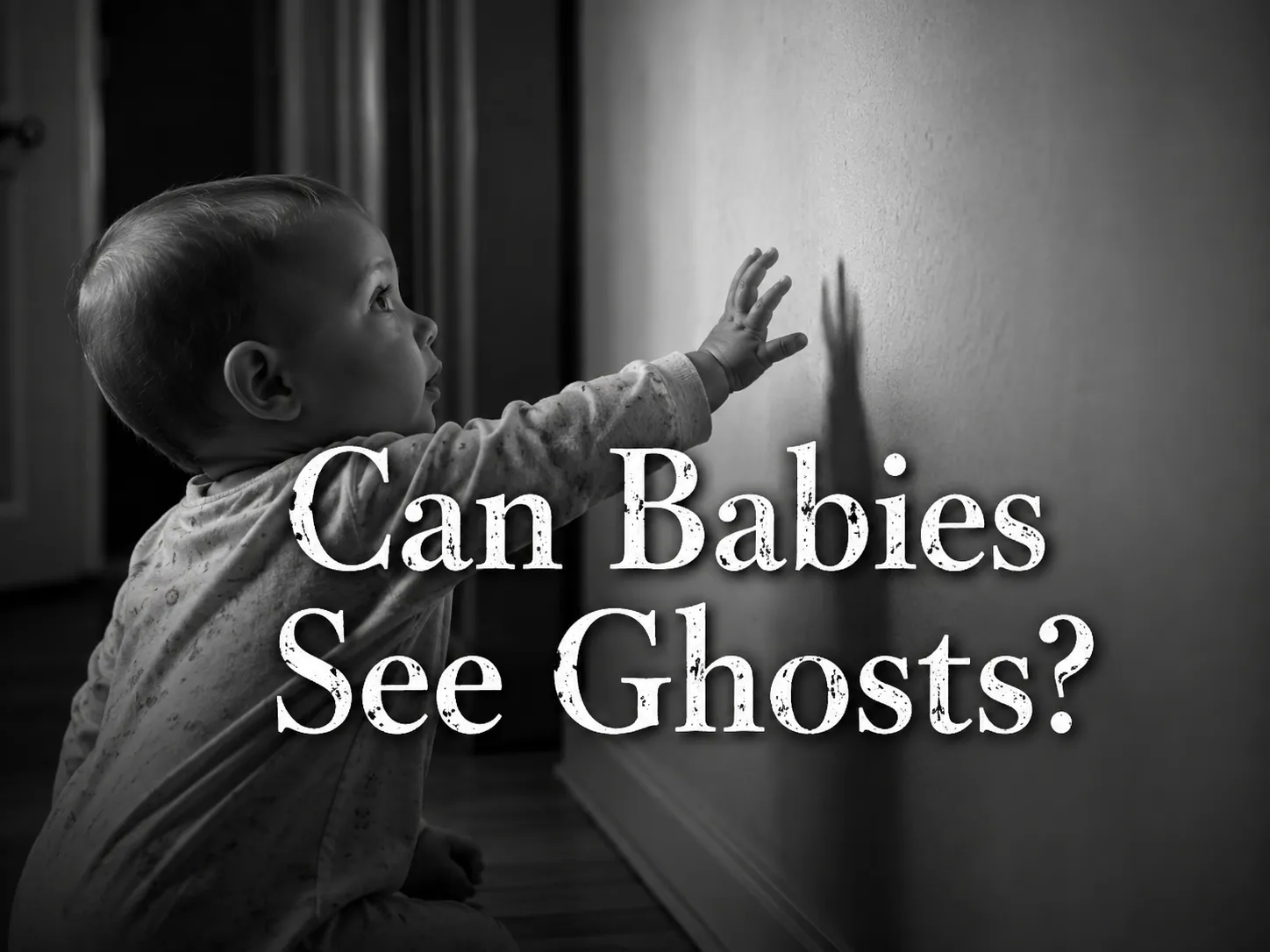
Every parent knows the moment: your baby stares at an empty corner, smiles widely, and reaches out with tiny hands. It’s both adorable and a bit unsettling. The scene ignites a question that has lingered for generations: can babies see ghosts?
While it might sound silly at first, experts in child development, psychology, and perception have all explored why babies act this way, and their findings are more interesting than you might think.
No matter how you see the world, it’s clear that babies experience things very differently from adults. Their brains grow faster than at any other time in life—by 64% in the first 90 days, according to a 2014 study from the University of California, San Diego, in JAMA Neurology. Their vision is still developing, and their senses are constantly taking in new information.
So when babies stare into space and giggle, something is definitely happening in their busy minds. The real question is what that something is.
Summary
So, Can Babies See Ghosts? The Science vs. The Paranormal View
This is the main question, and there isn’t one clear answer. Instead, there are two very different ways to look at what’s happening.
The Scientific View
Scientists agree that there’s no evidence babies can see ghosts, spirits, or anything supernatural. What babies do have is a way of sensing the world that’s truly different from adults. That difference explains much of what seems mysterious.
Newborns start life with vision between 20/200 and 20/400, according to the American Academy of Ophthalmology. That’s about the same as legal blindness in adults. Instead of seeing clear images, babies mostly notice light, movement, and strong contrasts. Their central vision is still developing, but their side vision is already active. So, a baby might react to a flicker of light, a faint shadow, or the line where dark furniture meets a light wall—things adults usually don’t notice.
A 2016 Smithsonian report shared research showing that babies can notice tiny visual details that adults no longer see. Scientists call this process perceptual narrowing, where the brain learns to ignore unimportant information as we grow. Babies haven’t started this filtering yet, so their visual world is, in some ways, richer and more detailed than ours.
Developmental psychologist Jean Piaget found that children between the ages of two and seven often mix up fantasy and reality, relying more on what they see than on logic. Before that, during the first two years, babies are just taking in all the sights and sounds around them without being able to sort or explain them. So, to a baby, a speck of dust in sunlight and a stranger’s face are both equally new and interesting.
On the topic of hallucinations: they are far more common in children than most parents realize, and they are often entirely benign. Studies of large pediatric populations have found that hallucinatory experiences may occur in 8% to 21% of children around age 11, with the vast majority being transient and resolving spontaneously — in roughly 50% to 95% of cases, according to research published in journals including Schizophrenia Research.
Benign hypnagogic hallucinations (occurring just before sleep) and hypnopompic hallucinations (occurring while waking) are reported in 25% and 18% of the general population, respectively, and are especially common in young children. In other words, a toddler who says they “saw someone” in the night is far more likely to be experiencing a normal developmental phenomenon than a supernatural one.
In short, science says babies look at empty corners because they notice things adults miss, like small changes in light, tiny movements, or sharp edges. Their rapidly growing brains are busy taking in and storing all this information.
You may also enjoy:
9 Haunted Houses in Arizona That Hold Terrifying Secrets
October 7, 2025
The Lernaean Hydra: Greek Myth’s Deadliest Creature
October 28, 2025
The Paranormal View
For people who believe in spirits, the answer is very different, and their reasoning makes sense within that belief system. Many psychic mediums and spiritual practitioners say babies are especially open to the paranormal, not because they have special powers, but because they haven’t yet learned the doubts and skepticism that adults develop over time.
Blair Robertson, a psychic medium and best-selling author of five books on the afterlife, has stated that babies don’t necessarily have an increased ability to perceive spirits — what they have is innocence.
In his view, adults are taught from early childhood that ghosts don’t exist, that seeing things that aren’t there is a sign of mental illness, and that the world operates according to fixed material laws. Babies carry none of those learned filters. As Robertson has described it, they experience spiritual connections naturally and powerfully because they have no limiting beliefs or blocks.
Diane Gremmel, another psychic medium, has framed it similarly: babies are unburdened by the logical constructs of the physical world and therefore interact with what she describes as an expanded reality that adults have been conditioned to ignore.
Interestingly, this very same concept is found in many cultures. In fact, stories of children seeing ghosts or spirits date back centuries, with the U.S. Ghost Adventures website citing reports of children interacting with spirits dating to 1716.
Around the world—from Japanese beliefs in yūrei to African traditions of ancestral spirits (including Yoruba beliefs) and indigenous practices in the Americas—children are often seen as more spiritually sensitive than adults.
In European folklore, changeling myths—the idea that faeries or spirits could swap human babies—show a cultural worry about how close babies seem to the non-human world. These stories are found across continents and centuries, hinting at a deep human need to explain the mysteries of early childhood.
All these traditions share the idea that moving from the spirit world to the physical world takes time, and that babies spend a while in between. Whether this is a real spiritual truth or just a way for people to make sense of new life is up to each person to decide.
What Are Babies Actually Seeing?
Learning what babies actually see can help explain the behaviors that lead to so many questions about ghosts.
When babies are born, their eyesight is very limited—about as clear as the big “E” on an eye chart. They can best focus on things 8 to 12 inches away, which is about the distance from a baby to a parent’s face during feeding. The American Academy of Pediatrics uses this as a standard for healthy vision in newborns. Even though their central vision is blurry, newborns are very sensitive to light, movement, and contrast right from the start.
Babies love looking at high-contrast edges, like where a white wall meets a dark border or where a ceiling light casts a sharp shadow. Dr. Tiffany Kimbrough, a pediatrician at the Children’s Hospital of Richmond at VCU, says that strong contrasts are among the easiest things for babies to see. That’s why ceiling fans are so interesting—they combine movement, patterns, contrast, and changing light.
By around five months, depth perception develops more fully, and babies can begin to see the world in three dimensions. By six months, most babies have fully developed color vision and can distinguish subtle differences in shades.
What’s happening in the brain is just as important. A major 2014 study from the University of California, San Diego (published in JAMA Neurology) scanned the brains of 87 newborns over 200 times.
They found that a baby’s brain grows about 1% per day right after birth, slowing to 0.4% per day by three months. In total, the brain grows by 64% in the first 90 days. The cerebellum, which helps with movement, more than doubles in size. The brain isn’t just taking in experiences—it’s being shaped by them as they happen.
Research in the Smithsonian shows that babies under six months can tell individual monkey faces apart—a skill that adults and even nine-month-old babies lose. This is a good example of perceptual narrowing. Babies notice visual details that older brains have learned to ignore.
You may also enjoy:
The Complete List of All Haunted Places in Arizona
November 18, 2025
Phenex: The Fiery Demon Marquis of Hell
August 26, 2025
Why Do Babies Stare at “Nothing” and Smile?
People who believe babies can see ghosts often point to this: a baby stares at an empty corner and suddenly smiles. For a tired parent in the middle of the night, this can feel unsettling. But science has some solid explanations for this behavior.
Light and shadow: Small changes in lighting that adults ignore can be very noticeable to babies. A tiny crack in the ceiling, dust floating in a sunbeam, or a faint reflection from a passing car can grab a baby’s full attention. Pediatric experts say babies’ eyes are drawn to anything fascinating from their background.
Motion detection: Babies’ brains are built to notice movement, which helps them learn and stay safe. Even tiny movements—a curtain moving from an air vent, a mobile swaying in a breeze, or a shadow shifting as clouds pass—stand out strongly to a baby’s developing brain.
Smiling reflexes and gas: Before six to eight weeks old, most babies’ smiles aren’t social. They happen on their own during REM sleep, when a baby feels relief from gas, or just as random signals in the growing nervous system. The real social smile—when a baby responds to a face or voice—usually starts around six to eight weeks. So, when parents see a newborn smile at nothing, it’s usually just a reflex.
Cognitive overload and daydreaming: When babies stare into space, it can mean they’re processing all the new things they’ve seen and heard. Their fast-growing brains sometimes need a break to sort through all this new information.
Why Many Parents Are Primed to See the Paranormal
It’s interesting to ask why the idea that babies see ghosts is so common and powerful. Part of the reason comes from how our minds work.
A 2025 Gallup poll — one of the most comprehensive surveys of paranormal belief ever conducted — found that approximately 39% of Americans believe that ghosts or spirits of the dead can return in certain places and situations.
A separate YouGov survey put that number at 41%. A RealClear Opinion Research poll found an even higher number — 61.4% — depending on how the question was framed. Women are consistently more likely than men to believe in ghosts across major surveys, with a YouGov poll finding that 50% of women and 31% of men reported believing in ghosts.
That means many new parents already believe in the supernatural. So, when their baby stares at nothing, it’s easy for them to connect the behavior to ghosts. Our minds are quick to match what we see to what we already believe.
Evolutionary psychology also matters. Humans are wired to pay attention to where others are looking. When a child stares at something we can’t see, it makes us curious and a bit uneasy. Add in the long history of ghost stories from many cultures, and it’s easy to see why people jump from a baby’s mysterious stare to thinking they see a ghost—even if science doesn’t support it.
Piaget himself noted that children up to roughly age seven or eight systematically regard dreams and mental images as objective external realities. Children in the preoperational stage (ages two to seven) engage in what researchers call magical thinking — the belief that thoughts can influence reality, or that unseen forces affect the world.
A 2008 study published in the Journal of Cognition and Culture found this to be consistent across child populations. This is entirely normal cognitive development, not a sign of paranormal perception.
The Bottom Line
Can babies see ghosts? The real answer depends on what you believe.
Science says no—not because ghosts have been proven not to exist, but because every behavior parents link to ghost-seeing has a clear developmental explanation. Babies are extremely sensitive to light and movement, notice things adults don’t, have brains growing rapidly, and show normal behaviors like reflex smiles and harmless, brief hallucinations.
The paranormal view says that just because there’s no proof doesn’t mean something isn’t real. Babies, without adult doubts or learned beliefs, might be more open to seeing things adults can’t. The idea isn’t backed by scientific studies. Still, it is supported by centuries of beliefs and stories from parents and spiritual practitioners worldwide.
What everyone agrees on is that infant consciousness is truly strange and wonderful. Babies aren’t just little adults with blurry vision. They are in the fastest stage of brain growth, experiencing the world in ways we can hardly imagine.
Whether ghosts are part of that world is a question science hasn’t answered yet—and maybe that’s why the idea still fascinates us.
You may also enjoy:
Nuckelavee: The Skinless Sea Demon That Brings Plague
February 10, 2026
Naamah: The Seductive Demon Queen of Infernal Desires
September 30, 2025
Sources
- Holland, Dominic, et al. Structural Growth Trajectories and Rates of Change in the First 3 Months of Infant Brain Development. JAMA Neurology, vol. 71, no. 10, 1 Oct. 2014, pp. 1266–1274. doi:10.1001/jamaneurol.2014.1638.
- Sosland, Morton & Edelsohn, Gail. (2005). Hallucinations in children and adolescents. Current psychiatry reports. 7. 180-8. 10.1007/s11920-005-0051-2. ResearchGate.
- Rangaswamy, Thara, and Mohan Greeshma. Course and outcome of schizophrenia. International review of psychiatry (Abingdon, England) vol. 24,5 (2012): 417-22. doi:10.3109/09540261.2012.707973. PubMed.
- Dagnall N, Denovan A, Murphy-Morgan C, Drinkwater KG, Powell D, and Neave N (2026). Mind over matter? The cognitive styles of scientific skepticism and paranormal belief. Front. Psychol. 17:1699045. doi: 10.3389/fpsyg.2026.1699045.
- YouGov. Two in Five Americans Say Ghosts Exist — and One in Five Say They’ve Encountered One. YouGov Survey of 1,000 U.S. Adults, Oct. 2021.
- Piaget, Jean. The Language and Thought of the Child. Translated by Marjorie Gabain, Routledge, 1926.
- American Academy of Ophthalmology. Vision Development: Newborn to 12 Months. AAO Eye Health, updated May 2025.
- American Academy of Pediatrics. Infant Vision Development: What Can Babies See? HealthyChildren.org.
- Tillman, Rebecca et al. Psychotic phenomena in 257 young children and adolescents with bipolar I disorder: delusions and hallucinations (benign and pathological). Bipolar disorders vol. 10,1 (2008): 45-55. doi:10.1111/j.1399-5618.2008.00480.x.
- Paul L Harris, Kathleen H Corriveau. Beliefs of children and adults in religious and scientific phenomena. Current Opinion in Psychology. Volume 40, 2021, Pages 20-23, ISSN 2352-250X.