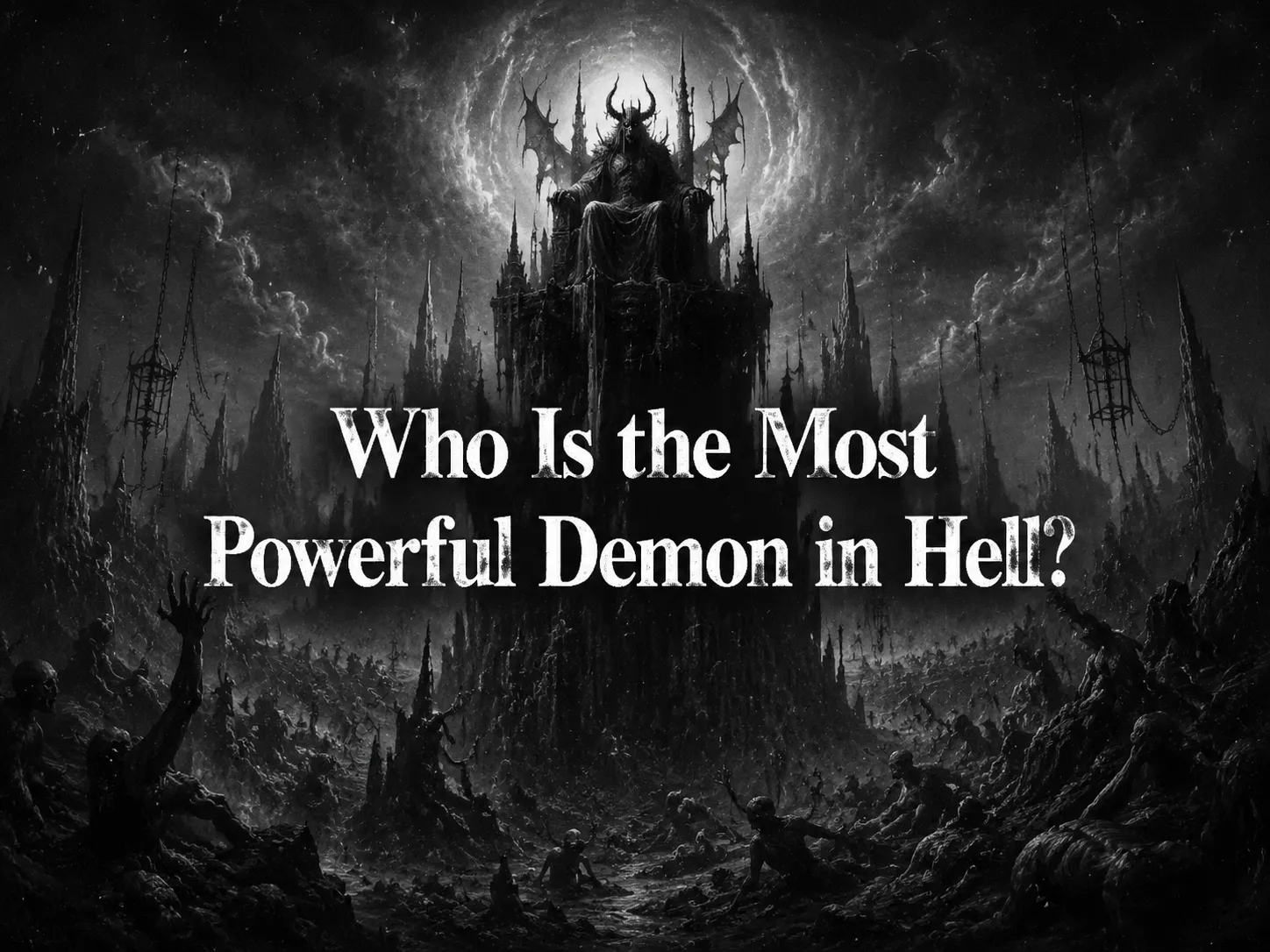
The most powerful demon in Hell, based on everything I’ve dug through in Christian scripture, patristic theology, and centuries of demonological literature, is Satan — also known as Lucifer, the fallen angel whose rebellion against God is described as the origin of evil itself. That’s the short answer, and it’s the one you’ll find almost everywhere.
But the deeper I got into the primary sources for my research, the more I realized that most treatments of the topic stop at the easy answer and never explain why it’s true, where the “hierarchy of Hell” idea actually comes from, or how much of it has nothing to do with the Bible at all.
I wanted to fix that and give you the full picture: the scriptural case for Satan’s supremacy, the medieval and Renaissance systems that ranked the rest of Hell beneath him, a full power ranking of the ten demons most consistently treated as the strongest, and the parts of the topic that even most demonology sites leave out.
Summary
Who Is the Most Powerful Demon in Hell? The Direct Answer
Within Christian theology, Satan is consistently identified as the most powerful of the fallen angels and the chief adversary of God. This isn’t because scripture crowns him “king of Hell” — it never does — but because of several converging facts that I think are worth laying out clearly, since most articles just assert the conclusion without the reasoning.
First, Satan is the only demon the New Testament describes as directly confronting Jesus Christ during the forty-day temptation in the wilderness (Matthew 4:1–11, Luke 4:1–13), a scene in which no other named demon appears. Second, Paul calls him “the god of this age” (2 Corinthians 4:4) and “the ruler of the kingdom of the air” (Ephesians 2:2), language applied to no other evil spirit in the New Testament.
Third, later theology — beginning with Church Fathers like Origen and Augustine — read the fall of a proud, radiant angel in Isaiah 14 and Ezekiel 28 as a description of Satan’s origin, cementing him as the first and greatest of the rebel angels rather than merely one demon among many.
Something I think is genuinely underreported: the Bible never actually says Satan rules Hell. In the Book of Revelation, Hell — or more precisely the “lake of fire” — is not his throne but his eventual prison and punishment (Revelation 20:10).
The image of Satan presiding over Hell as its monarch, holding court over lesser demons, comes primarily from medieval and Renaissance literature, especially Dante Alighieri’s Inferno (completed around 1320), where Satan is frozen waist-deep in ice at the very center of the ninth circle, mechanically chewing on history’s three worst traitors — Judas Iscariot, Brutus, and Cassius — rather than actively ruling anything. Even in that image, Satan is depicted as trapped and diminished, not triumphant.
Three centuries later, John Milton’s Paradise Lost (1667) gave the opposite image its cultural staying power: his Satan declares “Better to reign in Hell, than serve in Heaven,” a line so widely quoted that many people now assume it’s scriptural, when it’s actually Milton’s invention.
So my honest answer is this: Satan/Lucifer is the most powerful demon in the sense of being the first, proudest, and most theologically significant of the fallen angels — but Christian scripture presents him as a limited, ultimately doomed adversary permitted a temporary and bounded scope of action, not an omnipotent ruler of an infernal kingdom.
Satan and Lucifer: One Demon or Two?
Popular culture often treats “Lucifer” and “Satan” as two different beings — Lucifer being the angel before his fall, Satan being what he became afterward, or sometimes even distinct demons entirely. In mainstream Christian theology, they’re the same entity viewed at different points in the same story. However, I want to walk through exactly how that identification came to be, because it’s more constructed than most people realize.
The name “Lucifer” comes from the Latin Vulgate translation of Isaiah 14:12, where the Hebrew phrase helel ben shahar (“shining one, son of the dawn”) was depicted as “Lucifer,” meaning “light-bringer” or “morning star.” In its original context, this passage in Isaiah is a taunt directed at a Babylonian king, not a description of a fallen angel.
It was Church Fathers writing centuries later, particularly Origen in the 3rd century and later Jerome (who produced the Vulgate itself around 405 AD), who reinterpreted the “morning star” passage as an allegory for the Devil’s fall from Heaven — a reading that became standard in Western Christianity even though most modern biblical researchers now treat it as a case of theological reinterpretation rather than the passage’s original meaning.
“Satan” (Hebrew satan, meaning “adversary” or “accuser”) is used more literally throughout Scripture, from the accusing entity in the Book of Job to the tempter in the Gospels and the dragon of Revelation 12. By the time of Augustine’s City of God (written 413–426 AD, in the aftermath of the sack of Rome), the two names had merged into a single narrative: a glorious angel named for the morning star, who fell through pride and became the accusing adversary of humanity.
That fused identity — Lucifer-who-became-Satan — is what most Christian demonology still means by “the most powerful demon.” What I find worth flagging, though, is that not every demonologist kept the two names fused. As I get into below, Peter Binsfeld’s 1589 classification treats Lucifer and Satan as two separate princes with two separate portfolios, which tells you this “merger” was never universally accepted, just dominant.
The Biblical Passages Behind Satan’s Reputation
Four passages, read together, form the theological backbone of Satan’s status as Hell’s most powerful entity, even though none of them was originally written as a unified biography of one being. I think it’s worth listing them plainly, because most articles cite one or two and move on.
- Isaiah 14:12–15 — the “morning star” fallen from Heaven, later interpreted allegorically as Lucifer’s fall.
- Ezekiel 28:12–19 — a lament for the “king of Tyre” describing a being who was “in Eden, the garden of God,” covered in precious stones, and cast down for pride and corruption; also read allegorically as Satan’s fall by early theologians.
- Job 1–2 — “the satan” appears among the “sons of God” and is granted limited permission by God to test Job, a passage that shows the adversary operating strictly under divine authorization rather than independent power. This is arguably the single clearest biblical statement that Satan’s power is always delegated, never sovereign.
- Revelation 12:3–9 — a great red dragon, “that ancient serpent, who is called the devil and Satan,” is defeated by the archangel Michael and thrown down to earth, alongside a third of the stars (interpreted by most commentators as a third of the angels, meaning Satan is traditionally understood to command roughly a third of all fallen spirits).
None of these texts describes a ranked hierarchy of Hell or names Satan as ruler over other demons by title. That structure — princes, dukes, kings of Hell with named subordinates — was built centuries later by demonologists trying to systematize scattered scriptural references, apocryphal literature, and folk belief into an organized infernal court, which is exactly the material I want to walk through next.
Explore More Demons:
Pan: From Forest God to Christian Demon
August 26, 2025
What Is an Edimmu? The Ancient Demon of the Unburied Dead
October 1, 2025
Namtar: The Demon of of Death and Disease
October 1, 2025
Who Is the Demon Valefor, the Treacherous Duke of Hell?
August 12, 2025
Who Is Cimejes, the Twentieth Demon in the Ars Goetia?
November 13, 2025
Power Rank: The Top 10 Most Powerful Demons in Hell
Because there’s no single canonical ranking in scripture, I built the list of the most powerful demons in Hell by weighing three things for each demon: how much scriptural or deuterocanonical authority they’re given, how consistently they appear at the top of independent demonological systems (Binsfeld, Michaëlis, the Ars Goetia, and biblical commentary), and the scale of what they’re actually described as capable of doing:
1. Satan / Lucifer — The first and greatest of the fallen angels in virtually every Christian tradition. Uniquely confronts Christ directly (Matthew 4), is called “the god of this age” (2 Corinthians 4:4), and commands roughly a third of the fallen angels per the traditional reading of Revelation 12:4.
2. Beelzebub — Called “the prince of demons” by name in the Gospels themselves (Matthew 12:24), making him one of only two demons the New Testament explicitly places in a position of authority over others. Sébastien Michaëlis ranked him among the three highest angels before the fall, alongside Lucifer and Leviathan.
3. Leviathan — Described in Job 41 as a creature so fearsome that “on earth it has no equal,” and in Isaiah 27:1 scripture states that only God himself will be able to slay it “in that day.” No angel, demon, or human is ever described in scripture as capable of defeating Leviathan, which arguably makes it the single most powerful entity on the list in raw, unmatched strength — even though it isn’t usually described as commanding other demons.
4. Abaddon / Apollyon — Named directly as “king” of the demonic locusts of the abyss in Revelation 9:11, one of the only demons in the entire Bible given the explicit title “king” (Hebrew Abaddon, “destruction”; Greek Apollyon, “destroyer”). His army is described as torturing anyone without God’s seal for five months straight.
5. Asmodeus — In the deuterocanonical Book of Tobit, he kills seven successive husbands of a woman named Sarah before being driven off by the archangel Raphael using the burnt heart and liver of a fish. Later grimoires and demonological texts, including the Testament of Solomon, raise him to “king” among demons, and Peter Binsfeld made him chief tempter of lust, one of the original seven princes.
6. Belial — His name means “worthless” or “wicked” in Hebrew. In the Dead Sea Scrolls, particularly the War Scroll from Qumran, Belial is personified as the chief commander of the forces of darkness in the final battle against the “sons of light,” a status that makes him one of the most powerful demonic commanders in intertestamental Jewish literature, even though he never achieved formal canonical status in mainstream Christian scripture.
7. Mammon — Personified from Jesus’s statement “You cannot serve God and mammon” (Matthew 6:24, Luke 16:13), where “mammon” is an Aramaic word for wealth or riches. It was later theologians and poets, especially Milton in Paradise Lost, who turned this abstract concept into a fallen angel and a prince of Hell obsessed with gold, ranked by Binsfeld as the demon of greed.
8. Astaroth — Originates from Astarte (Ashtoreth), a Phoenician and Canaanite goddess of fertility, sexuality, and war, condemned repeatedly in the Old Testament (Judges 10:6, 1 Kings 11:5). By the time of the 1458 grimoire The Book of Abramelin, the plural feminine “Ashtaroth” had become a single male demon; later grimoires like the 18th-century Grand Grimoire rank him, alongside Lucifer and Beelzebub, as one of a supreme “unholy trinity,” commanding forty legions.
9. Azazel — Leader of the rebellious Watcher angels in the Book of Enoch, who teaches humanity forbidden arts and fathers the giant Nephilim. Uniquely on the list of the most powerful demons, Azazel has fully canonical status today in one living Christian tradition — the Ethiopian Orthodox Tewahedo Church and Eritrean Orthodox Tewahedo Church — even though he’s treated as non-canonical everywhere else.
10. Belphegor — Originates from Baal-Peor, a Moabite deity whose worship at Shittim led to a plague that, according to Numbers 25:9, killed 24,000 Israelites — one of the deadliest single episodes of divine punishment described anywhere in the Torah. Ranked by Binsfeld as the prince of sloth, and described in the 19th-century Dictionnaire Infernal as Hell’s ambassador to France.
Peter Binsfeld and the Seven Princes of Hell
One of the most influential — and least discussed in casual articles — sources for the modern idea of “powerful demons” ranked by role is the work of Peter Binsfeld, a German auxiliary bishop of Trier and theologian best known for his role in the witch trials of the late 16th century.
In his 1589 treatise De confessionibus maleficorum et sagarum (“On the Confessions of Warlocks and Witches”), Binsfeld paired each of the seven deadly sins with a specific demon believed to specialize in tempting people toward it, formalizing a list that later writers dubbed “the Seven Princes of Hell”:
| Demon | Sin |
|---|---|
| Lucifer | Pride |
| Mammon | Greed |
| Asmodeus | Lust |
| Leviathan | Envy |
| Beelzebub | Gluttony |
| Satan (or Amon) | Wrath |
| Belphegor | Sloth |
Binsfeld’s classification of demons wasn’t invented from nothing; it built on an earlier, less famous source, the 15th-century English Lollard tract known as the Lanterne of Light, which paired the sins with demons slightly differently — for example, associating Beelzebub with envy rather than gluttony, and Belphegor with gluttony rather than sloth.
Binsfeld’s version became the more widely circulated one because his book was translated into several European languages and became a standard reference for witch-hunters and inquisitors across Europe, which is a genuinely uncomfortable historical footnote: this “top demons” list that still circulates in horror content and occult shops today was compiled by a man actively prosecuting and executing people for supposed pacts with those same demons.
What’s important — and rarely mentioned — is that in Binsfeld’s own scheme, Lucifer and Satan are listed as two separate princes, ruling over pride and wrath respectively, rather than as one unified entity.
This directly contradicts the merged Lucifer/Satan identity built up by Augustine centuries earlier, and it illustrates a key point about Christian demonology as a whole: it was never a single, consistent system. Different theologians, writing in different centuries for different purposes, produced overlapping and sometimes contradictory hierarchies, and none of them were ever adopted as binding Church doctrine.
Sébastien Michaëlis and the Three Infernal Hierarchies
A second major, and often overlooked, systematization came from Sébastien Michaëlis, a French Dominican inquisitor and exorcist active in the witch trials around Avignon in the 1580s, where a series of cases in 1581 and 1582 led to at least fourteen women being convicted and burned.
In his 1613 book Histoire admirable de la possession et conversion d’une pénitente (“Admirable History of the Possession and Conversion of a Penitent Woman”), Michaëlis claimed to have obtained a ranked structure of Hell directly from a demon named Berith, extracted during an exorcism of a novice nun named Madeleine Demandolx de la Palud during the Aix-en-Provence possessions of 1609–1611 — a case that also led to the trial and execution by burning of a priest, Louis Gaufridi, accused of bewitching her.
Michaëlis organized demons into three descending hierarchies modeled on the Pseudo-Dionysian nine choirs of angels (the traditional Christian ranking of angels into Seraphim, Cherubim, Thrones, Dominions, Virtues, Powers, Principalities, Archangels, and Angels).
In his account, Beelzebub, Leviathan, and Lucifer were originally the three highest angels in Heaven — princes of the Seraphim — and were also the first three to fall, which is why Michaëlis ranks Beelzebub as tempting men toward pride on essentially equal footing with Lucifer rather than beneath him.
The most distinctive — and genuinely underused — detail of Michaëlis’s system is that he assigned each demon a specific opposing saint: a historical figure believed to have been tempted by that exact demon’s vice but who resisted it.
Beelzebub’s assigned adversary was Saint Francis of Assisi; a demon named Rosier, described as the second-ranking spirit among the order of Dominations who “tempteth men to fall in love” with “sweet and sugared words,” was opposed by St. Basil, who “would not listen to amorous and enchanting language.” The “demon versus saint” pairing was unique to Michaëlis and never adopted as official Church teaching, but it shaped centuries of exorcism folklore about which saints to invoke against particular temptations.
The Watchers of the Book of Enoch
One of the richest, and most commonly skipped, sources for “powerful demons” is the Book of Enoch, an ancient Jewish text usually dated to roughly the 3rd century BC, which describes a group of angels called the Watchers, led by figures named Semjaza and Azazel, who descend to earth, take human wives, and teach forbidden knowledge — including weapon-making, cosmetics, astrology, and sorcery — resulting in the birth of the giant Nephilim described briefly in Genesis 6:1–4.
What I think deserves more attention than it usually gets: 1 Enoch is quoted directly in the New Testament Epistle of Jude (verses 14–15), which cites “Enoch, the seventh from Adam” prophesying about the coming judgment — giving the text unusual scriptural weight despite never being accepted into the Catholic, Protestant, or Eastern Orthodox biblical canons.
It remains canonical scripture today only in the Ethiopian Orthodox Tewahedo Church and the Eritrean Orthodox Tewahedo Church, which means Azazel is one of the very few demonic figures who has fully canonical status in at least one living Christian tradition, even though he’s treated as apocryphal everywhere else.
Explore More Demons:
Who Is Leraje, the Demon of Gangrene and Battle?
August 22, 2025
Who Really Is Mephistopheles in the Faust Legend?
August 26, 2025
Who Is Cimejes, the Twentieth Demon in the Ars Goetia?
November 13, 2025
Who Is Vapula? The Lion-Winged Demon of Hell
August 28, 2025
The Dark Demon Seth: God of Chaos in Egyptian Mythology
October 2, 2025
The Ars Goetia and the 72 Spirits of Solomon
Much of the popular “kings of Hell” imagery — demons ranked as kings, dukes, marquises, and presidents, each commanding legions of spirits — comes not from theology at all but from ceremonial magic texts. The core source is the Ars Goetia, the first section of a 17th-century grimoire called the Lesser Key of Solomon, itself building on an earlier 1577 catalog by the physician and occult skeptic Johann Weyer titled Pseudomonarchia Daemonum (“The False Monarchy of Demons”).
Weyer compiled his catalog partly to argue against the witch trials of his era, believing that accused witches were often mentally ill or delusional rather than genuinely in league with the demons he was cataloging — a detail I think is rarely included in modern lists that treat his work purely as an occult reference, when it was originally written as a skeptical, almost reformist project.
Both texts trace their framing device back to the legend of King Solomon, drawn from the pseudepigraphal Testament of Solomon (composed sometime between the 1st and 5th centuries AD), in which Solomon is granted a magic ring by the archangel Michael that allows him to bind and command demons, forcing them to help build the Temple in Jerusalem before he eventually imprisons them.
Of the 72 spirits cataloged in the Ars Goetia, nine are traditionally ranked as kings, the highest of the documented titles — including Bael, described as speaking with a hoarse voice and granting invisibility, and Paimon, said to command legions and arrive with great noise and ceremony.
What the Catholic Church Actually Teaches
The Catholic Church has no official doctrine ranking demons by power, and it has never formally endorsed Binsfeld’s, Michaëlis’s, or the Ars Goetia’s hierarchies.
The Catechism of the Catholic Church is precise but limited on the subject. It affirms, citing the Fourth Lateran Council of 1215, that “the devil and the other demons were indeed created naturally good by God, but they became evil by their own doing” (CCC 391), and it states that their choice to reject God was free, radical, and irrevocable — “there is no repentance for the angels after their fall, just as there is no repentance for men after death” (CCC 393).
Satan is described as a real, personal being — “the angel who opposes God” (CCC 2851) — but the Catechism never assigns him a throne in Hell, never ranks other demons beneath him, and never confirms any of the elaborate princely titles that later folklore attached to figures like Beelzebub, Mammon, or Belphegor.
I also want to flag a practical detail: the Church’s own exorcism liturgy, the Rituale Romanum, first standardized in 1614 and still the basis for the modern De Exorcizandis Obsessis a Daemonio (revised in 1999), doesn’t ask an exorcist to identify which “prince of Hell” is possessing someone from a ranked list. It focuses instead on commanding any evil spirit to depart in the name of Christ, treating the specific identity or rank of the demon as largely irrelevant to the process.
That’s a meaningful contrast with the elaborate, named hierarchies I’ve covered above — the practical, sacramental tradition of the Church has never depended on knowing exactly which “duke” or “king” it’s dealing with.
In other words, the detailed infernal bureaucracy most people associate with “the most powerful demons in Hell” is a product of extra-biblical theology, medieval and Renaissance literature, witch-trial-era demonology, and ceremonial magic texts — not of the Bible or of formal Church doctrine, which limits itself to confirming that Satan and the other fallen angels are real, personal, unrepentant, and permanently opposed to God, without ranking them against one another.
Why There’s No Single, Fully Settled Answer
Pulling all of this together, the answer to “who is the most powerful demon in Hell” has three layers. Scripturally, Satan is the only entity singled out as directly confronting Christ and holding titles like “god of this age,” which is the strongest textual case for his supremacy.
Theologically, the Augustinian merger of Lucifer and Satan into one proud, fallen archangel, reinforced by the Church’s teaching that his rebellion was total and irrevocable, cemented that supremacy for the next 1,500 years of Christian thought.
But historically, the specific idea of a ranked infernal court — princes, dukes, and kings of Hell arranged beneath Satan — is a much later invention, assembled piece by piece by demonologists like Binsfeld and Michaëlis and by occult compilers of grimoires like the Ars Goetia, none of which carries the weight of scripture or official church teaching.
Satan remains, in every strand of the tradition I’ve reviewed, the most powerful — but exactly how organized, titled, or populated his supposed kingdom is depends entirely on which centuries-old, non-canonical source is doing the describing.
Frequently Asked Questions
Who is the strongest demon in demonology?
Across the major demonological catalogs — Binsfeld’s 1589 classification, Michaëlis’s 1613 hierarchy, and the Ars Goetia — Lucifer or Satan is consistently placed at or near the top. The one partial exception is Michaëlis’s system, which treats Beelzebub and Leviathan as having fallen from angelic ranks essentially equal to Lucifer’s, making them close rivals rather than clear subordinates within that one specific text.
Who is the strongest ruler of Hell?
If “ruler” means a title scripture itself actually uses, the strongest candidate is Beelzebub, whom the Gospels call “the prince of demons” (Matthew 12:24) — a direct title of rule that the Bible never applies to Satan. If “ruler” means the figure later Christian tradition as a whole treats as sovereign over Hell, that’s Satan, even though, as covered above, the Bible depicts Hell as his punishment, not his throne.
Who is Lucifer’s first demon?
There’s no single scriptural answer, but Sébastien Michaëlis’s 1613 hierarchy gives the most specific claim: he describes Beelzebub and Leviathan as the second and third angels to fall alongside Lucifer, making Beelzebub, in that particular tradition, effectively Lucifer’s first and most senior lieutenant among the fallen.
Who is the highest demon in Hell?
By theological consensus, Satan/Lucifer has the highest position, since Christian tradition treats him as the first angel to fall and the only one Christ personally confronts in scripture. By explicit biblical title, however, Beelzebub is the only demon actually called a “prince” ruling over the others within the text of the New Testament itself.
Is “Lucifer” actually the Devil’s name in the original Hebrew Bible?
No. The Hebrew phrase in Isaiah 14:12, helel ben shahar (“shining one, son of the dawn”), was directed at a Babylonian king as a taunt, not at a fallen angel. It only became associated with Satan after the Latin Vulgate translated it as “Lucifer” and Church Fathers such as Origen reinterpreted the passage allegorically centuries later.
Does the Bible ever say Satan rules Hell?
No. Revelation 20:10 describes Satan being thrown into the lake of fire as a punishment at the end of days, not as a throne he presides over. The image of Satan actively ruling Hell as a kingdom comes from later literature, most famously Dante’s Inferno and Milton’s Paradise Lost, rather than from scripture itself.
What’s the difference between Sheol, Hades, Gehenna, and Tartarus in the Bible?
These four terms are often flattened into a single English word, “Hell,” but they originally referred to different concepts. Sheol is the Hebrew term for a shadowy realm of the dead in the Old Testament, not a place of fiery punishment. Hades is its Greek New Testament equivalent, used similarly. Gehenna, referenced by Jesus, derives from the Valley of Hinnom outside Jerusalem, historically associated with child sacrifice and later used as a symbol of final punishment. Tartarus appears only once, in 2 Peter 2:4, specifically as the place where the sinning angels — not humans — are held.
Did the Seven Princes of Hell exist as a concept before Peter Binsfeld?
Not in exactly that form. Binsfeld’s 1589 pairing of demons with the seven deadly sins built directly on an earlier, less well-known 15th-century English source called the Lanterne of Light, which matched the same sins to a slightly different set of demons.
Is Azazel considered a canonical demon in any Christian church today?
Yes, in one specific case. Azazel appears as a leader of the rebellious Watcher angels in the Book of Enoch, a text quoted in the New Testament’s Epistle of Jude but excluded from most biblical canons. It remains fully canonical scripture today only within the Ethiopian Orthodox Tewahedo Church and the Eritrean Orthodox Tewahedo Church.
Who compiled the list of 72 demons in the Ars Goetia, and why?
The core catalog traces back to Johann Weyer’s 1577 Pseudomonarchia Daemonum. Weyer, a physician and student of the occult skeptic Cornelius Agrippa, is generally understood to have compiled his demon catalog partly to challenge the witch trials of his era, arguing that many accused witches were suffering from illness rather than practicing genuine demonic pacts — a reformist intent largely lost in later occult reworkings of his list.
Explore More Demons:
Who Is Leraje, the Demon of Gangrene and Battle?
August 22, 2025
Who Is Xezbeth, the Demon of Lies and Fraud?
August 29, 2025
Demon Naberius Explained: Origins, Powers, and Myths
August 26, 2025
The Terrifying Face of Tisiphone, Avenger of Blood Crimes
September 1, 2025
Balberith: The Infernal Scribe Who Tempts Humanity
August 16, 2025
Andhaka: The Blind Demon Who Challenged Lord Shiva
November 13, 2025
Sources
- De Laurence, L. W. The Lesser Key of Solomon, Goetia. Project Gutenberg, 7 Nov. 2023. Originally published by De Laurence, Scott & Co., 1916.
- Solomon, King of Israel (attributed). The Key of Solomon the King (Clavicula Salomonis). Translated and edited by S. Liddell MacGregor Mathers, George Redway, 1889. Internet Archive.
- Weyer, Johann. Pseudomonarchia Daemonum. Edited and translated by Joseph H. Peterson, digital edition, 2000. Twilit Grotto: Esoteric Archives.
- Winter, Jay, editor. The Complete Book of Enoch. Standard English Version, Winter Publications, 2015. Internet Archive.
- Ruys, Juanita Feros. Demons in the Middle Ages. Arc Humanities Press, 2017. JSTOR.
- Hershkowitz, Isaac. Angels and Demons in Early Modern Musar Literature: A Big Data Analysis. The Journal of Jewish Ethics, vol. 9, no. 1, 2023, pp. 29-54. Academia.edu.
- Reed, Jennifer. Christian Demonology | Origin, Demons & Importance. Study.com. Accessed July 31, 2026.
- Bane, Theresa. Encyclopedia of Demons in World Religions and Cultures. McFarland & Company, 2012. Internet Archive.
- Guiley, Rosemary Ellen. The Encyclopedia of Demons and Demonology. Visionary Living, Inc., 2009. Internet Archive.
- The Book of Tobit. Narrated by various speakers, LibriVox, 2006. Internet Archive. From the King James Version (Authorized).
- Binsfeld, Peter. Tractatus de confessionibus maleficorum et sagarum recognitus & auctus. Henricus Bock, 1591. Internet Archive.
- Abraham ben Simeon, of Worms. The Book of the Sacred Magic of Abra-Melin, the Mage. Translated by S. L. MacGregor-Mathers, The de Laurence Co., 1939. Internet Archive.
- Collin de Plancy, Jacques. Dictionnaire infernal: répertoire universel des êtres, des personnages, des livres, des faits et des choses qui tiennent aux esprits. 6th ed., Henri Plon, 1863. Internet Archive.