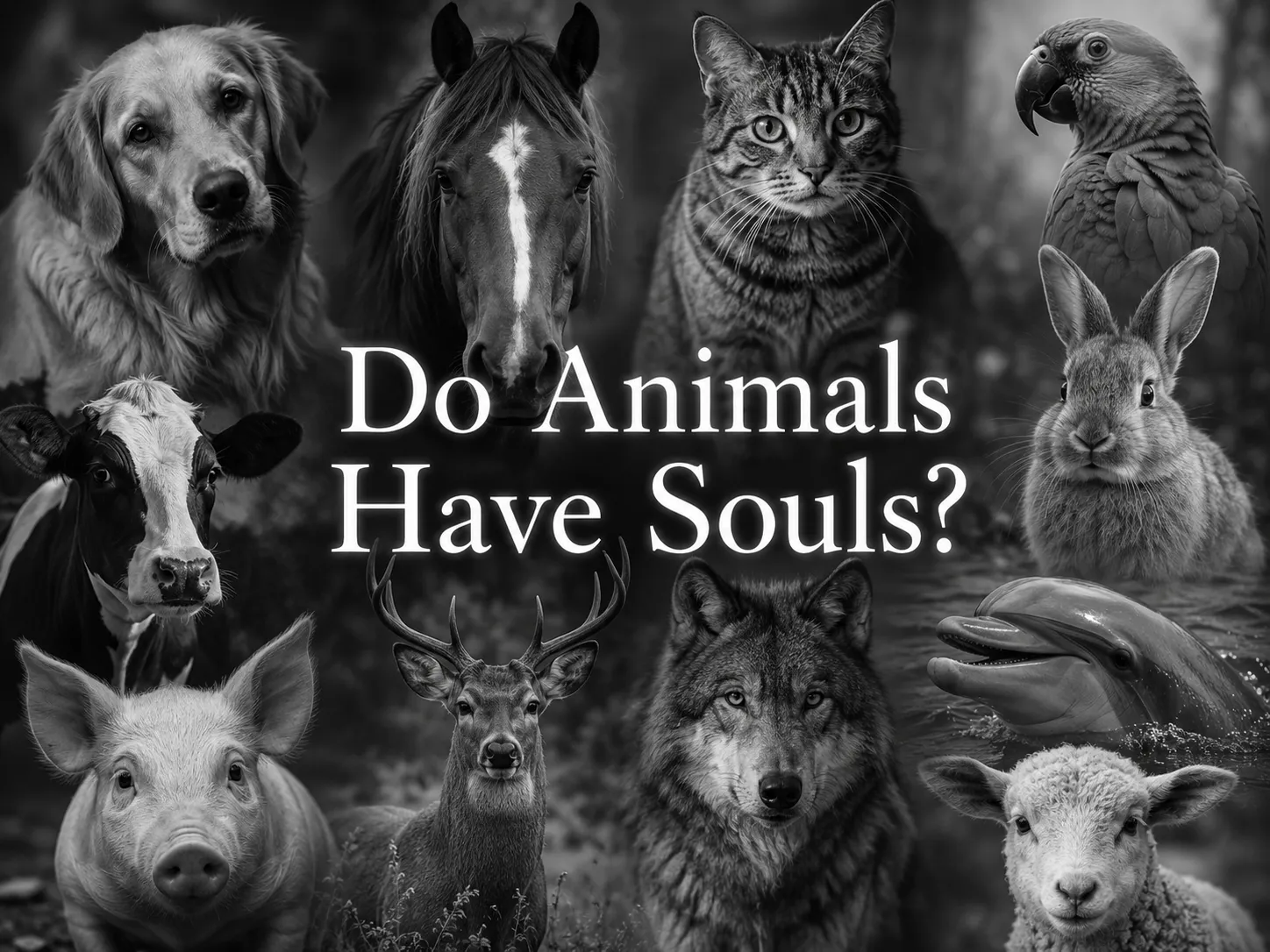
Do animals have souls? At first, it sounds like a simple question. Yet, as soon as you try to answer it, you find yourself tangled in centuries of theology, philosophy, and now even science.
If you’ve ever seen a dog wait by the door, an elephant stay near a fallen friend, or a cat decide for reasons only it knows that 3 a.m. is the perfect time to knock a glass off the counter, you’ve probably wondered if there’s more happening inside that animal than just biology.
Summary
So, Do Animals Have Souls? The Short Answer
There isn’t one clear answer, because the word “soul” means different things depending on how you define it.
If by “soul” you mean the ability to have inner experiences—like feeling pain, fear, pleasure, or attachment—then a lot of neuroscience research says yes.
In 2012, a group of leading neuroscientists signed the Cambridge Declaration on Consciousness, which said that non-human animals have the brain structures needed for conscious states and intentional behaviors, and that humans aren’t the only ones with these features.
In 2024, the New York Declaration on Animal Consciousness, signed by over 500 scientists, went even further. It stated there is real evidence that all vertebrates and many invertebrates, including cephalopods, decapod crustaceans, and insects, may have conscious experiences.
If “soul” means an immortal, rational spirit that faces moral judgment in an afterlife, as it’s usually defined in Christian, Jewish, and Islamic theology, then most traditional teachings say animals don’t have that kind of soul. Still, there is real disagreement even within those faiths.
If “soul” means a spark of the same life-force that animates all living things, as seen in Hinduism, Jainism, and many Indigenous traditions, then animals definitely have souls. In these views, animal souls are often seen as equal to, or even further along the spiritual path than, human souls.
In short, science is finding more and more evidence that animals have rich inner lives. Whether that counts as a “soul” in the religious sense is something no microscope or brain scan can answer. It depends on faith, philosophy, and your definition of the word.
You may also enjoy:
Inside the Infamous Amityville Haunting: What Really Happened?
October 21, 2025
The Complete List of All Haunted Places in California
November 19, 2025
What Do We Even Mean by “Soul”?
Before we can answer the question, it helps to separate the three main things people usually mean by “soul.” Mixing them up is often why debates about this topic go in circles.
- The philosophical or biological soul: In Aristotle’s view, later taken up by Thomas Aquinas, every living thing has a “soul” as its animating principle. Aquinas described three levels: vegetative souls for growth and reproduction (plants), sensitive souls for sensing and moving (animals), and rational souls for thinking and choosing freely (humans). In this view, animals have souls, but not the immortal, rational kind.
- The theological/immortal soul: The spiritual core that survives bodily death and faces divine judgment. This is the definition most religious debates about animals are actually arguing over.
- The scientific/consciousness definition: Whether an organism has subjective, felt experience (what philosophers call “phenomenal consciousness” or sentience) rather than simply reacting to stimuli like a machine.
Most disagreements about whether animals have souls happen because people are using different definitions—especially the theological and scientific ones—without realizing it.
What Modern Science Says About Animal Minds
Science can’t measure a soul, but it can measure things like consciousness, emotion, self-awareness, and pain perception. In the past twenty years, the focus has shifted from asking whether any animals have inner experiences to asking which animals do so, and how much.
The Cambridge Declaration on Consciousness (2012)
On July 7, 2012, an international group of cognitive neuroscientists, neuropharmacologists, neurophysiologists, and computational neuroscientists gathered at the University of Cambridge for the Francis Crick Memorial Conference and signed a formal declaration — reportedly in the presence of physicist Stephen Hawking — stating that the lack of a neocortex does not appear to preclude an organism from experiencing affective states, and that non-human animals possess the neuroanatomical, neurochemical, and neurophysiological substrates of conscious states along with the capacity to exhibit intentional behaviors.
The declaration specifically named all mammals and birds, and “many other creatures, including octopuses,” as falling within this conclusion. It also noted that birds appear to offer a remarkable case of the parallel evolution of consciousness, since their brains evolved independently from the mammalian neocortex yet arrived at comparable cognitive outcomes.
The New York Declaration on Animal Consciousness (2024)
More than a decade later, a 2024 conference at New York University produced a follow-up declaration signed by over 500 scientists and academics.
It went further than Cambridge, stating there is empirical evidence indicating “at least a realistic possibility of conscious experience” not just in mammals and birds, but in all vertebrates — including reptiles, amphibians, and fish — and in many invertebrates, including cephalopod mollusks, decapod crustaceans, and insects.
Importantly, the declaration treats this as a practical guideline, not final proof. It argues that we shouldn’t need absolute certainty about animal consciousness before taking their welfare seriously, and that it’s wrong to ignore the real possibility of conscious experience when making decisions about animals.
Self-Awareness and the Mirror Test
The most widely cited test for self-awareness is the mirror self-recognition (MSR) test, developed by psychologist Gordon Gallup in 1970: a researcher marks an animal somewhere it cannot see directly (such as the forehead), then observes whether the animal uses a mirror to investigate that mark on its own body, rather than treating the reflection as a stranger.
For decades, only humans and great apes reliably passed. That changed with a landmark 2006 study published in the Proceedings of the National Academy of Sciences, in which researchers Joshua Plotnik, Frans de Waal, and Diana Reiss exposed three Asian elephants to a large mirror and documented them progressing through the recognized stages of MSR — social response, physical inspection, repetitive mirror-testing, and finally self-directed investigation of marks placed on their own heads.
Dolphins had already demonstrated similar mirror self-recognition in earlier research by Reiss and Lori Marino. In 2008, researchers documented mirror self-recognition in European magpies, making them the first non-mammal confirmed to pass the test.
Interestingly, some very intelligent animals, including dogs, usually fail the mirror test. Researchers point out this is probably because the test relies on vision, while dogs mainly use their sense of smell. So, the test might just be measuring the wrong sense rather than a lack of self-awareness.
You may also enjoy:
Jinmenken: Japan’s Terrifying Human-Faced Dog
June 6, 2025
Leviathan: The God Serpent That Devours Souls
August 22, 2025
Empathy and Pro-Social Behavior
A widely cited 2011 study published in the journal Science by Inbal Ben-Ami Bartal, Jean Decety, and Peggy Mason at the University of Chicago placed a free-roaming rat in an arena with a cagemate trapped inside a clear, restrictive tube.
Within days, the free rat learned to deliberately open the door and release its trapped companion — but only when the tube held an actual cagemate, not when it held an inanimate object or was empty, and even when no social reward followed the rescue.
In a particularly remarkable variation, when researchers gave free rats the choice between releasing their trapped companion or eating a pile of chocolate chips from a second restrainer, the rats typically opened both restrainers. They shared the chocolate, rather than eating it all first.
The researchers concluded this was strong evidence that rats can help each other out of empathy, not just instinct. Some later studies have debated how much of this behavior is true empathy versus other motivations.
Cephalopod Cognition
Octopuses are a strong challenge to the old idea that only “higher” animals with big, human-like brains can have inner experiences. An octopus has about 500 million neurons, similar to a dog’s, but only a third of them are in its central brain. The other two-thirds are spread through its eight arms, and each arm can solve problems on its own.
In 2021, the UK government commissioned the London School of Economics to review the scientific evidence on sentience in cephalopods (octopuses, squid, cuttlefish) and decapod crustaceans (crabs, lobsters, shrimp). After examining around 300 studies against eight defined neurological and behavioral criteria, the review concluded there was strong-to-very-strong evidence of sentience in these animals.
Because of this, the UK’s Animal Welfare (Sentience) Act 2022 became the first major Western law to officially recognize sentience in invertebrates. Now, UK policymakers must consider the welfare of octopuses, crabs, and lobsters in their decisions—animals that, just a generation ago, most people thought couldn’t feel anything.
Grief and Mourning Behavior
Whether animals understand and mourn death—what researchers call comparative thanatology—is one of the most emotionally powerful and difficult areas to study.
Scientists can see the behavior, but they can’t directly know the feelings behind it. Still, researcher Barbara J. King has found strong evidence of grief-like behavior in many species, including elephants, chimpanzees, dolphins, cats, rabbits, dogs, and birds. Elephants are considered the “gold standard” for animal grief research because of decades of field studies in Kenya.
In one widely reported case studied by primatologist Patricia Wright, researchers observed a family group of lemurs returning to the body of a dead group member 14 times over 5 days, with the deceased’s mate repeatedly emitting a distinctive, low, mournful vocalization clearly different from the species’ normal distress calls.
None of this proves animals have souls, but it does challenge the old idea that animals are just simple stimulus-response machines with nothing meaningful happening inside.
Pain Perception
Another important scientific question is whether an animal’s reaction to harm is just a reflex, like a knee-jerk, or if it involves real, unpleasant feelings—what scientists call affective pain. This distinction is critical for animal welfare laws because only real suffering, not mere reflexes, warrants legal protection.
Reviews of cephalopod behavior — including documented avoidance learning, prolonged guarding of injured body parts, and responses to local anesthetic — were among the factors that convinced UK reviewers that octopuses experience affective pain rather than simple reflexes, directly shaping the 2022 legislation described above.
Descartes and the “Animal Machine”
It helps to know how Western thinking developed such a mechanical view of animals, since this idea still influences the debate today.
In the 17th century, René Descartes argued for what’s now called the doctrine of “animal automatism” — the idea that non-human animals are automata whose behavior can be explained entirely by bodily mechanism rather than by reason or an immaterial soul, as part of his broader mind-body dualism in which only humans possess minds capable of thought.
Descartes believed animals were essentially complex machines without inner experience, comparable in kind (if not complexity) to a mechanical clock, because he located all subjective experience in an immaterial soul that, in his view, only humans possessed.
Even in Descartes’ time, this idea was controversial. Philosophers like Gottfried Leibniz disagreed, saying that souls were a kind of “spiritual automaton” and rejecting the idea that animals have no souls or perceptions.
Still, Descartes’ view influenced Western science and medicine for centuries, including the use of animals in research based on the belief that they couldn’t really suffer. The Cambridge and New York Declarations have now formally rejected that assumption.
What Does the Bible Say About Animal Souls?
This is the single most-searched version of this question, and the honest answer is that the Bible never addresses it directly. No verse says outright “animals have souls” or “animals do not have souls.”
What exists instead is a handful of suggestive passages, a couple of important Hebrew words that get translated in confusing ways, and centuries of theological inference built on top of them. Here is what the actual text says, and how Catholic and Orthodox theology have each interpreted it.
You may also enjoy:
Complete Guide to Nevada Bigfoot Sightings (1970–2025)
August 4, 2025
USS Alabama Haunting: Eerie Ghost Sightings You Won’t Believe
September 23, 2025
The Dark Haunting of Fort Morgan: Soldiers, Spirits, and Tragedy
September 3, 2025
Ifrit: The Demon Born of Fire and Chaos
August 22, 2025
Who Is the Demon Caim in the Ars Goetia?
August 20, 2025
The Key Hebrew Words: Nephesh and Ruach
The confusion starts with translation. In Genesis 1:20 and 1:24, animals are described with the Hebrew phrase nephesh chayah — literally “living soul” or “living being.”
In Genesis 2:7, the exact same phrase, nephesh chayah, is used to describe Adam after God breathes into him: “the LORD God formed man from the dust of the ground, and breathed into his nostrils the breath of life; and man became a living soul.”
In other words, the Hebrew word most often translated “soul” (nephesh) is applied to animals and humans in the same terms in Genesis 1:30 and 2:7.
The Hebrew word ruach (“spirit” or “breath”) is also applied to both: Ecclesiastes 3:19-21 states plainly, “For that which befalleth the sons of men befalleth beasts; even one thing befalleth them: as the one dieth, so dieth the other; yea, they have all one breath… Who knoweth the spirit (ruach) of man that goeth upward, and the spirit (ruach) of the beast that goeth downward to the earth?”
If you take it literally, the author of Ecclesiastes is honestly unsure whether there’s any real difference between the human and animal spirit after death, rather than making a clear claim.
Catholic Church View
The Catechism of the Catholic Church addresses animals directly in paragraphs 2416 to 2418. It teaches that animals are God’s creatures, that God “entrusted animals to the stewardship of those whom he created in his own image” (CCC 2417), and that it is “contrary to human dignity to cause animals to suffer or die needlessly” (CCC 2418) — but it does not use the language of an immortal soul for animals.
Catholic theology, drawing heavily on Thomas Aquinas, has historically distinguished between the rational soul (possessed only by humans, and which Aquinas held to be spiritual and, because of that, capable of surviving the body) and the sensitive soul (possessed by animals, which Aquinas held to be entirely dependent on physical matter and therefore unable to survive death, as outlined in his Summa Theologiae, ST I, q. 78).
Since only humans are described in Genesis 1:26-27 as made “in the image and likeness of God,” and the Catechism says that “of all visible creatures only man is able to know and love his creator” (CCC 356), the Catholic Church leans toward the view that animals don’t have immortal souls in the same way humans do. However, there is still hope that animals could exist in some form in a renewed creation, a question the Church has never fully settled.
Eastern Orthodox Church View
Orthodox theology reaches a broadly similar conclusion through a different route and shows somewhat more open internal debate.
Officially, the Church teaches that animals lack the “rational soul” that defines human nature — a position traced back to St. John of Damascus (c. 675–749), who described the human being as “a rational and intelligent animal,” locating the decisive difference between humans and animals in reason and mind, the capacities that create a “meeting place” between human beings and God that animals do not share.
For this reason, mainstream Orthodox teaching says there is no scriptural or traditional evidence that animals are destined for Heaven or Hell as humans are, since only humans have that “double potential destiny.” At the same time, Orthodox writers often say that animals do have a soul in a more limited sense—a life force with perception, emotion, learning, and instinct. Still, they lack the rational soul that carries the “image of God.”
Importantly, this hasn’t been a fully settled question even among respected Orthodox theologians: the influential 20th-century priest Father Alexander Men reportedly hoped animal souls might be immortal and could go to Heaven precisely because they are incapable of the betrayal and malice humans are capable of, while St.
Luke of Crimea (Voino-Yasenetsky), a bishop and surgeon canonized by the Orthodox Church, wrote that the spirit of animals is tied to the body just as ours is, and that there is “every reason to expect” animal bodies will exist in the renewed creation after the end of the present world.
Metropolitan Kallistos Ware, one of the most influential modern Orthodox theologians, has written and spoken extensively on the topic of animal souls and has argued that inflicting needless pain on animals is not merely regrettable but sinful, given that there is every reason to believe that animals experience pain much as humans do.
Other Relevant Passages
Genesis 1:30 states that God gave “the breath of life” to every beast, bird, and creeping thing, using the same life-giving language applied to Adam.
Numbers 22:28 records God miraculously giving speech to Balaam’s donkey, which then has a brief, comprehensible conversation with its owner — a passage some theologians cite as evidence animals are not purely mechanical. In contrast, others read it as a one-time miracle rather than evidence of an ordinary animal mind. Psalm 104:29-30 describes God’s spirit sustaining the life of all creatures and animals alike.
Romans 8:19-22 describes “the whole creation” groaning and waiting to be set free from corruption alongside humanity, a passage that some scholars take to imply that animals share in a future redemption. In contrast, others read it as referring to creation in a general, non-individual sense.
Isaiah 11:6-9 famously prophesies that wolves will live with lambs in the messianic age, suggesting that animals have a place in God’s future kingdom, whatever form it takes. And Revelation 5:13 depicts “every creature” in Heaven, on earth, and in the sea joining in worship — though apocalyptic imagery is notoriously difficult to interpret literally.
So what’s the honest takeaway? Both the Catholic and Orthodox traditions agree on two points. First, Scripture never directly answers the question, so it’s left to theological interpretation rather than clear doctrine. Second, whatever animals may or may not have, only humans are believed to have the specific “rational soul” or “image of God” that creates a relationship with God and a destiny of Heaven or Hell.
The biggest area of hope—and where priests, theologians, and believers in both traditions often disagree—is what happens to the animal life-force after death, and whether animals might have a place in a renewed creation, whatever form that takes.
You may also enjoy:
What Other World Religions Teach About Animal Souls
Outside of Catholicism and Orthodoxy, other major religions come to very different conclusions—and often have just as much internal disagreement as Christianity.
Judaism. Jewish thought, particularly in Kabbalistic and Hasidic sources, distinguishes between a lower “animal soul” (shared by humans and animals, governing instinct, emotion, and survival) and a higher, uniquely human “divine soul” capable of transcendent moral choice.
In this context, the divine human soul is independent of any physical substance and lives on eternally after death. In contrast, an animal’s soul expires along with its body, since animals lack that higher divine soul.
Islam. Islamic teaching is generally more open to the idea of an afterlife for animals than the other Abrahamic religions. The Quran says that every creature on earth and every bird is part of a community like humans, and that all will be gathered before God. One hadith even says that a hornless sheep will settle scores with a horned one on the Day of Resurrection.
Most Muslim scholars believe the Quran and Islamic traditions support some kind of resurrection for animals. However, there is debate over whether animals will be rewarded or punished as humans are. Proving this first requires agreeing that animals have a soul (nafs), which is still debated among Islamic theologians.
Hinduism. Hindu thought generally has that all animals have souls, just as humans do, and is connected to the principle of ahimsa (non-violence), which recognizes that animals have their own lives, interests, and capacity to feel pain. Within the framework of karma and reincarnation, a soul that behaves badly in human form may be reborn as an animal, with all souls eventually regarded as part of the same Supreme Being moving through different life forms.
Buddhism and Jainism. Buddhism treats animals as full sentient beings within the same cycle of rebirth as humans. Buddhist doctrine has that any human can be reborn as an animal and any animal can be reborn as a human, meaning an animal encountered today could, in principle, be a reborn relative from a past life. Jainism takes the principle furthest: its central teaching of ahimsa has that all life is sacred regardless of species, and that only by living non-violently toward all beings can a soul escape the endless cycle of reincarnation.
Why People Are So Convinced Their Pets Have Souls
What is fascinating to me, after looking at the religious, philosophical, and scientific ideas above, is that none of them gives a clear answer. It’s that they all seem to be noticing the same basic thing, even though they start from very different places.
Hindu philosophy, Jewish mysticism, Aristotle, and modern neuroscience have almost nothing in common in their approaches. Yet, they all arrive to a similar split. There’s a “lower,” physical layer of mind that animals clearly share with humans—things like sensation, emotion, attachment, fear, and attention. Then there’s a separate, harder question about whether anything beyond that survives death or has cosmic importance.
This agreement doesn’t prove anything about theology. But it does suggest that the feeling behind the question—”there’s something it is like to be my dog”—isn’t just sentimentality. It points to something real that many different traditions and ways of thinking keep noticing.
I think this is also why the question is so hard to answer neatly: it’s really two questions in disguise. “Does my dog have a rich inner experience?” is, as the science above shows, no longer seriously debated—there’s real evidence for it now, unlike fifty years ago.
“Does my dog have something that lasts after death and matters to the universe like I do?” is a completely different question, and it’s not something evidence can answer. People who say “of course my dog has a soul” and those who say “no, that’s just neurons” are often not really disagreeing—they’re just answering different versions of the question without realizing it.
If I could offer one useful insight instead of just repeating the split, it would be this: you don’t need to answer the question before your love or grief for an animal is valid.
The emotional bond people have with animals doesn’t need any metaphysical approval to be real. I’ve noticed that much of the pain in this debate—even in religious forums and pastoral letters—comes from people who already know how they feel about their animal and are just looking for permission to trust that feeling.
The most honest answer science can give is that your pet almost certainly feels things—fear, comfort, attachment, and maybe even something like grief. Whether those experiences last forever is a question I can’t answer, and honestly, no one else can with full confidence. But not knowing shouldn’t make your bond with your pet any less real.
The Bottom Line
Whether animals have souls depends on what you mean by the question. If you’re asking if animals can think, feel, suffer, form attachments, and grieve, science now firmly says yes. If you’re asking if animals have an immortal spirit destined for judgment and an afterlife, that’s still a matter of faith, and different religions—and even people within the same religion—answer it differently.
Almost every tradition and scientific group agrees on one thing: animals are not just machines. They are beings who can have experiences, and that fact alone matters for how we treat them.
You may also enjoy:
Scylla: The Ancient Sea Monster That Haunted the Strait of Messina
November 17, 2025
Phenex: The Fiery Demon Marquis of Hell
August 26, 2025
January 14, 2026
Who Is the Demon Amy (Avnas) in the Ars Goetia?
April 28, 2025
Sources
- Andrews, Kristin, et al. The New York Declaration on Animal Consciousness. NYU Center for Mind, Ethics, and Policy, 2024.
- Aquinas, Thomas. Summa Theologiae. Translated by the Fathers of the English Dominican Province, Benziger Bros., 1947, Part I, Question 78.
- Ben-Ami Bartal, Inbal et al. Empathy and pro-social behavior in rats. Science (New York, N.Y.) vol. 334,6061 (2011): 1427-30. doi:10.1126/science.1210789.
- Birch, Jonathan & Schnell, Alexandra & Clayton, Nicola. (2020). Dimensions of Animal Consciousness. Trends in Cognitive Sciences. 24. 10.1016/j.tics.2020.07.007.
- Birch, Jonathan & Burn, Charlotte & Schnell, Alexandra & Browning, Heather & Crump, Andrew. (2021). Review of the Evidence of Sentience in Cephalopod Molluscs and Decapod Crustaceans. The London School of Economics and Political Science.
- Brown, Deborah J. Animal Souls and Beast Machines: Descartes’s Mechanical Biology. Peter Adamson, and G. Fay Edwards (eds), Animals: A History, OXFORD PHILOSOPHICAL CONCEPTS (New York, 2018; online edn, Oxford Academic, 21 June 2018), accessed 22 June 2026.
- Catechism of the Catholic Church. Libreria Editrice Vaticana, 1992, paragraphs 2416–2418 and 356.
- Farley, Lawrence. Will We See Our Pets in Heaven? Orthodox Church in America, 27 Jan. 2020.
- The Holy Bible. King James Version, Cambridge Edition.
- Pierce, Jessica. Do Animals Experience Grief? Smithsonian Magazine, 24 Aug. 2018.
- King, Barbara J. How Animals Grieve. University of Chicago Press, 2013.
- Low, Philip, et al. The Cambridge Declaration on Consciousness. Francis Crick Memorial Conference on Consciousness in Human and Non-Human Animals, Churchill College, University of Cambridge, 7 July 2012.
- Mousavirad, S. J. Animal Afterlife from the Viewpoint of the Quran, Islamic Narrations and Mulla Sadra. Theosophia Islamica, vol. 1, no. 1, 2021, pp. 81–96.