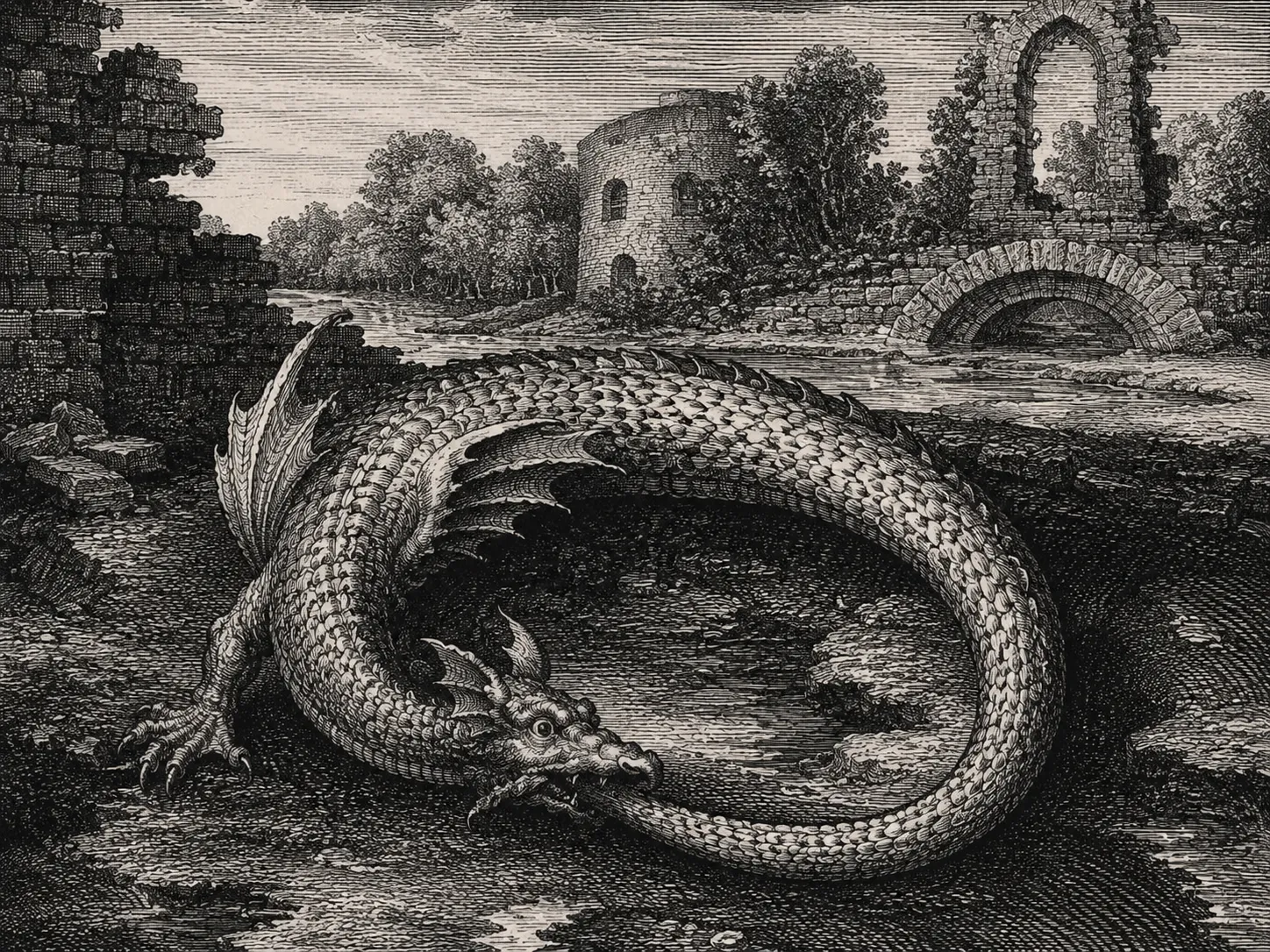
The Ouroboros is one of the oldest symbols in human history. It shows a serpent or dragon eating its own tail to form a complete circle, symbolizing the endless cycle of destruction and rebirth. The earliest known example comes from the 14th century BCE, in a funerary text inside Pharaoh Tutankhamun’s tomb.
However, the creature is more than just a snake eating itself. It stands for the idea that the universe keeps going by constantly renewing itself, where endings and beginnings are really the same thing. The symbol moved from Egyptian beliefs to Greek alchemy, Norse myths, Gnostic ideas, Hindu texts, and even modern chemistry, while retaining its core meaning.
Summary
Overview
| ATTRIBUTE | DETAILS |
|---|---|
| Names & Etymology | Ouroboros (primary); Uroboros (alt. spelling). From Greek ourá (“tail”) + boros (“devourer”) — “tail-devourer.” |
| Classification | Cosmological entity / primordial symbol; adopted across Gnostic, alchemical, and mythological traditions. |
| Species | Reptilian (serpent or dragon). |
| Origin | Appeared from Egyptian funerary theology as a representation of cosmic renewal; the sun god Ra’s nightly death and rebirth through the underworld. |
| Earliest Record | 14th century BCE. Enigmatic Book of the Netherworld, tomb of Tutankhamun (KV62), ancient Egypt. |
| Habitat | The outer boundary of the cosmos; no fixed geographic terrain. Appears in funerary contexts, magical papyri, and alchemical manuscripts across Egypt, Greece, and medieval Europe. |
| Diet | Itself. The Ouroboros feeds exclusively on its own tail — the act of consumption is also the act of self-renewal. |
| Physical Details | Depicted as a large serpent or dragon forming a perfect closed ring. In the Chrysopoeia of Cleopatra (3rd c. CE), shown as half-black and half-white. The Gnostic Pistis Sophia describes it as a twelve-part segmented dragon. |
| Strengths | Ontological self-sufficiency; forms the boundary between cosmic order and chaos. Cannot be attacked from outside — it has no outside. Sustains itself indefinitely without external input. |
| Weaknesses | The circle breaking (Norse variant: Jörmungandr releasing its tail triggers Ragnarök). In Gnostic tradition, specific gnosis (secret knowledge) can identify the correct segment of its body to pass through. In alchemy, an incomplete transformation cycle is the only failure state. |
| Warning | The Ouroboros does not hunt. Its danger is philosophical: those who mistake an eternal cycle for progress may spend a lifetime in motion while going nowhere. The real trap is the loop you don’t see. |
| Threat Level | Level 5 (Apocalyptic) [See the Threat Level Guide] |
| Survival Odds | 0% (You are already inside it. There is no surviving the Ouroboros — only understanding it, or not.) |
Who or What Is the Ouroboros?
The Ouroboros is not a typical monster. It does not hunt, attack villages, or appear in nightmares. Instead, it is a cosmic being—a serpent or dragon whose main action is endlessly eating its own tail. This act is both what it does and what it means. The Ouroboros is always shown focused on itself, not moving toward anything else. It is not good or evil, nor a god with plans. It is more like a law of nature given a physical form.
The creature is unusual because so many different cultures created almost the same image, even though they had no contact with each other. Ancient Egyptians, Norse storytellers, Vedic scholars, Gnostic Christians, Chinese jade artists, and indigenous South American groups all made their own versions of a serpent that circles the world and bites its own tail.
Each culture inflected it differently — the Norse version ends the world when it lets go; the Hindu version is the eternal couch on which creation rests; the Gnostic version is a twelve-part prison — but the visual grammar is identical. This convergence suggests that the Ouroboros taps into something structural about how the human mind processes time, cyclicality, and self-reference.
In most traditions, the Ouroboros is both one thing and everything at once. It marks the edge of the universe, represents time looping back on itself, and shows that matter never really goes away—it just changes form. The most famous Greek phrase written with it sums this up: hen to pan, meaning “the all is one.”
Ouroboros Origins & Creation
The creature does not have a single origin myth in the way a monster like the Minotaur does. It appeared from a confluence of direct observation, cosmological reasoning, and religious need — and its earliest traceable appearance anchors it firmly in ancient Egypt.
The oldest confirmed instance is found in the Enigmatic Book of the Netherworld, a funerary text discovered inside KV62, the tomb of Tutankhamun, dating to the 14th century BCE. In that text, the Ouroboros appears not once but twice — one serpent biting its tail encircles the head and upper chest of a mummiform monster, while a second encircles its feet.
This entity likely represents the unified Ra-Osiris, the sun god and the god of the dead merged into a single entity, representing Osiris reborn as Ra in the underworld. The serpents in this context are identified with Mehen, the coiling protector god who guards Ra during his dangerous nightly journey through the Duat. The image is, all things considered, not decorative; it is a cosmological diagram of the moment creation renews itself at the boundary between death and dawn.
Egypt’s relationship to the Nile almost certainly played a role in the symbol’s genesis. The Nile’s annual flooding cycle — predictable destruction followed by predictable fertility — gave Egyptian religious thought an unusually concrete model of death-into-renewal.
A serpent that eats itself and comes back to life, holding chaos at the edge of order, fit well with a society shaped by regular floods. Some researchers also connect the Ouroboros to the goddess Wadjet, the uraeus cobra who protected the pharaohs, and to Sata, a primeval serpent believed to guard the world from cosmic threats.
From Egypt, the symbol spread into the mixed Greek-Egyptian world during the Hellenistic era. The Greek Magical Papyri, written between about 200 BCE and 500 CE, show the first written use of the word ouroboros in protective spells. This was the first time the image was joined with spoken rituals.
The Vedic Aitareya Brahmana, written in early first-millennium BCE India, uses the image of a snake biting its own tail to show how Vedic rituals refer back to themselves, which proves the idea appeared in India without Egyptian influence. In Norse myth, Jörmungandr, the world serpent and child of Loki, grew so big that it could circle the world and bite its own tail. In the story, when the serpent lets go at Ragnarök, the world ends.
The Ouroboros is similar to other ancient beings from the same areas. For example, the Leviathan in Kabbalistic tradition is described in the Zohar as a creature with its tail in its mouth, wrapping around the world. The Gnostic Aion, a god of eternity, and the Orphic Phanes, who comes from a serpent-wrapped cosmic egg, are also related. All these figures—Leviathan, Aion, Jörmungandr, Ananta Shesha—are different versions of the Ouroboros in various cultures.
Etymology
The name Ouroboros comes from ancient Greek: οὐροβόρος (ourobóros), made from two roots. The first, οὐρά (ourá), means “tail.” The second, βόρος (bóros), comes from a verb meaning “to eat” or “to devour,” and suggests eating greedily or hungrily, not just casual eating.
So, the word means “tail-devourer,” though some say “he who eats the tail.” Merriam-Webster says the first use of the English word Ouroboros was in 1921, showing that the Greek term is fairly new in English, even though the symbol is much older than classical Greek.
It’s important to note that the name ouroboros is Greek, but the symbol itself is Egyptian. The Greek word does not show up in classical texts until much later, with the first written proof in the Greek Magical Papyri from Hellenistic-Roman Egypt. The image was used for over a thousand years before anyone wrote down the word.
Another spelling, uroboros, is found in older English writings, showing a different way of turning the Greek word into English. In 4th-century Latin texts, the writer Servius mentioned the Egyptian image but did not use the Greek word, which suggests the word and the image spread in different ways.
You may also enjoy:
Who Is the Most Powerful Demon in Hell?
July 31, 2026
Halphas Demon in Ars Goetia – Rank, Powers, and Lore
August 11, 2025
Ouroboros Pronunciation
In English, Ouroboros is usually pronounced oo-ROH-boh-ros, with the stress on the second part. The IPA is /uːˈroʊbərəs/. British English often says /ʊəˈrɒbərəs/, while American English uses /ʊˈroʊbərəs/. In both, the first part rhymes with “too,” and the last part is a soft “-ros,” not “-roze.”
What Does the Ouroboros Look Like?
In the oldest Egyptian art, the creature looks like a simple, smooth snake with no legs or wings, shown from the side with its tail in its mouth. It forms a neat, closed circle. There is no fire, no dramatic scales, and no scary fangs. The earliest images are calm and simple, using shape rather than scary details to convey the idea.
As the symbol moved into Greco-Egyptian alchemy and later into medieval European books, its look changed. The Chrysopoeia of Cleopatra, from 3rd-century Alexandria and kept in a 10th-century copy, shows the Ouroboros as half black and half white. The dark side stands for matter that changes, and the white side for what stays the same. This is the version most people see today.
Later alchemical drawings, like Lucas Jennis’s 1625 picture in De Lapide Philosophico, show the Ouroboros as a dragon with short legs and small wings, not just a snake. In these cases, it stands for mercury. Some medieval European books even show it with a crown on its head.
The Gnostic tradition includes a detail that most modern images leave out: in the Pistis Sophia, the Ouroboros is a dragon made of twelve parts, with each part linked to a dungeon that has a door opening upward. This is very different from the calm Egyptian circle, and almost no modern pictures show it this way.
Modern images often show the Ouroboros as if it is struggling, with its mouth wide open and scales standing up, especially in tattoos and pop culture. But in the oldest sources, the Ouroboros is perfectly still—a calm circle that does not look like it is eating at all, just existing. Eating and being whole are the same thing. There is no violence, no sound. It is like a picture of silence.
Ouroboros Mythology
Stories about the Ouroboros appear in many different texts: Egyptian funerary writings from the 14th century BCE, the Greek Magical Papyri from the Hellenistic and Roman times, 4th-century Gnostic religious texts, 3rd-century alchemical manuscripts from Alexandria, and Norse myths written down in 13th-century Iceland.
No one culture owns the main story—each group changed it to fit their own ideas about the universe.
The Egyptian version is the most ambitious. In the Enigmatic Book of the Netherworld, two Ouroboros serpents circle a mummy-like entity. This shows the moment when Ra and Osiris join in the underworld—when the sun god dies at sunset and is reborn at dawn.
The Ouroboros forms the boundary around this transition, marking the universe’s most important event. If the circle breaks, Ra does not rise. The world ends quietly, not with violence—the serpent just stops eating itself.
The most popular version today is the Norse story of Jörmungandr. Here, the Ouroboros image has an apocalyptic twist. Odin threw Jörmungandr into the sea, where it grew so large it could circle the world and bite its own tail.
As long as it holds on, the world stays together. Thor and Jörmungandr are old enemies. At Ragnarök, Thor kills the serpent with his hammer, but then takes nine steps and dies from its poison. The serpent’s death and the end of the world happen together. In this story, the Ouroboros is not comforting—the world only exists because the serpent keeps biting.
A less well-known and more unsettling version comes from the Gnostic tradition in the Pistis Sophia. Most people see the Ouroboros as a sign of renewal and endless return. But the Gnostic story, written around 400 CE, describes it as a dragon made of twelve parts, each part holding a dark dungeon with a door that opens upward.
In this view, the Ouroboros does not protect or renew the world—it traps souls in the material world. The circle is a cage. Eternal return is not freedom but a prison: any soul trying to escape runs into the serpent and is pushed back inside. This idea was largely lost when mainstream Christianity sidelined Gnostic texts. Still, it is one of the oldest and most thoughtful interpretations, and it completely reverses the usual meaning.
The alchemical tradition, which started in Alexandria and later spread to medieval Europe, gave the Ouroboros its most precise meaning. The Chrysopoeia of Cleopatra—likely written by an Egyptian Greek alchemist, not the famous queen—shows the serpent with the words hen to pan: “the all is one.”
The surviving copy, made in the 10th century, was later taken by Cardinal Bessarion, who brought it out of Constantinople before the Ottoman conquest in 1453 and gave it to Venice.
Today, it is in the Biblioteca Nazionale Marciana. Alchemists saw the Ouroboros as the driving force behind the Magnum Opus—the Great Work of transformation. It shows how base matter breaks down and then becomes something pure. The serpent eating itself represents breaking down, and the unbroken circle symbolizes becoming whole again. They saw this as a real process, not just a symbol.
You may also enjoy:
January 14, 2026
Botis in Demonology: From Serpent to Hell’s Noble
August 20, 2025
The Complete List of All Haunted Places in Alaska
November 20, 2025
Can You Defeat an Ouroboros? Powers & Weaknesses
The Ouroboros does not have powers like breathing fire or luring sailors. Its power is in what it represents—it is the idea of endless self-renewal made real. To know what the Ouroboros can do, you have to know what it is: a system that always turns its own ending into a new beginning. Its tail is both the end and the start. It does not need anything from outside to keep going.
This self-sufficiency is what made the Ouroboros so fascinating across traditions. Plato, even if he did not use the name, described a first being that fed on itself, saw with eyes turned inward, and heard only its own sounds. This perfect closed system needed nothing from outside.
The Ouroboros makes this idea real: it is the outer edge of the universe and the only thing that feeds on that edge. It keeps the world together by serving as the barrier that prevents order from turning into chaos—and it survives by feeding on that very process.
Each tradition explains the Ouroboros’s magic differently. In Egypt, its power is like gravity: the circle it makes is needed for the universe to stay in order. Its weakness is that if the circle breaks.
If the serpent lets go of its tail, like Jörmungandr at Ragnarök, the line between order and chaos disappears, and everything falls apart. Defeating the Ouroboros is the same as ending everything. This is not a trick a hero can use—it is the system’s total failure.
In Gnostic belief, the Ouroboros acts like a cosmic lock—twelve connected dungeons that keep souls trapped in the material world. The idea is that the serpent’s self-eating is like divine entropy: souls are always recycled inside the loop.
The Gnostic solution is not to fight, but to gain special knowledge—gnosis—so a soul can find the right door in the dragon’s body that opens upward. Knowledge, not strength, is what matters. You cannot attack the serpent; you have to find your way through it.
The alchemical tradition offers a different angle: the Ouroboros is not an adversary but a process, and its “defeat” is its successful completion. When the dissolution and reconstitution cycle completes perfectly — when the serpent fully consumes itself and is fully reborn — the result is the philosopher’s stone: matter so purified it transcends its own limits.
The Ouroboros doesn’t lose; it graduates. Its weakness, if it has one, is incompletion: an interrupted cycle, a transformation halted halfway, produces not gold but a worse corruption of the original material.
In no tradition is the Ouroboros defeated by conventional means. You cannot stab it, burn it, or trap it. Its strength is the impossibility of an outside — it has no outside. The only leverage any tradition offers is internal: find the seam in the twelve segments, acquire the knowledge that unlocks the door, or complete the alchemical work so thoroughly that the circle itself transcends into something else.
Ouroboros vs Other World-Serpents & Cosmic Cycles
| CREATURE & LORE | DANGER LEVEL | DETAILS |
|---|---|---|
| Jörmungandr (Norse) | Extreme. Encircles the entire world; releasing its tail triggers the apocalypse and floods the earth. Kills Thor with venom at Ragnarök. | Unlike the Ouroboros, Jörmungandr is a named character with a destiny — its grip on its own tail is the only thing holding the world together before Ragnarök. |
| Ananta Shesha (Hindu) | Medium. Not aggressive, it is the cosmic couch on which Vishnu rests between creation cycles. Its movement causes earthquakes. | Shesha means “that which remains” — the serpent is literally what is left over after the universe dissolves, serving as the substrate for the next creation. |
| Leviathan (Hebrew/Kabbalistic) | Extreme. A singular, world-encircling sea monster with its tail in its mouth; described in the Zohar as twisting around the entire world. | The Zohar specifies Leviathan has no mate — it is cosmologically alone — a detail that sets it apart from other world-serpents and links it directly to Ouroboros imagery. |
| Python (Greek) | High. A massive earth-serpent that guarded the oracle at Delphi; killed by Apollo. Did not hunt humans for food but defended sacred territory lethally. | Python was said to have emerged from the mud left by the great flood — a creature born of dissolution who then guarded the world’s most important prophetic site. |
| Tiamat (Babylonian) | Extreme. The primordial salt-water dragon whose body is literally split apart to form the sky and earth. Killing her is the act of creation. | Tiamat’s destruction does not end her — she becomes the world itself, making her arguably the most literal embodiment of the “creation through consumption” logic the Ouroboros encodes. |
| Quetzalcoatl (Aztec) | High. A feathered serpent deity associated with wind, creation, and cyclical time. Voluntarily exiled himself and was expected to return and end the current world cycle. | Quetzalcoatl is sometimes depicted eating his own tail in Aztec art, directly linking him to the Ouroboros concept — one of the clearest independent convergences of the symbol in the Americas. |
| Apep / Apophis (Egyptian) | Extreme. A chaos serpent that attempts to swallow Ra’s solar bark every night; if it ever succeeds, the sun will not rise. | Apep and the Ouroboros are conceptual opposites from the same culture — the Ouroboros ensures Ra’s rebirth; Apep tries to stop it. They occupy the same cosmological event but on opposite sides. |
| Aion (Greco-Roman / Mithraic) | Severe. A lion-headed deity encircled by a serpent coiling around its body, personifies eternity and boundless time. Not a predator — a force. | Mithraic mysteries depicted Aion with a serpent looped around its torso seven times — one coil for each planetary sphere — making it a cosmological map encoded in anatomy. |
| Nidhogg (Norse) | Severe. A corpse-eating dragon that perpetually gnaws at the roots of Yggdrasil; it does not hunt humans directly, but its success ends all existence. | Nidhogg is Jörmungandr’s philosophical inverse — where Jörmungandr holds the world together by gripping its tail, Nidhogg slowly destroys the tree that holds the worlds up. |
| Kneph (Egyptian) | Medium. A primordial serpent-creator god described as “the most ancient deity of the prehistoric world”; associated with the breath of creation, not with predation. | Macrobius attributed the Ouroboros’s origin partly to Kneph — the Phoenician-influenced Egyptian creator serpent whose coiled form predates even the Tutankhamun textual record. |
| Ladon (Greek) | High. A hundred-headed serpent that never slept, guarding the golden apples of the Hesperides; killed by Heracles but later placed among the stars as the constellation Draco. | Ladon is sometimes depicted coiled into a ring around the garden tree he guards — an ouroboric posture — though unlike the Ouroboros, his encirclement serves as external protection rather than self-renewal. |
| Cosmic Anaconda (Amazonian) | Severe. Indigenous peoples of South American tropical lowlands describe a world-encircling anaconda biting its own tail at the edge of the world-disc; it defines the boundary of reality. | This Amazonian world-serpent developed entirely independently of Old World traditions — one of the strongest pieces of evidence that the Ouroboros reflects a universal human cognitive archetype rather than cultural diffusion. |
My Take
What strikes me most about the Ouroboros is not its antiquity or its cross-cultural reach, though both are remarkable. It’s the fact that every civilization that encountered it eventually split into two camps: those who saw the closed circle as liberation and those who saw it as a trap.
The Egyptian and alchemical traditions read the self-consuming serpent as the engine of renewal — a reassurance that the cosmos repairs itself. The Gnostic tradition read the exact same image and concluded it was a prison. The Norse tradition read it as a ceasefire that will eventually end in mutual annihilation.
None of these readings is wrong. A closed loop is simultaneously a self-sustaining system and a system that can never escape itself. The Ouroboros is the only symbol in human history that can function simultaneously as a comfort (nothing truly ends) and a horror (nothing truly ends). Most symbols pick a side. The Ouroboros refuses.
There is also something philosophically precise about August Kekulé’s famous 1865 dream — dozing by a fireplace, watching a snake curl around and bite its own tail — and waking to realize that benzene was not a chain but a ring. The Ouroboros did not just encode cosmological intuitions about time; it apparently also encodes the correct molecular geometry of one of the most important compounds in organic chemistry.
Whether that is a coincidence or evidence that the human unconscious has always structured problems in recursive loops is a question the symbol itself would call unanswerable — and irrelevant. The circle is the circle. The ending is the beginning. The tail is already in the mouth.
You may also enjoy:
What Is Átahsaia, the Cannibal Demon of Zuni Mythology?
November 4, 2025
Hell’s Gate Bridge Haunting: From Tragic Deaths to Demonic Portals
September 23, 2025
Is Mothman Real? The Eerie Sightings That Say Yes
June 25, 2025
The Legend of Umibozu: Japan’s Most Frightening Ocean Yokai
September 10, 2025
Sources
- Cheney, Liana. Lavinia Fontana’s Cleopatra the Alchemist. Academia.edu.
- Plato. The Dialogues of Plato. Translated by Benjamin Jowett, vol. 3, Clarendon Press, 1892. Internet Archive.
- Pistis Sophia: A Gnostic Miscellany. Translated by G. R. S. Mead, J. M. Watkins, 1921.
- The Greek Magical Papyri in Translation, Including the Demotic Spells. Edited by Hans Dieter Betz, University of Chicago Press, 1986.
- Hornung, Erik, and Theodor Abt, editors. The Egyptian Amduat: The Book of the Hidden Chamber. Translated by David Warburton, Living Human Heritage Publications, 2007.
- Hornung, Erik. The Ancient Egyptian Books of the Afterlife. Translated by David Lorton. Cornell University Press, 1999.
- Prakash, Siddharth. (2021). Cosmic Serpents. ResearchGate.