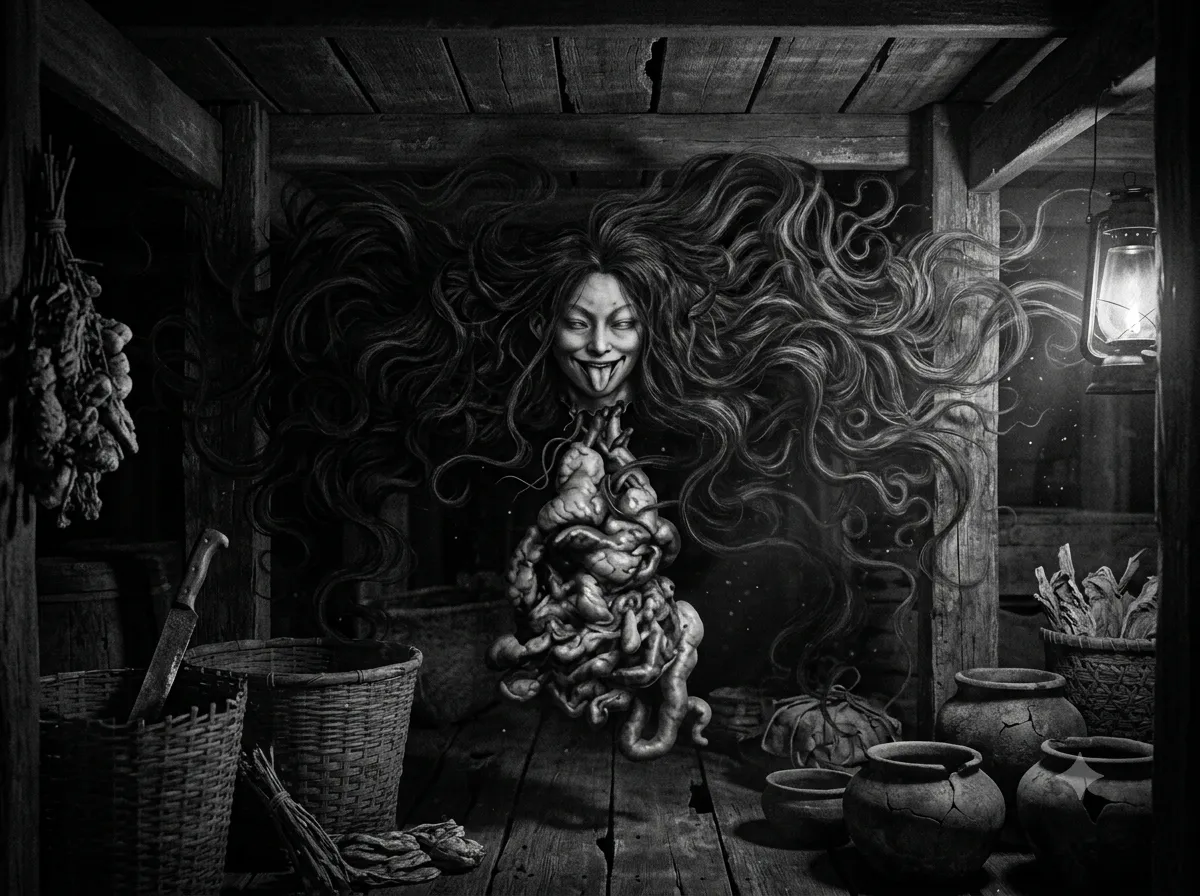
The Penanggalan is one of Southeast Asia’s most disturbing vampire legends. She is a living woman who uses black magic to detach her head and fly through the night, with her stomach, lungs, and intestines trailing below her like glowing ribbons.
She is not a wraith, not a corpse, not a demon in the classical sense. By day, she moves through her village as an ordinary woman, undetectable. By night, she hunts pregnant women and newborn infants, perched on the rooftops of birthing houses. She is older than Malaysia’s written records, and she is still spoken of in rural kampungs today.
Summary
Overview
| Attribute | Details |
|---|---|
| Names & Etymology | Penanggalan, Penanggal, Hantu Penanggalan (Peninsular Malaysia); Balan-Balan (Sabah); Tengelong / Tengalong (Kedah); Hantu Polong (Temuan people). From the Malay root tanggal — “to detach” or “to remove.” Full name translates as “the detacher.” |
| Classification | Vampiric witch/living spirit (hantu). Not undead — classified as a living human who has gained supernatural form through black magic. |
| Species | Humanoid |
| Origin | A mortal woman who makes a pact with a demon and undergoes a ritual: meditating fully submerged in a vat of vinegar, her body immersed except for her head, while abstaining from meat for 40 days. If the ritual is completed, she gains the ability to detach her head from her body at will. A secondary origin describes a priestess startled during a ritual bath, causing her head to violently tear free — permanently. The myth likely originated in the pre-Islamic animistic traditions of the Malay Peninsula, where the boundary between body and spirit was considered porous. |
| Earliest Record | 1834 — documented by East India Company officer Peter James Begbie. First formal English-language attestation recorded by the Oxford English Dictionary: 1839, in the writings of Thomas John Newbold, army officer and oriental scholar. Motifs consistent with the creature appear in oral traditions and hikayat (Malay epic literature) thought to predate these records by one to two centuries. |
| Habitat | Rural villages and kampungs (traditional Malay stilt-house settlements) across the Malay Peninsula, particularly the northern states of Kelantan, Kedah, and Penang. Also documented in Sabah (Borneo) and in oral traditions across maritime Southeast Asia. She conceals her dormant body during daylight in hidden chambers, banana groves, or secluded domestic spaces. |
| Diet | Blood — specifically the blood of pregnant women, women in active labor, and newborn infants. Also said to consume the placenta after burial. She uses an invisible tongue to feed through floorboards while her victims sleep. |
| Physical Details | A living woman’s severed head, with the stomach, lungs, and intestines trailing from the neck stump. The organs emit a faint, firefly-like bioluminescent glow in flight. Up close, she is distinguishable by the sharp, pervasive smell of vinegar absorbed during her nightly soaking ritual. No wings, no horns, no visible rot — her face is that of a living woman. In some regional accounts, she has full muscular control over her entrails and can use the small intestine as a prehensile limb to constrict prey. |
| Strengths | Able to pass undetected as an ordinary woman during daylight hours. Flight in detached head form. Invisible tongue capable of feeding through walls and floorboards. Blood contamination causes fatal wasting illness in victims. Entrails cause festering, non-healing sores on contact. Able to attack through architectural barriers that conventional intruders cannot breach. |
| Weaknesses | Her exposed organs are her critical vulnerability — thorny leaves of the mengkuang plant (Pandanus atrocarpus) scattered around windows and doorways will snag and injure her dangling entrails. Pineapple plants placed beneath stilt-houses serve the same purpose. Glass shards embedded in the wall tops or poured into her neck cavity will prevent reattachment. She must return to her body and soak her organs in vinegar before dawn every night — disrupting this routine is fatal. To permanently destroy her: locate the dormant body during daylight, separate and bury the head and torso in distant locations, with thorns or glass placed inside the neck stump to prevent reunion. A bomoh (Malay shaman) may conduct accompanying exorcism rites. She can always be identified by the faint smell of vinegar. |
| Warning | If you are pregnant, in labor, or caring for a newborn in a rural Malay stilt-house, hang mengkuang vines around every window and plant pineapples beneath the floorboards before nightfall. Do not dismiss a trusted midwife who smells faintly of vinegar — especially one with no reasonable explanation for the scent at dawn. |
| Threat Level | Level 3 (Apex Predator) [See the Threat Level Guide] |
| Survival Odds | 35% (Unless you know her botanical weaknesses and can identify her human disguise before nightfall, a birthing house encounter is almost certainly fatal for mother or infant.) |
Who or What Is the Penanggalan?
The Penanggalan, also spelled Penanggal and called Hantu Penanggalan in some dialects, is a nocturnal vampire from Malay ghost stories. What sets her apart from other Southeast Asian supernatural beings is that she is not undead. She is a living woman who has learned black magic powerful enough to let her remove her own head at will. Her empty body stays hidden while her head goes hunting.
The Penanggalan’s appearance is both specific and nightmarish. Her severed head floats through the air with her stomach, lungs, and intestines still attached, trailing from her neck.
These organs are believed to give off a faint light, creating a dancing glow as she moves through the dark. This was the traditional Malay explanation for the will-o’-the-wisp lights seen over swamps and rice fields. Up close, though, the glow is replaced by the wet sound and sour smell of her vinegar-soaked organs.
Her predatory focus is narrowly specific. She does not hunt indiscriminately. The Penanggalan targets pregnant women, women in active labor, and newborn infants. Traditional Malay stilt-houses were architecturally vulnerable to her: she would lurk under the floor panels and extend an invisible tongue upward through the gaps to feed on the blood of women giving birth above.
People whose blood she drank were said to develop a wasting illness with no natural cure. Even touching her was dangerous. Anyone brushed by her dripping entrails would get painful, festering sores that only a bomoh (a Malay shaman) could heal.
During the day, she appears as a normal woman. If you know what to look for, you might notice a faint, lingering smell of vinegar around her.
Origins & Creation
The Penanggalan’s origins go back further than any single written account. Scholars have found her mentioned in 19th-century Malay texts and colonial records, but her legend likely began centuries earlier. It grew out of pre-Islamic animistic traditions in the Nusantara archipelago, where people believed the line between the body and the soul was thin and could be changed through rituals.
The best documented origin mechanism entails a ritual of deliberate transgression. A woman — often identified as a midwife, a healer, or someone already versed in the occult — enters a pact with a demon in exchange for eternal beauty or youth.
The pact requires her to avoid eating meat for forty days while meditating in a vat of vinegar, with her body submerged up to her neck. If she completes the ritual without interruption, the transformation is permanent. Another origin story, which is more violent and less voluntary, tells of a priestess who was startled during a ritual bath. Her head tore away from her body and stayed separate, hunting forever after.
The earliest known English-language documentation of the Penanggalan appears in the work of Thomas John Newbold, an officer of the East India Company’s Madras Army and an oriental scholar who wrote in 1839 that “Penangalan takes up its abode in the forms of females, and afflicts them with an unnatural craving for human blood.”
This entry, now recorded in the Oxford English Dictionary as the word’s first known English attestation, came from Newbold’s observations throughout the Malay Straits. A second foundational account appears in Peter James Begbie’s 1834 writings, which document a Malay narrative involving a man with two wives and a bomoh’s curse — one of the first recorded story-forms of the legend.
The most thorough early ethnographic treatment belongs to Walter William Skeat, whose 1900 work Malay Magic provided a field-researched account of the Penanggalan’s nature, behavior, and the protective rituals practiced against her in Selangor and Perak.
Linguistically, the Penanggalan is connected to many similar beings across the archipelago and mainland Southeast Asia. The Krasue of Thailand, Leyak of Bali, Kuyang of Kalimantan, Palasik of West Sumatra, Ahp of Cambodia, Kasu of Laos, and Manananggal of the Philippines all share her main feature: a detached female head with trailing organs.
The geographic spread and morphological consistency of this motif across cultures that share Austronesian language roots suggests this imagery draws on a deep, pre-literate common cultural inheritance, later shaped independently by each region’s religious evolution. In the Malay Peninsula, the myth absorbed Islamic concepts of demonic pacts and spiritual transgression following the Islamization of the region beginning in the 14th century, without abandoning its animistic foundation.
There are also regional differences within Malaysia. In Kelantan and Kedah in the north, which share cultural ties with Thailand, the Penanggalan legend includes traits similar to the Thai Krasue, which shows how folk beliefs have traveled along trade and migration routes.
In Sabah, on the island of Borneo, a variant called Balan-Balan preserves the core morphology under a different name. In the Temuan indigenous community in Peninsular Malaysia, she is known as Hantu Polong. In Kedah, she is called Tengelong or Tengalong. Each name, each village, each forest path carries its own slightly altered version of the same terror.
You may also enjoy:
Likho: The One-Eyed Crone Who Brings Death and Bad Luck
September 11, 2025
12 Haunted Places in Arkansas You Should Never Visit Alone
October 8, 2025
Incubus: Demon of Lust and Nightmares
August 22, 2025
Etymology
The name Penanggalan comes from the Malay root word tanggal, which means “to detach,” “to remove,” or “to take off.” The prefix pe- is a standard Malay marker that turns a verb into a noun for the one who does the action. So, penanggal or penanggalan literally means “the detacher” or “that which removes.” The name is a straightforward description of what the creature does.
The etymology is not coincidental or unique to Malay. The parallel Filipino creature, the Manananggal, carries the same semantic content: the prefix mana- in Tagalog, combined with the root tanggal, produces a word meaning “the one who detaches.”
Both Malay and Tagalog belong to the Austronesian language family, and the common root word for this shared creature-concept is linguistic evidence of a common ancestral myth diffusing across island Southeast Asia before the modern nations existed.
The Oxford English Dictionary records the first use of the term penanggalan in English from 1839 — in Thomas Newbold’s writings — making it one of the relatively few pieces of Southeast Asian folklore that entered the formal English lexicon during the colonial era.
In different regional dialects, the creature is known by names that preserve her core identity while adapting to local speech. She is called Tengelong in Kedah, Balan-Balan in Sabah, and Krasue in Thai (a term likely from a different Austronesian root but similar in meaning). Each new name is a small act of cultural translation that keeps the meaning intact.
What Does the Penanggalan Look Like?
In the original Malay folklore recorded by Walter Skeat and other 19th-century writers, the Penanggalan is not a monster with fangs and claws. Instead, she is described as something more unsettling: a normal woman’s head, complete with hair and face, with her stomach and intestines still attached at the neck and glistening with moisture.
She has no bat wings, no decaying flesh, and no horns. The horror comes from her anatomy being out of place. She looks like a woman whose body was removed below the jaw, but her organs stayed attached.
When she flies, her organs spread out and dangle below her like pale, wet garlands. They do not hang quietly. Traditional stories say you can hear a soft, wet, slapping, or squelching sound as her entrails move through the air.
From far away, the pale glow of her organs looks like a will-o’-the-wisp or a ball of fire drifting in the dark. Up close, the main detail is the smell: she has a sharp, strong scent of vinegar from soaking her organs each night to shrink them so they fit back inside her body before dawn.
Modern media, especially video games and fantasy art, often shows the Penanggalan as a monster with huge fangs, glowing eyes, rotting flesh, and writhing tentacle-like organs. The oldest stories are more specific and, in some ways, even more disturbing. Her face is that of a living woman, not a corpse. The organs she drags behind her are functional, not just for show.
One detail that is rarely shown in popular depictions is that, according to some traditional stories, the Penanggalan can control her entrails. She can use them not just to drip blood, but to grab objects or even constrict her prey. Her small intestine, because of its length, can work almost like an extra limb. Modern horror rarely shows this, instead treating her organs as passive decorations rather than active hunting tools.
Are the Krasue and the Penanggalan the Same?
They are like sisters, not twins. It is easy to confuse them because both appear as floating female heads with trailing organs, both hunt pregnant women and infants, and both are female figures in Southeast Asian folklore linked to forbidden magic. But the differences between them go beyond just where they come from.
The Penanggalan is, at her core, a living witch. She is a mortal woman who uses black magic and becomes what she is through a ritual she chooses. She keeps her human body and returns to it every morning, so she can stay hidden in her community unless someone discovers her.
Her transformation is something she chooses and can reverse—she puts herself back together each day. This gives her a sense of control and secrecy, which is why people fear her: the enemy could be anyone, even the midwife or a neighbor.
The Krasue of Thailand and Cambodia, on the other hand, is usually shown as a cursed spirit. She is a woman who died because of sin, shame, or supernatural punishment, and her decapitated state is permanent and forced, not chosen.
In Thai stories, the Krasue is also known for the bright, glowing light around her organs and head, which is often described as so bright it can be seen from far away. The Penanggalan’s glow is softer, more like fireflies than a lantern.
When it comes to abilities, the Krasue is often linked to spreading disease to crops and contaminating water, with her dripping fluids causing sickness beyond her immediate victims. The Penanggalan’s harm is more focused: her bites and blood-drinking cause wasting illness in individuals, and her entrails leave festering sores if they touch someone.
The Krasue is also more often found in royal or aristocratic origin stories in Thai folklore, whereas the Penanggalan’s origins are usually rural—as a midwife, a village woman, or someone practicing local black magic.
You may also enjoy:
Stanley Hotel Haunting: What Really Inspired The Shining?
October 21, 2025
Who Is Vapula? The Lion-Winged Demon of Hell
August 28, 2025
Scylla: The Ancient Sea Monster That Haunted the Strait of Messina
November 17, 2025
Minos: The Tyrant King of Crete and His Dark Mythological Legacy
September 9, 2025
Myths, Legends, and Stories
The legends about the Penanggalan do not come from just one literary tradition. They exist in two main forms: the field notes of 19th-century colonial writers like Skeat and Newbold, who recorded the creature’s traits and protective rituals from Malay communities in Selangor, Perak, and Penang, and the oral stories told in Malay villages, where the Penanggalan was a warning passed from mother to daughter and midwife to midwife.
The most common story is about a midwife who makes a deal with a demon. She promises to avoid meat, meditate in vinegar, and serve a dark spirit in exchange for lasting beauty. Once the pact is done, she lives a double life: a trusted healer by day and a predator by night. Villagers start to notice that infants die in the homes she visits, new mothers get strange wasting illnesses, and the smell of vinegar lingers around some doorways at dawn.
Eventually, a man—often a husband, father, or bomoh—stays awake and watches through the night. He finds her sleeping body, headless, in her room, and comes back at sunrise to see the head trying to reattach itself. He pours glass shards into the neck before the head can return. She dies screaming at sunrise, trapped between two states.
This is the usual version. There is another story, mostly told in the northern states and recorded in Kelantan folklore, where the Penanggalan’s story is very different. In this version, her origin is not ambition or vanity, but grief. A woman whose child died in childbirth, with the midwife present, is changed not by her own choice but by the power of her mourning and anger.
In the story, the Penanggalan does not soak in vinegar or make any pact. She just refuses to accept death as the end, and her refusal is so strong that the line between her head and body breaks. She keeps attending births, not to harm them, but because she cannot stop, haunting the place she could not cross as a mother.
This version is rarely found in Western sources, but it appears in oral stories from rural Kelantan, showing a different origin based on maternal loss instead of sin.
Peter James Begbie’s 1834 account tells a different story: a Malay man has two wives of different skin tones, and the darker-skinned wife becomes jealous and asks a bomoh for help. The shaman’s curse turns the lighter-skinned wife into a Penanggalan, using the creature’s form as a weapon of personal revenge rather than for self-transformation.
This version, in which a Penanggalan is created by someone else’s curse rather than her own ambition, alters the story’s moral meaning. Here, the Penanggalan is as much a victim as a predator.
Can You Defeat a Penanggalan? Powers & Weaknesses
The Penanggalan does not hunt with physical strength. Instead, her power comes from the ritual idea of contamination. She has chosen to cross the line between the living and the supernatural, and her abilities come from that act.
Everything she touches takes on her in-between state. Her blood causes wasting sickness because it has been changed by supernatural means. Her entrails cause festering sores when they touch someone because they exist both inside and outside a living woman’s body, something made possible by black magic and dangerous to the natural world. Even her screech at a child’s birth is important: in Malay belief, the cry means she is claiming a soul entering the world.
Her invisible tongue, which is often overlooked, is how she feeds through floorboards and walls. The tongue is not just a symbol. Folklore says it is a real extension of her black magic, an organ that works beyond normal biology. It can reach up through wooden planks, find blood by scent, and draw it out without the victim noticing. That is why traditional defenses had to be built into houses, not just rely on fighting her directly—you cannot fight what you cannot see coming in.
The main and most often recorded defense is a plant. The mengkuang plant, a type of Pandanus with long, saw-edged leaves, was the key to protecting against the Penanggalan. The reason is simple: her organs are exposed, with no skin or protective covering. They are the most vulnerable part of her body at night.
Sharp needles that would be an inconvenience to an intact human body become a lethal hazard to exposed intestines. Looping mengkuang vines around windows or scattering the leaves beneath birthing beds was not a spiritual ritual in the abstract sense — it was a targeted anatomical trap. Pineapple plants, placed beneath stilt-houses for the same reason, served the same purpose: prickly leaves and fruit that would shred her trailing organs if she tried to enter through the flooring.
Glass shards placed on top of walls around Malay houses served two purposes: they protected against thieves and the Penanggalan, both by exploiting exposed vulnerability.
To kill her for good, the lore is clear: you must find her body while it is dormant during the day and break the connection between her head and body so it cannot be restored. Her head and torso must be buried far apart, with glass shards or thorns placed in the neck to stop any chance of reunion.
A bomoh conducting the burial might also perform exorcism rites drawn from pre-Islamic incantations, Islamic Quranic verse, or both, depending on regional religious practice. What matters in every version of the killing ritual is disrupting the reunion at first light — because a Penanggalan who cannot return to her body by sunrise is destroyed by the sunrise itself, trapped forever between her two states.
The vinegar that enables her survival is itself a clue to her nature. She soaks her organs each night not for comfort, yet for necessity: the vinegar shrinks them back to a size that fits inside a human torso. Without the nightly maintenance, her organs expand overnight and become too large to re-enter her body.
She depends on a daily routine: a container of vinegar, a hidden room, and an hour before dawn to prepare, which makes her very vulnerable to any disruption. If someone discovers her, the routine she needs can be broken.
You may also enjoy:
Penanggalan vs. Other Monsters
| Creature & Lore | Danger Level | Details |
|---|---|---|
| Krasue (Thailand / Cambodia) | High. Floats as a glowing severed female head over rice fields and villages, dripping fluids that blight crops and contaminate water, while hunting pregnant women and livestock. | Unlike the Penanggalan, the Krasue is more commonly portrayed as a cursed spirit rather than a living witch — her condition is typically punishment, not a deliberate pact. |
| Manananggal (Philippines) | High. Splits at the torso, grows bat-like wings, and flies at night to insert a proboscis-like tongue through thatched roofs to drain the blood and heart of fetuses directly from a sleeping pregnant woman’s womb. | The Manananggal’s lower half remains standing on the ground while she hunts — and destroying it before she returns at dawn kills her permanently, since she cannot survive without reattaching. |
| Leyak (Bali, Indonesia) | High. A shape-shifting witch who can appear as a flying head with entrails, a fireball, or a demon animal, and who steals life-force from the living to extend her own power. | The Leyak is deeply embedded in Balinese Hindu-animist cosmology and is considered more spiritually complex than a simple predator — some are believed to serve higher demonic powers and can only be neutralized by a Balian (traditional healer) of equal or greater spiritual rank. |
| Strigoi (Romania) | Severe. A reanimated corpse or living witch that feeds on blood and life-force, capable of infecting victims and converting them into strigoi through its bite, spreading exponentially through a community. | Romanian folklore distinguishes between two types: the strigoi mort (risen corpse) and the strigoi viu (a living person born with a caul or extra vertebra, predisposed to become one after death) — the living variant shares significant structural overlap with the Penanggalan’s concept of a witch in human disguise. |
| Pontianak (Malaysia / Indonesia) | High. The spirit of a woman who died during childbirth, luring men with a beautiful appearance and floral scent before disemboweling them with elongated fingernails. | The Pontianak and the Penanggalan are often confused, but they are distinct entities — the Pontianak is undead and targets men, while the Penanggalan is a living witch who exclusively hunts women in labor and newborns. |
| Lamia (Ancient Greece) | Severe. A cursed queen transformed into a child-devouring monster after her children were killed by the gods, hunting and consuming infants and young children, sometimes able to remove her own eyes. | The Lamia shares the Penanggalan’s specific predatory focus on children and infants, and both figures may encode ancient cultural anxieties about infant mortality that communities had no medical framework to explain. |
| Aswang (Philippines) | Severe. A shape-shifting creature that lives in disguise as a normal villager by day and hunts at night, consuming fetuses, corpses, and the sick — capable of replacing a victim with a banana-trunk double that appears alive but slowly wastes away. | The Aswang is considered an entire category of supernatural being rather than a single type, encompassing vampires, ghouls, and werebeasts — making it one of the most morphologically flexible supernatural threats in Southeast Asian folklore. |
| Strix (Ancient Rome) | High. A nocturnal bird-demon that flew into homes at night to drink the blood of infants in their cradles, and was believed to cause the sudden unexplained deaths of sleeping children. | Roman writers, including Ovid, documented protective rituals against the Strix that involved placing hawthorn branches at the threshold — a botanical defense strikingly parallel to the Malay use of mengkuang thorns against the Penanggalan, suggesting convergent cultural logic across entirely separate traditions. |
| Lilith (Jewish / Mesopotamian folklore) | Severe. A primordial demoness who stalks newborns and women in childbirth, strangling infants and causing stillbirths, and who cannot be repelled without specific protective amulets inscribed with angelic names. | Protective amulets called Shir Hamaalot were traditionally hung in the birthing room to ward off Lilith — a practice structurally identical to the Malay custom of hanging mengkuang thorns around the windows of a birthing house to block the Penanggalan. |
| Churel (South Asia) | High. The vengeful spirit of a woman who died during childbirth or the Diwali festival, appearing as a beautiful young woman with her feet turned backward, who lures men — particularly young relatives — and drains their life-force until they age and die. | In some regional accounts, a Churel is specifically the spirit of a mistreated woman who died while pregnant — making her origin a social critique of how pregnant women were treated, encoded in supernatural form. |
| Obayifo (Ashanti, West Africa) | High. A living witch who leaves her body at night as a ball of light to drink the blood of sleeping children and drain the vitality of crops, causing wasting illness in the children she feeds upon. | The Obayifo’s double life as an undetected member of her community mirrors the Penanggalan almost exactly — both are living women concealing a nocturnal predatory identity, detectable only by specific signs (the Obayifo by phosphorescent light emanating from her armpits and anus). |
| Langsuir (Malaysia) | High. The spirit of a woman who died in childbirth after learning her baby was stillborn, transformed into a banshee-like vampiric entity who feeds on children’s blood and can only be neutralized by stuffing her long hair and nails into the hole at the back of her neck. | The Langsuir is sometimes described as the original form from which the Penanggalan derives — some oral traditions hold that a Langsuir can transform into a Penanggalan if she continues to practice dark magic after her initial transformation. |
My Take
The Penanggalan legend is not mainly about fearing women. However, that is a common interpretation for Southeast Asian floating-head spirits. More specifically, she represents a fear of expertise.
In pre-modern Malay society, the bidan — the midwife — was among the most powerful figures in a village. She controlled access to the most dangerous threshold a community encountered: the margin between birth and death, where mothers and infants were most likely to die. Her knowledge was specialized, largely unverifiable, and intimate in ways that no one else in the community could evaluate.
When a child died in childbirth or a mother developed postpartum complications, the midwife was present. The Penanggalan legend is, in part, a cultural mechanism for processing the grief and suspicion that appeared from those deaths — a way of accounting for maternal mortality without surrendering faith in the system of care itself.
But there is something stranger about the Penanggalan that this social explanation does not fully capture: her compulsion. She must return to her body, soak herself in vinegar, and put herself back together before dawn. She is not free. The creature who wanted eternal beauty through black magic is now trapped in a nightly routine that is more humiliating than aging ever would have been.
The vinegar-soaked organs are not just a horror for others—they are a horror the Penanggalan must care for herself, alone, in the dark, every night, forever. There is something very specific about this: in the myth, the body’s revenge for being surpassed is not death, but the endless, unpleasant duty of putting itself back together.
She is Southeast Asia’s answer to a question every culture eventually asks: what does it cost to become something more than human? In the Malay telling, the answer is visceral, literal, and exactly as ugly as the question deserves.
You may also enjoy:
Who Is Vapula? The Lion-Winged Demon of Hell
August 28, 2025
Who Are the 72 Demons of the Ars Goetia?
July 16, 2026
What are Pisachas, the Demons of Possession and Decay?
February 12, 2026
Sources
- Penanggalan, N. Oxford English Dictionary, Oxford UP, July 2023, https://doi.org/10.1093/OED/8968276327.
- Nadeau, Kathleen. Aswang and Other Kinds of Witches: A Comparative Analysis. Philippine Quarterly of Culture and Society, vol. 39, no. 3/4, 2011, pp. 250–66. JSTOR, http://www.jstor.org/stable/23719118. Accessed 11 June 2026.
- Skeat, Walter William. Malay Magic: Being an Introduction to the Folklore and Popular Religion of the Malay Peninsula. Preface by Charles Otto Blagden, Macmillan and Co., 1900.
- Laranjo, Ronel, Kristina Martinez-Erbite, and Zarina Joy Santos. Intersection of Asian Supernatural Beings in Asian Folk Literature: A Pan-Asian Identity. The Asian Conference on Asian Studies 2013: Official Conference Proceedings, Osaka, Japan, 2013, pp. 102–115.
- Newbold, Thomas John. Political and Statistical Account of the British Settlements in the Straits of Malacca. Vol. 2. London: John Murray, 1839.
- Abdullah bin Abdul Kadir. Hikayat Abdullah. Singapore, 1849.
- Joyce, Michael. (2018). The Vampires Our Age Deserves: 21st Century Forms of Ancient Evil. eTropic: electronic journal of studies in the Tropics. 17. 10.25120/etropic.17.1.2018.3645.