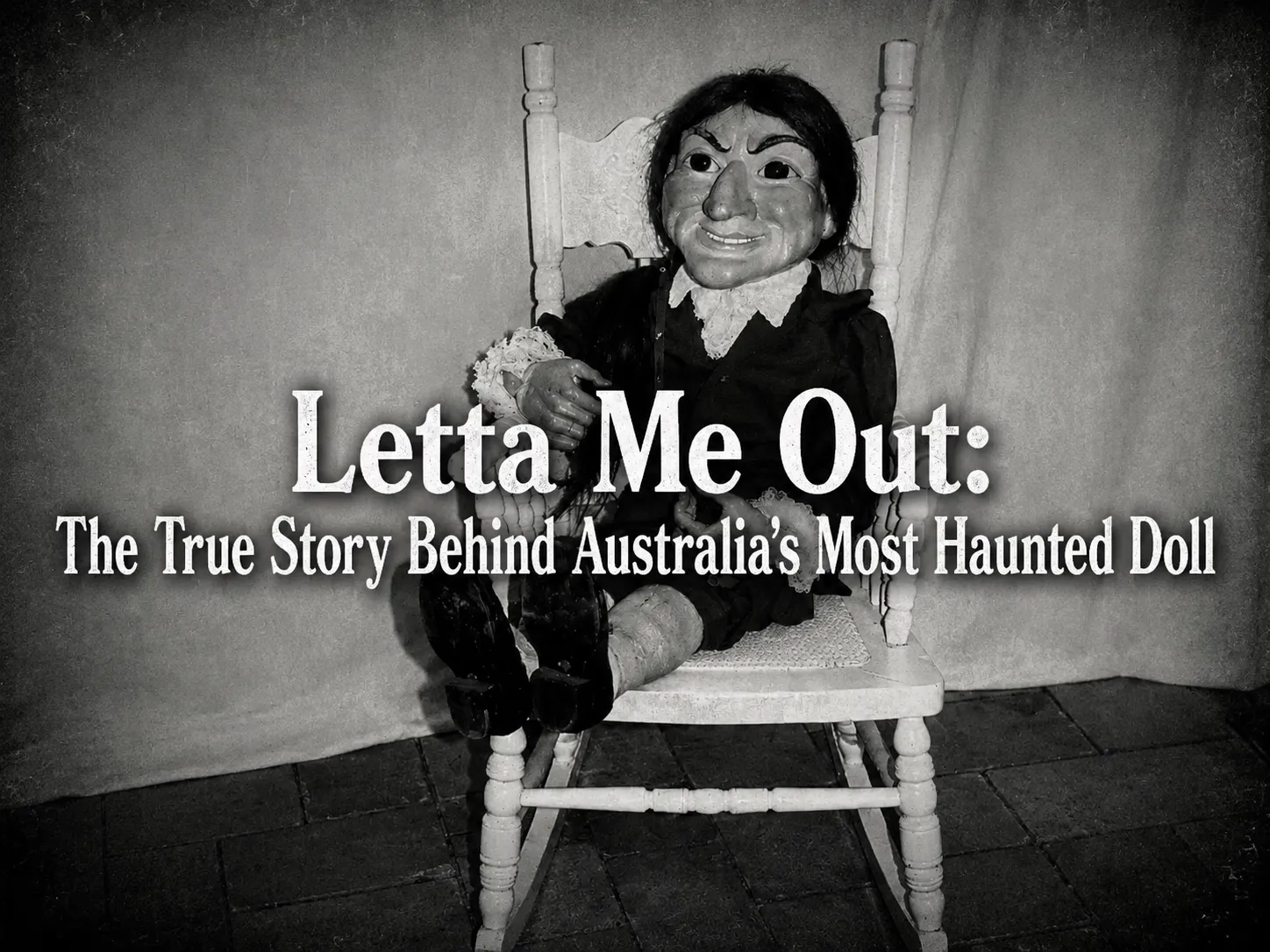
Letta Me Out is the name of a real, physical doll in Australia that has spent more than five decades collecting a reputation as one of the most unsettling “haunted” objects in the country.
Unlike most viral cursed-object stories, this one comes with a documented discovery date, a named family who has cared for it since the 1970s, and a museum-backed age estimate — details that make it more traceable than almost any other doll in the “cursed object” genre.
Summary
Key Takeaways
| Attribute | Details |
|---|---|
| Name | Letta Me Out (primary name); also known as “Letta the Doll,” “Letta,” and “Ledda” |
| Object Type | Hand-carved wooden doll, child-sized, with glass eyes and real human hair |
| Origin / Creation | Estimated mid-to-late 18th century (roughly 200–250 years old), believed to be of Eastern European origin |
| Current Location | Private residence, Warwick region, Queensland, Australia |
| Current Owner | Hayleigh Walton (granddaughter of original finder Kerry Walton), with the extended Walton family |
| Death Toll | 0 confirmed |
| Type of Curse / Haunting | Inhabited Object, Psychic Imprint, Poltergeist Activity Linked to Object, Residual Haunting |
| Manifestations | Overnight scuff marks matching the doll’s shoes, nausea/fainting/vomiting in witnesses, aggressive animal reactions, apparent changes in facial expression or eye color, falling picture frames, blown lightbulbs, rain reported during transport |
| Most Recent Incident | 2018 — public appearance at a “Night of Horrors” community event in Warwick, Queensland; no specific new incident has been independently dated since |
| Threat Level | 2/10 (harmless) [See the Threat Level Explanation] |
| Can the Public View It? | Yes — at periodic community and paranormal-interest events arranged by the Walton family; not on permanent public display |
| Hoax Confidence Rating | 5/10 (Neutral) [See the Hoax Confidence Rating Explanation] |
What Is the Letta Me Out Doll?
Letta Me Out (often shortened simply to “Letta”) is a hand-carved wooden doll, roughly the size of a small child, that was unearthed from beneath an abandoned house in Wagga Wagga, New South Wales, in 1972. It was found by a young man named Kerry Walton, who was exploring the derelict property with his brother out of curiosity — the house had a local reputation among neighborhood kids for being haunted.
Wagga Wagga itself is worth noting for context: it is the largest inland city in New South Wales, sitting on the banks of the Murrumbidgee River roughly 518 kilometers southwest of Sydney. The city’s name comes from the Wiradjuri language and is generally translated as “the place of many crows” — an incidental but fitting detail for a place that would later become known for producing one of Australia’s most talked-about haunted objects.
The doll has glass eyes, a full head of real human hair worn in a braid, and a carved face with arched eyebrows, a prominent nose, and a faint, closed-mouth smile that shows a hint of teeth.
Its arms, legs, and shoes are carved directly into the wood rather than assembled from separate parts, and it is dressed in a dark green suit with breeches and a frilled white shirt — clothing added later, since the doll’s original garments reportedly disintegrated by the time it was found. The paint covering its face, hands, legs, and feet is visibly worn and peeling in patches, consistent with age and handling rather than any deliberate distressing.
When Kerry Walton later had the doll examined at the Australian Museum in Sydney, museum staff used the metal nails embedded in the underside of its shoes to help date the piece. Their assessment placed its construction in the mid-to-late 1700s, making Letta roughly 200 to 250 years old, with a probable origin in an Eastern European, Romani (gypsy) community. No paperwork, maker’s mark, or family record has ever surfaced to confirm exactly who carved it or why — everything known about its pre-1972 history is inference, not documentation.
What separates Letta from generic “creepy doll” content is that it isn’t a folklore character or a marketing invention. It’s a specific, physical object that has been photographed, filmed, dated by a national museum, and passed down within one real family for over 50 years — and that family still owns and maintains a public presence for it today.
The Discovery: A Cellar in Wagga Wagga
The house where Letta was found sat empty in Wagga Wagga and carried a local legend long before Walton ever went looking. Children in the area told stories about an old man supposedly seen dragging a sack of human heads through the property — the kind of tale that gets passed between kids on a street rather than documented anywhere official, but one Walton had grown up hearing.
As an adult living in the Brisbane area, Walton returned to his hometown in the early 1970s and, prompted by curiosity about the old stories, decided to check out the abandoned house himself. Using a flashlight to search the cellar, he spotted what he initially believed was the body of a child.
On closer inspection, it turned out to be the carved wooden doll. Rather than leaving it, Walton took it home — a decision he has since discussed in multiple television interviews as one he still can’t fully explain, given how uneasy the discovery made him at the time.
Accounts differ on Walton’s exact age when this happened; various interviews and archived posts put him anywhere from his early twenties to as old as 29, and no single source has definitively settled the discrepancy. What is consistent across every account is the year and location: 1972, beneath a derelict house in Wagga Wagga.
It’s also worth noting how Walton himself describes the moment of discovery: using only a flashlight in a pitch-dark cellar, his first read on the shape in front of him was that he’d found human remains — a detail he has repeated consistently across decades of interviews. That immediate, visceral misidentification is part of why the story has stuck with audiences; it wasn’t framed from the outset as “I found an old toy,” but as a moment of genuine fear that only resolved into something stranger once he got a closer look.
Explore More Cursed Objects:
The 15 Most Haunted Dolls in the World
June 26, 2026
How the Doll Got Its Name
The name “Letta Me Out” didn’t come from the doll’s original owner, a label, or a psychic reading — it came from a joke. Not long after the discovery, Walton and his brother were driving home at night with the doll secured in a bag inside the vehicle.
Both men noticed the bag appeared to shift or move during the drive (something Walton has since acknowledged could easily have been a trick of headlights and shadow rather than anything supernatural). His brother jokingly gave the doll a voice, saying, “Letta me out! Letta me out!” — and the name stuck permanently.
Over the years, the name has also been rendered as “Ledda.” Some retellings claim it references the doll’s Romani (“gypsy”) background rather than the car-ride joke, but Walton’s own recounting on the 1981 television program that first brought Letta to public attention credits the incident in the car. I
It’s worth noting that some of the doll’s earliest media coverage used an ethnic slur as an alternate nickname for it; that usage has been dropped from the family’s own social media posts since roughly 2018, though it can still surface in older news archives and clips from that era.
Cursed Dolls Through History
Letta Me Out is often discussed as though the idea of a “cursed doll” were a modern invention of tabloid television. Still, the belief that a human-shaped object can carry harmful intent — or be used to direct it — is one of the oldest documented practices in human history. It has left a real paper trail.
The earliest well-documented case comes from ancient Egypt. Around 1155 BCE, a group of conspirators inside the royal palace — including a secondary wife of Pharaoh Ramesses III named Tiye, a treasury official, a military captain, and at least one royal chamberlain — plotted to assassinate the pharaoh and install her son on the throne instead of his chosen heir.
Part of their plan, according to the surviving trial record known as the Judicial Papyrus of Turin, involved crafting wax figurines and using them in magical rituals intended to incapacitate the palace guards and harm the pharaoh. The conspiracy is one of the best-documented assassination attempts from the ancient world specifically because it ended in a formal court trial, with the papyrus recording the plotters’ fates.
This wasn’t an isolated practice. In Graeco-Roman magical tradition, small effigies known as kolossoi were inscribed with a target’s name, then broken, melted, or buried in a grave so that restless spirits could be petitioned to act against the person they represented. Later, in medieval and early modern Europe, similar objects known as poppets were used in both curse work and, just as often, protective or healing magic — the doll wasn’t inherently evil, but rather a tool whose effect depended on the intention behind it.
Letta Me Out fits into the much older lineage interestingly. Unlike most of these historical examples, it wasn’t created to curse anyone. There is no ritual, inscription, or magical intent on record — only a doll of unknown purpose that acquired a frightening reputation after the fact, based entirely on what people experienced once it re-entered public life in the 1970s.
What People Claim Happens Around Letta
Letta has never been described, even by its own caretakers, as demonically possessed or overtly violent — its reported activity is stranger and more ambient than the “attacking doll” trope common to horror fiction. Reports gathered over decades of media appearances and firsthand accounts describe:
- Scuff marks appearing on floors near the doll overnight, in a pattern consistent with its own carved shoes, as though it had walked.
- Sudden feelings of nausea, faintness, or emotional overwhelm in people standing near it.
- Dogs and other animals reacting with visible agitation — barking, growling, or attempting to bite the doll — despite showing no such reaction to other objects in the room.
- The doll’s facial expression or eye color appearing to change to different observers.
- Small-scale environmental disturbances around the doll, such as picture frames falling from walls or light bulbs blowing out
- A frequent claim, repeated by multiple people over the years, that rain begins whenever the doll is being transported inside a moving vehicle.
One detail that separates Letta from many “evil doll” legends is the interpretation offered by at least one psychic who spent extended time with it: rather than describing it as malevolent, she characterized it as “sad” rather than “bad,” theorizing that its negative effect on people originate from resentment at being put on display rather than any intent to cause harm.
Kerry Walton has echoed a similar framing in interviews, at times suggesting the doll may have coincided with—or even contributed to—positive turns in his family’s fortunes rather than only misfortune.
Life Under the Walton Family’s Care
After bringing the doll home, Walton and his family kept it despite the household’s early unease. Scuff marks reportedly began appearing around the house within a relatively short time of the doll’s arrival. Family members have described feeling watched or unsettled in its presence — but rather than disposing of it, the family gradually incorporated it into their household, eventually displaying it seated in a small chair (photographed in recent years in a white rocking chair) for visitors and, later, cameras.
At one point, financial pressure led Walton to attempt to sell the doll. He found a buyer and drove to their home to finalize the sale with the doll in the car — and, by his own account, was unable to go through with it. He has described feeling physically unable to get out of the vehicle at the buyer’s house, and the sale eventually fell through. Walton kept the doll from that point onward.
Letta’s public profile grew primarily through Australian television. It first appeared on the program State Affair in 1981, where Walton told the discovery and naming story on camera for what appears to be the first documented time.
Further television appearances followed through the 1990s and into the early 2000s — including a 1994 segment on the program The Extraordinary and additional coverage in 1998 — along with periodic newspaper and magazine features, including at least two separate pieces run by Queensland’s Courier-Mail.
Video footage of the doll circulating online dates back at least to 2002, and it has continued making public appearances at events in the years since, including visits to regional Queensland for direct viewings by paranormal investigators and members of the public.
One of the more concretely dated public appearances came in 2018, when Walton brought Letta to a community “Night of Horrors” event in Warwick, Queensland — a rare instance of the doll’s attendance at a specific, locally documented event rather than a television taping.
Appearances like this have become the primary way the public can view the doll directly, since it is not part of any permanent museum collection or paid touring exhibit; access depends entirely on whichever events the Walton family chooses to bring it to.
Walton’s wife, Evelyn, was a longtime co-carer of the doll alongside him. Evelyn passed away in March 2023. Their granddaughter, Hayleigh, has since taken on an active caretaking role and now runs the doll’s social media accounts.
Letta Today
Letta Me Out maintains an active presence on both Facebook and Instagram, run by the Walton family (currently primarily Hayleigh) rather than by any commercial paranormal organization. Posts on these accounts are written in first person, as though narrated by the doll itself, and the pages also host scanned archival newspaper and magazine clippings documenting Letta’s decades of media coverage — though most of these scans are undated, making it difficult to build a precise timeline of every appearance.
The family has described Letta as having settled into life as something like an extended household member rather than a contained threat. In interviews, Hayleigh’s husband has described starting out skeptical before experiencing incidents he attributes to the doll — including lights turning on and a locked door opening on its own — after which he came to see Letta as, in the family’s words, content within their household.
The doll now lives with the extended Walton family in Queensland and continues to travel periodically for public appearances and photo opportunities, sometimes displayed inside a transparent case rather than handled directly by visitors.
Explore More Cursed Objects:
Is The Anguished Man Painting Truly Cursed?
May 26, 2025
Letta Me Out Compared to Other Famous Cursed Items
| Name | Type | Death Toll (Attributed) | Activity Level |
|---|---|---|---|
| Annabelle Doll | Cursed/Haunted Doll | at least 1 | 5/10 (occasional) |
| Robert the Doll | Cursed Doll (bad-luck curse) | None | 4/10 (occasional) |
| Dybbuk Box | Cursed Object (wine cabinet) | at least 2 | 7/10 (very active) |
| The Basano Vase | Cursed Object (ceramic vase) | over 100 | 2/10 (dormant) |
| The Crying Boy Painting | Cursed Painting | None | 2/10 (dormant) |
| Hope Diamond | Cursed Gemstone | over 10 | 1/10 (dormant) |
| James Dean’s “Little Bastard” Porsche | Cursed Vehicle | at least 2 (beyond Dean himself) | 2/10 (dormant) |
| Myrtles Plantation Mirror | Haunted Object / Residual Haunting | at least 3 | 6/10 (occasional) |
| Busby’s Stoop Chair | Cursed Chair | over 60 | 1/10 (dormant) |
| Anguished Man Painting | Cursed Painting | None | 4/10 (occasional) |
| Peggy the Doll | Cursed/Haunted Doll | None | 3/10 (dormant) |
| The Conjuring House (Perron Farmhouse) | Haunted Location / Object Collection | None | 5/10 (occasional) |
Letta is frequently grouped with a small handful of internationally known haunted-doll cases, though each has a distinct origin story and custody history:
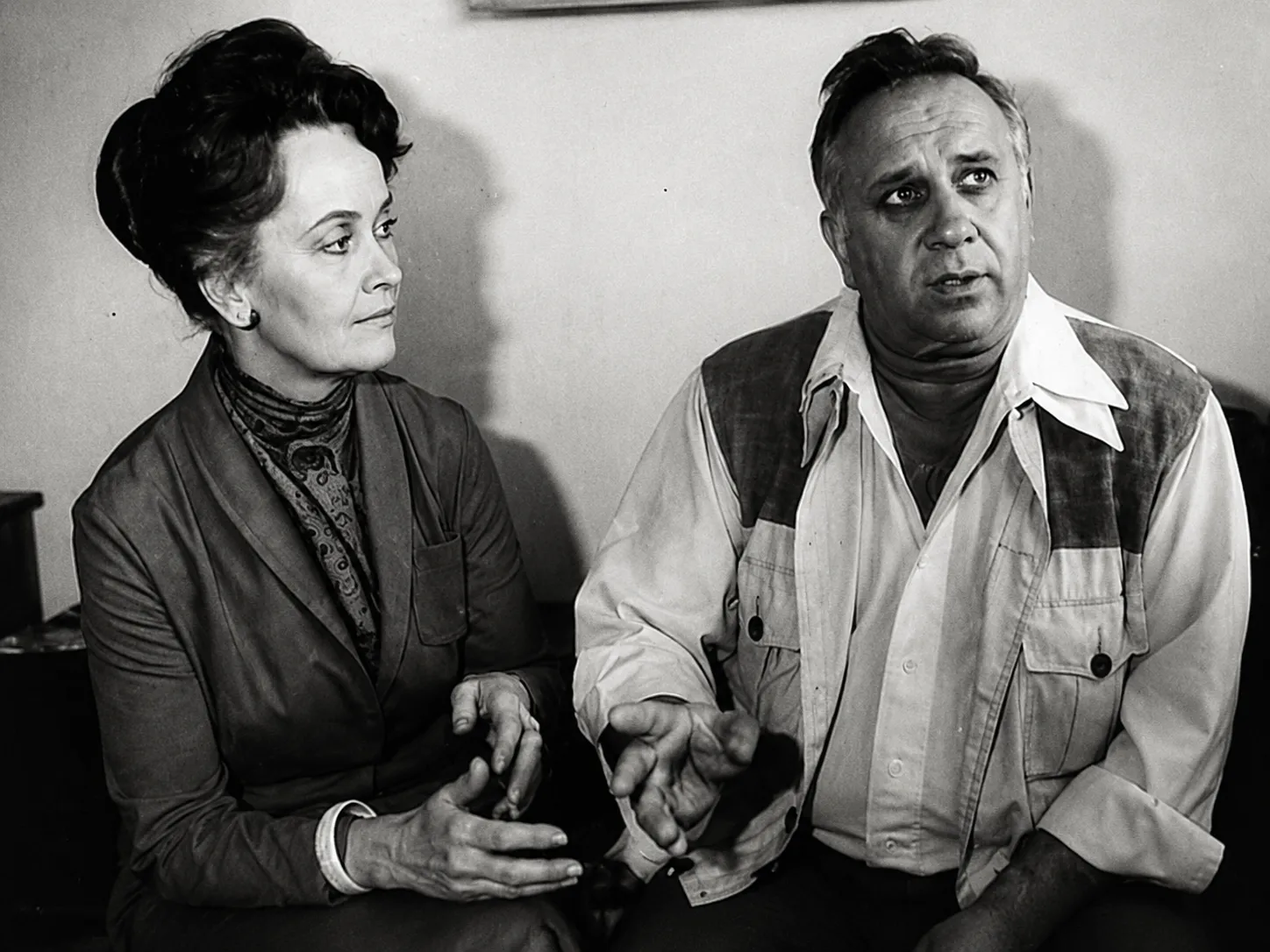
Annabelle is a Raggedy Ann-style cloth doll kept at the Warrens’ Occult Museum in Monroe, Connecticut, associated with paranormal investigators Ed and Lorraine Warren, who founded the New England Society for Psychic Research in 1952.
According to the Warrens’ account, the doll was given to a nursing student in 1970 and began exhibiting disturbing behavior before the family called in the Warrens, who concluded it was being used as a vessel by a non-human entity rather than housing a human spirit.
The museum, now run by the Warrens’ son-in-law Tony Spera, has since taken the doll on public tours; in 2025, one of those tours made headlines when its lead investigator died unexpectedly during a stop in Gettysburg, Pennsylvania, which briefly fueled online rumors that the doll itself had gone missing before organizers confirmed it remained secured at the museum.
Unlike Letta, Annabelle’s story is tied to a specific investigative organization. It has been the direct basis for a commercial horror film franchise beginning in 2014.
Robert the Doll is a straw-stuffed doll made by the German toy company Steiff (also known for teddy bears), given to a Florida boy named Robert Eugene “Gene” Otto around 1904.
Robert is now housed at the Fort East Martello Museum in Key West. Its reputation for causing bad luck to those who mock or photograph it disrespectfully has made it a fixture of Key West tourism, and visitors reportedly still mail the museum letters apologizing to the doll after experiencing bad luck they attribute to disrespecting it.
What distinguishes Letta from both is the lack of any commercial franchise, investigative organization, or professional paranormal team attached to its story. Its entire documented history runs through one family, making it comparatively easier to trace but also harder to independently verify, since most primary accounts trace back to the same small group of people rather than an institution with its own separate records.
What Explanations Exist Beyond the Supernatural?
Letta Me Out sits at the intersection of two very different ways of evaluating evidence, and a fair look at the doll means taking both seriously rather than dismissing either one outright.
The case for a natural explanation. No scientific body has tested or verified any of the paranormal claims attached to Letta. The only independent, verifiable fact established by outside experts is the doll’s approximate age, determined by the Australian Museum through examination of the shoe nails — a straightforward material-dating process, not a paranormal one. Beyond that single data point, everything else about the doll’s reported behavior rests on personal testimony rather than instrumentation or repeatable measurement.
Psychologists and researchers who study why objects like Letta unsettle people point to several well-documented, non-supernatural mechanisms. Pareidolia — the brain’s tendency to read faces and emotional expressions into inanimate objects — is especially pronounced with carved features and glass eyes, which don’t move or blink the way human eyes do, producing a persistent “staring” sensation.
Related to this is the uncanny valley effect, first proposed by Japanese roboticist Masahiro Mori in 1970 and taken up seriously by psychologists after his essay was translated into English in 2005: academic interest in the effect grew from roughly 35 published papers in 2004 to over 500 by 2015.
The theory claims that figures that are almost, but not quite, human-looking—a wooden face paired with real human hair, for instance—tend to provoke more discomfort than either clearly artificial or fully realistic figures.
Confirmation bias and priming are also difficult to rule out at organized viewings: a visitor told in advance that a doll is dangerous is primed to interpret ordinary discomfort, unfamiliar surroundings, or the social pressure of being watched by a camera crew as evidence of something paranormal.
Even the well-documented reaction of dogs barking near the doll has a plausible mundane explanation, since animals respond strongly to unfamiliar scent (old wood, preserved human hair, storage materials) and to their owners’ own body language, which shifts noticeably in the presence of something the owner has been told to fear.
The case paranormal investigators and the doll’s own carers make. From the other side of the argument, those who have spent extended time with Letta point out that skeptical explanations, while plausible in isolation, don’t fully account for the consistency of the reports or their independence from one another.
Kerry Walton’s family were not seeking out a haunted-doll story when the scuff marks first appeared on their floors — by their account, the phenomena preceded any media attention or public framing that could have primed them.
Paranormal investigators who work with objects like Letta generally argue that personal, repeated, firsthand testimony gathered over decades from unconnected witnesses — family members, journalists, television crews, and members of the public who had no prior expectation of what they’d experience — constitutes its own form of evidence, even if it isn’t the kind that fits inside a controlled laboratory setting.
They also note that not every claim made about Letta is negative: the psychic interpretation of the doll as “sad” rather than malicious, and Kerry Walton’s own suggestion that it may have coincided with improved fortune for his family, don’t fit neatly into a fear-based psychological explanation, since they run counter to what priming and suggestion would typically produce.
Neither side has the kind of evidence that would settle the question definitively. What can be said with confidence is that the doll’s age and origin are the only elements of its story that have been independently verified by an outside institution; everything relating to its reported behavior remains, by nature, a matter of testimony and interpretation rather than proof in either direction.
Frequently Asked Questions
Is Letta Me Out for sale?
Not currently. Kerry Walton once came close to selling the doll to a buyer decades ago but backed out of the deal before it was finalized. The doll has remained with the Walton family ever since, now under the care of his granddaughter Hayleigh.
Where is Letta Me Out kept now?
The doll resides with the Walton family in Queensland, Australia. Kerry Walton relocated to the Warwick area of Queensland after finding the doll in New South Wales, and it has stayed within the family’s household there, aside from periodic trips for public appearances.
Can the public see Letta Me Out in person?
Yes, on occasion. The doll has made appearances at paranormal-interest events. It has been made available for viewing and photos, sometimes inside a protective transparent case. Details of upcoming appearances are typically announced through the doll’s own Facebook and Instagram accounts, which the family manages directly.
How old is Letta Me Out, exactly?
Based on an examination of the nails in the doll’s carved shoes conducted by the Australian Museum in Sydney, Letta is estimated to be at least 200 years old, with some accounts placing the number closer to 250 years based on later analysis. This likely places its creation in the mid-to-late 18th century.
Does Letta Me Out have a documented connection to any deaths or serious injuries?
No verified reports link the doll to any deaths, hospitalizations, or serious physical harm. The phenomena described by witnesses — nausea, fainting, vomiting, emotional distress — are all short-term reactions reported by individuals in the doll’s presence, not injuries caused by physical contact with it.
Why did people used to call the doll by a different, offensive name?
Early press coverage of the doll, particularly from the 1980s through the early 2000s, sometimes used an ethnic slur tied to assumptions about the doll’s Romani origin as an alternate nickname. This usage has been phased out of the family’s own posts since around 2018, though it can still be found in older archived news clips and articles from that period.
Is there a movie based on Letta Me Out?
Unlike Annabelle, which inspired a dedicated Hollywood film franchise, there is no verified feature film currently based specifically on the Letta Me Out doll or the Walton family’s story. Its coverage has remained largely limited to television news segments, documentary-style programs, and social media rather than scripted horror cinema.
Is the belief in cursed dolls a recent phenomenon?
No. Documented cases of human-shaped figures being used for curses or believed to carry supernatural intent go back at least 3,000 years, to a recorded assassination attempt against Pharaoh Ramesses III around 1155 BCE that involved conspirators crafting wax figurines as part of the plot — an event detailed in the surviving Judicial Papyrus of Turin. The specific idea of an object being unintentionally “haunted,” as opposed to deliberately cursed, is a more modern framing. Still, the underlying belief that a doll-like entity can hold or channel something beyond itself is one of the oldest recorded superstitions in human history.
Has Letta Me Out ever been formally investigated by a paranormal research team, the way Annabelle has?
Not in the same organized, institutional sense. Annabelle’s case involved a dedicated research organization (the New England Society for Psychic Research) taking custody of the object and building a permanent exhibit around it. Letta, by contrast, has been visited informally by individual psychics and paranormal enthusiasts over the years, but it has never been taken into the custody of any paranormal research body — it has remained a private family possession throughout its entire public history.
Explore More Cursed Objects:
Is The Anguished Man Painting Truly Cursed?
May 26, 2025
The Real Story Behind Charley the Doll’s Curse
July 13, 2026
Sources
- Diel, Alexander, and Karl F MacDorman. Creepy cats and strange high houses: Support for configural processing in testing predictions of nine uncanny valley theories. Journal of Vision vol. 21,4 (2021): 1. doi:10.1167/jov.21.4.1
- Mori, Masahiro. The Uncanny Valley. Translated by Karl F. MacDorman and Norri Kageki, IEEE Robotics & Automation Magazine, vol. 19, no. 2, June 2012, pp. 98–100.
- Harris, Meghan. Mystery Surrounds 200-Year-Old ‘Haunted Doll From Hell’. The Courier-Mail. Accessed 30 July 2026.
- Redford, Susan. The Harem Conspiracy: The Murder of Ramesses III. Northern Illinois University Press, 2002.
- Ritner, Robert. (1993). The Mechanics of Ancient Egyptian Magical Practice. Studies in Ancient Oriental Civilization 54. 10.13140/RG.2.1.4050.2808.
- Uncanny Valley. Encyclopedia Britannica. Accessed 30 July 2026.
- Caruana, Nathan, and Kiley Seymour. Objects that induce face pareidolia are prioritized by the visual system. British Journal of Psychology (London, England: 1953) vol. 113,2 (2022): 496-507. doi:10.1111/bjop.12546.
- van Elk, Michiel. Perceptual Biases in Relation to Paranormal and Conspiracy Beliefs. PloS one vol. 10,6 e0130422. 26 Jun. 2015, doi:10.1371/journal.pone.0130422.
- Ritner, Robert Kriech. The Mechanics of Ancient Egyptian Magical Practice. The Oriental Institute, Chicago, 1993.