Huggin’ Molly is one of the strangest entries in American monster folklore, not because of what she does, but because of how little damage she leaves behind. She doesn’t drag people into the woods, drain blood, or vanish children without a trace.
Instead, this tall, black-cloaked creature from the small town of Abbeville, Alabama, catches her victims, wraps them in a bone-crushing embrace, and screams directly into their ear before disappearing into the dark. For over a century, that single, oddly domestic act of forced affection has been enough to keep generations of Alabama children indoors after sundown — and it’s still talked about today.
What makes Huggin’ Molly worth a closer look isn’t just the strangeness of her method. It’s the town she comes from, the real historical events that likely shaped her legend, the copycats who once impersonated her in real life, and the way her story has quietly evolved from a whispered warning between parents into a restaurant mascot, a trading card, and a horror film.
Summary
Fact Sheet
| Attribute | Details |
|---|---|
| Names & Etymology | Huggin’ Molly, also called “The Woman in Black”; name blends her signature act (a crushing, forced hug) with “Molly,” a common local given name. |
| Classification | Ghost / regional bogeyman apparition |
| Species | Humanoid (spectral) |
| Origin | Abbeville, Alabama folklore; said to be a grieving mother, a strict schoolteacher, or a murdered woman — no single confirmed origin. |
| Earliest Record | Oral tradition traced to early-1900s Abbeville, tied to the town’s old Agricultural School era. |
| Habitat | Streets of Abbeville, Alabama (Henry County, Wiregrass region), after dark |
| Diet | Some tellings say whiskey or food offered in place of a hug earns good luck instead. |
| Physical Details | Roughly 7–8 ft tall; black cloak or dress; wide-brimmed hat hiding her face; some retellings add greenish, rough skin. |
| Strengths | Moves silently, matches a fleeing victim’s pace exactly, piercing banshee-like scream, sudden appearance and vanishing. |
| Weaknesses | Cannot enter a securely closed, locked home; some retellings claim that a kiss, rather than a hug, will fluster her away. |
| Warning | Stay indoors after dark on Abbeville’s unlit streets — sightings cluster around lone nighttime foot traffic. |
| Threat Level | Level 1 (Nuisance) [See the Threat Level Guide] |
| Survival Odds | 99% (no account of lasting physical harm — the real damage is a ringing scream, not an injury) |
Who or What Is Huggin’ Molly?
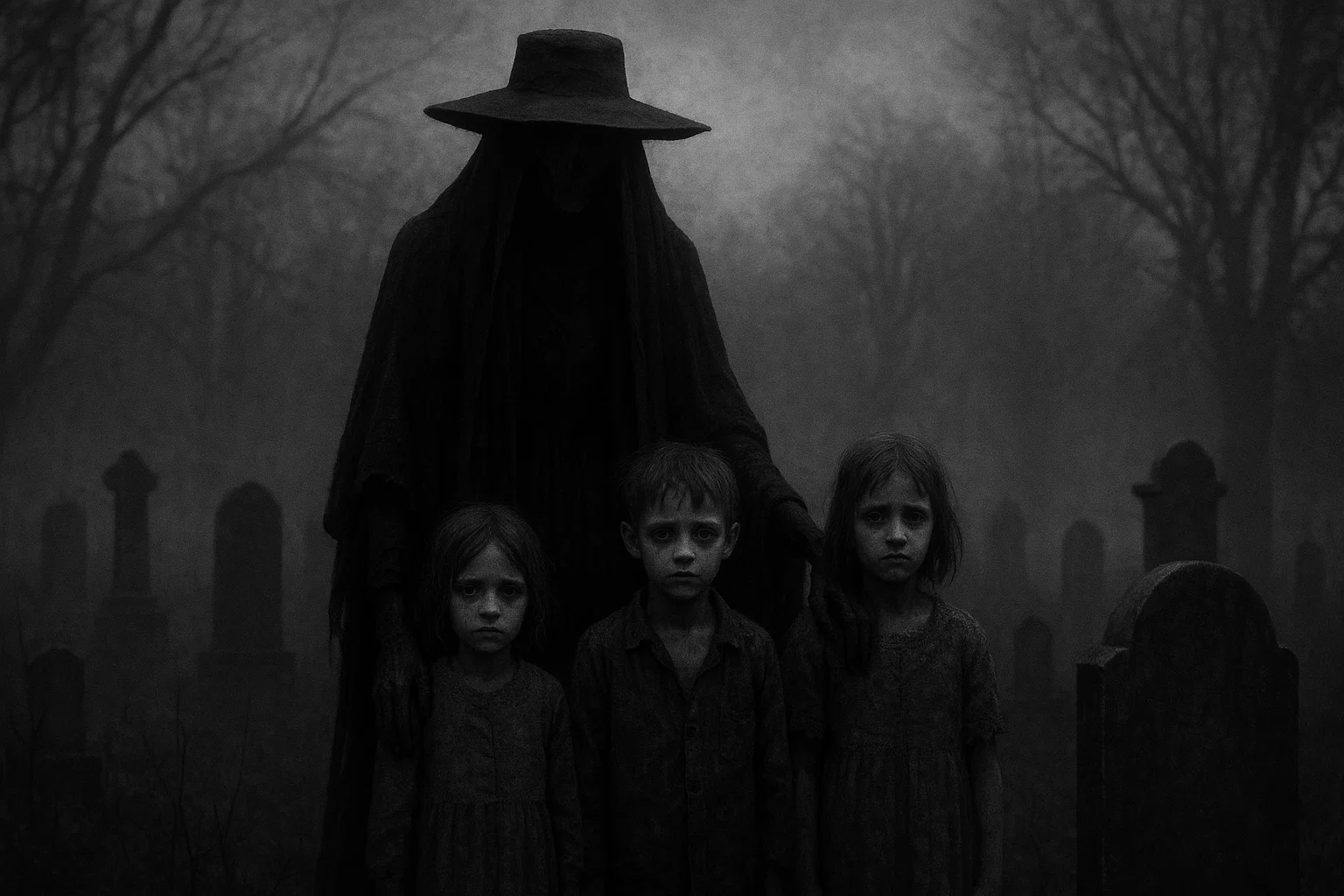
Huggin’ Molly is a supernatural monster from the folklore of Abbeville, a small county-seat town in the Wiregrass region of southeast Alabama. She is described, in her most consistent form, as an unusually tall woman — most accounts put her between seven and eight feet — dressed entirely in black, often with a wide-brimmed hat or hood that keeps her face hidden.
She is said to move silently through Abbeville’s streets after dark. If she comes across someone out too late, she does not attack them in any conventional sense. She chases them down, pulls them into an inescapably tight hug, and lets out a scream loud enough to leave the victim’s ears ringing. Then she disappears.
Unlike most regional monsters in American folklore, Huggin’ Molly has no body count, no confirmed injuries, and no consistent motive beyond enforcing a curfew. She isn’t a cryptid in the biological sense.
The legend’s staying power comes from an unusual emotional contradiction. A hug is normally a gesture of comfort. Huggin’ Molly turns that gesture into a threat, pairing it with a scream straight out of banshee lore. That contrast — comfort weaponized into terror — is part of why the story has outlived the specific generation of Abbeville residents who first told it, and why it continues to be retold, adapted, and merchandised nearly a century later.
Importantly, Huggin’ Molly is not a single fixed story. She is closer to a folk template with several competing versions layered on top of one another: a grieving mother, a strict schoolteacher, a murdered woman, or simply an unexplained entity with no history at all. That ambiguity, rather than weakening the legend, has allowed it to survive by adapting to whoever is telling it.
Abbeville, Alabama: The Small Town Where Molly Walks
Understanding Huggin’ Molly requires understanding Abbeville itself, since the legend is inseparable from the town’s real, documented history.
Abbeville sits in Henry County, in Alabama’s Wiregrass region near the Chattahoochee River and the Georgia state line. Long before European settlement, the area belonged to the Creek Nation. Abbeville’s name is tied to that heritage: the town and the creek that runs through it are believed to derive from the Muscogee (Creek) term “Yatta Abba,” meaning roughly “grove of dogwoods.”
Henry County itself was established on December 13, 1819 — a single day before Alabama achieved statehood — making it one of the oldest counties in Alabama and, for a time, its largest by land area. Abbeville was named the county seat in 1833 and was formally incorporated as a town in 1853.
Two real disasters shape the town’s collective memory in ways that likely intersect with the Huggin’ Molly legend. On May 20, 1906, an arsonist set fire to Abbeville, destroying much of the town’s original wooden downtown. A mechanic named Ward was arrested and charged with the arson; after posting bond, he fled the county and was reportedly never seen again. The brick buildings that replaced the burned wooden structures still form much of Abbeville’s historic downtown today.
Nearly a century later, on November 5, 2002, an F2 tornado tore through Kirkland Street in the heart of town, destroying homes and businesses and forcing the local high school to be rebuilt on a new site entirely. A town that has twice watched its own streets get physically erased and rebuilt is, unsurprisingly, one where stories about something menacing walking those same streets at night would have deep roots.
Abbeville also has an unusual educational history worth noting. In 1889, it became home to the Southeast Alabama Agricultural School (SAAS), created by an act of the Alabama legislature and considered the first free secondary school in the state and the first junior college associated with Auburn.
The school drew boarding students from five counties and three states, and it operated under that name until 1943, when it was reorganized into Abbeville High School. This detail matters because one of the most persistent origin theories for Huggin’ Molly directly involves the school — a fact that only makes sense once you know the institution was real, well-documented, and drew large numbers of unsupervised out-of-town teenagers into a small rural town every year.
You may also enjoy:
Alabama Sasquatch: Every Confirmed Hotspot, Mapped
April 18, 2025
The Sphinx: The Greek Monster That Devoured Thebes
October 30, 2025
What Huggin’ Molly Looks Like
The core physical description of Huggin’ Molly has remained fairly stable across a century of retelling: an extremely tall woman, often estimated at seven feet or more, wearing a black cloak, dress, or skirt, topped with a wide-brimmed black hat that obscures her face. Some tellings add a parasol or umbrella carried in one hand, a detail that ties her visually to an older Southern silhouette — a woman dressed for mourning, moving in a manner locals would have recognized rather than found instantly alien.
In recent years, particularly as the legend has spread online through cryptid-focused communities, a more elaborate and monstrous description has appeared: greenish-yellow, sandpaper-textured skin, an oversized head “as big as a bale of cotton,” long claw-like nails, and an overpowering smell of decay.
This version pushes Huggin’ Molly further from her original role as a human-shaped folk creature and closer to a traditional horror monster, complete with a documented weakness (sunlight) and a set of interaction “rules” that don’t appear in the older oral tradition at all.
This is a useful case study in how a local, word-of-mouth legend gets reshaped once it’s absorbed into the broader, internet-era cryptid canon — the original story was frightening because of how ordinary and human Molly looked; the newer version is frightening because she doesn’t look human at all. Both versions now circulate simultaneously, often without acknowledgment that they come from very different eras of the story.
Where the Legend Comes From
No single, verifiable origin story for Huggin’ Molly exists, and that lack is itself part of the folklore. Three explanations recur most often among people who grew up with the legend in Abbeville:
- The grieving mother. In this version, Molly was a real Abbeville woman who lost her own child, either to illness or an accident, and was driven to madness by grief. She began roaming the streets at night, and her hugs are interpreted as a distorted, desperate attempt to recover the physical comfort of holding her own baby.
- The disciplinarian schoolteacher or professor. This version ties Molly directly to the Southeast Alabama Agricultural School. Out-of-town students boarding in Abbeville for the school year were known to sneak out at night to visit friends and socialize. A faculty member — annoyed by the noise and disruption — is said to have disguised himself or herself as a “woman in black” specifically to frighten students back into their boarding houses before curfew.
- The murdered woman. A darker variant has it that Molly was killed on Abbeville’s streets after dark, and that her ghost now patrols those same streets in a distorted attempt to protect others from meeting the same fate.
None of these origin stories has ever been backed by a named individual, a death record, or a documented case in Abbeville’s local history, and no single version has ever “won out” as the accepted explanation. Local storytellers have historically treated that ambiguity as part of the point — the legend survives specifically because it can’t be definitively debunked or confirmed.
The Copycats Who Made Molly “Real”
One of the most interesting and least-discussed layers of the Huggin’ Molly legend is that, at multiple points, real people dressed up as her — and their impersonations were documented in local newspapers, which is a rare instance of a bogeyman legend leaving an actual paper trail.
According to local historical accounts, a disgruntled faculty member at the old Agricultural School is believed to have originated the “Woman in Black” disguise specifically to scare rule-breaking students back indoors, effectively becoming the first real-world “Molly.” The costume, however, didn’t stay contained to one person or one town.
In Headland, Alabama — a small town a short distance from Abbeville — an unidentified impersonator caused enough public alarm in the early twentieth century that the editor of the local newspaper published a formal warning, describing an unprincipled person parading Headland’s streets late at night dressed as a woman in black, frightening residents and setting off every dog in town.
A separate account describes a man in Baton Rouge who adopted the same “Woman in Black” costume for a much less innocent purpose — using it to pursue and frighten young women rather than to enforce a curfew.
These copycat cases matter for understanding Huggin’ Molly because they show the legend didn’t stay confined to campfire storytelling. It became a costume that real people in the Wiregrass region actually wore in public, which in turn reinforced the legend for the next generation — a self-sustaining loop between story and performance that folklorists call ostension.
You may also enjoy:
The Complete List of All Haunted Places in Colorado
November 19, 2025
What Is Mpisimbi, The Strange African Leopard-Hyena Cryptid?
February 6, 2026
Demon Xaphan: The One Who Tried to Burn Heaven
August 28, 2025
Recorded Encounters and Sightings
Because Huggin’ Molly belongs to oral tradition rather than documented history, “sightings” of her exist only as secondhand recollections passed down through Abbeville families — but a few specific accounts are told often enough to have become fixed points in the legend.
One frequently repeated story involves a teenage Abbeville boy working for a local grocery store in the 1920s, delivering goods on foot as dusk fell. Finishing his last delivery, he reportedly sensed someone following him. He turned to see a very tall, black-clad creature keeping pace with him at a distance.
When he sped up, the entity sped up; when he slowed, it slowed. He eventually broke into a run for his front door and slammed it shut behind him, and when he looked back through the window, the creature was gone. As the story is remembered, he refused to take another evening delivery route for the rest of his time working at the store.
The most recent widely repeated account dates to 2010, during Abbeville’s annual Yatta Abba Day festival — a heritage celebration named after the town’s original Creek-language name and held every May with arts, crafts, and community events.
According to local retellings, a teacher leading a group on a cemetery tour during the festival was interrupted by a dark, cloaked creature that appeared briefly between the headstones before storming off, startling everyone present.
Whether this was a genuine unexplained event or a planned piece of festival theater has never been confirmed either way — but notably, no one involved reported actually being hugged.
The Rules of the Encounter
Beyond the basic chase-and-scream sequence, Huggin’ Molly lore includes a set of behavioral “rules” that have developed around how an encounter is supposed to unfold — largely through repeated retelling rather than any single original source.
The consistent core, present across most versions of the legend for decades, is straightforward: Molly targets people, usually children, who are out after dark; if she catches them, she restrains them in an inescapably tight embrace and screams into their ear; and the only reliable way to escape her once an encounter has begun is to run — she is not described in any version as being able to follow a person into a securely closed home.
More elaborate additions have attached themselves to the legend over time, particularly in internet retellings: that offering Molly a gift, such as food or whiskey, in place of a hug might earn her good luck instead of terror, or that a kiss, rather than a hug, will fluster her into disappearing.
Huggin’ Molly vs Other Monsters
| Creature & Lore | Danger Level | Details |
|---|---|---|
| La Llorona (Mexico & Latin America) | Medium. A weeping ghost said to lure children near rivers and lakes, mistaking them for the sons she drowned. | Her cry is said to grow fainter the closer she actually is, inverting the normal logic of a warning sound. |
| El Cuco (Spain & Latin America) | Medium. A shapeless monster invoked by parents to make misbehaving or wakeful children fall in line. | He has no fixed physical form, since each parent traditionally describes him as whatever scares their own child most. |
| Krampus (Alpine Europe) | High. St. Nicholas’s dark companion whips misbehaving children with birch branches and hauls the worst offenders off in a sack. | Krampusnacht is still marked every December 5 with costumed street parades across Austria, Germany, and Slovenia. |
| Baba Yaga (Slavic folklore) | Severe. A forest witch who cooks and eats children who wander too far from home. | Her hut famously stands on chicken legs, and her fence is traditionally built from human bones. |
| Rawhead and Bloody Bones (British & Appalachian) | Medium. Hides in cupboards, wells, or under stairs, waiting to punish children who lie or snoop. | The name comes from the image of a skinned animal head, invoked specifically to stop children from peeking where they shouldn’t. |
| Boo Hag (Gullah Geechee, coastal Carolina & Georgia) | Medium. Sheds her own skin at night and “rides” sleeping victims, stealing their breath rather than their blood. | Leaving a broom by the bed is said to stall her, since she’s compelled to stop and count every straw before sunrise. |
| Nuckelavee (Orkney Islands, Scotland) | Extreme. A skinless horse-and-rider hybrid whose toxic breath blights crops, sickens livestock, and spreads plague. | Islanders believed it could never cross running fresh water, making a stream the only guaranteed escape route. |
| Wewe Gombel (Java, Indonesia) | Low. A tall, long-haired spirit who “kidnaps” neglected or abandoned children — but to shelter them, not harm them. | Unlike most child-taking folklore figures, she’s remembered as a caretaker who hides children safely under her hair. |
| Yara-ma-yha-who (Aboriginal Australian) | Low. A small, red, frog-like creature that ambushes from fig trees and drains blood through sucker-like fingertips. | It’s said to swallow victims whole and regurgitate them alive, slightly shorter and redder each time it happens. |
| Bloody Mary (United States & United Kingdom) | Low. A mirror-summoned spirit invoked by repeating her name in a darkened room, said to scratch or curse whoever calls her. | Folklorists cite her as one of the clearest cases of “ostension,” since the ritual itself is the entire legend. |
Huggin’ Molly Today
Huggin’ Molly has outgrown campfire storytelling and has become a genuine part of local identity and small-scale commercial culture in Abbeville.
The clearest example is Huggin’ Molly’s, a family-style restaurant at 129 Kirkland Street in downtown Abbeville, founded by Jimmy Rane — an Abbeville native and founder of Great Southern Wood Preserving, the company behind the YellaWood brand.
Rane grew up hearing the legend the way most Abbeville children did, warned that Molly would “get him” if he stayed out too late, and later named his restaurant after the town’s own phantom as a way of honoring local history while helping revitalize Abbeville’s downtown. The restaurant, styled like a vintage 1950s soda fountain, serves Southern comfort food alongside menu items that play directly on the legend, including “Molly’s Fingers” served with a “Come Back” sauce.
The legend has also crossed into modern collectible and screen media. Huggin’ Molly appears as a Spirit-type monster in the MetaZoo trading card game, included in its Cryptid Nation expansion alongside other American folklore figures.
In 2024, she became the subject of a found-footage supernatural horror film, The Legend of Huggin’ Molly, which brought the Abbeville story to a wider audience outside Alabama for the first time.
What sets Molly apart from most bogeymen — who tend to kidnap, devour, or otherwise permanently remove misbehaving children — is that her “punishment” causes no lasting physical harm.
She frightens, she screams, and then she vanishes. That makes her, functionally, a very effective, low-cost, no-injury form of parental discipline: a story that could get a child home before dark far more reliably than a simple verbal warning, without any actual risk to the child if the warning went unheeded.
The frequent costume impersonations in Headland and Baton Rouge point to a documented folklore phenomenon called ostension — the process by which people act out elements of a legend in real life, thereby reinforcing belief in the legend for everyone who hears about the “sighting” afterward.
Academic work on ostension and “legend tripping” (a related practice where adolescents deliberately seek out supposedly haunted sites to test a legend’s truth) has traced the pattern back at least as far as Mark Twain’s boyhood recollections in The Adventures of Tom Sawyer, and Huggin’ Molly fits the pattern closely: a warning that, at various points, adults and pranksters alike chose to physically perform, which then fed directly back into the belief system of the next generation of Abbeville children.
The Legend Lives On
More than a century after she is first said to have started walking Abbeville’s streets, Huggin’ Molly hasn’t faded the way most small-town legends eventually do. She survived a devastating fire, a destructive tornado, the closure of the very school some say created her. The shift from oral storytelling to internet folklore — and she’s now printed on restaurant menus, cast in a horror film, and illustrated on a trading card.
Whether she began as a grieving mother, an irritated professor, or simply an unexplained monster that Abbeville’s parents found useful, Huggin’ Molly’s real power was never physical. It was the simple, effective terror of not knowing exactly what — or who — might be waiting in the dark to give you a hug you didn’t ask for.
You may also enjoy:
The Dark History Behind the Dump Road Haunting in Alabama
September 17, 2025
Buer: The Demon of False Healing and Twisted Wisdom
August 20, 2025
Poveglia Island: The Most Cursed Island in Europe?
December 10, 2025
Sources
- Encyclopedia of Alabama. Abbeville. Encyclopedia of Alabama, Alabama Humanities Alliance.
- Encyclopedia of Alabama. Henry County. Encyclopedia of Alabama, Alabama Humanities Alliance.
- Scott, Marvin (Mrs.). History of Henry County, Alabama. Southeast Alabama Genealogical & Historical Society, 2006.
- Historical Marker Database. The Southeast Alabama Agricultural School / First Free Secondary School in Alabama. HMdb.org.
- Stroyer, Jacob. My Life in the South. Salem Press, 1885.
- Farzana U., Fathima. (2023). Baba Yaga: The Mysterious Wise Woman in Slavic Folklore. 10. 112.