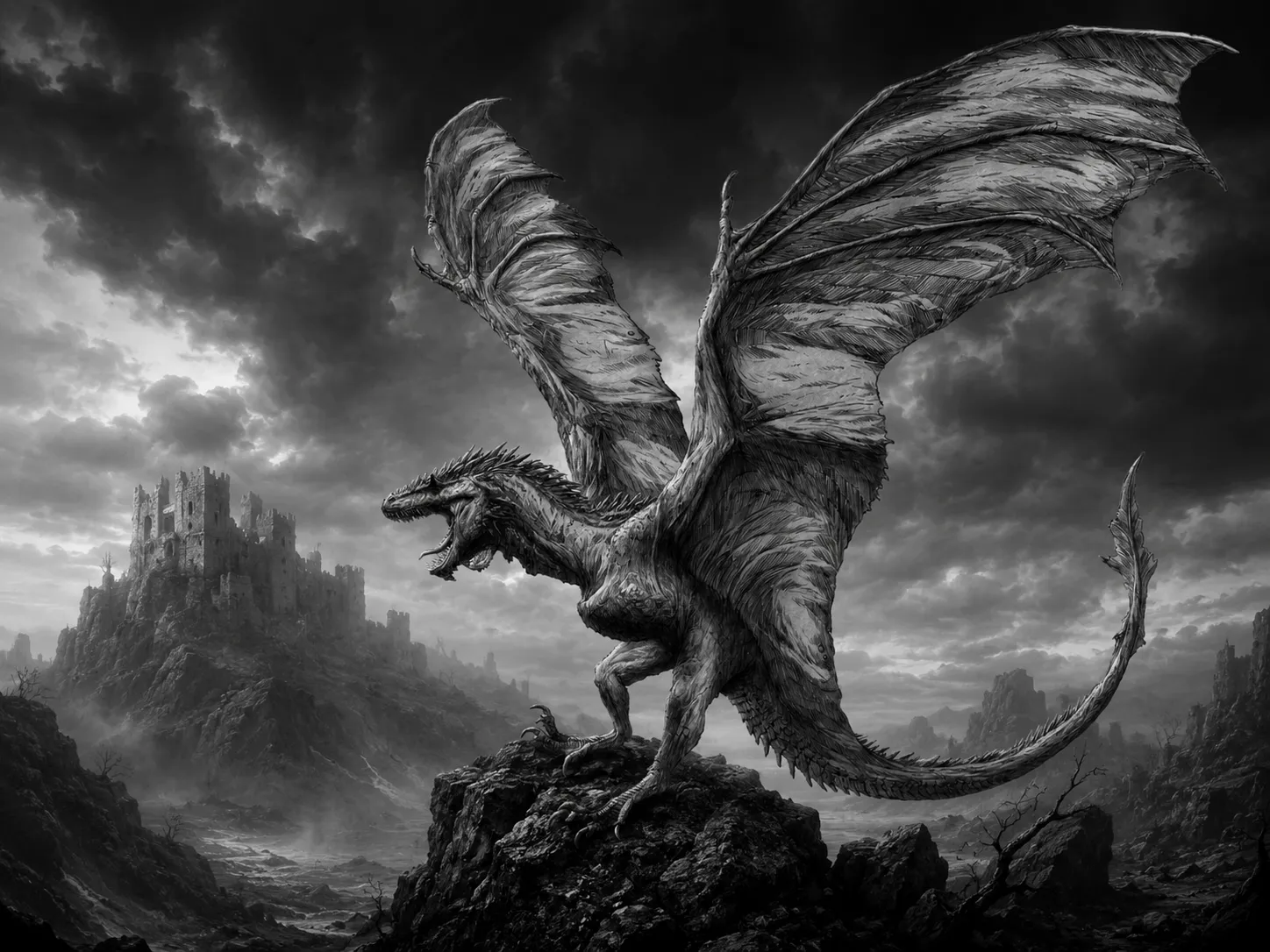
The wyvern is a legendary reptilian creature that plays a key role in medieval European folklore, bestiaries, and heraldry. It is remarkable because it has just two legs, bat-like wings, and a barbed or venomous tail, making it a unique creature in Western myths.
The wyvern is often linked to disease, war, and territorial power. It connects ancient Roman military symbols with medieval Christian stories about sin. Over time, what began as a symbol of fear became a lasting emblem of fierce nobility.
Summary
Overview
| Attribute | Details |
|---|---|
| Names & Etymology | Wyvern, Wivre, Vouivre, Guivre; derived from Middle English “wyvere” and Old North French “wivre,” which traces back to the classical Latin “vipera,” literally translating to “viper” or “adder.” |
| Classification | Mythological Monster / Legendary Beast |
| Species | Reptilian / Draconic |
| Origin | Evolved from ancient Roman cavalry draco standards merged with Anglo-Saxon and northern French folklore; invented to symbolize war, pestilence, and the toxic miasmas of medieval marshlands. |
| Earliest Record | 14th century (specifically recorded as “wyver” in the English heraldic document “The Great Roll” from 1312). |
| Habitat | Marshlands, stagnant fens, rocky riverbeds, and desolate coastlines across Great Britain and northern France. |
| Diet | Livestock, wild game, and occasionally humans who venture into its hunting grounds. |
| Physical Details | A bipedal draconic creature featuring a crested reptile head, a single pair of leathery bat-like wings, two eagle-like talons, and a long looped snake-like tail ending in a barbed stinger. |
| Strengths | Exceptional aerial agility, crushing grip strength, pressurized necrotizing venom, and a caustic, boiling breath mist. |
| Weaknesses | Extreme susceptibility to cold temperatures and sudden thermal shock, which freezes its internal metabolic engine, alongside vulnerability to chilled iron. |
| Warning | Do not venture into unmapped fens or foggy riverbeds alone at dawn; turn back immediately if you hear a dry, leather-like rattling of wings or detect the scent of sulfur. |
| Threat Level | Level 3 (Apex Predator) [See the Thread Level Guide] |
| Survival Odds | 35% (While an encounter in its territory is highly lethal, an armored or prepared target exploiting its extreme vulnerability to thermal shock has a realistic chance to escape). |
Who or What Is Wyvern?
The wyvern is a special type of legendary dragon, mainly set apart from classic four-legged dragons by its body shape. In old bestiaries and heraldry, it is described as a two-legged, winged reptile with a serpent or lizard-like body, eagle claws, and a coiled tail ending in a sharp, diamond-shaped stinger or spade.
Unlike the wise dragons of the East or the treasure-guarding dragons of the West, the wyvern was seen as a dangerous, aggressive predator. People believed it lived in marshes, rocky cliffs, and lonely coastlines.
In medieval times, people didn’t see the wyvern as just an animal. It stood for corruption, envy, and war. Early stories said its breath was a poisonous vapor that could ruin crops and spread deadly plagues, though later tales sometimes described it as breathing fire.
When the wyvern became part of heraldry in the High Middle Ages, its meaning changed. Instead of being seen as evil, it became a symbol of watchfulness and fighting skill. On a coat of arms, it showed a defender ready to strike any intruder with its deadly sting.
Origin & Lineage
The wyvern’s origins come from changes in military symbols, translations, and the fears of medieval Europe. Its two-legged, winged form didn’t start as a separate creature in ancient myths. Instead, it developed over time from the Roman draco, a serpent-shaped windsock used by cavalry.
The earliest written predecessors of the term for the monster appear in the High Middle Ages. In 1312, an English roll of arms known as The Great Roll (or The Banneret’s Roll) recorded the word “wyver” twice to describe a specific heraldic device.
Early medieval writers and artists didn’t use strict categories like we do today. In the 14th and 15th centuries, bestiaries often used terms such as “dragon,” “wyrm,” and “wyver” to refer to the same creature. The clear difference between two-legged and four-legged dragons wasn’t set until the 16th and 17th centuries, when English herald John Guillim wrote about it in his 1610 book, A Display of Heraldrie.
The wyvern was especially popular in Great Britain and northern France. In England, the two-legged dragon was closely linked to the old Kingdom of Wessex. Stories say King Alfred the Great used the golden wyvern on his battle flag against Viking invaders, and the symbol appears in the Bayeux Tapestry, showing King Harold II at the Battle of Hastings in 1066.
At the same time, across the English Channel, the wyvern became a big part of French local legends, known as the vouivre or guivre. People said it haunted the marshy countryside in places like Franche-Comté.
Several real-world factors helped spread belief in the wyvern:
- Pestilence and Disease: Early stories say the wyvern didn’t breathe fire, but instead had poisonous breath. People living near marshes and rivers in Britain and France often faced sudden outbreaks of diseases like malaria, which they blamed on “bad air.” The wyvern gave a face to these invisible threats.
- Prehistoric Discoveries: In medieval times, when people found fossils of ancient reptiles or large bird skeletons, they saw them as proof that two-legged, winged monsters like the wyvern once existed.
- Theological Allegory: In medieval Christian bestiaries, the wyvern had a key religious meaning. With its two legs and long, coiled tail, it stood for a fallen, corrupted nature—part noble creature, part crawling serpent. This made it a powerful symbol for Satan, envy, and war.
Etymology
The name wyvern has an interesting history. The modern English word comes from Middle English wyvere, which in turn derives from Old North French wivre. That word goes back to the Latin vipera, meaning “viper” or “adder.” At first, the term just meant a venomous snake, with no link to wings or two legs.
As the word moved into Old French and Anglo-Norman, it became vouivre or guivre in some areas. In northern France, vipera still meant small snakes. Still, “vouivre” came to mean “huge, mythical water monsters that guarded treasures in lakes and streams.”
By the 13th and 14th centuries, the English word had transition from “wyvere” to “wyvern,” with the ‘n’ added by analogy to words like bittern. Heraldic scholars then used ‘wyvern’ to clearly mean the two-legged, winged beast, setting it apart from the four-legged dragon.
You may also enjoy:
What Is an Androsphinx and Why Was It Feared in Ancient Egypt?
January 27, 2026
Belle Mont Mansion Haunting: Ghosts of Slavery and Tragedy
September 23, 2025
What Is a Banshee and Why Does It Scream Before Death?
December 9, 2025
What Does the Wyvern Look Like?
Historical records and medieval art show the Wyvern with a lean, bird-like, and reptilian body. Bestiaries describe it as having a fierce reptilian head, sometimes with ears or a backward horn, on a long, scaled neck. Its upper body has one pair of strong, leathery wings, like those of a giant bat.
Importantly, the wyvern’s lower body has just two strong legs ending in bird-like talons. Its body narrows into a long, muscular tail that often loops or knots, finishing with a barbed stinger said to be full of deadly venom.
Modern fantasy, video games, and movies often blur these details. They usually show the wyvern as a big, four-legged dragon without front arms, often with a bulky, dinosaur-like body. But in medieval stories, the wyvern was leaner, more agile, and clearly a mix of bird and reptile.
Old sources say the wyvern was not quiet. Its wings made a harsh, dry rattling sound, and it gave off a sharp, rhythmic hiss that people could hear from far away. Its body was said to create intense heat, not to make fire, but to produce a foul, bubbling saliva that could rot flesh on contact.
Myths, Legends, and Stories
Stories about the Wyvern come from three main sources: medieval English records, Anglo-Norman poems, and local oral tales from rural Britain. These stories reflect a time when wild places were a real threat to people’s lives.
The most famous story is the “Wyvern of Mordiford,” a legend from Herefordshire. In the usual version, a girl named Maud finds a baby green reptile in the woods and raises it on milk.
As the creature grew huge, it stayed loyal only to Maud but attacked the countryside, killing livestock and even farmers. The story ends with a hero from the Garstone family, who wears mirrored armor to confuse the wyvern and defeats it in a battle near the River Wye.
But a lesser-known 17th-century account from the Welsh border tells a much darker version. Here, the wyvern wasn’t a lost hatchling but was called up from the muddy riverbed during a time of chaos. In the story, the monster represents the community’s shared sins and broken promises.
Instead of being fed milk, the wyvern in the tale was given the bodies of executed criminals and unbaptized infants left in the woods. The mirrors on the knight’s armor weren’t just to distract the beast, but also acted as a spiritual tool.
When the wyvern looked into the mirrors, it saw the spiritual decay of the valley that had fed it. The old story says the monster didn’t die from a sword, but instead collapsed and melted back into the river mud as its own venomous heat destroyed it from within.
Wyvern vs Other Monsters
| Creature & Lore | Danger Level | Details |
| Dragon (Western Europe) | Extreme. Incinerates entire communities with elemental fire to protect its hoard. | Unlike the two-legged wyvern, classical Western dragons are traditionally depicted with four limbs alongside their wings. |
| Lindwurm (Germany & Austria) | Severe. Constricts victims with its massive snake-like coils and secretes a flesh-melting slime. | The famous Lindwurm statue of Klagenfurt, Austria, was sculpted after locals mistook the fossilized skull of a woolly rhinoceros for a dragon. |
| Amphiptere (European Heraldry) | High. Drops from tree canopies to strike down travelers with blinding aerial speed. | This creature represents the exact anatomical opposite of a lindwurm, possessing a pair of wings but completely lacking legs. |
| Cockatrice (Medieval England) | Severe. Kills anyone who looks at it instantly with a lethal glance or an envenomed hiss. | Folklore dictates that this rooster-headed serpent can be killed instantly if it hears a rooster crow or sees its own reflection in a mirror. |
| Tatzelwurm (Alpine Europe) | Medium. Attacks alpine livestock and sprays a blinding, venomous acid into the eyes of hikers. | Described as a cat-headed serpent with two short front legs, nineteenth-century sightings frequently blamed it for sudden cattle deaths. |
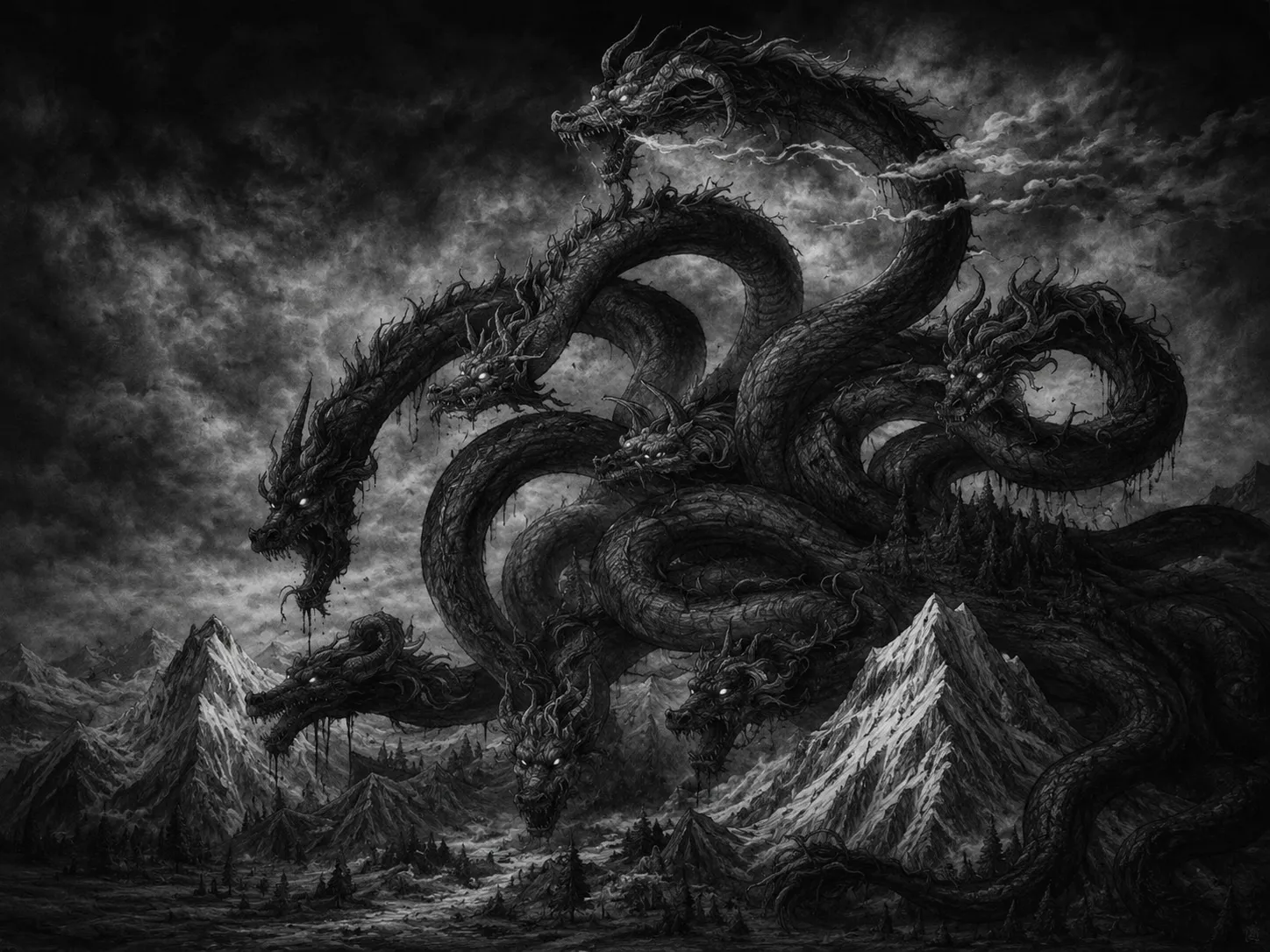
| Lernaean Hydra (Greece) | Extreme. Dissolves targets with highly acidic blood and regenerates multiple heads for every single limb severed. | Its breath was so uniquely toxic that merely smelling the footprints where the monster had walked could prove fatal to a human. |
| Yamata no Orochi (Japan) | Extreme. Devours human sacrifices annually while spanning an enormous body across eight separate valleys. | The legendary storm god Susanoo defeated this multi-headed beast by tricking it into drinking eight vats of highly refined sake. |
| Guivre (Northern France) | Severe. Lurks in secret woodland pools to swallow unsuspecting villagers whole and spread localized pestilence. | Local legends claim that this colossal serpent was deeply prudish and would freeze in complete embarrassment if confronted by a naked human. |
Can You Defeat a Wyvern? Powers & Weaknesses
To defeat a Wyvern, you need to understand how it works. Unlike dragons powered by magic or fire, the wyvern’s strength and flight come from its high body temperature and a special, dangerous biochemistry.
Its hot body quickly turns food into energy for its large wing muscles. It creates its main weapon: a powerful, deadly venom. The venom fills its tail stinger and can also be sprayed from its mouth as a boiling, corrosive mist.
Regular weapons like swords or arrows often can’t get through its tough belly scales. To beat the wyvern, legends say you have to use its need for heat against it. The creature is very sensitive to sudden cold or freezing temperatures. Old beliefs said that, since it was born from heat and bad air, its body fluids would freeze solid if exposed to intense cold.
In legends, hunters would lure the wyvern out of its marshes into cold caves or wait for freezing winter mornings. When it breathed in cold air or touched ice, its body would go into shock.
Its boiling venom would freeze right away, breaking its insides and making its wings stiff and brittle. Once its heat was gone, its scales became fragile, so a single strong blow from a cold iron spear could shatter its body.
A Terror of the Past?
The wyvern’s legacy isn’t just a leftover from old superstitions. It also reflects how Western symbols developed. In the Middle Ages, it stood out as a monster defined by what it couldn’t do, not just by its powers.
Unlike the giant, world-ending dragons of old stories, the wyvern was a more local and personal threat. It gave a face to the real dangers of medieval life: deadly marsh vapors, sudden attacks, and the fear of death from poison or disease.
When the wyvern became part of heraldry, its story changed. Putting the image of a fierce but defeated two-legged monster on a knight’s shield showed that people could overcome the wild, scary parts of nature and use that power for order.
The wyvern myth is still popular in modern fantasy because it feels both believable and scary. It reminds us that people didn’t just imagine monsters in the sky—they also saw them in the dark, misty places close to home, always ready for danger from the earth itself.
You may also enjoy:
The Nandi Bear: Africa’s Terrifying “Brain-Eating” Cryptid
November 11, 2025
Is the Black Prince’s Ruby Really Cursed?
May 26, 2025
Sabnock in Demonology: Powers, Legends, and Rituals
August 27, 2025
What Is the Holawaka? The Ethiopian Spirit Bird That Doomed Humanity
November 10, 2025
Sources
- The Bayeux Tapestry. Eleventh century. Musée de la Tapisserie de Bayeux, Bayeux, France.
- Guillim, John. A Display of Heraldrie: Manifesting a More Easie Accesse to the Knowledge thereof… 2nd ed., Printed by Richard Badger for Ralph Mab, 1632. Internet Archive.
- Wyvern. Merriam-Webster.com Dictionary, Merriam-Webster, 2026. Accessed 10 June 2026.
- Cooper, Bill. Dinosaurs from Anglo-Saxon and other Records. After the Flood: The Early Post-Flood History of Europe Explored, ch. 10, New Wine Press, 1995. Lambert Dolphin’s Library.
- Sayers, William. The Wyvern. Neuphilologische Mitteilungen, vol. 109, no. 4, 2008, pp. 457–65. JSTOR, http://www.jstor.org/stable/43344731. Accessed 10 June 2026.
- Lindahl, Carl, John McNamara, and John Lindow, editors. Medieval Folklore: A Guide to Myths, Legends, Tales, Beliefs, and Customs. Oxford University Press, 2002. Internet Archive.
- Bane, Theresa. Encyclopedia of Vampires, Werewolves, and Other Monsters. McFarland & Company, 2010.