Yamata no Orochi is the reason Japan’s emperors carry a sword that, according to legend, was never forged by human hands but pulled from inside a monster’s tail. Long before dragons became fantasy-genre wallpaper, this eight-headed, eight-tailed serpent was terrorizing a real river valley in ancient Izumo, demanding a human sacrifice every year until a storm god got it drunk and cut it to pieces.
What starts as a monster-slaying story turns out to connect a flood-prone river, Japan’s earliest iron industry, a lost imperial sword, and a 12th-century belief that the serpent came back as a child-emperor who drowned at sea. The story is far stranger, and far more historically loaded, than the picture-book version suggests.
Summary
Quick Facts
| Attribute | Details |
|---|---|
| Names & Etymology | Yamata no Orochi (八岐大蛇); also Koshi no Yamata no Orochi. Literally “Eight-Forked Serpent” or “Eight-Headed Dragon.” |
| Classification | Serpent-deity / dragon of Japanese Shinto mythology (kami of the yōkai-adjacent dragon type) |
| Species | Reptilian (serpent/dragon) |
| Origin | First recorded in Japan’s Kojiki and Nihon Shoki as a monstrous serpent terrorizing Izumo; widely interpreted as a personification of a flood-prone river or of ancient iron-smelting activity. |
| Earliest Record | Kojiki, 712 CE (also Nihon Shoki, 720 CE) |
| Habitat | Upper reaches of the River Hi (today’s Hii River), Izumo Province, in the mountains of modern Shimane Prefecture, Japan |
| Diet | Human flesh, specifically young women offered as annual sacrifices; strongly drawn to sake (rice wine) |
| Physical Details | Eight heads, eight tails; body spans eight valleys and eight peaks; eyes red as winter cherries; moss, cypress, and cedar growing on its back; belly always raw and bloody |
| Strengths | Immense size and reach; eight simultaneous heads/attack points; skin and body tough enough to chip a legendary sword |
| Weaknesses | Overwhelming fondness for strong sake, which leaves it drunk and defenseless; vulnerable to trickery and a divine blade |
| Warning | Never leave a daughter or strong sake unattended near the upper reaches of a flood-prone Izumo river during harvest season. |
| Threat Level | Level 4 (Regional Scourge) [See the Threat Level Guide] |
| Survival Odds | 5% (Only a god-level trick, not brute force, ever worked against it) |
Who or What Is Yamata no Orochi?
Yamata no Orochi (八岐大蛇, also written 八俣遠呂智) is a giant eight-headed, eight-tailed serpent from Japanese mythology, first recorded in the two oldest surviving Japanese texts: the Kojiki (712 CE) and the Nihon Shoki (720 CE). The name is usually translated as “Eight-Forked Serpent” or “Eight-Headed Dragon,” and in both chronicles the creature is slain by Susanoo, the storm god and younger brother of the sun goddess Amaterasu.
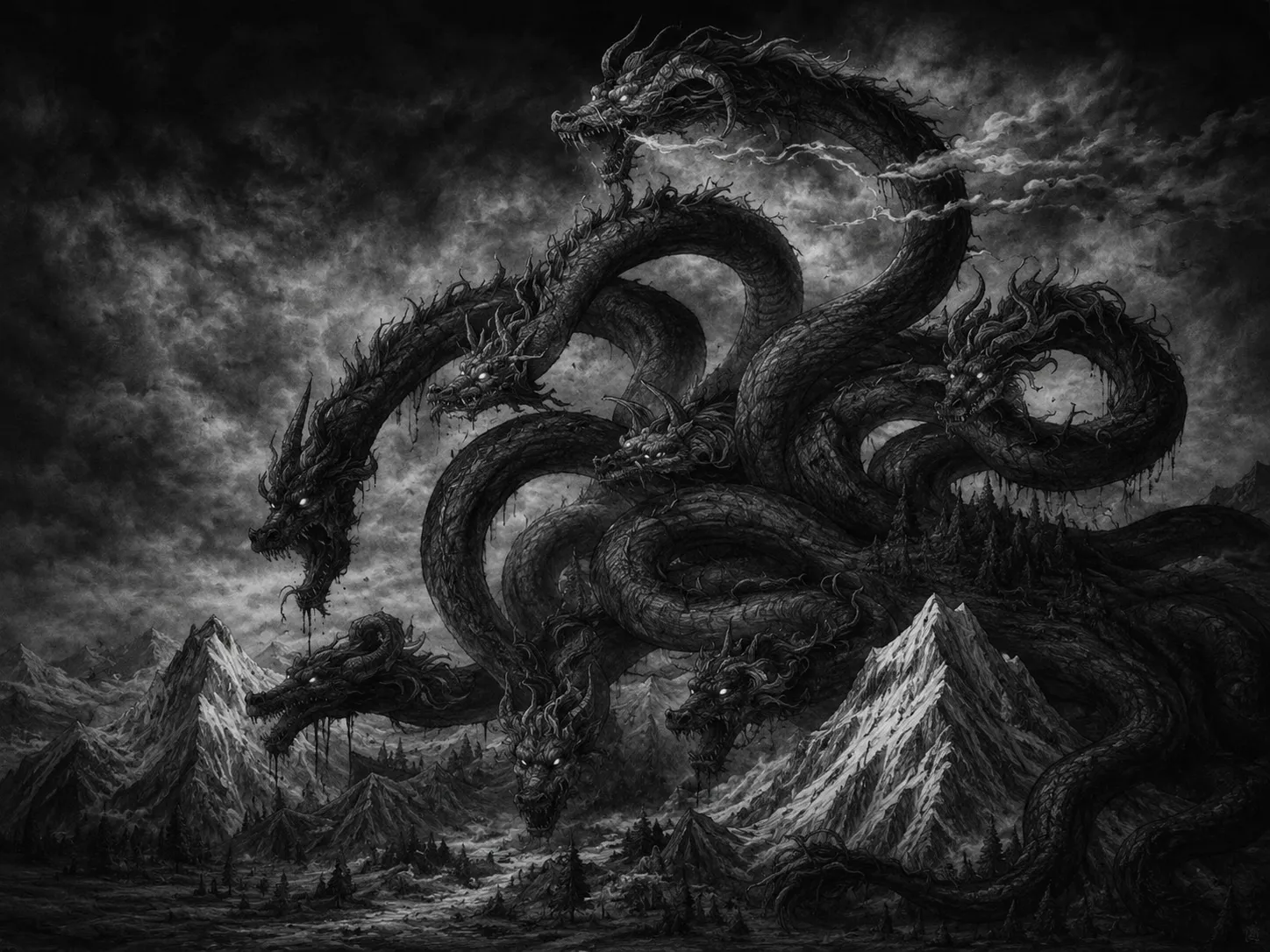
According to the earliest description, given by the earthly deity Ashinazuchi in the Kojiki, the serpent had eyes as red as winter cherries, eight heads and eight tails, a body so vast it stretched across eight valleys and eight mountain peaks, and skin overgrown with moss, cypress, and cedar.
Its belly was described as perpetually raw and bleeding. Each year it appeared from the region of Koshi to devour one of the daughters of Ashinazuchi and his wife Tenazuchi, earthly deities living at the headwaters of the River Hi (簸川) in Izumo Province, in what is now Shimane Prefecture.
Ashinazuchi identifies himself in the text as a son of the mountain god Ōyamatsumi, which places the whole family firmly among the local “earthly deities” (kunitsukami) of Izumo, as distinct from the “heavenly deities” (amatsukami) of Susanoo’s own lineage — a distinction the chronicles took seriously and that later feeds directly into the political readings of the myth discussed below.
What makes Yamata no Orochi more than a stock monster is what happens after its death. When Susanoo cuts through the serpent’s body, his blade chips on the fourth or middle tail. Investigating, he finds a second sword buried inside the creature’s flesh — a blade so significant it becomes one of the Three Imperial Regalia of Japan, the Kusanagi-no-Tsurugi, still symbolically tied to the legitimacy of the Japanese throne today.
The monster, in other words, is not just an obstacle in a hero’s path; it is the origin point of an object still central to Japanese imperial ideology.
How Susanoo Defeated the Serpent
The Kojiki’s account, the older of the two, unfolds as follows. After being expelled from the heavenly realm of Takamagahara for misbehaving toward his sister Amaterasu, Susanoo descended to a place called Torikami, at the headwaters of the River Hi in Izumo. There he found a chopstick floating downstream, which he took as a sign that people lived nearby. Following the river upstream, he came across an elderly couple, Ashinazuchi and Tenazuchi, weeping alongside their daughter, Kushinada-hime.
The couple explained that they had originally had eight daughters. Still, an eight-forked serpent from Koshi had devoured one every year. Kushinada-hime was the last, and her turn had come. Susanoo revealed that he was Amaterasu’s brother and offered to kill the serpent in exchange for the girl’s hand in marriage. Ashinazuchi agreed.
Susanoo then transformed Kushinada-hime into a comb and tucked it into his hair for safekeeping. He instructed the couple to brew an intensely strong sake called Yashiori-no-Sake (“eight-times-refined sake”) and to build a fence with eight gates, placing a vat of the sake behind each one.
When the serpent arrived, each of its eight heads dipped into a vat and drank until the creature collapsed into a drunken sleep. Susanoo then drew his sword, the Totsuka-no-Tsurugi (“sword ten hand-spans long,” its length measured the old way, in units of a closed fist), and hacked the serpent apart, turning the river red with its blood.
When his blade reached the middle tail, it chipped. Cutting the tail open, Susanoo found the second sword inside — later named Kusanagi, the “Grass-Cutter.” He presented it to Amaterasu as a token of reconciliation, and married Kushinada-hime, settling in Izumo.
The story does not end with the killing. Searching for a place to build a home with his new bride, Susanoo traveled to a spot he called Suga, exclaiming that his heart felt refreshed (suga-sugashi) there, which is said to be the origin of the place name.
As he raised his palace, clouds were said to rise above it, prompting him to compose a short verse: Yakumo tatsu / Izumo yaegaki / tsumagomi ni / yaegaki tsukuru / sono yaegaki wo — roughly, “Eightfold rising clouds, building an eightfold fence around Izumo, an eightfold fence to enclose my wife, oh, that eightfold fence.”
This is traditionally regarded as the oldest waka (a 31-syllable Japanese poem in the 5-7-5-7-7 pattern) in the historical record, meaning the same episode that produced one of Japan’s Three Imperial Regalia is also credited, in the Kojiki, with producing the first datable work of Japanese poetry.
The site of Susanoo’s palace is marked today by Suga Shrine in Unnan City, Shimane, which some traditions describe as the first Shinto shrine ever built. At the same time, nearby Yaegaki Shrine in Matsue — whose very name means “eightfold fence” — is dedicated to Kushinada-hime and remains a popular pilgrimage site for love and marriage, complete with a divination pond where visitors float a paper charm to see how quickly it drifts, said to predict how soon they will find a partner.
Six Stories, One Serpent
Most retellings of the myth rely only on the Kojiki version above, but the Nihon Shoki, compiled eight years later under Prince Toneri, actually preserves six separate variant accounts of Susanoo’s exile and deeds — and four of them describe the serpent-slaying differently enough to matter.
One Nihon Shoki variant relocates the entire episode. Instead of Izumo, Susanoo descends to the headwaters of the River E in Aki Province, where he meets a god called Ashinazu-Tenazu and his pregnant wife. In this version, there is no annual sacrifice of daughters; instead, every child the couple bears is devoured by the serpent as soon as it is born.
Susanoo tricks the serpent by pouring sake directly into each of its eight mouths rather than using a fence and vats, then kills it once it passes out. This variant also names the child born afterward — Inagami-Furukushi-Nada-hime — and traces her descendants to Ōkuninushi, the major deity of Izumo.
Another Nihon Shoki variant has Ashinazuchi and Tenazuchi demand that Susanoo slay the serpent before granting Kushinada-hime’s hand, describing the beast as having stone firs on each of its heads and mountains along its sides — imagery that pushes the serpent even closer to a literal landscape feature than the Kojiki’s river-and-valley description.
A further variant frames Susanoo’s arrival in Izumo as the end of a longer journey. After his banishment, he first travels with his son Isotakeru to the land of Silla on the Korean peninsula, settling at a place called Soshimori. Finding the land unsuitable, he builds a boat out of clay and sails east across the sea to Mount Torikami at the head of the River Hi — only then encountering “a serpent which devoured men.”
In this account, the sword he draws is called Ama-no-Hahakiri, the “Heavenly Fly-Cutter.” After finding the second sword inside the tail, he refuses to keep it, sending it up to Heaven through a descendant. Silla’s detour is one of the more remarkable omissions from most popular retellings, and it has fed decades of scholarly debate about a possible Korean-peninsula origin for parts of the myth.
A later hybrid text called the Sendai Kuji Hongi—traditionally but falsely attributed to Prince Shōtoku—adds a detail found nowhere else: when Susanoo chops the serpent into eight pieces, eight thunder gods appear from the fragments and ascend to Heaven.
What the Serpent Actually Looked Like
Strip away centuries of artistic embellishment and the original description is fairly precise. Both the Kojiki and Nihon Shoki independently describe: eyes compared to akakagachi, an old term for the red winter cherry (a plant now called Alkekengi, related to the modern Chinese lantern plant); eight forked heads and eight forked tails; a body long enough to cover eight valleys and eight peaks; moss, cypress, and cedar trees growing directly on its back as if it were a mountain ridge rather than an animal; and a belly that was constantly bloody and raw, as though diseased or infected.
In particular, neither chronicle describes the serpent breathing fire, flying, or speaking — traits later folklore and modern media sometimes graft onto it. The oldest sources present something closer to a monstrous landform than a classic fire-breathing dragon.
The Sword Inside the Tail
The blade Susanoo pulled from the serpent’s tail did not start out as “Kusanagi.” According to one Nihon Shoki variant, its original name was Ama-no-Murakumo-no-Tsurugi, the “Sword of Gathering Clouds of Heaven,” a name explained by the fact that clouds were said to constantly gather over the spot where the serpent lived.
The sword only became known as Kusanagi, “Grass-Mowing Sword,” generations later, during the era of the legendary Prince Yamato Takeru, who supposedly used it to cut back burning grass and save his own life during an ambush.
The sword’s mythical afterlife is unusually well documented. It was eventually enshrined at Atsuta Shrine in Owari Province (modern Nagoya), where it remains one of Japan’s most sacred objects, along with the mirror Yata-no-Kagami and the jewel Yasakani-no-Magatama, together forming the Three Imperial Regalia used to legitimize each new emperor’s accession.
According to the 14th-century war epic The Tale of the Heike, the sword was lost at sea during the 1185 Battle of Dan-no-Ura, when Taira no Tokiko leaped into the water carrying the child-emperor Antoku to prevent his capture.
Because the sword was never recovered, medieval commentators concluded that Yamata no Orochi itself, reincarnated, had orchestrated the emperor’s death specifically to reclaim the weapon it had lost centuries earlier—a genuinely strange twist rarely mentioned in general-audience retellings of the myth.
Explore More Monsters:
Koschei the Deathless: The Skeleton Sorcerer Who Couldn’t Die
September 11, 2025
Peter Stumpp: The Real Werewolf?
June 10, 2025
Typhon: The Father of All Monsters in Greek Mythology
November 14, 2025
Alkonost: The Bird-Woman Monster That Sings You Into Trance
September 12, 2025
What Does Yamata no Orochi Actually Symbolize?
This is the part of the myth I find genuinely more interesting than the fight scene itself, because none of the researchers who have studied it agree on a single answer — and I don’t think you’re supposed to pick just one. What follows are the major readings that have been proposed, and my own sense of how they fit together rather than compete.
I’d start with the reading I find hardest to dismiss: Yamata no Orochi as the River Hi itself, personified. The myth is pinned to a real, named waterway, the River Hi (now the Hii River in Shimane), and before its course was engineered during the Edo period, it flooded its banks with some regularity.
To me, the eight forking heads and tails read less like arbitrary monster anatomy and more like a fairly literal description of a braided river system — the multiple channels a river forms in its upper reaches when it’s carrying heavy sediment. If you accept that, the “sacrifice” of a daughter every year stops looking like a bloodthirsty ritual and starts looking like a yearly flood that damaged the rice harvest.
From there it’s a short step to what I’d call the agriculture-and-water-control reading, which the folklorist Miura Sukeyuki has argued for: the serpent as untamed nature, a river deity, and Susanoo as the human “culture” that imposes order on it.
What sells me on this one is a detail that’s easy to skim past — Kushinada-hime’s name itself, which translates to something close to “Wondrous Rice-Paddy Princess.” A myth that ends with a river deity subdued, and a rice-paddy princess rescued and married off is, structurally, a foundational story about securing farmland against flood damage. It’s not subtle once you notice it.
The reading I keep coming back to, though, is the iron-production theory, because it’s the one with the most physical evidence behind it. Izumo, and specifically the upper Hii River basin, was one of ancient Japan’s most important centers of tatara ironmaking — smelting iron out of river-borne iron sand (satetsu) rather than ore. The process demanded enormous quantities of charcoal, which meant clear-cutting the surrounding mountains, which in turn worsened the very flooding described above by silting up the riverbed with loosened soil.
Once you know that, the serpent’s blood-red, perpetually raw belly stops reading like generic monster gore and starts looking like a description of the reddish, iron-oxide-stained water produced by kanna-nagashi, the technique used to wash iron sand out of mountainside soil. The sword discovered in the tail, under this reading, is the technological “prize” the whole myth has been building toward.
What makes this more than speculation is that the 8th-century Izumo no Kuni Fudoki, an independent regional gazetteer, confirms that the Nita district — the same area tied to the Orochi story — really was Izumo’s most significant iron-producing center, and it separately credits Susanoo with two sons whose names translate to “Sword Prince” and “God of the Penetrating Halberd.” That’s not proof, but it’s real corroborating text, not just a modern analogy.
I also think the conquest reading deserves more weight than casual retellings give it. Under this view, the myth encodes the Yamato court’s absorption of Izumo, an independent regional power with its own gods and iron wealth: the serpent stands in for local Izumo cults or a rival group, and Susanoo’s presentation of the sword to Amaterasu — ancestral deity of the imperial line — dramatizes Izumo’s submission to Yamato authority.
What I find most telling here is a negative piece of evidence: the Izumo no Kuni Fudoki, a text written by and for the Izumo region itself, never mentions the Orochi-slaying at all. If the story were genuine local Izumo folklore, you’d expect the local gazetteer to know about it. Its absence is a big part of why some researchers argue the narrative was largely composed at the Yamato imperial court, not inherited from Izumo tradition.
A more specific version of the conquest theory, proposed by the philosopher Umehara Takeshi, reads the “eight-forked serpent of Koshi” almost literally as an invading force rather than a metaphor. Umehara pointed out that Koshi Province, the serpent’s stated origin in the Kojiki, contained Japan’s only known ancient jade sources, centered on the Hime River valley in what is now Itoigawa City, Niigata Prefecture.
His theory has that the “serpent” represented wealthy outsiders from the jade-rich region who dominated Izumo through economic leverage rather than military force, with the annual “devouring” of a daughter standing in for tribute payments or coerced marriage alliances. I don’t think this fully displaces the iron or river theories, but it’s a genuinely different kind of explanation — economic rather than agricultural or ecological — and it’s rarely mentioned outside specialist literature.
On the opposite end of the spectrum, the physicist Torahiko Terada offered a purely geological reading, proposing that the serpent’s writhing, multi-branched form was inspired by the sight of lava flows, turning the myth into a folk memory of volcanic activity rather than flooding or ironworking.
Finally, I think it’s worth placing the story in its wider comparative context, because it isn’t unique. Comparative mythologists classify the Susanoo-Orochi story as an example of Aarne–Thompson–Uther tale type 300, the international “dragon-slayer” pattern, and more specifically as a “Perseus-Andromeda” type myth, after the Greek story in which Perseus kills the sea monster Cetus to save the chained princess Andromeda.
The researcher Ōbayashi Taryō traced parallels between Yamata no Orochi and other Asian dragon-slaying myths, arguing the narrative pattern may have traveled to Japan alongside metallurgical knowledge from the lower Yangtze region, possibly via the Korean peninsula.
I find the Chinese comparison particularly useful: the jiaolong, a malevolent river-dwelling dragon distinct from the benevolent, rain-bringing “true dragon” of Chinese folklore, was also said to be capable of transforming into a sword — which is close enough to the Kusanagi episode that it’s hard to treat as coincidence.
The Korea connection shows up again in details most retellings skip entirely. In different Nihon Shoki variants, the swords Susanoo uses against the serpent are named Orochi-no-Aramasa and Orochi-no-Karasabi, both of which appear to derive from Korean-peninsula place names or terms — one possibly linked to the ancient Kaya confederacy in southeastern Korea.
Some linguists, including Roy Andrew Miller and Nelly Naumann, have gone further and argued that the word “Kusanagi” itself derives from an Old Korean word for a large serpent, borrowed into Old Japanese. Taken together with the Nihon Shoki variant in which Susanoo literally sails to Izumo from the Korean kingdom of Silla, I think it’s hard to read the myth as a purely domestic Japanese story — there’s a real cross-peninsula layer to it that tends to get quietly dropped from most popular summaries.
What Does the Name “Yamata no Orochi” Actually Mean?
The element yamata (八岐 or 八俣) literally means “eight forks” or “eight branches.” Still, in classical Japanese the number eight was frequently used idiomatically to mean simply “many” or “countless,” the same way it functions in words like yae (“many-layered”) and yashima (“many islands,” an old poetic name for Japan itself). So “Yamata” may originally have implied a many-forked or many-branched serpent rather than a literal, countable eight.
The word orochi is linguistically murkier. Its Old Japanese form was woröti, and while some Western linguists have proposed loanword origins from Austronesian, Tungusic, or Indo-European languages, Japanese researchers generally favor a native derivation — potentially combining an element meaning “tail” or “great,” with chi, an old word for “god” or “spirit” also seen in ikazuchi (thunder god) and mizuchi (a water-dwelling dragon spirit).
If correct, “orochi” would essentially mean something like “great tailed spirit,” an etymology that fits neatly with the creature’s status as a nature deity rather than a simple predator.
Explore More Monsters:
Baykok: The Bone Demon That Targets Warriors
February 13, 2026
Was Manuel Blanco Romasanta Really a Werewolf?
June 18, 2025
Jorogumo: The Deadly Spider Woman of Japanese Folklore
September 10, 2025
What Is a Selkie and Why Is Its Seal Skin So Dangerous?
January 29, 2026
Scylla: The Ancient Sea Monster That Haunted the Strait of Messina
November 17, 2025
Orthrus: The Two-Headed Hellhound of Greek Mythology
December 4, 2025
Ibuki, the Nāga Maiden, and Gozu Tennō
Local traditions did not treat Susanoo’s victory as the end of the story. According to belief centered on Mount Ibuki, on the border of Shiga and Gifu prefectures, Yamata no Orochi actually survived the encounter and fled there, later being venerated as the mountain deity Ibuki Daimyōjin.
The same mountain god is blamed, in the Nihon Shoki, for the death of the legendary prince Yamato Takeru: after Takeru dismissively strides over a great serpent he encounters on Mount Ibuki, not realizing it is the mountain god’s true form, the enraged deity summons an icy, blinding mist that leaves the prince fatally weakened.
A separate medieval picture-book tradition, the Ōeyama, goes further still, identifying Ibuki Daimyōjin — and, all things considered, Yamata no Orochi — as the father of the notorious oni Shuten-dōji, born after the serpent-god secretly impregnated a local lord’s daughter during nightly visits.
Buddhist commentators of the medieval period folded the serpent into an entirely different cosmology. The 15th-century scholar Ichijō Kaneyoshi, writing about the deities enshrined at Kyoto’s Gion Shrine (modern Yasaka Shrine), suggested that Yamata no Orochi was an incarnation of Jadokkeshin, the “Deity of Poisoned Snake Breath,” consort of the plague god Gozu Tennō, who was himself frequently conflated with Susanoo during this period.
Other texts identify the serpent instead with the Nāga Maiden of the Lotus Sutra, a dragon-princess creature from Buddhist scripture, further blurring the line between the ancient Shinto monster and imported Buddhist cosmology.
As already noted, the Tale of the Heike preserves the belief that Yamata no Orochi returned once more in the 12th century, incarnated as the child-emperor Antoku, specifically to retrieve the Kusanagi sword lost in its tail centuries earlier — a belief later dramatized in the Noh play Kusanagi, in which the monk Genshin is told the full story and learns that the reincarnated serpent went on to obstruct Yamato Takeru’s eastern conquests as well.
Yamata no Orochi vs Other Monsters
| Creature & Lore | Danger Level | Details |
|---|---|---|
| Hydra (Greece) | Severe. Guards the swamp of Lerna and grows two new heads for every one severed, making brute combat a losing strategy. | Heracles only won by having his nephew cauterize each stump with fire the instant a head was cut off, stopping the regrowth. |
| Illuyanka (Hittite) | High. Defeats the storm god in single combat and can only be beaten once it’s lured into a state of helplessness. | Preserved on Hittite cuneiform tablets, it is one of the oldest dragon-slaying myths on record, and the serpent is subdued through gluttony and drink, the same trick used against Orochi. |
| Vritra (Hindu/Vedic) | Extreme. Hoards all the world’s water, causing drought until the god Indra destroys it with a thunderbolt. | Vritra’s death is described as literally freeing the rivers back into the world, making it one of the clearest ancient “serpent equals river” myths anywhere. |
| Zmey Gorynych (Slavic) | Severe. A fire-breathing, three-headed dragon that kidnaps royalty and demands tribute from terrorized villages. | In several tellings, all three heads must be severed in a single stroke, or the surviving heads regenerate the lost one by morning. |
| Jörmungandr (Norse) | Extreme. So vast it encircles the entire world, biting its own tail, and is destined to poison the sky itself at the end of the world. | Unlike most dragon-slayer myths, its final battle with Thor at Ragnarök ends with both combatants dead, one of mythology’s rare “mutual kill” dragon fights. |
| Fafnir (Norse) | High. A treasure-hoarding dragon, once a dwarf corrupted by cursed gold, that poisons the ground it crawls over. | The hero Sigurd killed it from a pit dug beneath its crawling path, then tasted its heart’s blood and gained the ability to understand the speech of birds. |
| Apep / Apophis (Egypt) | Extreme. A primordial serpent of chaos that attacks the sun god’s boat every single night in the underworld. | Egyptian priests fought it ritually as well as mythically, writing its name on wax figures and burning them in the “Books of Overthrowing Apep” to weaken it in the unseen battle. |
| Jiaolong (China) | Medium. A malevolent, flood-linked river dragon blamed for drownings, distinct from China’s benevolent, rain-bringing “true dragon.” | It was said to be able to transform into other forms, including a sword, a shape-shifting detail scholars connect directly to the sword found in Orochi’s tail. |
| Kuzuryu, the Nine-Headed Dragon (Japan) | High. Terrorized Lake Ashi in the Hakone region, demanding human sacrifices from nearby villages. | Rather than being killed, it was sealed and converted into a guardian deity by a Buddhist priest, and it is still worshipped today at Hakone Shrine’s Kuzuryu Shrine with sake offerings. |
| Ladon (Greece) | Medium. A hundred-headed serpent-dragon guarding the golden apples of the Hesperides against any intruder. | Ladon was said to never sleep, an eternal-vigilance trait that stands in direct contrast to Orochi, whose defeat depends entirely on getting it drunk enough to fall asleep. |
Yamata no Orochi in Shimane Today
The myth remains a living part of regional identity in Shimane Prefecture, where the story is set, and the geography named in the myth still corresponds to real, visitable places. Mount Sentsu in Okuizumo — identified with the Torikami peak where Susanoo first descended — marks his arrival point in the story, while Suga Shrine and Yaegaki Shrine, discussed above, mark the sites of his marriage and household.
In Yokota, in Okuizumo, a modern sculpture of the eight-headed serpent stands outside the Okuizumo Tatara and Sword Museum, a facility dedicated to the region’s ironmaking history, and the Hii River is still occasionally described locally as running through eight tributary branches upstream — the same researchers point to when arguing for the river-personification theory.
Susanoo’s battle with the serpent is reenacted as the single most popular performance in Iwami Kagura, a form of traditional folk theater from the western part of the prefecture, historically the old Iwami Province; the Orochi dance typically involves multiple performers manipulating long, articulated serpent puppets with glowing eyes across the stage in a way few other kagura pieces attempt.
The serpent’s image appears on local infrastructure and branding throughout the region: it names the Okuizumo Orochi Loop, the prefecture’s largest highway spiral interchange, and Orochi Street in Izumo City, and its likeness features in the logos of the Izumo-based Susanoo Kankō bus company and the Matsue-based professional basketball team Shimane Susanoo Magic.
Explore More Monsters:
Rokurokubi Legends: Women Who Transformed Into Night Demons
September 9, 2025
What Is the Púca? Mythology, Origins, and Powers
January 30, 2026
Jinmenken: Japan’s Terrifying Human-Faced Dog
June 6, 2025
Bean Nighe: A Sinister Highland Death Omen
February 11, 2026
Sources
- Aston, William George, translator. Nihongi: Chronicles of Japan from the Earliest Times to A.D. 697. Vol. 1, Kegan Paul, Trench, Trübner & Co., 1896.
- Chamberlain, Basil Hall, et al. Translation of “Ko-Ji-Ki”; or, “Records of Ancient Matters,”. 2d ed., Published with permission of the Asiatic Society of Japan, Tōkyō, by J. L. Thompson, 1932.
- Heldt, Gustav, translator. The Kojiki: An Account of Ancient Matters. Columbia University Press, 2014.
- Tyler, Royall, translator. The Tale of the Heike. Penguin Publishing Group, 2012.
- Weiss, David. Slaying the Serpent: Comparative Mythological Perspectives on Susanoo’s Dragon Fight. Journal of Asian Humanities at Kyushu University (JAH-Q), vol. 3, 2018, pp. 1–20.
- Weiss, David. The God Susanoo and Korea in Japan’s Cultural Memory: Ancient Myths and Modern Empire. Bloomsbury Academic, 2022.
- Faure, Bernard. Rage and Ravage. Gods of Medieval Japan, vol. 3, University of Hawaii Press, 2022.