The Draugr is not a ghost in any way a modern reader would recognize. It has weight. It has a smell. It has hands that can crush a man’s ribs and a hatred that outlasts its own decomposing body. Long before Hollywood zombies shuffled out of graves, the Vikings were already telling each other, in deadly earnest, about corpses that sat up in their burial mounds, opened their eyes, and came looking for the people who had wronged them.
What makes the Draugr genuinely unsettling — and genuinely different from the vampires, mummies, and zombies it’s often compared to — is that it was never purely fiction to the people who told these stories. It was a working explanation for unexplained deaths, vanished travelers, ruined livestock, and the particular dread of a freshly dug grave. To understand why the Draugr still persist 700 years after the sagas that first recorded them, you have to understand exactly what they were believed to be, and why.
Summary
Draugr Overview
| Attribute | Details |
|---|---|
| Names & Etymology | Draugr (Old Norse); draugur (Icelandic), draug (Norwegian/Danish/Swedish), dreygur (Faroese). Related terms: aptrganga (“again-walker”), haugbúi (“mound-dweller”). From Proto-Germanic *draugaz, “phantom, mirage.” |
| Classification | Undead / Corporeal Revenant |
| Species | Humanoid (reanimated human corpse) |
| Origin | Arises in Old Norse belief when a person dies violently, greedily, or without proper burial rites, so the corpse’s identity stays bound to the body instead of departing to the afterlife. |
| Earliest Record | 13th–14th century Icelandic sagas (Eyrbyggja saga, c. 1250s; Grettis saga, c. 1310–1320), describing events set in the 9th–11th centuries. |
| Habitat | Burial mounds and barrows across Iceland and Norway; open fjords and coastal seas in the later Norwegian sea-draug tradition. |
| Diet | No fixed feeding pattern; kills livestock and humans out of rage, envy, or territorial defense rather than for sustenance. |
| Physical Details | Hel-blár (“death-blue”/black) or nár-fölr (“corpse-pale”) skin; grotesquely bloated; strength scales with the corpse’s size and decay. |
| Strengths | Superhuman strength; near-immunity to ordinary blades; can spread “contagious” undeath to those it kills; some shapeshift into seals. |
| Weaknesses | Iron weapons; decapitation; burning the corpse and scattering the ashes; correcting an upright or sitting burial posture before it can rise. |
| Warning | Avoid trespassing on unmarked burial mounds in rural Iceland and Norway, and never disturb a grave without first performing full burial rites. |
| Threat Level | Level 3 (Apex Predator) [See the Threat Level Guide] |
| Survival Odds | 35% (even Grettir, Iceland’s strongest outlaw, nearly died wrestling Glámr; an unprepared traveler fares worse) |
What Is a Draugr?
A Draugr is a corporeal revenant of Old Norse tradition: the physical corpse of a dead person, reanimated and still occupying its own decaying body, rather than a strange spirit. The distinction is the single most important thing to understand about the creature, and it’s the one modern retellings most often blur.
In Old Norse cosmology, the dead were not assumed to depart cleanly. A part of a person’s identity, and occasionally their strength and personality, was believed to remain bound to the corpse itself, especially when that corpse was buried with grave goods, weapons, or unresolved business. If that binding wasn’t handled correctly, the body itself could get up and walk.
The word appears about fifteen times in the entire corpus cataloged by the Dictionary of Old Norse Prose, alongside two closely related terms: aptrganga (“again-walker,” roughly fifteen citations) and haugbúi (“mound-dweller,” about six citations).
Medieval Icelandic writers used these terms with some looseness — a single restless corpse might be called all three within one saga, or called a “troll” instead — but modern scholarship, following the influential work of Ármann Jakobsson, treats them as a related family of corporeal undead, distinct from the intangible ghosts of Anglo-Saxon or continental European tradition. A Draugr can be wrestled. It can be decapitated. It bleeds, in its own foul way, and it can be physically stopped.
The why behind the Draugr is best understood as a piece of social and moral logic as much as horror. Ármann Jakobsson’s analysis of the sagas found a consistent pattern: “most medieval Icelandic ghosts are evil or marginal people. If not dissatisfied or evil, they are unpopular.”
Draugar are rarely ordinary, well-liked people who died peacefully. They are the greedy, the violent, the socially difficult — chieftains who hoarded silver, men who died mid-feud, outsiders buried without proper rites. Restlessness after death was, in effect, a verdict on how someone had lived.
The corpse’s inability to lie still mirrored the person’s inability, in life, to let go of grievance, property, or spite. This gave the Draugr a function beyond simple fright: it was a cultural mechanism for processing sudden or violent deaths, discouraging grave robbery of richly furnished mounds, and reinforcing the idea that how you died — and how you were buried — mattered enormously to the community you left behind.
The physical sign that a corpse might rise was itself codified in saga literature: the dead body was not found lying flat. It was found sitting upright, as with Þórólfr Lame-Foot in Eyrbyggja saga, or standing, as with Víga-Hrappr in Laxdæla saga.
Jakobsson has argued that correcting the posture — physically forcing a sitting or standing corpse back down — was itself treated as a necessary, dangerous act, one that risked the corpse’s “evil eye” (as later befalls Grettir when he faces Glámr).
The Draugr, in short, exists in Norse tradition as the answer to a very old question: what happens when death goes wrong, and the wrong person is the one it happens to.
Etymology: What the Word Draugr Actually Means
Draugr (Old Norse; plural draugar) is usually traced by linguists to a reconstructed Proto-Germanic root, *draugaz, meaning “delusion,” “illusion,” or “mirage” — itself descending from a Proto-Indo-European originate, *dʰrowgʰos, connected to a verb meaning “to deceive.”
That deceptive root shows up across the Germanic language family in words for phantoms and lies: Old Saxon gidrog (“delusion”), Old High German bitrog (“deception”) and gitrog (“ghost”), and it eventually filtered into Scots dialect as drow and trow (“malignant spirit”) — the same lineage that gave J.R.R. Tolkien’s fantasy world its subterranean “drow” elves, by an indirect and much later borrowing.
The word’s descendants are still alive in the modern Nordic languages: draugur in Icelandic, dreygur in Faroese, and draug in Danish, Norwegian, and Swedish (where an older native form, drög, came to mean simply “a pale, sluggish, ineffectual person” — a fossil of the word’s original horror worn down into an insult).
Medieval Icelandic texts, however, rarely used draugr alone to consistently describe these creatures. Three terms did most of the work, and each carried a slightly different shade of meaning:
- Haugbúi (“mound-dweller,” from haugr, “howe” or “barrow”) — a corpse that stays bound to its own burial mound, defending its grave goods and rarely traveling far. Kárr inn gamli in Grettis saga is the clearest example.
- Aptrganga (“again-walker”) — a more mobile, more dangerous revenant, one that leaves its grave to actively hunt the living, ruin farms, and stalk former neighbors.
- Draugr — used both as the general term for the phenomenon and, in some texts, interchangeably with the two above.
This vocabulary wasn’t philosophically rigorous even to the medieval authors who used it — a single haunting corpse might be labeled all three within the same saga — but the underlying idea stayed constant: this is a body, not a spirit, and it is not at rest.
You may also enjoy:
Where the Draugr Comes From
Almost everything known about the Draugr as a distinct monster comes from the Íslendingasögur, the Sagas of Icelanders, composed in Iceland mostly during the 13th and 14th centuries.
These texts present themselves as history, describing events set roughly two to four centuries earlier, during the settlement of Iceland and the Viking Age proper — but they were written down by Christian, literate Icelanders working from oral tradition, which means the surviving Draugr stories already carry a layer of retrospective shaping. Three sagas supply almost all of the material later writers draw on.
Grettis Saga and the Death of Glámr
Grettis saga Ásmundarsonar, generally dated to around 1310–1320 CE and surviving in a manuscript written just before 1400, contains what is probably the single most famous Draugr episode in the entire corpus.
A quarrelsome, ill-fated shepherd named Glámr is hired to tend a haunted farmstead in Iceland’s Vatnsdal region. Warned by the household not to work through Yule, Glámr defies the custom and is found dead in the snow shortly after — his body bruised, blackened, and impossible to move to consecrated ground. He is buried where he lies. Soon after, he begins walking.
The saga describes the terror plainly: people “fainted at the sight of him, while others went out of their minds.” Livestock are found dead, farmhands vanish, and the district is nearly emptied of tenants.
The outlaw hero Grettir Ásmundarson eventually confronts Glámr directly, in a brutal wrestling match that wrecks the farmhouse around them before Grettir finally overpowers and beheads him. Dying a second time, Glámr uses his last breath to curse Grettir — dooming him to weakness, a permanent fear of the dark, and an early, lonely death as an outlaw. That curse becomes the hinge on which the rest of Grettir’s own tragic story turns.
One big example: the text of Grettis saga never technically calls Glámr a draugr — he is called a “troll” — even though he is now the character most commonly cited by that name; the label was applied by later commentators and readers, a good example of how fluid the medieval vocabulary really was.
The same saga contains an earlier, quieter Draugr episode: Kárr inn gamli (“Kárr the Old”), buried in his own mound on the Norwegian island of Haramsey, who has haunted the land ever since his death, driving off every farmer except the one man he favors. Grettir breaks into the mound, fights Kárr in the dark, and beheads him with a sword named Jökulsnautr, afterward taking the treasure Kárr had died guarding.
Eyrbyggja Saga: Þórólfr Bægifótr and the Wonders of Fróðá
Eyrbyggja saga, generally dated to the mid-13th century and set on Iceland’s Snæfellsnes peninsula, gives two major Draugr sequences. The first concerns Þórólfr bægifótr (“Lame-Foot”), a violent, feuding chieftain who dies still angry and is found sitting upright in his chair — the saga’s sign that he will not stay dead.
He rises soon after, kills a shepherd with a single blow, and the shepherd himself rises in turn, spreading a chain of contagious undeath through the district. Þórólfr’s own son Arnkell eventually has the corpse exhumed and reburied at a safer distance. However, the hauntings are not fully resolved until much later in the saga.
The second, longer sequence is the Fróðárundur, the “Wonders of Fróðá,” which occupies roughly six chapters — an unusually long and detailed haunting narrative by medieval standards. It begins with the death of Þórgunna, a Hebridean woman staying at the farm of Fróðá, whose specific instructions about burning her bedlinen are ignored by the household.
What follows is a cascade of supernatural disasters: a shepherd dies mysteriously and reappears as a revenant; the farm is struck by a wave of illness and death; a spectral moon-shape appears indoors; and — famously — a dead man’s severed head is seen rising from the fireside hearth.
The chain of unrest is only broken when the local chieftain, newly Christian, brings in a priest to hold a formal legal “door-court” against the dead, along with an exorcism-like vigil, at which point the household name their grievances against the corpses directly and the hauntings finally cease.
Those studying Fróðárundur have argued that its dead act less like random monsters and more like agents of unresolved social disorder — restlessness tied directly to unfinished business among the living.
Laxdæla Saga and Other Legendary Sagas
Laxdæla saga supplies a shorter but influential example in Víga-Hrappr Sumarliðason, a violent man whose corpse is found standing upright after death — again, the saga’s shorthand for “this one is coming back.”
Beyond the family sagas, the fornaldarsögur (“legendary sagas”), a more fantastical and later genre, also feature Draugr-like figures; Hrómundar saga Gripssonar describes a mound-guardian named Þráinn who “turns himself into a troll” after death, is described as breathing fire and possessing claw-like hands strong enough to hook into a man’s neck — earning him a comparison in the text to a cat (kattakyn).
Because these legendary sagas are further removed from the family-saga tradition and lean more heavily into folklore and fantasy, we can generally treat their monsters as more embellished than the Draugar in Grettis saga or Eyrbyggja saga.
What a Draugr Looks Like
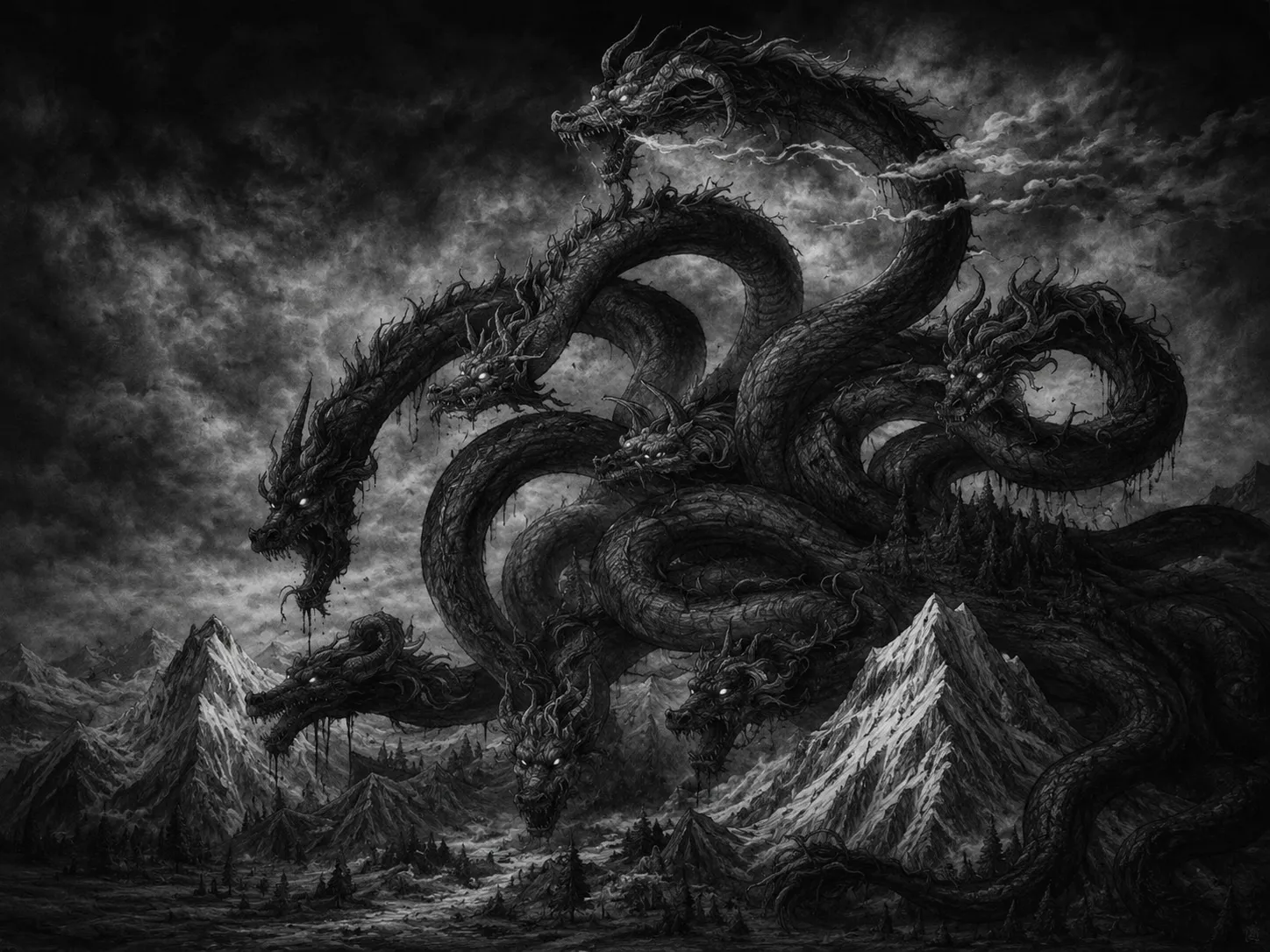
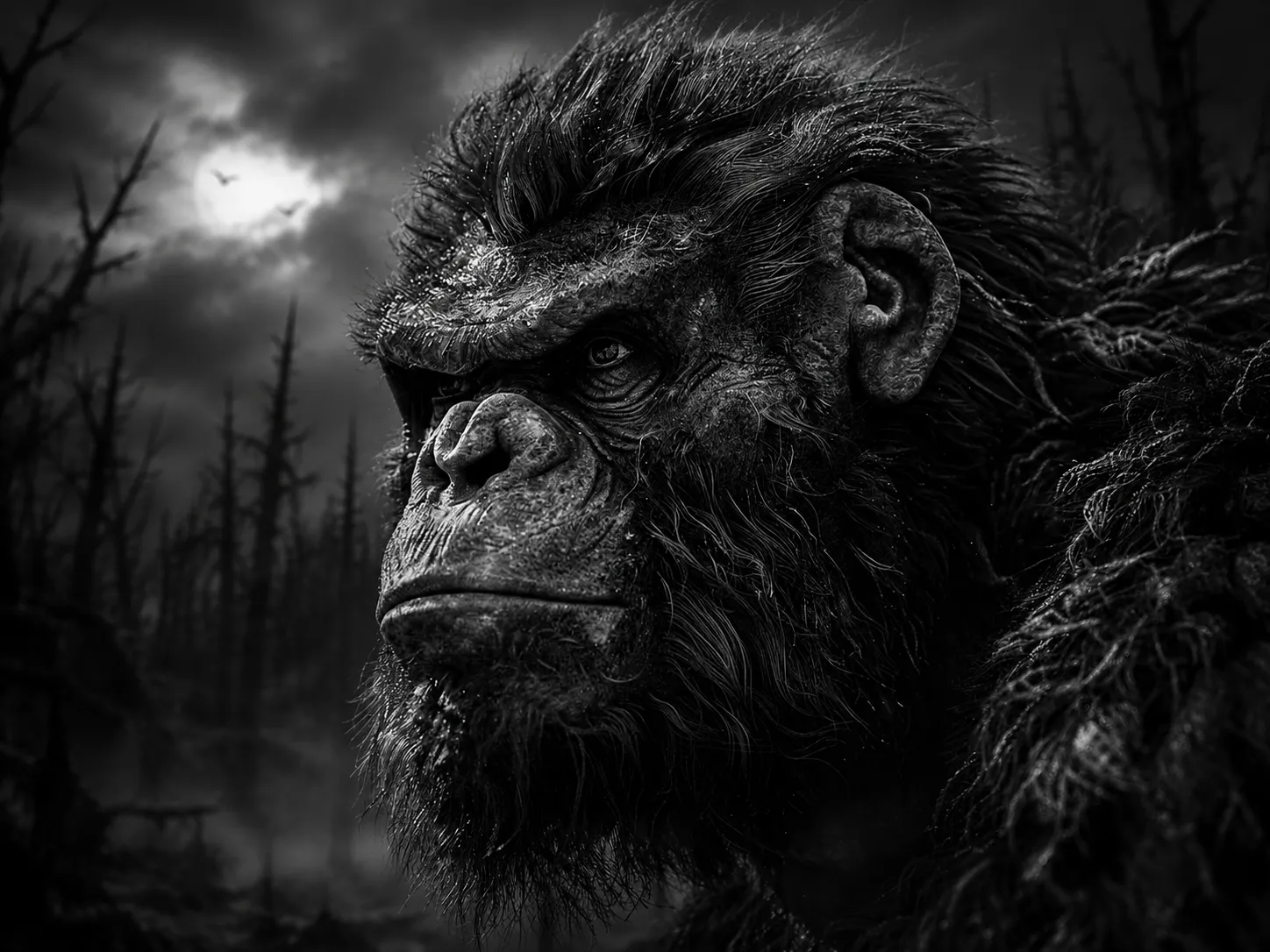
Saga descriptions of the Draugr’s appearance are sufficiently consistent to constitute a real visual tradition, not an invented one. The two frequent color terms are hel-blár (“death-blue” or “black as Hel”) and nár-fölr (“corpse-pale”).
Glámr, in Grettis saga, is described in the original as blár sem Hel en digr sem naut — “black as Hel and bloated like a bull” — capturing both the discoloration and the grotesque swelling of a body that has begun to decompose but refuses to finish dying. Þórólfr Lame-Foot in Eyrbyggja saga is similarly described as having turned black, his body unnaturally heavy to carry.
Physical strength is treated as scaling with the size of the corpse: ordinary people, once dead and risen, become monstrously powerful. This is presented in the sagas not as a magical add-on but as an intrinsic property of the undead condition itself — decay somehow concentrates rather than weakens the body’s force.
You may also enjoy:
Ittan-momen: The Flying Cloth Yokai That Strangles Victims
September 10, 2025
Is Cadborosaurus the Real Sea Serpent of the Pacific Northwest?
November 6, 2025
Types of Draugr
While medieval writers didn’t apply a strict taxonomy, three broad behavioral patterns appear clearly enough across the sources to function as informal categories:
- Haugbúi (mound-dwellers) stay bound to their own grave or barrow, generally attacking only those who trespass or attempt to rob the mound. Kárr inn gamli is the archetype.
- Aptrgangar (again-walkers) actively leave their graves to torment former neighbors, ruin farms, and pursue grudges from life — Glámr and Þórólfr both belong here.
- Sea-Draugar (draugen), a distinct and largely later tradition centered on Norway’s coast, are the restless dead of drowned sailors and fishermen who were never given a proper Christian burial. Unlike their land-bound, mound-dwelling ancestors, the sea-draug haunts open water and fjords rather than a barrow.
The sea-draug tradition is worth treating as a distinct strand of folklore rather than a simple offshoot, because it developed a distinct visual identity, largely centuries after the family sagas were written.
In the fishing communities of Trøndelag and northern Norway — where roughly one in four men who went to sea, according to local tradition, never returned — the draugen was imagined as a huge, seaweed-draped creature, often rowing the shattered half of a wrecked boat through fog and storm, its scream a death-omen heard just before a squall claimed another crew.
Sighting a draugen, or hearing its cry across open water, was widely taken as a sign that someone nearby was about to drown. This maritime image of the draug — as opposed to the barrow-bound corpse of the Icelandic sagas — was popularized visually in the late 19th and early 20th centuries by Norwegian illustrator Theodor Kittelsen, whose paintings did more than any single written source to fix the seaweed-covered, half-boat-rowing draug in the modern imagination.
Did the Vikings Really Bury the Dead to Stop Them Rising?
This is the part of Draugr lore that most retellings skip entirely. It’s arguably the most genuinely interesting: there is real, physical archaeological evidence, independent of the sagas, that some communities in Viking Age Scandinavia took active, deliberate steps to keep certain corpses from being raised.
The clearest cases come from what archaeologists classify as “deviant burials” — graves that depart from the normal supine, grave-goods-furnished pattern in ways that look less like punishment and more like restraint.
At Kopparsvik, a large Viking Age cemetery on the Swedish island of Gotland, and at a cemetery near Bogøvei on the Danish island of Langeland, archaeologists led by researcher Leszek Gardeła documented burials in which the dead were placed face-down (prone) with heavy stones deliberately positioned on the body — one grave near an old arm of the Roskilde Fjord contained a woman whose remains were pinned beneath two large boulders, one on the chest and one on the leg; another, at Langeland, showed a man buried prone with stones weighing down his hip, arm, and back. At least ten further graves at the same site follow a similar pattern.
At Slusegård in Denmark, a cemetery dating to just before the Viking Age proper, ten decapitated burials have been documented in a single site — an unusually high concentration for one cemetery.
One grave (numbered 309) contains a man whose severed head was placed back above his shoulders, with his right arm and right foot both broken and twisted into unnatural positions, a combination archaeologists have suggested may have been intended to physically prevent the corpse from moving, rather than simply to punish or mark the dead as a criminal or slave (both of which remain possible alternate explanations, since decapitation had multiple legal and social meanings in this period).
Archaeologists studying this material are careful to note that certainty is impossible — a corpse could be found face-down, weighted, or decapitated for reasons having nothing to do with revenant fear, including punishment of criminals, marking low social status, or entirely mundane burial accidents.
But the regular combination of prone positioning, deliberate weighting with stones, and post-mortem restraint of limbs, especially when it clusters at specific sites, has convinced many specialists that at least some of these burials reflect exactly the kind of anxiety the sagas describe in narrative form centuries later: a fear that certain dead people, in certain circumstances, needed to be physically stopped from standing back up.
How the Living Protected Themselves
Independent of any individual Draugr story, medieval Icelandic and broader Norse tradition preserved an entire set of funerary customs aimed specifically at keeping the newly dead from becoming restless. Some of these are described directly in the sagas; others come from later folklore collections and from Snorri Sturluson’s 13th-century Prose Edda. Two practices stand out as genuinely distinctive:
First, the preparation ritual known as nábjargir (“corpse-help”), which involved closing a dead person’s eyes, mouth, and nostrils and cutting their fingernails before burial.
The nail-cutting detail connects directly to Norse mythology’s account of the end of the world: Snorri’s Prose Edda explains that the nails of the unrighteous dead, if left uncut, would supply material for Naglfar, the ship built from dead men’s nails that carries the forces of chaos against the gods at Ragnarök — meaning the ritual had cosmological stakes, not just local ones.
Second, several practical measures aimed at physically confusing or restraining a corpse that might try to find its way home: carrying the body out of the house feet-first, so it could not see the way back; wrapping or covering the head, since the dead were believed to retain some form of sight even with their eyes shut; tying the toes together or breaking the ankles, to slow a walking corpse; and, in the most elaborate version of the custom, carrying the body out through a temporary opening broken into the wall of the house — a “corpse-door” — rather than through the normal entrance, which was then sealed back up, so the dead person’s spirit would have no familiar route back inside.
If a corpse rose anyway, the sagas describe a fairly consistent remedy: the body had to be physically subdued, decapitated (Þórólfr and Glámr both suffer this fate), and in the most serious cases burned, with the ashes disposed of somewhere the corpse could never be reassembled or return from — the fate of Glámr’s remains, and one that recurs across the tradition.
Draugr vs. Other Undead Creatures
| Creature & Lore | Danger Level | Details |
|---|---|---|
| Vampire (Serbia/Balkans) | Severe. Rises from the grave to drain blood and spread a deadly “vampire fever” through the family and livestock it visits first. | The 1726 death of Serbian hajduk Arnold Paole triggered a formal Austrian military investigation and mass exhumations that helped ignite Europe’s 18th-century vampire panic. |
| Jiangshi (China) | High. Hops on rigor-mortis-locked legs, hunting the living by sensing their breath and draining their qi, or life force, instead of blood. | Its iconic Qing-dynasty burial robes trace back to the real historical practice of “corpse-driving,” in which Taoist priests transported the dead home for burial over long distances at night. |
| Ghoul (Arabia) | High. A shapeshifting desert demon that lures lone travelers off the road with false lights or the disguise of a woman before killing and eating them. | Pre-Islamic Bedouin poets described the ghūl centuries before Islam; its now-famous habit of digging up graves was actually added later, by 18th-century French translator Antoine Galland. |
| Mummy (Ancient Egypt) | Medium. A ritually preserved corpse meant to guard its own tomb and possessions in the afterlife, rather than actively hunt the living. | The popular “Curse of the Pharaohs” is a 20th-century media invention, popularized after the 1923 death of financier Lord Carnarvon following the excavation of Tutankhamun’s tomb. |
| Zombie (Haiti) | Medium. In its original Haitian Vodou form, a person stripped of free will and consciousness — not a flesh-eating monster. | Ethnobotanist Wade Davis argued in the 1980s that some real-life “zombification” cases involved a tetrodotoxin-based powder capable of inducing death-like paralysis. |
| Barrow-wight (Anglo-Saxon / Tolkien) | High. A spirit that possesses and animates a corpse inside its own burial mound, attacking anyone who enters. | J.R.R. Tolkien, a professional philologist, modeled his Barrow-wights directly on the haugbúi of the Old Norse sagas he studied and translated. |
| Vetala (India) | Low. Possesses corpses hanging in cremation grounds and tests captors with unanswerable riddles rather than direct violence. | The 11th-century Sanskrit story cycle Baital Pachisi, in which a vetala tells King Vikramaditya twenty-five tales, is still read by Indian schoolchildren today. |
| Strigoi (Romania) | Severe. Rises from the grave to drain the vitality of its own family first, sometimes years after burial, spreading illness through a household. | As recently as 2004, villagers in Marotinu de Sus, Romania, exhumed a deceased relative and removed his heart in a real, documented strigoi-banishing ritual. |
| Nachzehrer (Germany) | Medium. Never leaves its grave; instead it chews its own burial shroud and body, remotely draining the life of surviving relatives. | Folklorists now trace the legend to misread decomposition: escaping gas naturally retracts a corpse’s lips, creating the illusion that it has been “chewing” its shroud. |
| Gashadokuro (Japan) | Extreme. A giant skeleton fused from the bones of unburied famine and war dead, silently grabbing and crushing lone travelers at night. | Despite feeling ancient, the Gashadokuro is a 20th-century invention, first named in a 1966 magazine article and visually based on a single 1844 woodblock print by Utagawa Kuniyoshi. |
The Draugr in Popular Culture
The Draugr’s modern visibility owes almost everything to video games and film, which have generally preserved its corporeal, tomb-guarding character while stripping away most of the moral and ritual context the sagas gave it.
The Elder Scrolls V: Skyrim (2011) popularized the term for an entire generation of players, depicting Draugar as mummified Nordic warriors guarding ancient burial tombs — a reasonably faithful visual nod to the haugbúi tradition, even if the game’s lore is its own invention rather than saga-accurate.
God of War (2018) uses Draugar as regular early-game enemies in its Norse-mythology setting. The 2022 film The Northman features a mound-dwelling undead guardian guarding a magical sword, an image drawn fairly directly from the Kárr inn gamli episode of the Grettis saga.
The 2018 Norwegian film Draug depicts blue-black, physically animated corpses consistent with the hel-blár saga tradition, while the 2018 Netflix animated series Hilda dedicates an episode (“The Draugen”) specifically to the Norwegian sea-ghost tradition, portraying the draugen as the spirits of drowned sailors.
Conclusion
The Draugr persists because it was never a simple monster to begin with. It’s a physical corpse and a moral judgment; a local folk belief and, quite possibly, an actual archaeological practice; a shepherd cursing a hero with his dying breath and a Danish grave with stones pinned deliberately over a body’s chest.
Strip away the modern embellishments — the invented names, the neat dates, the tidy village rituals that never appear in any surviving text — and what’s left is still genuinely strange: a culture that looked at its own dead, decided some of them might not stay down, and built an entire body of law, ritual, and story around making sure they didn’t.
You may also enjoy:
Alabama Sasquatch: Every Confirmed Hotspot, Mapped
April 18, 2025
Impundulu: The Strange Bird That Drinks Blood
May 21, 2025
The Japanese Kappa Monster: A Dark Obsession With Humans
September 9, 2025
Popobawa Sightings: Inside Zanzibar’s Most Feared Cryptid
November 12, 2025
Who Was Moloch, the Child-Devouring God?
August 26, 2025
Sources
- Eyrbyggja Saga. Translated by Hermann Pálsson and Paul Edwards, Penguin Classics, 1972.
- Gardeła, Leszek & Duma, Paweł. (2013). Untimely death: atypical burials of children in early and late medieval Poland. World Archaeology. 45. 10.1080/00438243.2013.799040.
- Grettis Saga. Encyclopedia Britannica, Encyclopedia Britannica, Inc. Accessed July 13, 2026.
- Grettis Saga: The Story of Grettir the Strong. Translated by Eiríkr Magnússon and William Morris, F. S. Ellis, 1869.
- Jakobsson, Ármann. (2018). Horror in the Medieval North: The Troll. The Palgrave Handbook to Horror Literature, ed. Kevin Corstorphine & Laura R. Kremmel, 2018, 33–43.. 10.1007/978-3-319-97406-4_3.
- Gunnell, T. (2024). Contact with the Dead in Iceland Past and Present: The Findings of a New Survey of Folk Belief and Experiences of the Supernatural in Iceland. Religions, 15(6), 661. https://doi.org/10.3390/rel15060661
- Laxdæla Saga. Translated by Magnus Magnusson and Hermann Pálsson, Penguin Classics, 1969.
- Sturluson, Snorri. The Prose Edda of Snorri Sturluson: Tales from Norse Mythology. Translated by Arthur Gilchrist Brodeur, American-Scandinavian Foundation, 1916.