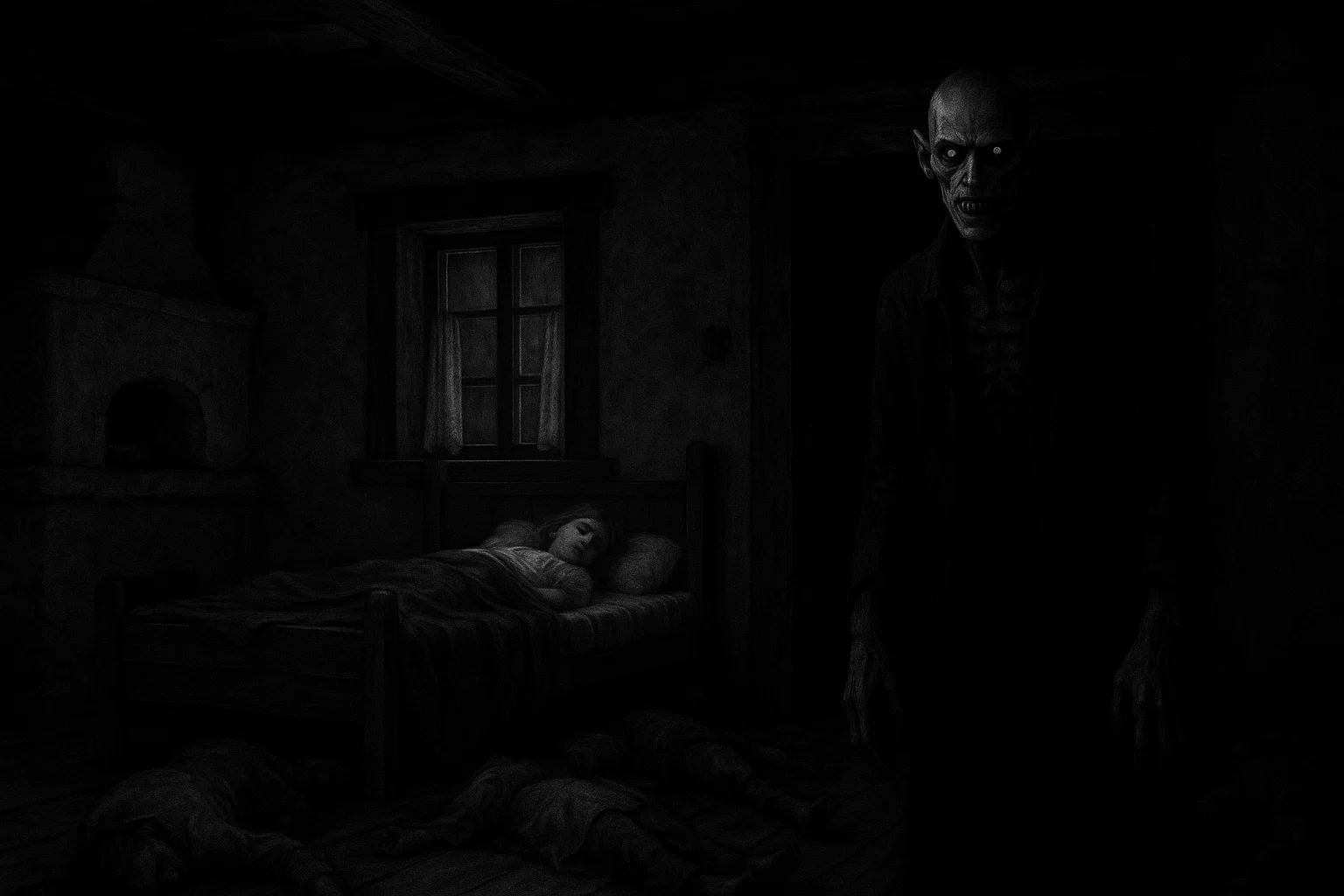
The Upyr is the original vampire, a malevolent undead monster from Eastern Slavic folklore that appeared almost a thousand years before Bram Stoker’s Dracula. First mentioned in 1047 AD in the Russian Primary Chronicles, the Upyr is a reanimated corpse possessed by an unclean spirit, driven to drink the blood of the living, especially its own family.
Unlike the suave aristocrats found in Gothic fiction, the Upyr is a horror embedded in village life. It is bloated, foul-smelling, and disturbingly precise in choosing its first victims.
Summary
Overview
| Attributes | Details |
|---|---|
| Names & Etymology | Upyr (Russian), Upir (Ukrainian/Belarusian), Upiór (Polish), Upír (Czech/Slovak); Proto-Slavic root ǫpyrь — “one who bites” or “one who thrusts” |
| Classification | Undead Revenant / Unclean Dead (nečistaya sila); categorized within Slavic demonology as a reanimated corpse inhabited by a malicious spirit |
| Species | Humanoid (Revenant) |
| Origin | Rises from the grave when a person dies in a state of spiritual impurity — by suicide, excommunication, sorcery, unbaptized death, or when a cat or dog jumps over the unburied corpse |
| Earliest Record | 1047 AD — Russian Primary Chronicles; a Novgorodian priest recorded under the epithet Upyr’ Likhij (“Wicked Upyr”) |
| Habitat | Rural villages, graveyards, and family homes across Russia, Ukraine, Belarus, and Poland; most concentrated in territories of historical Kievan Rus |
| Diet | Human blood (bitten directly over the heart, not the neck) and life-force energy drained from sleeping victims, particularly blood relatives |
| Physical Details | Pale, gaunt frame; wolf-like glowing eyes; retracted lips; reddened gums and sharp teeth; bloated and flushed after feeding; cold, waxy skin; smells of damp earth and decay; wears burial shrouds |
| Strengths | Daylight mobility (not restricted to night); kinship-bond life-force drain without physical contact; can masquerade as the living person it once was; causes wasting illness in victims over days or weeks |
| Weaknesses | Aspen or hawthorn stake through the heart; silver placed on the forehead; full body burning with ashes scattered at a crossroads or running water; compelled to count scattered poppy seeds until dawn; blessed herbs (thyme, rue) block entry to dwellings |
| Warning | If multiple family members fall ill and die in rapid succession after a recent household death — especially following an irregular burial — do not sleep alone in the home. Scatter poppy seeds across the threshold each night until the grave can be properly inspected and ritually secured. |
| Threat Level | Level 3 (Apex Predator) [See the Threat Level Guide] |
| Survival Odds | 35% — The Upyr targets your own family first and can drain you while you sleep, mistaking it for illness. If you recognize the signs early and know the correct rituals, you survive. If you don’t, you become the next host. |
Who or What Is the Upyr?
The Upyr is a type of undead creature from the folk beliefs of Eastern Slavic peoples, mainly in Russia, Ukraine, Belarus, and Poland. It is not a single monster or legendary creature, but a category of revenant—a corpse brought back by a malicious or restless spirit to prey on the living. In this way, it acts more like a folkloric disease carrier than a single supernatural predator.
What sets the Upyr apart from later Western vampire myths is its social logic. It does not hunt strangers. Instead, it returns to feed on those closest to it in life, such as spouses, children, and siblings, moving outward from its household in a way that mirrors how an epidemic spreads through a community.
The detail is important. The Upyr legend provided a way for people to understand and explain clusters of unexplained deaths within the same family or village.
In its original lore, the Upyr is also considered part of the “unclean dead”—a soul denied proper passage to the afterlife because of how it died or the sins it committed in life. This puts it in a broader Slavic category of beings whose deaths were spiritually incomplete, such as suicides, sorcerers, heretics, the unbaptized, and those who died violently or suddenly.
Unlike the romanticized vampire of modern fiction, which is seductive, aristocratic, and nearly immortal, the Upyr is a local terror. It is a dead neighbor who refuses to stay buried and whose presence is an immediate threat to the whole community.
Origins & Creation
The Upyr comes from the pre-Christian spiritual beliefs of the Eastern Slavic world, where people saw the boundary between the living and the dead as thin and risky. In this view, the dead needed careful, ritual management. Improper burial, unresolved sins, or a life tied to forbidden spiritual practices could trap a soul in a state that was neither fully gone nor fully present, creating the right conditions for an Upyr to appear.
Regional traditions list several causes for becoming an Upyr: dying by suicide, being excommunicated from the Orthodox Church, practicing sorcery or witchcraft, dying without baptism, and having an animal—especially a cat or dog—jump over the body at the moment of death or while the corpse is unburied. This last detail, the animal-crossing rule, appears in both Slavic and Turkic traditions, hinting at an old shared belief about how spiritual contamination could enter a corpse.
The earliest written record of the Upyr is from 1047 AD in the Russian Primary Chronicles, where a Novgorodian priest is called Upyr’ Likhij, meaning “Wicked Upyr.” This was not a description of a monster, but a name or nickname given to a living clergyman. This detail shows how profoundly the idea had already become part of the culture of Kievan Rus.
Another important text, the Word of Saint Grigoriy, is an Old East Slavic anti-pagan treatise from around 1047. It condemns the worship of upyri along with other forbidden pagan deities, showing the creature’s importance in pre-Christian rituals. By the 12th century, the Primary Chronicle of Kievan Rus mentioned undead beings like the Upyr, describing them as divine punishment for defying God.
The Upyr legend is most common in the lands of historical Kievan Rus, which include modern Russia, Ukraine, and Belarus, with important regional versions in Poland and Slovakia.
The spread follows the migration of Eastern Slavic peoples. It reflects the unique conditions of medieval village life there: isolated communities, high death rates from disease and famine, and a strong tradition of ancestor veneration that made the relationship between the living and the dead a constant concern.
The Upyr exists alongside other mythological beings in the region, such as the Serbian vukodlak (a vampiric werewolf hybrid), the Polish strzyga (a two-souled revenant), and the Russian kikimora (a household spirit linked to early death and domestic disaster). These figures all reflect worries about deaths that did not fit the accepted Christian order and the dangers they posed to community stability.
You may also enjoy:
The Dark Demon Seth: God of Chaos in Egyptian Mythology
October 2, 2025
Why Lumley Castle Is One of England’s Most Disturbing Hauntings
January 12, 2026
The Whaley House Haunting: America’s Most Terrifying Ghost Story
October 23, 2025
Etymology
The word upyr comes from the Old East Slavic upir’, and linguists think the Proto-Slavic root was either ǫpyrь or ǫpirь.
The main theory is that the root means “one who thrusts” or “one who bites,” describing how the creature attacks to drink blood, which matches Czech linguist Václav Machek’s analysis, which links the root to verbs meaning “to thrust into” or “to stick to” in South Slavic dialects.
However, the origin of the word is still debated. French linguist Franz Miklosich suggested that Slavic borrowed the word from the Turkic ubır or ubar, which means “witch” or “vampire.” This would reflect cultural exchange along trade and migration routes, especially through the Kipchak-Cuman migrations across the Eurasian steppes. Other linguists believe the opposite, that Turkic peoples took the term from Old Slavic. The question is still open.
The name’s journey across Slavic languages is traceable: Old Russian upir’ became Russian упырь (upyr’), Ukrainian упир (upyr), Belarusian упыр (upyr), Polish upiór (and older form wąpierz), Czech and Slovak upír, and Old Bulgarian впир (vpir).
The modern Western word “vampire” traveled from Serbian vampir through German Vampir and then into French and English — all of which descend from the same Slavic root.
Upyr Pronunciation
In English, Upyr is best pronounced OO-pier, with a long “oo” as in “moon,” followed by “pier” as in a dock. The stress is on the first syllable. The Russian word упырь ends with a soft sign, which makes the final consonant slightly palatalized—a sound not found in English—so the English version is close but not exact.
What Does the Upyr Look Like?
In the original folklore, the Upyr does not look elegant. Instead, it follows the disturbing logic of a corpse that does not decay properly. In Russian tradition, it appears as a pale, thin monster with faintly glowing, wolf-like eyes, reddened gums, and lips pulled back to show sharp teeth.
Ukrainian accounts add distinctive physical markers for those likely to become an Upyr: red hair, left-handedness, a unibrow, double teeth, or a grayish birthmark on the back.
In Polish legend, an Upyr in active predation walks with a limp and has a swollen, blood-engorged tongue — both indicators of recent feeding. Belarusian accounts include a particularly disturbing detail: the Upyr sometimes carries its own severed head under its arm.
After feeding, its skin takes on an unnatural flush. Before feeding, the body is cold and waxy, but the cheeks become mottled with color soon after it drinks blood. This matches the “ruddy corpse” descriptions found in church records when suspected Upyrs were exhumed. The skin is often said to smell like damp earth and decay—not the romanticized “cold stone” scent of Gothic fiction, but the real biological odor of a corpse starting to rot.
Modern media almost always gets this wrong. When the Upyr appears in pop culture, it is usually shown as a typical Western vampire: pale, sharp-featured, and stylishly dressed. Original stories describe it as bloated and covered in soil, dressed in burial shrouds, and moving with the awkward gait of a damaged but still moving body. It is not seductive. It falls into the uncanny valley—someone you once knew, but wrong in every detail.
One lesser-known detail from old folk tradition is that the Upyr was said to bite not the neck but the chest, directly over the heart. This sets it apart from almost every other vampire tradition in European folklore.
What Is the Difference Between a Vampire and an Upyr?
Today, people often use the terms interchangeably. Still, in their original cultures, they referred to beings that were truly different, with different rules.
The Western vampire, as defined by 18th and 19th-century Gothic literature, is basically aristocratic. It is charming, often immortal, can turn into bats or mist, and has a consistent set of weaknesses: sunlight, garlic, holy water, and wooden stakes. Most importantly, it preys on strangers and does not usually return to harm its own family first.
The Upyr is almost the opposite. It is not immortal in a romantic way; instead, it is a recently dead local person, still dressed in burial clothes. It goes after its own family before strangers, following the logic of closeness at home rather than hunting like a predator.
In most traditions, it can move freely during the day, which removes one of the Western vampire’s main weaknesses. It feeds on life-force as well as blood, causing a general wasting illness instead of just blood loss. Importantly, it is not seductive in the original stories. There is no charm, glamour, or aristocratic appearance. It is simply a dead neighbor driven to harm its own family.
The Upyr is also more closely linked to witchcraft. In Russian tradition, people often believed an Upyr had been a sorcerer or witch in life, someone who dealt with unclean forces before dying. This connection to forbidden power before death sets it apart from the Western vampire, which usually becomes supernatural only after death and infection.
You may also enjoy:
Incubus: Demon of Lust and Nightmares
August 22, 2025
Yuki-onna Legends: Tales of Love, Death, and Betrayal
September 9, 2025
The Dover Demon Mystery: Still Unsolved?
June 30, 2025
The Strange Hodag Monster: Wisconsin’s Fearsome Cryptid
September 26, 2025
Who Is Aim in Demonology? The Demon Prince of Fire and Ruin
August 12, 2025
Upyr Mythology
The narratives surrounding the Upyr are preserved primarily in two traditions: the ecclesiastical records and anti-pagan treatises of medieval Kievan Rus (11th–14th centuries), and the dense oral folklore collected by 19th-century Russian and Ukrainian ethnographers — most importantly in the compilation work of Alexander Afanasyev, whose eight-volume collection Народные русские сказки (published 1855–1867) documents regional variants of vampiric beliefs gathered directly from Russian, Ukrainian, and Belarusian oral sources.
Afanasyev’s Tale No. 363 (collected 1855–1867)
This is the primary folkloric narrative featuring the Upyr as a named creature, preserved in Alexander Afanasyev’s canonical collection and cataloged as tale type ATU 363 (“The Vampire / The Corpse Eater”) in the Aarne-Thompson-Uther international folktale index.
A young woman named Marusia attends a village feast, where she meets a kind, handsome, and apparently wealthy young man. They fall in love and agree to marry.
Her cautious mother tells Marusia to follow the man home to learn more about him. Marusia follows and watches him enter the local church in the dark. Peering through the window, she sees him eating a corpse. She does not reveal what she has seen.
The Upyr-bridegroom suspects she knows. He comes to her and asks directly, “Did you see me at the church?” She denies it. He tells her that her father will die the next day. Her father dies. He asks again the following night. She denies it again. Her mother dies. One by one, every member of her family is killed — each death following her denial of what she witnessed. Finally, he tells her that she herself will die.
Her grandmother, the only surviving relative, tells her what to do. Marusia follows the instructions, allowing her own death but under conditions that permit her to return to life. She comes back — but there is one condition: she must never enter a church. She marries a good man. He does not understand her refusal to attend services.
Eventually, he forces her to go to church. The Upyr, who has been waiting, discovers she is alive. He kills her husband and her son. With the grandmother’s help, using the water of life and holy water, Marusia revives her family and destroys the Upyr.
The tale carries a specific structural logic native to Eastern Slavic Upyr belief: the creature uses truth as a weapon and silence as a transaction. Each of Marusia’s denials is a small purchase of survival — and a payment extracted in family blood.
The Kinship Predation Accounts
Ukrainian folk tradition, recorded by 19th-century ethnographers in Poltava and Pokuttia, describes a particularly unsettling version of Upyr behavior that is different from the graveyard-monster image in Western stories. In these accounts, the Upyr does not just stalk its victims; it comes back pretending to be the living person it once was.
It behaves normally during the day. It eats at the family table. It embraces children. It asks how people slept. Only at night, while the household is unconscious, does it quietly drain their life force. The deaths that follow do not look like monster attacks — they look like illness: gradual weight loss, pallor, fatigue, and a slow decline that mimics consumption.
The Encyclopedia of Ukraine records that according to Ukrainian folk beliefs, Upyrs could also be living persons with vampiric properties, and that they were feared as agents capable of causing droughts and epidemics — an important expansion of the creature’s powers beyond simple blood-drinking.
The terror in these accounts is not confrontation but recognition after the fact: the community eventually realizes it has been mourning and nursing a predator it mistook for a grieving family member.
The Petar Blagojević Case, Serbia
While geographically Serbian rather than Russian or Ukrainian, this is one of the most consequential Upyr-adjacent cases ever officially documented, and the one most directly responsible for transmitting Slavic vampire belief to Western Europe.
Petar Blagojević died in 1725 in the village of Kisilova (modern Kisiljevo), in the part of Serbia then under Habsburg administration following the Treaty of Passarowitz (1718).
Within days of his death, nine of his fellow villagers died after brief illnesses. Each victim, before dying, reported that Blagojević had appeared to them in the night and “laid himself upon them, and throttled them.” His widow claimed he had knocked on her door after his funeral, demanding his shoes, and had attempted to strangle her.
Imperial Provisor Ernst Frombald, an Austrian administrative official, was summoned. The community threatened to abandon the village entirely if nothing was done. Under that pressure, Frombald agreed to oversee the exhumation.
He described the body as “completely fresh,” with blood around the mouth, and with what appeared to be new skin growing beneath the old. The village drove a stake through the corpse’s heart — at which point, Frombald noted, blood gushed from the wound — and the body was burned.
Frombald’s official report was published in the Viennese newspaper Wienerisches Diarium on July 21, 1725. It is recognized as one of the earliest published Western European documents to use the word Vampyri.
The report, combined with the Arnold Paole case of 1726–1732 (in which a former soldier’s post-mortem depredations were formally investigated by a military-medical commission), circulated across Germany, France, and England and ignited the vampire panic of the 1730s.
Within a decade, the word “vampire” had entered French and English. These Serbian cases, which are based on the same Eastern Slavic Upyr beliefs, are the direct link that turned the Upyr into the global vampire archetype.
You may also enjoy:
Is The Anguished Man Painting Truly Cursed?
May 26, 2025
The Family of the Vourdalak (Written 1839, Published 1884)
Although not oral folklore, Tolstoy’s novella is based directly on documented Upyr and vourdalak folk beliefs. It is worth mentioning because it is the most faithful fictional version of the Upyr’s main trait: targeting its own family, or kinship predation, in 19th-century literature.
Tolstoy wrote the novella in French in 1839 while traveling from Frankfurt, where he was attached to the Russian Embassy. It was not published during his lifetime; a Russian translation first appeared in 1884. The story is framed as the memoir of a French diplomat, the Marquis d’Urfé, who in 1759 seeks shelter in a remote Serbian village. The patriarch of the house, an old man named Gorcha, has left ten days before to pursue a Turkish bandit.
Before leaving, he made a solemn instruction to his sons, Dorde and Petar, and his daughter Sdenka. If he returns after exactly ten days, he is a man and should be welcomed. If he returns even one minute past that deadline, he is a vourdalak, and they must drive a stake through his heart without hesitation.
Gorcha returns on the tenth night — but after dark, at an hour that makes it impossible to count the days with certainty. He is wounded and strange. The sons cannot bring themselves to kill their father. One by one, across the following days and weeks, the family dies — each transformed into a vourdalak and continuing the predation cycle.
Tolstoy’s skill is in making the horror feel domestic rather than monstrous. The characters keep convincing themselves that everything is fine, that their father is still the same, and that the illness is just a coincidence. By the time they realize the truth, there is almost no family left to save.
The novella became the basis for the I Wurdulak segment of Mario Bava’s 1963 anthology horror film I tre volti della paura (released internationally as Black Sabbath), featuring Boris Karloff as Gorcha.
Can You Defeat an Upyr? Powers & Weaknesses
To understand the Upyr’s power, you need to look at its spiritual background. It is not a supernatural predator like those in Western fiction, which are seen as outside human nature.
The Upyr is a corrupted human body, still powered by a corrupted life force. Its strength comes from sharing the same biological and spiritual level as the living. It can move among people, touch them, and drain them because, in a way, it is still one of them.
This is why its main victims are blood relatives. In Slavic folk beliefs, family members shared a common spiritual essence, a life-force that was partly communal. The Upyr, still linked to this shared energy through family ties, can draw from it directly and without being seen. It does not always need to bite to kill.
Simple proximity to sleeping family members — described in several Ukrainian accounts as “lying beside” the victim — was enough to drain vitality over days or weeks, producing the symptoms of wasting illness: weight loss, pallor, fatigue, and eventual death. The bite — specifically the chest bite, aimed at the heart — was reserved for more direct, faster predation.
The Upyr’s ability to move in daylight is not just an extra power. It comes from the same idea: the Upyr is not a being of pure spiritual darkness, like a demon, but a corrupted body. Light, which can defeat purely spiritual beings in Slavic beliefs, cannot fully destroy something that still has a physical form.
This same logic explains its weaknesses. The Upyr is vulnerable to materials and rituals that break the link between its corrupted body and the spiritual world it draws from. An aspen wood stake through the heart is not just physical destruction, but also a spiritual separation. In Slavic folk belief, aspen was seen as protective and cleansing and was used in rituals to seal graves.
In Ukrainian tradition, putting silver on the Upyr’s forehead was effective. Silver was seen in Orthodox folk belief as a material linked to purity and sacred protection. Hawthorn stakes, used in Russian tradition, had extra meaning: hawthorn was connected to spiritual boundaries. It was planted around churchyards for its protective qualities.
Burning the body was considered the most reliable method, and it follows the same logic: fire destroys the corrupted flesh entirely, eliminating the physical vessel the unclean spirit required to operate. In Ukrainian practice, the ashes were then scattered over a crossroads or a body of running water — both of which, in Slavic cosmology, served as boundary points where the unclean could not reassemble or linger.
Scattering poppy seeds took advantage of the Upyr’s need to count things. This weakness rested on the belief that the creature’s unclean spirit still retained some part of the human mind’s need for order, which could be used against it.
Regional differences add more detail. In Poland, people used blessed herbs like thyme and rue as deterrents, placing them in doorways and windows. The idea was to prevent defilement—the Upyr could not enter a place already filled with spiritually protective materials.
All these methods share a common idea: the Upyr can be defeated not by force, but by following the right steps. You are not fighting a monster; you are finishing a ritual that should have been done correctly at the burial.
Upyr vs. Other Similar Creatures
| Creature & Lore | Danger Level | Details |
|---|---|---|
| Strigoi (Romania) | Severe. Exists in two forms — the strigoi viu (a living person who can project their soul at night to cause harm) and the strigoi mort (a risen corpse that feeds on blood and spreads disease). | A living strigoi viu can operate entirely undetected during daylight hours, making it one of the few vampiric creatures in European folklore that does not require death to begin predation. |
| Vrykolakas (Greece) | High. A reanimated corpse — often of someone who died excommunicated or unbaptized — that spreads plague and death by knocking on doors; those who answer die within days. | Greek Orthodox tradition held that the vrykolakas could not be destroyed by fire alone — the Church required a bishop’s dispensation to formally dissolve the body, otherwise burning was ineffective. |
| Jiangshi (China) | Severe. A hopping reanimated corpse that absorbs the life-force (qi) of the living through physical contact; arms rigidly outstretched, it moves in stiff hops because rigor mortis locks its joints. | Jiangshi are completely blind and track victims solely by detecting their breath — holding your breath as one passes is considered the only reliable evasion tactic in the source folklore. |
| Penanggalan (Malaysia) | Severe. A severed female head that detaches from its body at night, trailing glowing entrails, and feeds on the blood of newborns and women in labor; its entrails must be soaked in vinegar to refit the body by morning. | Pregnant women in traditional Malaysian communities reportedly hung thorned plants (particularly jeruju) above their doors specifically to snag the Penanggalan’s entrails and immobilize it before dawn. |
| Langsuyar (Malaysia) | High. A woman who died in childbirth and returned as a vampiric spirit; feeds on fish blood and attacks newborns, but can be permanently neutralized by cutting off her talons, filling her mouth with her own hair, and burying her with them. | Unlike most vampiric creatures, the Langsuyar can be fully reintegrated into human society through a specific ritual — there are recorded folklore accounts of communities successfully “curing” a Langsuyar and allowing her to remarry. |
| Vetala (India) | High. A spirit that inhabits and animates fresh corpses in cremation grounds; highly intelligent, it speaks in riddles and possesses supernatural knowledge — but its power depends entirely on remaining in the corpse, which it abandons if touched improperly. | The Vetala is one of the few vampiric entities in world folklore that is explicitly framed as a source of occult wisdom — in the Baital Pachisi, the sage Vikramaditya repeatedly attempts to capture a Vetala specifically to gain its prophetic knowledge. |
| Aswang (Philippines) | Severe. Shapeshifts between human and predator form; targets pregnant women and unborn children, extracting the fetus through a long, hollow tongue; operates entirely under a human disguise during daylight. | The Aswang is so deeply embedded in Philippine culture that it was reportedly weaponized as a psychological warfare tool by the CIA during the Huk Rebellion of the 1950s — operatives drained a dead insurgent of blood and left puncture wounds to make local troops believe an Aswang was operating in the area. |
| Strzyga (Poland) | High. A two-souled being born with teeth and two hearts; one soul departs at natural death, the other animates the corpse, which then feeds on blood and organs and can shapeshift into an owl. | The Strzyga is distinguished from the Upyr by its dual-soul origin — it is not a person who became a monster after death but a being born monstrous, with vampirism encoded at birth rather than earned through sin. |
| Vukodlak (Serbia / Bosnia) | High. A hybrid vampiric-lycanthropic revenant; a person cursed or bitten can transform between wolf and undead forms, and in Serbian tradition, it was specifically believed to chew through its own burial shroud before rising to attack cattle and humans. | Serbian communities traditionally buried suspected Vukodlak with their hamstrings cut and pins driven through the knees — physical immobilization rituals designed not just to prevent rising but to specifically stop the creature’s chewing reflex before it could escape the coffin. |
| Draugr (Norse / Iceland) | Extreme. A physically immense undead warrior that guards its burial mound, crushing or eating intruders; possesses superhuman strength, the ability to shapeshift, and, in some accounts, can drive the living insane through its presence alone. | Unlike most undead creatures, the Draugr retains full memory, personality, and tactical intelligence from its living self — Icelandic sagas record Draugar engaging in complex conversations and legal disputes before being put down. |
| Nachzehrer (Germany) | High. A passive but relentless undead that lies in its grave gnawing its own burial shroud and flesh; each bite causes the death of a living family member miles away, with no direct attack required. | The Nachzehrer was specifically associated with plague epidemics in German-speaking regions — gravediggers reportedly watched for the telltale sound of chewing from freshly sealed coffins as an early warning sign that a death cluster was about to begin. |
My Take
What makes the Upyr truly unsettling, even more than any movie vampire, is that it was never just a fantasy. It was a way for people to explain a real and frequent problem: how death spreads through a family.
When one person in a household died of tuberculosis in a medieval Slavic village, and then another, and then another, there was no germ theory to explain the pattern. There was only the terrible, accurate observation that the dead seemed to be killing the living. The Upyr is that observation depicted in a mythologically coherent way.
The detail that is always remarkable to me is how the Upyr targets its own family. It goes home first, attacking its spouse, children, and siblings.
This is not just a monstrous twist on human behavior—it is human behavior shaped by grief, especially the close contact of caring for the dying. The folklore reflects something real: those most at risk from disease were the ones who slept beside, held, and mourned the dead. The Upyr myth turned this closeness into a supernatural force.
There is also something interesting about the counting compulsion—the idea that scattering poppy seeds could help survivors last until dawn. Every culture that truly feared its undead gave them a weakness based on the idea of distraction.
A monster that can be stopped by making it count is one that still has a human mind. It is not just about destruction. It is a person, trapped and acting on corrupted instincts. That mix—the creature that is still, in a terrible way, someone you loved—is the real horror behind the Upyr, and it is something no Gothic remake has ever truly captured.
You may also enjoy:
January 13, 2026
Cadborosaurus: Is the Pacific Northwest Hiding a Sea Serpent?
September 25, 2025
The Stockwell Poltergeist: Who Was the Stockwell Ghost?
April 11, 2025
Who Is Aka Manah? The Terrifying Demon of Wicked Intention
October 2, 2025
Sources
- Afanasyev, Alexander Nikolayevich. Народные русские сказки [Russian Fairy Tales]. Vol 1. Moscow, 1855–1867.
- Afanasyev, Alexander Nikolayevich. Народные русские сказки [Russian Fairy Tales]. Vol 2. Moscow, 1855–1867.
- Young, Katharine & Barber, Paul. (1992). Vampires, Burial, and Death. The Journal of American Folklore. 104. 212. 10.2307/541237.
- Calmet, Dom Augustin. Dissertations sur les apparitions des anges, des démons et des esprits, et sur les revenants et vampires de Hongrie, de Bohême, de Moravie et de Silésie. Paris, 1746.
- Garza, Thomas J. Slavic Blood: The Vampire in Russian and East European Cultures. Kendall Hunt Publishing, 2016.
- Ralston, William Ralston Shedden. Russian Folk-Tales. Smith, Elder & Co., 1873.
- Tolstoy, Aleksey Konstantinovich. La Famille du Vourdalak: Fragment inédit des mémoires d’un inconnu. Written in 1839.
- Cooper, Brian. The Word ‘Vampire’: Its Slavonic Form and Origin. Journal of Slavic Linguistics, vol. 13, no. 2, 2005, pp. 251–70. JSTOR, http://www.jstor.org/stable/24599658. Accessed 11 June 2026.
- Sledzik PS, Bellantoni N. Brief communication: bioarcheological and biocultural evidence for the New England vampire folk belief. Am J Phys Anthropol. 1994 Jun;94(2):269-74. doi: 10.1002/ajpa.1330940210. PMID: 8085617.