Busby’s Stoop Chair is an unassuming oak chair that has been blamed for the deaths of dozens of people over the past three centuries, so much so that it now hangs bolted to a museum ceiling rather than sitting on the floor like an ordinary piece of furniture. Behind this simple wooden object rests a story of murder, execution, wartime tragedy, and a curse that some still refuse to test — even from a safe distance.
For a chair that looks like nothing more than a plain, ladder-back seat you might find in any old English farmhouse, the reputation attached to it is extraordinary. To understand why an entire town has organized its folklore around a single piece of furniture, it helps to start with what the chair actually is, before working through the centuries of history, legend, and skepticism that surround it.
Summary
Key Takeaways
| Attribute | Details |
|---|---|
| Name | Busby’s Stoop Chair; also known as the Dead Man’s Chair, Busby’s Chair, and the Stoop Chair |
| Object Type | An oak ladder-back armchair |
| Origin / Creation | Popularly dated to 1702, the year of Thomas Busby’s execution; furniture analysis by historian Dr Adam Bowett instead places the chair’s actual construction at around 1840, based on its machine-turned spindles |
| Current Location | Thirsk Museum, Kirkgate, Thirsk, North Yorkshire, England |
| Current Owner | Thirsk Museum (donated by former Busby Stoop Inn landlord Tony Earnshaw in 1978) |
| Death Toll | 0 confirmed deaths directly verified by inquest or official record; an undocumented number, popularly described as “dozens,” attributed to the chair across World War II and the 1970s |
| Type of Curse / Haunting | Cursed Object, Fatal Curse, Bad-Luck Curse, Hexed Object |
| Manifestations | Sudden and violent death shortly after sitting in the chair, fatal road accidents, wartime airmen failing to return from missions after sitting in the chair |
| Most Recent Incident | 1970s (exact date undocumented) – a delivery driver reportedly died in a road accident shortly after sitting in the chair while it was stored in the inn’s cellar; no incidents have been reported since the chair was suspended from the museum ceiling in 1978 |
| Threat Level | 3/10 (mildly threatening) [See the Threat Level Explanation] |
| Can the Public View It? | Yes — on permanent display at Thirsk Museum, North Yorkshire, suspended from the ceiling and not accessible for sitting |
| Hoax Confidence Rating | 7/10 (Probably a hoax) [See the Hoax Confidence Rating Explanation] |
What Is the Busby’s Stoop Chair?
Busby’s Stoop Chair, also known as the Dead Man’s Chair, is an oak chair associated with Thomas Busby, a man executed for murder in North Yorkshire, England, in 1702.
According to local legend, Busby cursed the chair shortly before his execution, declaring that anyone who sat in it would suffer a sudden, violent death. The chair remained in use for generations at the Busby Stoop Inn, a pub near the town of Thirsk that took its name from the execution site, before being donated to Thirsk Museum in 1978 after a landlord decided it had become too dangerous to keep in public use.
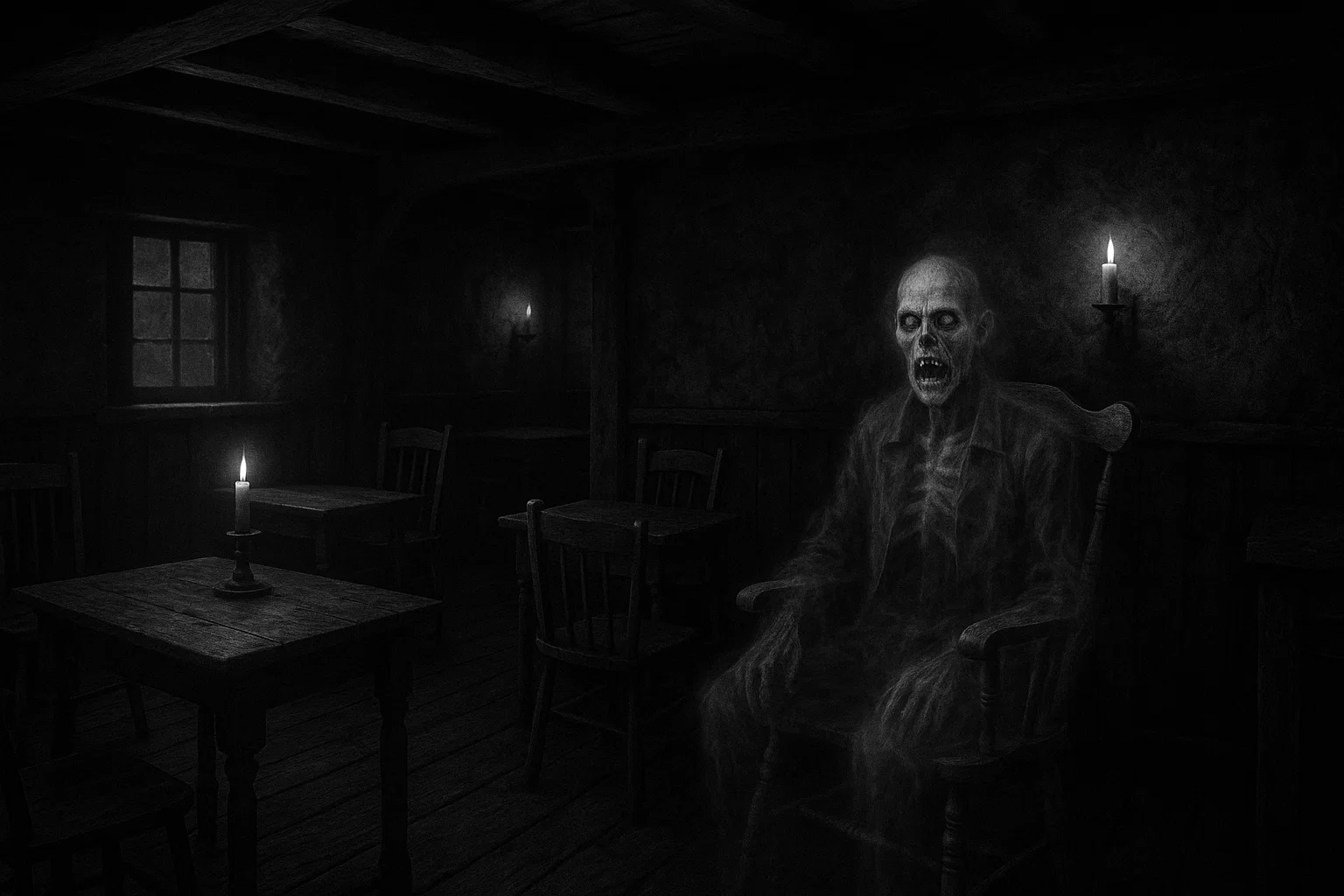
The chair itself is a simple ladder-back armchair made of oak, the kind of furniture that would not attract a second glance in any other setting. What sets it apart is the string of deaths and accidents that, over the decades, locals and visitors have attributed to the act of sitting in it. These reports intensified during the Second World War, when airmen stationed near Thirsk were said to have died on missions shortly after occupying the chair, and continued into the 1970s with a series of fatal accidents connected to people who had sat in it at the inn.
Today the chair is not simply stored out of reach as a precaution — it is suspended from the ceiling of Thirsk Museum, a deliberate measure taken to ensure that absolutely no one, including museum staff and cleaners, can ever sit in it again. A furniture historian who later examined the chair found physical evidence suggesting it may not even date to Busby’s lifetime, a detail that complicates the traditional story without erasing its perpetual grip on the public mind.
The History of Busby’s Stoop Chair
The story of the chair cannot be separated from the story of the man it is named after. Putting together the documented history alongside the folklore that grew up around it shows how a local 18th-century crime evolved into one of Britain’s most enduring paranormal legends — and uncovers several genuinely strange details about the era and the people involved that rarely make it into shorter retellings.
The Murder of Daniel Auty
Thomas Busby lived in the area around Thirsk in North Yorkshire in the late 17th and early 18th centuries. He was connected to Daniel Auty (also recorded in older sources as Awety or Autie), his father-in-law, with whom he was reportedly involved in a coin-counterfeiting operation and other criminal activity.
This detail is darker than it first appears: under English law at the time, counterfeiting the king’s coin was not treated as ordinary theft but was classed among the gravest offenses on the books, carrying the same ultimate penalty as murder itself. Busby and Auty were therefore already living under a standing threat of execution before the killing that made Busby infamous ever took place.
A dispute between the two men, the exact cause of which is not clearly documented, grew into violence, reportedly beginning at Busby’s own inn near Kirby Wiske before turning fatal later that day at Auty’s home, sometimes identified in local retellings as Danotty Hall.
The Trial and Execution of Thomas Busby
Following the murder, Busby was arrested and tried at the York Assizes in 1702. He was convicted and sentenced to death by hanging. What happened to his body afterward is one of the more overlooked and troubling details of the whole legend.
Busby was “gibbeted” — his corpse coated in tar or pitch to slow decomposition and then suspended in a specially built, human-shaped iron cage from a post at a crossroads near Thirsk, left on public display as a warning to others. This practice, known as hanging in chains, would not become a formal, legally mandated part of English sentencing until the Murder Act of 1752 — half a century after Busby’s execution.
In 1702, gibbeting was still entirely at a judge’s personal discretion, meaning the decision to display Busby’s body in this way was a deliberate, individual choice rather than a routine legal requirement. Gibbet posts of this kind were typically at least thirty feet tall and were sometimes reinforced with thousands of iron nails specifically to stop local residents from tearing them down, and corpses could remain hanging and decaying in public view for years, occasionally decades.
The stench from a body decomposing in open air was said to be strong enough that nearby residents shut their windows whenever the wind changed direction. This bleak spectacle gave the nearby inn its lasting name: the Busby Stoop Inn, “stoop” being the regional term for the post itself — the same naming pattern seen elsewhere in England, in which roads and landmarks near old gibbets still carry the names of the criminals displayed on them centuries later.
Detailed court records from the 1702 assizes have not survived, so many specifics of the trial itself are known only through local tradition rather than primary documentation.
You may also enjoy:
Complete Guide to Oregon Bigfoot Sightings (1904–2025)
August 6, 2025
The 9 Most Haunted Hotels in Arkansas You Can Still Visit
October 8, 2025
Why Gusion Is Feared in Demonology
August 21, 2025
Swiatek: Murder, Cannibalism, and a Wolf’s Curse
June 18, 2025
The Origin of the Curse Story
The legend holds that Busby cursed his favorite chair, vowing that death would come to anyone who dared sit in it. Two versions of this story circulate. In one, Busby was granted a final drink at his inn before being led away, and he cursed the chair as he departed for his execution. In the other, he uttered the curse earlier, while drunk in the chair after being confronted or arrested.
Both versions agree on the core claim: that occupying the chair invites the same sudden, violent death that met Busby himself. What is rarely mentioned is how late this specific story actually appears in the historical record.
Researchers who have examined local parish and press archives have found no formal written reference to a “Busby Stoop chair” or its curse before the mid-20th century — meaning the tale, as told today, seems to have taken its familiar shape roughly two hundred years after Busby’s death, rather than being a story passed down in writing from the 1700s.
The Chair at the Busby Stoop Inn
For much of the 18th and 19th centuries, the chair reportedly remained in ordinary use at the Busby Stoop Inn, a coaching inn that stood along the old Great North Road near the crossroads of the modern A61 and A167.
During this long stretch, it functioned as an unremarkable piece of pub furniture, and there is no documentation of a curse or associated deaths from this period — the darker reputation appears to have established much later.
This gap of well over a century, during which the chair sat in plain use with no recorded incident, sits uneasily alongside the modern legend and is one of the strongest pieces of evidence that the “curse” as a continuous, unbroken tradition may be considerably younger than the crime that supposedly inspired it.
World War II and the Airmen’s Deaths
The most widely repeated chapter of the legend concerns the Second World War. Canadian airmen stationed at nearby RAF Skipton-on-Swale, roughly four miles from Thirsk, were said to frequent the Busby Stoop Inn, and local accounts claim that airmen who sat in the chair failed to return from their subsequent bombing missions.
The airfield itself has a documented and genuinely grim wartime record, independent of the chair legend. It became operational in 1943 under No. 6 Group of the Royal Canadian Air Force and was home to No. 433 “Porcupine” Squadron, the last RCAF bomber squadron formed overseas during the war. Flying Handley Page Halifax bombers (later replaced by Lancasters in January 1945), the squadron flew 209 missions comprising 2,316 individual sorties over the course of the war and lost 38 aircraft in the process — losses that meant a young airman stationed there faced very real odds of death regardless of which chair he had or hadn’t sat in at the local pub.
After the war, both RCAF squadrons based there were disbanded in October 1945, the airfield closed permanently, and the site was never used again for aviation, eventually reverting to farmland now used for turkey and pig farming — an oddly mundane postscript to a site formerly associated with one of the chair’s most repeated ghost stories. As with the earlier centuries, no official casualty record or squadron history ties any particular aircraft loss to the chair itself; the connection exists purely in local memory and retelling.
The 1970s Deaths and the Move to Thirsk Museum
By the 1970s, a fresh surge of stories linked the chair to a series of fatal accidents among pub patrons, including a widely repeated account of a delivery driver who, while working in the inn’s cellar, sat in the chair and remarked on how comfortable it was, only to be killed in a road accident shortly afterward.
Landlord Tony Earnshaw, reportedly unsettled by the accumulating incidents, first moved the chair out of public view into the cellar before ultimately deciding it could not remain at the inn at all. In 1978, he donated it to Thirsk Museum, ending its two-and-a-half-century association with the pub.
The condition attached to the donation was unusually strict: the chair was to be suspended from the ceiling so that no one — not a visitor, not a member of staff, not even a cleaner — could ever sit in it again. What is less commonly reported is just how firmly the museum has held to that condition.
According to accounts from those close to the museum, this rule has been maintained for decades despite repeated requests from curious visitors to test the curse for themselves, and despite at least one reported threat of legal action from someone wanting to sit in it — a request the museum has consistently refused.
You may also enjoy:
Who Are the 72 Demons of the Ars Goetia?
July 16, 2026
The 9 Most Haunted Hotels in Arkansas You Can Still Visit
October 8, 2025
Cyclops Myths and Real History: Were the Giants of Greece Real?
October 30, 2025
Is the Lake Iliamna Monster Alaska’s Real-Life Sea Cryptid?
November 5, 2025
Adrammelech in the Bible: Child Sacrifices and Idolatry
September 30, 2025
Is the Busby Stoop Chair’s Curse Real?
When I line up the different versions of this story side by side, what strikes me most isn’t any single hole in the legend — it’s how many small inconsistencies accumulate the closer you look, and how neatly they point toward a story that was assembled well after the fact rather than passed down intact from 1702.
The physical evidence is the biggest problem. The chair on display at Thirsk Museum was examined by furniture historian Dr Adam Bowett, who found its spindles were machine-turned rather than shaped on a pole lathe, the technique in use during Busby’s lifetime. That places the chair’s construction at around 1840 — 138 years after Busby was executed.
This isn’t a minor quibble; it means the object at the center of the entire legend cannot be the chair Busby supposedly sat in and cursed. Either the story was transferred onto a later, similar-looking chair at some point, or the connection to Busby was invented for an object that had no original link to him at all.
The paper trail doesn’t match the timeline either. Despite the drama of the 1702 murder and execution, there’s no documented reference to a damned chair at the inn or anywhere else until the mid-20th century. That leaves a gap of roughly 250 years between the crime and the first known mention of the curse in print.
A story this vivid, if it had genuinely circulated continuously since Busby’s death, would be expected to leave some trace in parish records, local newspapers, or 19th-century collections of Yorkshire folklore — the kind of sources that dutifully recorded far less dramatic local legends. Its absence suggests the curse narrative crystallized fairly recently and was then projected backward onto a genuinely old crime, giving a mid-20th-century ghost story the borrowed authority of a 250-year-old one.
The core details of the murder itself shift depending on who’s telling it. Some versions describe the fatal dispute as a falling-out over the counterfeiting business Busby and Auty ran together; others portray it as a personal argument over Busby’s marriage to Auty’s daughter, or over Auty’s drinking and behavior at the inn.
Even Auty’s name is inconsistent across sources — rendered as Auty, Awety, and Autie depending on the account. None of this is unusual for a story that was transmitted orally for generations rather than fixed in a single written record early on, but it does undercut the idea that we’re dealing with settled historical fact rather than folklore that has been reshaped with every retelling.
The curse’s origin story contradicts itself at its most basic point. One version has Busby cursing the chair calmly, during a final drink at the inn before his execution. The other has him shouting the curse while drunk, before his arrest. These aren’t small variations in phrasing — they disagree on when the curse was made, in what state of mind, and under what circumstances, which is exactly the kind of divergence you’d expect from a story that was never anchored to a single original account.
The wartime deaths are the hardest to verify and the easiest to explain without any curse at all. No. 433 Squadron, based near the inn, lost 38 aircraft over 2,316 sorties during the war — a casualty rate high enough that almost any airman based there faced serious odds of not returning from a mission, whether or not he ever set foot in the pub.
Given how many young men passed through that inn during the war, it would be statistically unremarkable for some of them to have sat in a particular chair and later died on operations — not because the chair had any influence, but because the base rate of death for Bomber Command aircrew in that period was already extraordinarily high.
This looks less like a ghost story and more like a textbook case of selective memory: the deaths of men who sat in the chair were remembered and retold, while the presumably much larger number of men who sat in it and survived the war were simply never mentioned, because a survivor confirms nothing and makes for a duller story.
Taken together, a few working theories explain the legend better than a literal curse does. The first is a straightforward case of survivorship bias and retrospective storytelling — deaths get connected to the chair after the fact, while non-events are forgotten.
The second is that the legend carried genuine commercial value: a “cursed chair” was a powerful draw for a rural crossroads pub and later for a small local museum, giving both institutions a practical incentive to keep the story alive and largely unchallenged.
The third, and to me the most persuasive, is that the story we know today is a 20th-century piece of folklore that attached itself to a real 18th-century crime and a chair that happens to look the part, rather than a continuous account of the same haunted object across three centuries. None of this requires anyone to have lied outright — folklore rarely needs deliberate invention to take on a life of its own, only retelling, embellishment, and time.
Busby’s Stoop Chair vs Other Famous Cursed Objects
| Name | Type | Death Toll (Attributed) | Activity Level |
|---|---|---|---|
| Annabelle Doll | Doll | Less than 5 | 6/10 (occasional) |
| Robert the Doll | Doll | Less than 10 | 5/10 (occasional) |
| The Dybbuk Box | Wine cabinet/box | Between 5 and 10 | 6/10 (occasional) |
| The Crying Boy Painting | Painting | 0 confirmed; fires attributed, not deaths | 3/10 (dormant) |
| The Anguished Man Painting | Painting | 0 confirmed; illness and disturbances attributed | 5/10 (occasional) |
| The Hope Diamond | Gemstone | Over 10 | 2/10 (dormant) |
| The Basano Vase | Vase | Over 100 | 3/10 (dormant) |
| James Dean’s “Little Bastard” Porsche | Automobile | At least 2 confirmed, more attributed | 4/10 (occasional) |
| The Myrtles Plantation Mirror | Mirror | At least 5 | 6/10 (occasional) |
| Curse of Tutankhamun’s Tomb | Tomb/artifacts | Over 20 | 3/10 (dormant) |
| The Koh-i-Noor Diamond | Gemstone | At least 10, spanning centuries of owners | 2/10 (dormant) |
Visiting Busby’s Stoop Chair Today
Thirsk Museum, located on Kirkgate in Thirsk, North Yorkshire, houses the chair in its permanent collection. The museum itself occupies the house where Thomas Lord, founder of Lord’s Cricket Ground, was born in 1755, and it covers a broad range of local history alongside the Busby legend, including agricultural heritage, wartime history connected to the Canadian squadron once based nearby, and archaeological finds from the area.
The chair is displayed suspended from the ceiling, an arrangement that has been maintained since it arrived in 1978, and it continues to draw visitors specifically interested in its reputation as one of Britain’s most feared pieces of furniture.
Frequently Asked Questions
Is the Busby’s Stoop Chair real?
Yes. A physical oak chair by this name exists and is on permanent display at Thirsk Museum in North Yorkshire, where it has been kept since 1978.
Can visitors sit in the chair?
No. The chair is suspended from the ceiling of Thirsk Museum specifically to prevent anyone, including staff and cleaners, from ever sitting in it.
Did Thomas Busby actually curse the chair?
This detail comes entirely from local legend rather than verified historical record. There is no surviving documentation from 1702 confirming that Busby cursed a chair, and furniture analysis shows the chair on display was likely made around 1840, well after his execution.
You may also enjoy:
Who Is Pazuzu? The Terrifying Demon of Mesopotamia
August 26, 2025
Belphegor: From Moabite God to Seductive Maiden of Hell
August 29, 2025
Egyn: The Terrifying Demon King of the North
September 1, 2025
Sources
- Hanging in Chains: The Criminal Corpse on Display. Capital Punishment and the Criminal Corpse in Scotland, 1740–1834, NCBI Bookshelf, National Center for Biotechnology Information.
- Tarlow, Sarah, and Zoe Dyndor. The Landscape of the Gibbet. Landscape history : journal of the Society for Landscape Studies vol. 36,1 (2015): 71-88. doi:10.1080/01433768.2015.1044284
- Murder and the Law, 1752–1832. Harnessing the Power of the Criminal Corpse, NCBI Bookshelf, National Center for Biotechnology Information.
- 1751: 25 George 2 c.37: The Murder Act. The Statutes Project.
- Thirsk Museum, Birthplace of Thomas Lord in Thirsk, North Yorkshire. Thirsk Museum.
- J. W. Ocker. Cursed Objects: Strange but True Stories of the World’s Most Infamous Items. Quirk Books, 2020.
- Langdale, Thomas. A Topographical Dictionary of Yorkshire. 2nd ed., J. Langdale and T. Langdale, 1822. Internet Archive.