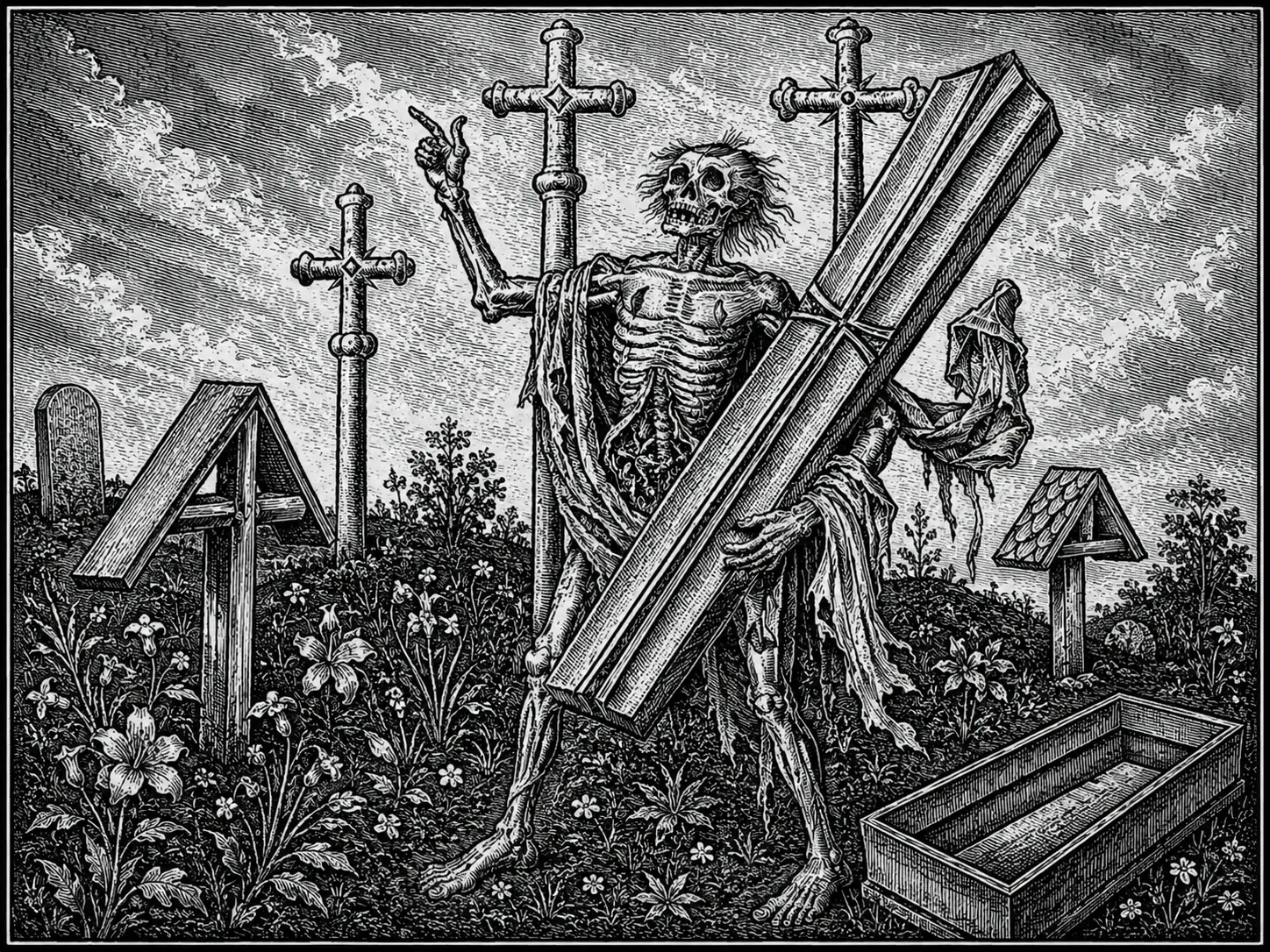
Long before the modern revenant was transformed into a glamorous cinematic antagonist, the monster personified a terrifying medieval reality: the physical return of unconfessed sin to terrorize the living. The walking corpse embodied the profound communal dread that a malicious life could corrupt the earth and rupture the boundary of the grave.
Unlike modern, incorporeal ghosts, the medieval scourge was characterized by a heavy, material rot, proving that the ultimate historical terror was the terrifying survival of human malice within decaying flesh.
Summary
Overview
| Attribute | Details |
| Names & Etymology | Revenant, Cadaver Animatum, Sanguisugae; Derived from the Old French verb “revenir,” literally meaning “to return” or “the one who returns.” |
| Classification | Undead / Corporeal Spirit |
| Species | Humanoid |
| Origin | Manifests when a person of profound wickedness, an unconfessed sinner, or an excommunicated individual dies without proper Christian last rites, causing the earth to reject the defiled corpse. |
| Earliest Record | 12th Century, documented within primary historical texts including William of Newburgh’s “Historia Rerum Anglicarum” and Walter Map’s “De Nugis Curialium.” |
| Habitat | Graveyards, rural parishes, churchyards, and the former domestic homesteads of the deceased across Medieval England, Wales, and Western Europe. |
| Diet | Does not ingest traditional food; it parasitically wastes away the life force of its victims through psychological torment and pestilence, though it is known to gnaw its own burial shroud within the tomb. |
| Physical Details | Matches the original height of the deceased but appears as a bloated, purplish, and turgid corpse distended with stagnant blood, exuding a heavy stench of grave-rot. |
| Strengths | Superhuman material strength capable of crushing victims under its immense physical weight, total immunity to conventional weapons, and the ability to spread lethal sickness via its foul breath. |
| Weaknesses | Ritualistic exhumation followed by physical decapitation, extraction of the heart, and complete cremation of the remains until reduced entirely to scattered ash. |
| Warning | Never walk alone near medieval parish boundaries or churchyards after dark, and flee immediately if you experience a sudden, suffocating odor of putrefaction accompanied by heavy, dragging footsteps. |
| Threat Level | Level 3 (Apex Predator) [See the Thread Level Guide] |
| Survival Odds | 35% (Encountering the physical entity unprepared in its localized territory results in a fatal crushing or lethal illness, though survival rates skyrocket if the community coordinates a formal ritual execution of the grave). |
Who or What Is a Revenant?
In Western European folklore, the entity is an explicitly material horror—not a fleeting, translucent phantom born of mist, but a tangible, heavy corpse reanimated by the sheer force of its own wickedness or an unholy demise.
This manifestation belongs to a bleak medieval worldview where the dead did not always rest quietly in consecrated ground. Instead, certain individuals returned to their former homesteads, driven by an insatiable, malicious impulse to torment their surviving families and neighbors.
The phenomenon was ingrained in the rural architecture of medieval England and Wales, where the thin veneer of Christianized burial rites frequently clashed with older, chthonic anxieties about the physical dead.
The monster was not an ethereal spirit whispering in the dark; it was a brute, corporeal force capable of breaking doors, strangling cattle, and physically crushing the living beneath its suffocating weight. It did not seek blood for sustenance like the later Eastern European vampire, nor did it wander aimlessly like a modern zombie.
Rather, the scourge acted as a localized plague, a literal extension of a deceased person’s unresolved malice that contaminated the very air of the parish, spreading lethal sickness and profound psychological dread until the community took drastic, physical action to neutralize the rotting vessel.
Origin & Lineage
The revenant’s origin, according to medieval Western European folklore, lies in a failed transition from life to the afterlife—a physical stasis resulting from human corruption and cosmic rejection. Rather than arising from an evolutionary curse, rumor, or demonic cause, this phenomenon was seen as an unnatural interruption of the expected spiritual journey.
Instead, its transformation was believed to require a specific and catastrophic convergence of moral decay and sudden, unholy death. Those who lived with profound malice—such as violent abusers, chronic thieves, or excommunicated heretics—and died abruptly while burdened by unconfessed mortal sins were considered most susceptible to this reanimation.
According to the beliefs of the time, such spiritual corruption was so complete that even consecrated churchyard soil would not accept their bodies. Denied entry to both Heaven and Hell, their vital energy was thought to remain trapped in their remains, transforming their tomb into the source of a new and tangible terror.
Interestingly, medieval chroniclers documented these events not as fables, but as public health crises and theological anomalies. The 12th-century Anglo-Norman historian William of Newburgh recorded several such cases in northern England in his “Historia Rerum Anglicarum,” describing them as a “warning to posterity.”
One of the most famous of these is the Alnwick Castle Revenant, a man from York who, after fleeing justice and dying in a fall from his own roof while spying on his wife, was said to rise from his grave and spread pestilence throughout the parish.
Another well-known account is the Buckinghamshire Ghost, an unquiet husband who was said to reanimate on the eve of the Lord’s Ascension, returning to his marital bed and attempting to suffocate his widow. He then reportedly wandered the village in daylight.
Newburgh also tells of the Berwick Revenant, a wealthy but corrupt citizen whose corpse repeatedly left its grave to terrify townspeople until it was exhumed, dismembered, and burned.
Later, around 1400 AD, an anonymous monk at Byland Abbey in North Yorkshire compiled a manuscript containing twelve distinct ghost stories, highlighting that some of these local scourges took on terrifyingly solid, violent shapes.
Among these was a reanimated canon who physically assaulted his former mistress, gouging out her eye—an act of post-mortem vengeance that forced the local monastery to dig up the heavy carcass and hurl it into a nearby lake to neutralize its material power.
These chronicled accounts demonstrate that each entity was an isolated, localized perversion of nature, born of individual human sin rather than of an interconnected family tree or a distinct biological lineage.
You may also enjoy:
Complete Guide to Nebraska Bigfoot Sightings (1957–2025)
August 4, 2025
The Japanese Kappa Monster: A Dark Obsession With Humans
September 9, 2025
Spontaneous Human Combustion: History and Real Cases
June 29, 2026
9 Haunted Houses in Arizona That Hold Terrifying Secrets
October 7, 2025
Etymology
The word “revenant” has its roots in the Old French verb revenir, meaning “to return” or “to come back,” which in turn comes from the Latin revenire. In essence, the term refers to “the one who returns.”
During the 12th and 13th centuries, however, chroniclers rarely used the French term. Instead, writers like Walter Map and William of Newburgh described these entities with Latin terms such as cadaver animatum (“animated corpse”) or sanguisugae (“bloodsuckers”), emphasizing their perceived effect on community vitality.
In local English dialects, people referred to them as “the walking dead” or “the unquiet corpse.” As the legend spread, the terms transitioned as well; in early Germanic and Scandinavian folklore, similar undead figures were called the wrecker or draugr—names that emphasized physical power and presence rather than just a spiritual return.
By the 19th century, “revenant” became standard in English literature. It kept its French form but lost its intense medieval associations, becoming a more poetic term for anyone or anything that returns after a long absence.
What Does the Revenant Look Like?
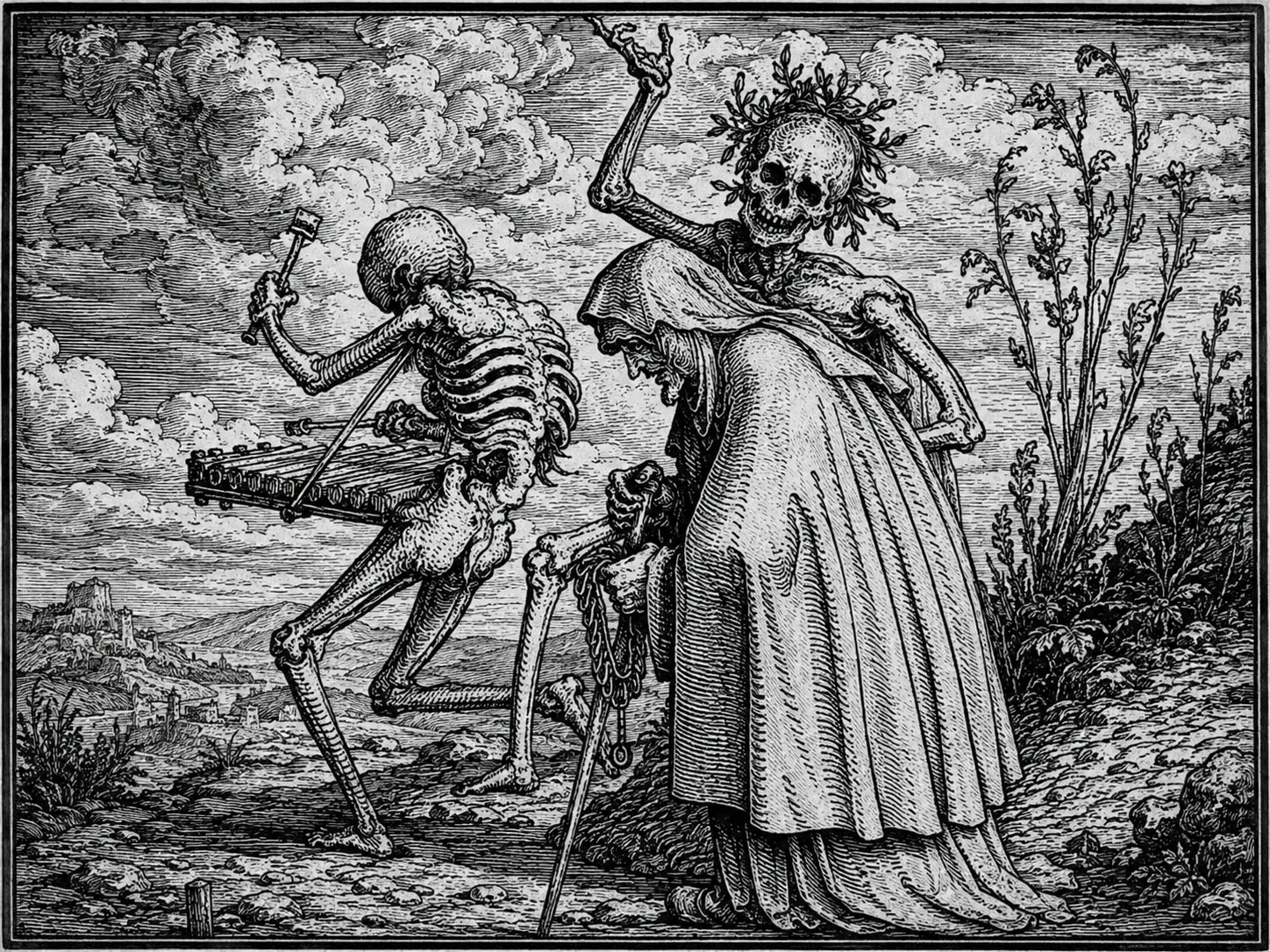
Contrary to modern depictions of pale phantoms or skeletal zombies, historical records describe revenants as grotesque figures. Twelfth-century sources portray them as bloated corpses with distended, purplish skin. Modern portrayals often show the undead as thin or bloodless. Still, original folklore describes the revenant as engorged with stagnant blood, which could erupt from its mouth and nose if its chest was pierced.
The creature moved with a heavy, dragging sound and gave off a stifling stench of decay that could sicken those nearby. A lesser-known detail from early accounts is that its burial shroud or clothing was often found shredded and chewed.
This was believed to occur because the revenant would gnaw at its own grave clothes while trapped underground, a sign of its unnatural hunger before emerging.
Myths, Legends, and Stories
The narratives surrounding the entity are preserved primarily in two extraordinary 12th-century Latin text traditions: William of Newburgh’s Historia Rerum Anglicarum and Walter Map’s De Nugis Curialium. These accounts are not vague fairy tales but are presented as sober, well-documented historical events that took place across the windswept landscape of medieval Britain.
While popular modern anthologies often gloss over these tales as generic ghost stories, the original records detail graphic, localized battles between terrified villagers and the literal walking corpses of their neighbors.
Perhaps the most famous account is from Buckingham, where a wicked man was buried, only to return three nights later. He entered his widow’s room, trying to crush her with his weight. When she escaped, he wandered the streets, attacking others, until the local bishop intervened by placing a letter of absolution on the corpse.
A darker, lesser-known account from the Scottish borders tells of the Vampire of Melrose, a priest known for his misdeeds. After dying unrepentant, his corpse was said to escape its tomb beneath Melrose Abbey, stalking his former mistress and lingering outside her door with a foul, pestilential breath.
The story’s climax came when four monks stood guard over the grave. At midnight, as the three rested, the revenant clawed its way out. One monk, overcome with fear, struck its shoulder with an axe. The creature groaned and retreated into the grave, which closed over it.
The next day, the monks exhumed the grave and found the body with a fresh axe wound and surrounded by blood. They carried it outside, dismembered it, and burned it, scattering the ashes to end the curse.
You may also enjoy:
Who Is the Demon Gäap? Powers, Rituals, and Origins
August 21, 2025
Who Are the 72 Demons of the Ars Goetia?
July 16, 2026
Lamashtu: The Demon Goddess Who Preyed on Infants
August 22, 2025
Semyaza: The Fallen Angel Suspended Between Heaven and Earth
September 29, 2025
Who Is the Demon Valefor, the Treacherous Duke of Hell?
August 12, 2025
Can You Defeat a Revenant? Powers & Weaknesses
Destroying the revenant required understanding its supposed source of power. It was not magical, but driven by mechanical strength—its body filled with stagnant blood that gave it unnatural force.
Because the Earth had rejected the soul, decomposition stopped, leaving the body rigid and strong, which allowed the revenant to break barricades and overpower several people at once.
Traditional weapons were said to be useless, as the revenant felt no pain and its organs were dead—a sword or arrow would only spill dark fluid. Folklore claimed that only the complete destruction of the body could release its energy.
Historical accounts say true destruction required exhuming the corpse, decapitating it, removing the heart, and burning the remains to ash.
The vulnerability was linked to medieval beliefs about resurrection. Decapitation was thought to separate the will from the body, while burning destroyed the form entirely, breaking the revenant’s connection to the world.
Only by scattering the ashes in running water or to the wind was the curse believed to be fully broken, preventing the revenant from returning.
Revenant vs Other Monsters
| Creature & Lore | Danger Level & Behavior | Details |
| Draugr (Scandinavia) | Severe. It guards its burial mound by physically crushing intruders, dragging them into the earth, or driving them mad with supernatural dread. The entity can increase its size and weight at will to suffocate its victims. | Unlike typical spirits, a draugr retains its physical earthly treasures and its corpse smells overwhelmingly of cosmic decay, occasionally possessing the ability to predict the future or change its shape. |
| Nachzehrer (Germany) | High. It remains inside its grave, chewing its own shroud and body parts to cast a sympathetic psychic curse that causes its living family members to waste away and die. It can also cause a fatal plague by ringing church bells from afar. | Folkloric tradition states that a person would become a nachzehrer if they were the first individual in a village to die during a catastrophic outbreak of the plague. |
| Vrykolakas (Greece) | Severe. It knocks on the doors of unsuspecting villagers at night and calls out their names, causing anyone who answers to perish from a sudden wasting disease the following morning. It spreads terminal sickness and absolute terror through entire communities. | According to Greek lore, an iron nail driven straight through the reanimated corpse’s navel was considered the most effective way to pin the physical shell to its coffin forever. |
| Jiangshi (China) | High. It tracks humans entirely by sensing the movement of their breath, leaping forward with rigid limbs due to advanced post-mortem stiffness to violently strangle victims. Once caught, it ruthlessly extracts their qi, or vital life force. | Applying a paper talisman inscribed with Taoist incantations directly to the forehead of a jiangshi will instantly paralyze it. |
| Strigoi (Romania) | Extreme. It rises from the cemetery to drain the blood of its living relatives, slaughter local livestock, and command packs of wolves to destroy crops. The entity can also transform into predatory beasts to infiltrate locked homes. | Historically, individuals born with a caul—a piece of embryonic membrane covering the head—were feared to be destined to transform into a strigoi after death. |
| Vetala (India) | High. It takes possession of human corpses hanging in cemeteries or charnel grounds to stalk and murder travelers, drive people insane, or cause miscarriages. It takes perverse pleasure in tormenting mortals with cryptic, life-or-death riddles. | Because it occupies dead matter but is not human itself, a vetala possesses an uncanny, encyclopedic knowledge of past, present, and future events. |
Why the Corpse Refused to Rot
The legend of the walking dead has persisted as more than a precursor to modern horror. It also mirrored the deep social anxieties of the Middle Ages, when survival depended on trust and shared beliefs. The appearance of a revenant symbolized a profound breakdown of these bonds.
The revenant was seen as a physical sign of unresolved sin—a warning that personal malice or heresy could survive death and threaten the entire community. It gave form to the fears of disease and sudden death, providing a focus for collective anxiety and grief.
Though exhumations and pyres are now a thing of the past, the structure of these old tales remains a core part of modern horror. Medieval stories of relentless revenants inspired the survival-horror and psychological suspense genres.
The revenant myth survives because it speaks to a deep human fear: that the past is never truly buried and the wrongs we try to hide will return, demanding to be faced.
You may also enjoy:
Who Is Leonard, the Demon of Black Magic?
August 22, 2025
Who Is Lucifer? Names, Myths, Titles, and Powers
August 25, 2025
Tanuki Yokai: The Mischievous Spirit with Disturbing Powers
September 9, 2025
Sources
- Map, Walter. Walter Map’s De Nugis Curialium. Translated by Montague Rhodes James, historical notes by John Edward Lloyd, edited by E. Sidney Hartland, Cymmrodorion Record Series, no. 9, The Honourable Society of Cymmrodorion, 1923. Internet Archive.
- William of Newburgh. Historia rerum Anglicarum Willelmi Parvi. Edited by Hans Claude Hamilton, vol. 2, Londini, sumptibus Societatis, 1856. Internet Archive.
- Urbanski, Charity. The Wiley Lecture: Monsters in Anglo-Norman Historiography; Two Notes on William of Newburgh’s Revenants. The Haskins Society Journal 32 2020 Studies in Medieval History: Studies in Medieval History. Ed. Laura L. Gathagan, William North, and Charles C. Rozier. Boydell & Brewer, 2021. 133–148. Print. Haskins Society Journal.
- Young, Simon. Grant, ‘Twelve Medieval Ghost Stories.’ Academia.edu.
- Westerhof, Danielle Marianne. Aristocratic Executions and Burials in England c. 1150 – c. 1330: Cultures of Fragmentation. 2007. University of York, PhD dissertation. White Rose eTheses Online.
- Donne, John. The Sermons of John Donne. Edited by Evelyn M. Simpson and George R. Potter, vol. 10, University of California Press, 1962.
- Weiss-Krejci, Estella. 2005 Excarnation, Evisceration, and Exhumation in Medieval and Post-Medieval Europe. In Interacting with the Dead: Perspectives on Mortuary Archaeology for the New Millennium, Pp. 155-172. Edited by Gordon Rakita, Jane Buikstra, Lane Beck and Sloan Williams. University Press of Florida: Gainesville. JEB Gordon FM Rakita, Lane A. Beck Und Sloan R. 2005.
- Lindahl, Carl, John McNamara, and John Lindow, editors. Medieval Folklore: A Guide to Myths, Legends, Tales, Beliefs, and Customs. Oxford University Press, 2002. Internet Archive.
- Bane, Theresa. Encyclopedia of Vampires, Werewolves, and Other Monsters. McFarland & Company, 2010.
- Guiley, Rosemary Ellen. The Encyclopedia of Ghosts and Spirits. 2nd ed., Facts on File, 2000. Internet Archive.