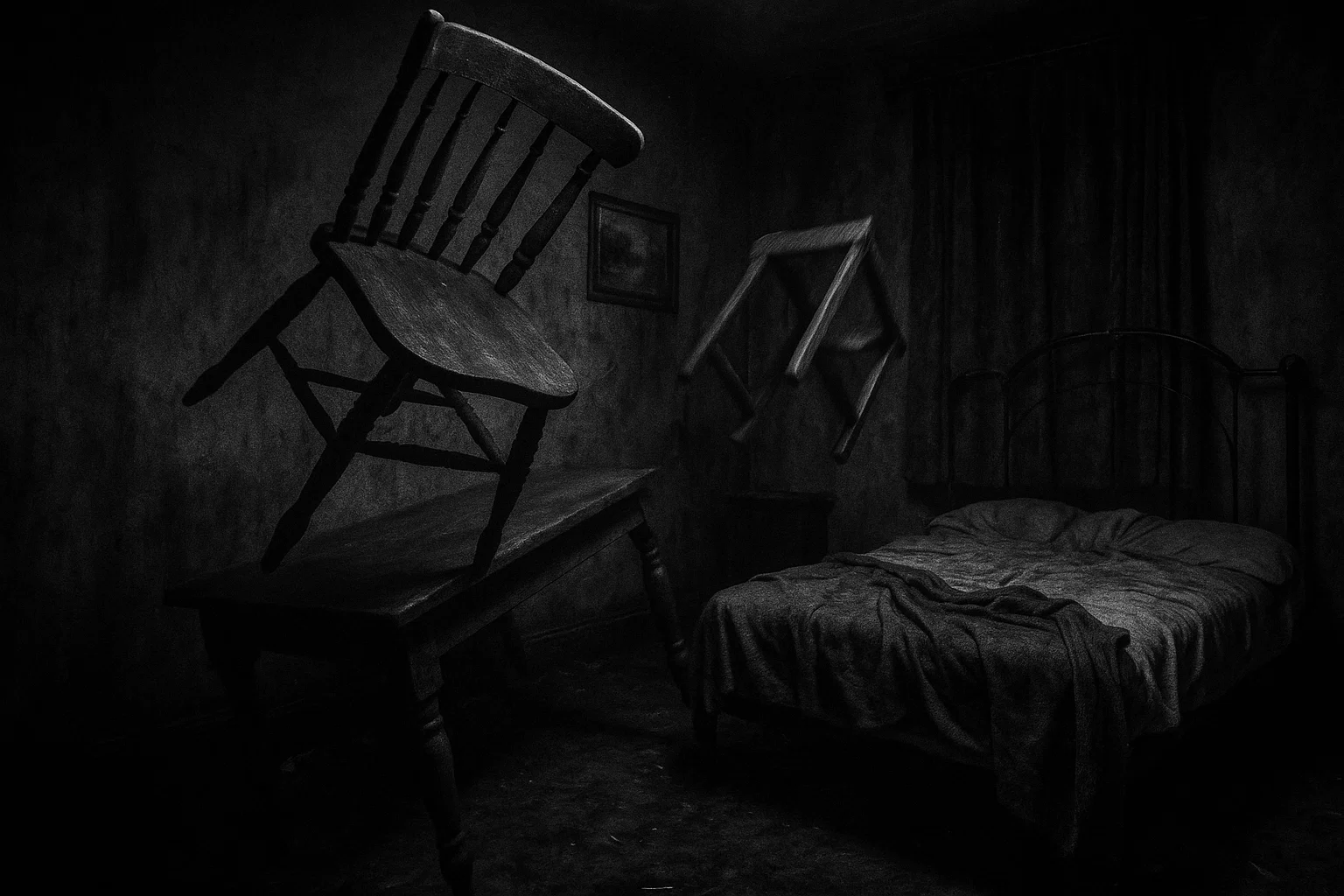
Among the many famous poltergeist cases in history, the Stockwell Poltergeist is remarkable—not because of a real ghost, but because it was one of the earliest and clearest examples of a hoax that fooled an entire community.
On January 6, 1772, in a quiet village just south of London, a widow’s home became the scene of flying dishes, crashing furniture, and strange noises. For one chaotic day, people believed a restless spirit was at work. But the truth was far more human.
Summary
Key Takeaways
| Attribute | Details |
| Name | Stockwell Poltergeist; The Stockwell Ghost |
| THC Scale | N/A [See the THC Scale Explanation] |
| Location / Origin | Stockwell, London, United Kingdom (specifically the home of Mrs. Golding) |
| Classification | Poltergeist |
| History | A series of violent kinetic disturbances beginning on January 6, 1772. |
| Casualties & Deaths | 0 historical deaths; 0 deaths attributed to the entity (Significant property damage only). |
| Manifestations | Physical (manipulation of household objects, breaking glass/china). |
| First reported sighting | January 6, 1772 |
| Recent reported sighting | January 7, 1772 (The event was a short-lived “burst” phenomenon). |
| Threat Level | N/A [See the Threat Level Explanation] |
| HCR | 10/10 (100 % proven fabrication) [See the Hoax Confidence Rating Explanation] |
| Access Status | Private. The original structures have long since been replaced by modern London developments. |
Historical Background
Stockwell in the 1700s
In 1772, Stockwell was a peaceful village in Surrey, just a few miles south of central London. It was surrounded by green fields, gardens, and small farms. The area had a few important buildings, including Stockwell Manor and the Tower public house, a popular local inn. Life was quiet—people worked the land, attended church, and gathered at the pub. The village was close enough to London to hear news from the city, but far enough to feel separate and safe.
The events took place in the home of Mrs. Golding, a widow who lived near the Tower pub. Her house was typical of the time: modest, two stories, with a kitchen, parlor, and cellar. It was a normal, orderly home—until January 6.
The People Involved
- Mrs. Golding: An elderly widow, respected in the community, who lived alone and hired help for housework.
- Ann Robinson: A teenage maid, around 18 or 19, hired by Mrs. Golding to cook, clean, and run errands. Little is known about her background.
- Mr. Gresham: A neighbor who owned a nearby house and offered shelter when things got strange.
- Mrs. Pain: A relative of Mrs. Golding who visited during the chaos and saw many of the events.
- Richard Fowler: Another neighbor who tried to help and stayed late into the night.
- Mr. Rowlidge: A local carpenter called in to check if the house was falling apart.
Other villagers, including a constable and curious locals, also got involved as word spread.
Beliefs of the Time
In the 1700s, many people in England believed in ghosts, witches, and spirits. Stories of haunted houses and noisy ghosts—called poltergeists (from German words meaning “noisy spirit”)—were common in books, newspapers, and sermons. People often blamed strange noises or moving objects on the dead or the devil.
This belief made it easy for unusual events to be seen as supernatural. Even educated people sometimes accept ghost stories. So when things started flying in Mrs. Golding’s house, no one immediately thought it was a trick.
You may also enjoy:
Alastor: Greek Avenger Turned Executioner of Hell
August 13, 2025
The 16 Most Haunted Places in Alabama
September 17, 2025
Anamelech: The Forgotten Lunar Demon of Ill Omens
August 16, 2025
What Happened on January 6, 1772
The Stockwell Poltergeist incident lasted only one day—January 6, 1772—but it was a whirlwind of destruction, confusion, and growing suspicion that unfolded over roughly 16 hours. What began as a few strange noises in a quiet widow’s kitchen quickly escalated into a full-blown storm of flying objects, loud crashes, and bizarre phenomena that followed the residents from one house to the next.
The timeline below is reconstructed from the detailed eyewitness accounts in the 1772 pamphlet An Authentic, Candid, and Circumstantial Narrative of the Astonishing Transactions at Stockwell, as well as later historical summaries.
Mrs. Golding’s House (10:00 a.m.)
The morning started like any other in the modest two-story home of Mrs. Golding, a respectable widow in her late 60s or early 70s. She and her teenage maid, Ann Robinson, were in the kitchen preparing the day’s meals when, around 10:00 a.m., the first unmistakable sign of trouble appeared.
A delicate china cup resting on a high shelf suddenly slid forward on its own and tumbled to the stone floor, shattering with a sharp crack. Before Mrs. Golding could react, a saucer followed, then a heavy stoneware plate—each crashing in quick succession with enough force to send shards skittering across the room.
The destruction spread rapidly. A wooden wall clock, a prized possession with brass workings, tore free from its hook and plunged downward, its face smashing and gears scattering. From the nearby staircase came the metallic clatter of a tin lantern being ripped from its nail and flung down the steps, bouncing noisily as it went. Food joined the chaos: a loaf of bread was hurled from the table, a wedge of cheese knocked to the floor, and jars of jam and pickles toppled, spilling sticky contents everywhere.
Most alarming were the sounds—loud, violent bangs that seemed to come from inside the walls, the doors, or even the ceiling, as if someone were pounding with a hammer from unseen places.
Mrs. Golding later recalled in the pamphlet: “I was in the kitchen when the cup fell without any visible cause; immediately after, the saucer and a large stone plate followed, breaking to pieces with great noise. I was so frightened I thought the house was falling.”
She had recently paid for repairs in the attic and feared the structure was failing. In a panic, she sent Ann to fetch Mr. Rowlidge, the local carpenter. He arrived within minutes, climbed the stairs, tapped beams, and checked joints, but found no cracks, shifts, or signs of settling.
He told her, as quoted: “There is no appearance of the house being in danger of falling; the timbers are sound.”
Still, he urged her to leave immediately for safety. Clutching a shawl and a few valuables, she and Ann hurried out the door and crossed the short distance to the neighboring home of Mr. Gresham.
Mr. Gresham’s House (12:00 p.m.)
By noon, Mrs. Golding and Ann had settled into Mr. Gresham’s spacious kitchen, hoping the danger had been left behind. But within minutes, the same inexplicable events resumed—this time in a completely different building.
A fresh egg perched on a high dresser shelf suddenly launched forward, sailing eight to ten feet through the air before striking the household cat squarely on the head and bursting open. Moments later, a ceramic teapot rose from the table as if lifted by an invisible hand, flew several feet, and landed with a thud directly on Ann’s foot.
Remarkably, she showed no pain, no surprise—just a calm shrug and the casual remark, later recorded by witnesses: “These things happen sometimes.”
The onslaught continued. Brass candlesticks toppled from the mantel, glass tumblers slid off shelves and shattered, and a heavy mortar and pestle clattered to the floor. Mrs. Pain, Mrs. Golding’s niece, had just arrived to check on her aunt and witnessed the teapot incident firsthand. She later wrote: “I saw the teapot fly from the table and strike Ann Robinson on the foot; she did not cry out, but said calmly, ‘It is nothing new.’”
The kitchen filled with the same deafening bangs and crashes that had plagued the first house. Yet a subtle pattern began to appear: whenever Ann stepped out briefly—to fetch water from the well or answer the door—the disturbances stopped completely. The moment she re-entered the room, objects resumed their violent dance.
Mr. Gresham noted in his statement: “When Ann was sent out of the room, all was quiet; upon her return, a candlestick fell with violence.”
Things Get Worse (3:00 p.m.)
By mid-afternoon, word of the strange events had spread through the village, and Richard Fowler, a sturdy and skeptical neighbor, arrived to help. He entered Mr. Gresham’s parlor determined to get to the bottom of the mystery.
Almost immediately, a thick book flew off a shelf and struck the wall beside him. A wooden chair tipped over backward with no one near it. Fowler, armed with a walking staff, tried to intercept the flying objects—he lunged for a pewter mug that had just left a side table, but it seemed to change direction mid-air, evading his grasp and clattering harmlessly to the floor.
The group experimented informally: they asked Ann to leave the room again, and once more, silence fell. When she returned, a candlestick rattled, then launched itself across the table.
Fowler later testified: “I saw a mug move from the table as if pushed by an unseen hand; I reached for it, but it turned in the air and fell beyond my grasp. This happened only when the girl was present.”
Ann moved about the room helping to sweep up broken glass and right overturned chairs, always calm, always unharmed—even when a heavy glass decanter grazed her shoulder. Her composure stood in bizarre contrast to the growing panic around her. Mrs. Pain observed: “Ann was never hurt, though things fell near her or upon her; she seemed unmoved, while we were all in terror.”
Back at Mrs. Golding’s House (6:00 p.m.)
As evening approached, Mrs. Golding insisted on returning home to assess the damage and secure her belongings. Escorted by Mr. Gresham, Mrs. Pain, Richard Fowler, and Ann, she cautiously re-entered her house.
The group first descended to the cellar, where they were met with a shocking sight: a massive nine-gallon oak beer keg, bound with iron hoops and too heavy for one person to lift easily, lay upside down. Its entire contents had poured out, flooding the stone floor with ale and filling the air with a yeasty stench. Nearby, a wooden bucket of water was bubbling furiously—as if boiling over an invisible flame—though the hearth upstairs had been cold all day.
Mr. Gresham described the scene: “We found the nine-gallon cask turned bottom upwards, and the beer running about the cellar; a pail of water was boiling, though no fire had been near it.”
Upstairs in the parlor, the scene was equally bizarre. A solid mahogany tea table, a substantial piece of furniture, had been flipped completely over, its legs pointing toward the ceiling. A box of tallow candles stored on a high shelf had fallen, scattering wax sticks like kindling.
The same loud bangs echoed again, and a final glass tumbler slid off a windowsill and shattered. Mrs. Golding lamented: “My best tea table was turned over, and the candles thrown down—everything in confusion.”
Throughout the inspection, Ann lingered at the edge of the group—ostensibly helping, yet always present when something moved. The escorts tested their theory once more: they sent Ann to the garden for a few minutes, and the house fell silent. When she stepped back inside, a chair scraped across the floor on its own.
Richard Fowler later wrote: “When Ann was sent into the garden, all was still; the moment she returned, a chair moved violently across the room.”
You may also enjoy:
Who Is the Demon Amy (Avnas) in the Ars Goetia?
April 28, 2025
July 1, 2026
Complete Guide to Wisconsin Bigfoot Sightings (1867–2025)
August 10, 2025
The Night Ends (1:00 a.m.)
The vigil dragged into the early hours. By 1:00 a.m., Richard Fowler—exhausted, shaken, and unwilling to spend another minute in the unnerving atmosphere—muttered an excuse and left for home. He later admitted: “I could bear it no longer; I left the house at one in the morning, greatly terrified.”
A handful of final incidents occurred: a faint knock from the pantry, one last glass shattering in the kitchen. But by 2:00 a.m., the house was finally still. Mrs. Golding reflected in her statement: “Between ten in the morning and two at night, we were in continual alarm; when it ceased, we were worn out with fear and watching.”
The day’s frenzy had run its course, leaving two households in disarray—floors slick with spilled liquids, air thick with plaster dust from cracked walls, and shelves stripped bare of crockery. No one had been seriously injured, but the physical and emotional toll was immense. Sixteen hours after it began, the “poltergeist” was gone—waiting only for the next day’s confrontation to reveal its true nature.
How the Mystery Was Solved
The chaos of January 6 left everyone exhausted, confused, and desperate for answers. By the morning of January 7, the broken dishes, spilled beer, and overturned furniture were still there—but the “ghost” was gone.
What followed was a careful, step-by-step investigation driven by the residents themselves. They didn’t have modern forensic tools, but they used common sense, close observation, and direct questioning to uncover the truth.
Patterns No One Could Ignore
Even during the height of the panic, a few people had started to notice something strange. The disturbances didn’t happen randomly—they followed a clear pattern:
- Everything stopped when Ann left the room. If she stepped outside to get water or run an errand, the banging, crashing, and flying objects instantly ceased. The moment she came back, the chaos started again.
- Ann was never seriously hurt. Heavy teapots, candlesticks, and mugs flew toward her, but they either missed or landed lightly. She never cried out in pain or showed fear.
- She stayed calm the whole time. While Mrs. Golding, Mrs. Pain, and the others were terrified, Ann acted as if it were just another day. She even helped clean up broken glass without flinching.
These observations weren’t made all at once—they built up over the 16-hour ordeal. By evening, Richard Fowler and Mr. Gresham were openly discussing it. Fowler later wrote in the pamphlet: “I observed that whenever the girl was absent, all was quiet; upon her return, something always moved or fell.” Mrs. Pain added: “Ann was struck several times, yet she showed no sign of pain or surprise—unlike the rest of us, who were in constant fear.”
These weren’t just hunches. The group began testing the idea on purpose. They would send Ann to another room or outside to the garden, and the house would fall silent. When she returned, a chair would scrape, a glass would fall, or a loud knock would echo from the wall. After several of these tests, the conclusion was unavoidable: whatever was causing the trouble was tied directly to Ann Robinson.
The Confrontation
The next morning, Mrs. Golding gathered everyone who had witnessed the events: Mr. Gresham, Mrs. Pain, Richard Fowler, and a few trusted neighbors. They sat Ann down in the parlor and asked her directly: “Are you doing this?”
At first, Ann denied everything. She claimed she was just as scared and confused as they were. But the group wasn’t convinced. They laid out the evidence:
- The activity only happened when she was present.
- She was never injured.
- Objects seemed to “follow” her from one house to the next.
They also pointed out something new: during the cleanup, they had found thin scratches on shelves where strings might have been tied, and small pieces of horsehair caught in cracks—exactly the kind of material that could be used to pull objects from a distance.
Under pressure—and with no way to explain the pattern—Ann finally broke. She admitted: “It was me. I did it all.”
How She Did It
Once Ann confessed, she explained her methods in detail. She had been planning the hoax for days, using simple yet clever tricks that exploited distraction, timing, and the era’s belief in ghosts. Here’s exactly how she pulled it off:
Strings and Horsehairs: Ann used thin horsehairs (strong yet nearly invisible) and fine threads tied to lightweight objects such as cups, saucers, and candlesticks. She attached them to shelves or tables in advance, running the lines through small cracks or under furniture. With a quick tug—hidden by a turn of her body or a moment when no one was looking—she could make items slide or fall.
Hand-Thrown Objects: For heavier items like the teapot or pestle, she used sleight of hand. When everyone was focused on one part of the room (like a loud bang she made by kicking a door), she would quickly grab and toss an object. The motion was fast and disguised by the chaos.
Pre-Set Traps: Ann loosened shelves, balanced items on edges, or placed objects where a small push (from her foot or elbow) would send them crashing. She also used vibrations—tapping the floor or wall—to trigger unstable items.
Sound Effects: The loud bangs? Ann created them by slamming doors, kicking walls, or dropping heavy objects behind furniture when no one was looking. In a wooden house, sounds traveled and seemed to come from everywhere.
The Bubbling Water (Still a Mystery): The bucket of water that appeared to boil without heat remains the one trick Ann never fully explained. Some historians believe she added quicklime (a chemical that reacts with water to produce heat and bubbles) or stirred it rapidly with a hidden stick just before the group entered the cellar. Others think it was a combination of both.
Ann practiced these tricks in secret, testing them when Mrs. Golding was out or asleep. She chose January 6 because she knew the widow would be home all day—and because recent attic repairs gave her the perfect excuse to blame “structural failure.”
Why Did She Do It?
Ann never gave a clear reason, but the witnesses and later writers offered several theories:
- Boredom and frustration. As a teenage maid in the 1700s, Ann had little freedom, no education, and no future beyond endless housework. Causing chaos may have been her way of feeling powerful.
- Attention. She was ignored most of the time. Suddenly, everyone was focused on her—even if it was out of fear.
- Resentment. She may have disliked Mrs. Golding or the strict rules of servant life.
In her confession, Ann reportedly said: “I wanted to see what would happen. I didn’t think it would go so far.”
You may also enjoy:
Pope Lick Monster: Louisville’s Most Haunted Cryptid
September 26, 2025
Why Lumley Castle Is One of England’s Most Disturbing Hauntings
January 12, 2026
15 True Ghost Stories You Shouldn’t Read Alone After Midnight
October 20, 2025
Empusa: The Seductive Demon That Devoured Men
October 3, 2025
Siren: The Haunting Monster That Lured Sailors to Death
October 31, 2025
The Stockwell Poltergeist Case File
The Stockwell Poltergeist case, although revealed to be a complete hoax, is a significant historical case study in the dynamics of poltergeist claims, the behavior of the alleged focus person, and the rapid spread of sensationalized information in the 18th century.
The unique elements center on the baffling phenomena that appeared to defy simple explanation and the method by which the perpetrator, the maid Ann Robinson, managed to maintain the illusion for a full day.
Transference (The Poltergeist’s Mobility)
A signature element of the Stockwell case was the alleged mobility or transference of the poltergeist. The initial disturbance began at Mrs. Golding’s residence, forcing the household to relocate to Mr. Gresham’s nearby home.
Remarkably, the violent activity, involving flying objects and loud noises, immediately recommenced after Ann arrived at the new location. This apparent ability of the entity to follow the focus person across a physical boundary was noted by witnesses, including Richard Fowler. It was even seen as a sign of an intelligent haunting targeting a specific individual.
In reality, the transference was a key piece of circumstantial evidence for the hoax, showing that the physical cause of the phenomena (Ann Robinson) was directly linked to the location of the activity, regardless of the house in question.
The Bubbling Water Anomaly
Among the physical manifestations, the events observed in Mrs. Golding’s cellar remain a long-lasting anomaly. Witnesses reported finding a large nine-gallon beer keg overturned with its contents spilled and, crucially, a pail of water boiling furiously without any visible heat source nearby.
Although the overturned keg was later attributed to Ann pushing it, the spontaneous boiling of the water was difficult for contemporary witnesses to reconcile with a simple hoax.
This specific anomaly required a sophisticated method on the maid’s part. Or, more likely, involved a combination of psychological misinterpretation and pre-staged activity in the dark cellar, taking advantage of the witnesses’ pre-existing terror and the lack of scientific scrutiny.
The 1772 Pamphlet
The entire case is meticulously preserved due to the immediate publication of An Authentic, Candid, and Circumstantial Narrative of the Astonishing Transactions at Stockwell. This pamphlet, compiled from the testimonies of multiple witnesses, including Mrs. Golding, Mr. Gresham, and Mrs. Pain, served as the primary documentation of the case.
Its rapid distribution was instrumental in establishing the legend. Yet the document itself contains the key contradictory observation—namely, that the activity ceased immediately when Ann Robinson was sent from the room.
Because of that, the pamphlet serves a dual purpose: it sensationalizes the alleged haunting while simultaneously providing structured eyewitness evidence that allows investigators to expose the fabrication.
Comparisons to Other Poltergeist Cases
The Stockwell Poltergeist wasn’t a one-of-a-kind deal—other spooky stories from the same era had people scratching their heads, too. Let’s break down how it stacks up against three big ones from the 1600s and 1700s: the Cock Lane Ghost (1762), the Epworth Poltergeist (1716), and the Tedworth Drummer (1662–1663).
1) Cock Lane Ghost (1762): Just a decade before Stockwell, this London haunting had the city buzzing. It centered on a girl named Elizabeth Parsons, who supposedly got messages from a ghost through mysterious knocks in her family’s home on Cock Lane. Crowds showed up, and big names like Samuel Johnson checked it out.
Like Stockwell, it turned out to be a scam—Elizabeth’s dad was behind it, trying to scam money and settle grudges. Both cases fooled tons of people with simple tricks (knocks vs. flying objects) and were exposed when someone noticed the “ghost” only showed up when a specific person was around. The big difference? Cock Lane was a family hustle, while Ann Robinson flew solo in Stockwell.
2) Epworth Poltergeist (1716): This one hit the Wesley family’s home in Lincolnshire, England, where John Wesley (future Methodist founder) grew up. For weeks, the house was plagued by weird knocks, footsteps, and objects moving around—like a goblet that jumped off a shelf. The family called the spirit “Old Jeffrey,” and some thought it was a prank by a servant or one of the kids. Sound familiar?
Like Stockwell, the Epworth case had a young person (maybe a servant) under suspicion, and the disturbances were physical—think moving stuff, not just creepy vibes. But unlike Ann’s clear confession, nobody ever pinned down who (or what) caused Old Jeffrey’s antics, leaving it a bit more mysterious.
3) Tedworth Drummer (1662–1663): Way back in Wiltshire, England, a guy named John Mompesson blamed a drummer for stirring up trouble after a dispute. Soon, his house was a mess—drums beating at night, objects flying, and even kids getting levitated (or so they said). People thought it was a curse or a spirit tied to the drummer.
Stockwell’s similarities are clear: both had physical chaos (flying stuff, loud noises) and a single person tied to the trouble (Ann vs. the drummer). The Tedworth case leaned heavily on demonic vibes, though, and never got fully debunked like Stockwell’s clean-cut hoax. Plus, Tedworth dragged on for months, not one wild day.
These cases show a pattern: back in the day, poltergeists were the go-to explanation for anything that went bump in the night. Stockwell stands out for Ann’s solo act and quick confession, but all four stories reveal how easy it was to spook folks—and how often someone was pulling the strings behind the scenes.
| Name | Location | Type of Haunting | Activity Level |
| Enfield Poltergeist | Enfield, UK | Poltergeist | 2 (dormant) |
| Black Monk of Pontefract | Pontefract, UK | Poltergeist | 4 (occasional) |
| Rosenheim Poltergeist | Rosenheim, Germany | Poltergeist | 1 (dormant) |
| Bell Witch | Adams, Tennessee, USA | Intelligent/Poltergeist | 3 (dormant) |
| Epworth Rectory Ghost | Epworth, UK | Poltergeist | 1 (dormant) |
| South Shields Poltergeist | Tyne and Wear, UK | Poltergeist | 2 (dormant) |
| Mackenzie Poltergeist | Edinburgh, Scotland | Poltergeist/Curse | 9 (very active) |
| The Battersea Poltergeist | London, UK | Poltergeist | 2 (dormant) |
| Thornton Heath Poltergeist | London, UK | Poltergeist | 1 (dormant) |
| Miami Poltergeist | Florida, USA | Poltergeist | 1 (dormant) |
Final Thoughts
The Stockwell Poltergeist was not a ghost story—it was a human story. A clever teenage maid used simple tricks to create a day of terror that fooled experienced adults. The case shows how fear, belief, and distraction can make the impossible seem real.
More than 250 years later, it remains a reminder: always look for the person behind the poltergeist. Sometimes the scariest thing isn’t a spirit—it’s a bored teenager with a string and a plan.
You may also enjoy:
Was Manuel Blanco Romasanta Really a Werewolf?
June 18, 2025
Is The Anguished Man Painting Truly Cursed?
May 26, 2025
Sources
- Mackay, Charles. Memoirs of Extraordinary Popular Delusions and the Madness of Crowds. Vol. 1, Richard Bentley, 1841. Internet Archive.
- Hone, William. The Every-Day Book; or, Everlasting Calendar of Popular Amusements, Sports, Pastimes, Ceremonies, Manners, Customs, and Events. Vol. 1, Hunt and Clarke, 1826. Internet Archive.
- Crowe, Catherine. The Night Side of Nature; or, Ghosts and Ghost Seers. Vol. 2, T.C. Newby, 1848. Internet Archive.
- Rutkowski, Pawel. Broken China and Flying Teapots: The Stockwell Ghost and the Spectacle of Fear. Emma Harris, Grażyna Bystydzieńska (Eds.), From Queen Anne to Queen Victoria. Readings in 18th and 19th Century British Literature and Culture, Vol. 5, Uniwersytet Warszawski, Instytut Anglistyki – Pracownia “Ośrodek Studiów Brytyjskich”, 2016.
- Pirvulescu, Sergiu. (2021). The existence of paranormal phenomena. ResearchGate.
- Waldron, David, and Sharn Waldron. Playing the Ghost: Ghost Hoaxing and Supernaturalism in Late Nineteenth-Century Victoria, Australia. Folklore, vol. 127, no. 1, 2016, pp. 71–90. JSTOR, http://www.jstor.org/stable/24774364. Accessed 12 May 2026.