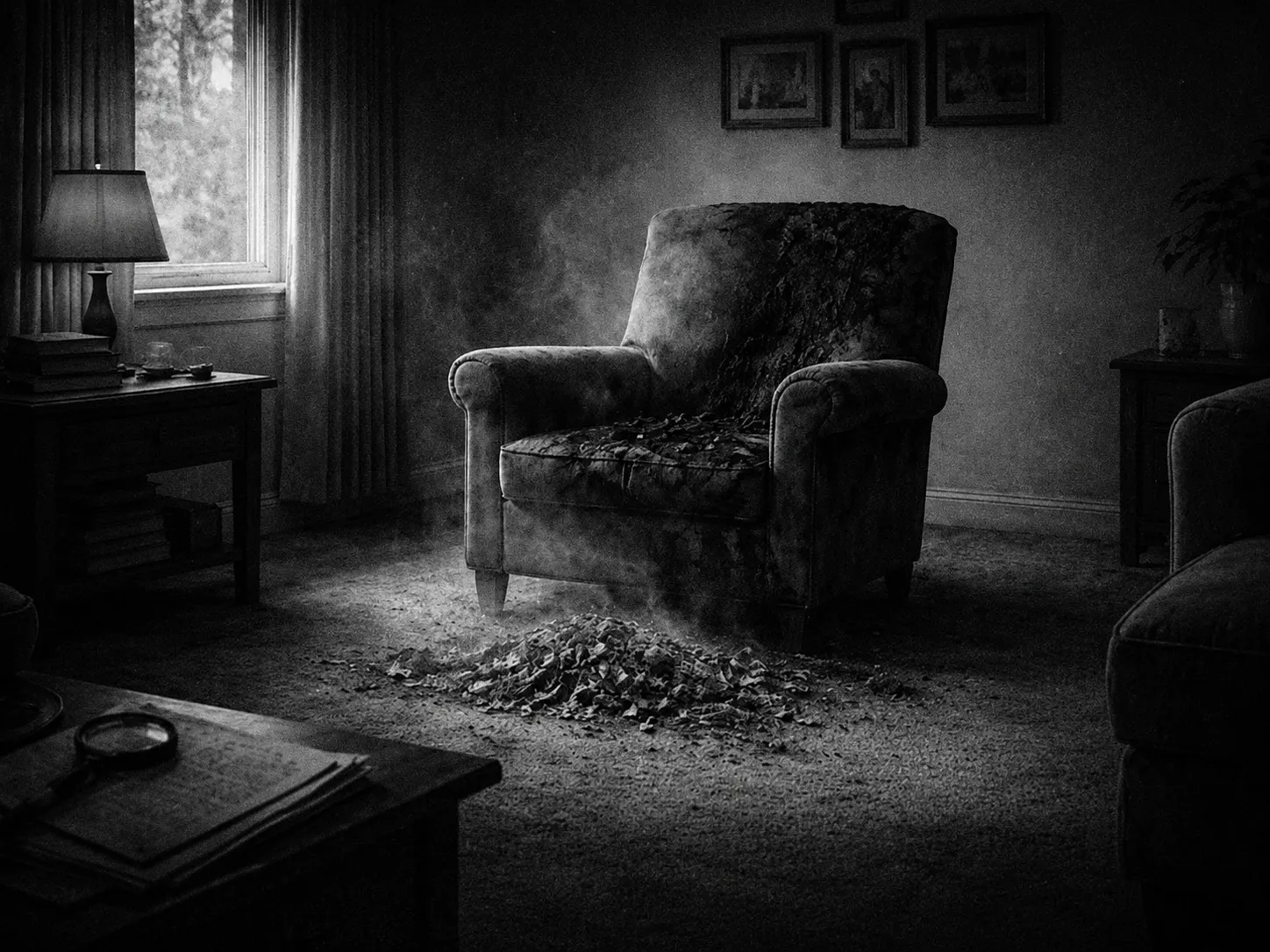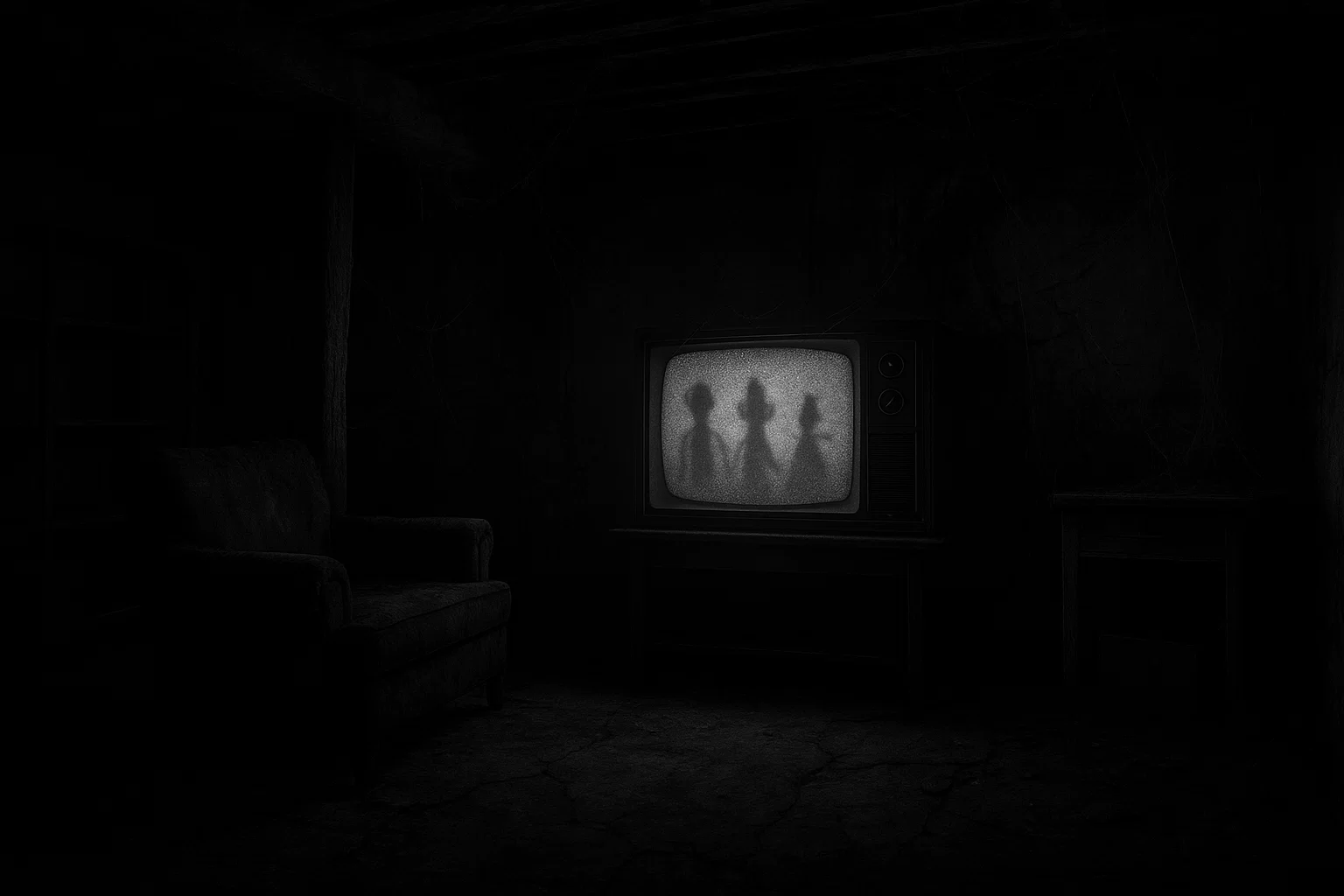
Some of the most disturbing internet horror stories aren’t about monsters at all. They’re about memory turning out to be unreliable in the worst possible way. Hollow Hour is an original creepypasta-style short horror story about a lost regional children’s show, a coastal town that quietly erased its own name, and a forum thread that seems to be calling something back just as much as it’s bringing old viewers together.
Story File
| 👁️ Title | Hollow Hour |
| 🪶 Author | Razvan Radu |
| 🪦 Genre | Creepypasta / Found-Footage Horror / Short Horror Story |
| 🏷️ Themes | Childhood Nostalgia, Forgotten Media, Coastal Folklore, Memory, Online Forums, Ancient Presence |
| ⏳ Read Time | 10 minutes |
| ☠️ Warnings | Disappearance, intense dread, themes of missing persons, disturbing imagery, ambiguous/unresolved ending |
| 📜 The Lore | A half-remembered children’s show from a decommissioned coastal town turns out to have been watching its viewers as closely as they watched it. |
| 🎬 The Scoop | A woman stumbles on a forum thread about a children’s show she’d forgotten for twenty-two years, and the more she and other forgotten viewers remember, the more something at the coast seems to be listening. |
Dana Whitfield was thirty-one when she found the thread. She was half-asleep on her phone at one in the morning, scrolling through a nostalgia forum called BackChannel where people exchanged memories of regional cable access shows that nobody else seemed to remember.
The post that made her stop scrolling read simply: “Did anyone else watch Hollow Hour on Channel 14 out of Marsten?” Underneath, there was a description that made her guts wrench before she even finished reading.
It was a low-budget children’s program about a lighthouse keeper’s daughter who solved riddles from a tide-worn puppet called the Wickman. His face was carved from driftwood, and his voice had a wet, creaking rasping that asked the same question at the end of every episode: “What did the water bring you tonight?”
She hadn’t thought about Hollow Hour in twenty-two years. Before she even realized it, she wrote a reply. She described the lighthouse set with its peeling paint, the girl puppet named Birdie with her too-wide painted smirk, and the tide pool segment where viewers were supposed to mail in drawings of “what the water brought.” Birdie would read them aloud in a voice that, episode by episode, sounded more like pleading than performing.
Replies came quickly, and that was the first wrong thing. It wasn’t just that people remembered the show, but how exactly they remembered it. Total strangers from three states away described the exact sound of the Wickman’s wooden joints and the exact cadence of his question.
There was even a detail Dana hadn’t mentioned and hadn’t seen anyone else mention yet: in the later episodes, the tide pool drawings stopped showing seashells and starfish. Instead, they became drawings of houses with blacked-out windows, family members with their mouths sewn shut, and other careful images that none of the children could have explained if you’d asked them why.
A user named Coastline_Tom posted that his older sister had appeared on the show once and was called up to read her own letter on air. After that, she came home different—quieter —and she would stand at the back window, facing the water, for hours. A few years later, she simply wasn’t in any of the family photos anymore, and nobody in the house ever explained why. It was the kind of thing you don’t explain when everyone has quietly agreed not to remember it clearly.
Dana called her mother that week, just like the thread seemed to be making everyone call someone. She asked, carefully, if her mother remembered Hollow Hour. Her mother’s voice became strange and small over the phone. “You used to send things in,” she said. “Drawings, for the tide pool segment. I never let you mail them, though. I burned every one before they left the house. I never told you why I knew to do that. I just knew.”
The thread kept growing, and a pattern started to appear. None of the posters seemed to notice it together, but each mentioned it on their own: everyone who remembered Hollow Hour had grown up within forty miles of a stretch of coastline near Marste.
Depending on which old maps you found, this area was sometimes labeled with a town name and sometimes just marked, in smaller and older print, as Drowned Point. Locals apparently stopped using that name on signs sometime in the 1970s, but no one could say exactly why. It seemed as if some words just fell out of a town’s vocabulary over time and were never picked up again.
Dana drove out there on a Saturday, mostly to prove to herself that the nervousness in her chest was just nostalgia combined with too many late nights reading the forum. Marsten greeted her the way towns greet people chasing a half-memory: it was smaller than she recalled, quieter, and the local cable provider had long since been absorbed into a regional company. There were no records of any Channel 14 programming from the era she asked about.
A young clerk told her, apologetically, that the archive for anything before 1995 had been “lost in a flood, actually, kind of a running joke around here.” His tone suggested it wasn’t really a joke, just the only way anyone could say the truth out loud without having to mean it.
She found the lighthouse easily enough. It had been decommissioned for decades, its light long gone, and its base was surrounded by tide pools that, forty years ago, might have been called a set for a children’s show.
Down at the water’s edge, half-submerged and bleached pale by years of salt and sun, she found a piece of driftwood shaped in a way her tired mind immediately and unwillingly saw as a face. It had a long jaw, two deep hollows in which eyes might have been carved, and the wood’s grain ran in a pattern that, from just the wrong angle, looked like a closed and patient mouth.
She didn’t touch it. Instead, she took a photo, her hands quivering so much that three out of four pictures were blurred. She drove home with the one clear photo shining on her passenger seat the whole way. For reasons she couldn’t explain, she refused to look directly at her phone’s screen for longer than it took to check the road.
That night, the forum thread had grown to nine hundred replies. Somewhere in the middle, a new account with no post history asked a single question that stopped every other conversation at once: had anyone else noticed that the question Birdie used to ask—what did the water bring you tonight—had started appearing in their own dreams? It was asked in a voice that wasn’t Birdie’s cheerful, painted performance, but something more ancient, wetter, and completely uninterested in a cheerful answer.
Dana fell asleep with her photo still open on her phone, face-up on the nightstand. She woke at 3 a.m. to a sound she would later struggle to describe as anything but what it was: the patient, rhythmic moan of old wooden joints, very close by. The sound moved with the calm confidence of something that had waited a long time for an invitation and had finally, after twenty-two years, received one.
She understood, just before the fear set in, that a photograph of a question is still, in its own way, an answer. Somewhere down at Drowned Point, something had been listening every time someone replied to that thread, cataloging each one the way Birdie used to catalog the drawings, sorting through which households had finally remembered enough to be worth a visit.
The forum went dark three days later. All nine hundred replies disappeared in a single server wipe that nobody at BackChannel could explain. Even the moderators seemed baffled and a little too willing to change the subject when asked.
Dana’s number stopped working not long after. Her mother filed a report that went nowhere, as these things typically do. The only trace anyone ever found was a single new post on a different, smaller forum months later. It came from an account with no history, describing—in detail overly precise to be mere guess—the exact moan of old wooden joints and the exact shape of a driftwood jaw.
The post ended by asking if anyone else remembered a show called Hollow Hour, if anyone else had ever sent something in to the tide pool, and if anyone else had ever really wondered what the water might still be planning to bring back.