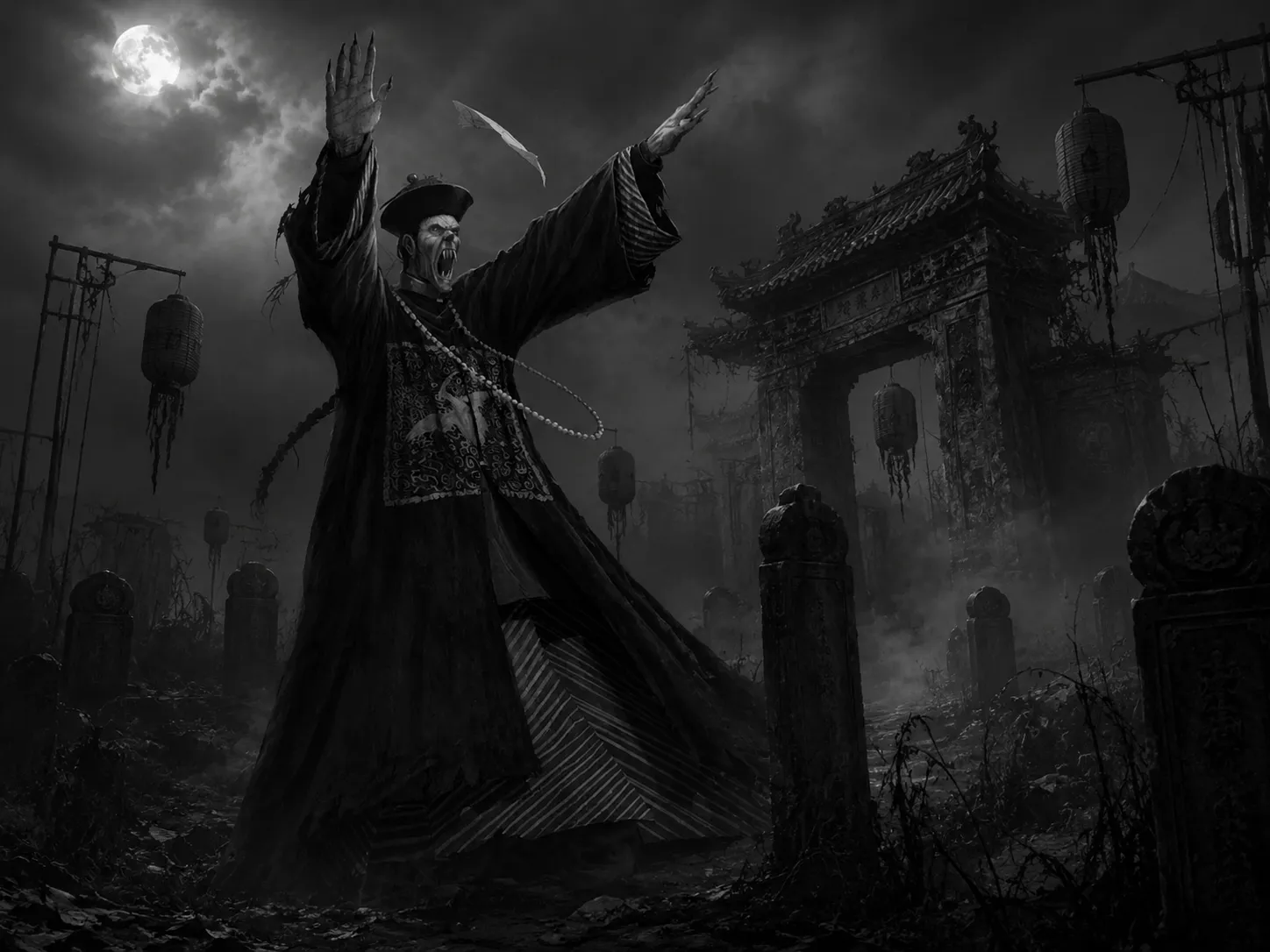
The Jiangshi (殭屍) is a reanimated corpse from Chinese folklore — a being of rigid limbs, voracious hunger, and bureaucratic attire that has haunted the Chinese imagination for centuries. Unlike the eloquent vampires of European folklore, this creature cannot bend its knees, cannot speak, and makes its way through the night entirely by sniffing out the breath of the living.
What makes this monster truly creepy is where it comes from: it isn’t born from ill will, but from neglect—being buried improperly, with entities trapped in decaying bodies that won’t break down. This idea, ingrained in literature from the Qing Dynasty and popularized by movies from Hong Kong, has turned the hopping corpse into a unique and profoundly fascinating monster in global folklore.
Summary
Overview
| Category | Details |
| Names & Etymology | Jiangshi (殭屍, Mandarin); also Geung-si (Cantonese), Cương Thi (Vietnamese), Kyonshī (Japanese), Gangsi (Korean); literal meaning: “stiff corpse.” Commonly mistranslated in Western marketing as “hopping vampire”—the vampire framing was popularized by Hong Kong cinema, not classical folklore. |
| Classification | Undead reanimated corpse; a distinct class of supernatural entity in Chinese cosmology, separate from the incorporeal ghost (guǐ, 鬼). Controlled variants fall under Taoist necromantic tradition; uncontrolled variants are classified as malevolent animated dead. |
| Species | Humanoid undead; corporeal and physically present, not spectral. Capable of biological evolution into more monstrous forms over time. |
| Origin of the Myth | Arises from the confluence of Qing Dynasty migratory labor culture and Taoist funerary tradition. Bodies of workers who died far from home could not always afford conventional transport; Taoist “corpse drivers” would reanimate and walk corpses home for burial. The spectacle of hopping cadavers traveling by night under priestly escort seeded the folklore. The supernatural creature also emerges from Chinese cosmological anxiety: a corpse whose soul’s lower component (the pò, 魄) was not properly released at death, trapping it in the body. |
| Earliest Record | The term jiangshi appears as early as the Han Dynasty in Sima Qian’s Records of the Grand Historian (c. 94 BCE), used descriptively for battlefield corpses. As a supernatural creature, the entity was first systematically classified in Yuan Mei’s Zi Bu Yu (子不語, c. 1788) and Ji Xiaolan’s Yuewei Caotang Biji (閱微草堂筆記, compiled 1789–1798, published 1800). |
| Habitat | Rests during daylight hours in coffins, sealed tombs, mountain caves, or any lightless enclosed space. Active at night across the rural landscapes and villages of southern and southwestern China—particularly the provinces of Fujian, Guangdong, and Jiangxi. By extension, wherever Chinese diaspora communities carried the folklore: Vietnam, Korea, Japan, and Southeast Asia. |
| Physical Profile | Human in shape but unmistakably wrong in presentation: arms permanently extended forward, legs fused together, neck and head completely immobile and locked forward. Skin is pale-grey to greenish-white, frequently mottled with decay, and may develop patches of white or silver fur in ancient specimens (a sign of accumulated yang energy). Long black fingernails. Wears the formal uniform of a Qing Dynasty official or bureaucrat. Emits a localized, physical cold before arrival. Completely blind; navigates entirely by detecting the exhaled breath of the living. |
| Diet | Primarily absorbs yang qi (陽氣)—the positive vital life-force exhaled by living beings. In later folklore and Hong Kong cinema, blood-drinking was added under Western vampire influence, but the original sources are consistent: the creature drains vitality, not blood. Victims are left drained of color and warmth, not necessarily exsanguinated. |
| Strengths | Immunity to conventional physical harm; extraordinary sensitivity to living breath (can track prey across distances by detecting exhalation); physical strength exceeding that of a living human; does not tire; does not feel pain; cannot be reasoned with or bargained with. Ancient specimens accumulate sufficient yang energy to run at speed rather than hop, and the oldest and most powerful are documented as capable of flight. Immune to most conventional weapons. |
| Weaknesses | Blind—holding one’s breath renders a person effectively invisible to the creature. Repelled by: sunlight (lethal); fire (confirmed in Zi Bu Yu as causing immediate violent reaction); Taoist fulu talisman affixed to the forehead (immobilizes it completely); the crow of a rooster (announces dawn, disrupts it); mirrors (reflects its own yang energy back at it); glutinous rice (its yin composition disrupts the creature’s yang saturation); peach wood (long associated in Chinese folk religion with protection against malevolent dead); hooves of a black donkey; vinegar (used by coroners in eastern Fujian); bagua symbols (the Eight Trigrams—the creature is compelled to attempt to count or comprehend them, halting its pursuit); the I Ching. |
| Threat Level | Level 3 — Apex Predator [See the Threat Level Guide] |
| Survival Odds | 35%. If you know how to hold your breath and have a Taoist talisman, your odds improve sharply. If you encounter one unprepared in darkness, at night, far from a rooster or a temple, you are statistically a corpse—and potentially its next recruit. |
| Warning | Do not travel alone through rural southern Chinese terrain at night—particularly near old burial grounds, abandoned inns, or mountain cave systems. Never leave a recently deceased person unattended and unburied. If you hear the rhythmic thumping of a single-gait hop approaching in darkness, stop breathing immediately. Do not exhale. Do not run. Do not look directly at it |
Who or What Is the Jiangshi?
The Jiangshi is essentially a class of undead creature — not a singular spirit or named individual, but an entire category of resurrected corpses capable of arising under a wide range of supernatural conditions. The word itself translates literally as “stiff corpse.” That physical stiffness is the defining biological fact of the entity’s existence.
However, the rigor mortis is not simply a cosmetic detail; it is the architectural prison of the Jiangshi’s being. The muscles and joints are locked into a state of terminal contraction, forcing the creature to keep its arms extended outward and its legs fused together — propelling itself forward only through a unceasing, rhythmic hopping.
What distinguishes the Jiangshi from other undead traditions is its metaphysical engine. In the Chinese cosmological concept, life is sustained by qi — the animating vital energy that circulates through all living things.
The Jiangshi does not hunger for blood in the romantic Carpathian sense; it hunts for yang qi, the positive, solar life force exhaled by the living with every breath, which makes the creature a predator not of flesh, but of vitality itself — a walking vacuum that drains the heat and energy from its victims, leaving them cold and depleted.
The creature also occupies a precise ecological niche within Chinese supernatural taxonomy. It is explicitly not a gui (鬼), the standard Chinese ghost, which is incorporeal and typically motivated by unresolved grievances. The Jiangshi retains its physical body — rotting, stiff, and increasingly monstrous, but emphatically corporeal.
The physical presence makes it uniquely dangerous: it can be touched, it can be struck, and it can be stopped — but only if you know the specific rules that govern it. Qing Dynasty scholars classified these creatures into grades, with freshly reanimated corpses occupying the lower rungs and ancient specimens, bloated with absorbed yang energy, capable of flight and near-invulnerability.
You may also enjoy:
Is Mothman Real? The Eerie Sightings That Say Yes
June 25, 2025
July 1, 2026
Do Residual Hauntings Fade Over Time?
September 4, 2025
Origin & Lineage
The Jiangshi’s origins stretch back to the earliest strata of Chinese civilization. The term “jiangshi” has existed in literature since the Han Dynasty, as early as Sima Qian’s Records of the Grand Historian, which described the aftermath of a battle ordered by Qin Shi Huang, China’s first emperor, as strewn with what the text described as stiff, unburied corpses.
At this early stage, the word was purely descriptive — a battlefield term for the rigid dead — and carried no supernatural implication. The transformation of jiangshi from a prosaic medical observation into a fully articulated monster took centuries of buildup.
The creature’s supernatural identity was most decisively shaped during the Qing Dynasty (1644–1912), and the reasons are sociological as much as literary. It was common during the Qing Dynasty for migratory workers laboring far from their ancestral home to be returned for a proper burial when they passed away, lest their departed spirits grow homesick. Lacking the funds for transportation, grieving families would pay a “corpse driver” to do the job with necromancy.
This corpse-driver was said to magically bind the wrists, ankles, and knees of the cadaver, forcing it upright, and then, with a long stick, would prod and poke the corpses so that they hopped home under their own steam. The processions traveled at night, with a priest at the front ringing a bell to keep bystanders away.
Eyewitness accounts of bodies bouncing in darkness along bamboo poles, lit by a single swinging lantern, were more than sufficient to seed a generation of ghost stories.
The legend of the hopping vampire was first formally detailed in a series of supernatural reflections compiled between 1789 and 1798 by Ji Xiaolan (also known as Ji Yun) and collected posthumously in a 1800 volume entitled Yuewei Caotang Biji (閱微草堂筆記) — its English-language translation being the rather evocative Random Notes at the Cottage of Close Scrutiny.
A near-contemporary work, Yuan Mei’s Zi Bu Yu (子不語, approximately 1788), provided an even more structured classification, organizing the undead into graduated tiers based on physical transformation and the color of the fur that could eventually grow across a Jiangshi’s body as it aged.
The creature is geographically associated with the southern and southwestern provinces of China — particularly Fujian, Guangdong, and Jiangxi — regions which were both heavily trafficked by migrant laborers and profoundly embedded in Taoist funerary traditions.
It is no coincidence that the Jiangshi’s folkloric epicenter overlaps almost perfectly with the historical range of the mao shan (茅山) Taoist tradition, whose priests specialized in necromantic control and the management of the dangerous dead.
The Jiangshi, as a result, exists in permanent dialogue with another key figure of southern Chinese supernatural lore: the Taoist sorcerer, without whom the creature would either remain inert or run rampant.
Etymology
The name Jiangshi is depicted in traditional Chinese as 殭屍 and in simplified Chinese as 僵尸, with the Hanyu Pinyin romanization jiāngshī and the literal meaning of “stiff corpse.” Both characters reward close examination.
The first character, 殭 (jiāng), carries the primary meaning of “stiff” or “rigid,” with a specific connotation of the biological stiffness that follows death — rigor mortis. The character combines the “corpse radical” (尸) with additional semantic components that reinforce the sense of something frozen and rigid.
Crucially, jiāng is not a neutral descriptor; in classical Chinese literary usage, it also implies something incomplete — a body that has failed to transition properly from the state of being alive to the state of being properly dead. The stiffness is, all things considered, simultaneously physical and metaphysical.
The second character, 屍 (shī), means “corpse” or “dead body.” This character is a semantically reinforced variant that combines the standard form “corpse radical” 尸 with 死 (sǐ, meaning “dead”), producing a word that explicitly means “dead-corpse,” graphically distinguishing the inanimate body from the many other meanings the radical 尸 carried in classical texts, including “personator of a dead ancestor” and “motionless.”
Together, the compound is almost tautological: the stiff dead-corpse. This reiteration is likely intentional — an emphatic marker designed to specify a body that is not simply deceased but grotesquely, unnaturally inert.
The characters for jiāngshī are read geung-si in Cantonese, cương thi in Vietnamese, kyonshī in Japanese, and gangsi in Korean. The Japanese reading kyonshī became especially influential in the 1980s through the spread of Hong Kong horror films, and the creature achieved independent popularity in Japan under that name.
In Southeast Asian languages, the creature is depicted in more culturally particular terms: Thai calls it phi dip chin (“Chinese leaping ghost”), while Malay and Indonesian sources use hantu pocong and vampir cina, respectively, the latter being a straightforward borrowing of the Western “vampire” label.
The English translation “hopping vampire,” while catchy, is considered by scholars a significant distortion — the ties between jiangshi and vampires, and the English translation of jiangshi as “hopping vampire,” may have been a marketing ploy manufactured by Hong Kong studios keen to enter Western markets.
You may also enjoy:
Magot: Demon of Alchemy, Illusion, and Treasures
August 25, 2025
Who Is Abezethibou? The Fallen Angel of the Red Sea
August 13, 2025
What Are the 14 Types of Hauntings? Everything You Need to Know
September 4, 2025
Who Is Xezbeth, the Demon of Lies and Fraud?
August 29, 2025
What Is the Snallygaster Monster and Why Does It Terrify Maryland?
September 26, 2025
What Does the Jiangshi Look Like?
In original folkloric accounts and Qing Dynasty texts, the appearance of the Jiangshi is way more varied — and more disturbing — than its cinematic icon suggests.
The canonical film image, established by the 1985 Hong Kong blockbuster Mr. Vampire and its sequels, presents the creature as a newly dead Qing Dynasty official: grey-green skin, arms rigidly extended, hopping in that distinctive stiff-legged gait. This image is not entirely wrong, but it flattens a much stranger taxonomy.
The Taoist text Da Qian Lu describes the creature as having “stiff limbs, a head that does not bow, eyes that do not slant, legs that do not part, and a body that does not decompose.”
What this description highlights, and what cinema almost always omits, is the absolute immobility of the neck and head. A Jiangshi cannot turn its head. Its look is locked permanently forward, which makes it a creature that must orient its entire torso to change direction — a detail which is equally visually strange and practically significant for those attempting to evade it.
It is common to depict them with long, sharp, black fingernails and pale or ashen skin with a greenish color, which is theorized to result from fungus and mold growing on older corpses.
More advanced specimens, described in Yuan Mei’s Zi Bu Yu, are covered in white or silvery fur — a bizarre biological marker indicating accumulated yang energy that pushes the creature far beyond the shambling zombie of the popular imagination and into something that more resembles an ancient, inhuman predator.
Crucially, the Jiangshi is blind. It cannot be seen in the conventional sense. Instead, it locates prey through a hypersensitivity to exhaled breath — specifically the carbon dioxide and heat of a living person’s exhalation.
This explains the most counterintuitive survival instruction in folklore: hold your breath. The creature would pass within arm’s reach of a motionless, silent person who had stopped breathing, completely undetected. No horror film has ever shown this detail with adequate seriousness.
The creature also emits a cold. Not metaphorical coldness, but a localized, physical coldness which witnesses in older accounts describe as preceding its arrival in a room — a drop in temperature that is its only warning.
Myths, Legends, and Stories
The primary narrative traditions surrounding the Jiangshi are preserved in two distinct textual lineages: the zhiguai (志怪) “strange tales” literature of the Qing Dynasty, particularly the collections of Ji Xiaolan and Yuan Mei compiled between approximately 1788 and 1800, and the oral folkloric traditions of southern China’s rural communities, many of which were never formalized in writing and survive only in fragmentary ethnographic records.
The most widely circulated foundational story involves the mechanics of the corpse driver — the Taoist priest who reanimates and steers a Jiangshi for the practical purpose of returning it home for burial.
In the standard account, a family in a southern province cannot afford the cost of transporting a deceased relative’s body from a distant city.
A Taoist specialist is hired. He affixes a yellow paper talisman — inscribed with binding spells — to the corpse’s forehead, thereby immobilizing the po soul’s worst impulses and making the body controllable.
Under the cover of night, the priest leads the hopping corpse home, ringing a small bell to clear the road of witnesses. The living must never look directly at a Jiangshi in transit. Those who do invite catastrophe.
While the “funeral logistics” narrative is the most commonly cited origin story, a far more disturbing class of tales from Fujian province concerns Jiangshi that were never intended to be created. These are the accounts preserved in the Zi Bu Yu tradition of Yuan Mei, and they deal with corpses that reanimated spontaneously — not through sorcery, but through the failure of proper burial.
One account describes a merchant who died on the road and whose body was left unburied for three days in a summer inn, awaiting a son who never arrived.
On the third night, the innkeeper’s daughter heard a rhythmic thumping from the storage room where the body had been laid. By morning, two servants who had been sleeping nearby were found dead, utterly pale in color, with no visible wounds. The body itself was gone. The inn was later abandoned.
Yuan Mei wrote in his Zi Bu Yu that “a person’s hun is good but his po is evil, his hun is intelligent but his po is not so good.” The hun leaves the body after death, but the po remains and takes control, so the dead person becomes a Jiangshi. This soul mechanics framework is important in order to understand the narrative logic of these tales.
The creature is not possessed by an outside demon — it is the deceased person, or rather the lowest, most animal stratum of their soul, left behind like sediment when the nobler spiritual components departed. The Jiangshi is, in a true sense, the worst part of a person, unfiltered and embodied.
In the Qing Dynasty, Yuan Mei’s Zi Bu Yu provided an elaborate classification of Jiangshi, dividing them into distinct primary grades based on fur color, and also recorded advanced forms and variants.
According to Zi Bu Yu, Jiangshi have multiple variants that become increasingly fierce as they evolve: a corpse initially transforms into a Hanba; the highest-grade Hanba can progressively transform into a “Kong.” The evolutionary hierarchy — from fresh corpse to fur-covered predator to something which surpasses physical categorization entirely — appears in almost no Western retellings. Yet, it is among the most compelling elements of the earliest lore.
One account from the Yuewei Caotang Biji describes a village near the Fujian-Jiangxi border where a series of deaths over several months were attributed to what locals identified as an old Jiangshi — one that had escaped detection for so many years that it had grown white fur along its shoulders and neck. The creature was reportedly never caught through conventional means.
Local Taoist priests eventually sealed the cave where it rested during daylight hours, using a combination of peach-wood stakes, mirror placements, and extended fasting rituals. Whether the creature died within or simply ceased to appear, the deaths stopped.
You may also enjoy:
Fomorian: The One-Eyed Giants of Doom
February 12, 2026
Who Is Oriens? The Forgotten Infernal King
August 26, 2025
Rokurokubi Legends: Women Who Transformed Into Night Demons
September 9, 2025
Who or What Is the Owlman of Mawnan Church?
November 5, 2025
Villisca Axe Murder House Haunting—A Chilling True Story
October 22, 2025
Can You Defeat a Jiangshi? Powers & Weaknesses
The power of the Jiangshi does not operate through brute force alone — it operates through an imbalance in the fundamental universal energies that Chinese metaphysics has been responsible for all life and death. The creature exists in a state of extreme excess of yang.
In the Taoist cosmological system, life needs a balanced circulation of yin and yang qi. Death, properly managed through correct burial and mourning ritual, allows that balance to disperse peacefully. The Jiangshi represents a catastrophic failure of that process: yang energy that should have dissipated at death has instead been trapped inside the corpse, accumulating and intensifying.
The creature, because of that hunts, the living not as a result of malice in any human sense, but because it is drawn irresistibly to the yang breath of the living — seeking to absorb more of what already traps it in its monstrous half-state.
The energetic logic explains why sunlight is lethal to the creature. Sunlight (yang energy in its most concentrated natural form) does far from simply inconvenience the Jiangshi — it overwhelms a system already saturated with yang, triggering a catastrophic resonance. The same logic explains the creature’s weakness to fire, which Zi Bu Yu described in visceral terms: “When set on fire, the sound of crackling flames, blood rushes forth and bones cry.”
The creature’s blindness and its dependence on detecting exhaled breath as its primary tracking mechanism create the most famous survival loophole: holding one’s breath. A perfectly motionless person who stops breathing becomes, to the Jiangshi, effectively invisible, which is not purely a neat trick; it symbolizes a deeper metaphysical principle. What the creature hunts is not a body but an indispensable signature. Remove the signature, and the hunter has nothing to track.
Taoist talismans (fulu), stuck on the forehead, immobilize the creature. With a unique spell, they can be used to transport the creatures with the handbell. The forehead talisman is the creature’s most iconic binding element, and its logic is precise: the forehead is the seat of the shen — the spirit — in Chinese physiognomy.
Pinning a charged inscription to that point suppresses the remaining po soul’s autonomy, reducing the creature from a predator to a puppet. This is why the talisman-on-forehead motif appears both in horror stories (as the method of control used by malicious sorcerers) and in funerary traditions (as the method used by legitimate Taoist priests conducting corpse transport).
Other documented weaknesses include glutinous rice (its yin-dominant composition interferes with the creature’s yang saturation), mirrors (which reflect the creature’s own excessive energy back at it, causing disorientation), the crowing of a rooster (whose call announces dawn and the return of solar yang, a force the creature cannot absorb without destruction), the hooves of a black donkey (whose specific vibrational frequency in folk belief disrupts reanimated tissue), and peach wood (a tree long associated in Chinese folk religion with life-force protection and the repulsion of the malevolent dead).
Vinegar, in particular, was used in practice by coroners in eastern Fujian — applied to a suspicious corpse to test for signs of Jiangshi activity, since the compound was believed to agitate residual po energy into visible manifestation.
The most counterintuitive protective measure documented in primary sources is the bagua (八卦) — the eight trigrams of the I Ching.
Displaying or reciting the bagua in the creature’s presence was said to cause it to halt and attempt to count or comprehend the symbols, a compulsion arising from the same obsessive, incomplete cognition that drives other undead traditions worldwide to count scattered seeds or grains. The Jiangshi, stripped of its hun soul and operating on pure po instinct, is apparently vulnerable to the hypnotic pull of sacred symbolic order.
Here is the mobile-optimized comparison table. Since mobile screens are narrow, the sentences are kept punchy and direct to prevent excessive vertical stretching in your WordPress theme.
Jiangshi vs Other Monsters
| Creature & Lore | Danger Level | Details |
| Draugr (Norse) | Severe. Guards its burial mound, slaughtering trespassers and livestock with superhuman strength. | They can increase their physical size and weight at will, crushing victims by simply sitting on them. |
| Nachzehrer (Germany) | Medium. Devours its own shroud in the grave, causing a magical plague that slowly wastes away living relatives. | A person becomes a Nachzehrer if they die an unusual death or are the first person in a village to die during an epidemic. |
| Vrykolakas (Greece) | Medium. Knocks on village doors calling out names; anyone who answers dies the next day. | Unlike modern vampires, this creature is a bloated, drum-like corpse that spreads mischief and terror rather than drinking blood. |
| Strigoi (Romania) | Severe. Rises from the grave to drain the blood of family members and destroy livestock. | Folklore dictates that a child born with a caul—a piece of embryonic membrane on their head—is highly likely to become one after death. |
| Vetala (India) | High. Inhabits cadavers to torment travelers, drive people insane, and kill children. | They possess an absolute mastery over the past, present, and future, making them valuable sources of forbidden knowledge if captured. |
| Gashadokuro (Japan) | Extreme. Roams the countryside at night to bite the heads off lone travelers and drink their spraying blood. | These fifteen-foot-tall monsters are composed entirely from the fused skeletal remains of people who died of starvation or in battle without a burial. |
| Pontianak (Malaysia/Indonesia) | Extreme. Lures men by transforming into a beautiful woman, then uses long fingernails to rip open their stomachs and eat their organs. | Its presence is signaled by a sharp scent of plumeria flowers followed by a sudden, intense stench of rotting meat. |
| Soucouyant (Caribbean) | High. Sheds its human skin at night to transform into a fireball that slips through keyholes to suck the blood of sleeping victims. | If you find its hidden skin while it is hunting and rub coarse salt on it, the skin will shrink and burn the creature to death. |
My Take on the Jiangshi
The Jiangshi survives as a cultural artifact not because it is the most terrifying monster in Chinese folklore — it is arguably not — but because it encodes one of the most fundamental anxieties in any civilization that has achieved sufficient complexity to develop bureaucratic structures: the fear of dying wrong, far from home, and being forgotten.
The creature is, at its philosophical core, a consequence of institutional failure. It arises when the systems of society — family obligation, funerary ritual, the proper management of the dead — break down.
The Qing Dynasty migratory labor economy, which sent hundreds of thousands of men to die in mines, on roads, and in distant cities far from their ancestral villages, generated exactly the conditions from which Jiangshi legends grew: bodies that could not be properly buried, souls that could not properly depart, families that had no graves to tend, and because of that, no mechanism for grief resolution.
The Jiangshi is what happens when a society’s apparatus for managing death is overwhelmed by the scale of its own expansion, which is why the creature wears a Qing Dynasty official’s uniform in its canonical depiction — not simply because that was the relevant period of the legend’s crystallization, but because the uniform is the costume of bureaucratic authority, of the state apparatus that sent men out to die and failed to bring them home. The monster wears the clothes of the system that created it.
The Jiangshi also illuminates something rarely discussed in comparative monster studies: the radical difference between Chinese and Western conceptions of what makes a corpse dangerous.
In Western vampire lore, the reanimated dead are dangerous because they have been corrupted by evil — by a demonic bite, a Satanic pact, a curse of divine punishment.
The Jiangshi is dangerous because the natural order was disrupted by human negligence. The evil is not supernatural in origin; it is administrative. It is the evil of an unmarked grave, of a delayed funeral, of a cat allowed to cross a coffin.
In the modern era, the creature migrated from literary texts to cinematic icons through the Hong Kong horror-comedy genre of the 1980s, where films like Mr. Vampire (1985) transformed the stiff-limbed predator into something simultaneously frightening and absurd — a monster whose physical limitations made it as much comedic as it was terrifying.
The tonal ambiguity was not a distortion of the earliest legend but perhaps its truest expression: the Jiangshi was always, in some sense, a creature that inspired both uneasiness and dark pity. It hops because it cannot walk. It hunts because it cannot rest. It exists in this monstrous liminal space because the people responsible for its peaceful dissolution failed in their most basic duty to the dead.
That duty — to return the dead to their proper place, to observe the correct rituals, to maintain the boundary between the living and the no-longer-living — is one that every human civilization has identified as sacred. The Jiangshi is what waits in the dark when that sacredness is treated as optional.
You may also enjoy:
Proserpina: Queen of the Underworld’s Dark Secrets
August 26, 2025
Rokurokubi Legends: Women Who Transformed Into Night Demons
September 9, 2025
Anamelech: The Forgotten Lunar Demon of Ill Omens
August 16, 2025
Buer: The Demon of False Healing and Twisted Wisdom
August 20, 2025
Frequently Asked Questions
What happens if a jiangshi bites you?
In original folklore, a bite or scratch from a jiangshi delivers what classical texts call “corpse poison” — an infection that causes the victim to gradually transform into a jiangshi themselves over the following hours or days. The creature does not intentionally create new jiangshi; the transformation is a consequence of the poison left in its claws and teeth, which carries the residue of decay and corrupted yang energy. Importantly, traditional accounts do not describe this as a guaranteed or instant transformation — the infected person can be treated by a Taoist priest with the correct countermeasures before the poison takes full hold. Modern Hong Kong cinema popularized the “jiangshi virus” framing. Still, the underlying folkloric logic is the same: proximity to a jiangshi’s body is itself a form of contamination.
Why do jiangshi jump?
Jiangshi hop rather than walk because rigor mortis has locked every joint in their body into a state of rigid, unyielding stiffness. The knees cannot bend. The ankles cannot flex. The spine cannot rotate. The only form of locomotion available to a body in that condition is a full-body vertical hop, with arms held rigidly forward for balance. This is not a supernatural ability — it is a direct consequence of the creature’s defining physical condition. The name jiangshi itself (僵屍, “stiff corpse”) encodes this reality: the stiffness is the creature. The hopping gait also reflects the real-world corpse-driving practice of the Qing Dynasty, where Taoist priests would bind the joints of cadavers during transport, producing the same rigid, forward-lurching movement witnesses reported seeing along mountain roads at night.
Why do jiangshi have talismans on their foreheads?
The yellow paper talisman (fulu, 符籙) affixed to a jiangshi’s forehead is a Taoist binding seal, not a decoration. In Chinese physiognomy, the forehead is the location of the shen — the spirit — making it the precise anatomical point through which the creature’s animating po soul can be suppressed. A Taoist priest inscribes a specific incantation onto the paper in red ink. He presses it to the forehead, effectively pinning the po soul in place and overriding its autonomous, predatory impulses. The result is a jiangshi that hops obediently rather than attacks — the same mechanism used by corpse drivers to transport bodies home for burial. When the talisman is removed or falls off, control is lost. In an uncontrolled jiangshi with no talisman, the po soul runs completely unchecked, is which point the creature becomes lethal.
Why do jiangshi count rice?
The compulsion to count scattered objects — known in folklore scholarship as arithmomania — is one of the jiangshi’s most profoundly embedded vulnerabilities, and it comes directly from the nature of its animating soul. The jiangshi is driven entirely by the po (魄), the lower, instinct-bound component of the Chinese soul described by Qing scholar Yuan Mei as “evil” and “not so good.” The po is a force of raw, unthinking compulsion — it cannot reason, plan, or resist a sufficiently powerful automatic impulse. The sight of scattered small objects (rice, seeds, iron filings, coins) triggers an overwhelming counting compulsion that overrides its hunting drive entirely, locking it in place until every grain is accounted for. This is a loophole baked inside its very nature: a creature running purely on the worst instincts of the soul is, paradoxically, helpless against the most basic mechanical distraction.
Are jiangshi intelligent?
Freshly risen jiangshi are essentially mindless — they are driven entirely by the po soul, which classical texts describe as the irrational, animalistic component of the self. They cannot speak, cannot plan, and operate on pure predatory instinct. However, the intelligence of a jiangshi scales directly with its age and the amount of yang qi it has absorbed. Yuan Mei’s Zi Bu Yu outlines a clear evolutionary hierarchy: as a jiangshi accumulates energy over decades or centuries, it gains speed, then the capacity for speech, then limited cunning, and eventually — in the most ancient specimens — full intelligence and even magical capability. At the apex of this progression, the creature is no longer functionally a mindless corpse but something closer to a demon. The jiangshi is, all things considered, not simply “intelligent” or “not intelligent” — it depends entirely on how old and how powerful the specimen is.
What are jiangshi afraid of?
Jiangshi are repelled by a specific set of objects and forces, each ingrained in Taoist cosmological logic. Sunlight is lethal — it overwhelms a body already saturated with confined yang energy. The crow of a rooster announces dawn and signals the return of solar yang, which the creature cannot survive. Mirrors cause it to perceive its own dead reflection, which reportedly disrupts its animating impulse. Peach wood (a tree associated with life and protection in Chinese folk religion) repels it. Glutinous rice, with its strong yin composition, disturbs the yang imbalance sustaining the creature. Fire triggers an immediate violent reaction described in Zi Bu Yu as bones crying and blood surging. It is also paralyzed by Taoist talismans on the forehead, bagua symbols (which trigger an irresistible compulsion to contemplate them), thunder, and — most counterintuitively — a person who simply stops breathing, since the jiangshi is blind and tracks prey entirely by detecting heat and the carbon dioxide in exhaled breath.
You may also enjoy:
The Manticore: Origins, Myths, and Symbolism
February 17, 2026
Was Manuel Blanco Romasanta Really a Werewolf?
June 18, 2025
Koolakamba: History, Sightings, and Scientific Explanations
February 4, 2026
Sources
- Chan, Leo Tak Hung. (1993). Narrative as Argument: The Yuewei caotang biji and The Late Eighteenth-Century Elite Discourse on The Supernatural. Harvard Journal of Asiatic Studies. 53. 25. 10.2307/2719467.
- Yuan, Mei. Zi Bu Yu (子不語) [What the Master Would Not Discuss]. A Collection of Supernatural Stories, Volume 1. c. 1788.
- Lewis, P.A.J., True, P. (2026). Spooky Encounters with Stiff Corpses: Hong Kong’s Cinema of the Undead. In: Bacon, S. (eds) The Palgrave Handbook of the Zombie. Palgrave Macmillan, Cham. https://doi.org/10.1007/978-3-032-05696-2_24
- Harrell, Stevan, editor. Perspectives on the Yi of Southwest China. Berkeley: University of California Press, c2001. http://ark.cdlib.org/ark:/13030/kt896nd0h7/.
- Wu, Jinhui. Corporal Revenant: Jiangshi and Beyond I. LITC330: Chinese Ghost Stories. Lecture, Reed College, Portland, OR, February 2, 2023.
- A Dead Occupation: Transporting a Corpse over a Thousand Li. Chinese Ghost Stories and Supernatural Tales, edited and translated by UBC CHIN 330 Students, Pressbooks, 2023.
- Sima, Qian. Records of the Grand Historian: Qin Dynasty. Translated by Burton Watson, Research Centre for Translation, Chinese University of Hong Kong / Columbia University Press, 1993. Internet Archive.