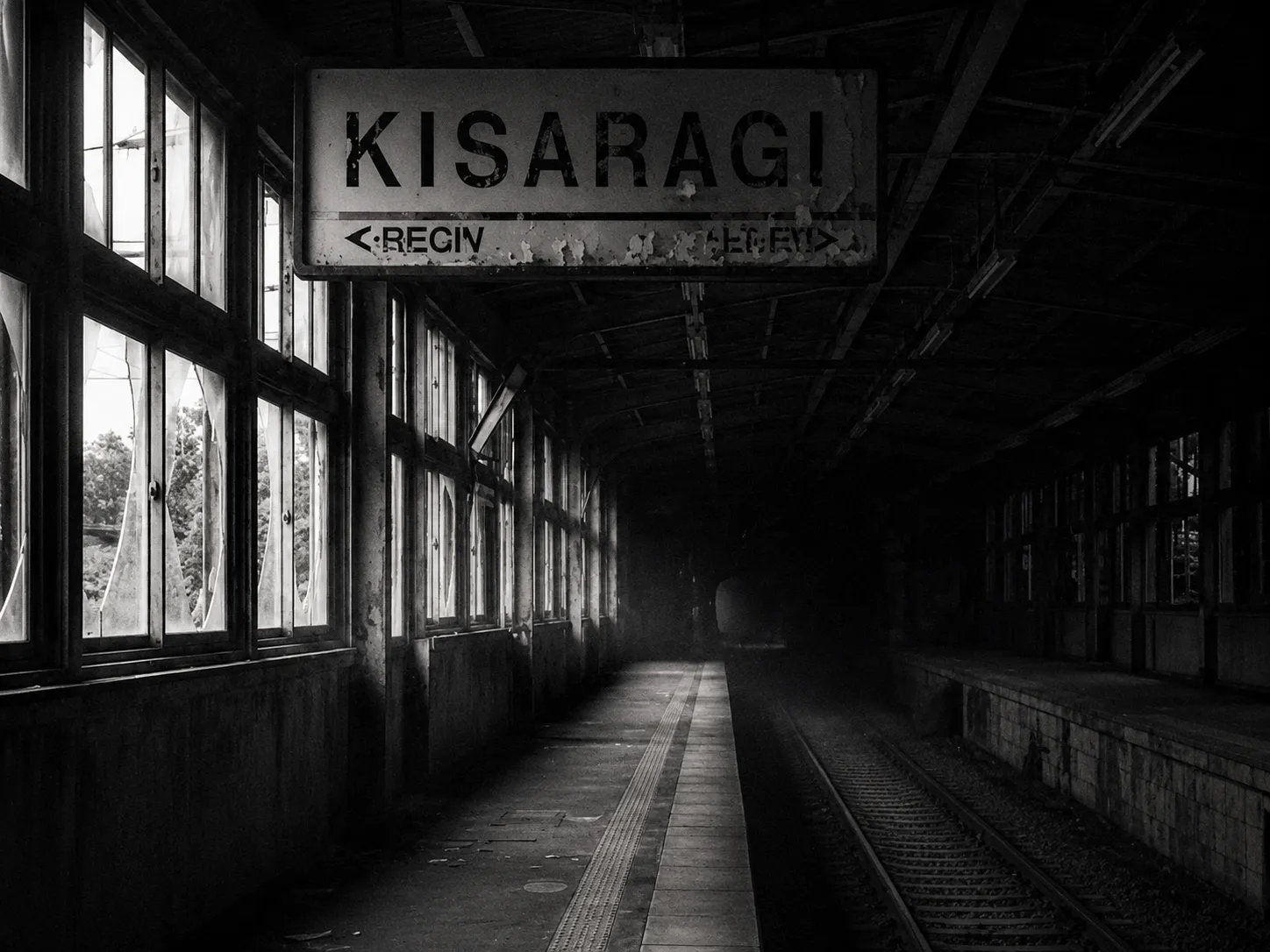
Kisaragi Station has no platform, no address, and no listing on any railway map in Japan — yet for two decades it has been one of the most-discussed ghost stories on the Japanese internet, built entirely from a single late-night forum post that was never finished.
It all started with one woman’s confused message about a train that wouldn’t stop. Since then, the story has grown into a wide-reaching piece of digital folklore, inspiring sister stations, songs, a feature film, and even a real railway company that embraced the myth. So what really happened in that original post, and why does the story still capture people’s attention?
Summary
What Is the Kisaragi Station Urban Legend?
Kisaragi Station (きさらぎ駅, Kisaragi-eki) is a Japanese urban legend about a railway station that does not exist on any map, supposedly reached only by accident, late at night, by a handful of unlucky train passengers. The legend began on January 8, 2004, on the Japanese anonymous message board 2channel (2ch), in a thread in the site’s occult subforum titled “Post About Strange Occurrences Around You: Thread 26.”
A poster using the name Hasumi wrote in, asking other users if it was okay to share something. She explained that she was riding her usual commuter train home on a private railway line in Shizuoka Prefecture. Still, the train had not stopped at a station in roughly 20 minutes — far longer than her normal five-to-eight-minute ride. She added that the only other passengers on the train besides her were five, and all of them were asleep.
Other users responded in real time, treating it like a live thread rather than a finished story. They suggested she might have boarded an express train by mistake, then told her to check on the conductor when the train still didn’t stop.
Hasumi reported that the conductor’s compartment had its blinds drawn, so she couldn’t see the conductor or driver, and confirmed she was riding a private railway in Shizuoka. Roughly an hour after boarding, the train finally stopped — at a station Hasumi had never seen or heard of before, with a sign reading “Kisaragi Station.”
From there, the thread followed her step by step: she got off, found the station unstaffed and unfamiliar, and discovered that no one on the forum could find any record of “Kisaragi Station” anywhere online.
Wandering outside, she failed to find a taxi, eventually located a phone booth, and called her parents, but they couldn’t locate her because Kisaragi Station didn’t appear on any map they checked. She described the area as unnervingly quiet, with a tolling bell and a slowly growing drumbeat audible in the distance.
Advised to walk back along the tracks, Hasumi was interrupted by a voice warning her not to walk on the track, and turned to see a man with only one leg — who then vanished without a trace. Frightened, she ran into a nearby tunnel and was injured along the way.
At the far end, a man greeted her and offered to help; the two returned to the station and boarded another train, which continued into a remote mountain area instead of back toward civilization. The man grew increasingly quiet and began muttering to himself. Hasumi’s final post said her phone battery was almost dead and that she intended to try to run.
She never posted again. No conclusive follow-up from “Hasumi” was ever verified, and the thread simply ends — which is precisely what turned a confusing forum post into one of Japan’s most long-lasting modern ghost stories.
You may also enjoy:
The Whaley House Haunting: America’s Most Terrifying Ghost Story
October 23, 2025
Complete Guide to Virginia Bigfoot Sightings (1879–2025)
August 8, 2025
Who Is Aim in Demonology? The Demon Prince of Fire and Ruin
August 12, 2025
Werewolves: Myths, Madness, or Monsters?
June 10, 2025
Why Gusion Is Feared in Demonology
August 21, 2025
Zmeya: The Multi-Headed Dragon of Slavic Nightmares
September 11, 2025
The Original 2chan Thread
What sets Kisaragi Station apart from other urban legends is that it isn’t really a story—it’s a transcript. Japanese horror fans have kept the thread’s timestamps almost down to the minute, which helps it feel especially real to new readers.
Here’s a condensed timeline based on the archived 2ch posts:
- 23:14 – Hasumi opens by asking if it’s all right to post, adding that what she’s about to describe might just be her imagination.
- 23:18 – She says she’s been riding a certain private railway line for a while now, and something feels strange.
- 23:23 – She explains it’s the same train she always takes for her commute, but it hasn’t stopped at a station in about 20 minutes — normally a five-minute ride, seven or eight at worst. Besides herself, she says, there are five other passengers, and all of them are asleep.
- 23:25–23:29 – Other posters ask whether she might have boarded an express or rapid service by mistake. Hasumi agrees that’s possible and says she’ll wait a little longer before worrying.
- 23:35–23:40 – As the train still doesn’t stop, users suggest she walk to the front car to check on the conductor, half-joking that something might be wrong with the driver.
- 23:44–00:00 – Hasumi reports back: the conductor’s compartment has its blinds drawn, so she can’t see the conductor or driver inside. She confirms she’s on a private railway in Shizuoka Prefecture. A user suggests knocking on the window; she does, and gets no response.
- 00:13–00:19 – Asked if she can see anything outside, like the names of passing stations, she notes the train has slowed slightly since coming out of a tunnel — one that isn’t normally on this route — and confirms she boarded at Shin-Hamamatsu Station.
- 00:23–00:25 – The train finally appears to be stopping. Several users immediately ask if she’s planning to get off.
- 00:25–00:26 – Hasumi posts that the train has stopped at a place called Kisaragi Station, a name she’s never seen or heard before, and asks whether she should get off. The replies are divided: some tell her to get off and investigate, while others suggest she stay on until the final stop.
- 00:29 – She’s already off the train by the time she posts again: the station is unmanned, and she believes she boarded the original train around 11:40 PM. Other users immediately start searching online for “Kisaragi Station” and find nothing.
- 00:34–00:36 – Looking for a posted timetable so she can get back, Hasumi can’t find one — and reports that the train has already left without her while she was writing. She decides to head out of the station to look for a taxi.
- Later posts (roughly 01:00–02:00) – No taxis turn up. She eventually finds a public phone booth and calls her parents. Still, they can’t locate Kisaragi Station on any map and are unable to come get her. She describes the surrounding area as mountainous grassland with no one else in sight. She says she can hear a bell tolling and a drumbeat slowly growing louder in the distance.
- Around 02:30–02:45 – Advised by the thread to start walking back along the tracks toward home, Hasumi is suddenly addressed by a voice warning her not to walk on the tracks because it’s dangerous. Turning around, she sees a man with only one leg — who vanishes immediately after speaking. Shaken, she runs and reaches the mouth of a tunnel marked by a sign reading “Isanuki,” and decides to run through it.
- 02:45–03:10 – She makes it through the tunnel, injured along the way, where a man greets her and offers to help. The two head back toward the station together and board another train — but this one continues away from the city, into what seems to be a remote mountain area rather than back the way she came.
- 03:10–03:44 – The man is talkative at first, but gradually grows quiet, then begins muttering to himself in a way Hasumi finds increasingly unsettling.
- 03:44 – Her final post says her phone battery is almost dead, that things are getting strange, and that she intends to make a run for it at the right moment — calling it her last post “for now.”
After that final message, the thread goes quiet. No further posts from the original Hasumi account followed, and the four-hour real-time exchange simply stops mid-sentence.
Is Kisaragi Station a Real Place?
No verified railway station by that name exists anywhere in Japan. Based on details in Hasumi’s posts — boarding at Shin-Hamamatsu Station on a private line in Shizuoka — researchers and fans have long tried to map the story onto the real Enshu Railway. This private line actually runs through Hamamatsu.
The trouble is that the story doesn’t line up geographically with that railway. Some have pointed out a contradiction: it takes approximately 33 minutes to ride the train from Shin-Hamamatsu to Nishi-Kajima Station, the end of the line, while Hasumi reported a journey of around 40 minutes to reach Kisaragi Station — meaning the train would have had to keep going well past where the tracks actually end.
The most commonly suggested real-world match is Saginomiya Station, a real stop on the Enshu Railway line. A reporter from Nikkan Spa visited Saginomiya Station to check the connection and found it looked nothing like the legend. The station had a staffed attendant booth, heavy traffic, and many nearby buildings, all of which are missing from Hasumi’s story.
However, an Enshu Railway employee pointed out that in 2004, when the story was posted, Saginomiya Station didn’t have a convenience store or bicycle parking nearby. The area was also much darker back then, which was closer to the lonely scene Hasumi described.
Even though the details don’t match, people still treat Saginomiya as the legend’s spiritual home. Enshu Railway has promoted the station as the birthplace of the urban legend and has held events there, choosing to encourage tourism rather than deny the rumor.
In January 2022, to mark the legend’s anniversary and the film’s release, Enshu Railway temporarily renamed Saginomiya Station to “Kisaragi Station”. It sold replica train tickets with Kisaragi Station as the destination. The tickets sold out in less than an hour.
Outside Shizuoka, similar stations have been reported in other parts of Japan. Some people say they saw the station as far away as Fukuoka Prefecture.
A 2011 Twitter post described a separate encounter on a train leaving Chiba Station in the Kanto region, which is far from the Enshu Railway line. None of these stories has been independently confirmed, and this inconsistency is part of the legend itself: Kisaragi Station seems to “move,” showing up wherever a late-night commuter might be.
You may also enjoy:
The Edmund King House Haunting: Montevallo’s Most Terrifying Legend
September 3, 2025
Children Vanished: The Werewolf of Eschenbach Case
June 18, 2025
Demon Naberius Explained: Origins, Powers, and Myths
August 26, 2025
How the Legend Evolved After Hasumi’s Final Post
Hasumi’s silence didn’t end the story; it made space for more. In the years after 2004, the original four-hour thread was copied to Japanese forums, summary sites, and blogs, with each repost reaching new readers who hadn’t seen the original.
A widely circulated but disputed follow-up appeared in 2011, when a comment posted on a horror blog’s comments section, signed “Hasumi,” claimed she had finally returned to the ordinary world after seven years away, describing a stranger who pulled her from a stalled car and told her to walk toward a light before she found herself back near her local station with her parents waiting.
No one has ever confirmed whether the comment was real. Anyone can post in comment sections; the writing style is different from the 2004 posts, and skeptics point out that a real seven-year disappearance would probably have led to a police missing-persons case. Still, there is no public record of one. Most retellings treat the “return” as an unverified addition rather than a confirmed ending.
Around the same time, copycat stories began to appear about other supposed “otherworld stations” with similar features, such as unstaffed platforms, mountain settings, and trains that wouldn’t stop.
Some of the better-known examples are “Tsukinomiya Station” in Aichi Prefecture on the Tokaido Main Line, and “Yami Station” and “Katasu Station,” which are described as being next to Kisaragi Station. In Japanese, these stories are sometimes called “ikai stations” (異界駅), which means stations from another world.
After 2010, the legend found new life as it spread from anonymous forums to platforms where people use their real names, especially Twitter. Kokugakuin University folklore researcher Iikura Yoshiyuki says the Kisaragi Station story changed over more than ten years as it moved from 2channel to Twitter, gaining new versions and details with each retelling instead of staying the same.
In 2014, the legend crossed over into real-world mapping tools. An anonymous user made a custom Google Maps location called “Kisaragi Station” on a pond near the University of Tsukuba. The prank marker had no link to the original Shizuoka setting. Still, it made the line between the fictional station and real, searchable places even blurrier.
Folklore, Isekai, and the Fear of Getting Lost
Unlike Japan’s older urban legends, which often feature vengeful spirits with clear backstories and survival rules, Kisaragi Station gives almost no explanation. There is no villain, no curse, and no clear reason why Hasumi ended up there. Folklore researchers say this lack of explanation is part of why the story has lasted so long.
Iikura Yoshiyuki notes that stories like this are written in the form of a realistic, first-person account from an actual narrator, which makes it feel to readers like they are genuinely listening in on someone’s real-time conversation rather than reading a polished work of fiction.
He places Kisaragi Station within a broader pattern: from around 2010 onward, Japanese urban legends increasingly developed through social-media interaction rather than as fixed, one-time stories, meaning the audience itself becomes part of how the legend grows.
Since the story first spread, people have had two main interpretations. The first links it to kamikakushi (神隠し), a long-standing concept in Japanese folklore in which someone is mysteriously taken away by gods, spirits, or other supernatural forces. This is the same idea behind the disappearance in Studio Ghibli’s Spirited Away.
The second interpretation sees Kisaragi Station not as a story of abduction, but as an accidental trip into a parallel world, or isekai, which is a very popular genre in Japanese fiction. Some commentators think the legend’s lasting appeal comes less from fear and more from the romantic idea of accidentally traveling to another world—the thought that a normal commute could suddenly lead somewhere completely different.
That uncertainty is also why the story never wraps up neatly. The original thread, as it survives, has no monster, no clear villain, and no on-screen death—just a woman who stops posting.
Whether it’s a ghost story, a hoax, or just an unfinished piece of collaborative fiction is been debated for 20 years. This ongoing debate may be what keeps the legend alive longer than other Japanese ghost stories with clearer endings.
Kisaragi Station in Film, Music, and Popular Culture
The legend’s reach has gone well beyond forum threads and blog reposts, into film, music, and merchandising.
The 2022 film. A live-action adaptation titled Kisaragi Station (きさらぎ駅) was released in Japan in 2022, directed by Jirô Nagae from a screenplay by Takeshi Miyamoto. The film follows Haruna Tsunematsu (played by Yuri Tsunematsu), a university folklore student who chooses the Kisaragi Station urban legend as the subject of her graduation thesis.
During her research, she learns of a woman named Junko Hayama (played by Eriko Sato), rumored to be the original “Hasumi” who posted about the legend in 2004, and the two eventually meet face-to-face.
The film became especially popular in regions close to Hamamatsu, the city most associated with the legend’s supposed real-world setting, and its release directly prompted Enshu Railway’s temporary station renaming and ticket-replica promotion described above. A separate Japanese-language film, Kisaragi Station Re:, which revisits the same legend, was released in June 2025.
Music. In 2020, a YouTuber operating under the username x0o0x_ released a song based on the urban legend with no visible title, achieved by using an invisible Unicode character so the title field on YouTube appears blank. This isn’t a display error — it’s a deliberate choice by the artist, and the song is genuinely referred to as a “titleless” track by fans.
On Spotify, where a blank title isn’t possible, the same song is listed instead as a string of forward slashes and spaces: “/ / // / /”. The song attracted a large online audience and is widely credited with reintroducing the legend to a younger generation of listeners. In 2021, Japanese EDM artist Camellia (かめりあ) released a track based on the legend on his album U.U.F.O., which is themed entirely around different Japanese urban legends.
Naming and language quirks. The original 2004 post never specified the kanji for “Kisaragi,” which is why the station’s name is typically written in hiragana (きさらぎ) rather than kanji. Some retellings and translations instead use the kanji for “demon” or “ghost,” which are pronounced the same way, reinforcing the out of this world framing. In Chinese-language retellings, the station is commonly written as “如月車站,” reflecting how widely the story has spread outside Japan, particularly in Taiwan and Hong Kong.
Frequently Asked Questions
Is Kisaragi Station a true story?
No verified evidence supports it as a factual event. It originated as an anonymous, real-time forum post in 2004, and no independent confirmation of Hasumi’s identity, disappearance, or return has ever surfaced. Most researchers and commentators treat it as a piece of creative internet folklore — convincing because of its real-time, first-person format, but unverifiable as an actual incident.
What happened to Hasumi?
According to the original thread, her final post said her phone battery was nearly dead and that she intended to try to escape from a man who had begun acting strangely. She never posted again under that account in the original thread. A 2011 comment claiming to be from her, describing a safe return after seven years, has circulated widely but is disputed and unconfirmed.
Which real station is Kisaragi Station based on?
Saginomiya Station, on the Enshu Railway line in Shizuoka Prefecture, is the most widely cited candidate, partly because Hasumi’s account places her departure point at the real Shin-Hamamatsu Station on the same line. The match isn’t exact — investigators have pointed to differences in staffing and surroundings — but Enshu Railway itself has embraced the connection through tourism events and a temporary renaming of the station in 2022.
What does “Kisaragi” mean?
Kisaragi is an old Japanese name for the second month of the lunisolar calendar, roughly corresponding to February. The original post never specified which kanji characters were intended for the station’s name, which is why it’s still typically written in hiragana.
Are there other stations like Kisaragi Station?
Yes. Following the original legend’s popularity, similar stories circulated about other supposed “otherworld stations,” including Tsukinomiya Station, Yami Station, and Katasu Station. These are generally understood to be later additions inspired by the original Kisaragi Station story rather than independent legends.
You may also enjoy:
What to Do If Your House Is Haunted: 11 Steps to Take Back Control
September 5, 2025
Utukku: The Faceless Shadow Demon of Mesopotamia
October 1, 2025
Who Is the Demon Gremory in Ars Goetia?
August 13, 2025
The Nandi Bear: Africa’s Terrifying “Brain-Eating” Cryptid
November 11, 2025
Sources
- Asazato, Itsuki. Nihon Gendai Kaii Jiten [日本現代怪異事典]. Kasama Shoin, 2018.
- 吉田史弥 (Yoshida Fumiya) (9 January 2018). 遠鉄「きさらぎ駅」? 消えた「はすみ」さん、都市伝説10年超 [Enshū’s “Kisaragi Station”? The disappearance of “Hasumi” and an urban legend over 10 years old]. Shizuoka Shimbun. p. 3. Retrieved 23 June 2026.
- I went to Saginomiya Station on the Enshu Railway, which is said to be the motif for the urban legend Kisaragi Station. Gigazine.net. Retrieved 23 June 2026.
- Kisaragi Station Official Trailer – YouTube.
- Hirota, Ryuhei. (2025). From Kisaragi Station to the Elevator Game: The Reconfiguration of the Otherworld in Japanese Internet Narratives. Fabula. 66. 8-24. 10.1515/fabula-2025-0002.