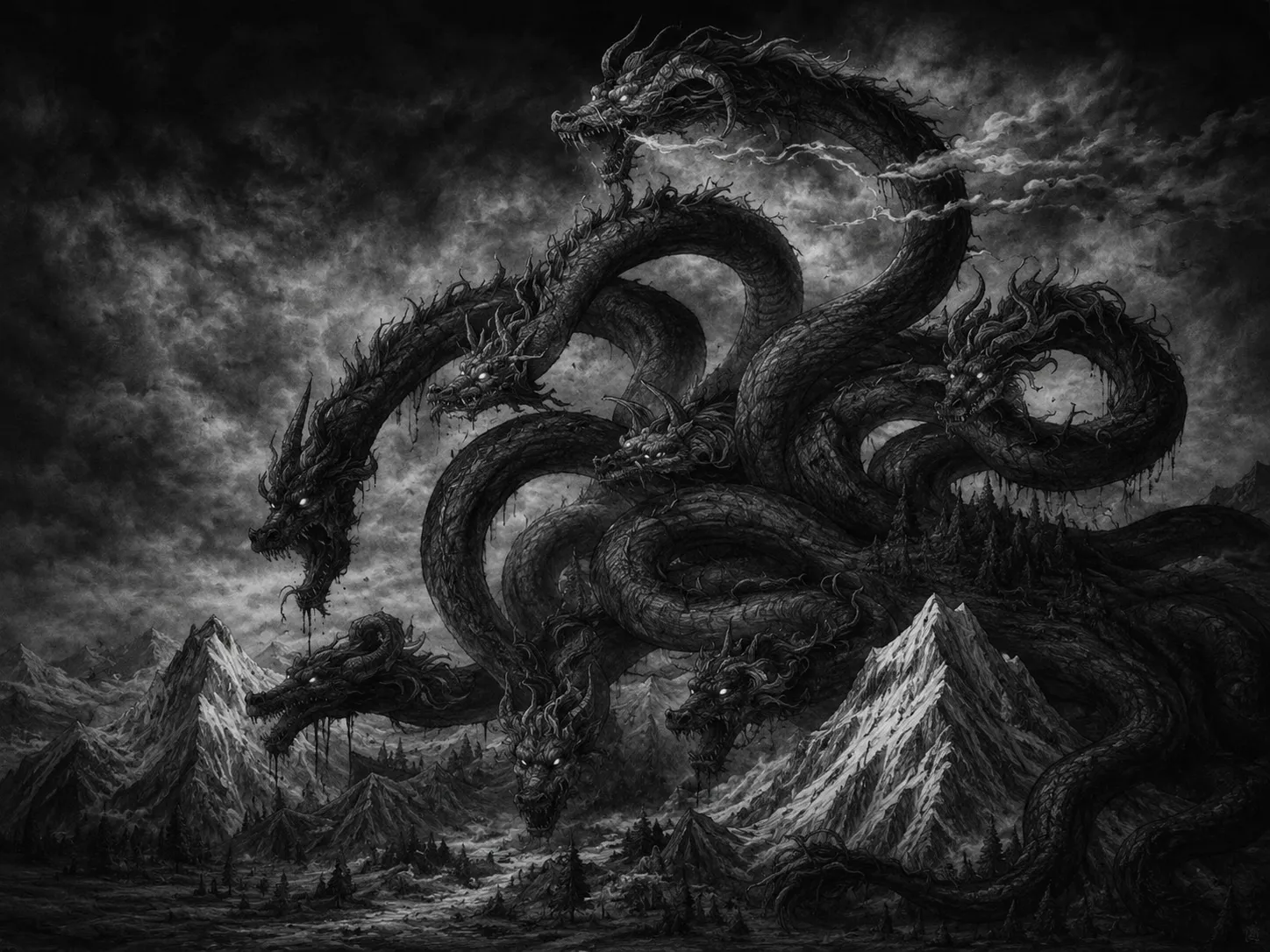
The Kuntilanak is one of the most feared spirits in the folklore of Indonesia, Malaysia, and Singapore. She is a vengeful female ghost, said to be born from the tragedy of dying during childbirth. At first, she appears as a strikingly beautiful woman dressed in white, but then reveals a monstrous form that can tear her victims apart.
The Kuntilanak is so strongly woven into the region’s identity that she even gave her name to a city: Pontianak, the capital of West Kalimantan. According to legend, the city was founded in 1771 after a sultan had to fire cannons to drive her spirits away.
However, she is not just one ghost, but represents an entire class of undead spirits. Few other creatures in world folklore capture a society’s fears about maternal death, ritual dangers, and the line between the living and the dead as clearly as the Kuntilanak does.
Summary
Overview
| Attribute | Details |
|---|---|
| Names & Etymology | Kuntilanak (Indonesian); Pontianak / Puntianak (Malay); Matianak; Kunti (colloquial). Name is a phonetic contraction of the Malay phrase perempuan mati beranak — literally “woman who died in childbirth.” |
| Classification | Vengeful ghost (hantu); vampiric spirit; undead maternal entity. Categorized within the Nusantara cerita hantu (ghost-story) tradition. |
| Species | Spectral / Shape-shifting (humanoid female form; secondary avian bird-form documented in regional variants) |
| Origin | Arises from the spirit of a woman who died during pregnancy or childbirth. The biological incompleteness of her death — a child never born — binds her soul to the physical world, unable to pass on. Any woman dying under these conditions can become one. |
| Earliest Record | Late 18th–19th century. The founding myth of Pontianak city (October 23, 1771) represents the earliest documented historical account tying the spirit to a specific event. British colonial ethnographer Walter William Skeat recorded related Peninsular Malay accounts during fieldwork in the 1890s. |
| Habitat | Banyan trees and banana groves, dense jungle riverbanks, the thresholds of homes where childbirth is imminent. Strongly associated with West Kalimantan (Borneo), the Malay Peninsula, and Java. Prefers swampland and forest edges over open terrain. |
| Diet | Blood — specifically from pregnant women, newborns, and men she lures through seduction. In her bird-form variant, she targets virgins and young women. She is also said to be drawn by the scent of blood and newborn clothing. |
| Physical Details | Pale skin; long, loose black hair covering her face; flowing white dress (sometimes blood-stained); glowing red eyes; long claw-like nails; razor-sharp teeth. Notably lacks feet — she floats silently above the ground. Her back is described as hollow or gaping when revealed. Emits a strong frangipani (kemboja/plumeria) scent, particularly at night. |
| Strengths | Shape-shifting (between beautiful woman, monstrous form, and bird); supernatural seduction; silent movement (no footsteps, no rustling); ability to be weaponized through black magic by a dukun (practitioner); draws victims through scent and sound (infant wailing); preferential access to the spiritually vulnerable (pregnant women, the newly born). |
| Weaknesses | A sharp iron nail driven into the crown of her head (Indonesian tradition) or the nape of her neck (Malay tradition) neutralizes her, converting her into a docile companion until removed. Iron objects carried on the body offer protection. Proper completion of post-birth rituals (belian ceremony among Borneo communities) prevents transformation. Protective charms given to new mothers block her scent-based attraction. Ritual incantations can ward her off. |
| Threat Level | Level 3 — Apex Predator [See the Threat Level Guide] |
| Survival Odds | 35% — If you encounter her unprepared at night near a riverbank or tree line, particularly during or after a birth nearby, your chances depend almost entirely on whether you smell frangipani before she reaches you. |
| Warning | If you are near dense jungle, river confluences, or banana/banyan groves in Indonesia or Malaysia after dark — especially in or around a home where a woman has recently given birth — do not approach any woman standing alone in white. If you smell frangipani with no source, leave immediately. |
Who or What Is the Kuntilanak?
The Kuntilanak is a type of vengeful female spirit in Indonesian and Malay-Archipelago folklore. She is the ghost of a woman who died while pregnant or during childbirth. Unlike the passive, mournful ghosts often found in Western stories, the Kuntilanak is active and predatory. She has a clear order of victims, usually going after pregnant women, newborns, and men she tricks through seduction.
She exists at the edge between life and death, which is why her stories are full of symbols of childbirth. She is attracted to the smell of blood and newborn clothes, haunts places where births happen, and her cries are sometimes said to sound like a baby crying in the dark.
The Kuntilanak is not a single ghost with a single story, but rather a type of spirit. Any woman who dies under certain circumstances can become one. This open-ended origin helps her legend last over time. In Indonesia, people often use the short form ‘kunti,’ showing how common she is in daily language.
She is part of the broader Indonesian concept of hantu, or supernatural creatures. Still, she is important as especially dangerous, purposeful, and long-lasting compared to most other spirits in her group.
You may also enjoy:
Ghost Orb Color Meaning: What Each Color Means and Why
January 5, 2026
Koschei the Deathless: The Skeleton Sorcerer Who Couldn’t Die
September 11, 2025
Demon Xaphan: The One Who Tried to Burn Heaven
August 28, 2025
What Is the History of the Kuntilanak?
The Kuntilanak’s story comes from the oral traditions of the Malay Archipelago, a region of islands, rivers, and jungles where, for centuries, many women died in childbirth without medical help.
In these societies, where maternal death was common and mysterious, folklore helped people make sense of why some deaths felt especially tragic—why a woman who died with a child still inside her seemed to leave something unfinished.
Her earliest roots lie among Southeast Asian spirits arising from impure or incomplete deaths. Academic sources link her to the cerita hantu, or ghost-story tradition of the Indonesian archipelago, in which she appears alongside other similar maternal spirits.
The Langsuir, a closely related entity, is documented in some of the earliest Malay-language sources on supernatural beings. British colonial officer Walter William Skeat, working among Peninsular Malays in the 1890s, described a related entity he called the “Mati-anak” (dead child), recording her as a nocturnal vampiric presence that announced herself with a piercing wail. Skeat’s accounts, drawn from direct fieldwork, represent some of the earliest ethnographic documentation of this spirit tradition in English-language sources.
The Kuntilanak is most strongly connected to West Kalimantan (Borneo), the Malay Peninsula, and Java—areas linked by trade and shared Malay culture. In West Kalimantan, her bond to the land is tangible: the city of Pontianak, founded on October 23, 1771, by Sultan Syarif Abdurrahman Alkadrie at the meeting of the Kapuas and Landak Rivers, is named after her.
According to the founding myth — preserved in regional histories and referenced in academic scholarship published in the Bijdragen tot de Taal-, Land- en Volkenkunde journal — Abdurrahman’s men encountered terrifying disturbances and sounds along the riverbank, attributed to Kuntilanak spirits.
The sultan ordered cannons fired to drive them off, and the settlement was built on the cleared ground. The Kuntilanak was, as a result, not simply a folk monster but the very first “owner” of the land on which a major city now stands.
The Kuntilanak is closely related to, and often confused with, the Langsuir, the Sundel Bolong, and the Thai Phi Krasue. All of these are female spirits from the region, born from traumatic deaths.
In Java, the Sundel Bolong, or ‘prostitute with a hole in her back,’ is a similar but separate entity, linked more to sexual violence and social stigma than to maternal loss. These similar stories show a shared base of myths across the archipelago, defined by common experiences and worries.
Etymology
The name ‘Kuntilanak’ is the Indonesian version. Its Malay counterpart, ‘Pontianak’ (also spelled ‘Puntianak’), is more widely recorded and has been studied more in terms of its origins.
The most common explanation is that ‘Pontianak’ is a shortened form of the Malay phrase perempuan mati beranak, which means ‘woman who died in childbirth.’ In Indonesian, perempuan means’ woman,’ mati means ‘died’ or ‘death,’ and beranak means ‘to give birth’ or ‘of the child.’
Another explanation breaks the word into puan (woman), mati (die), and anak (child). A third theory, based on geography, suggests the name comes from the Malay pohon tinggi, meaning ‘high tree.’ The idea fits because tall trees, especially banyan and banana trees, are believed to be the Kuntilanak’s home, and tree spirits are part of the beliefs of rural West Kalimantan. A related version, matianak, simply means ‘death of a child.’
The Indonesian form ‘Kuntilanak’ seems to be an adaptation of ‘Pontianak,’ changed by local Javanese and Indonesian speech patterns. The short form ‘kunti’ is now common in Indonesian slang and is used as a general term for maternal ghosts. During the Dutch colonial period, the spelling ‘boentianak’ was used in official documents.
What Does the Kuntilanak Look Like?
In traditional stories, the Kuntilanak appears as a pale, beautiful woman with long, loose black hair and a waving white dress, sometimes said to be stained with blood. Her lovely face hides her real form. She is often described as having no feet and floating silently above the ground.
When she is near, people notice the smell of kemboja (frangipani or plumeria), a flower linked to cemeteries and the dead in Indonesian culture. If you smell frangipani at night for no reason, it is a sign she might be close.
Modern horror films commonly get the Kuntilanak wrong by showing her as always grotesque—a screaming, broken-necked, rotting monster. In the original version of folklore, her danger comes from her beauty. She is frightening because she seems real. She only becomes a monster when she attacks, turning around to show her hollowed back or attacking with long, claw-like nails and sharp teeth.
Older Indonesian stories sometimes depict the Kuntilanak as a bird rather than a woman. In these versions, she makes a unique ‘ke-ke-ke’ sound while flying.
In the bird form, she can be used in black magic and sent by someone to cause a specific illness in women, usually characterized by vaginal bleeding. The bird version is much less known outside academic circles and is very different from the seductive ghost seen in movies.
What Is the Difference Between the Kuntilanak and the Langsuir?
Although people often mix up the Kuntilanak and the Langsuir in modern stories, traditional Malay-Indonesian folklore sees them as separate beings with different origins, behaviors, and ways of interacting with people.
The Langsuir is the spirit of the mother — specifically a woman who died after hearing that her child was stillborn, overwhelmed because of grief known as meroyan (a postpartum spiritual sickness).
She is elongated, spectral, and more specifically vampiric in the possessive sense: Langsuir is said to enter victims and drain blood from within, slowly causing a fatal end — more of an internal parasite than an external predator. By one tradition, the Kuntilanak is described as the stillborn child of the Langsuir, making them mother and offspring in the supernatural hierarchy.
The Kuntilanak, on the other hand, is the ghost of a woman who died during childbirth or while pregnant. She attacks from the outside, first by seducing and then by physically attacking her victims. She is often connected to haunting certain places, like trees, riverbanks, and the entrances of homes where a birth is happening.
The Pontianak, her Malay version, is known for the sweet smell of frangipani. The Langsuir does not have this scent; she is quiet and affects people from within, while the Kuntilanak is loud and noticeable. Both wear white, which has caused confusion in modern stories, but their spiritual roles are different.
You may also enjoy:
Complete Guide to Missouri Bigfoot Sightings (1960–2025)
August 1, 2025
How to Connect With Someone Who Passed Away
July 2, 2026
15 Most Terrifying Haunted Hotels in Alabama
October 6, 2025
Myths, Legends, and Stories
Stories about the Kuntilanak are mainly kept alive through the oral tradition of cerita hantu, the ghost-story genre of the Indonesian archipelago. These tales are also supported by colonial-era records and the founding documents of Pontianak in West Kalimantan.
Unlike European folklore, which often revolves around a single main text, Kuntilanak stories are flexible, vary across communities, and are closely linked to specific places.
The most famous and historically documented account is the founding of the city of Pontianak itself. In 1771, Sultan Syarif Abdurrahman Alkadrie led his followers down the Kapuas River in search of a site for a new settlement. When they reached the confluence of the Kapuas and Landak Rivers — a swampland dense with towering jungle — they were beset by terrifying sounds and disturbances.
The men identified these as the presence of Kuntilanak spirits, and the fear was so intense that they refused to continue their journey the following day.
Abdurrahman, unwilling to be stopped by ghosts, ordered his cannons to be fired into the jungle. The spirits were driven back. He then built his mosque and his palace on the land cleared by cannonballs, naming the settlement after the very entities he had expelled. The holiday tradition of firing bamboo cannons at celebrations in modern Pontianak is traced directly to this founding event.
What the popular version of the story omits is the academic subtext documented in scholarship published in Bijdragen tot de Taal-, Land- en Volkenkunde: the Kuntilanak in this account wasn’t just an obstacle to be cleared, but the primary spiritual owner of the land.
Researcher Timo Duile, who studied the myth, says that driving the Kuntilanak away from the riverbank created a split between nature and culture. The spirits moved into the wild trees as people settled the land.
In West Kalimantan, tall trees are regularly related to owner spirits, and one theory is that ‘Pontianak’ comes from the Malay pohon tinggi, meaning ‘tall tree.’ The cannon fire was more than an act of bravery, but also a way to push out the first spiritual inhabitants—a story of conquest told through ghost legends.
A unique version of the Kuntilanak comes from Javanese tradition, where her story shifts from a mere predator to a more sorrowful ghost. In these stories, she is less of a seductress and more of a grieving creature who returns mainly to mourn, not to harm.
This change is consistent with the Javanese focus on alus (refined, subtle) versus kasar (crude, violent) qualities, giving the Javanese Kuntilanak a more intricate moral character than those from Borneo or the Malay Peninsula.
Can You Defeat a Kuntilanak? Powers and Weaknesses
The Kuntilanak’s power follows a specific spiritual logic based on the idea of impure death.
In Malay-Indonesian beliefs, someone who dies with a child still inside her, or whose body’s natural process is suddenly stopped, cannot move on to the afterlife easily. The spirit stays in the world not out of anger, but because of the unfinished business of an incomplete birth. Her need to target pregnant women and newborns is seen as a compulsion, not just cruelty—she is pulled back to her own trauma again and again.
Her seductive power, or her ability to appear as a beautiful woman, is a perverted version of her incomplete humanity. She still looks human because she once was, and that appearance is what draws people in. The frangipani scent she gives off is really the smell of the cemetery, disguised as perfume—a sweet, although unsettling, sign of the dead world pretending to be part of the living.
Her bird form works differently. In this version, a dukun (a traditional magic practitioner) can send the Kuntilanak as a weapon against a chosen victim. In these traditions, her power can be used on purpose, making her not merely an uncontrolled spirit but a tool for targeted spiritual harm.
Her main weakness is the nail. In Indonesian tradition, driving a sharp iron nail into the top of the Kuntilanak’s head, especially at the crown, is said to neutralize her and turn her into a calm, even loyal companion. In the Malay version, the nail goes on the back of the neck.
Both versions share the same idea: the nail completes her body, closing the wound of her death and tying her being back to the physical world. If the nail is removed, she returns to her old self. The nail does not destroy her; it simply keeps her under control.
People use several ways to protect themselves from the Kuntilanak. These include carrying iron objects, staying away from banyan and banana trees at night, not leaving newborn clothes outside after dark (since that scent attracts her), and using ritual chants.
One specific custom is the belian ceremony among some Dayak communities in Borneo, where special rituals after childbirth are performed to prevent a woman who dies from becoming a Kuntilanak. The idea is that if the spiritual rites of childbirth are done correctly, the transformation will not happen.
Kuntilanak vs Other Monsters
| Creature & Lore | Danger Level | Details |
|---|---|---|
| La Llorona (Mexico / Latin America) | Severe. Wanders rivers and waterways, wailing for her drowned children, abducting children she mistakes for her own — often pulling them into the water to their deaths. | Unlike the Kuntilanak, La Llorona’s origin is not biological incompleteness but deliberate filicide — she drowned her own children after being abandoned, meaning her haunting is explicitly self-inflicted guilt made monstrous. |
| Langsuir (Malaysia) | Severe. Enters victims from within, possessing them and draining their blood internally in a slow, fatal process — a more insidious threat than the Kuntilanak’s external assault. | Traditional Malay lore describes the Kuntilanak as the stillborn child of the Langsuir, making them mother and offspring in the same supernatural lineage — one grieving mother, one unborn child, two distinct monsters. |
| Phi Krasue (Thailand) | Extreme. Manifests as a floating, disembodied female head trailing luminous entrails, feeding on blood, fetal tissue, and carrion — specifically targeting pregnant women during delivery. | The Phi Krasue cannot survive sunlight, which forces her to spend each dawn re-attaching her head to a hidden body — meaning she must maintain a secret daytime identity in a physical location, giving hunters a potential tracking advantage the Kuntilanak lacks. |
| Banshee (Ireland / Scotland) | Medium. Appears as a wailing woman near families of Gaelic heritage to announce an imminent death in that bloodline — she does not cause death, she heralds it. | The Banshee is family-specific, attaching herself permanently to particular Irish and Scottish clans rather than haunting geographical locations — she follows bloodlines, not buildings. |
| Strigoi (Romania) | Severe. A vampiric undead that rises from graves to drain blood from family members first before expanding outward — it prioritizes biological kin, systematically destroying households from within. | Romanian tradition holds that a Strigoi must drain its own family before it can target strangers, creating a village-level triage: if one household collapses with unexplained illness, neighbors know to check for a recent burial before it moves outward. |
| Churel (India / Pakistan) | Severe. The ghost of a woman who died during childbirth or festival periods, she lures young men — especially relatives — draining their life force and turning their hair white overnight. | The Churel is identified by her reversed feet — heels pointing forward, toes pointing backward — a detail that makes her trackable in soft earth, which is why South Asian folklore emphasizes checking footprints when a young man turns inexplicably old overnight. |
| Penanggalan (Malaysia) | Extreme. A female sorcerer whose head detaches at night, trailing a stomach and intestines soaked in vinegar, hunting newborns and women in labor to drink their blood. | The Penanggalan’s dangling entrails must be soaked in vinegar each night to shrink them back to fit inside her body — she must return home to a jar of vinegar before dawn or face permanent detachment, making her attack window strictly time-limited. |
| Manananggal (Philippines) | Extreme. Severs her own torso at the waist at night and flies using bat-like wings, using an elongated proboscis tongue to extract fetuses and the hearts of sleeping victims through their flesh. | The Manananggal’s only definitive vulnerability is her severed lower body left on the ground — if salt, ash, or garlic is rubbed on the exposed flesh before dawn, she cannot rejoin and dies when sunlight hits her disconnected halves. |
| Aswang (Philippines) | Severe. A shape-shifting creature that takes human form by day and hunts pregnant women and children at night, replacing stolen infants with banana-trunk effigies that rot within days. | The Aswang is unusual among Southeast Asian monsters in that it maintains a fully functional human social identity — it holds jobs, forms marriages, and participates in community life, making it impossible to identify without the test of staring into its eyes from an upside-down position. |
| Lilith (Ancient Near East / Hebrew) | Extreme. A primordial demon of the night who kills newborns and causes male sexual pollution, commanding a host of lesser demons across multiple ancient traditions simultaneously. | Lilith’s name appears in the Babylonian Talmud and in incantation bowls from 6th–7th century Mesopotamia designed to trap her — making her one of the oldest named supernatural entities specifically threatening to childbirth in recorded history. |
| Mormo (Ancient Greece) | Low. A child-eating bogeywoman invoked by Greek parents to frighten disobedient children into compliance — functionally a threat used to enforce social behavior rather than an independently active predator. | Mormo represents the ancestor of the entire “bogeyman” archetype across Western folklore — a monster whose power is entirely dependent on the credibility of the adult invoking her name, not on any independent capacity to hunt. |
My Take
What is remarkable to me about the Kuntilanak is that she is not simply a monster made to scare people. She is a symbol of grief that society did not know how to handle.
In pre-modern Indonesia and Malaysia, many women died during childbirth, making it a common and personal tragedy. The Kuntilanak is what happens when a culture cannot just forget that grief. She makes sure that women who died this way are remembered as dangerous, which, strangely, is a lasting form of recognition. You will never forget the Kuntilanak. She makes sure of it.
The weakness involving a nail in the head is one of the most revealing details in Southeast Asian folklore. The idea that she can be tamed and turned into a good wife by having a single nail inserted into her body changes the whole story.
She is not a demon to be cast out, but a wound that needs to be healed. The fact that the ‘cure’ is also a way to control her, making her obedient until the nail is removed, says something uncomfortable about the society that created the myth.
Indonesian scholars have also noted that the Kuntilanak functions simultaneously as a warning to women (don’t die incompletely, don’t leave things unfinished), as a projection of male fear onto the female body, and as a vehicle for expressing authentic grief over women lost in childbirth.
She is a monster, a victim, and a mirror at the same time. The fact that she was still potent enough in 1771 to name a city after her — and that city is still called Pontianak today — tells you everything about how profoundly she is inseparable from the land itself.
You may also enjoy:
Fenrir: The Bound Beast Waiting for Ragnarök
September 12, 2025
Rahab: Leviathan’s Twin and the Forgotten Demon Prince
September 30, 2025
Nuckelavee: The Skinless Sea Demon That Brings Plague
February 10, 2026
Sources
- Skeat, Walter William. Malay Magic: Being an Introduction to the Folklore and Popular Religion of the Malay Peninsula. Macmillan and Co., 1900
- Duile, Timo. (2020). Kuntilanak: Ghost Narratives and Malay Modernity in Pontianak, Indonesia. Bijdragen tot de taal-, land- en volkenkunde / Journal of the Humanities and Social Sciences of Southeast Asia. 176. 279-303. 10.1163/22134379-17601001.
- Nicholas, Cheryl. (2010). Cerita Pontianak: Cultural Contradictions and Patriarchy in a Malay Ghost Story. Storytelling. Self. 194-211. 10.1080/15505340.2010.504408.
- Syairaji, M. & Nurdiati, Detty & satria wiratama, Bayu & Prüst, Zita & Bloemenkamp, Kitty & Verschueren, Kim. (2024). Trends and causes of maternal mortality in Indonesia: a systematic review. BMC Pregnancy and Childbirth. 24. 10.1186/s12884-024-06687-6.
- Duile, Timo. Kuntilanak: Ghost Narratives and Malay Modernity in Pontianak, Indonesia. Bijdragen Tot de Taal-, Land- En Volkenkunde, vol. 176, no. 2/3, 2020, pp. 279–303. JSTOR, https://www.jstor.org/stable/26916440. Accessed 11 June 2026.
- Resti Nurfaidah. The Long-Lasting Gender: Cases of the Female. Legendary Spirits on Indonesian Stories. West Java Language Agency, Jalan Sumbawa 11, Kota Bandung. DOI 10.4108/eai.15-9-2021.2315610.