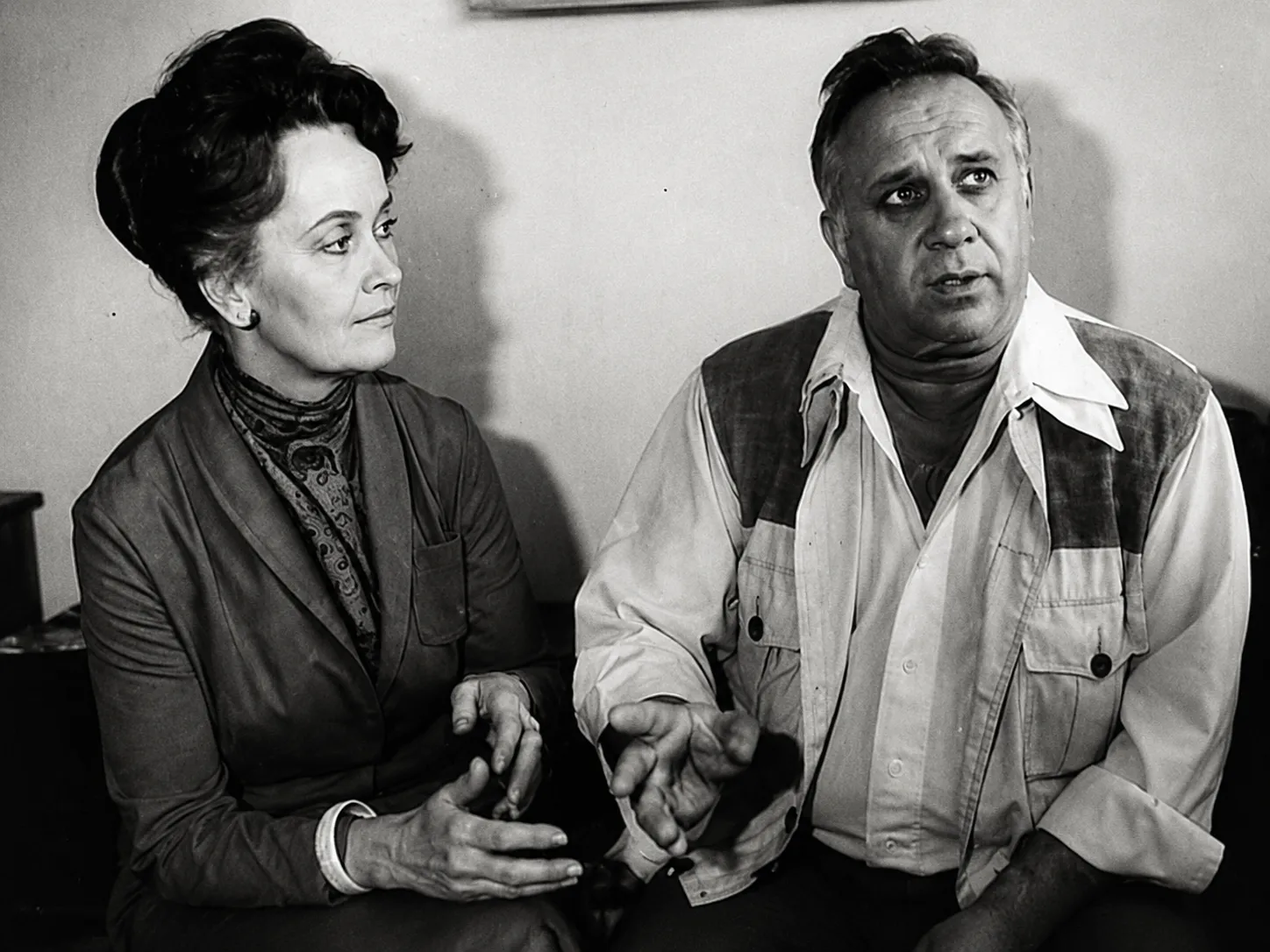
Ed and Lorraine Warren spent more than five decades walking into houses that most people would have fled, carrying little more than a camera, a rosary, and an unwavering conviction that evil was real. Long before “ghost hunting” became a TV genre, this Connecticut couple was already knocking on the doors of terrified families, cataloging supposedly cursed objects, and building a case file that would eventually inspire one of the highest-grossing horror franchises in film history.
Yet, behind the movie versions of Ed and Lorraine Warren lies a far more complicated and far less documented real story—one full of contested evidence, courtroom drama, Catholic mysticism, and a decades-long feud with the scientific skeptic community. Who were they really, what did they actually claim to find, and how much of what audiences know from “The Conjuring” movies has up against the historical record?
Summary
Who Are Ed and Lorraine Warren?
Edward Warren Miney was born on September 7, 1926, in Bridgeport, Connecticut, and Lorraine Rita Moran was born on January 31, 1927, in the same city.
Ed later said his fascination with the paranormal began at home: he claimed that between the ages of five and twelve, he and his twin sister, Babette, shared a bedroom repeatedly visited by what he described as a malevolent female presence, defined by sudden cold, unexplained footsteps, doors opening on their own, and a glowing shape he said resembled a woman’s face.
His father, a Bridgeport police officer, reportedly tried to comfort the children with rational explanations but, according to Ed, could never properly articulate one. Ed said the experience made his sister permanently afraid of the supernatural, while it pushed him toward demonology instead.
Ed and Lorraine met in 1944 at a Bridgeport movie theater where Ed worked as an usher, both still in their teens. By his later account, he offered to walk Lorraine and her friends home and bought each of them a soda, with Lorraine ordering the pricier ice cream soda. Ed then enlisted in the U.S. Navy during World War II, and his ship came under attack in the North Sea; he later described surviving that incident as a moment of divine intervention. He survived, and during a period of leave in 1945 the couple married.
Ed described himself as a self-taught, self-professed demonologist, author, lecturer, and amateur artist; he also worked at points as a police officer before turning to paranormal investigation full-time. Lorraine described herself as clairvoyant and as a light trance medium, claiming she could perceive the presence, mood, and intentions of spirits and perceive auras around people and places. Their daughter, Judy, was born on January 11, 1946 (some later sources list 1950), and for much of her early childhood she lived with her grandparents while her parents traveled.
After Judy’s birth, Ed briefly enrolled in art school but did not finish. Instead, by around 1952 the couple had begun touring New England towns, painting portraits of houses that were reputedly haunted and offering the paintings to homeowners in exchange for their ghost stories — an unusual, entrepreneurial way of building a case file from scratch, and a detail rarely mentioned outside the Warrens’ own retellings.
That same year, they formalized their work by founding the New England Society for Psychic Research (NESPR), frequently described as the oldest ghost-hunting organization in New England.
Devout Roman Catholics, the Warrens framed their investigations through a religious lens, believing that demonic forces were more able to afflict people who lacked strong faith. They worked closely with clergy on many of their cases, including formal exorcism requests submitted to the Catholic Church. The Warrens maintained throughout their careers that they never charged families a fee for an investigation itself, earning their income instead from books, paid lectures, and later media and licensing contracts.
Over the following decades, the Warrens said they investigated well over 10,000 cases — a number repeated consistently across their own promotional materials and NESPR’s website. Later fan and franchise-adjacent sources have inflated that number to as high as 100,000 claimed investigations, a number with no documented basis anywhere in the Warrens’ own record.
Even the original 10,000-case number has never been independently verified and is disputed by critics, who note the couple kept no standardized, peer-reviewable case files that could be audited after the fact.
Ed died on August 23, 2006, at age 79, in Monroe, Connecticut, having missed the cultural revival his work would soon undergo. Lorraine continued lecturing and consulting on film adaptations until her death on April 18, 2019, at age 92. Both are buried at Stepney Cemetery in Monroe, Connecticut.
The Founding of NESPR and Their Investigative Method
NESPR was structured to look more like a scientific institution than a two-person ghost-hunting operation. According to the Warrens and the organization’s own materials, its rotating roster of volunteers over the years included medical doctors, researchers, police officers, nurses, college students, and members of the clergy, lending the group an air of institutional trustworthiness even though it was never affiliated with a university or accredited scientific body.
Their working method combined several elements that they refined over their career:
- Interviews first. The Warrens typically began by interviewing every member of a household separately, looking to check consistency (or inconsistency) in the accounts of activity.
- Religious diagnosis. Ed classified cases along an escalating scale he described publicly in lectures and books: infestation, oppression, and possession, with the last reserved for the most extreme and rare cases that in his view warranted a Catholic exorcism.
- Lorraine’s “readings.” Lorraine would walk through a property and describe what she said she sensed — the presence, mood, and sometimes the identity of an entity — without, by her own account, being told details in advance.
- Recommendation to clergy. When the Warrens believed a case had crossed into possession, they said their role was to gather evidence to present to a priest, since neither of them was authorized to perform an exorcism themselves; that authority rested solely with the Church.
This method was also the central target of their critics: there was no controlled testing, no chain-of-custody documentation for photographs or recordings, and no independent replication of results, all of which are standard requirements in genuine paranormal or scientific research.
Ed and Lorraine Warren’s Most Famous Paranormal Cases
The Amityville Horror (1975–1976)
The case that first made the Warrens nationally famous began in Amityville, New York. In November 1974, 23-year-old Ronald DeFeo Jr. shot and killed his parents and four siblings in their sleep at 112 Ocean Avenue.
About a year later, George and Kathy Lutz moved into the same house with their three children and fled after just 28 days, reporting phenomena ranging from strange odors and cold spots to visions of a demonic pig-like creature. Jay Anson’s 1977 book “The Amityville Horror” became a best-seller and spawned the 1979 film and multiple sequels and remakes.
The Warrens arrived at the house with a local television news crew and conducted what has since been widely nicknamed, even by some skeptics, a “psychic slumber party” — an overnight investigation broadcast to a wide audience that established their reputation as go-to paranormal experts even though they presented no physical evidence.
One image from that night, showing what some interpreted as a “ghost boy” peering from a doorway, has been circulated for decades as supposed proof of the haunting. However, photographic analysts have argued it is more likely shows a person, possibly one of the investigators, caught mid-motion by the camera’s flash.
The Amityville case itself has been challenged for years, including by DeFeo’s own defense attorney, William Weber, who stated publicly that he and the Lutzes had discussed embellishing the story over wine after the criminal trial.
The Annabelle Doll (1970)
One of the Warrens’ most long-lasting artifacts began in 1970 with a Raggedy Ann doll given to a student nurse. She and her roommate reported the doll moving on its own around their apartment and, eventually, leaving what appeared to be threatening notes. A medium the women consulted told them the doll was linked to the spirit of a deceased seven-year-old girl named Annabelle Higgins.
The Warrens were called in and concluded that the entity attached to the doll was not an apparition at all but a demonic force using the doll to gain a foothold, or “inhuman means,” as Ed often phrased it in lectures. They took possession of the doll, sealed it inside a glass case inscribed with a warning, and displayed it in their Occult Museum.
Especially, the real Annabelle is a plain cloth Raggedy Ann doll, not the damaged porcelain evil doll created for the “Annabelle” film franchise — a deliberate cinematic invention to make the doll more visually frightening on screen.
Explore More Mysteries:
Are Ghosts Real? What Science, the Bible, and a Century of Paranormal Research Actually Show
July 25, 2026
July 1, 2026
July 24, 2026
The Perron Family Haunting (1970s)
Starting in 1970, Roger and Carolyn Perron and their five daughters lived in a Harrisville, Rhode Island, farmhouse where the family reported disturbing phenomena over the course of a decade. The Warrens, called in during the 1970s, concluded the land was cursed by a 19th-century woman known as Bathsheba Sherman, whom they described as a witch who had sacrificed her infant son to the devil and cursed the property so that everyone who lived there afterward would meet a terrible fate.
The case became the basis of the 2013 film “The Conjuring,” with Lorraine Warren serving as a consultant on the production and making a cameo appearance. The eldest Perron daughter, Andrea, went on to write her own multi-volume memoir about the family’s experiences in the house, independent of the Warrens’ own account.
The Enfield Poltergeist (1977–1979)
In August 1977, single mother Peggy Hodgson and her four children in Enfield, north London, began reporting furniture moving on its own, strange knocking, and disturbing behavior centered on 11-year-old Janet Hodgson, including apparent levitation and a rough voice speaking through her. The case was investigated at length over roughly a year by Maurice Grosse and Guy Lyon Playfair on behalf of the Society for Psychical Research, who compiled tape recordings and written logs.
The Warrens’ actual involvement, contrary to their later prominence in the story, was brief: they visited the Hodgson home once in 1978, drawn by the intense media coverage. Playfair, who worked the case for far longer, later said publicly that Ed Warren told him plainly that the case could be lucrative and that the Warrens showed up largely uninvited, a claim he repeated in interviews as late as 2016.
Peggy Hodgson herself died in 2003, reportedly on the same living-room sofa where a previous resident of the house, Bill Wilkins — the man Lorraine identified as the presence behind the haunting — had also died years earlier. Lorraine’s identification of “Bill Wilkins” as the entity, alongside her sense of a second, more hostile presence, became one of her most frequently cited “psychic” claims from the case.
The story became the basis for “The Conjuring 2” (2016), which greatly expanded the Warrens’ role beyond their real-life single visit and introduced the demon “Valak” as a new antagonist, an entity invented for the films rather than drawn from the genuine Enfield case files.
The “Devil Made Me Do It” Case (1981)
In 1981, 19-year-old Arne Cheyenne Johnson was charged with first-degree manslaughter in the killing of his landlord, Alan Bono, in Brookfield, Connecticut. His defense attorney attempted to argue that Johnson was under the influence of demonic possession — reportedly transferred to him during an earlier exorcism-style ritual performed on 11-year-old David Glatzel, the younger brother of Johnson’s fiancée, Debbie Glatzel.
The Warrens had been involved with the Glatzel family beforehand and testified to what they said they witnessed. The court did not allow a demonic-possession defense to be presented to the jury, since possession is not a recognized legal defense in American courts, and Johnson was convicted of first-degree manslaughter, not murder, and served roughly five years in prison.
This case has one of the more contentious paper trails of any Warren investigation. Writer Gerald Brittle turned it into the 1983 book “The Devil in Connecticut,” published with the direct cooperation of the Warrens, the Glatzel family, and Johnson himself, and it was separately adapted into the 1983 NBC television film “The Demon Murder Case.”
David Glatzel’s older brother, Carl Glatzel, later became one of the case’s most vocal public critics, telling the Associated Press in 2007 that David’s symptoms as a child stemmed from mental illness rather than possession and that the Warrens had exploited the family for financial gain.
In 2006, when Brittle’s book was reissued, Carl Glatzel and his brother Alan sued both Brittle and Lorraine Warren. However, the suit was dismissed, and Brittle later pulled the book from print, saying he was “fed up” with the continuing conflict rather than doubting its accuracy. The case became the basis for “The Conjuring 3: The Devil Made Me Do It” (2021).
The Snedeker Haunting (1986)
In 1986, the Snedeker family moved into a rented home in Southington, Connecticut, that had previously operated as a funeral home, and reported apparitions, foul odors, and disturbing behavior in family members, including a teenage son. The Warrens investigated and again concluded the activity was demonic.
The case was loosely adapted into the film “A Haunting in Connecticut” (2009) and has drawn some of the sharpest skeptical scrutiny of any Warren case, including from researchers Joe Nickell and Benjamin Radford, who examined contradictions in the family’s public statements.
The Smurl Haunting (1974–1989)
The Smurl family of West Pittston, Pennsylvania, reported years of disturbances in their duplex home beginning in the mid-1970s, escalating through the 1980s to include claims of physical assault by an unknown entity. The Warrens investigated extensively, and the case became the subject of a best-selling 1986 book and a 1991 television movie. It later became a central inspiration for “The Conjuring: Last Rites,” the fourth mainline film in the Conjuring series.
Books, Media Appearances, and Public Recognition
The Warrens were prolific public communicators long before reality television made ghost hunting mainstream entertainment.
They authored and co-authored numerous books recounting their casework, including “The Demonologist” (1980, written with Gerald Brittle), “The Devil in Connecticut” (1983, also with Brittle), “Deliver Us from Evil,” “Graveyard,” “Werewolf,” “Ghost Hunters,” and “In a Dark Place,” which opens with their own stated philosophy: that the study of demonic possession has never been, and likely never will be, a science.
Ed also lectured extensively at colleges, churches, and public forums for decades, particularly around Halloween, developing a reputation as a magnetic, if theatrical, public speaker who blended religious warning with showmanship. After Ed’s death, Lorraine and son-in-law Tony Spera continued a regular in-home lecture series at the Monroe property nicknamed “Warrenology,” where attendees could hear case histories directly from Lorraine and ask questions in a small-group setting.
They appeared regularly on talk shows and news programs from the 1970s through the 1990s, including televised debates with skeptics such as Joe Nickell of the Committee for the Scientific Investigation of Claims of the Paranormal (CSICOP), often on programs like “The Sally Jessy Raphael Show.” These televised confrontations exposed a real and lasting rift between the Warrens and the scientific skeptic community that outlasted both of their careers.
Their published legacy also became the subject of a major legal battle after their deaths. In 2016, Gerald Brittle sued Warner Bros. and New Line Productions for close to $900 million, alleging that “The Conjuring,” “The Conjuring 2,” and the “Annabelle” spin-offs infringed on an exclusivity clause in his original 1978 book contract with the Warrens, which he said barred them from authorizing any competing film adaptation without his consent.
A federal judge in Virginia allowed the copyright claim to proceed to trial in 2017, rejecting Warner Bros.’ motion to dismiss, but the case was settled and dismissed with prejudice in December 2017. In sworn declarations, Brittle stated that a disgruntled former Conjuring producer, Tony DeRosa-Grund — who was separately locked in his own contract dispute with Warner Bros. — had effectively controlled and financed the lawsuit from behind the scenes. Brittle said filing it had been a mistake.
Explore More Mysteries:
January 14, 2026
What Is A Paranormal Cold Spot and Why Does It Happen?
January 7, 2026
What Is a Poltergeist? Definition, Manifestations, and History
January 20, 2026
The Occult Museum
For decades, the Warrens ran a private “Occult Museum” out of the basement of their home at 30 Knollwood Road in Monroe, Connecticut, displaying items they said were haunted, cursed, or used in ritual practice — most famously the Annabelle doll, kept sealed in a glass case, alongside items such as a supposedly possessed toy monkey and dozens of other objects gathered across their casework.
The museum operated informally for decades before closing to the public in 2019 due to zoning restrictions on using a residential property for commercial tours; Lorraine’s death that same year effectively ended its public operations. Judy Warren and her husband, Tony Spera — who now runs NESPR — retained guardianship of the collection, including Annabelle.
In 2025, comedian Matt Rife and YouTuber Elton Castee purchased the Monroe property for roughly $1 million with plans to reopen it for tours and overnight stays, though the artifacts themselves, including Annabelle, remain separately in the Warren family’s care under a long-term guardianship arrangement rather than being part of the property sale.
What the Evidence Actually Supports
Trying to reach a fair verdict on Ed and Lorraine Warren means holding two things at once: the scientific case against their methods is genuinely strong, and yet a handful of details across their casework have never been fully explained by skeptics either. Neither side of the debate gets to claim total victory, and an honest look at the record should say so plainly.
Where the scientific critique is hard to argue with. The core complaint from professional skeptics is a methodological one, and it holds up. Organizations such as the Committee for the Scientific Investigation of Claims of the Paranormal (CSICOP) and the New England Skeptical Society (NESS) pointed out, repeatedly and specifically, that the Warrens’ investigations lacked calibrated instruments, controlled conditions, duplicate logging, or an independently verifiable chain of custody for photographs and recordings.
In 1997, NESS co-founders Steven Novella, a neurologist and Yale School of Medicine faculty member, and Perry DeAngelis were given direct access to the Warrens and toured their museum. They described the couple as personable, but concluded the physical “evidence” on display amounted to little more than what Novella called “off-the-shelf Halloween junk, dolls and toys,” and said the Warrens would not let them shadow an active investigation or independently test their strongest claimed evidence — including a video of the so-called “White Lady of Union Cemetery” in Easton, Connecticut, which Ed reportedly would show only inside his own home and never released for outside analysis.
That refusal to allow outside testing is, by any normal evidentiary standard, a serious problem: a claim that cannot be examined by a neutral third party cannot be verified, no matter how sincerely it is made. Ed’s own reply to the criticism — “you can’t have scientific evidence for a spiritual phenomenon” — is honest in its way, but it also concedes the skeptics’ central point: an unfalsifiable claim is not a claim that can be validated as fact.
Where financial motive muddies the picture. It is also fair to weigh the Warrens’ business incentives. Guy Lyon Playfair, who spent far longer investigating the Enfield case than the Warrens did, said in a later interview that Ed told him plainly the family “could make a lot of money” from the story, and that the Warrens arrived at the Hodgson home largely uninvited.
Carl Glatzel, whose brother David was at the center of the “Devil Made Me Do It” case, has said publicly that his family was exploited for profit and that his brother’s symptoms as a child were more likely explained by mental illness than possession. These are credible, on-the-record objections, not fringe speculation, and they deserve to be taken seriously alongside the Warrens’ own account.
Where the picture gets genuinely harder to dismiss. At the same time, it would be inaccurate to say every Warren case collapses under scrutiny. Several of the families involved — most importantly the Perrons, whose farmhouse became the basis for “The Conjuring” — have continued for decades, independently of the Warrens and independently of each other, to stand by their own first-hand experiences in those homes, long after any financial or promotional incentive to do so had faded for most of them.
Andrea Perron wrote a lengthy, independent multi-volume memoir of her family’s decade in the Rhode Island farmhouse that was not authored or ghost-written by the Warrens. Some cases, like Enfield, were also investigated at length by researchers entirely outside the Warrens’ orbit — Maurice Grosse and Guy Lyon Playfair spent roughly a year on the case for the Society for Psychical Research.
While they too never produced evidence that satisfied mainstream science, their much larger body of tape recordings and written logs is harder to write off as simple showmanship than the Warrens’ brief, single visit.
In other words: skepticism toward the Warrens’ own investigative rigor is well earned, but it does not, by itself, prove that nothing unusual happened in every one of the houses they visited — it mainly proves that the Warrens were not the right people, methodologically, to establish that one way or the other.
A fair conclusion. The honest middle ground is this: there is no serious scientific case that Ed and Lorraine Warren produced verifiable proof of demons, ghosts, or possession — the burden of proof was always on them, and by their own admission (and their own refusal to submit key evidence for outside testing) they never met it. But there is also no serious case that every family who ever called them was lying or fabricating an experience for attention; several of those underlying stories remain, at minimum, unresolved rather than debunked.
The Warrens were, at the very least, gifted storytellers and shrewd self-promoters who built a business around real human fear. Whether they were also witnesses to something genuinely unexplained is a separate question the historical record simply does not settle either way.
Separately, the couple’s personal life has also drawn public scrutiny. In 2017, Judith Penney publicly claimed she had a decades-long relationship with Ed Warren that began when he was 27 and she was 15, and alleged that Lorraine pressured her to have an abortion to avoid a public scandal; Penney also alleged she witnessed physical abuse within the household.
These specific claims have never been tested in a court of law and remain contested, but they are part of the documented public record surrounding the couple and are worth noting separately from the evidentiary debate over their casework.
Legacy
Ed Warren died in 2006, seven years before “The Conjuring” brought the couple’s work to a worldwide audience. Directed by James Wan and starring Patrick Wilson and Vera Farmiga as Ed and Lorraine, the 2013 film turned out to be a critical and commercial success, and Lorraine — the only one of the two who lived to see it — made public appearances at conventions and press events discussing the film and her own recollection of the underlying cases.
That single film became the anchor of “The Conjuring Universe,” which has since expanded into the “Annabelle” trilogy, “The Nun” and its sequel, “The Curse of La Llorona,” and further mainline sequels dramatizing other real Warren cases, including the Snedeker haunting and the Smurl family case in “The Conjuring: Last Rites.”
Collectively, the franchise has grossed billions of dollars worldwide and remains one of the most commercially successful horror franchises ever produced, built almost entirely on the case files of two self-taught investigators from Bridgeport, Connecticut.
Beyond the films, the Warrens’ influence is visible in the wider modern ghost-hunting subculture: their classification system for hauntings (infestation, oppression, possession), their practice of pairing investigation with religious counsel, and their model of building a “team” around a charismatic lead investigator all predate — and arguably shaped — the format used by later television ghost-hunting shows.
Whether seen as pioneering investigators, gifted storytellers, or something in between, Ed and Lorraine Warren remain the most recognizable names in American paranormal history, and their case files continue to generate new films, documentaries, and public debate more than a century after Ed’s birth.
Frequently Asked Questions
Did Ed and Lorraine Warren have any formal scientific or academic credentials?
No. Ed was self-taught in demonology and had no university degree in the subject; he briefly attended art school but did not complete it. Lorraine’s claimed clairvoyant abilities proved also self-professed rather than tested or certified by any recognized scientific body. NESPR involved doctors, nurses, and police officers as volunteers over the years, but the organization itself was never affiliated with a university or an accredited research institution.
Was Ed Warren ever formally authorized by the Catholic Church to perform exorcisms?
No. Ed Warren was not a priest and had no authority to conduct a Catholic exorcism. His stated role, as he described it publicly, was to investigate a case, determine whether it met the criteria for demonic possession, and then refer that evidence to Catholic clergy, who alone held the authority to request and perform an exorcism through the Church.
What happened to the real Annabelle doll after the Warrens died?
The doll remains in the Warren family’s care. After Lorraine died in 2019, guardianship of the entire artifact collection, including Annabelle, passed to the Warrens’ daughter Judy Warren and her husband, Tony Spera, who continues to run NESPR. When the Monroe, Connecticut property was sold in 2025, the artifacts were explicitly excluded from that sale and remain under the family’s separate custodial arrangement.
Did the Warrens ever lose a legal case or face a lawsuit over their claims?
The most direct legal fallout tied to their work was the 1981 trial of Arne Cheyenne Johnson, where a Connecticut court refused to allow demonic possession as a legal defense, and Johnson was convicted of manslaughter rather than acquitted. The Warrens themselves were not defendants in that case but were involved as witnesses and investigators who had worked with the family beforehand.
How many of the Warrens’ cases have actually been turned into films?
At least eight real cases they investigated have directly inspired feature films: Amityville, the Annabelle doll, the Perron family haunting, the Enfield poltergeist, the Arne Johnson trial, the Snedeker haunting, the Smurl family case, and the broader “White Lady of Union Cemetery” Connecticut folklore referenced in some of their lecture material, which has fed into wider Conjuring Universe lore beyond the core films.
Is NESPR still active today?
Yes. The New England Society for Psychic Research continues to operate under the direction of the Warrens’ son-in-law, Tony Spera, who has continued lecturing, giving tours related to the Warren case files, and managing the family’s archive of cases and artifacts since Lorraine died in 2019.
Explore More Mysteries:
How to Unlock Psychic Abilities
January 15, 2026
Are Ghosts Real? What Science, the Bible, and a Century of Paranormal Research Actually Show
July 25, 2026
July 1, 2026
What Is a Poltergeist? Definition, Manifestations, and History
January 20, 2026
Sources
- Anson, Jay. The Amityville Horror: A True Story. Prentice-Hall, 1977.
- Brittle, Gerald. The Demonologist: The Extraordinary Career of Ed and Lorraine Warren. Prentice-Hall, 1980.
- Brittle, Gerald. The Devil in Connecticut. Bantam Books, 1983.
- Garton, Ray, et al. In a Dark Place: The Story of a True Haunting. Villard Books, 1992.
- Perron, Andrea. House of Darkness House of Light: The True Story. AuthorHouse, 2011.
- Warren, Ed, et al. Graveyard: True Hauntings from an Old New England Cemetery. St. Martin’s Press, 1992.
- Warren, Ed, et al. Werewolf: A True Story of Demonic Possession. St. Martin’s Press, 1991.
- Brittle v. Warner Bros. Entertainment
- Arne Cheyenne Johnson. UVA LAW Digital Archive.
- Exclusive Case Files from the New England Society for Psychic Research. NESPR. Retrieved on July 24, 2026.