Almas is the name given to a hairy, human-like creature that villagers, hunters, and even Soviet scientists have reported encountering for centuries across the Caucasus, Pamir, Tian Shan, and Altai mountain ranges.
Unlike its more famous cousins, the Yeti and Bigfoot, the Almas is rarely described as ape-like — witnesses insist it looks unsettlingly, almost embarrassingly, human. That single detail is what pulled a Soviet Academy of Sciences commission, a decorated Red Army surgeon, and eventually a team of Oxford geneticists into a decades-long investigation that produced one of the strangest scientific detours of the twentieth century.
Summary
Infobox
| Attribute | Details |
|---|---|
| Name | Almas |
| Aliases | Almasty, Albasty / Albast, Ksy-giik, Kaptar, Voita |
| Ancestry | Central Asian “wild man” folklore (Caucasian & Mongolian oral tradition); later adopted as a Soviet-era relict-hominid research subject |
| Species | Speculative humanoid; mainstream science attributes reports to Homo sapiens (misidentified or displaced humans) or Ursus arctos (bears) |
| CCI Score | 2/10 (Almost certainly misidentification) [See the Cryptid Credibility Index] |
| Threat Level | 🟡 Unpredictable (Keep your distance; wild animal behavior) |
| Height / Weight | 5–6.5 ft (152–198 cm); est. 130–220 lbs (59–100 kg) |
| Physical Traits | Reddish-brown to dark hair roughly 6 in long covering the body except face, palms, and soles; pronounced brow ridge; flat nose; receding or absent chin; long arms reaching to the knees; bipedal, human-like gait |
| Habitat | High-altitude mountain forests, gorges, caves, and steppe/desert fringes above roughly 1,500 ft |
| Core Sighting Corridor | North Caucasus (Kabardino-Balkaria, Abkhazia) and the Mongolian Altai |
| Time Active | Nocturnal |
| Diet | Omnivorous — roots, berries, small mammals, and occasional livestock raiding |
| Movement | Bipedal; described by witnesses as capable of running at considerable speed |
| First Sighting | 1420s (Johann Schiltberger’s travel journal) |
| Last Notable Sighting | 2003 (reported Altai assault near a hiking trail) |
| Sighting Frequency | Widespread (101–500 sightings, including roughly 500 accounts alone collected by Dr. Marie-Jeanne Koffmann in the North Caucasus) |
| Evidence | Eyewitness testimony, footprint casts, an alleged hide reportedly kept in a Gobi monastery, and disputed skeletal remains (Zana/Khwit) that were ultimately DNA-tested |
| Rational Explanations | Misidentified brown bears; displaced, non-verbal, or disabled humans absorbed into an existing “wild man” folklore category; embellished or fabricated encounters |
| Status | Actively reported in remote areas but not recognized by mainstream science; the best-documented individual case (Zana) was scientifically confirmed in 2022 to be a modern human being, not an Almas |
Who or What Is an Almas?
The Almas (plural: almasty in Russian, almaslar in Turkic languages) is a cryptid — an animal whose existence is claimed but not confirmed by mainstream science — said to inhabit the Caucasus Mountains, the Pamirs, the Tian Shan, and the Altai range of western Mongolia. The word itself comes from Mongolian and is generally translated as “wild man.” However, some linguists trace it to a compound of ala (“to kill”) and mal (“livestock”), reflecting local accounts of the creature as a nuisance to herders rather than a monster.
What sets the Almas apart from other “hairy hominid” cryptids is that it is consistently described as more human than animal. Local populations in the Caucasus and Mongolia have traditionally not treated the Almas as a mythical beast at all, but as a category of person — a primitive, uncivilized human living outside settled society.
This is a critical distinction: while the Yeti and Sasquatch are typically cast as ape-like monsters, the Almas occupies a folkloric space closer to the European “wild man” or woodwose, a feral human rather than an unknown primate.
Scientifically, no physical remains, verified photograph, or biological sample has ever confirmed the Almas as a distinct species. The creature’s profile is built entirely from oral testimony, footprint casts, and secondhand reports, some of which were taken seriously enough to be investigated by an official Soviet government commission — a level of institutional attention almost no other cryptid has ever received.
Appearance
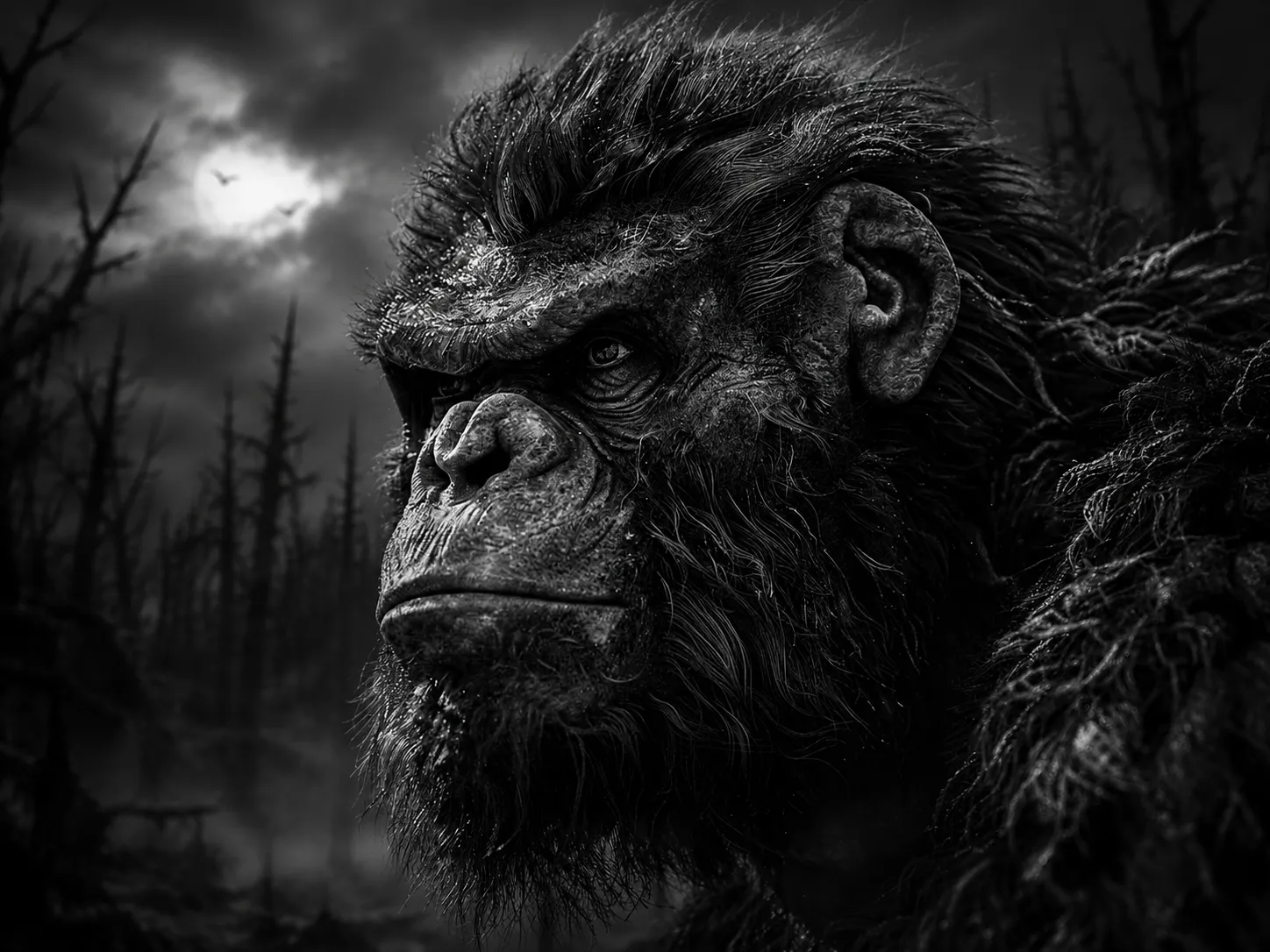
Across hundreds of collected testimonies, the Almas is described with remarkable consistency. It is reported to stand between five and six and a half feet tall, with a body covered in reddish-brown to dark hair roughly six inches long, except on the face, palms, and soles. The face itself is described as flatter and more human than ape-like, with a pronounced brow ridge, a low, sloping forehead, deep-set eyes, high cheekbones, a broad flat nose, and a receding or absent chin.
Witnesses often note a short or nonexistent neck, long arms reaching to the knees, and large hands with long fingers. Females are frequently described as having long, pendulous breasts said to be thrown over the shoulder while running or carrying a child.
The creature is usually reported as unclothed, though a minority of accounts describe crude coverings. According to lore, the creature is nocturnal, solitary or living in small family units, capable of communicating in booming or grunting vocalizations, and possessed of considerable physical strength and endurance in harsh mountain cold.
Regional names for the creature multiply across the Central Asian linguistic map: Albasty and Albast among Kazakh and Turkic communities, Ksy-giik in parts of the Tian Shan, Kaptar in Azerbaijan, Voita in some Caucasian dialects, and a range of Mongolian variants recorded by local researchers, including terms tied to specific habitats such as “burrow almas” (nühni almas) and “saxaul-thicket almas” (zagin almas), named for the desert shrub in which the creature was said to shelter.
One of the more evocative firsthand descriptions on record comes from Koumykov Feitsa, a 67-year-old resident of the village of Kurkuzhin in the Caucasus, interviewed by researchers about Almasty he recalled seeing as a young man in the 1930s. He described the creature’s coat as resembling a bear’s — dark and coarse — and said it was always seen without clothing, communicated only in mumbles or bellows rather than speech, showed no fear of people but fled from dogs, and could run at considerable speed.
That last detail — fear of dogs specifically, rather than of humans or firearms — recurs across several independently collected Caucasus testimonies and has been cited by field researchers as an oddly specific and consistent behavioral note that would be an unusual detail for unrelated informants to invent independently.
Habitat
Reports cluster around four main regions. In the North Caucasus, particularly the republics of Kabardino-Balkaria and Abkhazia, sightings and local legends have been recorded for generations, concentrated in remote gorges and forested slopes.
In the Pamir Mountains of Tajikistan, straddling the roof of Central Asia, herders and mountaineers have described encounters at high altitude. The Tian Shan range, spanning Kyrgyzstan, Kazakhstan, and western China, has produced its own body of testimony under local names like Ksy-giik.
Finally, the Mongolian and southern Siberian Altai — including the western Mongolian steppe and the Gobi’s fringes — hosts the most systematically documented body of Almas folklore anywhere in the world, thanks largely to a single Mongolian researcher’s decades of fieldwork.
Reports are not evenly spread through history. Interest surged sharply after 1956, when British and American expeditions searching for the Himalayan Yeti generated international press coverage. Central Asian communities, who had regarded their local “wild men” as an unremarkable fact of mountain life for generations, suddenly found Moscow newspapers and scientists interested in the same phenomenon, prompting a wave of newly reported sightings and a formal government investigation.
Alleged Sightings Through the Centuries
The written record of Almas encounters stretches back further than most cryptid literature, and the reports form a rough chronology that researchers have leaned on to argue the tradition is neither a recent invention nor a single misunderstanding.
1420s — the Schiltberger account. The earliest known written description comes from Johann (Hans) Schiltberger, a Bavarian nobleman captured by the Ottomans as a teenager and later passed into the service of various Central Asian khans. In the journal of his travels, later held in the Munich Municipal Library, Schiltberger described encountering two hair-covered wild people who lived like animals, their bodies covered in hair except for the face and hands, who had reportedly been presented to his captor as a gift by a regional warlord. In particular, Schiltberger’s journal is also credited with one of the first European descriptions of the Przewalski’s horse, the wild Central Asian horse species that was scientifically unknown to the West until the 19th century — a detail cryptozoologists have used to argue that a man capable of accurately describing one genuinely unfamiliar animal is a more credible witness for another.
1871 — Nikolai Przhevalsky’s expedition. The Russian geographer and explorer Przhevalsky, better known for the horse species that bears his name, led a mapping and reconnaissance expedition through Mongolia and reported observations connected to the Almas. He also noted that the creature already appeared in regional materia medica — the illustrated pharmacological and zoological reference books used by Mongolian and Tibetan medical practitioners. British anthropologist Myra Shackley later highlighted the detail as significant: those medicinal compendiums contained thousands of illustrations of real, observable animals used for pharmacology, and — unlike comparable medieval European bestiaries — did not otherwise include purely mythological creatures, suggesting the compilers regarded the Almas as a living, cataloguable animal rather than a legend.
1907–1928 — the Zhamtsarano mapping project. As detailed below, the Mongolian researcher Tsyben Zhamtsarano spent two decades systematically collecting, dating, and plotting the geographic locations of individual witness reports, producing the first attempt at a data-driven distribution map of Almas sightings.
1925 — the Topilski cave incident. One of the most dramatic reported encounters comes from Soviet Major-General Mikhail Topilski, who documented an episode during a military operation against anti-Soviet rebels holed up in a cave in the Pamirs. According to his account, soldiers encountered a hair-covered, human-like creature during the assault, which was shot after reportedly grappling with several of the fighters. Topilski’s report described the body in detail after the fact, noting its human-like proportions alongside its heavy coat of hair.
1937 — the monastery hide. Dordji Meiren, an associate of Zhamtsarano affiliated with early Mongolian scientific circles, reported seeing what he described as an Almas hide used in a Buddhist monastery ritual in the Gobi region — one of the few reports suggesting that physical remains were, at least briefly, in human hands.
1941 — the Karapetyan capture. The best-known Soviet-era case comes from Lieutenant Colonel Vazhgen S. Karapetyan, a medical officer, who stated that partisans operating near Buinaksk in the Caucasus brought him a prisoner they had captured, believing it might be a German infiltrator. Karapetyan described the individual as naked, powerfully built, covered in dark, fine hair similar to a bear’s coat, and unable or unwilling to speak. With the war underway and no clear protocol for handling the prisoner, local commanders reportedly had the man executed as a suspected spy. The account, first published decades later, remains one of the most frequently cited — and most impossible to verify — Almas stories in the literature, since no remains, records, or independent confirmation survive.
1945 — the Ishgin encounter. A Mongolian and Kazakh travel party of roughly sixty people, splitting into smaller groups near the end of October 1945, reportedly cornered and briefly restrained an Almas, initially suspecting it was a human spy. According to the witness Ishgin, once captured, the group could tell the creature was some kind of animal rather than a person; pressed for time, they fed it and released it back into the forest.
1963 — Ivan Ivlov’s family sighting. A Russian pediatrician, Ivlov reported observing what he described as a family group — an adult male, an adult female, and a juvenile — standing together on a mountain slope in the Altai region, at a distance he later estimated at around half a mile. What made Ivlov’s account unusual is what he did next: back in his medical practice, he began asking his young Mongolian patients whether they had ever seen an Almas. A hard to ignore number said yes, describing casual, fearless encounters with young Almas their own age while herding or playing outdoors — encounters the children treated as unremarkable rather than frightening. Ivlov’s driver independently corroborated seeing the same family group.
1972 — an unnamed Soviet doctor’s account, cited by Myra Shackley, describes another family-group sighting, adding to the small cluster of reports describing the Almas in apparent social units rather than as solitary individuals.
1993 — the Sitnikov river sighting. Russian researcher Alexei Sitnikov, leading an expedition toward Lake Tonee in Russia’s Far East (unrelated to his group’s original purpose of investigating reports of a giant serpent), reported that his team spotted a reddish, fur-covered, manlike creature on the opposite bank of a river they were crossing by raft. The monster reportedly made grunting vocalizations before retreating into the treeline.
2003 — the Altai assault report. A Mongolian news agency reported that a driving instructor and a male companion hiking in the Altai Mountains were approached by a male Almas, which allegedly grabbed the woman before her companion was able to intervene and drive it off — one of the very few modern reports describing direct physical contact rather than an observation at a distance.
Taken together, the reports cover nearly six centuries, several unrelated ethnic and linguistic communities, and witnesses ranging from an enslaved medieval nobleman to Red Army officers, Soviet doctors, and modern Mongolian civilians — a consistency of description that hominology researchers have pointed to as significant, even though consistency alone is not physical proof.
The Soviet Snowman Commission
Few cryptids anywhere in the world have been the subject of an official state investigation. The Almas is the exception.
In January 1958, the Presidium of the USSR Academy of Sciences established a formal Commission for the Study of the Snowman Question, prompted by growing public debate and a stream of testimonies reaching Moscow, including a report from the Chief Inspector of Hunting for the Republic of Dagestan, who claimed to have observed a creature and its footprints on a high mountain slab of snow in August 1958. The commission organized a research expedition to the Pamirs that same year, based out of the Academy’s own Botanical Institute station in the region, whose staff had reported encountering “strange manlike beings.”
The driving force behind the commission was Boris Porshnev, a Soviet historian, philosopher, and polymath who had built his academic reputation studying popular revolts in Ancien Régime France before turning to prehistory and human origins.
Porshnev proposed that the Almas — and similar reports worldwide — represented surviving relict populations of Neanderthals that had persisted into the modern era in remote, low-population mountain regions. He argued the surviving hominids should be reclassified entirely out of the family Hominidae, into a separate taxonomic family he called Troglodytidae, because they lacked language and were, in his view, not fully human despite their appearance.
Porshnev’s theory, later dubbed simply “the Porshnev theory,” influenced Western cryptozoologists Bernard Heuvelmans and Ivan T. Sanderson; Porshnev and Heuvelmans co-authored a French-language book in 1974 arguing for the continued survival of Neanderthals. Porshnev’s own Pamir expeditions failed to produce physical evidence, and his academic standing declined in the years that followed. However, his published bulletins remain the single largest archive of primary-source Almas testimony ever assembled by a government body.
One of the commission’s most remarkable recruits was Dr. Marie-Jeanne Koffmann, a French-born surgeon who had moved to the Soviet Union in the 1930s, commanded an alpine troop battalion during the Second World War, and then spent six years in a Stalin-era labor camp after being falsely accused of spying for France. Released in 1954, she was selected in 1958 as the physician on the Academy’s official Pamir expedition.
Koffmann went on to spend more than three decades based in the village of Sarmakovo in Kabardino-Balkaria, systematically gathering an archive of roughly 500 eyewitness accounts, footprint casts, and ethnographic records from the North Caucasus.
She never obtained a photograph or physical specimen. Still, her fieldwork remains the most extensive individual body of Almas research on record, with part of it published in the French journal Archéologia in 1992. Koffmann died in 2020, shortly after her 101st birthday.
The Case of Zana of Abkhazia
No individual story shaped Almas folklore more than that of Zana, a woman said to have been captured living wild in the forests near the Adzyubzha River in Abkhazia in the mid-19th century.
According to local accounts, hunters tracked and subdued her after a violent struggle; she was described as extraordinarily tall and powerful, covered in dark hair, and initially aggressive toward her captors. She was eventually purchased by an Abkhaz nobleman, Edgi Genaba, who kept her at his estate in the village of Tkhina, where she lived until her death around 1890.
Zana reportedly bore several children of ordinary human appearance, and generations of her descendants continued to live in the region into the modern era. For over a century, Russian hominologists — including Koffmann and Porshnev — debated whether Zana represented a genuine relict Neanderthal or wild hominid.
Long before DNA sequencing existed, the skull attributed to Khwit had already cast doubt on the Almas theory. In the early 1990s, American physical anthropologist Dr. Grover Krantz — himself a serious, credentialed Sasquatch researcher rather than a skeptic looking to debunk the case — examined the skull directly and concluded it showed no Neanderthal or non-human features whatsoever, describing it as entirely modern in structure. Krantz’s conclusion, offered decades before the genome could be sequenced, turned out to anticipate the eventual genetic verdict almost exactly.
The question was finally settled by hard genetic evidence. In 1971, researchers located the grave of Zana’s son, Khwit, and decades later a skeleton believed to be Zana’s own was exhumed from a family cemetery. In 2015, University of Oxford geneticist Bryan Sykes generated headlines with DNA analysis of saliva from Zana’s living descendants and a tooth from Khwit’s remains, concluding she carried entirely sub-Saharan African ancestry unlike any group in the surrounding region — a finding he linked, controversially, to speculation about an ancient out-of-Africa lineage.
A more rigorous resolution came in a 2022 peer-reviewed genomic study, published after full-genome sequencing of both the Khwit and Zana skeletal remains. The identical mitochondrial DNA and the confirmed parent-child relationship between the two have verified the skeletons’ identities, and population genomic analysis has traced Zana’s immediate ancestry to present-day East African populations.
The study’s authors concluded definitively that Zana was a fully modern human woman, not an Almasty of any kind. They proposed that her presence in 19th-century Abkhazia was most plausibly linked to the historical trafficking and enslavement of East Africans through Ottoman-controlled Black Sea trade routes — a population documented to have settled in small numbers in the Caucasus during that era.
In short, one of the best-known “Almas capture” stories in cryptozoological history has now been closed by DNA evidence: Zana was a human being, likely displaced by slavery, whose foreignness and unfamiliar appearance to her captors were folded into local wild-man legend over generations.
Discover More Cryptids:
Tahoe Tessie: The Mysterious Lake Monster of the Sierra Nevada
November 4, 2025
Beast of Bray Road: Wisconsin Creepiest Cryptid?
September 24, 2025
Rinchen, Jamtsarano, and Mongolia’s Almas Archive
The Mongolian side of the Almas story rests almost entirely on the work of two researchers whose contribution rarely appears in English-language cryptid coverage. In the early 20th century, the Mongolian ethnographer and revolutionary intellectual Tsyben Zhamtsarano began systematically compiling reports of Almas encounters after a colleague, B. Baradiin, described meeting one of the creatures personally during his travels.
Zhamtsarano interviewed caravan drivers, nomadic monks, and travelers who claimed sightings or knowledge of tracks, plotting every documented encounter between the late 19th century and 1928 onto a dedicated map, noting the informant’s name in the margin for each entry. He also had a staff artist, Soyoltai, sketch each witness’s description of the creature’s appearance, producing what may be the earliest systematic visual dataset ever compiled for a cryptid.
Zhamtsarano was later imprisoned and died during Stalin-era political purges. His archive might have been lost entirely if not for his student and successor, the linguist and Mongolist Byambyn Rinchen. Rinchen, who himself survived imprisonment from 1937 to 1942 before being formally exonerated in 1963, preserved Zhamtsarano’s collection and expanded it with his own fieldwork, publishing his findings in September 1958 in direct response to correspondence with Porshnev.
Rinchen’s data, gathered from Mongolian herders and travelers, indicated that the geographic range attributed to the Almas had contracted steadily over the decades, roughly tracking the same shrinking habitat occupied by Mongolia’s wild horses and camels in the southeastern part of the country — a detail Rinchen used to argue that the Almas, whatever it was, behaved ecologically like a genuine, if rare, animal population rather than a purely symbolic legend.
Later Mongolian field investigations, including a study centered on testimony collected from a witness named Zhugdariyn Damdin, produced forensic-style facial reconstructions of the Almas based on several eyewitness descriptions, along with the recovery of an unidentified skull near a landmark called Almasyn Ulan (“red rock of the almas”) — though none of the material has been subjected to independent, peer-reviewed verification.
Comparative Analysis: Other Similar Cryptids
| Cryptid | Danger Level | Details |
|---|---|---|
| Yeti | ⚠️ MEDIUM — Generally avoids humans but is blamed in Sherpa folklore for livestock kills and occasional traveler disappearances in high mountain passes. | A 2017 genetic study matched several famous “yeti” hair and tissue samples to the Himalayan brown bear, undercutting decades of physical evidence claims. |
| Bigfoot / Sasquatch | 🕊️ LOW — Overwhelmingly described as shy and avoidant, with no verified fatal attack despite thousands of North American sighting reports. | The 1967 Patterson–Gimlin footage, shot at Bluff Creek, California, remains the single most frame-by-frame analyzed piece of cryptid evidence in history. |
| Skunk Ape | 🕊️ LOW — Reported mainly as a foul-smelling nuisance that raids campsites and garbage rather than confronting people directly. | Its name comes from the overpowering sulfurous odor witnesses consistently describe, which some researchers attribute to the swamp gas and decaying vegetation of its Everglades habitat. |
| Yowie | ⚠️ MEDIUM — Aboriginal and modern accounts describe territorial behavior, including rock-throwing and short charges at intruders. | Yowie sightings predate European settlement of Australia, appearing in Aboriginal oral tradition under regional names such as “Doolagahl” long before the term “Yowie” became widespread. |
| Orang Pendek | 🕊️ LOW — Consistently described as reclusive, fleeing into dense jungle cover rather than confronting the villagers who report tracks. | Unlike most hairy-hominid cryptids, it is described as under five feet tall, leading some researchers to suggest it could represent an undiscovered ape species rather than a hominid. |
| Yeren | ⚠️ MEDIUM — Chinese accounts from Hubei province include a documented 1976 incident in which a passing vehicle reportedly struck one on a mountain road. | China ran its own government-funded Yeren research expeditions through the 1970s and 1980s, making it one of the only cryptids besides the Almas ever investigated with state resources. |
| Barmanou | 💥 HIGH — Accounts from the mountains of Pakistan and Afghanistan describe an aggressive creature capable of overpowering livestock and, in local stories, cornered shepherds. | Local folklore claims the Barmanou’s feet point backward, a trait said to deliberately mislead anyone trying to track it by its footprints. |
| Mapinguari | 💥 HIGH — Amazonian folklore describes a foul-smelling, single-eyed creature capable of killing livestock and hunters with its claws and a piercing roar. | Some researchers have linked the legend to a folk memory of the giant ground sloth, a genus that only went extinct in South America around 10,000 years ago — recent enough to have overlapped with early human settlers. |
| Nguoi Rung | ⚠️ MEDIUM — Vietnamese and Cambodian jungle accounts describe a startled, defensive creature occasionally reported throwing branches at intruders. | Reports of the “forest person” spiked among American and Vietnamese soldiers during the Vietnam War, who described encounters in the dense jungle cover of the Annamite Range. |
| Ebu Gogo | ⚠️ MEDIUM — Flores Island folklore describes small, hairy people said to have abducted and even eaten children, unusually violent compared to most wild-man legends. | Scientific interest in the legend was renewed by the 2003 discovery of Homo floresiensis, a diminutive extinct human species whose fossils were found on the very same Indonesian island. |
Scientific Explanations and Skepticism: My Take
Having gone through the historical record, I don’t think the Almas is a surviving hominid species, and I want to walk through why, because the reasoning matters more than the conclusion.
Start with the one Almas case that ever got a definitive scientific answer: Zana. For over a century, this was cryptozoology’s best evidence — a physically unusual woman, captured alive, whose bloodline persisted into the modern era where samples could actually be tested.
If any Almas case was going to hold up, it should have been this one. It didn’t. Grover Krantz’s skull examination in the early 1990s and the 2022 full-genome sequencing both arrived at the same place: a modern human being, most plausibly a trafficked East African woman whose unfamiliar appearance and language got absorbed into an existing wild-man category by people who had no other framework for her. That’s not a footnote to the Almas story — I think it’s the single most important data point in it, because it’s the one time the legend was tested against hard evidence rather than more testimony, and the legend lost.
It’s a strong reason to be skeptical of every other capture story that never got that kind of scrutiny, including Karapetyan’s 1941 account, which is dramatic precisely because it’s completely unverifiable — no remains, no records, nothing that could ever be checked the way Zana’s remains eventually were.
I also think the pattern of the sightings themselves argues against a hidden species more than for one. A breeding population large enough to persist for six centuries across the Caucasus, Pamirs, Tian Shan, and Altai — thousands of kilometers apart — would need to number in the hundreds or thousands of individuals, spread across some of the most heavily traversed trade and military corridors in Eurasian history.
Genghis Khan’s empire, Silk Road caravans, Soviet military operations, and modern agriculture all passed directly through this territory for centuries. None of it produced a body, a bone, a hair sample with a nuclear genome attached to it, or a photograph that has survived scrutiny.
Compare that to how quickly genuinely rare Central Asian animals — snow leopards, saiga antelope, even the wild Przewalski’s horse Schiltberger described — eventually turned up specimens once scientific expeditions went looking specifically for them. The Almas never has, despite a state-funded Academy of Sciences commission actively trying.
That said, I don’t think the tradition is simply invented, and I think that’s the more interesting part of the story. The consistency across unrelated witnesses — Koumykov Feitsa’s detail about dogs specifically frightening the creature, the repeated descriptions of family groups rather than solitary monsters, the near-universal insistence that it looks human rather than ape-like — reads to me less like a shared myth and more like a shared folk category that real, ambiguous encounters kept getting sorted into.
Isolated brown bears seen briefly on two legs at a distance account for a good share of it; Bigfoot and Yeti research has repeatedly documented the same misidentification pattern. But I think a meaningful portion of the older reports, particularly the capture and interaction stories, are more plausibly explained the way Zana’s case turned out to be explained: real people — displaced, non-verbal for reasons of trauma or disability, or simply from an unfamiliar ethnic or linguistic group — encountering communities that had a centuries-old “wild man” template ready-made to receive them.
I’d also push back gently on Porshnev’s specific relict-Neanderthal framework, separate from the broader question of whether something unusual was being seen. His proposal requires Neanderthal populations to have survived, undetected, into the 20th century in a region that has actually been fairly well surveyed archaeologically — and it requires those survivors to have lost most of the distinguishing Neanderthal skeletal traits (the heavy brow, solid build, distinctive cranial shape) while somehow keeping a full-body coat of hair no Neanderthal fossil evidence supports.
That’s a lot of unsupported adjustment to make a folklore description fit a specific extinct species, when a simpler explanation — real but rare human encounters, filtered through an old and remarkably stable regional folklore category — accounts for the same evidence without requiring an undiscovered hominid lineage. I find that simpler explanation more convincing, even though I don’t think it’s the whole answer for every single report, and even though it leaves some of the more detailed 20th-century military and family-group accounts frustratingly unresolved.
A Legend Sustained by Institutions, Not Just Storytellers
What distinguishes the Almas from most cryptids is not the plausibility of its existence, but the caliber of the people who took it seriously. A government academy, a career historian-philosopher, a decorated wartime surgeon, and a Mongolian linguist who survived Stalinist imprisonment all devoted years of their professional lives to documenting it — and in the case of Zana, modern genome sequencing was eventually brought to bear on a 19th-century legend.
The creature itself remains as undocumented today as it was in Tamerlane-era chronicles that first described “wild, hairy men” wandering Central Asia in the 15th century. But the paper trail it left behind — commission bulletins, hand-drawn witness sketches, ethnographic maps, and a peer-reviewed ancient-DNA study — makes the Almas one of the best-archived unconfirmed creatures in the history of cryptozoology.
Discover More Cryptids:
Complete Guide to Oklahoma Bigfoot Sightings (1942–2025)
August 5, 2025
The Mysterious Almas Cryptid: 600 Years of Sightings
July 20, 2026
Who or What Is the Owlman of Mawnan Church?
November 5, 2025
Complete Guide to Wisconsin Bigfoot Sightings (1867–2025)
August 10, 2025
Eloko: The Tiny Forest Cryptids That Kill Without Warning
February 3, 2026
Sources
- Coleman, Loren, and Patrick Huyghe. The Field Guide to Bigfoot, Yeti, and Other Mystery Primates Worldwide. Avon Books, 1999.
- Heuvelmans, Bernard, and Boris Porshnev. L’Homme de Néanderthal est Toujours Vivant. Plon, 1974.
- Margaryan A, Sinding M-HS, Carøe C, Yamshchikov V, Burtsev I, Gilbert MTP. The genomic origin of Zana of Abkhazia. Advanced Genetics. 2021; 2(2):e10051. https://doi.org/10.1002/ggn2.10051.
- Porshnev, B. F., et al. The Troglodytidae and the Hominidae in the Taxonomy and Evolution of Higher Primates. Current Anthropology, vol. 15, no. 4, 1974, pp. 449–56. JSTOR, http://www.jstor.org/stable/2740797. Accessed 20 July 2026.
- Hill, Sharon A. Cryptozoology and Pseudoscience. Skeptical Inquirer, Jan. 2011.
- Rossi, Lorenzo. (2015). A Review of Cryptozoology: Towards a Scientific Approach to the Study of “Hidden Animals”. 10.1007/978-3-319-22246-2_26.
- Clark, Jerome. Cryptozoology A to Z: The Encyclopedia of Loch Monsters, Sasquatch, Chupacabras, and Other Authentic Mysteries of Nature. Simon & Schuster, 1999. Internet Archive.
- Schiltberger, Johann. The Bondage and Travels of Johann Schiltberger, a Native of Bavaria, in Europe, Asia, and Africa, 1396–1427. Translated by J. Buchan Telfer, Hakluyt Society, 1879.
- Shackley, Myra. Still Living? Yeti, Sasquatch, and the Neanderthal Enigma. Thames & Hudson, 1983.
- Sykes, Bryan. The Nature of the Beast: The First Genetic Evidence on the Survival of Apemen, Yeti, Bigfoot and Other Mysterious Creatures into Modern Times. Coronet, 2015.