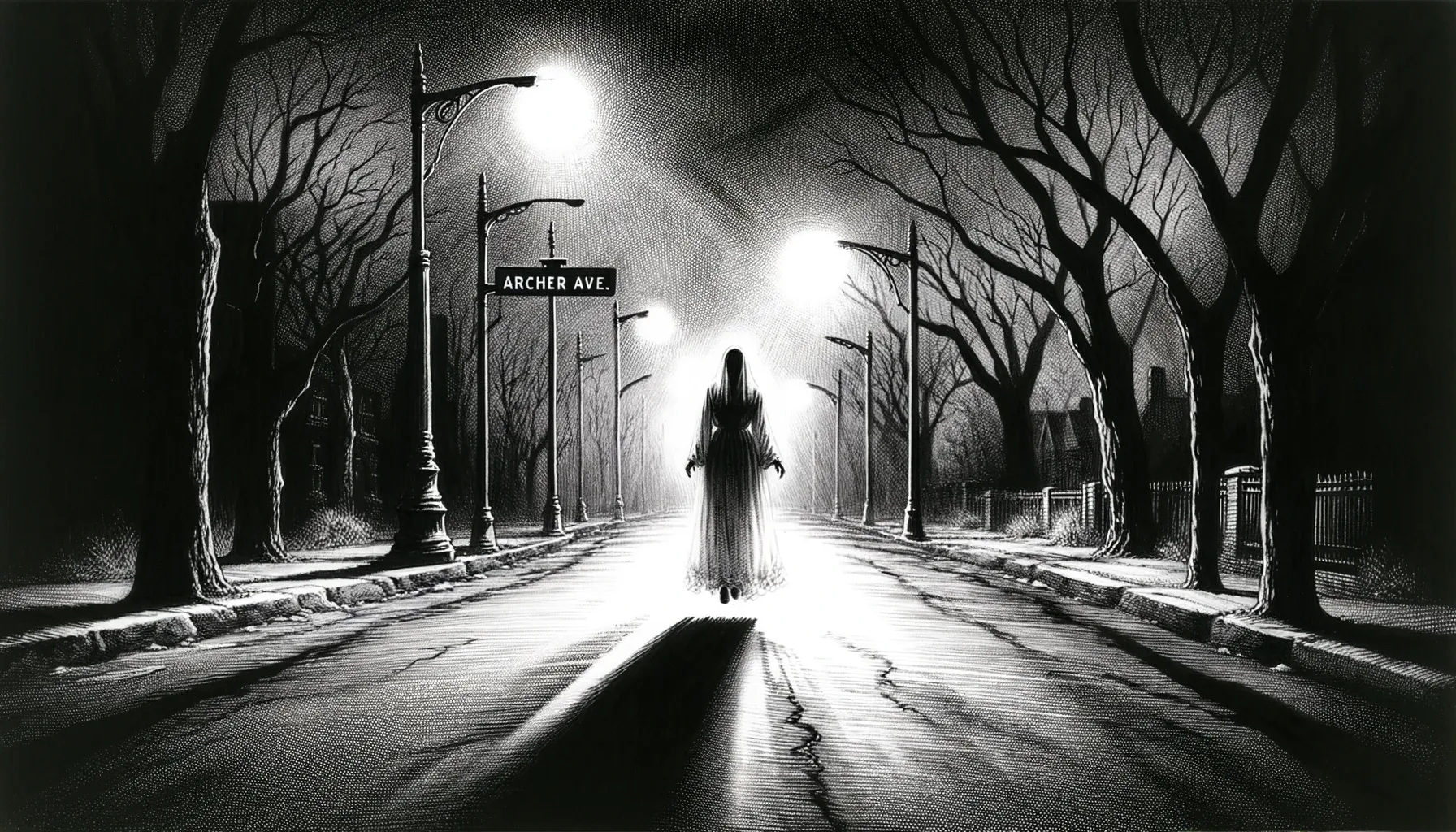
For many, Resurrection Mary is just another “vanishing hitchhiker” story, but what happens along Chicago’s southwest corridor is much more complicated. Unlike hauntings that simply replay the past, this entity seems aware and responsive, even keeping up with technological and transportation advances over the years.
Plus, a detail that is often missed in mainstream stories is that during a well-known 1976 Resurrection Mary encounter, a police officer didn’t just see a woman. He also found part of the cemetery’s iron bars bent and burned with handprints the size of a person’s, hinting that the entity can produce intense heat.
Summary
Key Takeaways
| Attribute | Details |
| Name | Resurrection Mary; The Vanishing Hitchhiker of Archer Avenue |
| THC Scale | L-5 [See the THC Scale Explanation] |
| Location / Origin | Archer Avenue, specifically the stretch between the Willowbrook Ballroom and Resurrection Cemetery (7200 Archer Rd, Justice, IL 60458). |
| Classification | Intelligent; Crisis Apparition |
| History | Commonly attributed to a hit-and-run death of a young woman leaving a dance hall (circa 1930–1934). |
| Casualties & Deaths | 1 primary historical victim (the entity itself); 0 attributed secondary deaths. |
| Manifestations | Visual (full-bodied apparition), Physical (scorched iron bars), Environmental (extreme localized cold). |
| First reported sighting | 1934 (reported shortly after the death of Mary Bregovy) |
| Recent reported sighting | Ongoing; sporadic reports in the 2010s. |
| Threat Level | 2/10 (harmless) [See the Threat Level Explanation] |
| HCR | 2/10 (extremely likely authentic) [See the Hoax Confidence Rating Explanation] |
What Is the Resurrection Mary Haunting?
Many paranormal investigators believe that the strange events along Archer Avenue are an Intelligent haunting with strong physical effects. Unlike a “stone tape” haunting that just repeats itself, Resurrection Mary acts with purpose. She asks for rides, talks to drivers, and chooses where she wants to go, which shows she’s more than just a memory—she seems to have her own awareness.
One detail that’s often overlooked is that she tends to appear to young men driving alone, heading northeast late at night. It seems like she uses the energy and closed space of a moving car to help her take shape.
Many witnesses say the temperature inside their car suddenly drops, as if the entity is pulling heat from the air to appear more solid, a classic sign that she can affect her surroundings to make contact.
Who Is the Resurrection Mary?
The story of Resurrection Mary began during the “Dance Hall Era” of the 1920s and 30s, when Chicago’s southwest side was full of big ballrooms and dark, risky roads.
To deduce where the legend started, we need to look at the real people and lively places involved. The main candidates for the haunting each bring different clues, and comparing these with eyewitness accounts points to a complicated energy shift.
Candidate Profile: Mary Bregovy (The 1934 Fatality)
The person most often linked to the Resurrection Mary legend is Mary Bregovy, a 21-year-old factory worker from the Polish-American area near 47th and Damen. She died on March 10, 1934, which matches up with the first reported sightings. Bregovy was killed when the car she was in, driven by John Thoel, crashed into a support column of the “L” tracks at Lake Street and Wacker Drive.
Some skeptics point out that the accident happened miles away from Archer Avenue. However, burial records from Resurrection Cemetery show she was buried in an orchid-colored dress and matching shoes, which is very similar to the “white” or “see-through” dress people report seeing on the ghost.
In the 1950s, funeral directors in the area reported seeing a dark-haired woman in the cemetery, matching Bregovy’s hair color, which suggests that the stories about a “blonde” hitchhiker might have come later as the legend transformed over time.
Candidate Profile: Anna “Marija” Norkus (The 1927 Tragedy)
Another strong theory is that the ghost is Anna Norkus, who died on July 20, 1927, just before her 13th birthday. Her case connects more directly to the ballroom. Records show her group was driving home from the Oh Henry Ballroom at 1:30 a.m. when their car fell into a 25-foot ditch at 66th Street and Harlem Avenue.
The accident was especially tragic: Anna was “crushed” under the car, and another passenger, Adam Lewieki, died the next day. One important detail for investigators is the “Gravedigger Strike” that happened in the late 1920s.
Although her death certificate says she was supposed to be buried at St. Casimir Cemetery, history shows that because of the strikes, many bodies ended up in temporary vaults or unmarked graves at Resurrection Cemetery. This kind of mix-up is often seen as a trigger for hauntings, leaving spirits unsettled.
The Oh Henry Ballroom
The Oh Henry Ballroom, later called the Willowbrook, was at the heart of the Resurrection Mary story. Built in 1921 by John Verderbar for $100,000, it was impressive for its time, with a large maple dance floor. After a big fire in 1931, it was rebuilt as a grand Spanish Baroque-style ballroom.
It seems the haunting is linked to a cycle of tragedy involving people leaving the ballroom. In the 1930s, Archer Avenue was a narrow, dangerous road with deep ditches and woods on both sides. Going from the lively, joyful ballroom—where people danced to bands like Count Basie—to a sudden car accident created what researchers call a “liminal trap.”
The ghost isn’t just tied to one place. Resurrection Mary seems to be trying to finish a journey cut short, retracing the last mile and a half from the ballroom to the cemetery gates.
You may also enjoy:
Is the Lake Iliamna Monster Alaska’s Real-Life Sea Cryptid?
November 5, 2025
The Lake Tanganyika Monster: A Living Prehistoric Beast?
November 10, 2025
The Dark Story Behind the Boyington Oak Haunting
September 18, 2025
What Is A Paranormal Cold Spot and Why Does It Happen?
January 7, 2026
New Mokele-Mbembe Sightings, Theories & Evidence
June 3, 2025
Resurrection Mary Ghost Sightings
Documented sightings of Resurrection Mary have been reported over several decades, primarily along Archer Avenue. Richard Crowe, a noted Chicago folklorist, claimed to have collected more than three dozen distinct, consistent reports from witnesses.
| Year | Location | Details of Sighting or Report |
| 1934 (Late Spring) | Archer Avenue near Resurrection Cemetery | First generalized reports of a young woman attempting to run toward cars and climb onto the running boards of passing vehicles, as if desperately seeking help. |
| 1939 (January) | Liberty Grove and Hall, and Archer Avenue | Jerry Palus met and danced with a woman named Mary; he noted her ice-cold skin; she asked for a ride home and vanished as they neared the cemetery gates. |
| 1951 | Archer Avenue | A driver reported picking up a young woman in a white dress who abruptly and silently vanished from the rear seat of his car near the cemetery entrance. |
| 1960s (Mid) | Willowbrook Ballroom & Archer Avenue | Several young men claimed to have danced with a quiet, pale blonde woman at the ballroom. When offered a ride, she disappeared from the car as they passed the gates of Resurrection Cemetery. |
| 1973 (Feb/Mar) | Harlow’s Nightclub, Cicero Avenue | Mary reportedly showed up at the nightclub twice in one month, dancing alone in a dress that resembled a faded wedding dress. Bouncers stated no one saw her enter or exit. |
| 1976 (August) | Resurrection Cemetery gate | A driver reported seeing a woman pulling at the bars. Two wrought-iron bars were later found bent apart with scorched handprints. |
| 1978 | Archer Avenue | A driver swerved to avoid hitting a woman in a white dress who suddenly appeared in the road. She vanished after his car stopped. |
| 1979 (January) | Archer Avenue near a small shopping center | Cab driver Ralph picked up a young blonde woman who suddenly yelled “Here! Here!” before vanishing from the locked vehicle. |
| 1980 (Early) | Resurrection Cemetery | Clare and Mark Rudnicki drove past and observed a young woman in a white dress walking slowly along the roadside, with a distinct white aura surrounding her. She disappeared as they turned their car around. |
| 1989 (October) | Front of Resurrection Cemetery | Driver Janet Kalal reported a pale young woman stepping into the path of her car. She felt an impact, but there was no physical damage to the car, and the woman disappeared instantly, leaving a human-shaped depression in the fresh snow. |
Jerry Palus (1936)
This encounter is important because it happened before the legend became widely known, long before ghost hunting was popular. Palus, who often went to Liberty Grove Hall at 47th and Mozart, spent a whole evening dancing with a woman who called herself “Mary.”
He noticed two strange things: her skin felt “ice cold,” and she had a strong, almost hypnotic presence. In paranormal research, a “cold” ghost usually means it’s pulling heat from its surroundings to appear more real.
When he offered her a ride home, she asked him to go toward Archer Avenue instead of her original address on South Damen Avenue. As they neared the cemetery, she whispered, “Where I’m going, you cannot follow,” and disappeared while the car was still moving. My analysis of this case looks at what happened after the event:
The next day, Palus went to the Damen Avenue address and recognized “Mary” in a photo. Her mother told him the girl had died five years earlier. This makes the sighting a “crisis apparition,” showing strong interaction—possibly powered by the energy from hours of dancing.
The Scorched Gate Anomaly (1976)
On August 10, 1976, the Justice Police Department got a call from a driver who said a young woman was trapped behind the gates of Resurrection Cemetery.
Officer Pat Homa went to check and didn’t find anyone, but he did see something unusual. Two of the cemetery’s heavy iron bars were bent apart, and in the middle were two burned handprints where the metal’s green coating had been scorched off.
Investigators see this as a sign of a powerful burst of heat, as in poltergeist cases. For a ghost to bend and burn metal like this, it would need to release a huge amount of heat in one spot or somehow affect the metal’s structure.
The cemetery later said a truck had backed into the gates, but that doesn’t explain the burned, finger-shaped marks. I believe the scorching shows the entity was trying to become physical, using the metal bars to release a large amount of built-up static energy.
The Vanishing Passenger of 1979
A taxi driver known as “Ralph” in local stories picked up a woman in white near Chet’s Melody Lounge, right across from the cemetery. She looked completely real and spoke quietly and politely.
Ralph said she was “young enough to be my daughter” and wore a faded white dress that seemed old-fashioned for the late 1970s. She disappeared from the backseat while the cab was moving, and the door never opened.
This is a classic case of what’s called Entangled Energy. The ghost didn’t leave the car in the usual way—she just stopped being visible to the driver as soon as the cab entered the “Resurrection Triangle,” the area between Archer, Roberts Road, and 79th Street.
I think the ghost uses the car like a Faraday cage—a safe space where she can appear for a short time before getting too close to her burial site, which pulls her back into a non-physical state. The fact that this happened in January, when there’s a lot of static in the air, supports the idea that she uses natural electricity to stay visible.
Theories
Explanations for the Resurrection Mary phenomenon can be categorized into folklore traditions, spiritual entity theories, psychological analyses, and more recent investigations.
The Vanishing Hitchhiker
This long-established sociological theory claims that the Resurrection Mary narrative is a localized expression of the widespread vanishing hitchhiker urban legend. Similar stories are documented globally and typically involve a driver picking up a passenger who disappears near an accident site or cemetery, later confirmed to be a person who died years before.
Folklorists argue that the various Resurrection Mary sightings adhere so strictly to this established template that the events are likely the product of collective storytelling and the cultural need for warning tales regarding lonely highways and the dangers of the night.
The Trapped Intelligent Entity
This paranormal theory proposes that Resurrection Mary is a true Intelligent Ghost—the restless spirit of the woman who died on Archer Avenue. The dynamic nature of her encounters, in which she speaks, asks for rides, and displays emotional distress (e.g., being cold to the touch or frantically attempting to climb onto vehicles), suggests a conscious, regular pattern of behavior rather than a simple residual replay.
Proponents theorize that the spirit is emotionally distressed by her untimely death and is perpetually attempting to complete the journey she was never allowed to finish, repeatedly seeking a ride home or back to her burial site.
The Blending of Victims
Modern researchers, particularly those seeking specific historical documentation, have suggested that Resurrection Mary is not a single ghost but rather a hybrid of multiple historical tragedies into a single, cohesive narrative.
Because the actual event—a hit-and-run death on Archer Avenue—doesn’t have a definitive, singular victim, the identity of the ghost has been attributed to various local women who died tragically in the area between the 1920s and 1930s (e.g., Anna Norkus and Mary Bregovy).
This theory suggests that the spectral phenomenon is the cumulative spiritual trauma of the area’s dark history, manifesting in a standardized, recognizable form.
Quartz Piezoelectricity and the Archer Avenue Bedrock
The Chicago area, particularly the southwest corridor, sits atop a significant amount of limestone and dolomite, which often contain quartz deposits.
The Quartz Piezoelectricity theory says that when the Earth’s crust is under pressure—like from heavy traffic on Archer Avenue—the quartz crystals in the ground can create an electromagnetic field. This field might store memories or trauma. Since the cemetery and ballroom are linked by one road, that road could act like a giant conductor.
Tectonic Strain Theory (TST)
Michael Persinger’s theory claims that stress in Earth’s crust can generate small electromagnetic fields that affect the human brain, leading people to see or hear things that seem real. Archer Avenue isn’t on a big fault line, but the area’s heavy development and river history could create enough underground pressure for this to happen.
The Thoughtform (Tulpa) Hypothesis
Because the Resurrection Mary story is so well known in Chicago, some researchers think she has become a Thoughtform, which means that if enough people believe in her and expect to see her, their combined energy could actually create the ghost. That could explain why she always appears young, even as the world changes—she’s shaped by what people imagine.
You may also enjoy:
Ghoul: The Original Monster Worse Than Zombies
February 18, 2026
Complete Guide to Iowa Bigfoot Sightings (1965–2025)
July 28, 2025
Who Is Malphas? The Great President of Hell
August 25, 2025
Resurrection Mary vs Other Similar Entities
| Name | Location | Type of Haunting | Activity Level |
| The White Lady of Blue Bell Hill | A229 road, Kent, England | Apparition | 7 (very active) |
| La Llorona | Southwestern US, Mexico, Latin America | Ghost (General) | 10 (extremely active and dangerous) |
| The Lady of White Rock Lake | White Rock Lake, Dallas, Texas, USA | Apparition, Ghost | 6 (occasional) |
| Annie’s Road Ghost | Jackson Road, Pine Barrens, New Jersey, USA | Apparition, Crisis Apparition | 4 (occasional) |
| Martha | Route 13, Mascoutah, Illinois, USA | Apparition, Ghost | 5 (occasional) |
| The Phantom Hitchhiker of Highway 37 | Highway 37, Indiana, USA | Apparition | 5 (occasional) |
| Elisa Day (The Vanishing Hitchhiker) | Mount Misery Road, Huntington, New York, USA | Apparition, Crisis Apparition | 6 (occasional) |
| The Ghost of Archer Road | Archer Road, Summit County, Ohio, USA | Apparition | 3 (dormant) |
| Bloody Mary (Queen Mary I) | Various locations, including the Tower of London, England | Residual, Poltergeist | 8 (very active) |
| Anna Norkus (The Girl in the White Dress) | Willowbrook Ballroom, Illinois, USA | Apparition, Ghost | 7 (very active) |
| The Hitchhiker of Route 6 | Route 6, Massachusetts, USA | Apparition | 4 (occasional) |
| The Phantom Lady of the Bypass | Marlborough Bypass, Wiltshire, England | Apparition | 5 (occasional) |
Beyond the Hitchhiker Archetype
After years of studying the “Resurrection Triangle,” I believe that just seeing Mary as a hitchhiker misses the bigger picture. My research, including newer stories from Reddit and local archives, suggests that the ghost is changing from a person-like entity to something more like a unique energy tied to the area.
A new detail that’s come up among investigators is that “Mary” has started appearing in ride-share cars, not just as a hitchhiker. In 2024, a driver said a mysterious passenger set the cemetery as her destination, but the app glitched and the passenger vanished as they crossed the Des Plaines River bridge. This hints that the ghost can interact with modern technology, which I call Digital Psychometry.
We also need to consider the geology of Archer Avenue. The road sits on a huge limestone ridge called the Niagaran Escarpment, which is full of calcium carbonate and iron-rich minerals.
I think the “Resurrection Triangle”—the area between the cemetery, forest preserves, and Des Plaines River—acts like a giant natural battery. During humid late spring, the ground can release bursts of static energy. This could explain why recent reports mention “glowing orbs” near the cemetery gates before people see the ghost.
One thing that really is remarkable to me is that recent witnesses say Resurrection Mary seems more upset or confused than before. Unlike the calm, polite ghost from the 1930s, today’s reports describe her as “hysterical” or “incoherent,” sometimes even jumping into cars at stoplights instead of waiting to be picked up.
To me, this shows that the Thoughtform we’ve created is breaking down due to the noise and chaos of modern life. Instead of seeing a girl trying to get home, we’re now seeing a fading memory struggling to exist in a world that’s moved on.
Music, Television, and Media
The Archer Avenue ghost story has grown beyond local legend and become a classic example of the “Vanishing Hitchhiker” in American paranormal media. Unlike most local ghosts, Resurrection Mary has been featured in national media, which has transformed how people see the haunting.
Over time, Mary’s story has become a lasting part of our culture. Producers and musicians often use her legend to explore themes such as longing and the pain of a life cut short.
Television and Investigative Documentaries
Interest in Resurrection Mary really took off after she was featured on the famous show “Unsolved Mysteries” with Robert Stack. The episode, which aired in the early 1990s, used dramatic reenactments that cemented the image of a blonde woman in a white dress.
The show also featured a 1973 story from Harlow’s Nightclub, where a manager saw a woman dancing alone with “big spooly curls” and a very pale face. This was important because it showed that Mary wasn’t just a roadside ghost—she could also appear in busy, lively places.
In the 2020s, the haunting has appeared on several paranormal TV networks, often highlighting the scorched gate story. Movies like the 2005 “Resurrection Mary” add dramatic twists, such as a “deal with the devil,” showing how the media often turns the ghost into a character with her own motives instead of just a repeating spirit.
Musical Tributes and Ballads
Resurrection Mary has inspired many songs, especially in folk and rock music. One of the earliest and most genuine tributes is “The Ballad of Resurrection Mary” by Guy Gilbert (1977), a Chicago single that shows how much people were fascinated by the legend. The lyrics talk about her “long white dress and cold, cold hand,” echoing what witnesses like Jerry Palus described.
Another standout is the song “Resurrection Mary” by British rock star Ian Hunter, released in 1981 on his album Short Back ‘n’ Sides. Produced by Mick Ronson, the song has a moody feel that matches the lonely vibe of Archer Avenue. Hunter’s interest shows that the legend has reached far beyond Chicago and into the world of international rock music.
The “Bloody Mary” Tradition at Chet’s
One of the most unique traditions is at Chet’s Melody Lounge, a bar right across from the cemetery. The bar has been featured in many travel shows and documentaries for its Sunday ritual of leaving a Bloody Mary at the end of the bar for the ghost.
This gesture of “hospitality” for a ghost is a rare mix of media attention and modern ritual. Here, the ghost is treated like a local celebrity, not a threat. This ongoing tradition keeps the legend alive in people’s minds, even when there aren’t many new sightings.
Is Resurrection Mary Haunting Real?
After looking at almost a hundred years of reports, I believe the Archer Avenue case is one of the strongest examples of a spontaneous haunting in North America.
I don’t think it’s just a regular ghost story. Instead, I see it as a mix of environmental energy and a Thoughtform. The 1976 incident with the burned cemetery gates shows we’re dealing with something that can physically affect the world—much more than just a memory stuck in stone.
Still, the fact that Mary’s character has stayed the same over time suggests that the haunting continues because of people’s shared beliefs. I think a real tragedy in the 1930s left a mark, and years of local attention and stories have turned it into an Intelligent Thoughtform. Now, this entity draws energy from the busy roads and the quartz-rich ground in the Des Plaines Valley.
The “vanishing” isn’t a magic trick—it happens because the ghost loses her physical form once she leaves the high-energy environment of a moving car.
In my view, Resurrection Mary is a rare “living” legend, shaped as much by our attention today as by the past. She’s not dangerous, but her story is a powerful example of how human belief and the natural world can interact.
You may also enjoy:
Who Is Zagan, Hell’s Great Transformer?
May 28, 2025
The Complete List of All Haunted Places in Arizona
October 7, 2025
What Are the Teihiihan—the Cannibal Dwarves of the Great Plains?
November 4, 2025
Is the Drish House the Most Haunted Mansion in Alabama?
September 3, 2025
Vassago: The Demon Who Pretends to Be an Angel
May 29, 2025
Pendle Hill: England’s Most Cursed Moor of Witches and Ghosts
January 21, 2026
Sources
- Cook County Clerk’s Office. Genealogy Records and Death Certificates, 1920-1940. Cook County Government Digital Portal, Chicago, IL.
- Illinois State Library. Illinois Digital Archives: Ghost Lore and Local History Collections. Illinois State Library Digital Repository, Springfield, IL.
- U.S. Geological Survey. Mineral Resources Data System (MRDS): Carbonate Deposits of Northeastern Illinois. USGS ScienceBase-Catalog, Reston, VA.
- Bielski, Ursula. Chicago Haunts: Ghostlore of the Windy City. Lake Claremont Press, 1998. Internet Archive.
- Goldstein, Diane E., et al. Haunting Experiences: Ghosts in Contemporary Folklore. Utah State University Press, 2007. JSTOR.
- Tony Cornell. (2002). Investigating the Paranormal. New York: Helix Press.
- Pirvulescu, Sergiu. (2021). The existence of paranormal phenomena. ResearchGate.
- Carrington, Hereward. True Ghost Stories. J.S. Ogilvie Publishing Company, 1915. Internet Archive.
- Maria (Bregovy) Bregovy (abt. 1850 – 1892). WikiTree, 17 Oct. 2023.
- Ona ‘Anna’ Marija Norkus (1914-1927). Find a Grave, 26 July 2009.
- Merten J. Mandeville Collection in Parapsychology and the Occult Sciences. University of Illinois Urbana-Champaign Library, 2024.