There’s a particular kind of horror that doesn’t come from monsters at all — it comes from a mind quietly unraveling in real time, narrating its own collapse with total confidence. “What the Walls Kept” is an original psychological horror story centered on an unreliable narrator, obsession, and guilt that refuses to stay buried. It’s a tale of murder and confession in the classic tradition of psychological horror fiction, where the scariest sound in the story might be entirely real or nothing at all. If you’re a fan of slow-creeping dread, claustrophobic first-person horror, and stories that leave you questioning exactly how much of the narrator’s account you should trust, this one belongs on your list.
Story File
| 👁️ Title | What the Walls Kept |
| 🪶 Author | Razvan Radu |
| 🪦 Genre | Psychological Horror |
| 🏷️ Themes | Unreliable Narrator, Obsession, Guilt, Murder, Confession, Paranoia |
| ⏳ Read Time | 7 minutes |
| ☠️ Warnings | Graphic violence, murder, dismemberment (non-explicit), psychological breakdown, intense dread |
| 📜 The Lore | A confession that refuses to stay buried, told by a narrator who insists, a little too often, that he isn’t mad. |
| 🎬 The Scoop | A tenant’s quiet disgust for his landlord’s hands spirals into murder — but burying the evidence doesn’t stop the sound those hands keep making from beneath the floor. |
I will tell you everything, because the telling is the only thing that has ever made the sound stop, even for a few minutes, and I am so very tired of the sound.
I did not hate my landlord. I want that understood before anything else. Mr. Albrecht was an old man, half-deaf, half-blind, and entirely harmless, and for the eleven months I rented the basement room beneath his house I had no quarrel with him at all — except for his hands.
His hands were enormous, swollen at the knuckles with some arthritic rot, the nails yellowed and ridged like old horn, and every evening he would come down the back stairs to collect the rent and set those hands flat on my table while he talked, spreading his fingers wide as if to claim the wood beneath them. I could not eat at that table afterward. I scrubbed it with bleach until the grain split. Still I felt his hands on it, under the surface, waiting.
You will say this is a small thing to build a hatred on. You are right. It is exactly because it was so small, so foolish, so impossible to explain to another living person, that it grew the way it did — like a seed forced into a crack too narrow for it, splitting the stone from the inside simply because it had nowhere else to go.
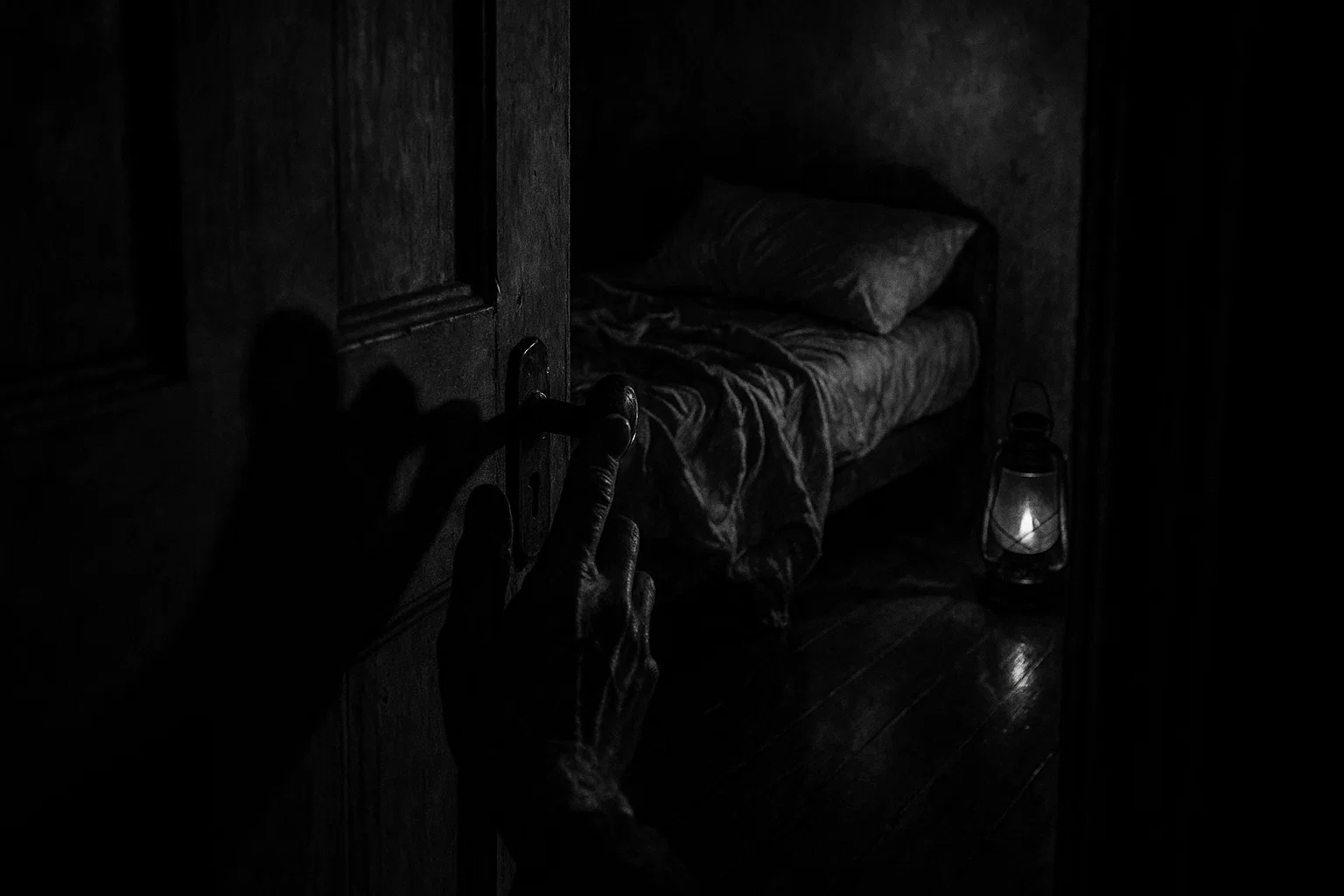
I began watching him sleep. Not every night — I am not what you think I am, not at first — but often enough that I came to know the architecture of his rest the way a sailor knows a coastline. He slept on his back, hands folded on his chest like a man already laid out for viewing, and some nights, in the gap beneath his bedroom door, I would watch those terrible hands twitch and curl as he dreamed, and I would think: not yet, not yet, not yet, the way another man might count sheep.
On the night I finally went up the stairs, I had a plan so careful it frightens me still to describe it, the way it is frightening to find out afterward how much patience you were capable of. I had practiced opening his door in the dark for a week, learning which floorboard sang and which stayed silent, until I could cross that room blind and barefoot without disturbing so much as the dust. I carried no weapon at first. I only meant to look at the hands one more time, to see if proximity might cure me of my disgust the way exposure is supposed to cure other fears. It did not cure me. It fed me.
He woke while I stood over him — not fully, just enough to mutter something thick and unintelligible and reach out, in his half-sleep, to pat the air beside him the way you’d reassure a frightened dog. His hand brushed my wrist.
The warmth of it, the soft, spongy give of that diseased flesh against mine, undid something in me that I had kept tied down for eleven months. I do not remember crossing to the kitchen for the cleaver. I remember only that I was holding it, and that the moonlight through his window had gone the color of old milk, and that I did what needed doing with a thoroughness that should have disgusted me and instead felt, God forgive me, like the first deep breath after a long illness.
I will not describe the hour that followed in the detail it deserves, because some details are not mine to give to you, but I will tell you this much: the hands were the last part of him I dealt with, and the hardest, because even separated from the rest of him they would not stop curling, the tendons drawing the fingers into a slow, deliberate fist long after there could have been any earthly reason for them to move at all.
I told myself it was only the body’s last electricity discharging itself, a thing doctors could explain in a sentence. I told myself this while I wrapped each piece separately, while I scrubbed the floorboards on my knees until my own knuckles bled, while I carried what remained down to the cellar beneath my basement room — a hollow under the foundation stones that Mr. Albrecht himself had shown me once, proudly, as a feature of the house’s old construction, a place, he’d said, where a man could hide anything he liked from the damp.
I sealed the hollow with new mortar and slept that night better than I had in eleven months. The first night, there was nothing. No sound. No guilt worth mentioning. I had, I thought, simply solved a problem the way other men solve problems.
The police came on the third day, summoned by a niece who’d expected a phone call that never arrived, and I welcomed them into my basement room with an ease that surprises me even now to recall. It began while the younger officer was asking me, almost as an afterthought, whether I’d heard anything unusual in the night.
A sound from beneath the floor. Faint. Wet. A working, kneading sound, like dough being pressed by hands too patient to hurry — and underneath it, fainter still, the dry click of knuckles flexing against stone. I answered his question. I do not remember what I said. I remember that the sound did not stop. It got louder. It found a rhythm, patient and unhurried, the unmistakable working of fingers against mortar from the inside, testing the seal the way a man tests a locked door he fully expects, eventually, to open.
I knocked over my coffee. I told them to listen. I told them it was coming from the cellar, that they would find the hands still moving down there, still working at the seam I’d sealed, patient as worms, and that they had to break the floor now, immediately, before whatever was left of those fingers finished what they were doing.
They did not need to break the floor. I broke it for them, on my knees, with a kitchen knife and then with my own hands when the knife wasn’t fast enough — and when three grown men finally pulled me clear of it and looked themselves, the wall held nothing at all. No hollow. No hidden flesh. Nothing but solid stone exactly as old Mr. Albrecht had built it generations before either of us was born, because it turned out, gentlemen, are you listening, it turned out there had never been a hollow under those stones at all — only a story he’d told me once in passing, about his grandfather, a place that existed in conversation and nowhere else.
And yet I can hear it now, telling this to you. I can hear it under this very floor, patient, curling, closing itself into the fist it has been building toward for longer than I have left to listen.
That is why I am telling you everything. Not from guilt — I want that understood, too. I am telling you because the sound only ever quiets while I am speaking, and I find, gentlemen, that I am no longer willing to sit in silence and let it finish counting.
If “What the Walls Kept” got under your skin, you’ll find more original horror like it in our horror story collection — tales of obsession, guilt, and the things confession can’t quite put back together.