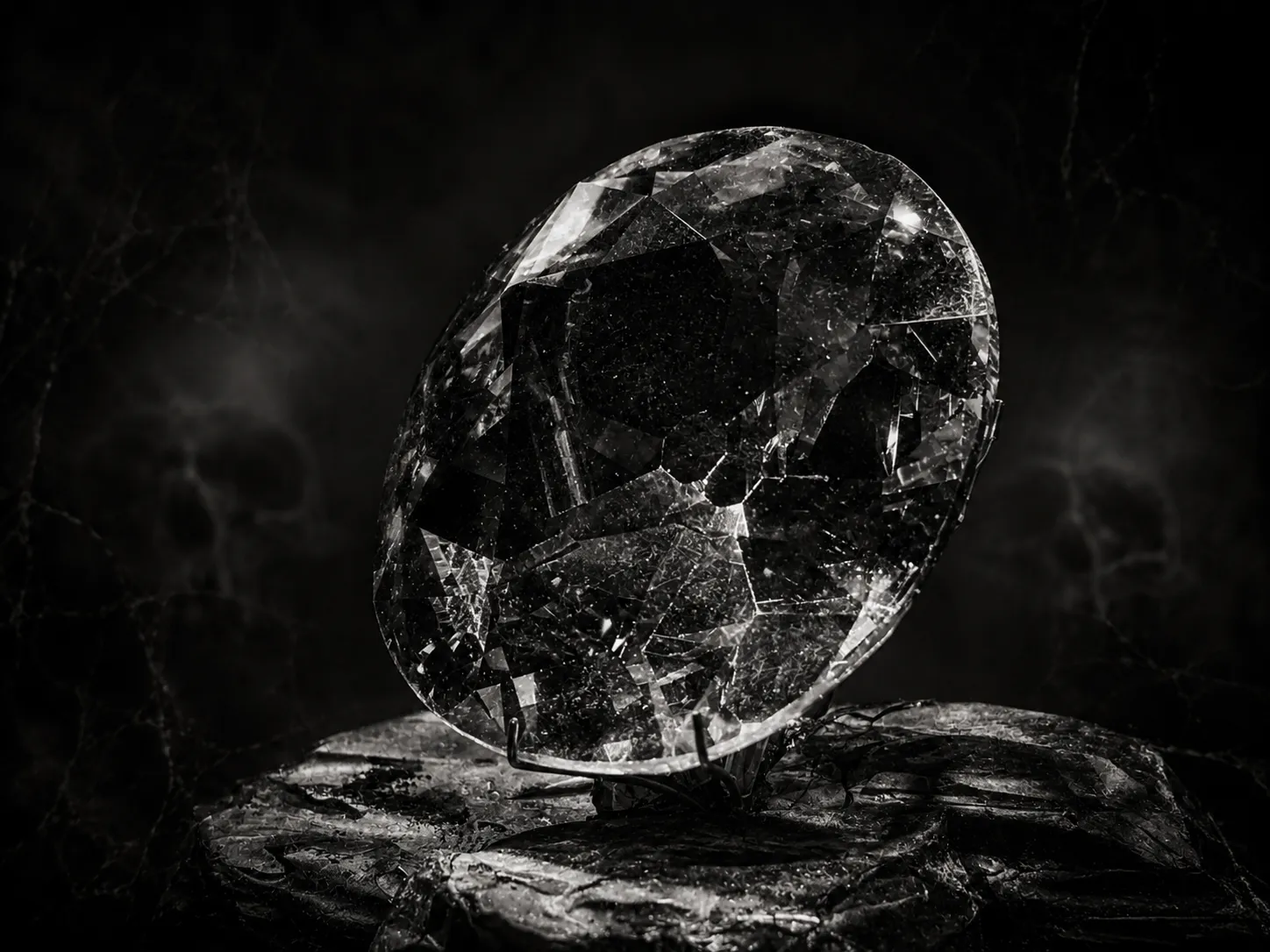
The Koh-i-Noor diamond is often linked to the downfall of more kings, emperors, and dynasties than almost any other object in history. For more than seven hundred years, this 105.6-carat stone has changed hands through conquest, betrayal, torture, and murder. Its history is filled with deposed rulers and violent deaths, making even skeptics wonder if there might be some truth to the legend.
Today, the diamond rests behind glass in the Tower of London. Still, many people are fascinated by the question of whether it is truly cursed and what that curse might be.
Summary
Key Takeaways
| Attribute | Details |
|---|---|
| Name | Koh-i-Noor (also spelled Koh-i-Nur, Kohinoor; Persian for “Mountain of Light”) |
| Object Type | Diamond — 105.6-carat oval brilliant-cut stone, set into a British royal crown |
| Origin / Creation | Mined in India, most likely near the Kollur Mine on the Krishna River; first documented historical appearance in 1306. The diamond’s exact formation date is unknown, as diamonds are geological, not manufactured |
| Current Location | Jewel House, Tower of London, England |
| Current Owner | The British Crown, held as part of the official Crown Jewels (not personal property of any individual royal) |
| Death Toll | 10+ confirmed historical deaths of named rulers and officials tied to the diamond’s possession or pursuit (including Nadir Shah, Kharak Singh, Nau Nihal Singh, Chand Kaur, Sher Singh, Dhian Singh, Suchet Singh, Hira Singh, Jawahar Singh, and Shah Shuja Durrani), plus an estimated 20,000–30,000 deaths from the 1739 Delhi massacre connected to the diamond’s looting. None of these deaths have any documented supernatural cause. |
| Type of Curse / Haunting | Bad-Luck Curse, Fatal Curse |
| Manifestations | None of the haunting type (no apparitions, voices, or moving objects are recorded in any source). The only documented “manifestations” are historical: deposition, blinding, torture, exile, and death among the diamond’s male owners. |
| Most Recent Incident | 2023 — Buckingham Palace confirmed Queen Camilla would not wear the Koh-i-Noor, or even a replica, at King Charles III’s coronation, citing the stone’s colonial controversy (not a paranormal event) |
| Threat Level | 1/10 (harmless) [See the Threat Level Explanation] |
| Can the Public View It? | Yes — on permanent public display at the Tower of London Jewel House |
| Hoax Confidence Rating | 6/10 (Leans fabricated) [See the Hoax Confidence Rating Explanation] |
What Is the Koh-i-Noor Diamond Curse?
The Koh-i-Noor curse is a centuries-old warning, traditionally traced to a Hindu text from around the time of the diamond’s first authenticated appearance in 1306, during the rule of the Kakatiya dynasty in southern India.
The curse is usually quoted as: “He who owns this diamond will own the world, but will also know all its misfortunes. Only God, or a woman, can wear it with impunity.” This legend suggests the stone gives its owner great power but brings ruin, betrayal, exile, or death, especially to men. Women who wear or own it are believed to be safe from its effects.
The story of the curse is more of a documented rumor than an ancient superstition. It seems to have become widely known in the West only in the mid-19th century, around the time the diamond arrived in Britain. The rumor is believed to have started with the Delhi Gazette and was soon repeated by The Illustrated London News.
The story became so popular that Queen Victoria reportedly expressed concern about it. This led to a counter-rumor, still repeated today, that the curse only affects male rulers and that women are safe. Historians still debate whether the curse is an ancient belief or a 19th-century addition to the diamond’s violent history.
What is clear is that the diamond’s history is filled with one disaster after another, which has helped keep the legend alive.
Origins of the Koh-i-Noor
The early history of the Koh-i-Noor is unclear. Colonial-era administrator Theo Metcalfe said there is only “very meagre and imperfect” evidence about the diamond before the 1740s, and no record of its original, uncut weight. Many Victorian writers and modern historians link the stone to the Kollur Mine near the Krishna River in today’s Andhra Pradesh, India, a region known for producing some of the world’s largest diamonds.
The first verifiable written record of the diamond comes from the 18th-century historian Muhammad Kazim Marvi, who documented the 1739 invasion of northern India by the Persian ruler Nader Shah of the Afsharid dynasty.
Marvi identified the Koh-i-Noor as one of many gemstones set into the Mughal Peacock Throne, the breathtaking jeweled throne commissioned roughly a century earlier by the Mughal emperor Shah Jahan, the same ruler who built the Taj Mahal.
According to popular accounts, when Nader Shah sacked Delhi and looted the throne, the Mughal emperor Muhammad Shah attempted to hide the diamond inside his turban. During a ceremonial exchange of turbans, Nader Shah is said to have discovered the stone and exclaimed “Koh-i-Noor,” Persian for “Mountain of Light,” giving the diamond the name it carries to this day.
A History of Deaths, Incidents, and Misfortunes
The Koh-i-Noor became known as a “cursed” object because of the brutal and well-documented violence that followed nearly every change of ownership for over a century.
The Fall of Nader Shah and His Successors (1739–1747)
The diamond’s first confirmed appearance in the historical record is tied directly to a massacre. After Nader Shah of Persia defeated the Mughals and occupied Delhi in March 1739, a riot broke out when a rumor spread that a palace guard had killed him; in retaliation, Nader Shah ordered a citywide reprisal known as the qatl-e-aam, or “killing of the masses.”
Over roughly six hours on March 22, 1739, his troops killed an estimated 20,000 to 30,000 men, women, and children in Delhi, with the bodies disposed of in mass graves and funeral pyres without any formal count ever taken. It was in the aftermath of the massacre that Nader Shah looted the Mughal treasury, the Peacock Throne, and, according to tradition, the diamond that would become known as the Koh-i-Noor.
Nader Shah did not enjoy his prize for long. By 1747, his own increasingly paranoid and brutal rule had turned his officers against him, and a group of conspirators led by an officer named Salah Beg stormed his tent at his camp near Mashhad while he slept. Nader Shah managed to kill two of his attackers before he was fatally struck down.
According to several historical accounts, when loyal Afghan troops led by Ahmad Shah Durrani reached the royal tent afterward, they found Nader Shah’s body decapitated. Durrani is said to have removed Nader Shah’s signet ring and the Koh-i-Noor from the scene before leading his men back to Kandahar, where he was elected the new ruler and founded the Durrani Empire.
The diamond’s misfortune did not end with Nader Shah. His grandson, Shah Rukh, briefly inherited a fragment of the Afsharid realm and, according to multiple historical sources, was tortured by a rival local chief who attempted to force him to reveal the location of various royal treasures. Shah Rukh survived after being rescued by Ahmad Shah Durrani, to whom he reportedly gave the Koh-i-Noor as a gesture of gratitude.
You may also enjoy:
Minos: The Tyrant King of Crete and His Dark Mythological Legacy
September 9, 2025
Impundulu: The Strange Bird That Drinks Blood
May 21, 2025
Is the Lukwata Real or Just an African Legend?
November 11, 2025
Dajjal, the One-Eyed Antichrist Who Deceives the World
October 3, 2025
Blindings, Disease, and Betrayal in the Durrani Court (1772–1818)
During its nearly sixty years in Afghanistan under the Durrani dynasty, the diamond was involved in some of the strangest and most gruesome events in its history.
Ahmad Shah Durrani himself, the diamond’s first Afghan owner, suffered for years from a disfiguring facial disease, described in contemporary Afghan and British sources alternately as a gangrenous ulcer, leprosy, or cancer, which slowly destroyed his nose and spread across his face. He reportedly wore a jeweled false nose in his final years to conceal the damage, and the disease eventually killed him in 1772.
His descendants fared little better.
In 1801, Ahmad Shah’s grandson, Shah Zaman, who had inherited the diamond, was overthrown by his own brother, Mahmud, during a winter coup. According to the Afghan chronicler Mirza Ata, Shah Zaman was blinded with a hot needle on his captors’ orders, a procedure that destroyed his sight almost instantly.
Even blinded and imprisoned, Shah Zaman managed to hide the Koh-i-Noor by concealing it behind plaster in the wall of his cell in the Bala Hissar citadel in Kabul. Two years later, in 1803, yet another brother, Shah Shuja Durrani, overthrew Mahmud, freed the blinded Shah Zaman, and received the diamond from him in gratitude.
Mahmud’s own reign was no less violent. After briefly losing the throne in 1803, he reclaimed it in 1809 by defeating Shah Shuja in battle, forcing him and his family to flee toward the Punjab. Years later, Mahmud had his own powerful wazir, Fateh Khan, blinded and then executed, a decision that triggered a rebellion by Fateh Khan’s brothers and, in the end, cost Mahmud his throne for good in 1818; he spent his remaining years as a much-diminished ruler of Herat until he died in 1829.
Shah Shuja, meanwhile, was captured after his defeat, imprisoned, and tortured by the governor of Kashmir in a failed attempt to force him to reveal where the diamond was hidden; it was his wife, Wafa Begum, who eventually smuggled the stone, along with much of the family’s remaining treasure, to safety.
Even after losing the Koh-i-Noor years later to Ranjit Singh, Shah Shuja’s violent luck continued: having briefly regained the Afghan throne in 1839 with British backing during the First Anglo-Afghan War, he was assassinated in April 1842.
Seeking refuge after their ordeal, Shah Shuja, Wafa Begum, and the blinded Shah Zaman arrived at the court of Maharaja Ranjit Singh, founder of the Sikh Empire, in Lahore. Ranjit Singh agreed to help rescue and protect the Afghan royal family in exchange for the diamond.
Still, when Shah Shuja and Wafa Begum stalled on handing it over, Ranjit Singh placed the family under armed guard and withheld food from them until they surrendered the stone, which finally happened on June 1, 1813.
The Collapse of the Sikh Empire (1839–1845)
This period was the bloodiest and most intense chapter in the diamond’s history. After Ranjit Singh died in June 1839, both the throne and the diamond became the focus of a six-year power struggle that claimed the lives of nearly every major figure involved.
His son and successor, Kharak Singh, was overthrown in a palace coup in October 1839 and slowly poisoned with lead and mercury while imprisoned, dying in November 1840. On the very day of his father’s funeral, Kharak Singh’s own son and successor, Nau Nihal Singh, was struck unconscious when a stone gateway at Lahore Fort collapsed on him as he left the cremation grounds; he died shortly afterward under circumstances historians have described as mysterious.
The throne then passed briefly to Chand Kaur, Kharak Singh’s widow, who was forced to abdicate after a violent two-day siege in January 1841 and was murdered in her palace in June 1842, her skull crushed with wooden clubs by her own attendants.
The next ruler, Sher Singh, was assassinated in September 1843 alongside his son and his powerful wazir, Dhian Singh, in a plot carried out by the Sandhanwalia brothers, who reportedly used firearms rigged to fire unexpectedly during a hunting demonstration before mutilating the bodies. Dhian Singh’s own brother, Suchet Singh, was killed in March 1844 while leading a failed coup against Dhian Singh’s son and successor as wazir, Hira Singh.
Hira Singh’s tenure proved no safer: he was hunted down and killed by mutinying troops in December 1844 while attempting to flee Lahore with cartloads of treasure. The wazirship then passed to Jawahar Singh, brother of the regent Maharani Jind Kaur, who was dragged from his elephant and killed by soldiers in September 1845, reportedly stabbed and speared dozens of times in front of the court.
By the time the dust settled and the British annexed Punjab in 1849, the throne had cycled through at least seven rulers and chief ministers in barely a decade, nearly all of them murdered, and had landed on a five-year-old child, Duleep Singh, the last Maharaja of the Sikh Empire.
In 1849, following the British East India Company’s victory in the Second Anglo-Sikh War, the ten-year-old Duleep Singh was made to sign away the diamond and his throne under the terms of the Treaty of Lahore.
He was later separated from his mother, converted to Christianity under British guardianship, exiled to England, and ultimately died in relative poverty in a Paris hotel in 1893, a fall from absolute monarchy to obscurity that many writers have folded into the curse narrative.
Cholera and Storms at Sea (1850)
Even the diamond’s voyage to Britain was marked by disaster. The stone was transported aboard the steamship HMS Medea, which departed India in April 1850.
During the crossing, a severe cholera outbreak struck the crew, and the ship was refused assistance and provisions when it tried to stop at Mauritius for quarantine. The Medea also weathered a violent storm severe enough to nearly dismast the vessel before it reached the Cape and continued safely to England.
After its arrival, the Koh-i-Noor was formally presented to Queen Victoria on July 3, 1850, and put on public display the following year as the star attraction of the Great Exhibition in London’s Crystal Palace.
The reception was lukewarm: the stone had been cut in the traditional Mughal style, which prioritized preserving the diamond’s natural size over maximizing its sparkle, and the satirical magazine Punch reportedly mocked the dull-looking gem as a “Mountain of Darkness.” Disappointed, Prince Albert commissioned a complete recutting of the stone.
The recutting began at the Garrard & Co. workshop in London on July 16–17, 1852, using a specially built steam-powered cutting mill. The work was supervised by Prince Albert and the Duke of Wellington, who was given the honor of making the first cut, under the technical direction of the Queen’s mineralogist, James Tennant.
The actual polishing was carried out by two master craftsmen sent from the Coster diamond firm in Amsterdam, Levi Benjamin Voorzanger and Joseph Abraham Fedder. The process took 38 days, cost Prince Albert roughly £8,000, and dramatically reduced the stone, in part to remove a significant internal flaw discovered during the work.
Although Albert was reportedly unhappy with how much weight was lost, most diamond experts, both at the time and since, have agreed the decision improved the stone’s brilliance significantly.
You may also enjoy:
Why the Kitsune Is the Most Dangerous Yokai in Japanese Folklore
September 10, 2025
Pegasus: The Blood-Soaked Horror Born from Medusa’s Neck
December 4, 2025
Andhaka: The Blind Demon Who Challenged Lord Shiva
November 13, 2025
Carats, Size, and Market Value
Stripped of legend, here are the diamond’s verified physical facts. Before recutting, the earliest reliably attested weight of the Koh-i-Noor was 186 old carats, equivalent to roughly 191 modern metric carats (about 38.2 grams).
After the 1852 recutting in London, the diamond was reduced to its current weight, today measured at 105.602 modern metric carats (about 21.12 grams); for over a century the diamond’s official weight was listed as 108.93 carats, until the figure was revised following more precise measurement in 1992.
The finished stone is an oval modified brilliant cut measuring 3.6 centimeters long, 3.2 centimeters wide, and 1.3 centimeters deep. While a standard brilliant-cut diamond has 58 facets, the Koh-i-Noor has 66, due to eight extra “star” facets added around its culet.
It is impossible to put an exact dollar value on the Koh-i-Noor because it has never been bought or sold. The diamond has changed hands only through conquest, extortion, or as spoils of war, so it has never been formally appraised or insured.
The 16th-century Mughal emperor Babur reportedly said the diamond was worth about two and a half days’ expenses for the whole world, showing how hard it was to measure its value even then. Today, estimates of its market value range from hundreds of millions to over a billion dollars. Still, these numbers are only guesses since the diamond will almost certainly never be sold.
Where Is the Koh-i-Noor Diamond Today?
The Koh-i-Noor currently remains part of the official Crown Jewels of the United Kingdom, set into the front of the crown made in 1937 for Queen Elizabeth, the Queen Mother, wife of King George VI. That crown is on public display in the Jewel House at the Tower of London, alongside replicas of the diamond set into earlier crowns it once occupied, including those of Queen Alexandra (1902) and Queen Mary (1911).
In keeping with the curse legend, the diamond has been worn exclusively by women since arriving in Britain; the Queen Mother wore it at her own coronation in 1937 and again at her daughter Elizabeth II’s coronation in 1953, although there is no record of Elizabeth II ever wearing the stone personally during her seventy-year reign.
The diamond’s ownership remains one of the most disputed issues in the world of cultural repatriation. India has formally and repeatedly demanded the diamond’s return since gaining independence in 1947, arguing it was looted during colonial rule.
Pakistan asserted its own claim in 1976, a request the British government rejected outright, with the British Prime Minister at the time stating that the diamond’s transfer had been explicitly provided for in the 1849 peace treaty.
Iran and, in 2000, the Taliban government of Afghanistan have also laid claim to the stone, citing the periods it spent in Persian and Afghan hands. The British government’s official position has remained that the diamond’s status is “non-negotiable.”
Most recently, the diamond’s controversial history came back into the spotlight during the 2023 coronation of King Charles III, when Buckingham Palace announced that Queen Camilla would not wear the Koh-i-Noor, nor even a replica of it.
Instead, she wore a reset version of Queen Mary’s crown featuring the Cullinan III, IV, and V diamonds from Queen Elizabeth II’s personal collection, a decision the palace attributed to “sustainability and efficiency,” even as commentators widely noted it sidestepped growing political pressure from India over the stone’s colonial origins.
Koh-i-Noor vs Other Famous Cursed Objects
| Name | Type | Death Toll (Attributed) | Activity Level |
|---|---|---|---|
| Hope Diamond | Bad-Luck Curse | Multiple owners’ deaths and ruin popularly attributed across its history; no scientifically verified count | 2/10 (dormant) |
| Annabelle Doll | Demonic Attachment, Inhabited Object | 2 deaths popularly attributed (a motorcyclist legend tied to mocking the doll) | 6/10 (occasional) |
| Robert the Doll | Inhabited Object | 0 confirmed; bad luck and accidents anecdotally reported by visitors | 4/10 (occasional) |
| Dybbuk Box | Dybbuk Attachment | 0 confirmed deaths; illness and nightmares anecdotally reported by past owners | 5/10 (occasional) |
| The Crying Boy Painting | Cursed Object | 0 confirmed deaths; linked in British tabloid folklore to house fires | 1/10 (dormant) |
| Busby’s Stoop Chair | Fatal Curse | Roughly 63 deaths popularly attributed over its folklore history | 1/10 (dormant) |
| The Basano Vase | Fatal Curse | 7 deaths popularly attributed, per a widely circulated but unverified internet legend | 2/10 (dormant) |
| James Dean’s Porsche (“Little Bastard“) | Cursed Object | Several deaths and injuries popularly attributed to people who handled the wreckage | 1/10 (dormant — wreckage missing since the 1960s) |
| The Hands Resist Him | Portal Object | 0 confirmed deaths; viewers reported figures appearing to move in a 2000 eBay listing | 3/10 (dormant) |
| Black Orlov Diamond | Fatal Curse | 3 suicides popularly attributed to early 20th-century owners | 1/10 (dormant) |
| Delhi Purple Sapphire | Bad-Luck Curse | 0 confirmed deaths; misfortune anecdotally reported by a string of owners | 1/10 (dormant — sealed in nested boxes at the Natural History Museum, London) |
| Myrtles Plantation Mirror | Mirror-Bound Entity, Residual Haunting | 0 confirmed deaths directly tied to the mirror itself | 5/10 (occasional) |
Is the Koh-i-Noor Curse Real?
Historians who have studied the diamond’s documented past generally agree on two things: the violence surrounding the Koh-i-Noor was very real, and the “curse” label attached to that violence is largely a 19th-century framing device rather than an ancient, continuously held belief.
Richard Kurin, the Smithsonian’s first Distinguished Scholar and Ambassador-at-Large and author of a history of the similarly “cursed” Hope Diamond, has suggested that gemstones taken by force from conquered peoples often acquire a curse reputation precisely because of how they were acquired, observing that when the powerful take things from the less powerful, cursing the powerful is often the only recourse available to the dispossessed.
Historians Anita Anand and William Dalrymple, authors of an extensively researched history of the diamond, found that much of the popular “traditional” account of the Koh-i-Noor’s earliest centuries, the version repeated in countless books and articles, was based on the work of a single 19th-century British amateur geologist whose research was later shown to be profoundly flawed.
Their findings suggest that while the documented chain of assassinations, blindings, poisonings, and depositions from the 1740s onward is factually accurate, the older legend connecting the stone all the way back to ancient Hindu mythology and a divine curse is a lot murkier and less verifiable than popular retellings suggest.
In this way, the Koh-i-Noor’s reputation as a cursed object may reflect the harsh realities of dynastic power and colonial conquest just as much as any supposed supernatural force linked to the stone.
You may also enjoy:
Mastema: The Angel of Hostility Who Tested the Faithful
September 29, 2025
Haagenti: The Demon of Alchemy and Transformation
August 21, 2025
What Is the Nurikabe Yokai? The Haunted Barrier That Traps Travelers
September 9, 2025
The Dover Demon Mystery: Still Unsolved?
June 30, 2025
Sources
- Anand, Anita, and William Dalrymple. Koh-i-Noor: The History of the World’s Most Infamous Diamond. Bloomsbury Publishing, 2017.
- Kurin, Richard. Hope Diamond: The Legendary History of a Cursed Gem. Smithsonian Books, 2006.
- Kaicker, Abhishek. Anatomy of a Massacre: Nadir Shah in Delhi, 1739. The King and the People: Sovereignty and Popular Politics in Mughal Delhi, Oxford University Press, 2020, doi:10.1093/oso/9780190070670.003.0002.
- W.S. Ward. The Koh-i-noor Diamond. Appleton’s Journal. Vol. 8, No. 173 (20 July), pp. 76-77, (1872).
- Malecka, Anna. Naming of the Koh-i-Noor and the Origin of Mughal-Cut Diamonds. The Journal of Gemmology, 2017.
- N. B. Sen. HISTORY OF KOH – 1 – NOOR (The Brightest Jewel in the British Crown). New Book Society of India, August 1953.