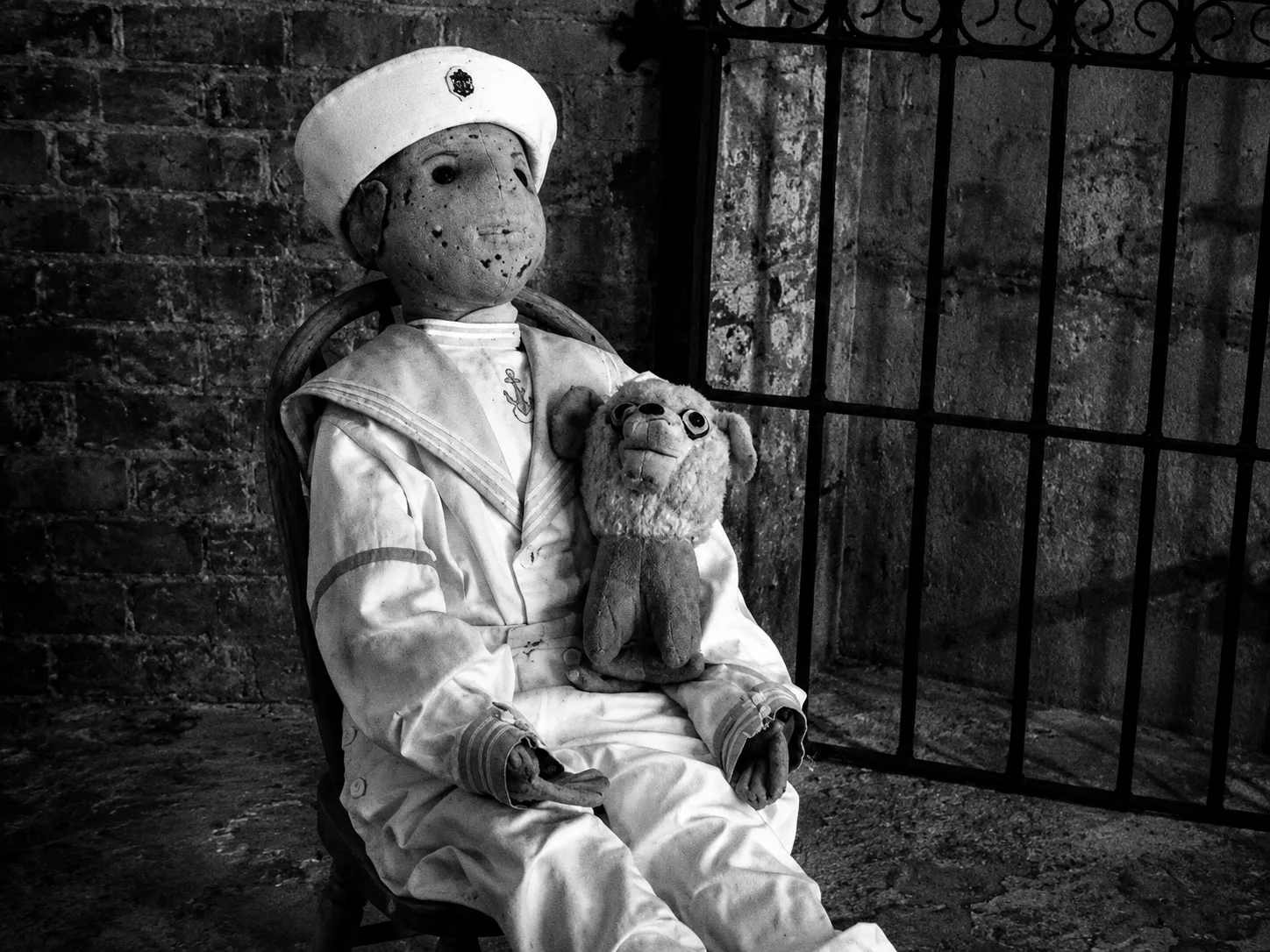
Robert the Doll has reportedly been blamed for car crashes, broken marriages, lost luggage, hospital visits, and worse, yet for most of his existence, he looked like nothing more than a tired old sailor-suited toy with a stuffed dog tucked under his arm.
So how did a handmade doll from a German toy workshop end up locked behind glass in a Florida fort, fielding one to three letters of apology every single day? The answer is part documented family history, part century-old gossip, and part modern internet legend — and untangling the three is where the real story gets interesting.
Summary
Overview
| Attribute | Details |
|---|---|
| Name | Robert the Doll (primary name); also referred to simply as “Robert”; occasionally called “the Otto doll” or “the cursed doll of Key West” in tourism and ghost-tour material. |
| Object Type | Doll — a roughly 40-inch handmade figure originally created as part of a window-display set of clowns/jesters, later repurposed as a child’s toy. |
| Origin / Creation | Circa 1900–1904, manufactured by the Steiff Company in Giengen, Germany. |
| Current Location | Fort East Martello Museum, Key West, Florida, USA. |
| Current Owner | Key West Art & Historical Society (a public nonprofit; donated by previous private owner Myrtle Reuter in 1994). |
| Death Toll | 0 confirmed deaths + 0 reliably documented deaths popularly attributed to the doll. (Some uncorroborated single-source blog claims describe a death linked to the doll’s imagery, but no verifiable account of this could be confirmed for this article, so it is not counted here.) |
| Type of Curse / Haunting | Cursed Object, Bad-Luck Curse, Hoodoo/Voodoo Conjure Object (legendary/unconfirmed origin story), Inhabited Object. |
| Manifestations | Reported camera and electronic device malfunctions, the doll allegedly changing position or facial expression, giggling and footsteps (mainly while stored in the attic of the Otto home), and “bad luck” reported by visitors after photographing the doll without permission — including accidents, lost luggage, job loss, illness, and divorce. |
| Most Recent Incident | No single, independently verifiable recent incident could be confirmed during research. The museum continues to report receiving apology letters at a rate of roughly 1–3 per day, with the doll’s most recent major media appearance being a 2015–2016 stint at Zak Bagans’ Haunted Museum in Las Vegas (Travel Channel’s “Deadly Possessions”). |
| Threat Level | 3/10 (mildly threatening) [See the Threat Level Explanation] |
| Can the Public View It? | Yes — on permanent public display in a protective glass case at the Fort East Martello Museum, open to visitors most days; photography is allowed, though local tradition holds that visitors should ask the doll’s “permission” first. |
| Hoax Confidence Rating | 7/10 (Probably a hoax) [See the Hoax Confidence Rating Explanation] |
Who (or What) Is Robert the Doll?
Robert the Doll is a roughly 40-inch-tall handmade doll, stuffed with wood wool (a packing material called excelsior) and dressed in a child’s sailor suit, that has been on permanent display at the Fort East Martello Museum in Key West, Florida, since the mid-1990s.
He originally belonged to Robert Eugene Otto — a boy everyone called “Gene,” who belonged to a prominent Key West family — who received the doll around 1904, when he was about four years old, and named it Robert after himself.
According to the Key West Art & Historical Society, which owns and exhibits the doll, Robert was most likely manufactured by the German toy company Steiff (the same firm credited with creating the first commercial teddy bear, named for Theodore Roosevelt). He was probably never intended to be a children’s toy at all.
A Steiff company historian consulted by the museum suggested Robert was likely part of a window-display set of clowns or jesters, which would explain his oversized proportions and faintly unsettling, jester-like painted face. His sailor suit wasn’t a Steiff accessory — it was reportedly one of Gene’s own childhood outfits.
What makes Robert famous isn’t his manufacturing history, though — it’s the decades of stories describing him moving on his own, laughing, staring out windows, and supposedly cursing people who disrespect him. Today, more than 120 years after he was made, Robert is considered one of the most famous “haunted” objects in the United States.
He has his own social media following, has been the subject of a five-film horror franchise, has appeared on multiple paranormal television series, and draws ghost hunters, TV crews, and curious tourists from around the world to a glass case at 3501 South Roosevelt Boulevard in Key West.
The Real Story Behind the Doll
Most competing accounts of Robert agree on a handful of documented facts and then diverge sharply once the storytelling kicks in.
What’s Reasonably Well Documented
Robert Eugene Otto belonged to a prominent Key West family. The Otto family home, a Queen Anne-style Victorian house at 534 Eaton Street, built in the 1890s, still stands today and operates as a guesthouse known as the Artist House.
Gene grew up with the doll, studied art at the Art Students League in New York and the Academy of Fine Arts in Chicago before refining his craft in Paris, and eventually became a respected local artist who helped design the gallery at the Fort East Martello Museum. In this very museum, Robert lives today.
While in Paris, Gene met Annette Parker, and the two married on May 3, 1930. The couple returned to live in the Eaton Street home, where Gene continued painting (often, according to local accounts, with Robert propped in the turret-room window beside him) until Gene died in 1974.
You may also enjoy:
Viné: King of Demonic Forces. Facts & Myths
May 28, 2025
Auvergne Werewolf: Real Curse or Witch Hunt?
June 19, 2025
Where the Legend Takes Over
The most repeated version of Robert’s origin claims he was a gift from a servant of Bahamian descent who worked for the Otto family and who supposedly practiced folk magic, gifting (or cursing) the doll either out of affection or in retaliation for mistreatment. Some retellings even name her — most often as a woman called Emeline Abbott.
It’s a dramatic story, and it’s the one most ghost-tour scripts lean on. Still, researchers who have dug into it, including paranormal author David Sloan (whose 2014 book Robert the Doll is considered the most thorough investigation of the legend), have found no solid evidence connecting the Abbott family or any specific servant to the doll’s origin.
There’s also no record that the Abbotts ever traveled to Germany. A Steiff doll of Robert’s size and quality would have been an expensive specialty item — likely well beyond the means of a household servant in early-1900s Key West.
The competing, less sensational account — that Gene’s grandfather bought the doll on a trip to Germany and gave it to him as a birthday present — fits the doll’s documented Steiff origins far more comfortably, even if it makes for a less spooky bedtime story.
This is the core tension running through almost every version of the Robert legend: a real family, a real doll, and a real decades-long emotional attachment, wrapped in layers of campfire-style embellishment that have grown with every retelling.
How Robert Earned His Haunted Reputation
Long before Robert had a museum display case, he had a reputation inside one house. As a child, Gene reportedly grew so attached to the doll that he carried it everywhere, spoke to it in two distinct voices, and — according to family accounts passed down over the years — would blame it whenever something in the house went wrong, insisting, “I didn’t do it. Robert did it.”
One frequently repeated story claims that when Gene was about ten, his mother woke to his screams in the night and found his room in shambles, with Robert seated calmly at the foot of his bed.
The earliest reports of neighbors and schoolchildren actually seeing the doll “move” reportedly date back to the late 1940s, when children walking past the Eaton Street house claimed to see Robert shift from one side of the upstairs window to the other.
The stories didn’t stop when Gene became an adult. After he married Annette and returned to live in the family home, the doll was given its own chair in the home’s turret room.
Annette reportedly grew uneasy with Robert’s presence — uneasy enough that, after Gene’s death, she is said to have had the doll locked away in a cedar chest in the attic, where he stayed until the house changed hands. Nearly every version of the story includes reports of footsteps, giggling, and movement coming from that attic space whenever the house was supposedly empty.
From Attic to Museum
After Gene’s death, the Eaton Street property eventually passed to Myrtle Reuter, who found Robert still in the house. Reuter lived with the doll for roughly two decades. By her own account, she experienced enough unexplained activity — footsteps, the sound of giggling, objects moved from where she’d left them — to become convinced Robert was, in some sense, haunted.
In 1994, she donated him to the Key West Art & Historical Society, telling then-director Joe Pais that the doll was haunted and had even locked her in a room of her own house. The museum accepted the donation but, notably, didn’t put Robert on display right away; he reportedly spent time in storage, covered with a sheet, before staff began exhibiting him and letting word of his arrival spread.
Once Robert went on public display, the now-familiar pattern began in earnest: visitors and staff reported cameras and electronic devices malfunctioning near his case, and letters — addressed directly to the doll — started arriving from people apologizing for some perceived slight and asking to have a string of bad luck lifted.
The museum’s curator, Cori Convertito, Ph.D., has said the collection now numbers more than a thousand letters, arriving at a rate of roughly one to three a day, decades after the doll first went on exhibit.
Alleged Victims of “The Curse”
Most Robert the Doll articles repeat the same vague list of misfortunes — car accidents, divorce, job loss — without naming a single source. A handful of accounts, however, are tied to real, identifiable people and dates, which makes them worth looking at directly (while still treating them as personal anecdotes rather than verified cause-and-effect):
- A 2009 TripAdvisor review. A reviewer using the handle “HowardRK” described photographing Robert without asking permission, then finding that every photo from his entire Key West trip — more than 50 images — had vanished from his camera’s memory card, including unrelated footage shot the next day on a parasailing trip. He also reported unexplained noises at night after returning home.
- Amy Schreckengost, an Artist House staff member. In an interview with HowStuffWorks, Schreckengost — who worked at the guesthouse built from Gene Otto’s old home — said she avoided visiting Robert at the museum for years out of discomfort. When she finally went and declined to ask his “permission,” she said her digital camera stopped saving new photos entirely for the rest of the visit. She also keeps a guestbook at the Artist House specifically for guests to log their own unexplained experiences.
- Bonnie Randolph, featured on Travel Channel’s Deadly Possessions. When Robert was loaned to Zak Bagans’ Haunted Museum in Las Vegas in October 2015, the resulting episode (which first aired April 2, 2016) centered on a woman named Bonnie Randolph, who traveled to seek help after attributing a string of personal misfortunes to an encounter with the doll.
- An apology letter from “Kristie in Port St. Lucie.” Among the letters on permanent display near Robert’s case is one in which a visitor named Kristie describes how her life became unusually difficult after visiting and photographing Robert without asking, and asks the doll directly to lift whatever curse he had placed on her.
The museum’s curator has been candid that the letters represent only one side of the story — visitors write in to report bad luck. Still, nobody writes back to confirm whether saying sorry actually fixed anything.
You may also enjoy:
Is Mothman Real? The Eerie Sightings That Say Yes
June 25, 2025
Bryce Hospital Haunting: Alabama’s Most Haunted Asylum
September 19, 2025
Visiting Robert Today: Rules, Rituals, and the “Permission” Myth
Robert the Doll is on permanent exhibit at the Fort East Martello Museum, operated by the Key West Art & Historical Society. He is kept inside a protective, UV-filtering, humidity-controlled glass case — an upgrade, according to the museum, donated by an admirer of the doll.
Once a year, Convertito performs a kind of check-up, removing Robert from the case to weigh him and assess whether Florida’s humidity has affected his excelsior stuffing.
A widely repeated visitor tradition has it that you must politely ask Robert’s permission before photographing him, or risk bad luck. This ritual has become something of a Key West pop-culture phenomenon — complete with a #SorryRobert hashtag used by tourists posting apology selfies.
However, it’s worth noting that even paranormal investigators who collaborate closely with the museum describe the “ask for permission” ritual as a modern, manmade tradition with no real basis in the doll’s documented history, rather than an actual rule Robert himself ever “enforced.”
Visitors also leave Robert gifts; after it became local knowledge that he supposedly has a sweet tooth, the museum began receiving a steady stream of candy (including, on one occasion, eight bags of peppermints with no return address), along with money and, occasionally, items museum staff describe as “completely inappropriate.”
Robert the Doll in Pop Culture
Robert spent the first 104 years of his existence never leaving Key West. That changed in May 2008, when the museum lent him to TapsCON, a paranormal convention in Clearwater, Florida, hosted by The Atlantic Paranormal Society (TAPS), the team behind Ghost Hunters.
In October 2015, he traveled again — this time to Las Vegas, for an appearance in Zak Bagans’ Haunted Museum that became the debut episode of the Travel Channel series Deadly Possessions (and was later rebroadcast as the first episode of Ghost Adventures: Artifacts).
Robert’s growing fame also spawned an entire low-budget horror franchise loosely inspired by his legend, beginning with the 2015 film Robert, followed by several sequels, including The Curse of Robert the Doll (2016) and Robert Reborn (2019). The real doll and a museum-store replica also turned up in the second season of the travel series Ozzy & Jack’s World Detour, and his story has been featured on the Lore podcast and TV series.
Is Robert the Doll Really the Inspiration for Chucky?
One of the most persistent claims about Robert is that he inspired Chucky, the killer doll from the Child’s Play film franchise. It’s an appealing connection — both are dolls that talk, both are tied to a child owner, and both stories involve voodoo somewhere in their backstory — but it doesn’t hold up to scrutiny.
Don Mancini, who wrote the original Child’s Play screenplay and has written or directed every film in the franchise since, has repeatedly said his inspiration came from elsewhere entirely: the 1980s Cabbage Patch Kids and My Buddy doll crazes (and his own father’s career in advertising, which shaped the film’s satirical take on marketing to children), the killer-doll segment in the 1975 film Trilogy of Terror, and the Twilight Zone episode “Living Doll.”
David Sloan, the Key West-based author of Robert the Doll and widely considered the foremost researcher on the doll’s history, has said plainly that Robert “was not the inspiration” for Chucky, and has pushed back publicly on the rumor, noting that Robert didn’t even gain widespread public attention until 1994 — six years after the first Child’s Play film was released in 1988. The two “haunted doll” legends simply grew up independently of each other.
Why the Legend Persists
Setting aside the supernatural framing, there are some fairly ordinary explanations offered for why Robert’s legend has persisted so powerfully. A child talking to and blaming a beloved toy is unremarkable on its own; an old house settling, drafts moving curtains, and the simple unease most people feel looking at an aged, worn doll’s face can account for a great deal of what gets reported as “activity.”
Psychologists who study belief in curses also point to the power of suggestion: once visitors are told in advance that disrespecting Robert causes bad luck, any ordinary mishap that follows — a lost bag, a flat tire, a dead camera battery — is far more likely to be remembered, noticed, and retold as proof of the curse, while uneventful visits simply go unmentioned.
A digital camera failing to save photos, for instance, is a common and well-documented quirk of card errors and battery drain, not necessarily evidence of anything paranormal — though it’s easy to see why it feels different when it happens inside Robert’s room.
None of that makes Robert any less of a fixture in American paranormal folklore. Real or not, the doll’s story persist because it combines an actual historical figure, a genuine century-old artifact you can still go see in person, and an oral tradition that Key West locals and visitors alike have kept retelling — and embellishing — for well over a hundred years.
Frequently Asked Questions
Is Robert the Doll a true story?
Partly. Robert Eugene Otto, the Otto family home, and the doll itself are all real and documented. The supernatural elements — the curse, the voodoo origin story, the moving and laughing — are folklore that grew up around a real family’s unusually close relationship with a childhood toy.
How old is Robert the Doll?
Robert was made around the turn of the 20th century and given to Gene Otto around 1904, making him roughly 120 years old as of the mid-2020s.
Where can you see Robert the Doll in person?
Robert is on permanent public display at the Fort East Martello Museum, 3501 South Roosevelt Boulevard, Key West, Florida, where he’s kept inside a protective glass case.
What is the curse of Robert the Doll?
According to local legend, anyone who disrespects Robert — especially by photographing him without first asking permission — may experience bad luck such as accidents, illness, job loss, or relationship problems. The museum’s own paranormal collaborators describe the “ask permission” rule itself as a modern legend rather than a documented historical practice.
Is Robert the Doll really haunted?
There’s no scientific evidence that Robert is haunted. What is documented is that the doll has a long history of being treated as if it were alive — first by Gene Otto, and later by generations of visitors, ghost hunters, and museum staff who report unexplained incidents around its case.
Was Chucky from Child’s Play based on Robert the Doll?
No. Chucky’s creator, Don Mancini, has stated his inspiration came from 1980s doll fads and earlier killer-doll stories like Trilogy of Terror, not from Robert. The “Chucky was based on Robert” claim is a popular myth that even Robert’s own biographer has publicly disputed.
Do you really have to ask Robert the Doll’s permission before taking his photo?
It’s a popular Key West tourist tradition (hashtag #SorryRobert online). Still, it isn’t a rule with any documented historical basis — it’s a modern superstition that grew up around the doll after he went on public display.
Who owns Robert the Doll now?
Robert is owned by the Key West Art & Historical Society. The nonprofit also operates the Fort East Martello Museum, where he’s on display. He was donated to the Society in 1994 by Myrtle Reuter, the last private owner of the Otto family home.
Can you send a letter to Robert the Doll?
Yes. The museum receives roughly one to three letters a day addressed directly to Robert — many of them apologies from visitors blaming bad luck on the doll — and has collected more than a thousand of them over the years.
You may also enjoy:
Who Was the Beast of Gévaudan? Truth or Myth
June 23, 2025
Fresno Nightcrawler: Real Cryptid or Clever Hoax?
September 25, 2025
Bean Nighe: A Sinister Highland Death Omen
February 11, 2026
Sources
- Sloan, David. Robert the Doll. Phantom Press, 2014.
- Key West Art & Historical Society. Robert the Doll. Retrieved on June 24, 2026.
- Pirvulescu, Sergiu. (2021). The existence of paranormal phenomena. ResearchGate.
- Baker, Joseph & Bader, Christopher. (2014). A social anthropology of ghosts in twenty-first-century America. Social Compass. 61. 569-593.
- Twilight Zone. Living Doll. Season 5, Episode 6. Aired in 1963.
- Wiseman, Richard & Greening, Emma & Smith, Matthew. (2003). Belief in the paranormal and suggestion in the seance room. British journal of psychology (London, England : 1953). 94. 285-97. 10.1348/000712603767876235.