Peggy the Doll has earned a reputation few haunted objects ever achieve: people claim to feel sick from simply looking at a photograph of her. Unlike most “cursed” dolls, whose stories are tied to a single haunted house or a single family, Peggy’s legend spread almost entirely online, through a single Facebook post that triggered dozens of reports of nausea, chest pain, and terror within 24 hours.
What is it about this three-foot, blonde-haired, blue-eyed doll that has convinced paranormal investigators, TV audiences, and casual internet scrollers alike that she is dangerous to even look at? The story behind Peggy is stranger and better documented than most people realize.
Summary
Key Takeaways
| Attribute | Details |
|---|---|
| Name | Peggy the Doll, commonly referred to simply as “Peggy.” No other widely reported nicknames or alternative names exist. |
| Object Type | Doll (vintage-style doll with blonde hair and blue eyes; exact material and manufacturer have never been publicly documented) |
| Origin / Creation | Unknown; no confirmed manufacture year or maker has ever been publicly documented |
| Current Location | Zak Bagans‘ Haunted Museum, Las Vegas, Nevada, USA |
| Current Owner | Zak Bagans |
| Death Toll | 0 confirmed human deaths; 0 human deaths popularly attributed to the doll. One non-fatal heart attack (Katreen Reedick) and one pet death (a cat) have been linked to Peggy by witnesses, but no fatalities have ever been directly attributed to her. |
| Type of Curse / Haunting | Spirit Attachment, Inhabited Object, Illness-Inducing Curse, Intelligent Haunting |
| Manifestations | Headaches, nausea, dizziness, chest pain and a reported heart attack, computer and device freezing, sudden temperature drops, disembodied footsteps, shattering light bulbs, dogs barking and spinning in circles, a missing notebook, flies appearing indoors, and a typewriter allegedly typing on its own |
| Most Recent Incident | September 2, 2017 — Peggy was featured in a televised séance on Ghost Adventures: Artifacts intended to break the “bond” between her and Jayne Harris. No independently documented incidents have been publicly reported since she went on permanent display at the Haunted Museum in 2019. |
| Threat Level | 4/10 (mildly threatening) [See the Threat Level Explanation] |
| Can the Public View It? | Yes — Peggy is on permanent display at Zak Bagans’ Haunted Museum in Las Vegas. Visitors must sign a waiver before entering her room. |
| Hoax Confidence Rating | 6/10 (Leans fabricated) [See the Hoax Confidence Rating Explanation] |
What Is Peggy the Doll?
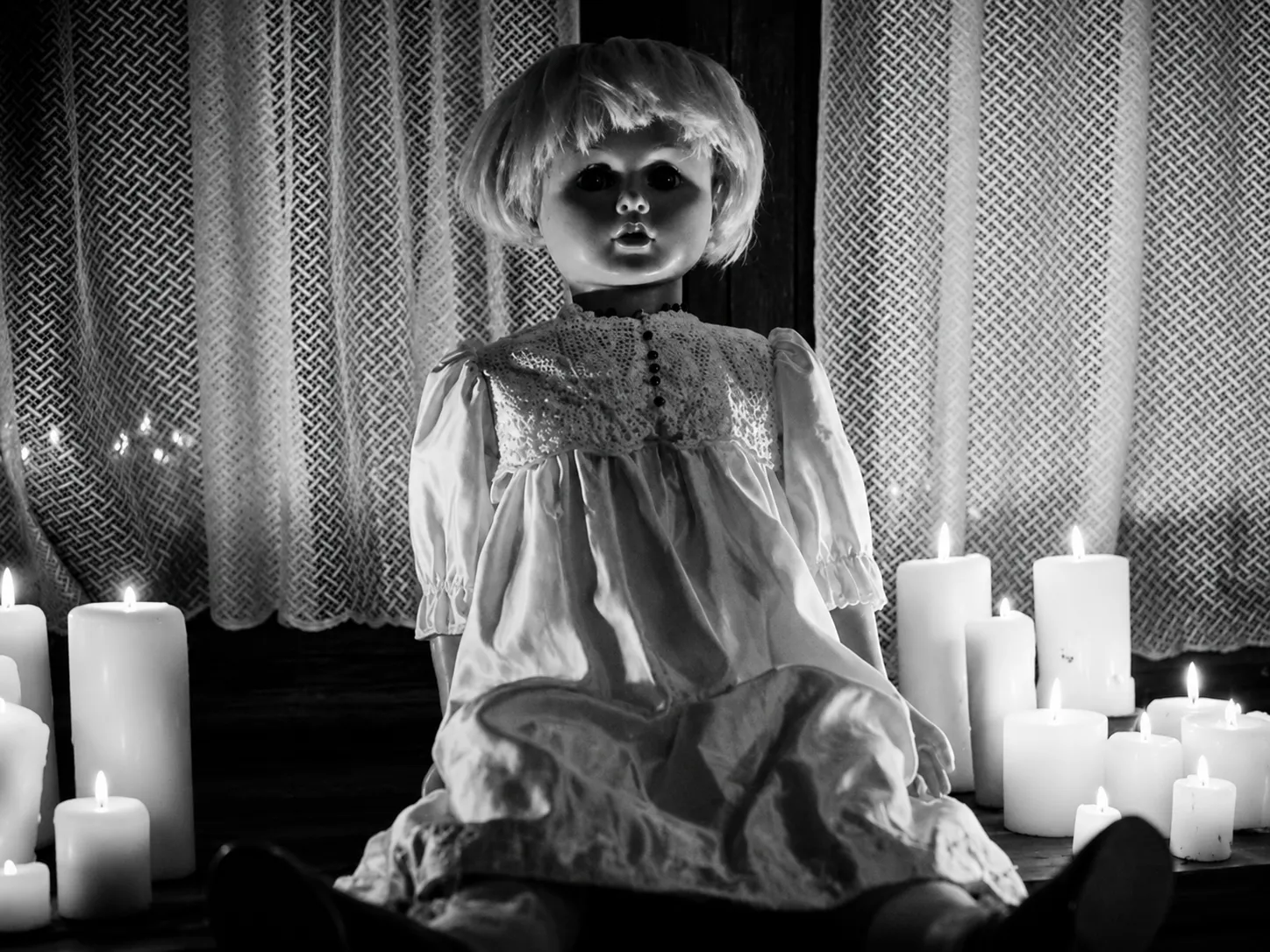
Peggy is a doll currently housed at Zak Bagans’ Haunted Museum in Las Vegas, Nevada, and she is widely described as one of the most feared haunted objects circulating online today. What sets her apart from other “cursed” collectibles is the claim that she doesn’t need to be touched, or even seen in person, to affect someone.
According to paranormal investigator Jayne Harris, who owned Peggy for roughly two years before passing her to Bagans, simply viewing a photo or video of the evil doll has been enough to trigger headaches, nausea, chest pain, and panic attacks in some viewers. Harris says the first 80 of these reports arrived privately within the first 24 hours after she posted a single photo of Peggy online, from people who had no connection to one another.
When it comes to the number of alleged incidents, however, the title of the world’s “most evil” or most reported-on haunted doll usually goes to a different toy: Robert the Doll, a Steiff-made sailor doll that has lived at the Fort East Martello Museum in Key West, Florida, since 1994.
Robert’s curator has reported that the doll receives one to three letters a day, almost year-round, from visitors apologizing for disrespecting him or begging him to lift a curse they believe caused a car accident, a divorce, a lost job, or a run of bad luck.
Multiplied across more than three decades on public display, that adds up to a documented paper trail of many thousands of alleged incidents, making Robert’s file the largest of any allegedly haunted doll in the world, even though the misfortunes attributed to him tend to be mundane rather than physically violent.
Peggy’s incident count is smaller in raw numbers but far more severe in the type of harm reported, since her case includes claims of heart attacks and strokes rather than lost luggage or broken cameras. That distinction, quantity for Robert versus claimed medical severity for Peggy, is what keeps both dolls at the top of paranormal “most dangerous doll” rankings.
The Origin Story of Peggy the Doll
Unlike Robert the Doll or Annabelle, Peggy has no tidy origin story involving a specific tragedy, a dying child, or a documented birthplace. That gap is part of what makes her story so unsettling: there is no single, traceable “ground zero” moment to point to. What exists instead is a patchwork of secondhand accounts, mostly relayed by Jayne Harris herself, describing how an ordinary-looking doll ended up at the center of one of the internet’s most feared paranormal cases.
According to Harris, Peggy’s first known owner was an older woman who picked the doll up secondhand, at what different retellings of the story describe as either an estate sale or a UK “car boot sale” (the British equivalent of a garage sale).
Almost immediately, the woman said her life took a dark turn. She began suffering from intense, frequent nightmares, waking up feverish and physically shaken, and she reported that moving the doll to different rooms in her house did nothing to stop the dreams.
As her condition worsened, she says she began experiencing hallucinations and a string of unexplained illnesses. Desperate, she brought in a local priest to bless the home, or possibly perform an informal exorcism, on two separate occasions. Both attempts reportedly failed to change anything.
It was only after recovering from one particularly severe episode that the woman decided, with certainty, that the doll itself was responsible, and that she needed to get rid of it permanently. That decision led her to Jayne Harris, a UK-based paranormal investigator who specializes in cases involving haunted dolls and objects.
In the foreword of Harris’s later book on the case, the first owner is identified solely by her initials, “JW,” reflecting how little verifiable identifying information exists for the very first link in Peggy’s chain of ownership. No name, hometown, or date has ever been publicly confirmed for her, which means the entire origin story rests on Harris’s secondhand retelling rather than any independent documentation.
Things did not improve once Peggy changed hands. Harris has said that within about four days of bringing the doll into her home, she began suffering from a mystery illness of her own: overwhelming fatigue that left her feeling completely drained.
Over roughly two weeks, the exhaustion escalated to the point where she could not get out of bed. It was only after a fellow investigator, referred to as Hazel, removed the doll from the house that Harris says her health began to recover. The detail is important because it means the very first person to formally study Peggy as a paranormal case also became, by her own account, one of its alleged victims before she ever showed the doll to the public.
The lack of a clear, documented backstory is actually one of the more unusual features of Peggy’s case within the haunted-doll genre. Most famous haunted dolls – Robert the Doll, Annabelle, Mandy the Doll at the Quesnel Museum in Canada – are tied to a specific child, a specific house, or a specific recorded death.
Peggy has none of that. Her legend was built almost entirely on secondhand reports of what happened to strangers who saw her, layered on top of an origin story that cannot be independently verified, rather than on a documented tragedy that predates her fame.
How Jayne Harris Discovered Peggy’s Powers
Jayne Harris is a British television presenter and self-described paranormal investigator, known for co-presenting the Discovery+ and Really Channel series Help! My House Is Haunted and Celebrity Help! My House Is Haunted, as well as Unexplained: Caught on Camera and Sky TV’s Paranormal Captured.
In 2016, VICE’s Broadly vertical referred to her as the UK’s foremost female paranormal investigator. She later trained as a Master Herbalist, qualifying in 2020, and opened an herbal remedy shop in 2024 while also running Ostara Events, a company that hosts UK-based paranormal weekend events.
According to Harris, within days of bringing Peggy home, she began experiencing extreme fatigue that made it difficult to get out of bed, a symptom that reportedly eased whenever a friend temporarily took the doll out of the house. Harris later uploaded a photo and, eventually, a video of the then-unnamed doll to her Facebook page and YouTube channel, Haunted Dolls, in 2015, without providing any backstory or explanation.
She has said that messages began arriving almost immediately from strangers describing headaches, chest pains, dizziness, computer freezes, footsteps in empty rooms, dogs barking and spinning in circles, and even light bulbs shattering after they viewed the image. One of the messages, from a self-described psychic medium, identified the spirit attached to the doll by the name “Peggy” for the first time.
Harris says she went on to run controlled investigations with the doll, monitoring electromagnetic field (EMF) readings and room temperature, and used a spirit box in an attempt to record voices. She has also stated that five separate psychic mediums, working independently of one another, told her they sensed both a female and a male presence around the doll.
The female identifies herself as Peggy, while the male reportedly never communicates directly but is described as carrying a darker, more hostile energy, one that some involved in the investigation believe is actually responsible for the negative physical effects people report.
You may also enjoy:
Inkanyamba: Real Beast or Local Legend?
May 22, 2025
6 Real Haunted Houses in Arkansas with Chilling True Stories
October 8, 2025
What Are the Teihiihan—the Cannibal Dwarves of the Great Plains?
November 4, 2025
Who Is Aim in Demonology? The Demon Prince of Fire and Ruin
August 12, 2025
Documented Incidents and the Alleged Spirit Inside Peggy
The single most-cited incident in Peggy’s case involves a lady named Katreen Reedick, who says she suffered a heart attack within seconds of viewing an image of the doll online, despite having no prior history of heart problems.
Reedick, a single mother of two, later appeared alongside Harris and Zak Bagans on the Deadly Possessions television special, where she described her fear that whatever haunted the doll could hurt her again, or worse.
During a filmed séance with Harris, Bagans, medium Patti Negri, and a paranormal investigator named Aaron, witnesses say Reedick’s demeanor shifted. She began laughing oddly, moments before a nearby antique typewriter reportedly began tapping out letters on its own.
Beyond Reedick’s case, Harris says she logged more than 80 separate reports of physical symptoms within the first 24 hours of posting a single photo of Peggy online in 2015, all from strangers with no connection to one another. The reported symptoms varied in severity: headaches, chest pains, nausea, and dizziness were the most common, but some viewers described anxiety attacks paired with sudden, unexplained flashes of imagery involving psychiatric hospitals.
Other accounts describe computers or phones locking up on Peggy’s image, rooms turning suddenly cold, footsteps in empty houses, dogs barking and spinning in circles, and light bulbs shattering.
One woman says she dreamed of Peggy warning her regarding her cat, only to find the animal gravely ill the next morning; it reportedly died later that same day. Harris has said that when reports like these reach her, she will speak to Peggy directly and ask her to stop, and that the volume of messages typically slows down afterward, though never disappears entirely.
Harris’s own investigation produced a few additional data points that rarely make it into shorter retellings of the story. She has described running EMF (electromagnetic field) meter readings and temperature monitoring on rooms where Peggy was kept, both of which she says showed abnormal fluctuations, and she used a spirit box in an attempt to record voice responses.
In one incident relayed to the Daily Mail, Harris said her logbook containing her private research notes on Peggy disappeared after a conversation with the doll, only to turn up later wedged in the ceiling beams of her home, high enough that her husband needed a ladder to retrieve it. Harris has framed the as evidence that Peggy did not want certain information about her made public.
On the question of who, or what, is actually inside the doll, psychic mediums who have worked with Harris (reports vary between four and five mediums over various retellings of the story) have converged on a broadly similar profile: a female spirit who identifies herself by the name Peggy, born in 1946 in the Holland Park area of London, who died young from a chest-related illness, possibly an asthma attack.
Some of these mediums have also claimed the spirit had an intense dislike of clowns. Several have floated a darker theory: that the spirit may have ties to the Holocaust, potentially the soul of someone who died during that period, though no historical record, name, or archival source has ever been produced to support the claim. Separately, several mediums have also reported sensing a second, male presence attached to the doll, one that never communicates directly but is described as carrying a distinctly “dark” and “nasty” energy.
Some investigators involved in the case believe the second entity, rather than Peggy herself, may be the one actually responsible for the more severe physical reactions people report. None of these identity theories have been independently verified by any historical record; they remain speculative accounts relayed entirely through psychic readings rather than documented biographical facts.
Peggy the Doll on Ghost Adventures and Deadly Possessions
Peggy’s story reached a much larger audience after Harris brought the doll to Zak Bagans, host of the Travel Channel series Ghost Adventures, for a segment on his spin-off show Deadly Possessions, which aired April 16, 2016.
During filming, Bagans reported flies landing on his face while discussing the doll, something he said had never happened to him before on camera, and claimed that the camera filming Peggy stopped recording at the exact moment the crew considered whether to reveal her face on air.
A later séance involving Harris, Bagans, Katreen Reedick, and psychic medium Patti Negri reportedly produced sounds from a nearby antique typewriter typing on its own, along with candles that appeared to burn more intensely on cue.
Peggy also appears in a dedicated episode of the spin-off series Ghost Adventures: Artifacts, titled “Peggy the Doll and John Murrell’s Thumb,” which frames her as a doll that has caused serious illness in over 80 people.
Peggy the Doll vs. Other Famous Haunted Dolls
| Name | Type | Death Toll (Attributed) | Activity Level |
|---|---|---|---|
| Robert the Doll | Doll | No confirmed deaths; blamed for accidents, illness, and bad luck | 6/10 (occasional) |
| Annabelle | Doll | At least 1 (a motorcyclist, per Ed and Lorraine Warren’s account) | 5/10 (occasional) |
| The Dybbuk Box | Wine cabinet | At least 1 (the original owner’s grandmother, per the box’s own backstory) | 6/10 (occasional) |
| The Basano Vase | Vase | Over 100 (according to the vase’s own centuries-spanning legend) | 2/10 (dormant) |
| The Crying Boy Painting | Painting | No confirmed deaths; linked to unexplained house fires | 2/10 (dormant) |
| The Hands Resist Him | Painting | No confirmed deaths | 4/10 (occasional) |
| Mandy the Doll | Doll | No confirmed deaths | 5/10 (occasional) |
| Okiku the Doll | Doll | No confirmed deaths | 3/10 (dormant) |
| The Anguished Man | Painting | No confirmed deaths | 3/10 (dormant) |
| The Myrtles Plantation Mirror | Mirror | Between 10 and 12 (attributed to the plantation’s broader ghost legend, not confirmed history) | 6/10 (occasional) |
| Harold the Haunted Doll | Doll | No confirmed deaths (the original owner has since said the haunting was staged) | 1/10 (dormant) |
| The Conjure Chest | Chest / furniture | Between 3 and 4 (per the chest’s own oral hoodoo-tradition legend) | 2/10 (dormant) |
Theories Behind Peggy’s Curse
I don’t think any single theory fully accounts for everything reported in Peggy’s case, and truthfully, that’s what makes it more interesting to dig into than most haunted-doll stories.
Below are the explanations I think are worth weighing, both the paranormal ones investigators lean on and the scientific ones skeptics reach for, along with a small number of discrepancies in the story itself that I think deserve more scrutiny than they usually get.
The paranormal theories
The explanation Harris and her collaborators favor is a possession or attachment theory: that a genuine spirit, or in Peggy’s case possibly two, has bonded to the doll and uses it as a kind of anchor to interact with the living.
This lines up with a more general idea some paranormal researchers have proposed about dolls: that objects repeatedly handled by a person going through emotional trauma can absorb “residual energy” and become a kind of battery for that energy, which then gets triggered by later owners or viewers.
It’s a theory that’s been applied to Robert the Doll and Annabelle too. I think that’s worth noting on its own: Peggy fits an existing genre convention almost perfectly, right down to the unnamed original owner, the professional investigator who steps in, and the eventual “safekeeping” at a museum.
A second, more specific theory is the one already covered above: that Peggy is inhabited by the presence of a woman who died young in 1940s London, alongside a second, more hostile male presence that mediums believe is the one actually causing harm.
I find this detail, the idea that a comparatively gentle-sounding spirit is getting blamed for the actions of a second, unnamed entity, to be one of the more curious wrinkles in the whole case, since it conveniently explains why “Peggy” herself is described as restless and tragic rather than actively malicious, while something else takes the blame for the heart attacks and physical harm.
You may also enjoy:
The Strange Hodag Monster: Wisconsin’s Fearsome Cryptid
September 26, 2025
The scientific and psychological theories
The explanation most skeptics reach for first is the nocebo effect, the inverse of the well-known placebo effect, in which a person experiences genuine physical symptoms (headaches, nausea, dizziness) simply because they expect to, not because of any external cause.
It’s been studied clinically for decades and is commonly used to explain symptom clusters that follow warnings about wind turbines, medication side effects, or, in a case like this, a photo explicitly labeled “haunted” before anyone even looks at it.
Closely related is mass psychogenic illness, sometimes still called mass hysteria, where anxiety and physical symptoms spread through a group via suggestion and social reinforcement rather than any physical trigger.
This isn’t a fringe idea; it’s been documented in cases long before the internet existed, such as the “June bug epidemic” of 1962, in which dozens of textile factory workers in the southern United States showed genuine physical symptoms they attributed to insect bites, despite investigators finding no consistent physical cause, and even further back, in the Dancing Plague of 1518 in Strasbourg, where hundreds of people reportedly danced uncontrollably for days.
Both are frequently cited in psychological literature as evidence that groups of people can develop real, measurable symptoms from belief and social contagion alone.
I’d also point to two more mechanisms that I think are underused in most write-ups of this case. The first is the uncanny valley effect, a concept from perceptual psychology describing the specific unease people feel when looking at something that is almost, but not quite, human, a category dolls fall into by design.
The second is confirmation bias combined with viral amplification: once a photo is labeled “the doll that makes you sick,” anyone who feels even a passing headache after scrolling past it has a ready-made explanation waiting for them, while everyone who feels nothing simply doesn’t post about it, which skews the visible evidence toward the dramatic cases.
Discrepancies worth noting
A handful of inconsistencies stand out to me when comparing different retellings of Peggy’s story side by side. Some accounts describe her first owner finding the doll at an “estate sale.” In contrast, others describe a “car boot sale,” two different, mutually exclusive origin points for the same object.
The number of psychic mediums involved shifts between four and five depending on the source. And the identity of nearly every human witness in the story, aside from Katreen Reedick and Jayne Harris herself, is either unnamed or reduced to initials, which makes independent verification effectively impossible.
This pattern isn’t unique to Peggy: Ed and Lorraine Warren’s own retellings of the Annabelle case changed important details over time too, including the age of the girl the spirit was said to be and whether the doll was a birthday or Christmas gift, which suggests that oral, investigator-driven ghost stories tend to drift and reshape themselves with each retelling, regardless of which doll is involved.
Where Is Peggy the Doll Now?
Following the Deadly Possessions feature, Zak Bagans acquired Peggy in 2019, and she has remained at his Haunted Museum, housed inside the historic Wengert Mansion on East Charleston Boulevard in Las Vegas, ever since. She occupies her own room, shares the space with a handful of other dolls, and is monitored by cameras around the clock.
Visitors touring the museum must sign a waiver before entering her room, admitting the possibility of a paranormal reaction. Jayne Harris has said she remains involved in documenting Peggy’s case even after the doll left her care, and that Bagans has continued to report odd occurrences connected to the exhibit.
Frequently Asked Questions About Peggy the Doll
What happens if you look Peggy the doll in the eyes?
People who claim to have looked directly at Peggy, whether in person at the Haunted Museum or through a photograph, report a range of symptoms including headaches, nausea, chest pain, dizziness, and a feeling of dread. Some accounts also describe seeing a brief afterimage of Peggy’s face when closing their eyes shortly after looking at her. However, skeptics note this could simply be a normal visual afterimage rather than a paranormal event. None of these effects have been independently verified inside controlled scientific conditions.
Can you look at Peggy the doll through a screen?
Yes, and according to the reports collected by Jayne Harris, viewing Peggy through a screen, whether a photo, a video, or a livestream, has been just as likely to trigger reported symptoms as seeing her in person. This is actually the core of what makes Peggy’s case unusual among haunted dolls: the very first wave of 80 reported reactions came from people who saw only an online photo, not from anyone standing in the same room as the doll.
Who is the owner of Peggy the Doll?
Peggy is currently owned by Zak Bagans, host of the Travel Channel series Ghost Adventures. She is displayed at his Haunted Museum in Las Vegas, Nevada. She was previously owned by British paranormal investigator Jayne Harris, who cared for the doll for roughly two years and documented the case before transferring her to Bagans in 2019. Before Harris, Peggy belonged to an unnamed woman, referred to only as “JW,” who came across her at an estate sale.
Does Peggy the Doll have a movie?
No standalone feature film has been made about Peggy the Doll. She has, however, appeared on television, most importantly in a 2016 episode of Deadly Possessions alongside Zak Bagans, and in a dedicated episode of the spin-off series Ghost Adventures: Artifacts titled “Peggy the Doll and John Murrell’s Thumb.” Jayne Harris also documented the case in a nonfiction book, Peggy the Doll: A Very Different Haunting, co-written with psychic medium Patti Negri.
Is Peggy the doll a girl or boy?
Peggy is identified as female. According to the psychic mediums who worked with Jayne Harris, the primary spirit associated with the doll identifies herself by the name Peggy. Several mediums have also reported sensing a second, male presence around the doll, described as darker and more aggressive. However, the entity reportedly never identifies itself directly and is believed by some investigators to be responsible for the more severe physical symptoms people report.
Why is Peggy the doll cursed?
There is no confirmed origin for Peggy’s alleged curse. The doll’s first documented owner reported nightmares and health issues after acquiring her at an estate sale. Still, no tragic history, previous death, or ritual origin has ever been traced to the doll itself, which is unusual compared to most haunted-doll legends. Psychic mediums involved in the case have speculated that the doll is inhabited by the entity of a woman born in 1946 in London who died young from a respiratory illness, along with a second, more hostile male presence. Still, these theories remain unverified and are based entirely on psychic readings rather than documented history.
Is Peggy the Doll real, or a hoax?
Peggy is a physical doll that actually exists and is on public display at Zak Bagans’ Haunted Museum. What remains unverified is whether the reported symptoms people experience after seeing her are caused by anything supernatural. Skeptics cite the nocebo effect and mass suggestion as plausible explanations, since expectation of illness is a well-documented trigger for real physical symptoms. At the same time, paranormal investigators insist that EMF readings, temperature shifts, and psychic testimony collected around the doll point to something they cannot otherwise explain.
You may also enjoy:
The Enfield Poltergeist Case: Fact, Hoax, or Something More?
October 21, 2025
The Japanese Oni Monster: Appearance, Powers, and Myths
September 9, 2025
Namtar: The Demon of of Death and Disease
October 1, 2025
Sources
- Harris, Jayne, and Patti Negri. Peggy the Doll: A Very Different Haunting. CreateSpace Independent Publishing Platform, 2017.
- Harold W. Pfautz. The June Bug: A Study of Hysterical Contagion. By Alan C. Kerckhoff and Kurt W. Back. New York: Appleton-Century-Crofts, 1968. 239 pp, Social Forces, Volume 47, Issue 4, June 1969.
- Waller, John. A Time to Dance, a Time to Die: The Extraordinary Story of the Dancing Plague of 1518. Icon Books, 2009.
- Mori, Masahiro. The Uncanny Valley. Translated by Karl F. MacDorman and Norri Kageki, IEEE Robotics & Automation Magazine, vol. 19, no. 2, 2012, pp. 98–100.
- Colloca, Luana, and Franklin G Miller. The nocebo effect and its relevance for clinical practice. Psychosomatic Medicine vol. 73,7 (2011): 598-603. doi:10.1097/PSY.0b013e3182294a50.
- Tarafder, Binoy Krishna et al. Mass Psychogenic Illness: Demography and Symptom Profile of an Episode. Psychiatry journal vol. 2016 (2016): 2810143. doi:10.1155/2016/2810143.