The real Annabelle doll is one of the most talked-about objects in modern paranormal folklore. Yet, almost everything most people think they know about it comes from a horror movie franchise rather than the actual object sitting in a locked case in Connecticut.
Before Warner Bros. ever put a cracked-porcelain doll on screen, there was a soft, red-haired Raggedy Ann doll, a pair of nursing students, a séance, and a story that paranormal investigators Ed and Lorraine Warren would spend the rest of their careers telling. What actually happened, what has been embellished, and what simply cannot be verified is a far stranger story than the marketing for The Conjuring Universe ever let on.
This article separates the documented facts from the folklore, walks through the entire alleged case history in chronological detail, and examines exactly how the Warrens claim they contained the entity said to be attached to the doll — plus why, decades later, they never simply destroyed it.
Summary
Key Takeaways
| Attribute | Details |
|---|---|
| Name | Annabelle; also referred to as “the real Annabelle doll,” “the Annabelle Higgins doll,” and “the Warrens’ Raggedy Ann doll” |
| Object Type | A soft-bodied Raggedy Ann doll made of cloth, with yarn hair and button-style eyes — not the porcelain doll shown in the film franchise |
| Origin / Creation | Manufactured by the Knickerbocker Toy Company, estimated late 1960s to early 1970s; purchased from a hobby store and given to its original owner, Donna, around 1968–1970 |
| Current Location | The Warren Occult Museum, Monroe, Connecticut, USA (closed to public tours since 2019, though the doll occasionally appears at touring events) |
| Current Owner | The doll itself remains under the guardianship of the New England Society for Psychic Research (Tony Spera); the underlying property was purchased by Matt Rife in 2025 under a five-year artifact-leasing arrangement with NESPR |
| Death Toll | 0 confirmed + 1 attributed (an unverified motorcyclist fatality described only in the Warrens’ own retellings; the 2025 death of doll handler Dan Rivera was ruled natural/cardiac by the county coroner and explicitly unrelated to the doll) |
| Type of Curse / Haunting | Demonic Attachment, Inhabited Object, Cursed Object, Demonic Possession Trigger |
| Manifestations | Self-repositioning, handwritten notes in a childlike scrawl, blood-like marks on the doll, claw/scratch marks on a witness, sensations of paralysis, alleged vehicle malfunctions, reported “psychic slashes” |
| Most Recent Incident | July 13, 2025 — Dan Rivera, the doll’s longtime handler, died of a heart attack in a Gettysburg, PA hotel room while on the “Devils on the Run” tour. The county coroner confirmed natural causes and that the doll was not present in the room, though the death briefly fueled online speculation about the curse |
| Threat Level | 6/10 (potentially aggressive) [See the Threat Level Explanation] |
| Can the Public View It? | No — not on permanent public display since the museum’s 2019 closure, though it is occasionally shown at ticketed touring events and conventions |
| Hoax Confidence Rating | 5/10 (Neutral/Inconclusive) [See the Hoax Confidence Rating Explanation] |
Is Annabelle a Real Doll?
Yes. Annabelle is a real, physical object, and this is the single most misunderstood fact about the entire legend. The doll people picture — a sinister, cracked porcelain doll with a Victorian dress and lifeless eyes — does not exist. That version was invented for the 2014 film Annabelle, partly because the filmmakers could not use the Raggedy Ann trademark on screen and partly because the production wanted something more visually unsettling for a horror movie.
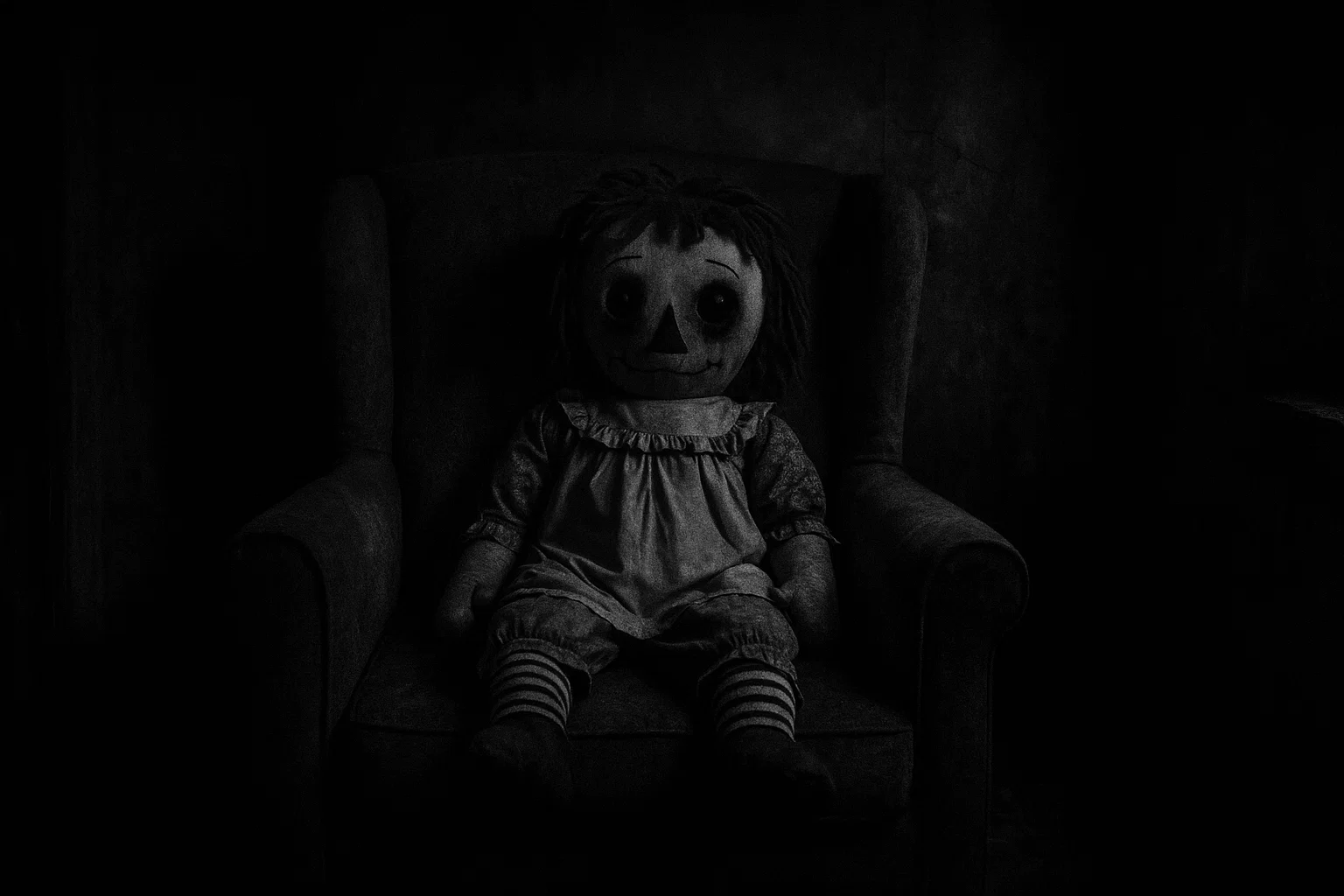
The actual doll kept by the Warren family is a mass-produced Raggedy Ann doll, roughly three feet tall, made of cloth with yarn hair, button-style eyes, and a friendly, stitched, triangle-nosed smile — the identical type of doll sold in toy stores and given as gifts to American children for generations.
Raggedy Ann herself was created by illustrator Johnny Gruelle, whose character and book series date back to 1915, decades before the doll at the center of this case was ever manufactured or purchased. The specific doll linked to the Warrens is generally dated to the 1960s or 1970s production era of Knickerbocker Toy Company Raggedy Ann dolls.
So the doll’s physical existence is not in dispute. What is disputed — and cannot be independently verified — is everything attached to it: the claim that it moved on its own, the claim that a demonic entity used it as a conduit, and the claim that it caused injuries or deaths.
Those aspects rest entirely on the testimony of the Warrens and the people who told them the story, with no independent documentation, police reports, or medical records ever publicly produced to confirm the supernatural elements.
The In-Depth History of the Real Annabelle Doll
The Origins: A Gift From a Mother to Her Daughter
According to the account published by the Warrens and later repeated on the website of the New England Society for Psychic Research (NESPR), the case opened with a nursing student in her late twenties, generally identified as Donna, who lived in an apartment in the Hartford, Connecticut area with a roommate, Angie, also a nursing student.
Donna’s mother bought her a vintage-style Raggedy Ann doll from a hobby store as a gift. Sources differ on the specific occasion and date: some Warren-affiliated timelines, including NESPR’s own published account, place the purchase around 1968, while other retellings tied to The Demonologist place it closer to 1970, with the gift given for a birthday rather than Christmas.
Ed Warren, however, stated in a recorded 1980s video tour of the Occult Museum that the doll was a Christmas present, one of several places where his own retelling varies from the version published in the book.
Researchers who have examined the doll’s design — a calico-dress Raggedy Ann style produced by the Knickerbocker Toy Company — note that the particular design did not exist before the 1960s/1970s, meaning the doll itself was very likely new or relatively new when Donna received it, not an antique with a long prior history, contrary to the impression given by later horror-film adaptations which imagined a dark backstory predating its purchase.
Donna placed the doll on her bed and later around the apartment as a decorative item, with no expectation that it was anything other than an ordinary gift.
A Roommate Ritual
Before anything strange was reported, Donna and Angie — both working shifts at the same hospital — reportedly began using the doll as part of a private joke between themselves. According to several retellings of the case, the two women started leaving Annabelle in different poses and locations around the apartment to startle each other, turning it into a private tradition to see who could deliver the better scare before the start of a shift.
The detail is relevant for understanding the case’s chronology: the roommates themselves admitted to intentionally repositioning the doll during the early period, which is part of why the events that followed were at first dismissed by them as their own doing, or as tricks played by one on the other, before they became convinced that neither of them was responsible.
First Signs
The pattern shifted, according to the account, when the doll began appearing in positions and locations that neither roommate could account for — including, in some retellings, being found kneeling in a chair, a posture a soft-bodied Raggedy Ann doll cannot hold or move into on its own without support.
Around the same period, small notes written in a childlike, uneven scrawl began turning up around the apartment, with messages including “help us” and “help Lou.” The women stated the notes were written on parchment paper, a detail the Warrens later emphasized because, according to their account, neither roommate owned or used parchment paper in the apartment.
On at least two separate occasions, the women also reported finding small marks resembling blood on the doll’s hands and chest. However, no laboratory testing of these marks has ever been documented or made public.
The Séance and the Story of “Annabelle Higgins”
Unnerved by the notes and the doll’s apparent movement, Donna and Angie contacted a medium to hold a séance in the apartment. According to the version of events published in The Demonologist and repeated by NESPR, the medium claimed to communicate with the spirit of a young girl who identified herself as Annabelle Higgins, said to have died on the grounds where the apartment complex now stood.
Accounts differ on the exact circumstances and age of this spirit: the book and NESPR’s timeline describe a seven-year-old girl who had died there previously. In contrast, Ed Warren’s own recorded museum tour instead described the medium as saying the girl was six years old and had died in an automobile accident just outside the building.
The medium reportedly told the women that the spirit felt safe and loved in their presence and wished to remain there, prompting Donna and Angie — out of sympathy for what they believed was a lonely, displaced child — to give verbal permission for the spirit to stay and to inhabit the doll.
The Warrens would later identify this moment, the granting of permission, as the major and ultimately dangerous mistake in the entire case, arguing it was precisely what an entity posing as a sympathetic child’s spirit needed to attach itself more firmly.
You may also enjoy:
The Attack on Lou
Rather than settling the household, the presence reportedly grew more aggressive after the séance. Angie’s boyfriend, referred to as Lou in the original version and renamed Cal in the 2013 reprint of The Demonologist, had been skeptical of the doll from the beginning and repeatedly urged the women to get rid of it, which the Warrens later suggested may have made him a specific target.
According to the account, Lou woke one night with the sensation of being paralyzed and unable to call out, and reported seeing the doll at the foot of his bed before feeling it move up his body toward his chest, followed by a sensation of being choked.
He said he blacked out during the encounter and woke the next morning with what appeared to be fresh claw or scratch marks on his chest, which he could not explain.
In a separate incident described in some retellings, Lou was also said to have been attacked in an otherwise empty room of the apartment while fully awake. It was this shift, from repositioned objects and handwriting to a claimed physical assault on a person, that reportedly convinced all three that the presence was not the harmless spirit of a child.
Contacting the Church, and Then the Warrens
Frightened by what had happened to Lou, the group first sought help from the clergy rather than paranormal investigators. They contacted a local Episcopal priest, identified in most versions of the story as Father Hegan, who recognized the case was beyond his own scope and brought in a superior, referred to as Father Cooke.
It was Father Cooke who then contacted Ed and Lorraine Warren, who by that point had already founded the New England Society for Psychic Research and had begun building a local reputation investigating reported hauntings in Connecticut.
This handoff — nurse to priest to superior priest to self-described demonologists — indicates the transition point in the case’s history from a personal, private ordeal into the far more publicized story that would eventually be documented in print, revisited for decades on television, and, in the end, adapted into a multi-film horror franchise.
A Note on Sources and Conflicting Details
Quick note: the entire history above rests on two primary sources that do not always agree with each other: Gerald Brittle’s 1980 book The Demonologist, written with Lorraine Warren’s direct involvement and using altered names for the people involved (Donna became Deirdre, Angie became Lara, and Lou became Cal in the 2013 reprint), and Ed Warren’s own oral retellings, captured in recorded museum tours and interviews, which differ on details as basic like the holiday the doll was given for, the age of the spirit described by the medium, and how that spirit was said to have died.
No version of the story is corroborated by an independent, contemporaneous document — such as a dated séance record, a medical note about Lou’s injuries, or a police report — meaning the entire early history of the case, however detailed it may appear, is reconstructed solely from testimony given years after the events were said to have happened.
The Warrens’ Involvement and Their Attempts to Contain the Entity
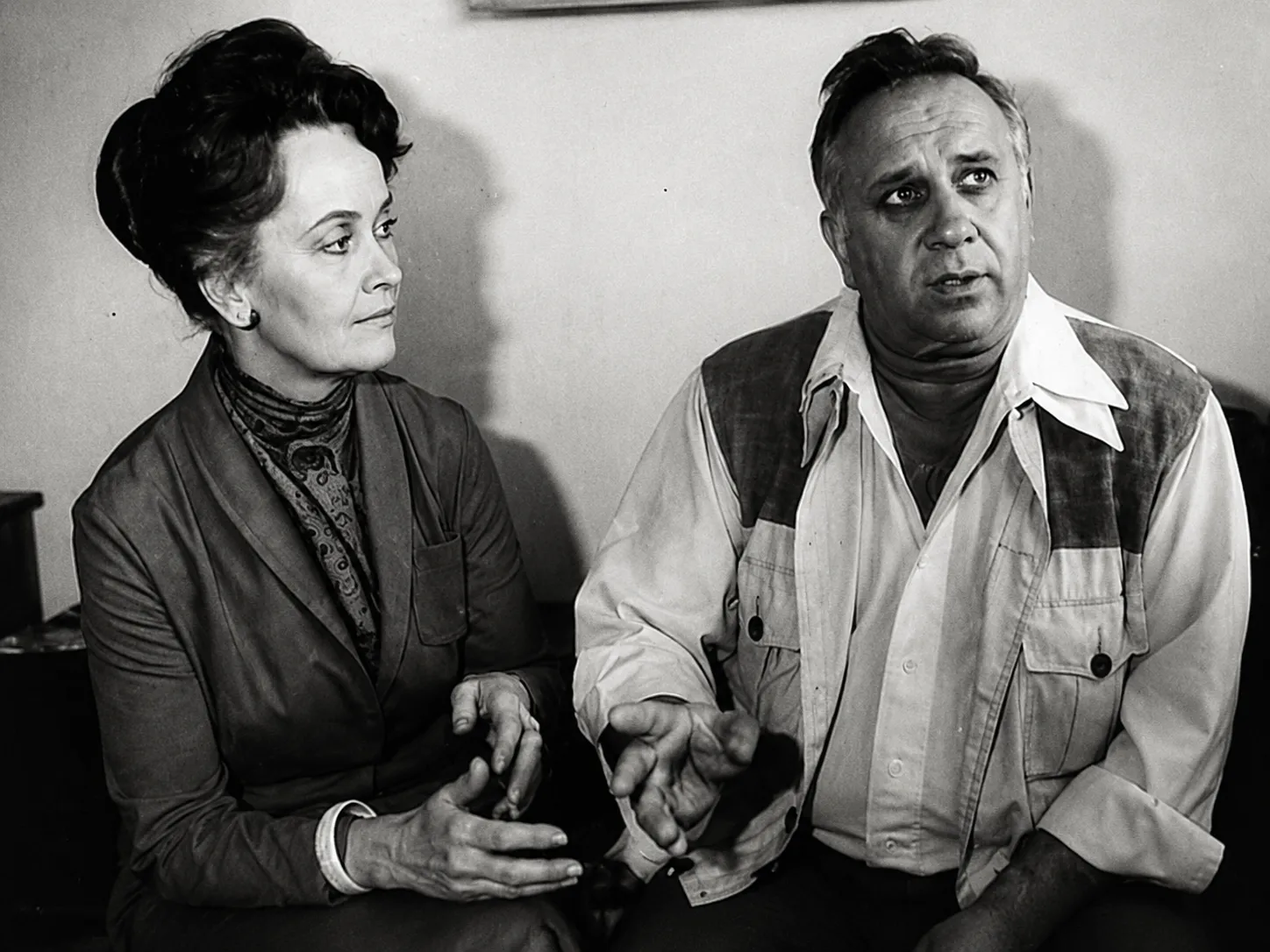
Ed and Lorraine Warren arrived at the apartment to investigate the doll and the reported disturbances directly. Lorraine, who described herself as a clairvoyant, and Ed, who described himself as a self-taught demonologist, together ran the New England Society for Psychic Research, which they had founded years earlier.
Their conclusion in the Annabelle case became the template for how they would frame dozens of future cases throughout their careers: they determined that the presence was not the spirit of a deceased child at all, but an inhuman or demonic entity which had used the sympathetic story of “Annabelle” specifically to gain trust and access to the young women, with the eventual goal of possessing a human being rather than simply animating an object.
With Father Cooke present, the Warrens said they arranged for a blessing or exorcism-style rite to be performed on the apartment itself, intended to cleanse the space of the entity’s influence and bless the people living there.
At Donna’s request, the Warrens then removed the doll from the apartment. They took it into their own custody, a step they said was necessary because the entity remained attached to the object even after the apartment was blessed.
According to the Warrens, the doll did not go quietly. They claimed that on the drive home, their car experienced unexplained mechanical trouble, including issues with the brakes and steering, which they attributed to the entity’s resistance to being removed.
Once the doll was in the Warrens’ home, they said it continued to reposition itself in different rooms despite being restrained, and that a Catholic priest who visited and openly mocked the idea that the doll was dangerous was later involved in a car accident, which the Warrens presented as further evidence of the entity’s reach.
Rather than attempting a formal Rite of Exorcism on the doll itself — which in Catholic doctrine is reserved for the possession of a person, not an object — the Warrens instead had the doll blessed repeatedly. They built a custom wooden and glass display case for it.
They lined elements of the case with items intended to have protective or blessed significance. Ed Warren placed a handwritten sign on the case reading “Warning: Positively Do Not Open,” instructing that the case never be opened and that the doll never be touched or handled without their supervision.
This containment approach — permanent, blessed sequestration rather than an attempt at exorcism or destruction — became the Warrens’ long-term solution and remained unchanged for the rest of their lives. The doll was placed on display in their Occult Museum, a private collection housed at their home in Monroe, Connecticut, alongside other objects they claimed were linked to hauntings and demonic activity they had investigated.
You may also enjoy:
The Demon Div: The Terrifying Horned Demon of Chaos
October 3, 2025
Malaga Inn Haunting: Why Room 007 Terrifies Guests to This Day
September 22, 2025
Eliza Battle Haunting: Alabama’s Most Infamous River Ghost Story
September 18, 2025
Kelpie: The Deadly Water Horse That Feeds on Human Victims
December 9, 2025
Alleged Deaths and Injuries Attributed to the Doll
Over the decades, the Warrens and their successors publicized several incidents said to be connected to Annabelle, on top of the first claims involving Lou and the priest who crashed his car.
Among the most frequently repeated is the story of a young man who allegedly mocked the doll during a museum visit, tapping on its glass case and daring it to do something, only to die shortly afterward in a motorcycle accident, with his girlfriend surviving with serious injuries.
Another widely repeated claim involves a homicide detective who is said to have been “attacked” or scratched by the doll during a visit and to have suffered health problems afterward that the Warrens linked to the encounter.
Keep in mind that none of these later incidents have documentation beyond the Warrens’ own retellings and the accounts published in Gerald Brittle’s The Demonologist; no independent news reports, police records, or named victims backing the motorcycle accident or the detective’s injuries have ever been produced.
What the Real Annabelle Doll Actually Looks Like Today
The doll currently housed by the Warren family’s successors is still the genuine cloth Raggedy Ann doll from the case, not a replica and not the porcelain doll from the films. It remains inside the custom display case built decades ago, kept at what was the Warrens’ Occult Museum in Monroe, Connecticut. That museum closed to public tours in 2019 after the town cited zoning violations, since the property was never permitted for a commercial attraction.
Since then, the doll has occasionally traveled for limited public and media appearances, including a 2025 promotional tour connected to the final Conjuring film. In August 2025, comedian Matt Rife purchased the Warrens’ former home and the Occult Museum collection, taking on legal guardianship of the artifacts, including Annabelle, for at least five years.
A viral claim that circulated in August 2020, suggesting the doll had “escaped” its case, was traced back to social media posts and an unverified edit to a public wiki page, and was debunked directly by Tony Spera, the current director of the New England Society for Psychic Research and the Warrens’ son-in-law.
Is the Doll Truly Haunted?
The Annabelle case has drawn sustained criticism from skeptical researchers for the same reason nearly all of the Warrens’ cases have: the complete lack of independent, verifiable evidence.
Joe Nickell, a longtime investigator for the Committee for Skeptical Inquiry, was one of the most vocal critics of the Warrens throughout the 1980s and 1990s, arguing that their conclusions relied entirely on Lorraine Warren’s claimed clairvoyant impressions and Ed Warren’s dramatic presentation rather than documented investigation.
Nickell and fellow skeptic Benjamin Radford also concluded that other Warren-linked cases, most notably the Amityville haunting and the Snedeker family “haunting” that inspired The Haunting in Connecticut, were fabricated or significantly embellished. The New England Skeptical Society, founded by Steven Novella and Perry DeAngelis, examined the Warrens’ body of work directly and rejected it as unsubstantiated, while still describing the couple personally as sincere in their beliefs rather than deliberate con artists.
Academic researchers who study paranormal folklore, including religious studies researcher Joseph Laycock, treat the Annabelle case less as a literal event and more as a modern legend, noting that the “demonically possessed toy” trope predates the Warrens’ story and likely draws on earlier folklore surrounding the Key West haunted doll known as Robert the Doll, as well as a 1963 Twilight Zone episode titled “Living Doll,” which featured a mother character named Annabelle five years before the Warrens’ story became public.
Science writer Sharon Hill has similarly argued that much of the mystique surrounding Annabelle comes from the Warrens’ own promotional efforts rather than any independently verifiable phenomena, bluntly noting that, apart from the mythology, the physical doll itself is unremarkable.
Fact vs. Fiction: Debunking the Most Popular Claims About Annabelle
Because the Annabelle case has been retold for over fifty years across a book, museum tours, television interviews, and an entire film franchise, a lot of half-true and outright invented details now circulate as if they were established fact.
The doll is a real object.
Confirmed fact. Unlike many “haunted object” legends that turn out to be entirely invented, the physical doll exists, has existed continuously since its purchase in the late 1960s or early 1970s, and remains in the custody of the Warren family’s successors today. This is one of the few elements of the entire case that does not depend on anyone’s testimony — it can be, and has been, photographed and documented by journalists and museum visitors.
The doll is a soft-bodied Raggedy Ann, not a porcelain doll.
Confirmed fact. Design records for Knickerbocker Toy Company’s calico-dress Raggedy Ann dolls place the manufacture of this style in the 1960s–1970s, consistent with the timeline of Donna’s account.
The frightening ceramic doll with cracked features and a Victorian dress exists only in the film franchise; the production deliberately avoided the Raggedy Ann likeness partly for trademark reasons and partly to make the doll more visually unsettling on screen. Side-by-side photographs of the real doll in its display case versus the film prop make this one of the easiest claims in the entire case to verify.
The Occult Museum closed to the public due to zoning violations, not supernatural danger.
Confirmed fact. The Monroe, Connecticut, property the Warrens used to display Annabelle and their other collected items was never permitted to operate as a commercial attraction or museum. The town’s closure of public tours in 2019 was a straightforward administrative and zoning matter. However, it is frequently framed online in more dramatic or mysterious terms than the actual paperwork supports.
The doll “escaped” its case in 2020.
Confirmed fiction. This specific claim can be traced to its origin: a cluster of social media posts and an unverified edit to a public wiki page in August 2020, both of which were directly and publicly refuted by Tony Spera, the current director of NESPR and the Warrens’ son-in-law. This is a rare instance in the entire legend where the debunking is as well-documented as the original claim, since the hoax’s spread and correction both happened in the age of screenshots and archived posts.
The doll changed ownership in 2025.
Confirmed fact. Comedian Matt Rife purchased the Warrens’ former home and its Occult Museum collection in August 2025, becoming the legal guardian of the entire artifact collection, including Annabelle, for at least five years. This is one of the few recent developments in the case that is supported by conventional news reporting rather than only by NESPR’s own statements.
A cult ritual and a home invasion caused the possession, as shown in the 2014 film.
Confirmed fiction. There is no version of the Warrens’ own account, the NESPR timeline, or The Demonologist that includes Satanic cultists, a character named John or Mia, or a home invasion. Every element of that plotline was invented for the film and has no connection to the case as it was originally documented.
The Warrens performed a formal exorcism on the doll itself.
Confirmed fiction, on a technicality that is often glossed over. In Catholic doctrine, a Rite of Exorcism applies specifically to the possession of a person, never an inanimate object, which is a distinction the Warrens themselves publicly acknowledged. What they arranged, with Father Cooke present, was a blessing of the apartment and its occupants — not a rite performed on the doll. The doll was later blessed and sealed away, but never formally “exorcised” in the doctrinal sense the word implies.
The doll caused notes to appear, attacked Lou, caused car trouble, and was connected to a fatal motorcycle accident and a detective’s injuries.
Unverifiable, not confirmed. This is the largest category in the entire case. Every one of these claims originates from a single lineage of sources — the Warrens’ direct testimony and Gerald Brittle’s book, written in close collaboration with Lorraine Warren — with no independent corroboration ever produced: no photographed notes, no medical record for Lou’s claimed scratches, no named motorcyclist, no accident report, and no named detective.
The lack of a single piece of third-party documentation over fifty-plus years, and the fact that the case has been retold in international media, is itself important, given how much easier such records would be to produce than the supernatural claims themselves.
You may also enjoy:
Who Was the Beast of Gévaudan? Truth or Myth
June 23, 2025
Aeacus the Underworld Judge: Horror Stories from Greek Mythology
September 9, 2025
Satanachia: Demon General of Hell’s Legions
August 28, 2025
Zmeya: The Multi-Headed Dragon of Slavic Nightmares
September 11, 2025
Who Is Oriens? The Forgotten Infernal King
August 26, 2025
Disagreements and Inconsistencies Worth Noting
A close comparison of the different versions of the Annabelle story reveals inconsistencies that rarely get mentioned when the case is retold, and they matter more than they might first appear:
The date of the doll’s purchase shifts depending on the source — NESPR’s own published timeline places it around 1968, while the version tied to The Demonologist places it closer to 1970. Ed Warren’s recorded museum tour describes the doll as a Christmas gift, while other retellings describe a birthday gift.
Even the age and cause of death of “Annabelle Higgins” is inconsistent: the book and NESPR describe a seven-year-old who died on the property previously, while Ed Warren’s own oral account instead describes a six-year-old killed in a car accident nearby.
These are not minor typos; they are the two people most responsible for popularizing the story — Lorraine Warren through the book and Ed Warren through his own public talks — who give details that directly contradict one another about the central entity of the entire legend.
The names of everyone involved were also changed between the first telling and the 2013 reprint of The Demonologist, with Donna becoming Deirdre, Angie becoming Lara, and Lou becoming Cal. Publishers changing names to protect real people’s privacy constitutes a normal editorial practice.
However, it also means that no one outside the Warrens’ own circle has ever been able to independently locate, contact, or verify the existence of the actual nursing student, her roommate, or her roommate’s boyfriend using a consistent, traceable identity. Every version of the story funnels back through the Warrens as the sole point of contact with the original participants.
Taken together, these inconsistencies point to a story that was likely reconstructed from memory, retold verbally many times before it was ever written down, and shaped along the way by whoever was telling it at a given moment — Ed’s more theatrical museum-tour version versus Lorraine’s more polished, book-ready version.
That pattern is common in oral legend and does not necessarily mean anyone was lying outright, but it does mean the case cannot be treated as a fixed, single set of documented facts. It is, more accurately, several overlapping accounts that agree on the broad outline — a doll, two nurses, a séance, an attack, the Warrens’ involvement — while disagreeing on nearly every specific detail beneath that outline.
Real Annabelle Doll vs Other Famous Cursed Objects
| Name | Type | Death Toll (Attributed) | Activity Level |
|---|---|---|---|
| Robert the Doll | Haunted Doll | None confirmed; bad luck and injuries popularly attributed to those who mock it | 5/10 (occasional) |
| The Dybbuk Box | Cursed Object (Wine Cabinet) | No confirmed deaths; multiple illnesses and nightmares attributed by successive owners | 6/10 (occasional) |
| The Crying Boy Painting | Cursed Painting | None confirmed; blamed anecdotally for house fires across the UK in the 1980s | 3/10 (dormant) |
| The Hope Diamond | Cursed Jewelry | Multiple owners’ deaths and financial ruin attributed across several centuries | 2/10 (dormant) |
| The Basano Vase | Cursed Object (Vase) | Several deaths attributed across centuries of legend | 3/10 (dormant) |
| Busby’s Stoop Chair | Cursed Chair | Dozens of deaths attributed in popular legend | 2/10 (dormant, now suspended from a ceiling to prevent sitting) |
| The Myrtles Plantation Mirror | Haunted Mirror | None confirmed; residual haunting and handprints reported | 5/10 (occasional) |
| “Little Bastard” (James Dean’s Porsche) | Cursed Vehicle | Several deaths and injuries attributed to the car and its salvaged parts | 4/10 (occasional) |
| The Anguished Man Painting | Haunted/Cursed Painting | None confirmed; illness and disturbing sounds reported by the owner | 4/10 (occasional) |
| Peggy the Doll | Haunted Doll | None confirmed; illness and bad luck reported by handlers | 5/10 (occasional) |
| The Hands Resist Him | Haunted Painting | None confirmed | 3/10 (dormant) |
| The Chase Vault Coffins | Poltergeist Activity Linked to Object | None; phenomenon involved coffins allegedly moving, not deaths | 1/10 (dormant, vault now sealed) |
Conclusion: A Real Object, an Unprovable Story
The real Annabelle doll is not a hoax in the sense that people sometimes assume — it genuinely exists, it genuinely sat inside the Warrens’ home for decades, and the core outline of the story (a doll given as a gift, roommates who grew frightened, a séance, and the Warrens’ later involvement) is consistent across every version of the account.
What is far less convincing is the supernatural content layered on top of that outline. Every dramatic detail — the moving doll, the attack on Lou, the crashing cars, the motorcyclist, the detective’s scratches — traces back to a single source: the Warrens themselves, later relayed through a book written in close collaboration with Lorraine Warren.
No police report, hospital record, named eyewitness outside the immediate circle, or independent investigator has ever verified the paranormal elements of the case, which places it squarely in the territory of unverifiable personal testimony rather than documented fact.
Given the Warrens’ well-established pattern, seen just as clearly in Amityville and the Snedeker case, of building dramatic, financially lucrative stories about ordinary or explainable events, the far more probable explanation is that this began as a genuinely frightening, misinterpreted experience for two young women, which was then shaped and amplified over time into a marketable legend.
One detail, though, is worth sitting with regardless of where you land on the story’s truth: if the Warrens sincerely believed a malevolent, possibly dangerous entity was attached to that doll, why did they keep it intact in a display case instead of destroying it outright? The most likely answer has little to do with theology and everything to do with business and belief working in tandem.
As devout Catholics, the Warrens maintained that only a blessing or containment, not destruction, was the appropriate response to a demonic presence, since they believed the entity itself was not “in” the doll so much as using it, meaning burning or breaking the object would not have banished anything.
But it is also true that Annabelle, locked behind glass with a hand-lettered warning sign, was the single most valuable and famous exhibit the Warrens ever owned — the centerpiece of their Occult Museum, their books, their lecture tours, and eventually an entire film franchise. A destroyed doll cannot be displayed, photographed, or licensed to a movie studio.
Whether one believes the Warrens were sincere investigators who followed their own doctrine or savvy self-promoters who understood the commercial value of a locked box no one was allowed to open, the outcome was the same either way: Annabelle survived.
You may also enjoy:
Altamaha-ha: The Creepy Cryptid Lurking in Georgia’s Waters
September 25, 2025
The Strange Hodag Monster: Wisconsin’s Fearsome Cryptid
September 26, 2025
What Is a Basilisk? Origins, Mythology, and Powers
January 28, 2026
What Is a Ghost Orb? The Paranormal Phenomenon Explained
January 5, 2026
Who Really Is Mephistopheles in the Faust Legend?
August 26, 2025
Sources
- Brittle, Gerald. The Demonologist: The Extraordinary Career of Ed and Lorraine Warren. Graymalkin Media, 2013.
- Baker, Joseph & Bader, Christopher. (2014). A social anthropology of ghosts in twenty-first-century America. Social Compass. 61. 569-593.
- Tony Cornell. (2002). Investigating the Paranormal. New York: Helix Press.
- Guiley, Rosemary Ellen. The Encyclopedia of Ghosts and Spirits. 3rd ed., Facts On File, 2007. Internet Archive.
- Kiley Seymour, Philipp Sterzer, Natalie Soto. Believing is seeing: The link between paranormal beliefs and perceiving signal in noise. Consciousness and Cognition. Volume 106, 2022, 103418, ISSN 1053-8100.
- Shin, Yun Kyoung et al. Strong evidence for ideomotor theory: Unwilled manifestation of the conceptual attribute in movement control. Frontiers in Psychology vol. 14 1066839. 4 Apr. 2023, doi:10.3389/fpsyg.2023.1066839.
- NESPR official Annabelle case timeline. warrens.net. Retrieved on July 7, 2026.
- Hwang, Wook, and Sara Slavin. Brittle v. Warner Bros. Entertainment Inc. Loeb & Loeb, Sept. 2017
- Toner, Patrick Joseph. Exorcism. Catholic Answers. Retrieved on July 7, 2026.
- Cusack, Carole. (2024). Satanism, by Joseph P. Laycock. International Journal for the Study of New Religions. 12. 272-274. 10.1558/ijsnr.28775.