While the modern Gashadokuro is frequently reduced to a generic giant skeleton in movies, its traditional role in Japanese folklore was far more profound: it served as a visceral monument to the devastating consequences of societal breakdown, famine, and unburied war casualties.
The entity symbolizes the collective rage of individuals denied the sacred funerary rites essential to pacifying the human soul, transforming unhallowed fields of mass starvation into an active, vengeful predator. This macro-organism functions as an absolute failure of state responsibility, rising from the soil of tragedy to punish the living.
Summary
Overview
| Attribute | Details |
| Names & Etymology | Gashadokuro, Ōdokuro; Japanese for ‘rattling skeleton’ or ‘great skull’. |
| Classification | Yōkai, Onryō (Wrathful/Vengeful Spirit), Spectral Undead. |
| Species | Composite Spectral Macro-Humanoid. |
| Threat Level | Level 3 (Apex Predator) [See the Thread Level Guide]. |
| Origin | Formed from the unquenchable malice (onnen) of hundreds of corpses left to rot on battlefields or during mass famines without proper funerary rites; their collective bones knit together into a single giant entity. |
| Earliest Record | 19th-century precursor (1844 woodblock print by Utagawa Kuniyoshi); modern standardized folkloric classification established in the mid-20th century (circa 1966–1972) by Shigeru Mizuki. |
| Habitat | Desolate battlefields, abandoned provincial borders, and dark rural highway paths across Japan, particularly around the Kanto and Kansai regions. |
| Diet | Human blood and vital life force. |
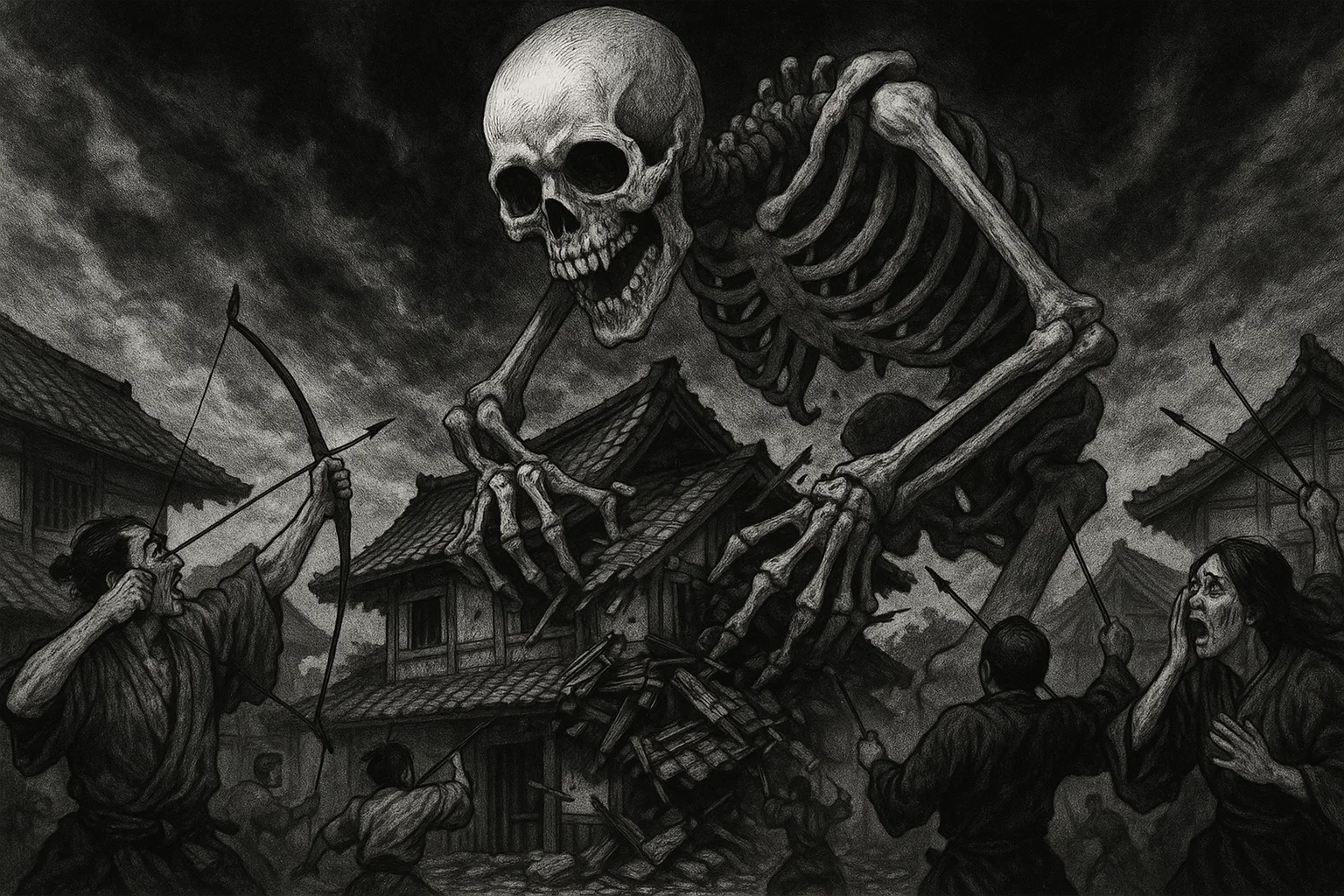
| Physical Details | An immense human skeleton standing between 15 to 90 feet tall, carrying the stains of earth and rot, completely silent in its movement until it strikes. |
| Strengths | Invisibility until immediately before an attack, completely silent movement, immense physical strength fueled by spiritual malice, and near-immunity to conventional physical weapons. |
| Weaknesses | Shinto purification rituals, Buddhist apotropaic charms, chanting of sacred sutras (like the Heart Sutra), which dissolve the collective bond of the souls, and exposure to the first rays of morning sunlight. |
| Warning | If you experience a sudden, deafening ringing in your ears while walking alone on dark rural paths in Japan after midnight, immediately drop to the ground, remain perfectly still, and pray for the dawn. |
| Survival Odds | 35% (If you are caught unprepared on an open road, you will become a statistic, but a calm mind capable of reciting Buddhist sutras or hiding until sunrise can successfully escape). |
Who or What Is Gashadokuro?
The Gashadokuro is a towering spirit from Japanese folklore, classified as a yōkai or onryō (vengeful spirit). According to lore, the creature is born from the bones of hundreds of people.
Instead of being the spirit of one person, the Gashadokuro is a single entity made from the collective anguish of people who died from starvation or war and were left unburied. Their unrest leaves behind onnen—a lingering grudge filled with sorrow and resentment.
When the pain and anger of these souls builds up, their bones are believed to fuse together into a giant skeleton. The Gashadokuro is driven by a hunger for what it never had in life—food and peace.
Old stories tell of the monster that stalks travelers at night along remote paths, targeting those who are alone. The Gashadokuro seeks to consume their blood and vitality, attempting to fill its endless emptiness. More than just a monster, it represents the fears of forgotten people rising to confront the living.
Origin & Lineage
The modern idea of the Gashadokuro is not an ancient, unbroken tradition. Instead, it comes from a blend of old history and 19th-century art, and was shaped into its current form by 20th-century writers like Morihiro Saito and manga artist Shigeru Mizuki. Their works in the 1960s and 1970s merged scattered ghost stories into a single, giant skeleton creature.
To give the legend historical roots, later writers connected the Gashadokuro to the 10th-century rebellion of Taira no Masakado. After Masakado’s defeat and death, stories grew about his daughter, Princess Takiyasha, who was said to use sorcery to raise the unburied dead from the battlefields.
Beyond this specific legend, the idea of the Gashadokuro was shaped by Japan’s difficult history, especially the Edo period and earlier times of war. The monster is tied to places where many were buried without rites, abandoned borders, and lonely roads—reflecting deep cultural trauma and guilt.
In times of famine and war, such as during the Great Tenmei Famine, the state often failed to provide proper funerals for the poor and fallen soldiers.
In Shinto and Buddhist beliefs, unburied bodies create onnen—a spiritual grudge that lingers. Faced with many anonymous skeletons, people imagined their fear as a single, giant predator. This gave a concrete form to the anxiety that neglected victims might return for revenge.
Etymology
The name Gashadokuro is a combination of sounds and meaning: it uses an onomatopoeic word and the kanji for skeleton to create a name that hints at both its sound and appearance.
The first part, gasha (or gacha-gacha), mimics the clattering sound of bones. The second part, dokuro (髑髏), means “skull” or “skeleton”. Together, the name means “the rattling skeleton” or “clacking skull.”
Unlike ancient beings from the 8th-century Kojiki, the term Gashadokuro does not appear in early medieval texts. Instead, local dialects in Tohoku and Kanto once used Ōdokuro (大髑髏), meaning “Great Skeleton,” to refer to similar giant apparitions.
The word Gashadokuro became common in the mid-20th century, when folklorists recorded stories about spirits making “gasha-gasha” sounds as they wandered at night. The name itself acts as a warning, echoing the sound the monster is said to make.
What Does the Gashadokuro Look Like?
Early artwork and stories describe the Gashadokuro as a giant human skeleton, sometimes as tall as ninety feet.
Unlike the glowing, magical versions in modern games, the traditional Gashadokuro is simply a huge, weathered skeleton—mundane in form but terrifying because of its size and unnatural presence.
Folklore says the Gashadokuro has no muscles or tendons—its bones are held together by the shared grudge of the souls that form it. Some stories say it is invisible until it attacks, a detail often missing from modern retellings.
Despite its size, it moves without a sound—no footsteps or crashing. The only warning is a sudden ringing in a victim’s ears, followed by the faint rattle of bones. According to legends, the creature smells of damp earth and old blood.
Myths, Legends, and Stories
Stories about the Gashadokuro come from Edo-period fiction, 19th-century plays about the Masakado rebellion, and rural ghost tales. These stories often stress that ordinary people have no way to fight the spirit, which is born from shared suffering.
The best-known legend tells of Princess Takiyasha, who used black magic to summon the Gashadokuro to protect her family’s fortress. In this story, the giant skeleton acts as an unstoppable weapon, tearing down walls and terrifying even the bravest samurai.
A lesser-known story from Nagano tells of a traveler walking at night who suddenly hears a deafening ringing in his ears. Frozen in place, he looks up to see a huge skeletal hand reaching down from the darkness.
The legend says the Gashadokuro does not crush its victims, but lifts them up and bites off their heads, then drains their blood into its bones.
The next morning, villagers found the traveler’s dry, bloodless body on the path—no footprints, no sign of struggle. It was as if the giant skeleton left no trace.
Gashadokuro vs Other Monsters
| Creature & Lore | Danger Level | Details |
| Gashadokuro (Japan) | High. It stalks lonely rural roads at midnight to decapitate travelers and drink their spraying blood to satisfy its eternal hunger. | This macro-organism is an invisible hive-mind whose arrival is heralded solely by a sudden, intense ringing in the victim’s ears. |
| Nuckelavee (Scotland) | Severe. It breathes toxic vapors that wilt crops, causes mass plagues, and actively chases down humans to tear them apart. | This skinless, horse-human hybrid monster cannot tolerate the purity of flowing fresh water, making river crossings the only escape route. |
| Wendigo (Algonquin Mythology) | Extreme. It possesses humans driven by greed or desperation, transforming them into emaciated, cannibalistic monsters with an insatiable hunger. | Every time a Wendigo consumes a human being, its physical body grows in direct proportion to the meal, ensuring it remains eternally starving. |
| Draugr (Norse Mythology) | High. It guards its burial mound with supernatural strength, crushing intruders or driving them completely insane with proximity. | These undead reanimated corpses retain their full living intelligence and can alter their physical body weight to become as heavy as stone. |
| Rawhead & Bloody Bones (Anglo-American Lore) | High. It hides inside deep water wells or dark basement steps to drag disobedient children down into its blood-soaked lair. | This creature is described as a skinless, raw skull that hitchhikes on a reanimated razorback hog skeleton to track its prey. |
Can You Defeat a Gashadokuro? Powers & Weaknesses
The Gashadokuro’s strength comes not from muscle, but from the combined grudge of many souls. Weapons are useless against it—swords pass through its ribs, and arrows or bullets simply break on its bones.
To survive, one must break the spiritual bond holding it together. Folklore claims that Shinto purification or Buddhist rituals—such as protective charms or chanting—are the only ways to weaken or dispel it.
Introducing a powerful, localized source of sacred peace—such as a consecrated omamori (amulet) or the chanting of the Hannya Shingyo (Heart Sutra) by a completely fearless ascetic priest—can puncture the entity’s emotional engine.
The sacred vibrations of the sutra break the shared focus of malice, causing the individual souls to remember their own specific identities. When this occurs, the collective bond shatters instantly, causing the entire multi-story structure to immediately collapse into a harmless, chaotic pile of normal, weathered human bones.
For most people, the only way to survive is to hide and stay silent until morning. With the sunrise, the Gashadokuro loses its power and disappears back into the earth.
The Architecture of Collective Trauma
The Gashadokuro myth persist not just because it is frightening, but because it represents the trauma and failures of society. The monster appears only when communities fail to care for the vulnerable and forget their responsibilities.
In Japanese tradition, an unburied body is not just a health risk, but a serious spiritual crisis. The Gashadokuro gives shape to the guilt and sorrow of a society that has left the dead forgotten.
As long as society neglects the vulnerable and forgets the dead, the legend warns that the past may return, demanding to be recognized and remembered.
You may also enjoy:
Incubus: Demon of Lust and Nightmares
August 22, 2025
Koolakamba: History, Sightings, and Scientific Explanations
February 4, 2026
Likho: The One-Eyed Crone Who Brings Death and Bad Luck
September 11, 2025
Was Manuel Blanco Romasanta Really a Werewolf?
June 18, 2025
The Drish House Haunting: 150 Years of Unexplained Tower Lights
September 3, 2025
Sources
- Kuniyoshi, Utagawa. Takiyasha the Witch and the Skeleton Spectre (Sōma no Furu-dairi). 1844, Woodblock Print.
- Davisson, Zack. (2026). The Persistence of Yōkai. Education About Asia. 29. 10.65959/eaa.1847. ResearchGate.
- Bradt, Aaron. The Role of Yokai in Japanese Myth. 2016. Academia.edu.
- Foster, Michael Dylan. The Book of Yokai: Mysterious Creatures of Japanese Folklore. University of California Press, 2015. Internet Archive.
- Johnson, Adam J. The Evolution of Yōkai in Relationship to the Japanese Horror Genre. 2021. University of Massachusetts Amherst, Capstone Project. ScholarWorks@UMass Amherst.