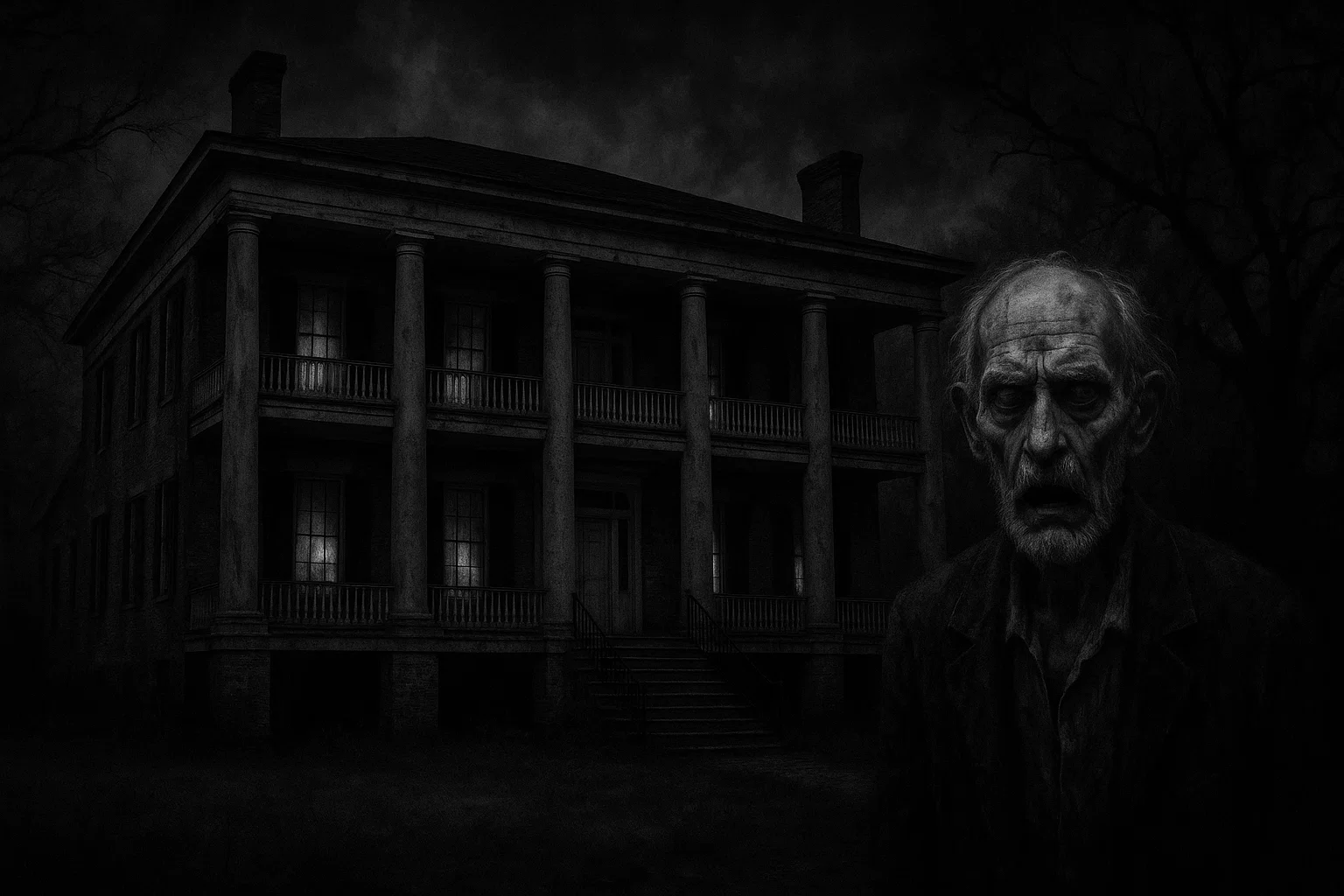
Just south of downtown Prattville, Alabama, stands a well-preserved nineteenth-century Federal-style estate completed in 1844. Known in local ghost stories as the Plantation House or by its formal name, Buena Vista (the Montgomery-Janes-Whittaker House), this historic home is where lasting architecture and a history of trauma meet.
This well-kept estate draws researchers interested in strange events, especially reports of a mysterious woman seen on the upper floors and a playful male presence linked to the early twentieth century.
Summary
Key Takeaways
| Attribute | Details |
| Name | Plantation House in Prattville; Buena Vista; Montgomery-Janes-Whittaker House |
| THC Scale | L-3 [See the THC Scale Explanation] |
| Location / Origin | 641 County Road 4 E, Prattville, Autauga County, Alabama, USA |
| Classification | Intelligent, Residual |
| History | Construction initiated circa 1822 by early landowners; completed in 1844 by Captain William Montgomery. Transitioned through multiple family ownerships, structural fires in the 1920s, and commercial operations before preservation. |
| Casualties & Deaths | Multiple unverified historical deaths due to natural causes, disease, and historical regional conflict; 0 deaths or injuries directly attributed to paranormal activity. |
| Associated Entities | The Lady in Blue (an older female apparition), an unidentified young girl, and Mr. Davis (a 1920s-era male entity). |
| Manifestations | Auditory (mysterious footsteps), Visual (apparitions in windows and stairwells), Environmental (localized electromagnetic fluctuations, phantom doors swinging open). |
| First reported sighting | Circa 1921, following a documented structural fire on the property. |
| Recent reported sighting | 2014, during formal investigative sweeps by regional paranormal research teams. |
| Threat Level | 2/10 (harmless) [See the Threat Level Explanation] |
| HCR | 3/10 (Probably authentic) [See the Hoax Confidence Rating Explanation] |
| Access Status | Private / Historic Museum. Owned by the Autauga County Heritage Association; accessible via scheduled historical tours and authorized events. Trespassing outside operating hours is strictly prohibited and local laws are enforced. |
What Is the Plantation House Haunting?
The haunting at the Plantation House in Prattville is complex, showing signs of both lingering energy and intelligent spirits. Instead of a single main ghost, research suggests that different presences are found in different parts of the house.
The main spirit is an older woman, often called “The Lady in Blue” or “Fuzzy” by local researchers. She seems aware of her surroundings and interacts with people, especially in the second-floor bedrooms and the third-floor attic. Witnesses say she changes her movements when she sees someone she doesn’t recognize.
Another spirit, known as “Mr. Davis” and connected to the house’s twentieth-century past, acts differently. He often focuses on female visitors, creating feelings like a gentle breath on the neck or a light touch along the upper back.
These experiences often happen at the same time as sudden changes in electromagnetic fields, hinting that the spirit might use static electricity to make physical contact. Such events usually occur when something in the environment changes, like when new recording equipment is brought in or when the house is being restored, which seems to disturb the usual magnetic field of the property.
Plantation House Haunted History
To understand the strange events at Buena Vista, it helps to look at the property’s long and complicated history. Construction started around 1822, led by early Autauga County landowners John W. Freeman or Josiah Huie.
Captain William Montgomery, a wealthy man who lived at the same time as Prattville’s founder, Daniel Pratt, later bought the unfinished estate. He oversaw its completion, and the grand Federal-style house was finished in 1844.
The estate served as the main center for a large southern farm. Over the years, it saw many hardships common in the antebellum South, including suffering, illness, and early deaths. Captain Montgomery lived there with his wife, Ann Burrows Montgomery, until he died in 1859.
During the Civil War, the estate was managed by their son, Confederate Lieutenant William Montgomery. The family faced personal tragedies during this time, including the deaths of Lieutenant Montgomery’s children, Mary Willie Montgomery in 1870 at age six and William Montgomery in 1872 at age two.
All of this family grief and loss happened right where the museum stands today.
The Andrew Jackson Staircase Blueprint Anomaly
An interesting piece of history links the home’s main area of ghost activity—the 24-foot spiral mahogany staircase—to a famous national figure. Family papers from the nineteenth century, kept by Montgomery descendant Mrs. Annie Mae Montgomery Martin, state that General Andrew Jackson visited the house while it was still under construction.
Jackson was so impressed by the staircase’s design and engineering that he told his builders to study it. Later, they used the blueprint to rebuild the grand staircase at his own Tennessee home, The Hermitage, after a fire in 1834.
This link between the two staircases raises an interesting idea about how space and structure might affect hauntings. The Hermitage is also known for its ghost stories. Since both places have the same unusual staircase design, it’s possible that the features causing strange sounds and sightings were copied from one house to the other.
After the Montgomery family, Mary Emma Scott Stewart bought the property in 1910 and added Colonial Revival features, like a large front porch with Ionic columns. In the following decades, the house’s balance was changed for good. In 1921, when Jacob Janes owned it, a major fire damaged the house. The main wooden frame survived, but the fire meant the house had to be rebuilt.
Local stories say that the fire’s sudden heat released old memories trapped in the house’s wood. When the Fred Whittaker family bought the estate in 1937, they began a major restoration to update the interior.
Workers covered the original materials with thick plaster, heavy brick floors on the porch, and new decorations. The process trapped the old, stressful energy inside the walls. During this time, people began to report seeing “The Lady in Blue” more often, especially in the rooms she was said to have used.
You may also enjoy:
Plantation House Ghost Sightings
Over the past century, many different people have reported seeing and hearing strange things at this house. After the property became a museum under the Autauga County Heritage Association, these reports became more consistent and stable.
| Date | Witness | Description of the event |
| Circa 1925 | Lawhorne Family Matriarch | Nightly encounters over a one-week duration involving a female figure wearing a blue robe standing at the foot of the bed with outstretched arms. |
| Circa 1930 | Resident Aunt | Visual observation of the blue-robed figure materializing in a secondary bedroom, vanishing upon recognizing the occupant. |
| Late 20th Century | Museum Guests & Staff | Repeated visual sightings of an older woman reading in the third-floor attic window late at night when the building was vacant. |
| Circa 2005 | 13-Year-Old Visitor | Refusal to ascend the spiral staircase due to an unseen woman standing adjacent to the tour guide, actively waving at the witness. |
| 2014 | Twisted Paranormal Society | Anomalous equipment readings, baseline electromagnetic spikes, and a distinct perception of dense, negative energy fields within restricted areas. |
The Bedroom Apparitions (1920s)
The first detailed reports came from the Lawhorne family, who lived in the house after the 1921 fire. The family’s matriarch said that for a week straight, a woman in a blue robe would quietly enter her bedroom each night, stand at the foot of the bed, and hold her arms out over her feet in a stiff, repeated motion.
To see if the events were real, the woman’s sister slept in the room one night. The ghost appeared at the usual time, came to the bed, but when it noticed someone different, it changed its posture and vanished right away.
This event is important for paranormal researchers. The repeated visits suggest a Residual loop, like a recording of past actions. But the ghost’s sudden reaction to a new person shows it might have some awareness, hinting that it’s more than just a replay of old events.
The Staircase Encounter (Circa 2005)
During a regular tour led by a substitute librarian, something strange happened to the guide’s thirteen-year-old cousin. As they approached the tall mahogany spiral staircase, the teenager suddenly stopped, looked very scared, and refused to go any further.
When asked, the teen said, “I swear someone’s next to you on the stairs, waving at me.” The teen described the entity as an older woman, matching earlier reports of the blue-robed ghost from the 1920s. The tour guide, however, didn’t see or feel anything unusual.
This event may show how teenagers can be more sensitive to their surroundings or expect to see something unusual. The spiral staircase itself, with its heavy wood and tall height, can create strange sounds or sensations that might make people feel they’re not alone.
You may also enjoy:
July 1, 2026
The Complete List of All Haunted Places in Alaska
November 20, 2025
Theories
The 1860 Demographic Trauma
This theory suggests that the main cause of the lingering phenomena at the estate is a strong concentration of past human suffering, following the parapsychological idea called the Stone Tape Theory.
Supporters of this idea believe that certain building materials, especially dense old-growth heart pine and early clay-and-lime mortars, can act as a recording medium, absorbing intense emotional energy during times of great trauma.
According to the 1860 U.S. Federal Slave Schedule, the estate’s matriarch, Ann Burrows Montgomery, held a baseline population of approximately 107 slaves on the plantation grounds.
Daily life for such a large group of slaves led to extreme physical exhaustion, fear, family separations, and many unrecorded deaths. This ongoing suffering happened right where the museum stands today.
The theory proposes that this long-lasting emotional suffering left a permanent mark on the property. What visitors see as the quiet movement of a female ghost or heavy feelings in certain areas are not active spirits, but a replay of past trauma. These effects appear when current weather conditions match those during the original events.
Geomagnetic Induction
A technical look at the estate’s structure offers a unique explanation for phenomena such as heavy doors swinging open or locking on their own, based on the metals used in the building.
The National Register of Historic Places survey from October 25, 1974, notes that the original locks, hinges, and hardware on the second and third floors were custom-made in Birmingham, England, and have clear British markings. These heavy iron and brass pieces were brought by mule teams from Washington Landing on the Alabama River to the mansion to secure its large timber doors.
From an engineering point of view, British iron from the 1800s has very high magnetic permeability because of certain impurities from the smelting process. This means the house contains many materials that can easily conduct magnetic fields.
The theory says these metal fixtures interact with the Earth’s natural magnetic field. When there is increased solar activity or lightning in Autauga County, the English iron locks and hinges become slightly magnetized, which creates small electromagnetic fields that can move the parts or make them move more easily.
This can make the heavy doors come loose and swing open on their own, offering a physical explanation for what some people think is ghost activity.
Infrasound and Structural Acoustic Resonance
This theory is based on the physics of low-frequency sound waves below 20 Hz, which can cause strong physical and mental effects. The house has a large, open 24-foot spiral mahogany staircase connecting three floors, built in an unusual shape.
When wind blows across the land south of Prattville and hits the house’s roof, it flows into the third-floor attic and down the central staircase, turning the spiral stairs into a natural sound amplifier.
Studies show that infrasound around 18.98 Hz can cause the human eyeball to vibrate slightly, which the brain perceives as gray or blue shadows at the edge of vision.
Being exposed to these low-frequency sounds for a long time can trigger the body’s natural fight-or-flight response, leading to symptoms such as rapid breathing, sweating, fear, and the feeling that someone is nearby. Since the staircase carries these sounds, people climbing it often experience them, which explains why many sightings and panic attacks occur there.
Piezoelectric Tectonic Stress
This geological theory suggests that the strange events at the site are linked to underground stress along the Fall Line, where the hard rocks of the Piedmont meet the softer soils of the Coastal Plain.
The ground under Autauga County has thick layers of quartz sand and minerals. When tectonic plates move or press together, the pressure on these quartz layers generates electrical currents and changing magnetic fields, a phenomenon known as piezoelectricity.
These electrical currents move up through the mansion’s foundation, using the brick supports and pine framing as pathways. As the changing magnetic fields reach the upper floors, they can affect the temporal lobes of people inside.
Research shows that electromagnetic stimulation of the temporal lobe can cause short, mild seizures that lead to vivid hallucinations. People might hear phantom footsteps, smell things that aren’t there, or feel like they are being watched.
Behavioral Priming
A behavioral psychology approach suggests that these experiences are completely subjective, shaped by the observer’s mindset and expectations. The Plantation House in Prattville has a grand, intimidating antebellum design, with a large Ionic portico and tall structure—features often linked to ghost stories and the tragic history of the South.
According to this theory, when a museum guest or paranormal investigator enters the property, they are already expecting to see something unusual. Their minds are on high alert, so they quickly misinterpret normal sights and sounds as something paranormal.
For example, the creaking of old timbers after sunset is heard as ghostly footsteps. Shadows from tree branches on the third-floor windows look like an old woman. Sudden drafts in the attic feel like cold spots. This cycle of misinterpretation makes people believe the house is haunted, even when nothing unusual is happening.
You may also enjoy:
Plantation House vs Other Haunted Locations
| Name | Location | Type of Haunting | Activity Level |
| Gaineswood Mansion | Demopolis, Alabama, USA | Intelligent | 5 (occasional) |
| Sturdivant Hall | Selma, Alabama, USA | Intelligent | 6 (occasional) |
| Myrtles Plantation | St. Francisville, Louisiana, USA | Residual / Intelligent | 8 (very active) |
| Oak Alley Plantation | Vacherie, Louisiana, USA | Residual | 4 (occasional) |
| Gorgas House | Tuscaloosa, Alabama, USA | Residual | 5 (occasional) |
| Ferry Plantation House | Virginia Beach, Virginia, USA | Intelligent / Shadow Figures | 7 (very active) |
| Carnton Plantation | Franklin, Tennessee, USA | Residual / Poltergeist | 6 (occasional) |
| Rosedown Plantation | St. Francisville, Louisiana, USA | Intelligent | 4 (occasional) |
| Belle Alliance | Donalsonville, Louisiana, USA | Residual | 3 (dormant) |
| Magnolia Plantation | Derry, Louisiana, USA | Demonic / Poltergeist | 9 (very active) |
| Nottoway Plantation | White Castle, Louisiana, USA | Intelligent | 4 (occasional) |
| Sorrel-Weed House | Savannah, Georgia, USA | Intelligent / Shadow Figures | 8 (very active) |
| Whaley House | San Diego, California, USA | Residual / Intelligent | 8 (very active) |
| Ashton Villa | Galveston, Texas, USA | Intelligent | 5 (occasional) |
Is Plantation House Haunting Real?
After looking at a century of eyewitness accounts, checking property records, and studying changes to the site, I have reached a clear conclusion. The evidence does not show any dangerous or evil presence. Instead, it points to a clear example of a low-frequency environmental loop.
My main theory is that the 1921 fire is the key event. The main female entity has been described the same way from the 1920s to today, showing no change in behavior. She does not interact with anyone and only moves along the same parts of the staircase and upper rooms.
The touches people feel and credit to “Mr. Davis” are probably caused by static electricity building up on the old iron railings and wood, which then discharges when visitors touch them in dry weather. The evidence strongly suggests a real, natural environmental recording. This historic Plantation House in Prattville is a great example of how major events can leave lasting marks on a place for generations.
You may also enjoy:
What Is Átahsaia, the Cannibal Demon of Zuni Mythology?
November 4, 2025
Chimera: The Three-Headed Beast That Even Gods Feared
October 28, 2025
Pope Lick Monster: Louisville’s Most Haunted Cryptid
September 26, 2025
Poludnitsa: The Noon Witch Who Haunts the Fields of Slavic Folklore
September 11, 2025
What Is A Paranormal Cold Spot and Why Does It Happen?
January 7, 2026
Sources
- van Lutterveld, Remko et al. The neurophysiology of auditory hallucinations – a historical and contemporary review. Frontiers in psychiatry vol. 2 28. 16 May. 2011, doi:10.3389/fpsyt.2011.00028.
- Cardeña, Etzel. (2018). The Experimental Evidence for Parapsychological Phenomena: A Review. American Psychologist. 73. 663-677. 10.1037/amp0000236. ResearchGate.
- Mühlhans, Jörg H. Low Frequency and Infrasound: A Critical Review of the Myths, Misbeliefs and Their Relevance to Music Perception Research. Musicae Scientiae, vol. 21, no. 3, 2017, pp. 267-286. Sage Journals.
- Sharon A. Hill. The ‘Stone Tape Theory’ of Hauntings: A Geological Perspective. SharonAHill.com, 2017. Academia.edu.
- National Park Service. National Register of Historic Places Digital Archive (NPGallery). U.S. Department of the Interior.
- National Archives and Records Administration (NARA). Record Group 29: Records of the Bureau of the Census (1860 Slave Schedules, Autauga County, Alabama). Washington D.C.
- Martin, Annie Mae Montgomery. Buena Vista Family History and Documentation. Autauga County Historical Files, Cited in Department of the Interior Heritage Records, National Park Service Archive, Washington, D.C.