Quetzalcoatl is one of the most complex and well-documented deities from the ancient world. His influence was so strong that his worship survived the fall of many civilizations and was adopted by each new culture for more than two thousand years.
He is at once a feathered serpent of cosmic size, a wind god, the inventor of the calendar, and a mortal priest-king whose downfall became one of Mesoamerica’s most famous stories. Even his name suggests a strange idea: a serpent that can fly.
But what truly sets Quetzalcoatl apart is that his worship was not limited to a single civilization but was shared by almost all of them.
Summary
Creature Infobox
| Attribute | Details |
|---|---|
| Names & Etymology | Quetzalcoatl (Nahuatl); lit. “precious-feathered serpent.” Also: Kukulkan (Yucatec Maya), Q’uq’umatz (K’iche’ Maya), Ehecatl (wind aspect), Ce Acatl Topiltzin Quetzalcoatl (priest-king identity), Tlahuizcalpanteuctli (Venus aspect) |
| Classification | Creator deity/culture hero / divine priest-king; member of the Nahua pantheon |
| Species | Serpentine-avian deity (fully zoomorphic, feathered serpent in earliest form; later also anthropomorphic) |
| Origin | First emerges in Olmec iconography at La Venta (c. 900–200 BCE); formalized as a major cult deity at Teotihuacan (1st century BCE–1st century CE); absorbed and reinterpreted by the Toltecs, Aztecs, and Maya across fifteen centuries |
| Earliest Record | Stela 19, La Venta (Olmec site, Tabasco, Mexico); organized worship documented at Teotihuacan c. 1st century BCE. The name “Quetzalcoatl” first appears in Spanish-language texts c. 1578 (Oxford English Dictionary) |
| Habitat | Celestial and atmospheric realms (wind, sky, Venus); earthly cult centers at Teotihuacan, Cholula, Tula, Chichén Itzá, and Tenochtitlan across central Mexico and northern Central America |
| Diet | As a deity: not cannibalistic. Received offerings of animals, birds, butterflies, and self-drawn priestly blood — explicitly opposed to human sacrifice in his Toltec priest-king identity |
| Physical Details | Earliest form: enormous feathered rattlesnake, body encrusted with iridescent quetzal feathers. Later anthropomorphic form: bearded man with black-soot face, conical ocelot-skin cap, curved turquoise mosaic ear-pendant, duck-billed wind mask (as Ehecatl), and cross-sectioned spiral conch shell ornament |
| Strengths | Control over wind and atmospheric forces; dominion over Venus and its 584-day cycle; power over life, death, and resurrection; creator of the current human race; inventor of the ritual calendar and writing; patron of priestly and creative power; capable of descending to and escaping the underworld |
| Weaknesses | His divine authority is entirely dependent on the integrity of his priestly discipline — intoxication, sexual transgression, or violation of ritual vows collapses his sacred power completely. No weapon defeats him; internal moral compromise does. His protective cosmic function is also suspended during the 8-day “dark period” of Venus |
| Warning | Quetzalcoatl is not a predatory monster — he does not hunt humans. The danger in his mythology is cosmic and indirect: his absence or exile from the divine order unleashes civilizational collapse, drought, and the withdrawal of the creative forces that sustain agriculture and human life. If you must provoke a deity, do not provoke the one responsible for wind, rain preparation, and the calendar |
| Threat Level | Level 5 (Apocalyptic) — [See the Threat Level Guide] |
| Survival Odds | 0% (Not a predator, but a god-tier force responsible for the fabric of the current world age — his wrath or absence is existential, not personal) |
Who or What Is Quetzalcoatl?
Quetzalcoatl is hard to define. He is not just a monster, not only a god, and not exactly a historical man, but somehow he is all three at once. This mix is what makes him one of the most fascinating figures in world religion.
At his core, Quetzalcoatl is a male god worshipped by the Nahua peoples, a group that includes the Toltecs and the Aztecs. He was honored across central Mexico and northern Central America for about fifteen centuries.
He served as the patron of priests, the god of wind (in his aspect as Ehecatl), the inventor of books and the ritual calendar, the protector of craftsmen and goldsmiths, the lord of the morning and evening star (Venus), and a primary architect of human civilization itself.
In Aztec cosmology, he was credited with descending to Mictlan, the underworld, to gather the bones of the dead and anoint them with his own blood, literally creating the human beings who populate the current age of the world.
But Quetzalcoatl is equally inseparable from the historical — or semi-historical — figure of Topiltzin Ce Acatl Quetzalcoatl, a Toltec priest-king who ruled the legendary city of Tula (Tollan) sometime between 900 and 1000 CE and who adopted the god’s name as his title.
The man-god fusion is not accidental: in Mesoamerican thought, exceptional rulers became living embodiments of divine forces, making the boundary between a deity and his chosen avatar deliberately, philosophically blurred.
The archaeological and documentary record confirms his reach across more than seventy distinct painted, written, and monumental sources, spanning cultures from the Olmec to the Maya to the Aztec. In the Maya world, he was known as Kukulkan in the Yucatán and as Q’uq’umatz in the Guatemalan highlands — both names translating to the same fundamental image: a feathered, or precious, serpent.
Origin & Lineage
Quetzalcoatl’s worship began much earlier than many people think. It did not start with the Aztec Empire, which is where most people first hear about him, but it goes back to the Olmec and earlier Mesoamerican civilizations.
The oldest known image of the Feathered Serpent appears on Stela 19 at La Venta, an Olmec site in what is now Tabasco, Mexico. La Venta was active from about 900 BCE to between 300 and 200 BCE, so the idea of Quetzalcoatl existed at least two thousand years before the Aztecs named him. The carving shows a snake with a beak and a feathered crest, combining the serpent of the earth with the bird of the sky—two powerful symbols in Mesoamerican beliefs.
The first documented organized worship of a feathered serpent deity, however, appears at Teotihuacan, the great urban and religious center in the Mexican highlands, during the first century BCE or first century CE — placing it squarely in the Late Preclassic to Early Classic period of Mesoamerican chronology.
The Temple of the Feathered Serpent at Teotihuacan, which still stands northeast of modern Mexico City, bears carved serpent heads that archaeologists believe are linked to the calendar, suggesting that even in this earliest period, the deity was tied to cosmic timekeeping.
Archaeological evidence at that same temple also reveals mass sacrificial burials beneath its foundations, indicating that the cult’s earliest incarnation was a lot bloodier than the relatively refined, scholarly deity he would later become under Toltec stewardship.
After Teotihuacan fell around 600 CE, the feathered-serpent cult spread quickly and took hold in places like Xochicalco, Cacaxtla, and Cholula, all of which show clear images of the feathered serpent. Cholula, in today’s Puebla, became the main center for Quetzalcoatl worship during the post-Classic period, and its Great Pyramid—the largest by volume in the world—was largely dedicated to him.
The regions most intimately tied to Quetzalcoatl’s mythology are the Central Mexican Plateau, the Gulf Coast lowlands (where Topiltzin Ce Acatl Quetzalcoatl is said to have vanished), and the Yucatán Peninsula, where his Maya counterpart Kukulkan dominated the sacred city of Chichén Itzá.
These regions are connected by shared trade routes, political influence networks, and the overarching cosmological obsession with Venus, whose 584-day synodic cycle the cult of the feathered serpent tracked with extraordinary precision.
Within the Aztec mythological framework, Quetzalcoatl is also profoundly intertwined with his eternal rival and dark mirror, Tezcatlipoca — the god of the night sky, obsidian, sorcery, and chaos. Their cosmic antagonism drove multiple cycles of creation and destruction in Aztec cosmology, and Tezcatlipoca orchestrated Quetzalcoatl’s downfall and exile from Tula.
You may also enjoy:
Python: The Terrifying Serpent Demon Apollo Had to Kill
September 1, 2025
The Demon Räum in Ars Goetia: What You Need to Know
August 11, 2025
Behemoth in Demonology: The Colossal Tempter
August 29, 2025
What Is the Nurikabe Yokai? The Haunted Barrier That Traps Travelers
September 9, 2025
Family Tree
| Relationship | Name |
|---|---|
| Father (Version 1 — Codex Zumarraga) | Ometecuhtli |
| Mother (Version 1 — Codex Zumarraga) | Omecihuatl |
| Father (Version 2 — Codex Chimalpopoca) | Mixcoatl (god of the hunt) |
| Mother (Version 2 — Codex Chimalpopoca) | Chimalma (“Shield Hand”) |
| Siblings (Version 1) | Tezcatlipoca, Xipe-Totec, Huitzilopochtli |
| Sibling (Version 2) | Xolotl (the dog-headed underworld companion) |
Etymology
The name Quetzalcoatl is a direct compound from Classical Nahuatl, and its construction is both literal and philosophically dense. The word breaks into two components: quetzalli and cōātl.
Quetzalli refers specifically to the long, iridescent tail feathers of the resplendent quetzal (Pharomachrus mocinno), a bird found in the cloud forests of southern Mexico and Guatemala whose emerald plumage was considered among the most precious materials in Mesoamerica — more valuable, in many contexts, than gold.
Importantly, quetzalli did not simply mean “feather” in the generic sense; it carried the connotation of preciousness, rarity, and divine beauty. The full Nahuatl name for the bird itself was quetzaltototl, with tototl meaning simply “bird” — indicating that quetzalli functioned more as a quality descriptor than a direct bird reference. By the Oxford English Dictionary’s reckoning, the name first entered the English written record in 1578, through a translation by Thomas Nicholas.
Cōātl means “serpent” or “snake,” and especially, the Nahuatl Dictionary entry for Quetzalcoatl also records a regional variant — Ehquetzalcōātl — meaning “whirlwind,” a blend with ehecacōātl (“wind serpent”). This variant points out his deep identification with wind, breath, and the invisible motive force behind weather and movement.
So, the name is best translated not just as “feathered serpent,” but as “precious-feathered serpent” or, as some researchers say, “quetzal-feather serpent.” The creature brings together the highest sky, represented by the mountain bird, and the lowest earth, represented by the serpent, thereby combining the entire vertical world into a single being.
Among the Maya, the equivalent name Kukulkan (Yucatec) and Q’uq’umatz (K’iche’) both translate the same underlying concept — “feathered serpent” — through their own languages, confirming that the theological idea was pan-Mesoamerican even as the name varied by region and tongue.
In the Nahuatl dictionary compiled by Fray Bernardino de Sahagún around 1577, Quetzalcoatl is also called “dios del aire” — god of the air — recognizing his wind identity (Ehecatl) as inseparable from his snake-like divine nature.
What Does Quetzalcoatl Look Like?
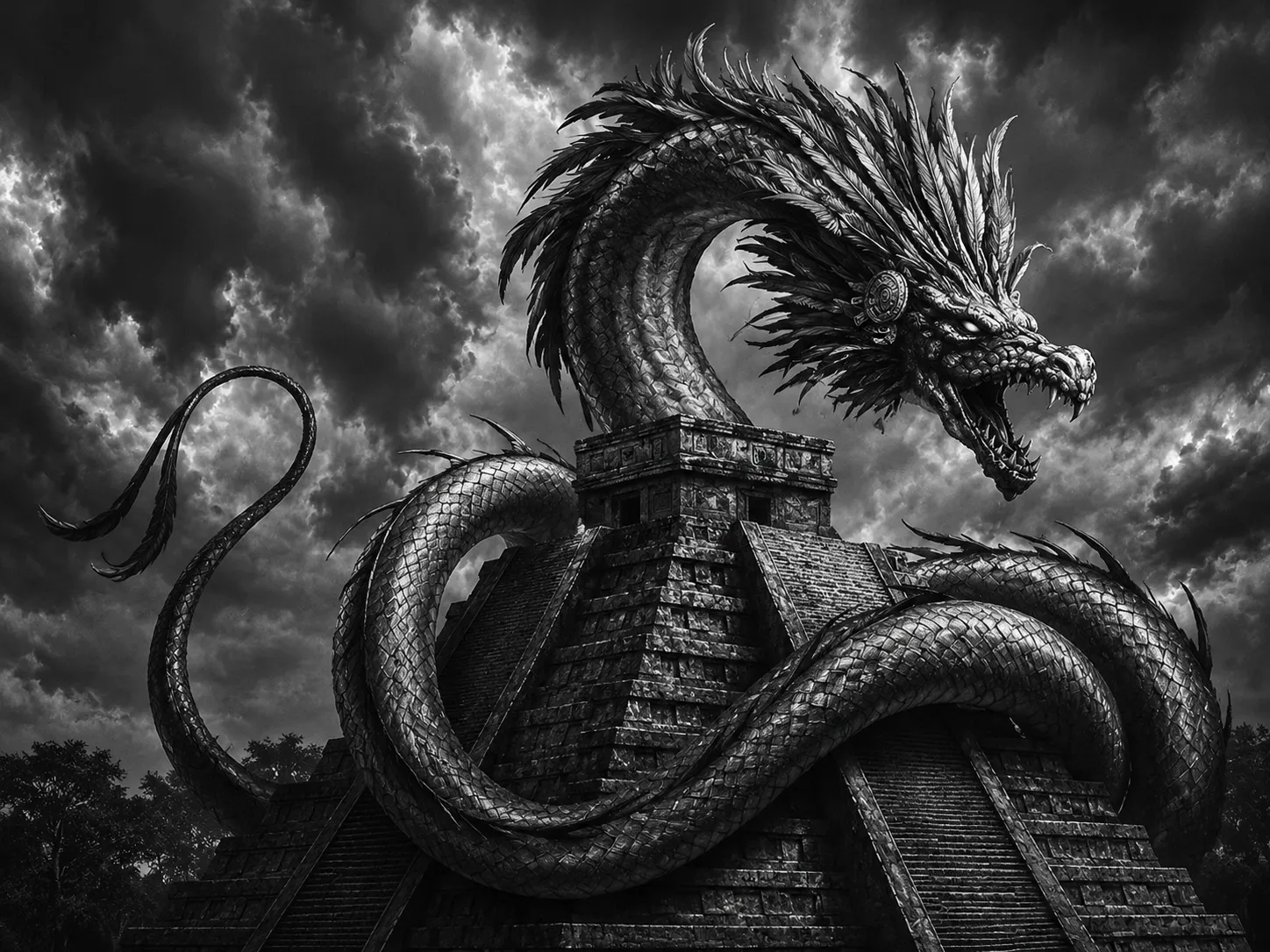
In his earliest animal form, as shown at Teotihuacan and Xochicalco, Quetzalcoatl appears as a huge rattlesnake covered with the shiny green tail feathers of the quetzal bird. The feathers are so thick that they create a living, rustling coat along his whole body.
His rattlesnake tail curves up behind him, and his large, fang-filled mouth is often shown open. In Mesoamerican art, this open mouth means he is showing divine power, not aggression. Sometimes, a human face looks out from his jaws, hinting that the serpent is both a carrier and a container of something deeper inside.
Over centuries, as his cult evolved through Toltec and then Aztec hands, Quetzalcoatl developed a parallel human form, portrayed as a bearded man — bearded in a region where indigenous men characteristically had sparse facial hair, a detail that later colonial-era mythographers seized upon with great interest.
In this anthropomorphic aspect, he wears a distinctive conical wind mask (a duck-billed mask associated with his Ehecatl form), a soot-blackened face, a curved turquoise mosaic ear pendant, and a spiral wind symbol on his costume, as described in the Florentine Codex with remarkable specificity. He also wore a conical ocelot-skin cap and was adorned with a gold necklace and spiral-shell pendants — the shell symbolizing the wind and the breath of life.
The lesser-known biological paradox embedded in his depictions is the shell motif: Quetzalcoatl is frequently shown carrying or wearing a cross-sectioned conch shell (ehecailacocozcatl, the “wind jewel”), whose spiraling interior, when cut, reveals a Fibonacci pattern. Mesoamerican priests associated this spiral directly with Quetzalcoatl’s breath — the idea being that wind, like the conch’s interior, is invisible but geometrically ordered, an organizing principle hidden beneath apparent chaos.
Modern video games and movies often show Quetzalcoatl as a fire-breathing winged dragon with a Mesoamerican look. But these versions miss an important detail: in original art, the feathers do not just decorate the serpent—they actually replace the scales in certain parts of the body. This shows that the creature is not just feathered, but is in the middle of changing between two forms.
Myths, Legends, and Stories
The narratives surrounding Quetzalcoatl are preserved across several distinct textual traditions: the Florentine Codex (compiled by Fray Bernardino de Sahagún circa 1577, drawing on Nahuatl informants in the decades after the Conquest), the Anales de Cuauhtitlan (a Nahuatl text compiled around 1570, which preserves the fullest surviving account of the Topiltzin cycle), the Leyenda de los Soles (circa 1558), the Codex Chimalpopoca, and various colonial-era indigenous chronicles such as the Historia Tolteca-Chichimeca. Together, these sources provide both the cosmic mythology of the god and the remarkably human tragedy of his earthly incarnation.
You may also enjoy:
Who Is Zagan, Hell’s Great Transformer?
May 28, 2025
The Lobizon Legend: Werewolf, Curse, or Cryptid?
May 17, 2025
Top 11 Most Haunted Houses in Delaware
December 1, 2025
The Creation of Humanity: The Bones of the Dead
One of the most remarkable Quetzalcoatl narratives concerns the creation of the current age of humanity. After the gods destroyed the previous world, the bones of the ancient dead lay in the underworld of Mictlan. Quetzalcoatl descended there, accompanied by his dog-headed companion Xolotl, to steal those bones back from Mictlantecuhtli, the lord of the dead.
Mictlantecuhtli agreed to surrender the bones — but placed an impossible condition. Quetzalcoatl had to walk the full circuit of the underworld while playing a conch shell horn. The problem was that the shell had no holes, making it impossible to play. Quetzalcoatl outsmarted the trap by commanding worms to bore holes in the shell and bees to enter it, thereby creating sound through an organic collaboration with the smallest creatures of the earth.
He gathered the bones and fled. Mictlantecuhtli, furious at the deception, sent quail to intercept him. In the chaos, Quetzalcoatl stumbled and fell, scattering and cracking the bones on the ground — which is why, the Leyenda de los Soles explains, human beings are all different in size and height. Back on the surface, Quetzalcoatl ground the broken bones into a paste and anointed them with his own blood drawn by piercing himself. From this mixture, the humans of the present world were formed.
Humanity, in this telling, is literally made of divine sacrifice and imperfect material — born broken, born from a god’s deliberate wound.
The Fall of Topiltzin: Tezcatlipoca’s Mirror
The most detailed and psychologically harrowing narrative in the Quetzalcoatl tradition is the fall of Topiltzin Ce Acatl Quetzalcoatl, preserved with extraordinary specificity in the Anales de Cuauhtitlan.
Topiltzin ruled Tula as both priest and king — celibate, devoted to fasting, opposed to human sacrifice, offering the blood of animals and his own body instead to the gods.
Under him, the sources describe Tula as an earthly paradise: corn grew to enormous size, cotton grew already colored in brilliant hues, and birds of incomparable plumage filled the city. He taught the arts of stonework, featherwork, and metallurgy, and his reign was understood as the high point of Toltec civilization.
Tezcatlipoca, the god of the night sky and obsidian sorcery, came to destroy him — not through open warfare but through psychological manipulation. He appeared before Topiltzin carrying a smoking mirror of black obsidian, his signature instrument of dark revelation. When Topiltzin looked into it, he saw his own face aged, profoundly lined, and decayed beyond recognition. Shattered by the vision of his own mortality, Topiltzin’s composure broke.
Tezcatlipoca then produced pulque — the fermented agave drink — and offered it to the priest-king with the claim that it would cure his sickness. Topiltzin refused four times. On the fifth offer, Tezcatlipoca gave him just enough to taste, and the taste broke his willpower. He drank a full cup, then four more. In his intoxicated state, he sent for his celibate sister — or, in some versions, a devoted celibate priestess — and broke his most fundamental vows.
When he came to himself again, Topiltzin understood that his sacred authority had been destroyed. He wept, composed lament songs, and began the preparations for his own exile. He burned his buildings, buried his treasury of jade and turquoise where it could not be found, transformed his brilliantly plumed birds into plain sparrows, and departed Tula with a retinue of followers.
His enemy, Tezcatlipoca, harassed him throughout the journey eastward to the Gulf Coast.
At a place called Tlapallan on the coast, accounts diverge sharply: some say he cremated himself, his heart rising from the pyre to become the morning star Venus; others say he spent eight days in the underworld before emerging as Venus; and yet another version, hard to ignore in its imagery, has that he built a raft from intertwined serpents and sailed east across the sea — his last recorded act a departure rather than a death.
The Darker, Forgotten Version: Cholula’s Accounting
While the Tula narrative is the most commonly told version of Quetzalcoatl’s fall, a regional tradition documented in connection with Cholula — the city that remained his most dedicated cult center through the post-Classic era — preserves a variation that complicates the simple “trickster tricks the virtuous king” reading.
In the Cholula tradition, the historical entity of Topiltzin Ce Acatl Quetzalcoatl arrives not as a native Toltec king but as a powerful outsider who imposes the cult of the feathered serpent on a city that had other religious commitments. The city’s existing priestly establishment, in this version, is what drives him out — making his exile less a cosmic moral fall and more a political assassination dressed in divine language.
This reading is supported by the archaeological evidence at Cholula itself, where layers of construction reveal competing religious authorities rather than a single unified devotion.
You may also enjoy:
Kikimora: The Nightmare-Weaving Spirit of Eastern Europe
September 11, 2025
Who Really Is Mephistopheles in the Faust Legend?
August 26, 2025
Who Was Apep, the Ancient Demon of Darkness?
August 16, 2025
Can You Defeat Quetzalcoatl? Powers & Weaknesses
Quetzalcoatl’s powers are not based on brute force, but on cosmic balance. Knowing this difference is key to understanding both what he can do and where he is truly vulnerable.
His most fundamental power is creative synthesis: Quetzalcoatl rules the wind (as Ehecatl), and in Aztec cosmological thinking, wind is not merely weather — it is the breath that animates existence, the invisible organizing principle that sweeps the paths clean for rain, prepares the earth for life, and gives direction to what would otherwise be random atmospheric chaos.
The Florentine Codex describes him as “the wind, the guide and road-sweeper of the rain gods.” His physical power over the elements is not an arbitrary supernatural force but a specific cosmic function: he is the transition state between absence and presence, the mechanism by which nothing becomes something.
His identity as the Venus deity adds a second axis of power. Because Venus, as the morning star, disappears from the sky for eight days before reappearing, and because Quetzalcoatl’s mythology explicitly maps onto this cycle — his death and resurrection mirroring the planet’s disappearance and return — he is simultaneously a deity of death and resurrection.
The astronomical encoding of his powers means his influence operates on a calendrical clock rather than an arbitrary supernatural whim. During the eight-day dark period of Venus, when the god is metaphysically “in the underworld,” his protective function over the living world is suspended.
His weakness, paradoxically, is built into the same structure that generates his strength: Quetzalcoatl is the god of self-sacrifice and purity of will, and his power is maintained precisely by the integrity of his priestly code. This is not merely a moral observation — it is a structural theological claim.
When Tezcatlipoca broke that integrity through intoxication and sexual violation of vows, Quetzalcoatl did not simply feel guilt. His divine authority literally collapsed because, in Mesoamerican religious logic, sacred power is not an external gift bestowed on a person — it is generated by the accumulation of disciplined ritual behavior. The moment the discipline breaks, the power dissolves.
The stories make it clear: Quetzalcoatl cannot be defeated as long as he follows his priestly duties and stays true to himself. No weapon or army can beat him. But if he loses his self-control, he is undone. A mirror and five cups of alcohol succeed where thousands of warriors fail. His greatest strength is also his greatest weakness.
The ritual logic that appears from this in the broader culture is equally remarkable: priests devoted to Quetzalcoatl practiced ritual bloodletting — piercing their own ears, tongues, and other body parts to offer their blood — not as cruelty, but as a conscious imitation of the god’s own logic of self-sacrifice as the engine of cosmic renewal. To approach Quetzalcoatl’s power, one had to replicate his mechanism of self-wounding on a generational scale.
Quetzalcoatl vs Other Monsters
| Creature & Lore | Danger Level | Details |
|---|---|---|
| Typhon (Greece) | Extreme. The “father of all monsters,” Typhon challenged Zeus himself and nearly seized control of Olympus before being buried under Mount Etna, where his writhing causes volcanoes and earthquakes. | Typhon fathered many of Greek mythology’s most famous monsters, including the Lernaean Hydra, Cerberus, and the Chimera, making him the single most prolific source of mythological terrors in Western tradition. |
| Apep / Apophis (Egypt) | Extreme. The serpent of chaos and darkness who attacks Ra’s solar barque every night as it travels through the underworld, threatening to extinguish the sun and end all existence. | Unlike most Egyptian deities, Apophis was never worshipped — his cult was exclusively one of ritual destruction, where priests would burn, spit on, and symbolically dismember his image each night to ensure sunrise. |
| Kukulkan (Maya, Yucatán) | Extreme. The direct Maya equivalent of Quetzalcoatl, governing creation, rulership, and cosmic order at Chichén Itzá, where his shadow descends the El Castillo pyramid staircase as a serpent during equinoxes. | The El Castillo pyramid at Chichén Itzá was architecturally engineered so that the triangular shadow pattern during the spring equinox creates the optical illusion of a feathered serpent descending its northern staircase — a feat of astronomical precision achieved without modern instruments. |
| Nüwa (China) | Severe. A serpentine creator goddess who repaired the sky after the pillar of heaven was broken, averting the end of the world; dangerous only when the cosmic order she sustains is threatened. | Nüwa is credited with creating humanity by molding figures from yellow clay, a mythological parallel to Quetzalcoatl’s own act of creating humans from bone paste anointed with his own divine blood. |
| Vritra (Hindu / Vedic) | Extreme. A colossal serpentine or dragon-like asura who dammed all the world’s rivers, causing a catastrophic drought across the earth until slain by the thunder-god Indra. | Vritra’s defeat by Indra in the Rigveda is one of the oldest recorded dragon-slaying myths in the world, appearing in texts dating to approximately 1500–1200 BCE — predating most comparable European dragon narratives by over a millennium. |
| Leviathan (Hebrew / Biblical) | Extreme. A primordial sea serpent of immeasurable scale is described in the Book of Job as a creature whose breath sets coals ablaze and whose chest is armored like overlapping shields that no weapon can penetrate. | Leviathan appears in both the Hebrew Bible and the Dead Sea Scrolls, where later apocalyptic texts describe it as being preserved until the end of days, when it will be slain and served as a feast for the righteous — an end reserved specifically for the Last Judgment. |
| Jörmungandr (Norse) | Extreme. The Midgard Serpent, offspring of Loki, encircles the entire earth beneath the ocean and holds its own tail in its mouth; when it releases its tail, Ragnarök begins and the world ends. | At Ragnarök, Jörmungandr and Thor are prophesied to kill each other simultaneously — Thor slays the serpent but then walks exactly nine paces before collapsing from its venom, making this the only recorded mythological duel in which both the god and the monster die. |
| Sobek (Egypt) | Severe. The crocodile-headed god of the Nile who could unleash the river’s destructive flooding, consume the dead, and sever limbs with his jaws; also a protective deity whose favor had to be cultivated through ritual. | Live crocodiles were kept in sacred pools at Sobek’s primary temple at Kom Ombo and adorned with gold earrings and bracelets — worshipped as living avatars of the god, then mummified upon death in rituals that produced thousands of crocodile mummies, many of which still exist. |
| Shenlong / Divine Dragon (China) | Severe. The celestial dragon responsible for generating rain and controlling weather; capable of causing devastating drought or catastrophic flooding if neglected, angered, or improperly honored through ritual. | Chinese imperial authority was explicitly tied to Shenlong’s favor — the Emperor held the title “Son of Heaven” in part because his legitimacy depended on maintaining proper ritual relationships with celestial forces, including the dragon, making royal failure literally read as divine abandonment. |
| Bakunawa (Philippines) | Extreme. An enormous sea serpent that periodically rises to swallow the moon, causing lunar eclipses; in some traditions, it has already swallowed six of the original seven moons, leaving only one. | Traditionally, lunar eclipses in the Philippines were attributed directly to Bakunawa’s swallowing, and communities would respond by making loud noises — banging pots, drums, and gongs — to frighten the serpent into releasing the moon before it could be permanently consumed. |
| Illuyanka (Hittite) | High. A powerful serpentine dragon who defeated the storm-god Teshub in their first encounter, stole his eyes and heart, and had to be defeated through mortal trickery rather than divine force — a rare case of a god requiring human assistance to win. | The myth of Illuyanka is one of the oldest recorded dragon narratives in the ancient Near East, preserved on cuneiform tablets from approximately 1400–1200 BCE, and is notable for being one of the earliest texts in which a god explicitly loses a fight to a monster. |
Why Quetzalcoatl Cannot Die
Quetzalcoatl’s survival over fifteen centuries and through at least six major civilizations is not just due to geography or conquest. It shows how the image of a feathered serpent—a creature that combines two impossible things—captures the human imagination as people contemplate the meaning of existence.
Every advanced Mesoamerican civilization faced the same question: how do you show a world that is both physical and spiritual, earthly and heavenly, mortal and divine? The feathered serpent answers this with one image.
It does not just talk about opposites—it combines them. A serpent cannot fly, and a bird cannot slither, but Quetzalcoatl does both. This is why he works so well as a symbol: he shows that our usual ways of dividing reality are not enough.
The historical tragedy of Topiltzin Ce Acatl Quetzalcoatl adds a second, more psychologically penetrating layer. He is a civilization’s ideal — the wise ruler who builds rather than destroys, who refuses human sacrifice in an era defined by it, who governs through knowledge and artistry rather than violence — and then he falls. Not to an enemy army, not to a natural disaster, but to his own interior weakness, triggered by a mirror and alcohol.
The Anales de Cuauhtitlan preserves the destruction of Tula not as a military defeat but as a moral collapse from the inside. That portrait of civilizational failure is so precise and so human that it reads less like mythology than like historical testimony.
What Cortés and his successors could never fully extinguish — what survives in the continued veneration of Quetzalcoatl’s imagery from Oaxaca to the Yucatán to Chicano muralism in the 20th century — is the underlying idea the god encodes: that the highest human aspiration is the synthesis of opposites, the creative reconciliation of sky and earth, of destruction and renewal, of the serpent that must shed its skin to survive and the bird that was born knowing how to rise.
The feathered serpent lasts because it is not just a symbol of the Aztecs, the Toltecs, or the people of Teotihuacan. It is a way of thinking—a way to imagine that things which seem impossible together can actually be united. When cultures faced the prospect of losing everything, they turned to this image. It still has power today.
You may also enjoy:
What Is Átahsaia, the Cannibal Demon of Zuni Mythology?
November 4, 2025
Alabama Sasquatch: Every Confirmed Hotspot, Mapped
April 18, 2025
Sowden House Haunting: L.A.’s Most Cursed Mansion
October 27, 2025
Who Is Flauros, the Demon Duke of Fire?
August 29, 2025
Semyaza: The Fallen Angel Suspended Between Heaven and Earth
September 29, 2025
Sources
- Bierhorst, John, trans. History and Mythology of the Aztecs: The Codex Chimalpopoca. University of Arizona Press, 1992.
- Karttunen, Frances. An Analytical Dictionary of Nahuatl. University of Oklahoma Press, 1992.
- Sahagún, Bernardino de. General History of the Things of New Spain (Florentine Codex). Translated by Arthur J. O. Anderson and Charles E. Dibble, School of American Research and University of Utah Press, 1950–1982.
- Taube, Karl A. The Temple of Quetzalcoatl and the Cult of Sacred War at Teotihuacan. RES: Anthropology and Aesthetics, vol. 21, 1992, pp. 53–87. Mesoweb.
- Norman, V. Garth. The Planet Venus as the Morning Star. Ancient America Foundation, 23 July 2024.
- Taube, Karl A. The Iconography of Toltec Period Chichen Itza. Hidden among the Hills: Maya Archaeology of the Northwestern Yucatan Peninsula, edited by Hanns J. Prem, Verlag von Flemming, 1994, pp. 212–46. Mesoweb, 2018.