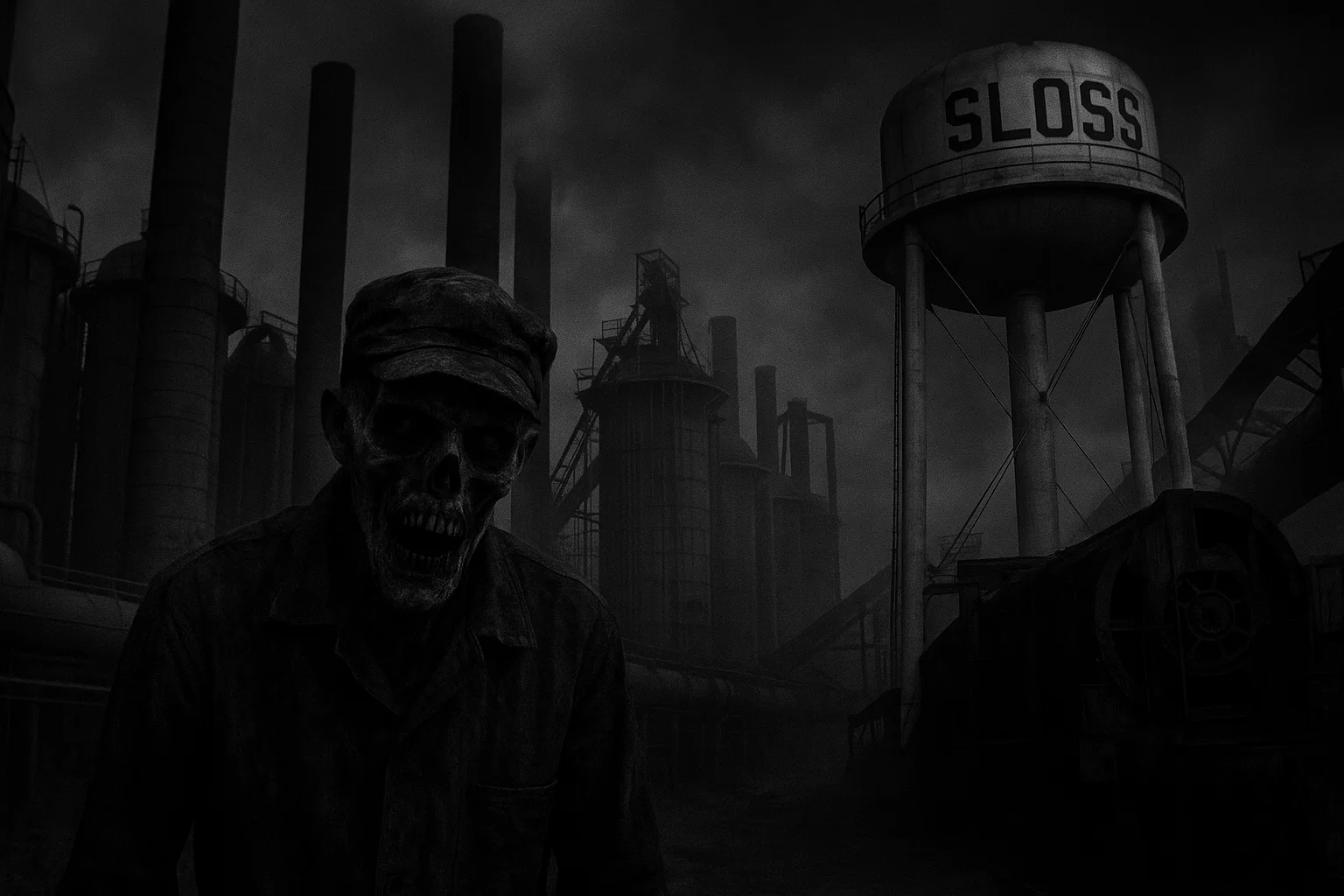
The Sloss Furnaces ghost has become one of the most talked-about legends in American paranormal lore, drawing ghost hunters, TV crews, and curious tourists to a rusting Birmingham, Alabama landmark long after its blast furnaces went cold.
What makes this place different from the average “haunted house” story is that its horror is from something undeniably real: nearly a century of brutal, often fatal working conditions, a body count of documented industrial accidents, and — as Sloss Furnaces itself has now publicly admitted — a legend that was partly manufactured to sell haunted house tickets.
So what actually happened at Sloss, who really died there, and which of the site’s famous ghost stories can be traced to real history rather than marketing?
Summary
Key Takeaways
| Attribute | Details |
|---|---|
| Name | Sloss Furnaces (also: Sloss Furnaces National Historic Landmark; associated entities marketed as “Slag” Wormwood and “Theophilus Jowers”) |
| THC Scale | L-4 [See the THC Scale Explanation] |
| Location / Origin | 20 32nd Street North, Birmingham, AL 35222, USA (approx. 33.5214° N, 86.7902° W) |
| Classification | Residual, Intelligent |
| History | Operated as a pig iron blast furnace 1882–1971; documented fatal accidents in 1882, 1892, and 1897; built on a history of segregated and convict-leased labor; closed 1971, preserved as a National Historic Landmark in 1981. |
| Casualties & Deaths | At least 47 confirmed worker deaths documented across the site’s history. No deaths are independently verified as caused by paranormal activity — the widely cited “47 deaths under Slag Wormwood” figure is unverified folklore, and Sloss Furnaces has publicly stated the Wormwood character was fabricated for a haunted house attraction. |
| Associated Entities | “Slag” Wormwood (likely fictional, per Sloss Furnaces’ own statement); the folklore figure associated with the name “Theophilus Jowers”; an unidentified shadow figure reported in the Blowing Engine Building |
| Manifestations | Auditory (footsteps, disembodied voices, banging), Visual (shadow figures, glowing humanoid shapes), Physical (pushes, scratches, being struck), Environmental (cold spots, EMF spikes reported by investigators) |
| First reported sighting | Folklore traces the earliest underlying incident to circa 1887 at the neighboring Alice Furnace; the first organized paranormal investigation of Sloss itself was conducted in 2005. |
| Recent reported sighting | Ongoing; most recently referenced in Alabama Public Radio’s October 2025 feature on the site’s ghost lore. |
| Threat Level | 3/10 (mildly threatening) [See the Threat Level Explanation] |
| HCR | 7/10 (Probably a hoax) [See the Hoax Confidence Rating Explanation] |
| Access Status | Yes — free self-guided tours Tuesday–Saturday 10 am–4 pm and Sunday 12 pm–4 pm; guided and seasonal night tours available for a fee; no independent paranormal investigations are currently bookable on-site. |
What Is the Sloss Furnaces Haunting?
The Sloss Furnaces haunting refers to decades of reported paranormal activity at the former Sloss Furnaces pig iron plant in Birmingham, Alabama, which operated from 1882 to 1971 and is now preserved as a National Historic Landmark and museum.
Visitors, night security staff, maintenance workers, and paranormal investigators have described shadowy human figures, mysterious footsteps, cold spots, unexplained pushes and scratches, moving objects, phantom voices, and self-opening doors throughout the site — particularly in the Blowing Engine Building, the oldest structure still standing at Sloss, built in 1902.
At least 47 workers are confirmed to have died at the ironworks site, in an era when the furnaces ran around the clock, and the work itself was extraordinarily hazardous. The haunting is generally attributed to the spirits of these workers, and two figures dominate the folklore above all others: a foreman known as “Slag” Wormwood, and a real historical figure whose death became the basis for the legend of “Theophilus Jowers.”
One of these stories has real roots in Alabama oral history. The other, according to a 2023 statement released by Sloss Furnaces itself, was invented to sell tickets to a now-closed haunted house attraction.
In that statement, a Sloss representative said the story of “Slag” Wormwood is not true, and that most of the reported hauntings of Sloss found online were fabricated to sell tickets to a haunted house attraction that ended in 2019. Untangling fact from marketing is the key to understanding what actually makes the site so unsettling.
You may also enjoy:
Zombie: Origins, Mythology, and Folklore
February 20, 2026
The Complete List of All Haunted Places in Arkansas
October 8, 2025
Who Is Hanbi? The Formless Demon of Ancient Mesopotamia
October 1, 2025
The Demon Megaera: Serpents, Blood, and Divine Vengeance
September 1, 2025
Top 5 Most Haunted Mirrors in the World
July 13, 2026
Real Deaths and Documented Accidents at Sloss Furnaces
Long before ghost tours existed, Sloss and its predecessor plants had a well-documented record of fatal accidents — some covered by contemporary newspapers, others preserved in academic histories of the Birmingham iron industry.
These incidents, independent of any ghost legend, form the historical backbone of the site’s dark reputation.
- The deaths of Aleck King and Bob May (November 1882). According to the academic history Sloss Furnaces and the Rise of the Birmingham District: An Industrial Epic by historian W. David Lewis, two Black laborers, Aleck King and Bob May, were lowered into the interior of Furnace Number One to clear ore and coke that had baked onto the brick walls. The material they dislodged fell into still-smoldering material in the hearth below, and the resulting smoke and gas overcame both men, who fell to their deaths. A crowd reportedly gathered afterward to view their remains. Their names are rarely mentioned in most modern retellings of Sloss’s ghost stories, even though their deaths are among the earliest documented fatalities at the site.
- A fatal scaffold collapse (February 4, 1892). The New York Times reported that a scaffold inside a newly erected hot blast stove at Sloss Furnaces collapsed, dropping eight men fifty-eight feet. Two workers, John Staton and John Richie, were killed instantly; five others were seriously injured, with the paper noting their injuries could prove fatal.
- A body found in a water tank (August 4, 1897). The New York Times, under the headline “Dead in a Furnace Tank,” reported that a boy discovered a badly decomposed body in a large water tank on the Sloss grounds. The victim was identified as Joseph F. Webb, a local Southern Railway painter last seen at a bar the night before. Because the furnace was reportedly out of his way from his usual route home, some of his friends suspected foul play, though this was never confirmed.
- A suicide at the neighboring Alice Furnace (November 1882). The same week King and May died, a worker named Samuel Cunningham is recorded to have taken his own life at the nearby Alice Furnace (a separate, earlier Birmingham ironworks, not Sloss itself) by climbing the hoist to the top of the furnace stack and jumping in.
- Convict labor deaths. Sloss and other Birmingham-district furnaces relied heavily on convict leasing — a system in which the state leased incarcerated laborers, disproportionately Black men, to private industry. Research into the period indicates mortality rates among leased convict laborers in Alabama’s mines and furnaces were extremely high, with cave-ins, disease, and brutal conditions killing workers at rates far above those of free laborers.
Several other frequently repeated accident stories — including an 1888 blowing-engine explosion said to have blinded six workers and a worker allegedly crushed in a cog wheel during a lunch break — appear in local paranormal research but have not been independently verified through contemporary newspaper archives, and should be treated as unconfirmed local legend rather than documented fact.
The Legend of Theophilus Jowers
Unlike the manufactured Wormwood legend, the ghost story now associated with the name “Theophilus Jowers” has real roots in Alabama folklore that predate Sloss’s life as a tourist attraction — though the story has clearly been altered in the retelling.
According to folklorist Dr. Alan Brown, in the late 1800s a worker was helping replace an old iron bell near one of the furnaces when disaster struck. While attempting to lower the heavy bell into the molten iron to be melted down, he lost his balance near the boilers, the rope slipped from his grasp, and he was pulled into the furnace along with the bell.
Historical research into the underlying incident suggests the real man behind the legend may have been named Richard Jowers, who reportedly died in a similar fall at the Alice Furnace on September 9, 1887 — not at Sloss itself, since Sloss’s oldest surviving building dates only to 1902.
The now-famous name “Theophilus Calvin Jowers” appears to originate from a 1978 book, The Ghost in the Sloss Furnaces, by celebrated Alabama folklorist Kathryn Tucker Windham, who is credited with popularizing (and possibly fictionalizing the name of) the story for a wider audience.
According to Windham’s account, the dying man had vowed to his wife that as long as there was a furnace standing in the country, he would be there, and — as the story goes — his spirit kept that promise, allegedly relocating from the Alice Furnace to Sloss after Alice was dismantled. Windham’s book recounts a family story in which Jowers’ son reportedly saw his late father’s ghost walking through the flames of the furnace while showing his own son the mill where his grandfather had worked.
This is a case where information tends to get flattened online: many sites present “Theophilus Jowers” as an established historical figure with a documented biography, when the more accurate picture is that a real, but only loosely documented, 1887 furnace death was later folded into a folklore tradition and given a literary name by a folklorist writing nearly a century later.
You may also enjoy:
Eloko: The Tiny Forest Cryptids That Kill Without Warning
February 3, 2026
Andras in the Ars Goetia: The Great Marquis of Discord
April 28, 2025
Honey Island Swamp Monster: The Cajun Sasquatch of Louisiana
September 25, 2025
Kikimora: The Nightmare-Weaving Spirit of Eastern Europe
September 11, 2025
“Slag” Wormwood: The Ghost Story Sloss Furnaces Says It Invented
No name comes up more often in connection with the Sloss Furnaces ghost than James “Slag” Wormwood — a supposedly sadistic graveyard-shift foreman said to have driven dozens of workers to their deaths through reckless overwork before being killed by his own men, either pushed or accidentally falling into a furnace called “Big Alice” around 1899 or 1906, depending on the version of the story.
This is, by Sloss Furnaces’ own account, fiction. Sloss Furnaces released a statement clarifying that the story of James “Slag” Wormwood is not true, and that while it is a fascinating story in its own right, the Wormwood legend and most of the reported hauntings of Sloss found online were fabricated to sell tickets to a haunted house attraction.
That attraction, called Sloss Fright Furnace, ran from 1997 to 2019 and drew more than one million visitors to Birmingham over its run, appearing in at least twelve national television and cable broadcasts as well as USA Today and other national publications before it closed.
Some research into the character’s origins suggests Wormwood was loosely built on top of the real death of a worker at the Alice Furnace — meaning the character may be a fictionalized hybrid of the very real Jowers-adjacent incident and the site’s genuinely brutal graveyard-shift conditions, repackaged into a single villain for haunted-house storytelling.
Despite Sloss’s own debunking, the Wormwood character has taken on a life independent of the facts: he remains the most commonly cited figure in modern ghost stories about the site, and is often blamed by name for reported shoves, scratches, and the phrase “get back to work” or “push some steel” allegedly heard by visitors and staff.
Documented Sightings and Paranormal Investigations
Unlike many “haunted” locations where the evidence is mostly secondhand, Sloss Furnaces has an unusually long paper trail of specific paranormal investigations and named witnesses, spanning two decades.
- First formal investigation (2005). According to paranormal researchers, the first organized investigation of Sloss took place in 2005, when the Kentucky-based group Ghost Chasers International visited the site — despite the location’s reputation, no formal paranormal investigation had reportedly been conducted there before that year.
- Oxford Paranormal Society investigation (September 14, 2007). This investigation was important because outside media documented it: the team was accompanied by a reporter and two photographers from the Birmingham News. Investigators placed four stationary infrared cameras at the catwalks and entrances, split into three groups, and recorded EVP (electronic voice phenomena) sessions. No visual evidence was captured, but the team reported recording a voice near a plaque commemorating Theophilus Jowers, and described three questions being “answered” by a loud banging sound during the session.
- G.H.O.U.L. Alabama investigation (May 2008). A separate paranormal research group conducted a daytime investigation focused on EVP work. While the group did not capture usable audio evidence, multiple investigators independently reported hearing the same strange female voice at the same moment. They separately described hearing unexplained footsteps approaching near the boiler room and smokestacks that did not register on any recording device.
- Ghost Adventures, Season 1 (2008). The Ghost Adventures crew — Zak Bagans, Nick Groff, and Aaron Goodwin — filmed a dusk-to-dawn lockdown investigation at Sloss Furnace for the Travel Channel series’ first season, one of the earliest nationally televised paranormal investigations of the site.
- Ghost Adventures: Aftershocks (2015). Bagans returned to Sloss for a follow-up segment in which he said he witnessed what he described as compelling evidence of a possession at the site.
- Staff and visitor accounts. Longtime maintenance staff, including a security worker identified in interviews as Ron Bates, have described repeatedly catching the shape of a man out of the corner of their eye in the Blowing Engine Building — a figure that vanishes whenever they turn to look directly at it — along with objects that are moved between rooms and doors that open and close with no one present. Paranormal investigator Kevan Walden has separately described being struck across the face by an unseen force while exploring the tunnels alone, leaving a visible mark.
- Older, less-verified claims. Local paranormal research also references older, harder-to-verify incidents passed down informally at the site: an injured watchman reportedly said he was pushed from behind in 1926; three supervisors were reportedly found knocked unconscious inside a boiler room in 1947; and in 1971, near the very end of the plant’s operating life, a night watchman is said to have reported a violent encounter with an unidentified entity, after which he was found with severe burns despite the furnaces being cold. These accounts appear only in secondhand paranormal research rather than contemporary news coverage, and should be read as local lore rather than confirmed incidents.
As of recent years, Sloss Furnaces does not offer bookable overnight paranormal investigations to the public the way it did during the Fright Furnace era; most ghost-related access today comes through seasonal night tours run by the museum itself rather than independent paranormal teams.
You may also enjoy:
Shax: The Deceptive Demon Marquis of Hell
August 28, 2025
Poveglia Island: The Most Cursed Island in Europe?
December 10, 2025
Complete Guide to Wisconsin Bigfoot Sightings (1867–2025)
August 10, 2025
Who is the Demon Zepar in Ars Goetia? Powers and Myths
August 11, 2025
From Abandoned Ironworks to National Historic Landmark
The building’s transformation from a working furnace to a haunted tourist attraction is itself part of the story. After the Jim Walter Corporation closed the furnace in 1971, it donated the property to the Alabama State Fair Authority for possible redevelopment as a museum. Still, the vacant plant sat abandoned long enough for an architects’ group to publicly label it “an eyesore and a health hazard.”
By 1976, the State Fair Authority had actually determined that redevelopment wasn’t feasible and moved toward demolishing the furnaces — a plan that was stopped only after local preservationists formed the Sloss Furnace Association to lobby for the site’s survival.
In 1981, the furnaces were designated a National Historic Landmark by the United States Department of the Interior, and the site opened to the public on Labor Day weekend, 1983, as the nation’s first and only twentieth-century blast furnace site preserved as a museum. For over two decades, its haunted reputation was amplified by Sloss Fright Furnace. The seasonal haunted house ran from 1997 to 2019 and is directly responsible for popularizing the Wormwood legend nationally.
What’s Changed Recently
The most significant recent development in the Sloss Furnaces ghost story isn’t a new sighting — it’s an official correction. In a public statement, Sloss Furnaces said directly that these stories “should be, and are more interesting when, based in fact in order to give an accurate representation of Sloss to the public.”
The organization has been explicit that the haunted house attraction, not documented history, is the true source of most of the specific “Slag Wormwood” claims that dominate ghost-tour websites and YouTube videos today.
This matters for anyone researching the topic now, because it means the most widely repeated version of the Sloss ghost story — complete with a named villain, a specific death date, and a body count directly attributed to him — is acknowledged by the site’s own stewards as promotional fiction layered on top of a real, tragic labor history.
The genuinely documented material — the 1882, 1892, and 1897 deaths, the site’s convict-leasing and segregation history, and the more loosely sourced Jowers/Alice Furnace legend — represents a smaller but more historically grounded set of stories than most competitor coverage acknowledges.
Sloss Furnaces vs Other Haunted Industrial and Institutional Landmarks
Sloss belongs to a specific niche of haunted attraction: a preserved, publicly touchable industrial or institutional ruin with a real death toll, a National Historic Landmark or equivalent designation, and a folklore layer added on top of that history.
| Name | Location | Type of Haunting | Activity Level |
|---|---|---|---|
| Carrie Blast Furnaces | Rankin, Pennsylvania, USA | Residual | 4/10 (occasional) |
| Bethlehem Steel Stacks | Bethlehem, Pennsylvania, USA | Residual | 3/10 (dormant) |
| Scranton Iron Furnaces | Scranton, Pennsylvania, USA | Residual | 3/10 (dormant) |
| Eastern State Penitentiary | Philadelphia, Pennsylvania, USA | Intelligent, Poltergeist | 8/10 (very active) |
| West Virginia Penitentiary | Moundsville, West Virginia, USA | Poltergeist, Intelligent | 7/10 (very active) |
| Ohio State Reformatory | Mansfield, Ohio, USA | Intelligent, Shadow People | 8/10 (very active) |
| Old Idaho Penitentiary | Boise, Idaho, USA | Intelligent, Residual | 6/10 (occasional) |
| Waverly Hills Sanatorium | Louisville, Kentucky, USA | Intelligent, Demonic (claimed) | 9/10 (very active) |
| Trans-Allegheny Lunatic Asylum | Weston, West Virginia, USA | Intelligent, Shadow People | 8/10 (very active) |
| Pennhurst Asylum | Spring City, Pennsylvania, USA | Intelligent, Poltergeist | 7/10 (very active) |
| Central State Hospital | Milledgeville, Georgia, USA | Residual, Intelligent | 5/10 (occasional) |
| Preston Castle | Ione, California, USA | Intelligent, Residual | 6/10 (occasional) |
| Bobby Mackey’s Music World | Wilder, Kentucky, USA | Demonic (claimed), Intelligent | 7/10 (very active) |
| Lonaconing Silk Mill | Lonaconing, Maryland, USA | Residual | 3/10 (dormant) |
Is Sloss Furnaces Actually Haunted?
There’s no way to definitively prove or disprove the Sloss Furnaces ghosts — that’s true of every reportedly haunted location.
What sets Sloss apart is that its ghost stories sit on top of real, well-documented industrial history: real deaths recorded by contemporary newspapers, a real convict-leasing and segregation system, and a workforce that persisted in conditions most modern visitors would find unimaginable.
At the same time, Sloss Furnaces itself has publicly stated that its most famous villain, “Slag” Wormwood, and most of the specific haunting claims that circulate online were invented to promote a haunted house that closed in 2019. The Jowers legend has more genuine folklore roots, tracing back to a real, if loosely documented, 1887 furnace death and a folklorist’s 1978 book — even if the popular version has been altered along the way.
Whether you find the catwalks of the Blowing Engine Building genuinely unsettling or simply atmospheric, Sloss Furnaces remains a rare thing: a place where you can walk through ninety years of real, sometimes brutal industrial history and decide for yourself how much of what’s said to linger there is memory, and how much is marketing.
You may also enjoy:
Buné: Demon King of Riches and Necromancy
August 12, 2025
Who Is Pazuzu? The Terrifying Demon of Mesopotamia
August 26, 2025
Auvergne Werewolf: Real Curse or Witch Hunt?
June 19, 2025
Tanuki Yokai: The Mischievous Spirit with Disturbing Powers
September 9, 2025
Sources
- Windham, Kathryn Tucker. The Ghost in Sloss Furnaces. Birmingham Historical Society, 1978.
- Lewis, W. David. Sloss Furnaces and the Rise of the Birmingham District: An Industrial Epic. University of Alabama Press, 1994.
- Barefield, Marilyn Davis. A History of Mountain Brook, Alabama & Incidentally of Shades Valley. Southern University Press, 1989.
- Committee for the Humanities in Alabama. Like It Ain’t Never Passed: Remembering Life in Sloss Quarters. Sloss Furnaces National Historic Landmark, 1985.
- Cruikshank, George M. A History of Birmingham and Its Environs. The Lewis Publishing Company, 1920.
- Convict-Lease System. Encyclopedia of Alabama. Retrieved on July 1, 2026.
- History of Sloss Furnaces. Sloss Furnaces Foundation. Retrieved on July 1, 2026.