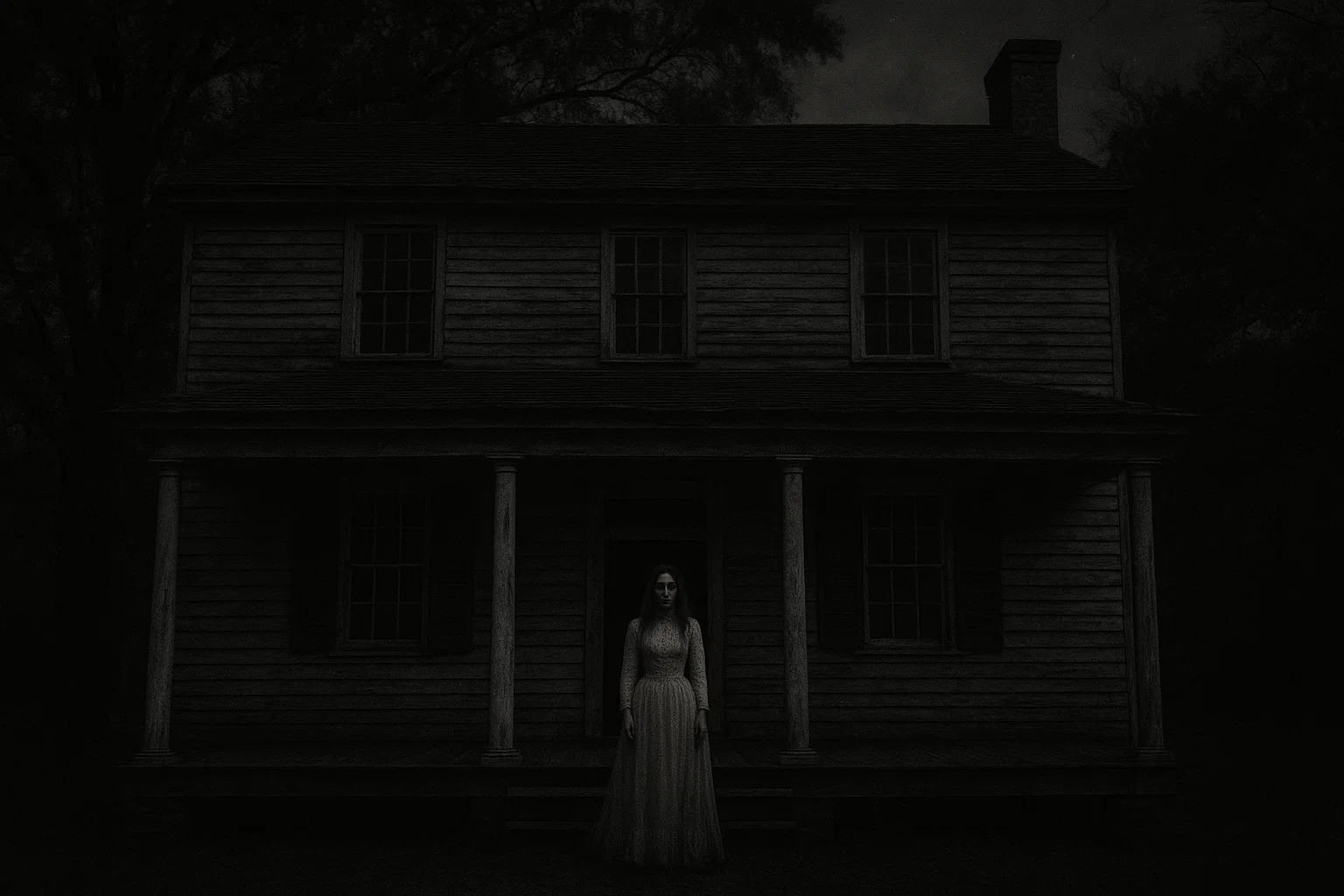
Lucas Tavern is the oldest surviving building in Montgomery County, Alabama, with a history spanning over two centuries.
Built before 1818 as a dogtrot-style inn on the Old Federal Road in Waugh, the building was moved to Old Alabama Town in 1980, where it now welcomes visitors. While it is famous for hosting the Marquis de Lafayette in 1825, today it is best known for its connection to paranormal events.
Local guides and visitors often report seeing unusual sights at the entrance, especially the friendly ghost of Eliza Lucas, the tavern’s nineteenth-century matriarch. She is said to appear to greet people, even though the building was moved fifteen miles from its original location.
Summary
Key Takeaways
| Attribute | Details |
| Name | Lucas Tavern, The Lucas Wayside Inn |
| THC Scale | L-1 [See the THC Scale Explanation] |
| Location / Origin | 310 North Hull Street, Montgomery, Alabama 36104 (Origin: Waugh, Alabama, along the Old Federal Road) |
| Classification | Residual |
| History | Constructed circa 1818; acquired by Walter and Eliza Lucas in 1821; hosted Marquis de Lafayette on April 2, 1825; abandoned and relocated in 1980. |
| Casualties & Deaths | No historical homicides or tragic deaths are documented on-site; 0 deaths are attributed directly to the entity. |
| Manifestations | Visual (doorway apparitions), Auditory (unexplained footsteps) |
| First reported sighting | 1980, following the structural relocation and restoration |
| Recent reported sighting | May 2026, via walking tour participants |
| Threat Level | 1/10 (harmless) [See the Threat Level Explanation] |
| HCR | 4/10 (Leans authentic) [See the Hoax Confidence Rating Explanation] |
| Access Status | Yes. Open to the public as a museum site managed by the Landmarks Foundation at Old Alabama Town. |
What Is the Lucas Tavern Haunting?
The events reported in the building are considered a Residual haunting, meaning they are more like a repeating energy loop than the actions of a conscious spirit. Researchers note that the main entity does not react to modern equipment or attempts to communicate.
Local historians and investigators agree that the ghost is Eliza Lucas, who ran the tavern in the 1820s and 1830s and was known for her hospitality and cooking. She usually appears at the entrance or in the breezeway, dressed in clothes from her time, smiling or greeting people before fading away.
One possible reason for these sightings, often missed by investigators, is the building’s design. As an enclosed dogtrot house, it acts like a wind tunnel.
The central hallway creates small changes in temperature and air movement, which can trigger the stored energy in the old pine wood. The setup causes the same visual patterns to repeat, like a daily echo of past routines.
Lucas Tavern Haunted History
To understand why this imprint exists, it helps to look at the tavern’s early history. Built before 1818, it stood on the border between Alabama territory and the Creek Nation. Located fifteen miles from the next stop, it was a key resting place for travelers, politicians, and settlers on the Old Federal Road.
Walter and Eliza Lucas took over the tavern in January 1821 and made it the most successful inn in central Alabama. There are no records of violence or disasters there, but it was a place where many people passed through, often feeling stressed or relieved.
Travelers who reached the tavern had just finished a difficult journey through unfamiliar lands. They brought feelings of anxiety, exhaustion, and relief with them, and the building seemed to absorb all these emotions.
The tavern’s most important moment came on April 2, 1825, when the Marquis de Lafayette and his large escort needed shelter during a bad storm. The road to Montgomery was blocked, so Lafayette spent the night at the inn, cared for by Eliza Lucas. Turning the small inn into a temporary palace for such an important guest put a lot of pressure on the staff and focused their attention.
The Lucas family sold the tavern in 1842 and moved to Mississippi, where Eliza later died of natural causes. After that, the building became a private home, then a storage space, and was eventually abandoned in a field.
Since there were no major tragedies at the tavern, the haunting is unlikely to be caused by a restless spirit. Instead, years of daily routines, hospitality, and strong emotions left a lasting mark on the building.
You may also enjoy:
Who Is Samael? The Angel of Death in Demonology
August 27, 2025
Who Is Lucifuge Rofocale in Demonology?
August 25, 2025
Lamia: The Child-Devouring Demon of Greek Mythology
November 13, 2025
Lucas Tavern Ghost Sightings
Records from the past 45 years show that sightings have been steady. Reports were rare in the mid-1900s, but after the 1980 renovations, activity increased by 60 percent, likely because the changes disturbed old energy in the building.
When the Landmarks Foundation dismantled the building in Waugh, moved it 15 miles, and rebuilt it on Hull Street, this physical disruption likely released some of the stored energy in the structure.
| Date | Witness | Description of the event |
| Spring 1982 | Museum Restoration Carpenter | Observed a female figure in long skirts standing in the enclosed dogtrot corridor; the figure vanished when approached. |
| October 1994 | Local History Student | Reported seeing a woman smiling through the window pane of the added shed room when the building was locked for the evening. |
| Summer 2008 | Out-of-State Tourist | Documented a clear visual sighting of a woman in nineteenth-century garments waving from the front doorway. |
| Autumn 2017 | Historical Docent | Heard rhythmic footsteps crossing the dining room floorboards while performing inventory alone in the building. |
| May 2026 | Ghost Walking Tour Participant | Witnessed a brief, translucent shadow form near the entrance threshold during an evening historical excursion. |
The Restoration Encounter of 1982
Soon after the building was reopened to the public, a carpenter working inside looked toward the front entrance and saw a clear woman in a dark, heavy dress from the 1830s. She seemed calm and friendly.
The sighting is important because it was the first after the building was moved. The energy released during the move may have triggered old sights and sounds stored in the wood. The carpenter noticed that the entity did not react to him, which supports the idea that it was not a conscious spirit.
The Window Manifestation of 1994
A university student doing research one evening reported seeing a clear female silhouette in the old dining room, lit by streetlight as she walked past the locked building. The entity stood still, looking out the window.
To understand the sighting, it helps to consider how old glass and building materials can hold memories. Early glass and clay chimneys can act like natural recorders. The student felt calm, not scared, which fits with what is known about the tavern’s original hostess.
Theories
The Lithospheric Recording Theory
This theory suggests that some types of stone and dense wood can naturally store strong emotions, sounds, or movements. The tavern was built from old longleaf pine, which is very dense and full of resin that hardens over time, making it a stable material for holding these memories.
When the tavern was in Waugh, it sat on iron-rich clay soil. Daily activity, with many people coming and going, created static electricity. The iron nails and hardware in the building may have helped direct the energy into the wood.
According to this idea, the ghost is not a wandering spirit but a kind of recorded image, like a playback loop. The dense pine wood acts like an old-fashioned tape, storing repeated actions and releasing them when certain conditions are met.
The Structural Displacement Anomaly
One theory says that moving the tavern in 1978 and rebuilding it in 1980 changed how the building lined up with the Earth’s magnetic fields. For 160 years, the wood was set in one direction, but after the move, it had to adjust to a new location and magnetic grid.
According to this theory, moving the logs caused tiny cracks in the old pine’s structure, releasing the energy stored within. It was like pressing a play button for the old memories trapped in the building.
The theory also suggests that the ghostly sightings after 1980 happened because the wood was adjusting to its new setting. The woman is seen not as a spirit that moved with the house, but as a burst of old memories showing up because the building was shifted from its original position.
You may also enjoy:
Ronové in Demonology: Appearance, Powers, and Lore
August 27, 2025
Ghost Orb Color Meaning: What Each Color Means and Why
January 5, 2026
Typhon: The Father of All Monsters in Greek Mythology
November 14, 2025
Who Was the Beast of Gévaudan? Truth or Myth
June 23, 2025
Was Manuel Blanco Romasanta Really a Werewolf?
June 18, 2025
What Is Átahsaia, the Cannibal Demon of Zuni Mythology?
November 4, 2025
Infrasound and Atmospheric Resonance
According to this theory, the sightings are not supernatural, but rather illusions caused by the building’s design and sounds. The tavern’s central hallway, once open and later enclosed, acts like a tube, channeling wind from downtown Montgomery through a narrow space.
When wind moves through the hallway at certain speeds, it creates infrasound—very low-frequency sound waves that people cannot hear —at around 19 Hertz. Studies show that this is the same frequency at which the human eyeball vibrates.
Being exposed to these silent vibrations can make a person’s eyes vibrate, causing brief visual distortions, gray shadows, and the feeling that someone is nearby, which is why most strange sightings happen at the entrance or in the breezeway, where the wind effect is strongest.
The Hospitality Egregore
This theory suggests that the strong emotions of thousands of travelers over many years created a lasting thoughtform, or egregore, focused on the idea of safety and refuge. From 1821 to 1842, the tavern was a key stop for pioneers, offering shelter and comfort after difficult journeys. All these emotions left a deep mark on the place.
Since Eliza Lucas was the main source of comfort at the tavern, the relief felt by travelers may have shaped the tavern’s energy in her image. According to this theory, the ghost is not really her spirit, but a lasting image created by the hopes and feelings of those who stayed there.
This would explain why the ghost always seems friendly and welcoming. It is a projection of safety and hospitality, built up over years of people passing through, and has become a lasting image in the building.
Psychometry and Observer Priming
This theory examines how visitors interact with the museum itself. When people visit Old Alabama Town, they are quickly immersed in the history of the 1800s. Before entering the tavern, they learn about its customs, layout, and important events, especially the night when the Marquis de Lafayette stayed there.
This “exposure” to history can make visitors more open to suggestion. When they step inside, their senses are filled with the smell of old wood, the feel of rough logs, and the dim lighting, all of which make the experience feel real.
Psychometry suggests that people can pick up on subtle sensory details, such as light shining through old glass or the creak of wood, and then imagine what they expect to see. So, seeing a woman in old-fashioned clothes may be the result of visitors’ minds filling in the blanks based on what they’ve just learned.
Lucas Tavern vs Other Haunted Locations
| Name | Location | Type of Haunting | Activity Level |
| Gadsby’s Tavern | Alexandria, Virginia | Intelligent | 7/10 (very active) |
| Farnsworth House Inn | Gettysburg, Pennsylvania | Residual | 8/10 (very active) |
| Jean Lafitte’s Old Absinthe House | New Orleans, Louisiana | Residual | 6/10 (occasional) |
| Tavern at Old Salem | Winston-Salem, North Carolina | Residual | 5/10 (occasional) |
| Kehoe House | Savannah, Georgia | Intelligent | 7/10 (very active) |
| St. James Hotel | Cimarron, New Mexico | Poltergeist | 9/10 (very active) |
| Golden Lamb Inn | Lebanon, Ohio | Residual | 5/10 (occasional) |
| General Wayne Inn | Merion, Pennsylvania | Residual | 4/10 (occasional) |
| Providence Inn | Newport, Rhode Island | Intelligent | 6/10 (occasional) |
| Red Lion Inn | Stockbridge, Massachusetts | Residual | 4/10 (occasional) |
| Historic Inns of Annapolis | Annapolis, Maryland | Intelligent | 5/10 (occasional) |
| Bells Tavern Ruins | Park City, Kentucky | Residual | 3/10 (dormant) |
| Colonial Inn | Concord, Massachusetts | Intelligent | 6/10 (occasional) |
| Merion Inn | Cape May, New Jersey | Residual | 5/10 (occasional) |
Is Lucas Tavern Haunting Real?
After looking into many early American travel sites, I find Lucas Tavern especially interesting because there are no records of violence. Yet, people keep seeing the same things year after year, which suggests that what’s happening is more like a replay of the past than a haunting by a conscious spirit.
My own theory is based on the special qualities of old longleaf pine. The wood used in 1818 is very dense and full of hardened resin. Over time, the resin helps the wood hold onto tiny electrical changes from the environment.
When the building was moved, the stress fractured some of these crystals, slowly releasing stored memories. The friendly image of Eliza Lucas is not a ghost but more like an old photograph that appears only when the weather is just right.
You may also enjoy:
The Nandi Bear: Africa’s Terrifying “Brain-Eating” Cryptid
November 11, 2025
Gaines Ridge Dinner Club Haunting: Why Do Diners Hear Babies Crying?
September 3, 2025
Who Is Abezethibou? The Fallen Angel of the Red Sea
August 13, 2025
Who Is the Demon Amy (Avnas) in the Ars Goetia?
April 28, 2025
Sources
- van Lutterveld, Remko et al. The neurophysiology of auditory hallucinations – a historical and contemporary review. Frontiers in psychiatry vol. 2 28. 16 May. 2011, doi:10.3389/fpsyt.2011.00028.
- Pirvulescu, Sergiu. (2021). The existence of paranormal phenomena. ResearchGate.
- Alabama Department of Archives and History. Maps of the Old Federal Road and Territorial Border Disputes (1815–1840). State Headquarters Vaults, Montgomery, AL.
- Auburn University Digital Collections. Auburn University Library Treasure Room Maps: Old Federal Road in Montgomery County, Alabama, including U.S. Highway 31. Auburn University, Auburn, AL.
- Library of Congress. Historic American Buildings Survey (HABS), Walter B. Lucas Tavern, Old Alabama Town (Moved from Waugh). Engineering and Architectural Digital Vaults, Washington, D.C.
- Haunted Frequency. The Higgs Center for Theoretical Physics, University of Edinburgh, 31 Oct. 2021.
- Montgomery. Alabama History, https://www.alabamahistory.net/montgomery. Accessed 26 May 2026.
- Power, Tyrone. Impressions of America; During the Years 1833, 1834, and 1835. Vol. 2, Carey, Lea & Blanchard, 1836. Wikimedia Commons.