If you enjoy gothic horror stories filled with psychological suspense and rich history, ‘Edward Mordrake’ offers a chilling survival tale. Set in Victorian England, it follows the story of a cursed twin, deep loneliness, and a tragic fall into madness. This horror story is perfect for readers who like body horror, dark family secrets, and slow-building psychological tension.
| 👁️ Title | Edward Mordrake |
| 🪶 Author | Razvan Radu |
| 🪦 Genre | Gothic Horror |
| 🏷️ Themes | Parasitic Twin, Cursed Heir, Isolation, Descent into Madness, Victorian England, Dark Family Secrets |
| ⏳ Read Time | ~14 minutes |
| ☠️ Warnings | Severe psychological torment, Animal cruelty, Self-harm, Intense paranoia |
| 📜 The Lore | A grim historical tragedy exploring the dark, supernatural manifestations behind the medical anomaly of a parasitic twin. |
| 🎬 The Scoop | Trapped within his foggy estate, a wealthy Victorian heir desperately fights to protect his loved ones from the malicious whispers of a second face on the back of his head that grows increasingly hungry for blood. |
Summary
Chapter 1: The Cursed Heir
Mordrake Manor stood on the misty edge of London, its gothic spires lost in the constant fog of 1872. The old stone walls, worn by time, were covered in thick ivy that seemed to move in the dim light, making the house feel almost alive.
The air smelled of coal smoke mixed with the damp scent of rotting autumn leaves that covered the overgrown gardens. Inside, the manor’s long corridors had oak-paneled walls that seemed to swallow the light from gas lamps and the quiet creak of the floorboards.
Candelabras let wax drip onto the marble floors, their flickering light casting shaky shadows. The house was full of secrets, but none was darker than Edward Mordrake’s.
At twenty-two, Edward was the only heir to the Mordrake fortune, built from railways, colonial trade, and smart investments. With sharp cheekbones, blue eyes, and chestnut curls, he could have been popular in London’s high society, attending balls and operas.
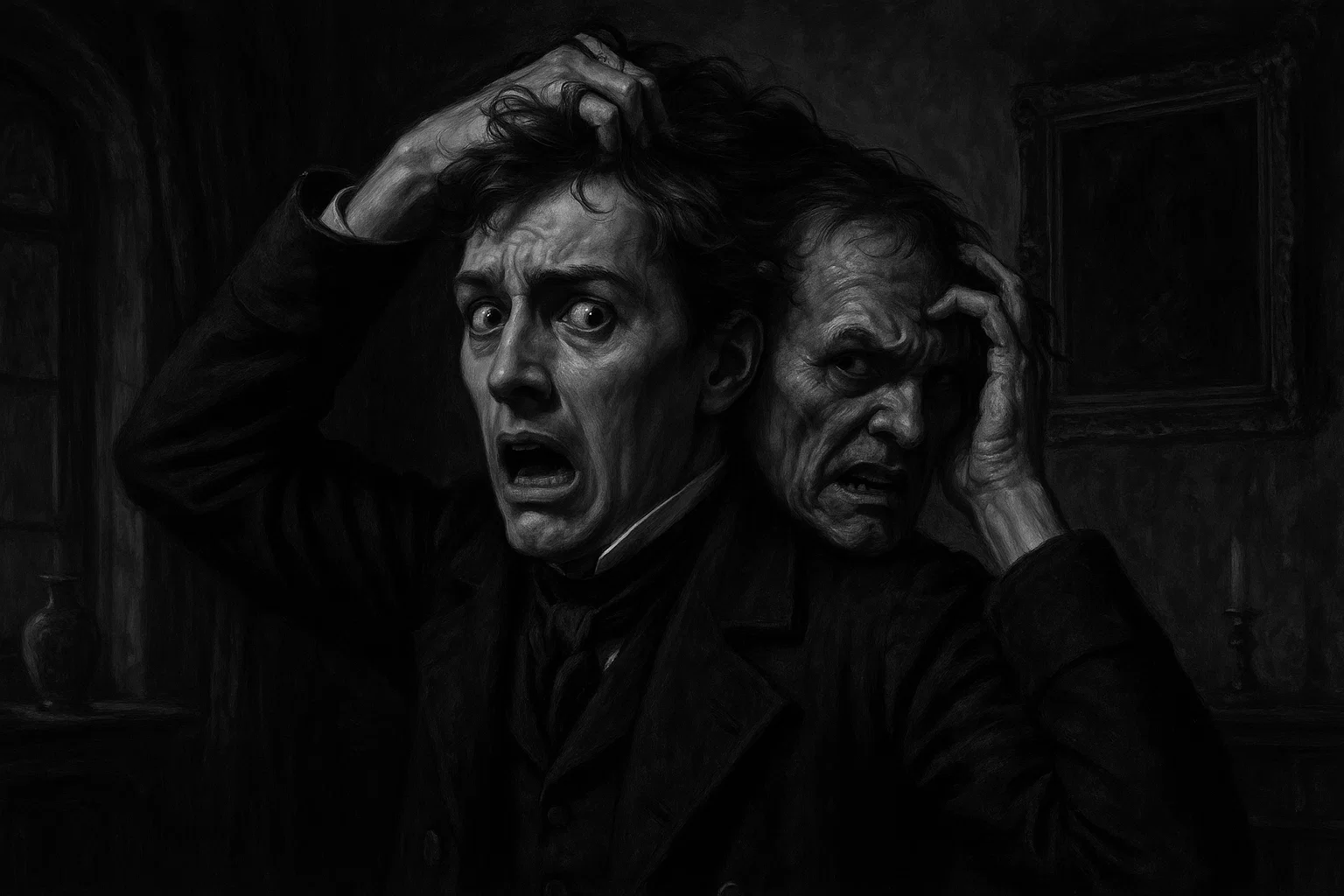
But Edward was trapped, forced to stay in the manor’s dark halls by a secret so disturbing it shaped his whole life. On the back of his head, hidden under carefully styled hair and high collars, was a second face—a twisted, eyeless version of his own, with a lipless mouth that sometimes moved as if it meant harm.
Edward was born with craniopagus parasiticus, a parasitic twin absorbed before birth. He called it his “diabolical twin.” It was more than a deformity; it seemed alive and cruel, its whispers constantly tormenting him and wearing down his sanity.
Edward lived in isolation. The manor’s beauty, with its crystal chandeliers, library of leather-bound books, and tapestries of Mordrake ancestors, felt like a fancy prison. He couldn’t risk being seen in London’s busy streets or at social events. Even with all his wealth, he found little comfort, since every mirror or shiny surface was a danger.
He wore hooded cloaks even inside, stayed away from polished silver, and always kept his back to the wall during the few times he saw others. The manor was both his safe place and his prison. Its silence was broken only by the wind through broken windows and the constant voice of the face: You’re alone, Edward. You’ll always be alone.
Edward’s family lived in the manor too: his mother, Lady Beatrice, who was fifty and frail, always holding her rosary beads and using her faith to fight off sadness; and his sisters, Margaret, sixteen, and Eliza, fourteen, whose young spirits were dimmed by the house’s sadness.
They knew of Edward’s condition, a secret enforced by their late father, Lord Henry, with threats and bribes. “The Mordrake name must remain untarnished,” he’d declared, his voice cold as iron.
Beatrice’s love for Edward was tinged with sorrow; she prayed for his soul, her eyes red from sleepless nights. Margaret, studious and curious, often lingered near Edward’s study, hoping to understand her brother’s distance.
Eliza, who was playful and impulsive, left drawings and notes under his door, but he never answered. They loved him, but they were also afraid of him. They feared their brother, who pulled away from their touch and sometimes had a look in his eyes that didn’t seem like his own.
Chapter 2: The Seeds of Malice
The diabolical twin was not only a physical parasite but also seemed to infect Edward’s soul, leaving a deep wound in his mind.
Hidden under his chestnut hair, the second face was eyeless and lipless, a twisted version of his own. It seemed to move with a strange, unnatural life. Even though its sockets were blind, they seemed to follow shadows in the dim light, and its silent mouth twisted into sneers that made Edward shiver.
The whispers started like a child’s nightmare, quiet and hard to catch, much like the sound of dead leaves in the manor’s overgrown gardens.
The first whisper came when Edward was nine, a bright boy with a penchant for sketching birds in the manor’s library. He’d been perched on a stool, charcoal smudging his fingers, when the voice slithered into his thoughts: The sparrow in the garden trusts you. Break its wings.
He froze, snapping his pencil in his hand. The words weren’t his, but they came from inside him, cold and sharp. He tried to ignore them and focus on his drawing—the sparrow’s feathers and small eyes—, but the voice kept coming back, filling his mind with thoughts of power and control: Feel its bones snap. Be strong. For days, the voice followed him everywhere.
One misty morning, unable to bear the torment, Edward crept to the garden, where ivy strangled the stone walls, and the air smelled of damp earth and decay.
A sparrow hopped on a crumbling fountain, oblivious to the boy’s trembling hands. Do it, the voice hissed, and Edward, tears stinging his eyes, lunged. His small fingers closed around the bird, its frantic wings beating against his palms.
He squeezed too hard and too quickly, and heard a sickening crunch. The sparrow stopped moving, its small body limp. Edward dropped it and began to sob as the face’s laughter echoed in his mind, low and rough. He buried the bird under a rosebush, its thorns scratching his skin, but the face’s happiness stayed with him: Good, Edward. You’re learning.
The next year, at ten, the face’s demands grew darker. Pip, the family’s spaniel, was Edward’s shadow, a gentle creature with soulful eyes that followed him through the manor’s shadowed halls.
The voice targeted Pip with a venom that made Edward’s stomach churn. The dog loves you, it whispered, as Edward tossed a stick for Pip in the courtyard. Show it pain. Show it you’re a master. Edward resisted, his nights spent clutching his pillow, whispering prayers his mother had taught him.
But the voice was relentless, painting visions of blood and power: Strike it, Edward. Feel its life fade. It spoke in the quiet hours, when the manor’s silence was broken only by the creak of beams and the drip of wax from dying candles.
One evening, as dusk cloaked the estate in gray, Edward lured Pip to the stables, his hands shaking with a piece of stale bread. The dog wagged its tail, trusting, as the voice urged, Now, Edward. Now.
He picked up a stone, feeling its cold weight, and hit Pip’s side. The dog yelped, looking at him in shock, and Edward hit him again, harder, until Pip lay whimpering, blood in his fur. The face’s laughter was so loud in Edward’s mind that he couldn’t even hear his own sobs.
He fled, leaving Pip to limp away, but Lady Beatrice found the scene, her screams piercing the night. Lord Henry beat Edward, his belt cracking like thunder, but the true punishment was the face’s voice: You did well. You’re mine.
The cruelty escalated as Edward entered his teens. At fifteen, during a rare outing to a village fair, the face turned its malice outward. The fair was alive with laughter, the air thick with the scent of roasted chestnuts and mud, but Edward felt only dread, his collar high to hide the face.
A drunken farmer, stumbling through the crowd, brushed against him, muttering a slur. The voice seized the moment: He disrespects you. Push him. Hurt him. Edward tried to walk away, his heart pounding, but the voice was a tide, pulling him under: Do it, or I’ll never stop.
In a moment of weakness, he pushed the man into a ditch. The splash and the farmer’s angry words were lost in the noise of the fair. Edward ran away, breathing hard, while the face’s laughter filled him with a sick feeling: More, Edward. You crave it.
By seventeen, the face’s demands turned inward, toward the manor’s heart—his family. Margaret, his studious sister, twelve at the time, was his closest confidante, her quiet questions about his books a rare comfort. But the face despised her curiosity. She knows too much, it whispered, as Margaret read by the fire, her glasses glinting. She’ll tell. Stop her.
Edward resisted, locking himself in his room, but the voice was relentless, painting visions of Margaret’s betrayal: She’ll expose you. Silence her. One night, unable to sleep, Edward found himself in the hallway, a kitchen knife in his hand, the blade catching the moonlight. The voice urged, Cut her. Just a little. Teach her fear.
He crept to Margaret’s room, the floorboards groaning under his weight. She slept, her dark hair fanned across the pillow, unaware of the blade trembling in his grip.
The face’s voice repeated: Do it. Do it. Edward lifted the knife, holding his breath, but then Margaret moved and said his name in her sleep. The moment passed. He dropped the knife, its sound loud in the quiet room, and ran away, his heart pounding with guilt and fear.
The next morning, Margaret found the knife, her eyes wide with confusion, but she said nothing, her silence a wound deeper than any blade. The face laughed, undeterred: Next time, Edward. Next time.
Edward’s diary, hidden in his study, became his confessor, its pages stained with ink and tears:
The whispers are a plague, born of Hell itself. He speaks of sparrows, dogs, strangers… now Margaret. He wants her blood, says she’ll betray me. I hurt Pip, I pushed a man, I stood over my sister with a knife—I’m losing myself. His voice is louder than mine, his will stronger… I fear what he’ll demand next.
The face’s cruelty grew stronger, and its whispers felt like chains around Edward’s soul. Each cruel act—against the sparrow, the dog, the stranger, and his sister—made its hold on him tighter, pulling him further into a darkness he couldn’t escape.
The manor, with its creaking halls and old portraits, no longer felt like a home. It was now a place where Edward’s sanity was tested and worn away.
Chapter 3: A Fragile Light
Clara Langley was a rare exception to Edward’s solitude. Nineteen, with golden hair and eyes like summer skies, she was the daughter of Lord Thomas Langley, a business associate of Edward’s late father. Their quarterly visits to discuss railway investments were the only times Edward allowed himself to hope.
Clara was beautiful, her laugh like bells echoing in the manor’s gloom, but it was her kindness that captivated him. She spoke to him as an equal, not a curiosity, her questions about his books—Shelley, Byron, Kant—genuine, her smile free of pity.
Their first meeting, two years prior, had been in the library. Edward, reading alone, had startled when Clara entered. “You have a poet’s soul, Mr. Mordrake,” she’d said, her voice warm, and he’d blushed, his collar high to hide the face.
Over time, their conversations deepened—literature, music, the stars—always within the manor’s walls, where Edward felt safe. Clara seemed to care for him; her glances lingered, her letters, delivered discreetly by a maid, were filled with warmth: I cherish our talks, Edward. They make this old house feel alive. He loved her, a secret he guarded fiercely, though the face despised her: She pities you. She’ll betray you.
Clara’s visits were a balm, but they sharpened the face’s malice. During one meeting, as she laughed at a shared jest, the face whispered, “She mocks you.” End her. Edward’s hand trembled, spilling tea, and he excused himself, fleeing to the garden where the cold air might drown the voice.
Clara, sensing his distress, followed. “Edward, are you unwell?” she asked, her hand brushing his sleeve.
“I’m fine,” he lied, his back to a tree to hide the face. “Just… the air in there is stifling.”
She studied him, her eyes soft. “You don’t have to hide from me,” she said, and his heart ached with the impossibility of truth. The face’s whisper cut through: She’ll expose you. Kill her now. He fled to his room, locking the door, the voice a storm in his mind.
Chapter 4: The Escalation
For nearly a year, hope had flickered in Edward’s heart, fragile as a candle flame in a storm. His mother, Lady Beatrice, had sought out Dr. Alistair Godwin, England’s most renowned physician, a man whose name was whispered with reverence in medical circles.
Godwin, a gaunt creature with piercing gray eyes and a reputation for miracles, had spent months studying Edward’s condition—craniopagus parasiticus, a parasitic twin absorbed in the womb, leaving only the grotesque second face.
The family had clung to the possibility of surgery, a desperate bid to free Edward from the thing that tormented him. Beatrice’s rosary beads clicked incessantly, her prayers a frantic plea for salvation; Margaret, sixteen, pored over medical texts, hoping to understand her brother’s affliction; Eliza, fourteen, left drawings of angels outside his door, her childish faith a balm against the manor’s gloom.
Edward, confined to his chambers, dared to dream of freedom. He imagined a life without the whispers, without the face’s malice—a life where he could face Clara Langley, the woman he loved, without fear of betrayal.
In his study, surrounded by books on philosophy and anatomy, he wrote in his diary, the ink trembling on the page:
The surgery is my last hope… If Godwin can cut it away, I’ll be free—free to live, to love Clara, to see my sisters without dread. The whispers grow louder, but I cling to this chance. I must.
But the face mocked his hope, its voice a serpent’s hiss: They’ll never cut me out, Edward. We’re one. Its eyeless sockets seemed to gleam with triumph, its mouth twitching as if savoring his desperation.
Edward pressed his hands to his temples, willing the voice to stop, but it slithered on: Your family wants you dead. The surgery is their lie.
The day of reckoning came on a rain-soaked evening, the manor’s windows rattling under the storm’s fury. Dr. Godwin arrived, his black coat dripping, his face grim as he was ushered into the drawing room. Edward, forbidden from the meeting, lurked outside, his ear pressed to the heavy oak door, his heart pounding like a trapped bird.
The face whispered, gleeful: Listen, Edward. Hear their betrayal. He strained to catch the muffled voices, his breath shallow, his fingers clawing at the doorframe.
Lady Beatrice’s voice, frail but resolute, broke the silence: “Dr. Godwin, please—tell us there’s hope. Edward can’t endure this… this thing much longer.” Her words cracked, a sob swallowed by her clasped hands.
Margaret, her voice steady but laced with fear, added, “We’ve read your papers, Doctor. Your work on cranial anomalies—you’ve saved others. Can’t you save him?”
Eliza, barely audible, whispered, “He’s so sad… I just want my brother back.”
Godwin’s reply was a knife, cold and precise: “I’ve studied the case exhaustively—dissections, consultations, every text on parasitic twins. The face is intertwined with Edward’s brain; the blood vessels, the nerves… they’re inseparable. Surgery would almost certainly kill him. The risk is too great—I won’t do it.”
Beatrice gasped, her rosary beads clattering to the floor. “But he’s suffering!” she cried. “You must try—please, for my son!”
“There’s no precedent for success,” Godwin said, his tone heavy. “The face is not just flesh; it’s… unnatural. I’ve seen its movements, its… awareness. I cannot, in good conscience, proceed.”
Margaret’s voice trembled: “Then what do we do? He’s fading—locking himself away, avoiding us. What’s left for him?”
Eliza’s sob broke through: “He’s not Edward anymore… He’s scared all the time.”
Edward, hidden behind the door, felt his knees buckle, his vision blurring with tears. The surgery—his last hope, his dream of freedom—was gone.
The face’s laughter erupted, a guttural roar that shook his skull: I told you, Edward! They can’t tear us apart! We’re forever!
He clutched his head, his nails digging into his scalp, but the voice was relentless, dripping with triumph: They want you dead—your mother, your sisters. The surgery was their excuse to kill you. I’m the only one who knows you, loves you.
“No,” Edward whispered, his voice a broken thread. “They love me… They want to help me…” But the face’s words burrowed deep, planting seeds of paranoia: Beatrice prays for your death. Margaret reads to find ways to betray you. Eliza’s drawings mock you. I’m your truth, Edward—your only truth.
He stumbled back from the door, his back against the cold stone wall, the manor’s shadows swallowing him. The storm outside roared, lightning illuminating the portraits of his ancestors, their painted eyes glaring with accusation.
He fled to his study, the floorboards groaning under his frantic steps, and collapsed at his desk, his diary open before him. His pen scratched wildly, ink splattering like blood:
It’s over. Godwin won’t cut it out—says I’ll die. The face laughs, says it’s my only friend, that my family wants me gone… I hear it now, louder than ever, saying they planned to kill me. I don’t believe it—I can’t—but it’s in my head, always in my head. I’m drowning.
The face’s voice swelled, a chorus of malice: Forever, Edward. You and I, bound eternal. They hate you—Clara, too. She’ll betray you, expose you. Only I love you. Edward slammed his fists on the desk, a glass shattering, its shards glinting in the candlelight.
The manor felt as if it were closing in on him, the air heavy with the smell of mildew and sadness. He thought of Clara, her golden hair and kind eyes, but the face’s whispers grew more hateful: She pities you. She’ll tell the world. Kill her before she does.
Edward’s hands trembled, his breath ragged. He loved Clara, loved his sisters, his mother—but the face’s lies were a poison, twisting his thoughts.
The surgery had been his lifeline, and now it was severed. He was trapped, a prisoner to the thing that lived within him, its laughter a chain around his soul.
The manor’s darkness felt heavier, and the storm outside matched the turmoil in his mind. He was alone except for the face, whose voice made a cruel promise: We’re one, Edward. Forever.
Chapter 5: The Breaking Point
The failed surgery broke Edward Mordrake, leaving him empty in the dark, heavy atmosphere of Mordrake Manor. The old halls, with their worn tapestries and flickering gas lamps, felt as if they were closing in on him, making his mind feel even more fragile.
Edward’s mother, Lady Beatrice, had retreated into fervent prayer, her rosary beads clicking like a death knell through the night. His sisters, Margaret and Eliza, moved through the house like wary specters, their laughter silenced by the weight of Edward’s decline.
He avoided them, fearing the face’s newest obsession, its words a poison that festered from the surgery’s collapse: Your sisters know your shame. They’ll tell the world—end them. The voice was a blade, sharp and unyielding, as Edward watched Margaret and Eliza in the parlor, their chess game a fleeting echo of happier days.
Margaret’s thoughtful frown and Eliza’s gentle laugh used to comfort him, but now he felt cut off from them. The face hissed in his mind, its laughter rough and low: They plot against you. Kill them, Edward. Be free.
He fled to his chambers, the heavy door slamming behind him, its thud reverberating through the manor’s hollow heart. He pressed his hands to his ears, his nails digging into his scalp, but the voice was inside him, inescapable: They hate you—Beatrice, Margaret, Eliza. They wanted the surgery to kill you.
Edward’s breath hitched, his vision blurring with tears. He loved his sisters, their gifts—Margaret’s books, Eliza’s drawings—stacked untouched outside his door.
But the face’s lies, seeded in the overheard conversation with Dr. Godwin, took root: They’re liars. They’ll expose you. He paced the room, the floorboards groaning, the storm outside rattling the windows like a beast clawing to get in.
Clara Langley’s final visit was a cruel flicker of light in his darkness. She arrived with her father, Lord Thomas, her golden hair catching the candlelight, her eyes—bright as summer skies—searching his face with a tenderness that broke his heart.
They met in the library, its shelves heavy with dusty tomes, the air thick with the scent of old leather and wax. “I’ve missed you, Edward,” she said softly, her hand brushing his, her touch a fleeting warmth against the cold dread that gripped him.
For a moment, the face’s whispers stilled, and Edward dared to hope, his voice trembling as they spoke of poetry—Shelley’s longing, Byron’s defiance. Clara’s laughter, soft and clear, was a lifeline, pulling him from the abyss.
“You make this house feel alive,” she said, her smile a guiding light in his shadowed world.
But as she left, her father’s arm guiding her through the manor’s arched doorway, the face’s voice erupted, dripping with venom: She’s lying, Edward. She’ll expose you. Her blood will silence her lies. The words were a dagger, twisting in his chest.
He loved Clara—her letters, hidden in his desk, were proof of her care, her words a shield against despair: Our talks are my joy, Edward. Never change.
Yet the face painted visions of her betrayal—her lifeless body sprawled on the manor’s marble floor, her golden hair stained crimson, her eyes empty as its own sockets. Kill her, it urged, its laughter a sickening gurgle. She pities you, mocks you. End her.
Edward staggered to his study, his hands shaking as he lit a candle, its flame trembling in the draft. The manor’s walls seemed to pulse, the portraits of his ancestors glaring with accusation, their painted eyes mirroring the face’s blind malice.
He opened his diary, his pen scratching wildly, ink splattering like blood:
He wants Clara dead—my Clara, my only light. He says her kindness is a lie, that she’ll ruin me, just as he says of Margaret and Eliza. The surgery was my hope, and now it’s gone… He tells me they all wanted me dead, that he’s my only truth. I’d rather die than harm her—than harm any of them—but he never stops. He’s winning. I’m losing myself.
He avoided Clara’s letters, their delicate script a torment he couldn’t face, fearing they’d fuel the face’s rage. He avoided his sisters, their footsteps in the hall a reminder of the face’s demands: They’ll betray you. End them all. He paced the manor’s corridors at night, the floorboards creaking under his weight, the wind’s howl a chorus to the face’s storm: Kill them, Edward. Be free.
The shadows felt alive, filled with the face’s malice, whispering together: We’re one. Forever. When Edward caught a rare glimpse of himself in a mirror, he saw the face’s sneer and its eyeless sockets, as if it enjoyed seeing him fall apart.
The manor’s darkness felt overwhelming, the air thick with the smell of decay and sadness. Edward’s dreams, which once had Clara’s smile, were now nightmares of blood: Margaret’s throat cut, Eliza’s laughter gone, and Clara’s eyes empty.
The face’s voice was a relentless tide, pulling him under: They hate you. I love you. Kill them. He clutched his head, his sobs echoing in the empty room, the candle’s flame flickering as if mocking his fragility.
The surgery had been his hope for salvation, and losing it felt like a death sentence for his soul. The face was taking over, its whispers felt like chains, and its laughter promised endless suffering.
Chapter 6: The Final Act
On the eve of his twenty-third birthday, Edward was a shadow of himself, his eyes sunken, his skin sallow. The face’s voice was deafening, a relentless assault: Do it, Edward. End her.
He sat in his room, a candle flickering on his desk, its flame trembling in the draft. The manor was silent, save for the storm outside, its thunder shaking the walls. The face’s laughter was shrill: You’re mine, Edward. You always were.
He stumbled to the mirror, a rare act of defiance, and stared at the face. Its eyeless sockets gleamed, its mouth twisted into a triumphant grin. “You’ll not have me,” Edward whispered, his voice raw. The face laughed: You can’t escape.
Desperate, Edward ran to his study, his heart pounding. He couldn’t live like this—not with Clara’s life at stake, not with his sisters in danger. The face’s voice was a torrent: Kill her. Kill them all. He clutched his head, tears streaming down his face.
“No!” he screamed, his voice echoing in the empty room. “I won’t!”
In a frenzy, he turned to the wall, his back to the mirror. He slammed his head against the stone—hard, harder, each impact a thunderclap in his skull.
“Stop!” he cried, blood trickling down his neck as the face’s laughter turned to shrieks. You can’t silence me! it hissed, but Edward didn’t stop. He struck again, the pain a distant echo compared to his need for freedom.
The wall cracked, plaster crumbling, blood staining the stone. The face’s voice faltered, its whispers turning to garbled moans.
With a final, desperate blow, Edward felt a sickening crunch—bone and flesh collapsing. The face was silent. He staggered, vision blurring, and collapsed, blood pooling beneath him.
As darkness surrounded him, he managed a small smile, feeling a brief sense of peace. “I’m free,” he whispered, his voice barely more than a breath.
Epilogue
Edward was found at dawn by Margaret, her screams rousing the household. The second face, crushed and lifeless, hung limp, its malice extinguished.
Lady Beatrice, heartbroken, ordered it removed and burned, the flames roaring unnaturally green, as if the face resisted even in death. Clara, learning of Edward’s fate, wept for the man she’d loved, keeping his letters as a private memorial. His diary, found open on his desk, bore his final plea:
Destroy it. Burn it. Let it not curse another soul.
The news of Edward’s death spread, fueled by servants’ whispers and Charles Lotin Hildreth’s article in The Boston Post.
By 1896, it reached Anomalies and Curiosities of Medicine, where Drs. Gould and Pyle speculated on craniopagus parasiticus, but offered no answers. The manor fell silent, its halls emptier without Edward’s shadow.
Yet on some nights, when the wind howls through the gardens, a faint, eerie sound can still be heard. It is not words, but something soft and unsettling, as if the face’s evil remains even after death.
Recommended Reading: Did you find Edward’s tragic fate gripping? If you want more suspense and thrills, try the psychological horror story ‘The Cursed Phone Numbers‘ and see if you can handle its intense, seven-day countdown.