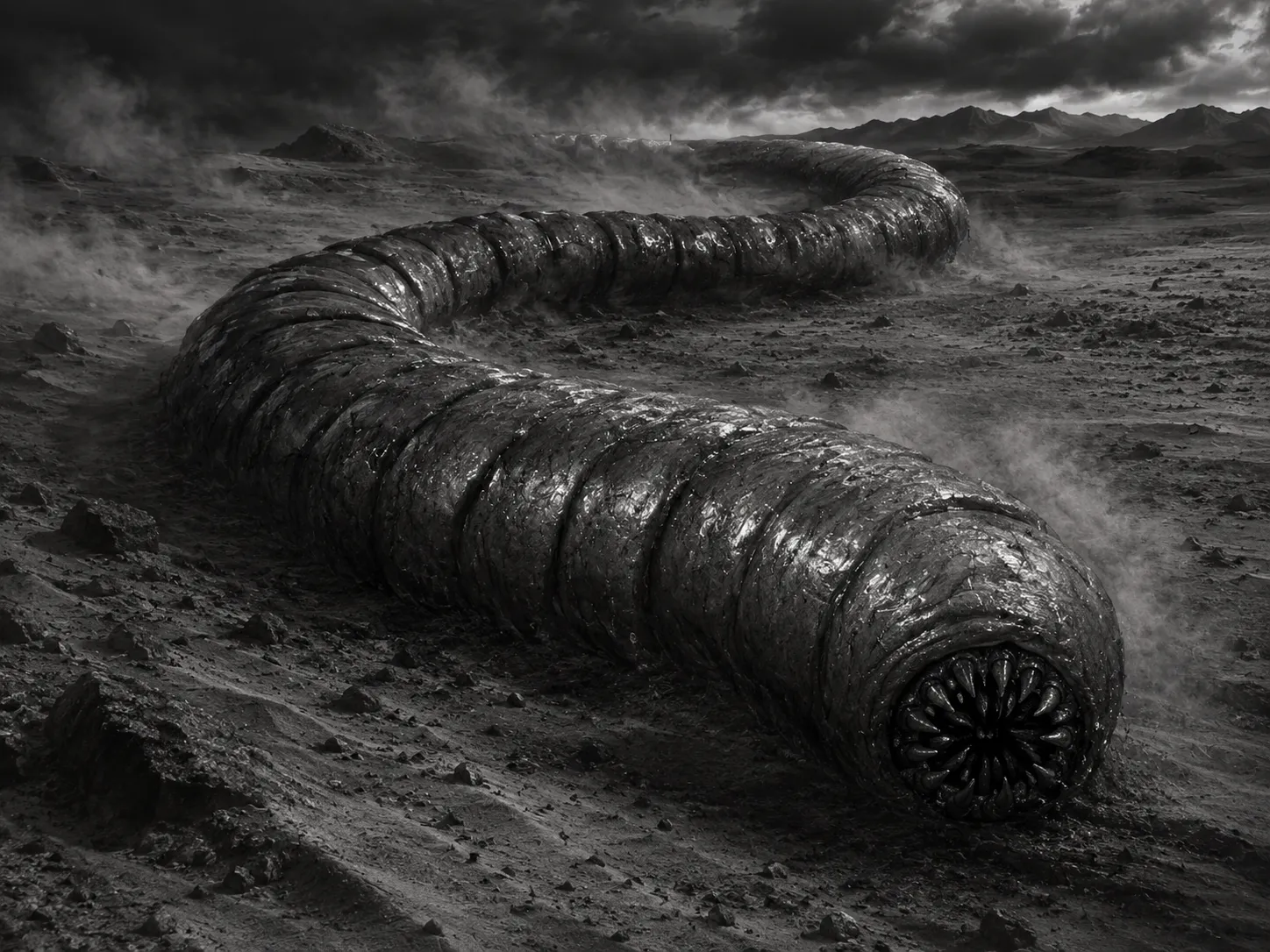
The Mongolian Death Worm (called olgoi-khorkhoi, or “intestine worm,” by locals) is a mysterious creature said to live beneath the sand dunes of the southern and western Gobi Desert. People describe it as thick, blood-red, and headless, with the power to kill instantly using venom or electricity.
Even though no one has ever found a specimen, taken a photo, or discovered any physical evidence, many Mongolian herders still believe it exists. Since the 1920s, Western explorers have tried to uncover the truth, turning the local legend into one of the most famous mysteries in desert cryptozoology.
Summary
Mongolian Death Worm Infobox
| Attribute | Details |
|---|---|
| Name | Mongolian Death Worm |
| Aliases | Olgoi-khorkhoi, Allergorhai-horhai, Allghoi khorkhoi, Olgoj chorchoj, Shar khorkhoi (yellow variant), Intestine Worm |
| Ancestry | 20th-Century Mongolian Oral Tradition / Gobi Nomadic Folklore |
| Species | Unknown — speculative limbless reptile or worm-like organism |
| CCI Score | 2/10 (Almost certainly misidentification) [See the Cryptid Credibility Index] |
| Threat Level | 🟢 Harmless (Safe to track; essentially a ghost story) |
| Height / Weight | 2–5 ft long (0.6–1.5 m); thick as a man’s arm; weight unrecorded |
| Physical Traits | Sausage-shaped, headless and tailless in appearance, blood-red or yellowish skin, no visible eyes or limbs, smooth segmented texture |
| Habitat | Arid sand dunes and dry riverbeds of the western and southern Gobi Desert; associated with saxaul bushes and the parasitic Goyo herb |
| Core Sighting Corridor | Southern Gobi Desert near Ihbulag, Dalandzadgad, and Nemegt Uul, Mongolia |
| Time Active | Summer months (June–July); reportedly emerges after rainfall |
| Diet | Unknown; folklore claims it preys on livestock and humans |
| Movement | Burrows underground; displaces sand in visible waves while traveling beneath the surface |
| First Sighting | 1922 (Roy Chapman Andrews’ account of the Mongolian Premier’s testimony) |
| Last Notable Sighting | August 2009 (David Farrier expedition interviews) |
| Sighting Frequency | Rare |
| Evidence | Secondhand eyewitness testimony, oral tradition, one witness identification test using a live snake specimen (1983); no photographs, footprints, or physical remains |
| Rational Explanations | Misidentified Tartar sand boa (Eryx tataricus); possible unknown amphisbaenian (worm lizard); cultural taboo and linguistic isolation amplifying secondhand reports |
| Status | Actively part of Mongolian folklore; scientifically unconfirmed; no organized expedition since 2009 |
Who or What Is the Mongolian Death Worm?
The Mongolian Death Worm is not regarded as a single creature with its own identity, but as a mysterious animal that nomadic Mongolians have described in similar terms for many years. People refer to it as “it,” much like how Bigfoot or the Yeti are seen as whole species rather than individual animals.
Unlike many other legendary creatures, the worm is not mainly a tourist draw or just a rumor shared by outsiders. Instead, people who actually live in the Gobi Desert talk about it carefully, and sometimes even hesitate to mention it. The best-known search for the worm was led by Ivan Mackerle, a mechanical engineer and cryptozoologist from the Czech Republic, who organized a major expedition to the Gobi Desert in 1990 after hearing secondhand stories.
The Mongolian Death Worm is remarkable compared to other legendary cryptids because it does not have a long history in ancient myths. Unlike many cryptids with deep roots in folklore, there is no clear evidence of the worm in old stories. Its reputation mostly grew in the twentieth century, based on oral accounts collected by a few outside researchers rather than ancient texts.
You may also enjoy:
Aeacus the Underworld Judge: Horror Stories from Greek Mythology
September 9, 2025
The Dark History Behind the Dump Road Haunting in Alabama
September 17, 2025
Mongolian Death Worm Mythology
The earliest written trace of the legend in the West comes not from an ancient text but from a 1920s diplomatic dinner. In the summer of 1919, Roy Chapman Andrews and his expedition party were in the Mongolian capital, then called Urga, meeting with the Premier and other cabinet officials to finalize permits for a paleontological expedition.
The Premier asked Andrews to catch a specimen of the allergorhai-horhai for the Mongolian government. He described it as sausage-shaped, about two feet long, without a head or legs, and so poisonous that touching it would cause instant death.
Interestingly, none of the officials had seen the creature themselves. Still, they all strongly believed in it and described it in almost the same way. The pattern of secondhand but consistent stories would shape the legend for the next hundred years.
This suggests the worm’s story did not come from a single tribal myth but from a broad oral tradition among Mongolian herders and officials living in the Gobi. Mongolia’s unique language and political history kept it isolated from the West for centuries, especially after the Mongol Empire fell and during the communist era. Because of this, the legend remained largely within Mongolia, untouched by outside scrutiny, until Andrews brought it to wider attention.
The story’s meaning seems closely linked to a genuine respect and even spiritual unease toward snake-like creatures. In Mongolian folklore, these beings are seen in mixed ways. For example, they are connected to dragons and water, which earns them respect. Still, they are also seen as symbols of danger or evil. The deep respect and fear is so strong that Mongolians often avoid saying the word for “snake” (mogoi) out loud, choosing instead to use phrases like “long worm” or “merciful one.”
In this context, a creature that could kill silently and instantly from under the sand became a perfect symbol of the hidden dangers of the desert. It offered an explanation for sudden, mysterious deaths or illnesses in one of the harshest places on Earth.
What Does the Mongolian Death Worm Look Like?
Descriptions of the worm have stayed very similar over the years and among different witnesses, which helps keep the legend alive. Most people say it is a large, thick creature, between two and five feet long, with bright red or yellowish skin.
People who claim to have seen it say it looks like a sausage, is over half a meter to a meter long, and as thick as a man’s hand. It also resembles a cow’s intestine, which is where its Mongolian name comes from. Its tail is short and blunt, and it is hard to tell the head from the tail because it has no eyes or other features.
The worm’s color is its most often mentioned feature: a deep, “blood-red” shade that locals connect to its origin story. Some accounts also mention a rare yellow version called the shar khorkhoi, but this is much less common than the red type.
People usually say the worm feels smooth and segmented, without fur or scales, which adds to its organ-like image. The way it is described fits a tradition of making ordinary animals sound more dangerous, and its features are similar to a real desert reptile mentioned later in this article.
Habitat
The death worm’s alleged territory is one of the most extreme environments on the planet. The creature is said to inhabit the western or southern Gobi, specifically the most arid, sandy regions of that desert, with Andrews himself noting it favored the sandiest, driest stretches of the western Gobi.
More specific folkloric coordinates point toward the region around Ihbulag and Dalandzadgad in the southern Gobi, as well as the Nemegt Uul area—both real, sparsely populated locales known among paleontologists for their fossil-rich basins.
The Gobi is not just an endless sea of sand, as many people imagine. Its name comes from the Mongolian word for “waterless place,” but much of it is made up of bare rock, not sand. The environment includes gravel plains, dunes, rocky outcrops, and different microclimates. There are true deserts, semi-deserts, and desert-steppe areas, with rolling dunes, limestone cliffs, and even some grasslands in the east where tough shrubs and flowers grow.
Rain is very rare in the heart of the desert, falling only once every two or three years and averaging less than four inches per year. Temperatures can reach 104°F in summer and drop to -40°F in winter, and windstorms can blow as fast as 140 km/h.
An interesting detail in the legend is that the worm is said to live where a parasitic herb called Goyo grows in the roots of saxaul bushes, which are real desert plants found throughout the Gobi. This makes the story more believable than most cryptid tales and suggests that people who know the desert well helped shape the legend.
Evaluating the territory against real wildlife distribution is revealing. The actual Gobi supports species such as the Asiatic wild ass, the goitered gazelle, and the critically endangered Gobi bear in isolated pockets, alongside argali sheep in the rocky mountains, Pallas’s cat, black-tailed gazelle, and various foxes along the steppe margins.
None of these animals looks like a red, limbless, burrowing worm. But the area is home to a real reptile, the Tartar sand boa, whose range and burrowing habits closely match the legend.
The fact that the worm’s reported sightings align with where the snake lives is the strongest ecological clue that there might be a real animal behind the story, even if it is not as strange as the legend suggests.
Mongolian Death Worm Sightings
Unlike creatures like Bigfoot or the Loch Ness Monster, which have thousands of reported sightings, the Mongolian Death Worm has very few. Most of its sightings are secondhand stories from a short period in the twentieth century.
There has never been a confirmed, direct sighting of the worm by a named person with solid proof. Instead, the stories come from locals who tell Western investigators what they heard from relatives, neighbors, or others.
A journalist who did the most thorough interviews in recent years found that most sightings happened in the 1950s, which raises questions discussed later in the Theories section.
You may also enjoy:
Are Ghosts Real? What Science, the Bible, and a Century of Paranormal Research Actually Show
July 25, 2026
The Dark Story Behind the Boyington Oak Haunting
September 18, 2025
What Is the Black Shuck? History, Legends, and Belief
February 9, 2026
The Demon Div: The Terrifying Horned Demon of Chaos
October 3, 2025
Proserpina: Queen of the Underworld’s Dark Secrets
August 26, 2025
The Mongolian Premier’s Circle (Urga, 1919–1922)
The foundational “sighting” report is, fittingly, a chain of secondhand testimony rather than a direct eyewitness account.
At a 1919 cabinet dinner in Urga (modern Ulaanbaatar), the Mongolian Premier told Roy Chapman Andrews that he personally knew a man who had seen the allergorhai-horhai and survived to tell the story, while a cabinet minister separately claimed that “the cousin of his late wife’s sister” had also encountered it.
Andrews said he never met a Mongolian who admitted to seeing the creature himself. However, many claimed to know someone who had. Whenever his team visited a place said to be a worm hotspot, locals would say it was actually found “a few miles away.” This pattern of always shifting, secondhand sightings became the standard for almost every later report.
Locals Identifying the Tartar Sand Boa (Mongolia, 1983)
One of the strongest pieces of evidence comes from a test, not a random sighting.
In 1983, Mongolian locals who claimed to have seen the olgoi-khorkhoi were shown a Tartar sand boa. They confirmed that the snake was the same animal they had described. This is important because it is the only time witnesses were shown a real animal and asked to compare it to the legendary worm—and they said it was a match.
Ivan Mackerle’s Witness Interviews (Southern Gobi, 1990 and 1992)
Ivan Mackerle first heard about the worm from a student and traveled to southern Mongolia in 1990. He found that many Mongolians did not want to talk about the creature, and his search was made harder by a government ban on organized hunts for the death worm.
After the ban was lifted, Mackerle’s team spent eight weeks searching for the large, deadly, dark-red worm in the Gobi. They collected secondhand stories from nomads that matched the sausage-like, headless creature Andrews had described years before. The team used motorbikes, sand vehicles, aerial surveys, and vibration detectors.
Mackerle later wrote about his findings in the book Mongolské záhady (“Mongolian Mystery”), using interviews with travelers, diplomats, and translated local reports.
Center for Fortean Zoology Expedition (Gobi Desert, 2005)
In 2005, zoological journalist Richard Freeman from the Center for Fortean Zoology led an expedition to interview witnesses and look for physical evidence of the worm, but found nothing.
Like Mackerle’s team before them, Freeman’s group talked to eyewitnesses and visited reported sighting spots in remote desert areas. They found that many Mongolians did not want to talk about the creature, with some saying that even mentioning its name could bring bad luck.
David Farrier’s Witness Accounts (Southern Gobi, August 2009)
New Zealand journalist David Farrier departed for the Gobi Desert on August 4, 2009, traveling specifically to a defined area in the southern Gobi where he stated the all prior sighting reports had clustered, putting his own odds of success between five and fifteen percent.
Farrier decided to make the trip after talking to Richard Freeman about the CFZ’s earlier unsuccessful search. He interviewed locals who said they had seen the worm and noticed that most reports seemed to have happened in the 1950s, with far fewer since then. Like others before him, Farrier found no physical evidence.
Looking at all the reports, it is clear that the evidence for the worm is almost entirely based on similar stories, not physical proof. There is no body, no clear photo, and no sighting has ever been confirmed by someone outside the original storyteller’s group.
Evidence & Investigations
Even compared to other cryptids, the evidence for the Mongolian Death Worm is very limited. No bones, skin, photos, videos, or footprints have ever been found or checked by independent experts. Every major search—by Mackerle in 1990 and 1992, the Center for Fortean Zoology in 2005, and David Farrier in 2009—ended without results.
There is only a small amount of published material about the worm, and most of it refers back to itself. Researcher Brian Dunning found that almost every account relies on Ivan Mackerle’s work and the few secondhand stories he collected. This means that nearly all modern writing about the worm comes from one person’s research.
Mackerle first published his findings in the Czech magazine Reflex in 1991, followed by Filip in 1992, with English translations appearing in 1992 and 1994 in the newsletters The Faithist Journal and World Explorer. He also produced a 30-minute Czech television documentary titled “The Sand Monster Mystery,” which aired in 1993.
The strongest piece of evidence is still the 1983 test, when locals who said they had seen the olgoi-khorkhoi were shown a Tartar sand boa and said it matched their description. However, this points to an ordinary animal, not the legendary creature described in folklore.
One secondary Mongolian source reported that a Soviet scientist, A. D. Simulkov, described the creature in 1930. Still, no original source for this claim has ever been found, and there is no other mention of the scientist or the report.
No major zoological institution has done a scientific study of the worm; all research so far has come from independent cryptozoologists, journalists, and TV shows, not from peer-reviewed science.
Theories
Tartar Sand Boa
The main scientific theory is that the worm is actually a real reptile. The Tartar sand boa is a non-venomous snake that lives in the area, and in 1983, locals who saw a live one said it was the same animal they called olgoi-khorkhoi.
Researchers, including herpetologist Gorelov, believe the legend of the olgoi-khorkhoi began with the Tartar sand boa. The snake has a thick, blunt body and likes to bury itself in sand, which matches the worm’s description. The stories about venom and electricity are likely made up.
You may also enjoy:
What Is Redcap? The Bloodthirsty Goblin of Scottish Folklore
February 5, 2026
Lamashtu: The Demon Goddess Who Preyed on Infants
August 22, 2025
Complete Guide to Wyoming Bigfoot Sightings (1967–2025)
August 10, 2025
Gwodz Road Haunting: Alabama’s Most Terrifying Ghost Story
September 17, 2025
Aeacus the Underworld Judge: Horror Stories from Greek Mythology
September 9, 2025
The Amphisbaenian (Worm Lizard)
Another theory suggests the worm could be a different kind of burrowing reptile. Cryptozoologist Michel Raynal thinks it might be an amphisbaenian, a group of limbless, reddish-brown reptiles.
After his 2005 expedition, Richard Freeman decided that the worm’s supposed supernatural powers are just stories. He thinks the sightings probably involved an unknown or undocumented species of worm lizard or amphisbaena living in the Gobi’s gravel and sand, not a snake.
Linguistic Isolation Amplifying a Single Source
Another explanation looks at how the legend spread, rather than which animal started it. Mongol is a unique language written in Cyrillic script, and very little of its literature has been translated. This meant that outside researchers had almost no access to original Mongolian sources until Mackerle’s work in the 1990s.
This caused a bottleneck: almost every English-language story about the worm since the early 1990s comes from the same small set of sources Mackerle collected. So, the idea that there is a huge, ancient tradition is partly an illusion caused by limited access to original material, not by real widespread folklore.
Cultural Taboo
The pattern of “everyone believes it, but nobody has seen it” may originate from cultural caution rather than genuine shared sightings. Locals often avoid talking about the creature, thinking that saying its name could bring harm, which fits with the Mongolian custom of not naming snakes directly.
Mongolians often use other words instead of “snake” out of respect or caution. The same habit of avoiding the death worm’s name could make it seem like there is a mysterious agreement about the creature, which outside investigators have sometimes mistaken for proof of a hidden species.
Declining Sightings as a Generational and Soviet-Era Artifact
Farrier’s interviews showed that most sightings were reported in the 1950s, which matches a specific time in history: the early years of the Mongolian People’s Republic under Soviet rule, before the government later banned organized searches for the worm.
The drop in reports since then may be due to changes among nomadic herders, the fading of oral storytelling as Mongolia modernized, and years of limited access to remote areas during the communist era. These factors would make new firsthand stories less likely, whether or not the animal ever existed.
Other Similar Cryptids
| Cryptid | Danger Level | Details |
|---|---|---|
| Tatzelwurm | ⚠️ MEDIUM. A short, legless or stub-limbed lizard-like creature said to hiss venom and lunge at hikers in the Alps before retreating into rock crevices. | Described across Austrian, Swiss, and Bavarian alpine folklore since the 18th century, it’s sometimes depicted with a catlike face fused onto a serpent’s body. |
| Kappa | 💥 HIGH. Lurks in rivers to drag down swimmers and extracts the shirikodama, a mythical jewel containing the soul, directly from its victims. | Japanese folklore claims a kappa can be neutralized simply by bowing to it, since etiquette compels the creature to bow back and spill the water from the dish atop its head. |
| Kelpie | 🩸 SEVERE. Appears as a beautiful, lost horse near lakes but once a weary traveler mounts it, its skin turns hyper-adhesive, trapping them as it dives into deep water to devour them. | Scottish legend held that a kelpie could be tamed permanently if a person managed to slip a bridle over its head before it recognized the trick. |
| Bunyip | ⚠️ MEDIUM. Said to drag livestock and unwary travelers beneath the surface of billabongs and swamps across the Australian outback. | Aboriginal Australian oral traditions describe wildly different bunyip forms from region to region, making it one of the least visually consistent water cryptids on record. |
| Amphisbaena | 🕊️ LOW. A two-headed serpent of Greco-Roman legend said to bite with both ends simultaneously, though actual recorded attacks are essentially nonexistent. | Its name lent itself directly to the real-world taxonomic family Amphisbaenidae, the limbless burrowing lizards still cited as a leading explanation for death-worm sightings. |
| Ninki Nanka | 🩸 SEVERE. A dragon-like river serpent in Gambian and Senegalese folklore said to kill or drive mad anyone who glimpses it directly. | Local legend insists that merely seeing the creature, not touching it, is enough to trigger death, paralleling the death worm’s claim that proximity alone can kill. |
| Loch Ness Monster | 🕊️ LOW. No credible account attributes a human death or injury directly to the creature despite nearly a century of reported encounters. | Sonar sweeps, hydrophone arrays, and a dedicated decades-long surveillance project have produced far more organized scientific scrutiny than any single death-worm expedition. |
| Chupacabra | ⚠️ MEDIUM. Blamed for livestock deaths across Latin America and the southern United States, typically drained of blood rather than physically mauled. | Genetic testing on several captured “chupacabra” carcasses has repeatedly identified them as coyotes or dogs suffering from severe mange. |
| Jersey Devil | 🟡 UNPREDICTABLE. Reported gliding over the New Jersey Pine Barrens, occasionally blamed for livestock mutilation but rarely linked to direct human harm. | The legend traces to a specific 1735 colonial birth story involving a cursed thirteenth child, giving it one of the most precisely dated origin myths of any North American cryptid. |
| Tsuchinoko | 🕊️ LOW. A stout, snake-like creature from Japanese folklore is rumored to spring several feet into the air, but there are no documented attacks on people. | Some regional legends claim the tsuchinoko can speak and even lie to travelers, a trait almost no other serpentine cryptid worldwide is said to possess. |
| Sandworm (Saharan legend variants) | 🟡 UNPREDICTABLE. Folk tales from parts of North Africa describe giant burrowing worms that disturb camel caravans, though reports of attacks are vague and unverified. | These tales likely influenced Western pop culture’s sandworms, creating a feedback loop in which fiction like Dune later reshaped how cryptozoologists searched for the death worm itself. |
| Mokele-mbembe | 🟠 DANGEROUS. Said to inhabit Congo Basin rivers and reportedly charges canoes that venture too close to its territory. | Cryptozoological expeditions searching for it have used similar vibration and noise-based luring techniques to those Ivan Mackerle later adapted for his death-worm searches. |
Is the Mongolian Death Worm Real?
What is most remarkable about this case is not the stories themselves, but how they are built. Almost every modern account—from different decades, expeditions, and TV shows—can be traced back to one Czech engineer’s research from the early 1990s. Because Mongolian is such an isolated language, Western skeptics could not check these stories for almost seventy years after Andrews first wrote about them.
This is a very weak foundation for a so-called “global cryptid.” It also explains why the descriptions are so similar—not because many people saw the same thing, but because almost everyone writing about the worm since 1991 has used the same few secondhand Mongolian sources.
The 1983 identification test is the most underrated piece of the puzzle. It is rare in cryptozoology to have actual witnesses directly confront a candidate animal and confirm the match in real time, rather than have skeptics retroactively guess at an explanation decades later.
That single data point, paired with the genuine ecological overlap between the Tartar sand boa’s range and the worm’s folkloric territory, does more to explain the legend than any expedition’s failure to find a body.
My assessment: the Mongolian Death Worm almost certainly is not real as described—a venom-spitting, electricity-discharging creature has no plausible biological mechanism and no supporting trace evidence after a century of searching.
But the legend is very likely “real” in a narrower sense: a genuine, exaggerated folk memory of a real, strange desert reptile, magnified by linguistic isolation, cultural caution around naming dangerous animals, and the multiplying effect of a single influential researcher’s secondhand sources becoming the entire Western record.
You may also enjoy:
Lamashtu: The Demon Goddess Who Preyed on Infants
August 22, 2025
Glasya-Labolas: The Griffin-Winged Demon of Blood and Wisdom
August 21, 2025
Tengu Yokai: Terrifying Bird Spirits That Punish the Arrogant
September 9, 2025
Why the Kitsune Is the Most Dangerous Yokai in Japanese Folklore
September 10, 2025
Hillbilly Beast of Kentucky: What Boone Really Saw
June 30, 2025
Sources
- Shuker, Karl. The Beasts That Hide from Man: Seeking the World’s Last Undiscovered Animals. Paraview Press, 2003.
- Clark, Jerome. Cryptozoology A to Z: The Encyclopedia of Loch Monsters, Sasquatch, Chupacabras, and Other Authentic Mysteries of Nature. Simon & Schuster, 1999. Internet Archive.
- Rossi, Lorenzo. (2015). A Review of Cryptozoology: Towards a Scientific Approach to the Study of “Hidden Animals”. 10.1007/978-3-319-22246-2_26.
- Andrews, Roy Chapman. On the Trail of Ancient Man. G. P. Putnam’s Sons, 1926. Internet Archive.
- Andrews, Roy Chapman. The New Conquest of Central Asia: A Narrative of the Explorations of the Central Asiatic Expeditions in Mongolia and China, 1921-1930. American Museum of Natural History, 1932. Internet Archive.
- Kuzmin, S. L., et al. Zemnovodnye Mongolii [Amphibians of Mongolia]. KMK Scientific Press, 2017.
- Beckwith, Sam. Interview: Ivan Mackerle. Prague TV.
- Davies, Adam (April 2004). Death Worm!. Fortean Times.
- Patočka, Jiří, and Zdeňka Navrátilová. Cynomorium Plants: Bioactive Compounds and Pharmacologic Actions. Military Medical Science Letters, vol. 89, no. 2, 2020, pp. 90–98. Military Medical Science Letters.
- Schembri, Elise. Cryptozoology as a pseudoscience: beasts in transition. Studies by Undergraduate Researchers at Guelph Vol. 5, No. 1, Fall 2011, 5-10.
- Hill, Sharon A. Cryptozoology and Pseudoscience. Skeptical Inquirer, Jan. 2011.