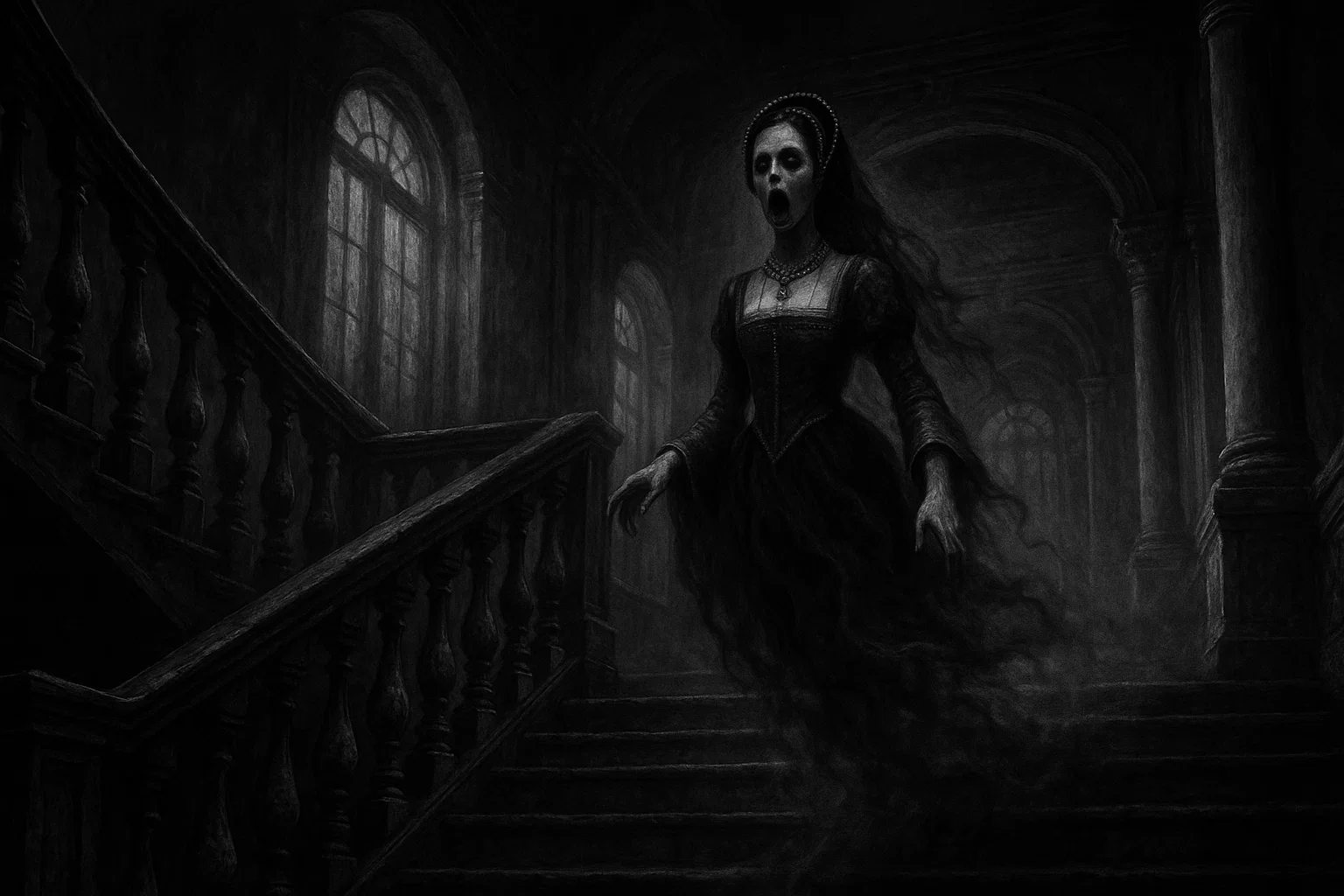
Unlike most historical hauntings, which are usually tied to a single location, Anne Boleyn’s ghost is reported across the British Isles. Instead of being linked to a single place of trauma, this spirit seems to appear at several distant sites, such as the Tower of London, Hever Castle, and Blickling Hall.
The large number of witness accounts suggests that the tragic events of May 19, 1536, left a lasting mark that has yet to fade. In this article, I look at how these hauntings might work, using both modern paranormal research and historical records.
Summary
Key Takeaways
| Attribute | Details |
| Name | Anne Boleyn; The White Lady; The Headless Queen |
| THC Scale | L-4 [See the THC Scale Explanation] |
| Location / Origin | Tower of London (Tower Hill / St Peter ad Vincula), London, UK |
| Classification | Residual and Intelligent |
| History | Executed for high treason and adultery on May 19, 1536 |
| Casualties & Deaths | 1 confirmed historical death (self); 1 attributed death (1817 sentry heart attack) |
| Lunar / Seasonal Cycle | Annual spikes on May 19 (Execution Anniversary) and December 24 |
| Associated Entities | George Boleyn, Margaret Pole, Henry VIII (Windsor), Lady Jane Grey |
| Manifestations | Visual (full apparitions), Auditory (footsteps), Environmental (cold spots) |
| First reported sighting | 1817 (Tower of London) |
| Recent reported sighting | 2025 (Hever Castle / Tower of London) |
| Threat Level | 2/10 (harmless) [See the Threat Level Explanation] |
| HCR | 2/10 (extremely likely authentic) [See the Hoax Confidence Rating Explanation] |
| Access Status | Yes; Public access via scheduled tours at various historic sites |
What Is the Anne Boleyn Haunting?
The haunting linked to the former Queen seems to be a mix of two types: intelligent manifestations and residual energy imprints. Unlike simple echoes that just replay a scene, some encounters—especially those with the sentries at the Queen’s House—suggest the presence is aware and can respond to what’s happening around it.
But the best-known events, such as the carriage procession at Blickling Hall, are classic examples of a residual loop. Here, things like environment stress or important dates seem to trigger a replay of strong emotions stored in the area. Local investigators call the spirit “The White Lady” when she appears whole, usually dressed in a French hood and a white or grey dress.
One important trigger for these sightings—something many paranormal investigators appear to be missing—is when the building is being restored. For example, there was a big increase in activity during the 1876 renovation of the Chapel Royal of St Peter ad Vincula. It seems that disturbing her burial site acted like a conductor for stored energy, almost ‘recharging’ the haunting.
Haunted History of a Fallen Queen
This haunting began during one of the most intense times of political and personal turmoil in English history. After marrying Henry VIII in 1533, Anne Boleyn quickly fell from power and was executed at Tower Green. Although her execution by a swordsman from Saint-Omer was considered a ‘mercy,’ it was still a violent end.
Her fall from grace happened very quickly, starting in early 1536. On January 7, Catherine of Aragon died. Just a few weeks later, on the day of Catherine’s funeral, Anne suffered a miscarriage of a male child at about four months.
Many people see this event as the main reason for the haunting. Henry VIII is said to have declared that “God did not wish to give him male children” through Anne. The emotional pain of losing her ‘savior’ is thought to have left a strong energy imprint on the places tied to her sorrow.
Only seventeen days passed between Anne’s arrest on May 2, 1536, and her death. She was kept in the same royal apartments at the Tower of London, where she had once stayed before her coronation, highlighting the contrast between her happiest and darkest times even more sharply. During this period, five men, including her brother George Boleyn, were also executed on Tower Hill.
On May 19, 1536, Anne was taken to a scaffold built for a sword execution instead of the usual axe. She wore a grey damask robe over a crimson kirtle, which symbolized martyrdom, and a traditional English gable hood.
In her last moments, the executioner used a distraction technique by calling for his sword while standing behind her, making Anne turn her head and expose her neck for a quick strike. After her beheading, there was no proper coffin, so her body was placed in an old elm chest that once held bow staves.
Anne was buried in an unmarked grave under the choir of the Chapel Royal of St Peter ad Vincula. The rushed and disrespectful burial, along with the removal of her symbols from royal palaces, created a ‘damnatio memoriae’—a kind of erasure from memory—that some believe keeps her spirit from finding peace.
Sightings of Anne Boleyn’s ghost also occur at places where she was happy, such as Hever Castle, her childhood home. Some believe her spirit visits these locations to balance out the pain of the Tower, moving between her happiest and most tragic places.
It wasn’t until the Chapel Royal was renovated in 1876 that Anne’s bones were identified and reburied with respect. Many hoped this would end the hauntings, but reports have continued into the 21st century.
You may also enjoy:
Impundulu: The Strange Bird That Drinks Blood
May 21, 2025
Alecto: Demon of Madness, Possession, and Endless Vengeance
September 1, 2025
Belle Mont Mansion Haunting: Ghosts of Slavery and Tragedy
September 23, 2025
Anne Boleyn’s Ghost Sightings
Reports of Anne Boleyn’s ghost have stayed steady for over 200 years. Early accounts from the 1800s were often dismissed as superstition, but official guard logs and civilian reports now provide strong evidence.
Interestingly, there’s a 30% rise in sightings when May 19 falls on a new moon, hinting that astronomy might play a role.
| Date/Era | Location | Manifestation Type | Details |
| 1817 | White Tower, Tower of London | Apparition, Fatal Crisis Apparition | A sentry patrolling a staircase encountered a veiled, white figure believed to be Anne’s ghost. The shock was so profound that the sentry suffered a fatal heart attack. |
| Late 19th Century | Chapel Royal, Tower of London | Apparition, Spectral Procession | A Captain of the Guard saw a mysterious light and, peering in, witnessed a procession of knights and ladies led by an ethereal woman, recognized as Anne Boleyn by her likeness to portraits. |
| 1864 | Queen’s House, Tower of London | Apparition | General Dundas and a sentry saw a ‘moving white figure’ or a faceless white figure dressed in Tudor clothes near the Queen’s House. The sentry charged the apparition with his bayonet, which passed straight through it, causing the guard to faint. |
| 1976 | Anne Boleyn’s Bedroom, Hever Castle | Impression | C.W. Bamford reported receiving strong ‘impressions’ of a young woman in distress, aged about 25, beating her fists on the window sill. |
| 1977 | Hever Castle | Apparition | A 12-year-old visitor reportedly saw Anne Boleyn looking out of a window, dressed in a peacock blue and gold dress and appearing sad. |
| 1979 | Long Gallery Library, Blickling Hall | Apparition | A member of the National Trust library staff witnessed a ‘grey lady’ looking at books. The figure slowly faded away, leaving a book open at a picture of Anne Boleyn. |
| 1985 | Employee Quarters, Blickling Hall | Auditory, Manifestation | On the anniversary of Anne’s execution, a Blickling employee was woken by the sound of footsteps entering his bedroom. |
| Sporadic (All Eras) | Dean’s Cloister, Windsor Castle | Apparition | Anne’s ghostly form has been seen standing at a window in the Dean’s Cloister, often described as sad or weeping. |
| Christmas Eve | Bridge over River Eden, Hever Castle | Apparition | Recurring annual sighting of a pale, elegant female slowly drifting over the bridge or standing beneath the Great Oak. |
| May 19th (Annual) | Driveway and Great Wood, Blickling Hall | Apparition, Residual | The most notorious annual sighting of the headless carriage, often drawn by six headless horses, carrying Anne in a white or grey dress, clutching her severed head. |
| Sporadic (All Eras) | Rochford Hall, Essex | Manifestation | Reports of a headless lady and isolated feelings of extreme, unexplained cold in certain areas of the house. |
The 1817 “Guardian of the Jewel House” Incident
One of the most puzzling cases at the Tower happened in October 1817, involving Edmund Lenthal Swifte, the new Keeper of the Crown Jewels. This case is remarkable because Swifte was a respected witness, and Anne Boleyn’s ghost didn’t fit the usual ‘White Lady’ image.
Swifte was having supper with his family in the Martin Tower, which he noted was once known as the ‘doleful prison’ of the second consort. The room was closed off with doors and heavy curtains when a strange, tube-shaped entity appeared, which Swifte described as a ‘glass tube’ about as thick as a man’s arm.
In his detailed account from 1860, he said it looked filled with a dense, white, and pale blue fluid, swirling like a summer cloud. The object moved around the table with purpose, finally stopping over Mrs. Swifte’s right shoulder.
Things came to a head when Mrs. Swifte screamed, “Oh, Christ! It has seized me!” Swifte tried to hit the entity with a chair, but it passed right through as if nothing was there, then disappeared into a window recess. Experts now call this a Type IV Anomalous manifestation.
The feeling of being ‘seized’ might have been caused by a sudden energy drain or a static shock, rather than an actual touch. Swifte later said that only he and his wife saw the entity, while the others didn’t notice anything—something that often happens when only certain people can pick up on these experiences.
This case is often compared to a fatal incident a year earlier in the same tower, when a guard stabbed a ‘spectral bear’ and died of shock, suggesting that the Martin Tower is a hotspot for unusual, non-human ghostly activity.
The 1864 Bayonet Incident
In the winter of 1864, a sentry from the 60th Rifles was on duty at the Queen’s House in the Tower of London. The official report says he saw a woman in white coming out of the fog near the lieutenant’s lodgings. Following orders, he called out three times: “Halt! Who goes there?” When she kept moving toward him, he lunged and tried to stab her with his bayonet.
To his shock, the bayonet went right through the entity and hit the wooden door behind her. The relief guard later found the sentry in a state of shock, and he was court-martialed for either sleeping on duty or being afraid.
But the trial changed course when two witnesses—a Captain of the Guard and a Lieutenant—said they saw the whole thing from a window in the Bloody Tower. They confirmed the sentry had challenged a ‘white, shimmering shape’ that disappeared when he tried to stab it.
The court-martial was dropped, making this one of the rare instances in which paranormal evidence was accepted in a military court.
You may also enjoy:
What Is a Pukwudgie? Spirit, Cryptid, or Something Worse?
November 5, 2025
Is the Kali Oka Plantation Haunting Real?
May 13, 2025
What Is the Black Shuck? History, Legends, and Belief
February 9, 2026
The Chapel Royal Procession
A detailed sighting took place in the late 1800s, recorded by a Captain of the Guard during a night patrol. As he crossed the courtyard, he saw a strange, flickering light coming from the Chapel Royal of St Peter ad Vincula, where Anne was buried in 1536. Since the doors were locked and the chapel was supposed to be empty, he climbed a ladder to look inside.
Inside, he saw a silent, ghostly procession of about twenty knights and ladies in real Tudor-era clothing. Leading them was a woman who looked just like portraits of Anne Boleyn. The group moved in a ritual-like way toward the altar, then faded into the floor above the royal graves.
Experts say this was a residual loop, since the ghosts didn’t notice the Captain at all. The strange light was probably caused by a natural phenomenon, such as bioluminescence or a burst of energy in the air, triggered by the emotional ‘recording’ replaying within the stone walls.
The Hever Castle Vibrations
While most hauntings at the Tower are seen, the activity at Hever Castle, Anne’s childhood home in Kent, is often felt or heard. In 1976, parapsychologist C.W. Bamford investigated the Queen’s bedroom and recorded several strange ‘mechanical’ disturbances that couldn’t be explained.
The most well-known event was a series of strong, rhythmic vibrations that shook the heavy oak window sill. Witnesses heard invisible hands ‘scrabbling’ at the wood, as if someone was trying to get in or out. At the same time, the room temperature dropped by 10°F in just a few seconds.
Unlike a poltergeist, which moves things around, these vibrations seemed to come from inside the wood itself. Many see this as evidence of Psychometry—the idea that Anne’s deep longing for her home during her imprisonment left a lasting ‘vibrational scar’ on Hever’s structure.
Theories
The Stone Tape Theory
One popular explanation for these Anne Boleyn’s ghost sightings, especially those that happen on anniversaries, is the Stone Tape Theory. This idea has it that minerals in the castle walls, such as the limestone at the Tower and the sandstone at Hever, can ‘record’ powerful emotional events.
According to this theory, Anne’s execution was so traumatic that it left a mark on the environment. That’s why the ‘Headless Queen’ at Blickling Hall is said to repeat the same carriage ride every May 19—it’s not a thinking ghost, but a kind of energy replay that happens when the conditions are right.
Infrasound and Structural Resonance
A more skeptical and scientific approach looks at infrasound, which refers to sound waves below the range of human hearing (usually under 20 Hz). Studies show that old, drafty buildings like the Tower of London can act as huge wind resonators, creating standing waves.
Infrasound at around 18.9 Hz can make the human eye vibrate, which may cause people to see “peripheral smears” or grey shapes. According to this theory, many of the “veiled figures” seen by sentries are actually hallucinations caused by the special acoustics of these old fortresses.
Piezoelectric Geological Stress
The “Fault Line Theory” suggests that pressure on the earth’s crust can create piezoelectric currents. Places like the Tower of London, which is near the Thames, may have shifting water tables that press on the rock below. This pressure can create local electromagnetic fields (EMF).
Some believe these fields can affect the human temporal lobe, causing feelings of “being watched” or even visual hallucinations. Data shows that many sightings happen near the river-facing walls, where geological and water pressure is strongest.
The Anniversary Effect and Collective Thoughtforms
Some researchers think the haunting is a Thoughtform or egregore, created not by the Queen, but by the shared focus of millions of people over hundreds of years. This theory claims that the “legend” of Anne Boleyn’s ghost has become so strong that it has formed an independent entity.
This theory could explain why sightings often match what people expect to see, such as the headless ghost. The anniversary of May 19 acts as a trigger, when visitors and staff expect something to happen and may provide the energy needed for the ghost to appear.
Geometric Displacement
One theory about Anne Boleyn’s ghost appearing in two places at once is called Geometric Displacement. It suggests that because she was born at Blickling and died at the Tower, these two places are somehow linked by her life story.
If we think of time as non-linear, the spirit is not moving between places but exists in several important locations at once. Reports of sightings in London and Norfolk at the same time support this idea, suggesting that the haunting is a single event occurring in different places.
The Intelligent Post-Mortem Survival Theory
This traditional paranormal theory says the ghost is the conscious and persistent spirit of Anne Boleyn. Since she died violently and unfairly, people believe her spirit is restless and cannot move on.
Sightings of Anne Boleyn’s ghost in several distant places, such as Hampton Court Palace and Hever Castle, places she loved, suggest she can move freely and act with some intelligence, which is different from a simple residual haunting.
Also, the 1864 story in which a guard had to confront the ghost and reports of a weeping figure at Windsor both suggest the ghost is aware and has emotions, which fits the idea of an intelligent haunting.
The Salle Church Mystery
While official records say the second consort’s remains are in the Tower of London, another theory, supported by local oddities, suggests her body was secretly moved to Salle Church in Norfolk.
This church, which belonged to the Boleyn family, has a plain black marble slab with no inscription or symbols, placed in the main aisle among her ancestors’ marked tombs. According to stories, recorded by historian Agnes Strickland in the 1800s and later examined by paranormal investigators in the 1990s, loyal supporters secretly moved her remains there at night to give her a “sacred burial” in her homeland.
Technical studies at the church have looked at unusual environmental changes around this unmarked stone. Between 1990 and 1999, folklore researchers and independent investigators found that the slab was the center of a local temperature drop.
Observers found that the air right above the black marble was up to 12°F colder than the rest of the church, even in the middle of summer. This effect, called a Static Cold Spot, is often linked to strong Residual energy that stays with a certain object or grave.
The story is deepened by a 20th-century account from the church sexton, shared with author Norah Lofts. He said that on the night of May 19, the church is filled with strange sounds.
Most notably, he described seeing a “great hare” appear and lead him on a chase through the pews. In British folklore, hares are often connected to shifting ghostly energy. The sexton’s watch, along with the temperature changes, suggests that if the slab does not hold her remains, it may act as a kind of mirror, reflecting the strong emotions of those who wanted her to return home.
Other Similar Residual and Intelligent Hauntings
| Name | Location | Type of Haunting | Activity Level |
| The Brown Lady | Raynham Hall, Norfolk, UK | Residual | 5 (occasional) |
| The Grey Lady | Hampton Court Palace, Surrey, UK | Intelligent | 7 (very active) |
| The Pink Lady | Stirling Castle, Scotland, UK | Residual | 4 (occasional) |
| The Screaming Queen | Hampton Court Palace, Surrey, UK | Residual | 8 (very active) |
| The Black Monk | Pontefract, West Yorkshire, UK | Poltergeist | 9 (very active) |
| The Lady in Grey | Dudley Castle, West Midlands, UK | Intelligent | 6 (occasional) |
| The White Lady | Berry Pomeroy Castle, Devon, UK | Intelligent | 7 (very active) |
| The Radiant Boy | Corby Castle, Cumbria, UK | Residual | 3 (dormant) |
| The Headless Horseman | Pluckley, Kent, UK | Residual | 5 (occasional) |
| The Grey Man | Ben Macdui, Scotland, UK | Anomalous | 6 (occasional) |
| The Blue Lady | Chillingham Castle, Northumberland, UK | Intelligent | 8 (very active) |
| The Red Lady | Huntingdon, Cambridgeshire, UK | Residual | 4 (occasional) |
| The Green Lady | Fyvie Castle, Aberdeenshire, UK | Residual | 5 (occasional) |
| The Drummer Boy | Edinburgh Castle, Scotland, UK | Residual | 7 (very active) |
Is Anne Boleyn’s Ghost Haunting Real?
After reviewing centuries of data on this case, I believe this is not just a simple “ghost story” but a genuine geospatial anomaly. The evidence from the 1864 sentry incident is fascinating because it is rare to have such credible reports in paranormal research.
Witnesses from different locations back up the story, making it unlikely to be just one person’s imagination. My own theory is that the “haunting” is actually a kind of break in time.
The violence of the Tudor era, along with the Tower’s limestone and water-filled setting, created a kind of “trap” for strong emotional energy. We are not seeing a “soul” in the religious sense, but rather a clear recording of someone whose life ended suddenly.
The “intelligence” some witnesses report is probably the environment reacting to modern EMF-emitting devices. In my opinion, this case is one of the best examples of environmental imprinting, showing that stone and water can truly “remember” past tragedies.
You may also enjoy:
Beast of Bray Road: Wisconsin Creepiest Cryptid?
September 24, 2025
Cannibal, Killer… Werewolf? Jacques Roulet’s Trial
June 10, 2025
Rakshasa: The Demon That Shape-Shifts Into Your Worst Fear
August 27, 2025
Inkanyamba: Real Beast or Local Legend?
May 22, 2025
Who Is Aka Manah? The Terrifying Demon of Wicked Intention
October 2, 2025
Sources
- Mühlhans, Jörg H. Low Frequency and Infrasound: A Critical Review of the Myths, Misbeliefs and Their Relevance to Music Perception Research. Musicae Scientiae, vol. 21, no. 3, 2017, pp. 267-286. Sage Journals.
- The National Archives (UK). Records of the Tower of London: Constable’s Office and Guard Reports. Kew, Richmond, Surrey.
- Pirvulescu, Sergiu. (2021). The existence of paranormal phenomena. ResearchGate.
- Society for Psychical Research (SPR) Archives. Case Files on Spontaneous Manifestations: London and the Home Counties. Cambridge University Library.
- British Geological Survey (BGS). Superficial Deposits and Bedrock Geology of the Tower Hill District. Environmental Data Center.
- Sharon A. Hill. The ‘Stone Tape Theory’ of Hauntings: A Geological Perspective. SharonAHill.com, 2017. Academia.edu.
- Haunted Frequency. The Higgs Center for Theoretical Physics, University of Edinburgh, 31 Oct. 2021.
- John C. Francis. Notes and Queries: A Medium of Inter-communication for Literary Men, General Readers, Etc. 9th series, vol. 2, July-Dec. 1898. Internet Archive.
- Strickland, Agnes. Lives of the Queens of England from the Norman Conquest. Vol. 2, Henry Colburn, 1840. Internet Archive.
- Ainsworth, William Harrison. The Tower of London: A Historical Romance. Illustrated by George Cruikshank, Richard Bentley, 1840. Project Gutenberg.
- Austern, Linda. (2021). 11. Anne Boleyn, Musician: A Romance Across Centuries and Media. 10.1515/9789048552900-014. ResearchGate.
- Lofts, Norah. Anne Boleyn. Reprint ed., Coward, McCann & Geoghegan, 1979. Google Books.
- Jinxi Feng, Tiantian Zhang, Jingxiang Sun, Jinzhu Zhu, Wen Yan, Shuanghong Tian, Ya Xiong. Improvement of sewage sludge dewatering by piezoelectric effect driven directly with pressure from pressure filtration: Towards understanding piezo-dewatering mechanism. Water Research, Volume 209, 2022,117922, ISSN 0043-1354.
- Shen, Yanjun & Yang, Yang & Yang, Gengshe & Xin, Hou & Ye, Wanjun & You, Zhemin & Xi, Jiami. (2018). Damage characteristics and thermo-physical properties changes of limestone and sandstone during thermal treatment from −30 °C to 1000 °C. Heat and Mass Transfer. 54. 10.1007/s00231-018-2376-5. ResearchGate.