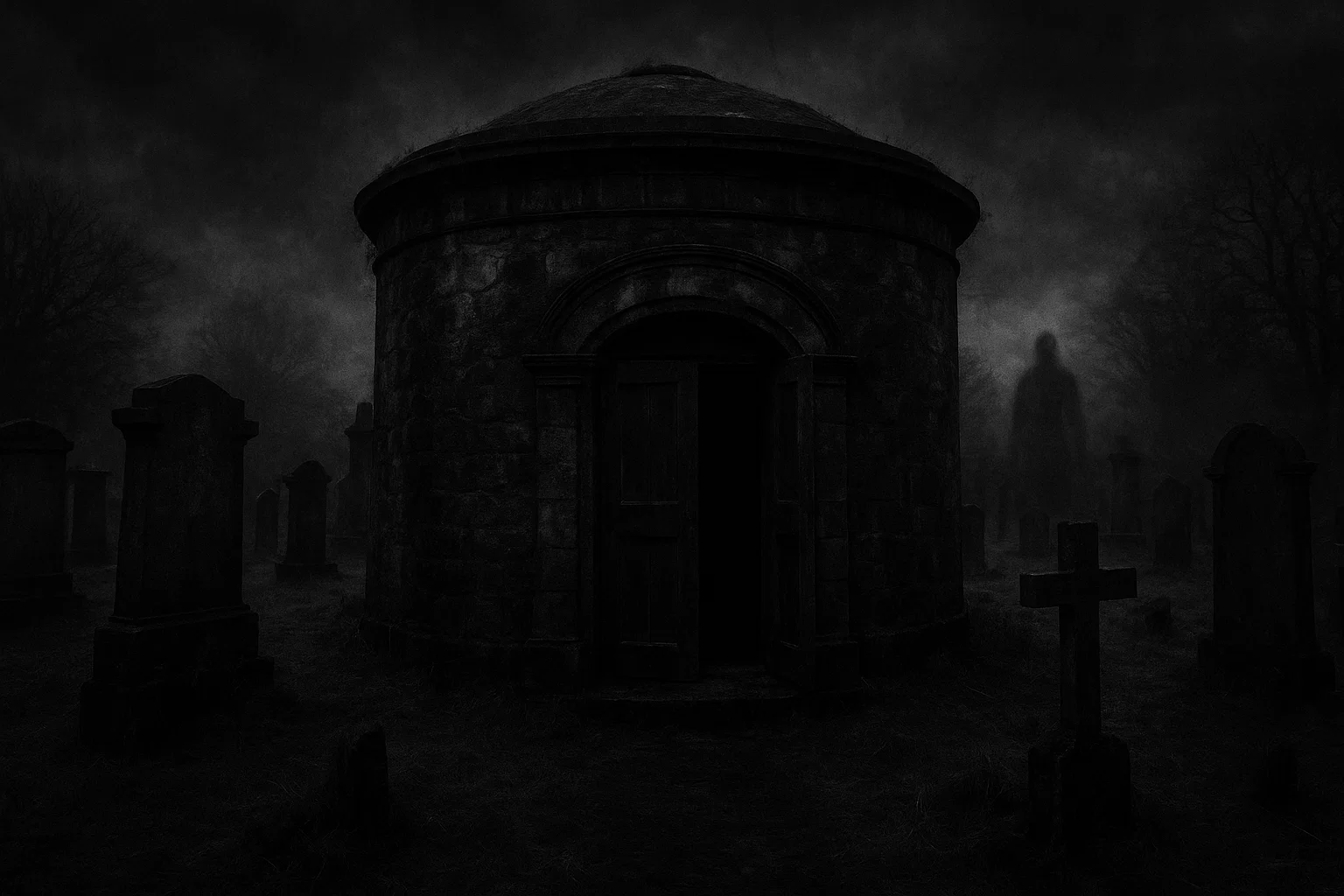
Ever heard of the Mackenzie poltergeist? The uneasy feeling around the infamous Black Mausoleum hints at a break between past trauma and what people experience there today.
Most stories highlight the dramatic reports of scratches and fainting, but they rarely mention the sandstone beneath the mausoleum, which might store centuries of sorrow like a battery. The Mackenzie poltergeist seems to draw energy from the many visitors who walk over the Covenanters’ mass graves.
Summary
Key Takeaways
| Attribute | Details |
| Name | Mackenzie Poltergeist; The Spirit of “Bluidy” George Mackenzie. |
| THC Scale | L-6 [See the THC Scale Explanation]. |
| Location / Origin | Greyfriars Kirkyard, Candlemaker Row, Edinburgh, Scotland (55.9469° N, 3.1923° W). |
| Classification | Poltergeist; Intelligent. |
| History | The 1679 Covenanter persecutions and the 1998 desecration of the Mackenzie Tomb. |
| Casualties & Deaths | Approx. 18,000 historical deaths in the Killing Time + 0 confirmed modern deaths (hundreds of reported physical injuries). |
| Manifestations | Physical (scratches, burns, bruising), Auditory (growls), Environmental (sudden temperature drops). |
| First reported sighting | December 1998. |
| Recent reported sighting | Ongoing; reported regularly on nightly tours as of May 2026. |
| Threat Level | 8/10 (dangerous) [See the Threat Level Explanation]. |
| HCR | 3/10 (Probably authentic) [See the Hoax Confidence Rating Explanation]. |
| Access Status | Yes. Controlled access via guided tours; the Black Mausoleum is otherwise locked by the City Council. |
What Is the Mackenzie Poltergeist?
The strange events at the Black Mausoleum are considered a form of poltergeist activity that directly interacts with people. Unlike typical hauntings with ghostly sightings or repeating events, this one focuses on physical contact. Known locally as the Mackenzie Poltergeist, it is closely tied to the tomb of Sir George Mackenzie, whose harsh actions in history left behind a lot of negative energy.
People rarely see full ghostly figures here. Instead, the haunting shows up as physical attacks. Visitors often feel sudden warmth in certain spots, then notice welts, scratches, or bruises shaped like fingers.
One key event often missed is what happened in 1998, when a homeless man broke into the tomb for shelter and accidentally disturbed the remains. This act seems to have turned the site from a quiet monument into a place of active paranormal activity.
Interestingly, the force here seems to pick out certain people in a group, ignoring others, which suggests it acts with some awareness rather than at random.
Mackenzie Poltergeist History
The origins of the trouble at Greyfriars Kirkyard go back to the “Killing Time,” a period of serious religious and civil conflict in 17th-century Scotland. Sir George Mackenzie of Rosehaugh (1636–1691), who served as Lord Advocate under King Charles II and James VII, played a central role in these events.
Mackenzie was well-educated and wrote on legal ethics, but he is best remembered for leading harsh legal actions against the Covenanters. This group of Scottish Presbyterians signed the National Covenant in 1638 to oppose the King’s efforts to control the Church of Scotland. He was also the chief legal official responsible for persecuting the Covenanters.
After the Battle of Bothwell Bridge on June 22, 1679, where the Covenanters lost to the Duke of Monmouth, Mackenzie took about 1,200 prisoners. Since there was no prison big enough, he used a narrow, walled area next to Greyfriars Kirkyard as an outdoor jail. This place, now called the Covenanters’ Prison, became known for its cruelty.
The prisoners were treated with deliberate cruelty. For five months, they had to stay outside without shelter and sleep on the bare ground during the cold Scottish autumn and winter. Mackenzie allowed them only four ounces of bread each day, and anyone who tried to give them extra food or blankets was harshly punished.
Guards were allowed to shoot any prisoner who tried to stand up at night. Out of the 1,200 men, hundreds died from cold, disease, and hunger. Others were executed at the nearby Grassmarket, and their heads were sometimes displayed on the city gates.
In November 1679, Mackenzie ordered that the last 257 “unrepentant” prisoners be sent to the American colonies as slave labor. But the ship, called the Crown, sank off the coast of Orkney during a storm. Reports say the captain had the hatches chained shut to stop the “heretics” from escaping, so nearly 200 prisoners drowned while still locked below deck.
Mackenzie became obsessed with hunting down these religious minorities, which earned him the nickname “Bluidy Mackenzie” because he often used torture, like the “boot” to crush legs and “thumbscrews” to force confessions.
When he died in London in 1691, his body was brought back to Edinburgh and buried in the Black Mausoleum. The tomb was placed so it could be seen from the prison where he had overseen the suffering of his enemies.
For more than 300 years, the site stood as a quiet reminder of this government-led cruelty. Local stories claimed that Mackenzie’s spirit could never find peace and was stuck near the souls of those he had tormented.
One important (but often forgotten) event is the 1906 Preservation Conflict, recorded in the Edinburgh City Council Archives (Public Health Committee Minutes). At that time, residents who lived near the Kirkyard asked the city to seal or move the Mackenzie tomb. They complained about a constant, heavy, sulfur-smelling fog that seemed to come from the Black Mausoleum and settle in the lower parts of the cemetery.
The 1906 reports did not describe anything supernatural; instead, they focused on health concerns. Residents said living near the tomb caused repeated tiredness, breathing problems, and a strange metallic taste in the air.
The City Council dismissed these complaints, blaming them on poor ventilation in the Old Town. However, the technical details of the “Greyfriars Gloom” are similar to modern ideas about stagnant ionized air and strong electromagnetic fields.
The true “awakening” of the Mackenzie poltergeist happened in December 1998, when a homeless man broke into the mausoleum to get out of a storm. He fell through some floorboards into a hidden lower vault with the remains of several Mackenzie family members. Investigators believe this disturbance released a burst of energy that had been building up in the Kirkyard’s soil for 300 years.
You may also enjoy:
What Is a Harpy, The Winged Horror That Tormented Kings?
October 31, 2025
The Nandi Bear: Africa’s Terrifying “Brain-Eating” Cryptid
November 11, 2025
The Dover Demon Mystery: Still Unsolved?
June 30, 2025
Alecto: Demon of Madness, Possession, and Endless Vengeance
September 1, 2025
Baykok: The Bone Demon That Targets Warriors
February 13, 2026
Mackenzie Poltergeist Manifestations Timeline
Since these events were first recorded in late 1998, Greyfriars Kirkyard has become a main location for studying sudden bursts of kinetic energy. Records show that between 1999 and 2026, there have been over 950 documented “physical incidents” in or near the Black Mausoleum and the Covenanters’ Prison.
The data shows that about 170 visitors have fainted, and there are over 500 separate reports of “phantom attacks.” These injuries often appear as a unique “three-point” scratch pattern, which was studied in a 2002 forensic report called The Mackenzie File.
A local dermatologist who studied these cases noticed something unusual: the skin on these marks was often “cauterized” or heat-sealed, not cut by a sharp object, suggesting that the “claw marks” are not from physical injury but likely from small bursts of heat or mini-plasma discharges caused by the charged environment.
Even after several attempts to seal the tomb, the site still averages about 2.4 physical reports each month over almost thirty years.
| Date | Witness | Description of the event |
| December 1998 | Unidentified Trespasser | Breaks into the tomb; reports a “cold blast” and falls into a pit of bones; flees in terror. |
| January 1999 | Local Resident | Found unconscious outside the mausoleum gates with unexplained bruising on the neck. |
| May 1999 | Jan-Andrew Henderson | The first documented tour guide to witness a guest fainted and found with “burn marks” on the hands. |
| June 1999 | American Tourist | Reports three deep, bloody scratches appearing on the back while standing inside the prison. |
| October 1999 | British Student | Experiences a “choking sensation” and loses consciousness; wakes with red finger-shaped marks on throat. |
| January 2000 | Colin Grant (Minister) | Reports a “force of pure evil” during a failed exorcism; dies of a heart attack weeks later. |
| March 2000 | Tour Group Member | Suffers a broken rib after claiming to be “shoved” by invisible hands against the stone wall. |
| August 2000 | German Visitor | Documents “hot spots” on the skin that rapidly developed into large, purple welts. |
| November 2000 | Journalist | Reports of camera equipment being “ripped” from hands and found destroyed; the witness suffered a bloody nose. |
| June 2002 | Edinburgh Resident | Reports feeling a “bite” on the shoulder; blood was found on the shirt despite no visible culprit. |
| September 2003 | Tour Guest | Faints inside the Black Mausoleum; wakes with a distinct hand-shaped bruise on the thigh. |
| May 2004 | Paranormal Investigator | Records a sudden 20-degree temp drop; later finds “claw marks” across the chest. |
| December 2005 | Australian Tourist | Claims to have been “punched” in the stomach; medical exam showed internal bruising but no skin break. |
| July 2006 | Group of Five Guests | Multiple witnesses reported seeing “black shadows” followed by three people fainting simultaneously. |
| February 2008 | Documentary Crew | Sound technician reports being “tripped”; suffers a sprained ankle and finds scratches on the leg. |
| April 2010 | Local Teenager | Trespasses at night; found by police in a state of shock with “burn-like” blisters on both wrists. |
| July 2011 | Research Team | Documented EMF spikes followed by a witness experiencing a sudden, violent migraine and nosebleed. |
| October 2012 | Halloween Tour Guest | Reports hair being “pulled out” by the roots; a visible bald patch and scalp bleeding were documented. |
| March 2015 | Italian Tourist | Suffers a “seizure-like” episode near the Mackenzie tomb; wakes with bruises on both ankles. |
| August 2017 | Vlogger | The camera records a sudden “slap” sound; the witness’s face shows immediate reddening and swelling. |
| May 2019 | Skeptical Blogger | Initially dismissive; ends tour with four parallel scratches on the lower back. |
| November 2021 | Tour Guide | Reports being “pushed” down the steps of the mausoleum; suffers a fractured wrist. |
| September 2023 | Canadian Visitor | Loses consciousness; wakes with “brand-like” marks on the chest resembling old script. |
| January 2025 | Paranormal Enthusiast | Claims an invisible force “lifted” them off the ground; documented bruising around the waist. |
| April 2026 | Recent Tour Attendee | Reports “intense burning” on the neck; finds three long scratches that remained for weeks. |
The 1999 “First Contact”
Greyfriars Kirkyard transitioned from a place of historical interest to a site of violent activity after the Black Mausoleum was broken into in late 1998. The effects of this event continued throughout 1999.
In December 1998, a homeless man seeking shelter from a winter storm broke into the mausoleum of Sir George Mackenzie. While attempting to find a place to sleep, he forced open a set of iron floor gratings, plummeting into a lower ventilation vault.
During the fall, he crashed through the lid of a 17th-century coffin, landing in a mass of skeletal remains and “putrid dust.” The individual fled the site in such a state of hysteria that he reportedly ran directly into a local park ranger, shouting about “ghosts” and “skeletons.”
By early 1999, the City of Edinburgh Council had sealed the tomb, but the balance of the environment had already been disturbed.
The first recorded victim of the Mackenzie poltergeist was a local woman near the mausoleum gates in January 1999, who said she was “blasted back by a wave of cold air.” Soon after, Jan-Andrew Henderson, a local historian who had just started leading tours in the previously locked Covenanters’ Prison, began to notice something unusual: guests were not just scared, they were actually being physically harmed.
In spring 1999, the first widely reported case of unexplained skin marks appeared. A visitor said they felt fine during the tour, but later found three bloody claw marks on their shoulder. By summer 1999, reports increased, including one case where a woman was found unconscious near the Mackenzie tomb. She later said it felt like she was being “strangled by invisible cold hands.”
Investigators looking at these 1999 reports believe the force was chaotic and reacted strongly to people at first. Unlike most hauntings that develop slowly, this one showed strong activity right after the Mackenzie family vault was disturbed. It seems the break-in served as a “pressure release valve” for centuries of pent-up negative energy.
The 2000 Exorcism Attempt
By 2000, the rising number of injuries caused by the Mackenzie poltergeist attracted international media attention, which also led Reverend Colin Grant, a minister from the Spiritualist Church of Scotland, to step in. Grant was known for his experience in “cleansing” troubled places and felt he had a duty to deal with what he saw as a growing spiritual problem.
In March 2000, after reports of visitors getting broken ribs, deep scratches, and strange bruises, Grant was allowed into the Covenanters’ Prison and the Black Mausoleum to perform an exorcism.
During the hours-long ritual, Grant said his experience was very different from his past cases. He did not think the presence was just that of Sir George Mackenzie’s spirit. Instead, he believed the site was filled with many “anguished souls” and a single, stronger “darkness” that fed on the area’s tragic history.
People who were there, including journalists, saw that Grant became visibly upset. He said the “evil” he felt was so strong that it was “physically painful.” He also said the entities were not ready to leave and that the ritual probably made things worse.
Just weeks later, in May 2000, Colin Grant died suddenly of a heart attack. The official autopsy report mentions natural causes, but the timing—right after he called the site “lethal”—shocked the paranormal community. Newspaper archives, including the Edinburgh Evening News, covered the tragedy and the debate about public safety.
From an investigative point of view, Grant’s failed exorcism and sudden death offer insight into the entity’s possible defenses. Looking at it from an environmental perspective, Grant’s ritual may have served as a lightning rod, drawing a large surge of static electricity from the quartz-rich sandstone.
Grant said the air felt “heavy and resistant,” a feeling often linked to strong low-frequency sounds and local magnetic changes. These environmental factors can put stress on the heart and may have triggered his fatal heart attack.
Grant’s exorcism was the only major religious effort to stop the Mackenzie poltergeist, and after it failed, the City Council temporarily banned night-time visits to the Black Mausoleum.
You may also enjoy:
Complete Guide to Virginia Bigfoot Sightings (1879–2025)
August 8, 2025
Who Is Pazuzu? The Terrifying Demon of Mesopotamia
August 26, 2025
The Dover Demon Mystery: Still Unsolved?
June 30, 2025
Theories
To understand the Mackenzie poltergeist and what happens at the Black Mausoleum and the nearby prison, we need to look beyond folklore and use different fields of study. The following theories try to explain how a historic place can become a site of physical activity.
The Lithic Crystalline Theory (Stone Tape)
The Stone Tape Theory, made popular by T.C. Lethbridge in the 1960s and later used by local investigators, suggests that minerals in the ground can “record” strong emotional events. Greyfriars is mostly made of Old Red Sandstone, which has a lot of quartz, a crystal known for its piezoelectric qualities.
This theory says that the suffering of the 1,200 Covenanters who were imprisoned and starved here was “stored” in the stone as electromagnetic marks. The 1998 break-in acted as a trigger, “releasing” this stored energy.
So, the Mackenzie poltergeist may not be a ghost, but a huge burst of energy from the rocks, like a battery finally discharging.
Infrasound and Atmospheric Resonance
Another leading scientific theory, often supported by skeptics and sound experts, looks at infrasound—sound waves below 20Hz that we can’t hear but can feel in our bodies.
Research by Vic Tandy has shown that infrasound can cause people to hyperventilate, feel cold chills, and even experience “gray-out,” a condition in which the eyes vibrate, and people see “shadow figures” at the edge of their vision. The Black Mausoleum, with its thick stone walls and small openings, might act like a Helmholtz resonator.
When wind from the North Sea moves through Edinburgh’s streets and hits the tomb just right, it might create standing waves of infrasound. This theory suggests that the “evil” feeling is actually a physical reaction to sound, though it doesn’t fully explain the strange scratches found on visitors.
The Tulpa or Egregore Hypothesis
The Thoughtform (Tulpa) Theory says the collective minds of people create the entity. This idea comes from Tibetan mysticism and was updated by researchers in the 1972 Philip Experiment. It suggests that if enough people strongly believe in and fear something, it can become real in some way.
For hundreds of years, Sir George Mackenzie has been seen as Edinburgh’s “boogeyman.” Since tours started in 1999, thousands of visitors have come to the Kirkyard expecting to be attacked.
According to this theory, people’s beliefs have basically created the poltergeist. The entity’s actions—violent, mocking, and predictable—match what people expect from a “Bluidy” prosecutor, suggesting the haunting is a psychic projection fueled by the visitors.
Tectonic Stress and Piezo-Electromagnetic Fields
Dr. Michael Persinger’s Tectonic Stress Theory claims that stress in the Earth’s crust, especially near fault lines, creates local magnetic fields. Edinburgh sits on a volcanic landscape with many underground cracks. The theory suggests that pressure on these rocks causes temporary magnetic changes that affect the temporal lobes of the human brain.
This interaction can make people feel a “presence” and even cause the skin to develop welts or rashes. In this view, the Mackenzie poltergeist is caused by the Earth’s seismic energy moving through the graveyard, so the “ghost” is actually a rare natural event.
The Poltergeist as Recurrent Spontaneous Psychokinesis (RSPK)
Parapsychologist William G. Roll proposed the RSPK theory, which claims that the Mackenzie poltergeist comes from a living person rather than the dead. Usually, this person is under a lot of stress and unconsciously affects their surroundings. In the Mackenzie case, some think it could be a “Group RSPK” effect.
The tense mood of the dark tours, along with the disturbing stories, might cause some sensitive people in the group to act as triggers. Their anxiety could set off bursts of energy, leading to scratches and fainting. This means the “poltergeist” could actually be the visitors’ own mental energy, reflected by the site’s special environment.
The Residual Vacuum and Predatory Attachment
A theory often discussed by investigators like Jan-Andrew Henderson is the Residual Vacuum idea. It says that the large number of deaths in the Covenanters’ Prison created a “void” of lost life force. When the homeless man broke into the Mackenzie vault in 1998, he broke the “seal” between this void and our world.
This theory suggests the entity is not a person but a non-living force that seeks to stabilize itself by absorbing heat and electrical energy from people. This idea could explain the sudden temperature drops (as it absorbs energy) and the physical attacks (as it releases energy).
The 2003 “Dead Zone” Radio-Frequency Survey
To better understand the strange environmental effects in the Covenanters’ Prison, a technical survey was done in 2003 to measure Radio-Frequency (RF) signals around the Black Mausoleum.
The results, later published in a 2004 Society for Psychical Research (SPR) bulletin, showed a local “Dead Zone” that didn’t match what would be expected from the building’s structure. While the thick sandstone walls block some signals, researchers found almost no RF signals in a three-meter area around the tomb’s entrance. This effect is usually caused by dense ionized air, not just stone.
The data showed that the air in this “Dead Zone” acted like a Faraday cage, blocking incoming signals, which is important because high levels of ions are often linked in paranormal research to bursts of energy or poltergeist activity.
The survey found that the strength of this RF blocking decreased with temperature drops, suggesting that the entity or the environment was drawing energy from the air to maintain this electromagnetic shield. This survey is important because it moves the case from personal stories to measurable, scientific evidence, showing the site is “electrically out of phase” with the rest of Edinburgh.
You may also enjoy:
Why the Kitsune Is the Most Dangerous Yokai in Japanese Folklore
September 10, 2025
St. James Hotel Haunting: Civil War Ghosts, Outlaws, and Tragic Spirits
September 22, 2025
Proserpina: Queen of the Underworld’s Dark Secrets
August 26, 2025
Tanuki Yokai: The Mischievous Spirit with Disturbing Powers
September 9, 2025
Mackenzie Poltergeist vs Other Similar Manifestations
| Name | Location | Type of Haunting | Activity Level |
| The Bell Witch | Adams, Tennessee, USA | Poltergeist | 8 (very active) |
| The Black Monk of Pontefract | West Yorkshire, England | Poltergeist | 7 (very active) |
| The Enfield Poltergeist | Enfield, London, UK | Poltergeist | 4 (occasional) |
| The Amherst Mystery | Nova Scotia, Canada | Poltergeist | 2 (dormant) |
| The South Shields Poltergeist | Tyne and Wear, England | Intelligent | 5 (occasional) |
| Gef the Talking Mongoose | Isle of Man | Poltergeist/Thoughtform | 1 (dormant) |
| The Thornton Heath Poltergeist | London, UK | Demonic | 6 (occasional) |
| The Rosenheim Poltergeist | Bavaria, Germany | Poltergeist | 2 (dormant) |
| The Battersea Poltergeist | London, UK | Intelligent | 3 (dormant) |
| The Drummer of Tedworth | Wiltshire, England | Residual | 2 (dormant) |
| The Jaboticabal Poltergeist | São Paulo, Brazil | Poltergeist | 9 (very active) |
| The San Pedro Haunting | California, USA | Intelligent | 7 (very active) |
| The Canneto di Caronia | Sicily, Italy | Anomalous/Poltergeist | 8 (very active) |
My Takeaway
After looking at the data, I think the Mackenzie poltergeist could be a rare type of Hybrid Poltergeist—a mix of leftover energy from the land and energy released by people. There are too many consistent reports of physical injuries from different sources to call it just hysteria. Still, I don’t believe the spirit of George Mackenzie is attacking people out of old revenge.
I think the Black Mausoleum is a center for a huge buildup of static energy, powered by the piezoelectric sandstone and the iron-rich soil. The “ghost” is really a kind of living electrical storm, shaped by the site’s dark stories. When people go into the Black Mausoleum, they aren’t meeting a person—they’re entering a high-voltage psychic field.
The scratches and bruises are caused by bio-electric grounding, where the energy from the entity jumps to the human body. This case shows that some places can “remember” trauma and, under the right conditions, bring that memory to life in a violent, physical way.
You may also enjoy:
Manipogo: Are There Sea Monsters in Canada?
May 20, 2025
Bear Creek Swamp Haunting: The Darkest Ghost Story in Alabama
September 23, 2025
The Strange Hodag Monster: Wisconsin’s Fearsome Cryptid
September 26, 2025
Koschei the Deathless: The Skeleton Sorcerer Who Couldn’t Die
September 11, 2025
The Complete List of All Haunted Places in Arkansas
October 8, 2025
Sources
- Cardeña, Etzel. (2018). The Experimental Evidence for Parapsychological Phenomena: A Review. American Psychologist. 73. 663-677. 10.1037/amp0000236. ResearchGate.
- Edinburgh City Archives. Public Health and Kirkyard Records (1890–1910). City of Edinburgh Council, Edinburgh, Scotland.
- National Archives of Scotland. Records of the High Court of Justiciary: Trial Papers and Covenanter Petitions (1679–1685). Edinburgh, Scotland.
- Dullin, Eric. A Detailed Phenomenology of Poltergeist Events. Journal of Scientific Exploration, 2024. Academia.edu.
- British Geological Survey (BGS). Lithostratigraphy and Mineralogy Database: Midlothian Region. Keyworth, Nottingham, UK.
- Henderson, Jan-Andrew. The Ghost That Haunted Itself: The Story of the McKenzie Poltergeist. Mainstream, 2001. Internet Archive.
- Ventola, Annalisa, and Bryan Williams. Poltergeist Phenomena: A Primer on Parapsychological Research and Perspectives. Publicparapsychology.org. Academia.edu.
- Roll, William G. The Poltergeist. N. Doubleday, 1972. Internet Archive.
- Hewison, James King. The Covenanters: A History of the Church in Scotland from the Reformation to the Revolution. Vol. 1, John Smith and Son, 1908. Internet Archive.
- Misery, Laurent et al. Psychogenic itch. Translational psychiatry vol. 8,1 52. 1 Mar. 2018, doi:10.1038/s41398-018-0097-7.
- Lang, Andrew. Sir George Mackenzie, King’s Advocate, of Rosehaugh: His Life and Times, 1636(?)–1691. Longmans, Green, and Co., 1909. Internet Archive.
- Yang, Cai, et al. Self-Potential Response Characteristics of Red Sandstone Samples Under Uniaxial Compression. Journal of Geophysics and Engineering, vol. 16, no. 4, Aug. 2019, pp. 742–752, https://doi.org/10.1093/jge/gxz044.
- SL260: Records of Lothian and Borders Police. Edinburgh City Archives, City of Edinburgh Council. Accessed 14 May 2026.