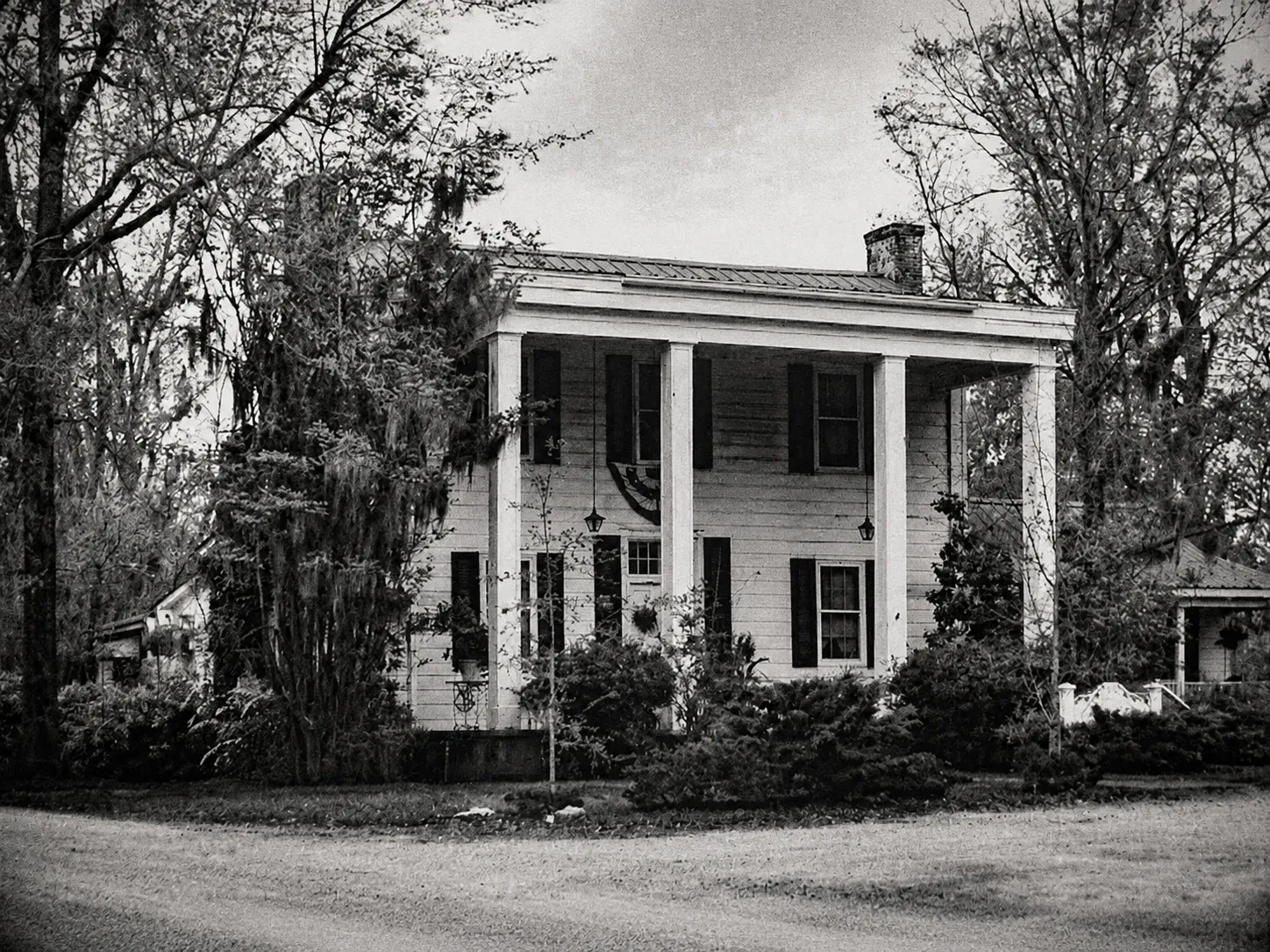
Gaines Ridge Dinner Club sits at the end of a quiet gravel drive outside Camden, Alabama. For nearly four decades, diners there have left with more than a full stomach — many swear they’ve heard a woman scream, a baby cry, or the phantom smell of pipe smoke drifting through a room where no one has lit a match in over a century.
Part of a nearly 200-year-old antebellum home, this unassuming Southern restaurant has earned a reputation that has nothing to do with its award-winning pie and everything to do with the presences its owners say never left.
Summary
Key Takeaways
| Attribute | Details |
|---|---|
| Name | Gaines Ridge Dinner Club (also known historically as the Hearn Place or Hearn Home) |
| Location / Origin | 933 Alabama Route 10, Camden, Wilcox County, Alabama, 36726 |
| Classification | Intelligent, Residual (based on reported voice-response and recurring unexplained sounds/smells; no independent paranormal investigation has formally classified the activity) |
| History | Built 1827–1837 for Rev. Ebenezer Hearn; passed through owners after his 1862 death; bought by the Fail family in 1898; vacant and deteriorating after World War II; restored and opened as a restaurant in 1985 |
| Manifestations | Auditory (screaming, crying, a voice calling a name, an unexplained fall), Olfactory (pipe smoke), Visual (a floating female figure, a man in black seen in mirrors) |
| First reported sighting | Family accounts place the earliest experiences in the restaurant’s opening years (mid-1980s), with Betty Gaines Kennedy also recalling odd occurrences from childhood in the house |
| Threat Level | 1/10 (harmless) [See the Threat Level Explanation] |
| HCR | 6/10 (Leans fabricated) [See the Hoax Confidence Rating Explanation] |
| Access Status | Yes — open to the public as a working restaurant, Thursday–Saturday, 5:30–9 p.m.; closed October 31–November 2 annually; reservations required for private events |
What Is the Gaines Ridge Dinner Club Haunting?
The Gaines Ridge Dinner Club haunting refers to a long-running series of unexplained sounds, smells, and apparitions reported inside the historic Hearn Home in Camden, Alabama — the building that now houses the restaurant.
Rather than centering on a single ghost story, the haunting is best understood as a cluster of frequent, decades-old experiences reported independently by the restaurant’s owners, staff, and guests: a woman’s scream with no discernible source, the persistent cries of an infant when no children are present, the smell of pipe tobacco in an empty upstairs room, a woman seen floating past the windows at night, and the apparition of a tall, gaunt, bearded man in black sometimes glimpsed in mirrors or hallways.
What separates Gaines Ridge from typical roadside ghost lore is the consistency of the witnesses. The claims don’t come from a single self-published account or an anonymous internet post — they come from the family that has owned the house since 1898 and operated it as a restaurant since 1985, repeated over more than thirty years to reporters, tourism officials, and paying customers who had no reason to expect a haunted dinner.
Co-founder Betty Gaines Kennedy, who ran the restaurant for over three decades, was famous for insisting the stories weren’t tall tales at all. As she put it in a promotional video for Alabama’s Ghost Trail, it isn’t a ghost story — it’s a “ghost truth.”
The house itself predates the Civil War, has survived multiple owners, a period of abandonment after World War II, and a full restoration in the 1980s — a long and well-documented history that gives the haunting an unusually solid historical foundation compared to most restaurant ghost stories.
The House Before the Hauntings
Long before it served steaks and seafood, the property was the residence of Rev. Ebenezer Hearn, a man whose life reads like frontier Alabama history in miniature.
Born in 1794, Hearn fought as a soldier in both the War of 1812 and the Creek War, serving under Andrew Jackson, before turning to the ministry. He became the first Methodist minister formally assigned to the Alabama Territory by the Methodist Tennessee Conference, preaching his first sermon in the territory at Bear Meat Cabin — present-day Blountsville — in April 1818.
Over the following years, Hearn rode a punishing circuit across the frontier, organizing Methodist churches in Shelby, St. Clair, Jefferson, Tuscaloosa, and Cotaco (now Morgan) counties. He founded more Methodist congregations in Alabama than any other individual of his era, a distinction that earned him the long-lasting title “Father of Methodism in Alabama.”
In 1822 he married Mary Walker, and the couple eventually settled permanently in Camden, where their home — sources place its construction between 1827 and 1837 — became known simply as the Hearn Place. Mary died in 1858 and Ebenezer in 1862; both are buried in Camden Cemetery, only a short distance from the house they built together.
There’s a quiet irony worth noting here for anyone drawn to the paranormal side of the story: the man some visitors believe still walks the halls in a dark coat spent his entire life traveling the Alabama wilderness to build churches. If the tall, bearded entity reported by guests really is Hearn, he would be a minister who, in death as in life, never quite managed to leave his post.
The property’s architecture also tells its own story. The original structure is a two-story I-frame house with a hall-and-parlor floor plan and Federal-style interior detailing — a fairly modest, functional design typical of early Alabama Black Belt homes, rather than the grand plantation-style mansion the word “antebellum” might conjure.
From the Fail Family to Gaines Ridge Dinner Club
After Ebenezer Hearn died in 1862, the home changed hands several times until 1898, when it was purchased by David John Fail Jr. and his wife, Elizabeth Newsom Fail.
The house remained in the Fail family for generations. In the early twentieth century, it underwent a significant remodel: the four columns that now front the structure were added, and the original small stooped porch was transformed into the columned façade recognizable today. In 1941, the home’s separate detached kitchen — a common feature of nineteenth-century Southern houses, kept apart from the main structure to reduce fire risk — was physically rolled on logs and attached to the main house.
Shortly after World War II, the family began renting the home to outside tenants. Eventually it sat vacant and slid into disrepair, a fate that befell countless historic homes across the rural South during the mid-twentieth century as families moved toward towns and cities.
The house’s fortunes reversed in 1985, when Fail family descendants Betty Gaines Kennedy and her sister, Haden Gaines Marsh, who had grown up in the home, decided to restore it rather than let it continue to decay. Neither sister had restaurant experience, and by Kennedy’s own account, most people who heard the plan gave the venture about six months before it folded.
Instead, the sisters opened Gaines Ridge Dinner Club in October 1985, naming it after their family surname — the Gaines family traces its Alabama roots to the territorial period and counts among its relatives George Strother Gaines and General Edmund Pendleton Gaines, two brothers who played prominent roles in early Alabama history.
Haden co-owned the restaurant for only its first year before Betty took over full operation in 1986. Kennedy ran Gaines Ridge for more than three decades before retiring in 2019, at which point her son Wes Kennedy, daughter-in-law Libby, and grandson Zach took over — keeping the restaurant and its ghost stories in the same family for well over a century.
Today the restaurant seats roughly 100 guests across five separate dining rooms, decorated with period antiques, oxen yokes, washboards, quilts, and other artifacts evoking the home’s nineteenth-century roots. One big example: Gaines Ridge has never advertised in any traditional sense; its reputation, both culinary and paranormal, has spread almost entirely by word of mouth and the occasional feature from Alabama’s tourism department.
The Ghosts of Gaines Ridge
The reported phenomena at Gaines Ridge fall into a fairly consistent set of categories, repeated by different witnesses across different decades — a pattern that has helped cement the restaurant’s status on Alabama’s paranormal tourism circuit.
- The screaming woman. Multiple guests and staff members over the years have described hearing a woman’s scream with no identifiable source. Betty Kennedy herself recounted one especially unnerving version of this. While working alone in the restaurant one night, aside from the cook, she heard a voice calling out her name. When she asked the cook whether she had called her, the cook said no — but confirmed she had heard the same voice.
- The crying baby. Guests and employees have reported hearing an infant crying somewhere in the house even when no children are on the premises. Some in the Kennedy-Gaines family have connected this to the tragic crib death of a Gaines ancestor within the historic house. However, this remains an informal family theory rather than a documented case.
- Pipe smoke with no smoker. In the restaurant’s early days, both Betty Kennedy and Haden Gaines Marsh independently reported smelling pipe tobacco smoke in an upstairs room where no one had been smoking — a detail that has stayed consistent in the family’s retelling since the 1980s.
- A woman floating past the windows. Perhaps the most photographed and repeated claim: several guests have reported seeing a woman seemingly floating outside the dining room windows at night, only to find no one there after investigation.
- The man in black. Some visitors report glimpsing a tall, gaunt, bearded man dressed in black, occasionally described as appearing in mirrors rather than as a solid entity in a room. Given the home’s history, speculation has long centered on Rev. Ebenezer Hearn himself. However, no one has ever definitively connected the sighting to him.
- The falling sound with no fall. In one frequently retold incident, diners and a server heard what sounded like someone falling hard inside a restroom — hard enough to rattle the door — only to find the room empty and nothing disturbed or knocked from the walls.
Owner Betty Kennedy’s own approach to these events became something of a house motto over the years. Rather than treating them as folklore to entertain diners, she maintained they were simply part of daily life at Gaines Ridge: anything unexplained that happened at the restaurant, she said, got blamed on the ghost — and she was convinced there was more than one.
Discover More Hauntings:
Is the Gaineswood Plantation Haunting Real or Just Southern Folklore?
September 18, 2025
The 9 Most Haunted Hotels in Arkansas You Can Still Visit
October 8, 2025
Is the LaLaurie Mansion Haunting Real?
October 24, 2025
The Winchester Mystery House Haunting: The Real Story
October 23, 2025
Hell’s Gate Bridge Haunting: From Tragic Deaths to Demonic Portals
September 23, 2025
Betty Gaines Kennedy and the “Ghost Truths”
Much of what the public knows about the Gaines Ridge haunting traces back directly to Betty Gaines Kennedy, who ran the restaurant from 1986 until her retirement in 2019. Kennedy grew up in the house when it was still known as the Hearn Place, decades before she and her sister converted it into a restaurant, giving her a rare vantage point: she experienced the home’s strange occurrences both as a child living there and later as a business owner responsible for reassuring nervous customers and staff.
Kennedy became a fixture of Alabama’s Ghost Trail, a state tourism promotion highlighting historic haunted sites, and appeared in interviews describing her encounters with a plainspoken, matter-of-fact tone rather than theatrical flourish — a style that likely contributed to the restaurant’s credibility among skeptics and believers alike.
She was known for drawing a sharp distinction between a “ghost story,” which implies embellishment, and what she called a “ghost truth” — something she insisted had genuinely happened to her, regardless of whether it could be explained.
Her matter-of-fact approach extended to staff as well: longtime server Deborah Dailey, describing the sheer range of events the restaurant caters, once summed up its role in the small Wilcox County community bluntly — from baby showers to funerals, the restaurant, in her words, handles guests “from birth to burial.”
Gaines Ridge Dinner Club vs. Other Haunted Historic-Home Restaurants & Inns
| Name | Location | Type of Haunting | Activity Level |
|---|---|---|---|
| Gaineswood | Demopolis, Alabama | Intelligent, Crisis Apparition | 4/10 (occasional) |
| St. James Hotel | Selma, Alabama | Intelligent, Residual | 7/10 (very active) |
| Drish House | Tuscaloosa, Alabama | Residual, Intelligent | 5/10 (occasional) |
| Oakleigh House Museum | Mobile, Alabama | Residual, Intelligent | 4/10 (occasional) |
| Sweetwater Mansion | Florence, Alabama | Intelligent, Residual | 5/10 (occasional) |
| Rawls Restaurant (former Rawls Hotel) | Enterprise, Alabama | Intelligent, Poltergeist | 4/10 (occasional) |
| Trowbridge’s | Florence, Alabama | Residual | 3/10 (dormant) |
| Lucas Tavern | Old Alabama Town, Montgomery, Alabama | Intelligent | 3/10 (dormant) |
| Grace Hall | Selma, Alabama | Intelligent | 4/10 (occasional) |
| Cedarhurst Mansion | Huntsville, Alabama | Intelligent, Residual | 4/10 (occasional) |
| The Olde Pink House | Savannah, Georgia | Intelligent | 7/10 (very active) |
| The Pirates’ House | Savannah, Georgia | Intelligent, Residual | 6/10 (occasional) |
| Muriel’s Jackson Square | New Orleans, Louisiana | Intelligent, Poltergeist | 7/10 (very active) |
| Brennan’s | New Orleans, Louisiana | Poltergeist, Intelligent | 5/10 (occasional) |
| King’s Tavern | Natchez, Mississippi | Intelligent, Crisis Apparition | 7/10 (very active) |
| McRaven House | Vicksburg, Mississippi | Intelligent, Poltergeist | 8/10 (very active) |
Visiting Gaines Ridge Dinner Club Today
Gaines Ridge Dinner Club remains a working restaurant, not a tourist attraction built around its ghost stories, which is part of what has kept its reputation grounded rather than gimmicky. It is located at 933 Alabama Route 10 (also referenced as Highway 10 E) just outside Camden, the seat of Wilcox County, a rural Black Belt county with a population of roughly 10,000 people. The restaurant is open Thursday through Saturday from 5:30 p.m. to 9 p.m., with additional evenings available by reservation for private events such as weddings, class reunions, and business functions.
Interestingly, the restaurant is closed every year from October 31 through November 2 — spanning Halloween, All Saints’ Day, and Día de los Muertos — the very days when folklore across multiple cultures has it that the boundary between the living and the dead grows thin. Whether this is coincidence, tradition, or a quiet nod to the house’s reputation has never been officially explained by the family.
Beyond the ghost lore, Gaines Ridge is genuinely well regarded for its food, particularly its Black Bottom Pie — a layered dessert of chocolate custard, rum custard, and whipped cream that earned a spot on the Alabama Tourism Department’s list of “100 Alabama Dishes to Eat Before You Die.”
The pie’s Southern pedigree runs deep: it was featured decades earlier by Mobile-born author Eugene Walter in his 1971 contribution to the Time-Life Foods of the World series, American Cooking: Southern Style. Diners can also expect scratch-made steaks, a seafood-heavy menu reflecting the region’s proximity to the Alabama River, and classic Southern sides — a menu built for generations of regulars rather than paranormal tourists.
For those planning a trip through Alabama’s Black Belt in search of the state’s ghost lore, Gaines Ridge is often paired with Gaineswood, the Greek Revival plantation home turned museum in nearby Demopolis, which has its own separate and long-documented haunted history.
Together, the two sites form one of the more historically substantiated stretches of Alabama’s paranormal tourism trail — places where the ghost stories are inseparable from genuine, well-documented nineteenth-century history rather than invented for effect.
Discover More Hauntings:
Is My Home Haunted or Just Old? How to Tell the Difference
September 5, 2025
6 Real Haunted Houses in Arkansas with Chilling True Stories
October 8, 2025
Sources
- Kiley Seymour, Philipp Sterzer, Natalie Soto. Believing is seeing: The link between paranormal beliefs and perceiving signal in noise. Consciousness and Cognition. Volume 106, 2022, 103418, ISSN 1053-8100.
- van Lutterveld, Remko et al. The neurophysiology of auditory hallucinations – a historical and contemporary review. Frontiers in psychiatry vol. 2 28. 16 May. 2011, doi:10.3389/fpsyt.2011.00028.
- Shiver, Joshua. Gaines Ridge Dinner Club. Encyclopedia of Alabama, Alabama Humanities Alliance / Auburn University, 24 Jan. 2020, updated 21 Oct. 2024.
- Kornegay, Jennifer. Worth the Drive: Gaines Ridge. Alabama Living Magazine, 25 Nov. 2014.
- Transcript of the autobiography of Ebenezer Hearn. Alabama Department of Archives and History.