Drish House has been called one of the most haunted buildings in the American South, a title it earned not through Hollywood embellishment but through more than a century of witness reports tied to a single, specific phenomenon: ghostly fire that flickers in a tower window where no fire has ever actually burned.
Long before “haunted history” content became a genre of its own, the Greek Revival mansion in Tuscaloosa, Alabama, was already the subject of a widely read folklore book, a federal architectural survey, and decades of newspaper coverage documenting its slow decline and eventual rescue.
What makes the Drish House haunting worth examining closely isn’t just the ghost story itself, but how thoroughly that story is woven into a real, documented, and at times genuinely painful history.
Summary
Key Takeaways
| Attribute | Details |
|---|---|
| Name | Drish House (also known as the Dr. John R. Drish House; officially listed on the National Register of Historic Places as the Jemison School–Drish House) |
| THC Scale | L-1 [See the THC Scale Explanation] |
| Location / Origin | 2300 17th Street, Tuscaloosa, Alabama (33°11′51″N, 87°33′43″W) |
| Classification | Residual |
| History | Built in 1837 for Dr. John R. Drish; Dr. Drish died in 1867 after a fall down the home’s staircase; his widow, Sarah Drish, died in 1884, reportedly after her wish for a candlelit tower vigil at her own funeral went unfulfilled |
| Casualties & Deaths | 2 confirmed historical deaths (John Drish, 1867; Sarah Drish, 1884) + 0 deaths documented as directly attributed to the entity; Sarah Drish is regarded in the legend as the haunting’s origin, not its victim |
| Manifestations | Visual (flickering, fire-like light in the tower window; occasional reports of a “woman in white”); Environmental (cold spots reported by staff and event guests) |
| First reported sighting | Historical documentation states hauntings were reported “since the early 20th century,” but no specific first date is recorded |
| Threat Level | 1/10 (harmless) [See the Threat Level Explanation] |
| HCR | 5/10 (Neutral) [See the Hoax Confidence Rating Explanation] |
| Access Status | Yes — Drish House operates as a private event venue and offers scheduled tours, including ghost-focused tours; access outside of booked events or tours is not permitted |
What Is the Drish House Haunting?
The Drish House haunting refers to a set of paranormal claims centered on the Dr. John R. Drish House at 2300 17th Street in Tuscaloosa, Alabama, most prominently a regular sighting known locally as the “death lights in the tower.” Witnesses over more than a century have reported seeing what looks like flames or a flickering, candlelit glow inside the mansion’s three-story brick tower, only for firefighters or investigators to arrive and find no fire, no smoke damage, and no rational source for the light.
The haunting is traditionally attributed to Sarah Drish, the widow of the home’s original owner, physician and building contractor Dr. John R. Drish. According to the legend first published in the 1969 folklore collection 13 Alabama Ghosts and Jeffrey by Kathryn Tucker Windham and Margaret Gillis Figh, Sarah held her husband’s wake in the home’s tower after his sudden death in 1867, surrounding his body with candles.
When she died seventeen years later, in 1884, she reportedly asked that the same candlelit tower vigil be repeated for her own funeral. Family members did not fulfill that wish, and Sarah’s spirit is said to have been returning to the tower ever since, manifesting as the ghostly lights that generations of Tuscaloosa residents have reported seeing.
Beyond the tower lights, the broader “haunting” label attached to Drish House also encompasses secondary reports collected over the decades: sightings of a woman in white on the grounds or in upper windows, cold spots and unexplained sounds reported by staff and event guests, and local rumors — never substantiated by any historical record — that the property sits on a Native American burial ground or that Drish struck some kind of supernatural bargain during his life.
The Real History of Drish House and the Family Behind It
Drish House was built in 1837 for Dr. John R. Drish, a Virginia native who had settled in Tuscaloosa in 1822 and built a successful career as both a physician and a building contractor.
He constructed the mansion at the center of a 450-acre plantation on the edge of what was then Alabama’s state capital — Tuscaloosa held that role from 1826 to 1846, before the capital moved permanently to Montgomery — placing the house at the heart of the young city’s most formative civic period. The house was completed the same decade the University of Alabama opened its doors in 1831, just a few miles from the property.
In 1835, two years before the house was finished, Drish — a widower — married Sarah Owen McKinney, a wealthy widow in her own right. His dual career as physician and building contractor put him in direct control of an enslaved workforce skilled in plasterwork and construction; historical architecture surveys credit these enslaved artisans with executing much of the earliest ornamental plasterwork found throughout Tuscaloosa, not just inside the Drish home itself, meaning the same hands that built the “haunted” mansion likely shaped other surviving landmarks across the city.
The original 1837 structure is credited to the influence of state architect William Nichols and featured full-width, monumental Doric porticoes on the front and rear facades, with two-story pilasters dividing each bay on all four sides.
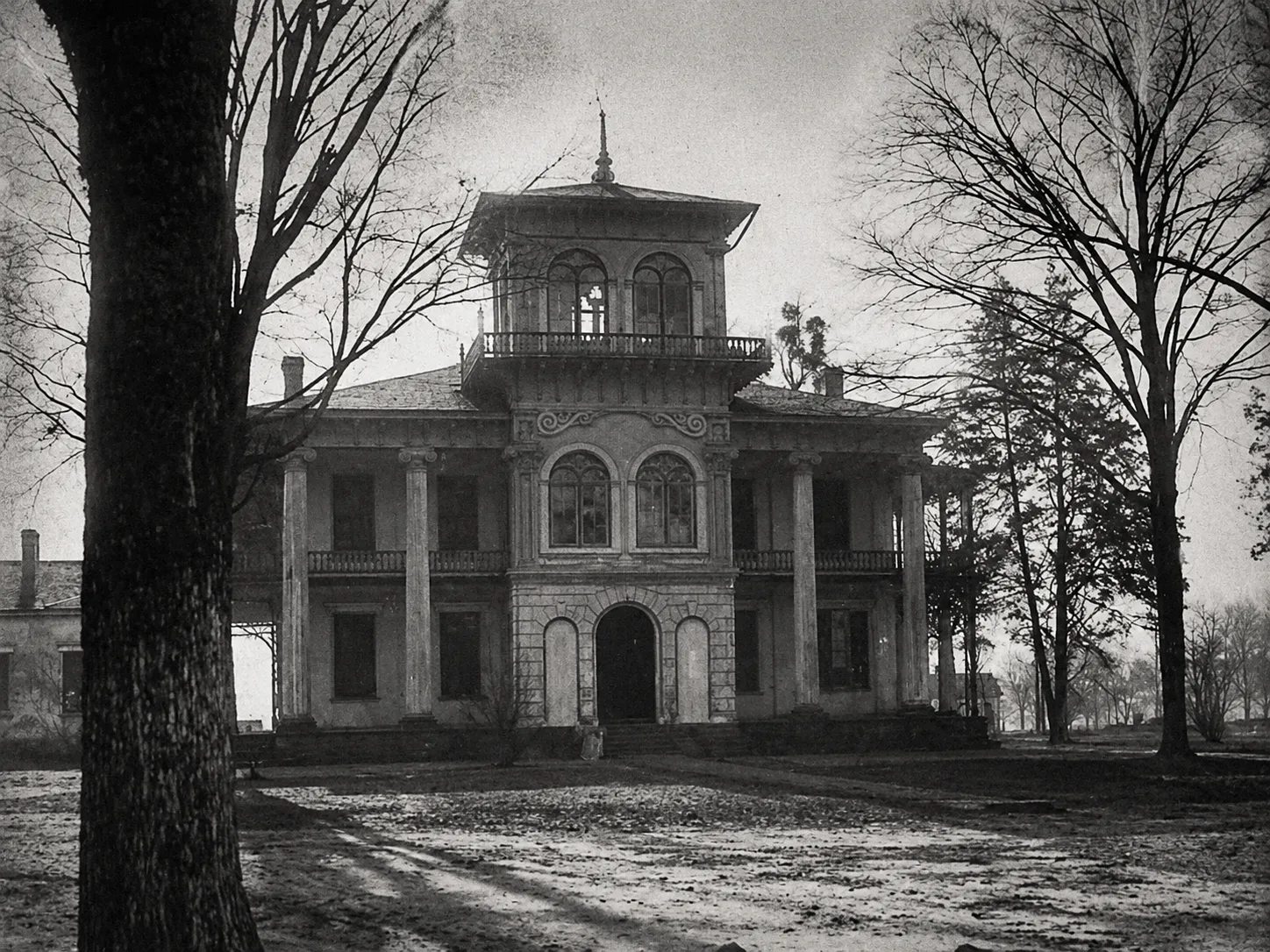
Before the Civil War, the home underwent a significant Italianate-style remodel: the front columns were changed to the Ionic order, decorative brackets were added beneath the eaves, two-story cast-iron porches were installed on each side, and — most importantly for the haunting legend — a three-story brick tower was added to the structure.
Architectural historians, including Robert Gamble in his reference work The Alabama Catalog: A Guide to the Early Architecture of the State, consider the finished house one of the most distinctive blends of Greek Revival and Italianate design anywhere in Alabama, a hybrid style that is itself something of a rarity in the region’s antebellum architecture.
The Death of Dr. Drish and Sarah’s Tower Vigil
John Drish died in 1867, reportedly after falling down a stairway inside the home. Sarah Drish lived another seventeen years, dying in 1884.
The wake-and-tower story that anchors the modern haunting legend — Sarah lighting the tower with candles for her husband’s vigil, then dying without her own wish for the same tribute being honored — comes down to us primarily through oral tradition later formalized in print by Windham and Figh’s 1969 folklore collection, rather than through contemporaneous newspaper accounts or estate records.
The distinction matters: the deaths of John and Sarah Drish are documented historical facts, drawn from public record and confirmed through the Historic American Buildings Survey, while the specific candlelit-wake narrative belongs to the realm of local legend passed down across generations before being preserved in book form more than eighty years after Sarah’s death.
“Death Lights in the Tower”
The tower-lights phenomenon is the single detail that elevated Drish House from a locally known haunted address to a story with statewide and eventually national reach. The account was formally titled “Death Lights in the Tower” when it appeared as one of thirteen stories across 120 pages in 13 Alabama Ghosts and Jeffrey, a collection that became a staple of Southern folklore literature and introduced generations of Alabama schoolchildren and readers to the state’s most famous haunted locations.
The book’s title character, “Jeffrey,” is itself a detail most retellings of the Drish House story leave out entirely, even though it explains why the book carries the authority it does in Alabama folklore circles. Jeffrey was an allegedly real ghost that Windham said began haunting her own home in Selma, Alabama, in October, acting as what she described as her collaborator on the ghost-story collections that followed.
During a Ouija board session held by young visitors to the Windham house who were trying to contact the entity, a photograph taken that night reportedly captured a dark, shadowy, vaguely human-shaped blot that Windham and others associated with Jeffrey. That image, and the reputation it built, helped turn Windham into one of the most trusted names in Southern ghost-story collecting, which is part of why “Death Lights in the Tower” was taken seriously enough to spread well beyond Tuscaloosa.
Windham herself brought considerable journalistic credibility to the project. Born in Selma in 1918 and a graduate of Huntingdon College in 1939, she spent four decades as a newspaper reporter, covering events from the Great Depression through the Civil Rights Movement at ground level in Selma, before later becoming a nationally recognized storyteller with thirty-three appearances on NPR’s All Things Considered.
13 Alabama Ghosts and Jeffrey was successful enough to spawn a seven-book “Jeffrey” series covering Georgia, Mississippi, and Tennessee ghost stories as well, selling hundreds of thousands of copies in total. In an odd twist that adds another layer to the collection’s own lore, the original publisher, Strode Publishers, was later destroyed by fire. The books went out of print for several years before the University of Alabama Press acquired and reissued them.
What separates the Drish House legend from countless generic “orbs and cold spots” haunted-house claims is its specificity and repetition across independent eras: the sightings were reported not just by twentieth-century ghost hunters primed to expect them, but by residents living near the property across multiple decades and multiple uses of the building, long before Drish House became a tourism attraction.
That consistency — the same tower, the same fire imagery, the same lack of a physical cause — is what has kept the story alive in regional folklore for well over a hundred years.
Discover More Hauntings:
What Are the 14 Types of Hauntings? Everything You Need to Know
September 4, 2025
Is the Kali Oka Plantation Haunting Real?
May 13, 2025
The Haunting of Edmund King House: Alabama’s Most Storied Ghost
September 3, 2025
From Plantation Home to Public School to Auto Parts Warehouse
One of the most interesting chapters of Drish House’s story is how many unrelated institutional lives the building lived after the Drish family departed. Following Sarah Drish’s death, the surrounding 450-acre plantation was sold and subdivided, forming part of Tuscaloosa’s first major residential expansion beyond its original town boundaries.
The house itself changed private hands several times before the Tuscaloosa Board of Education purchased it and opened the Jemison School inside the mansion in 1906, one of the area’s earliest public schools. The building served as a school until 1925 — meaning the “haunted” mansion spent nearly two decades filled daily with schoolchildren rather than standing empty, a detail that complicates the image of a perpetually abandoned, foreboding structure.
After the school closed, the mansion was purchased for use as a parts warehouse by Charles Turner’s Tuscaloosa Wrecking Company. It was during this unlikely chapter — a once-grand antebellum mansion converted into an auto-salvage warehouse — that photographer Walker Evans captured his now-famous 1935 or 1936 image of the building, formally cataloged as “Converted Italianate Revival House Behind Fence, Wrecking Company Near Tuscaloosa, Alabama.”
Evans was working for the Farm Security Administration at the time, documenting the effects of the Great Depression on American life. His photograph of the decaying, repurposed mansion is now held in the permanent collection of the Metropolitan Museum of Art, making Drish House one of the few reputedly haunted American homes with a direct connection to a major museum’s photography holdings.
In 1940, the property entered its fourth distinct identity when it was purchased by Southside Baptist Church, which used the mansion as the core of its worship facilities for the next fifty years, adding a sanctuary against one side of the house and a detached Sunday school building nearby. The church retained the property until it became defunct in the 1990s.
Across its full lifespan, then, Drish House has functioned as a private residence, a public school, an industrial warehouse, and a house of worship, in addition to its current role as an event venue — a chain of adaptive reuse that is unusually well documented for a Southern antebellum property of its size.
Other Paranormal Reports Associated With the House
While the tower lights remain the signature phenomenon, additional reports have accumulated around Drish House over the decades, particularly since it reopened to the public. Visitors and staff have described sightings of a woman in white believed to represent Sarah Drish, along with unexplained cold spots and sounds reported during events and tours held inside the restored building.
Quick note: many of these more recent accounts originate from staff, vendors, and guests attending weddings and other functions at the now-operating event venue, rather than from investigators exploring an abandoned structure — a useful piece of context when weighing how and when different categories of the legend developed.
Local storytelling has also attached a separate, unverified tale to the tower involving someone allegedly hidden and later burned inside it, with some claiming to see flames connected to that story specifically. No historical record supports the idea that Drish House has ever actually caught fire, and this narrative appears to be a folkloric elaboration on the death-lights legend rather than a distinct, documented event.
Near-Demolition and the Fight to Save Drish House
The building’s twentieth-century decline nearly ended in its destruction. After Southside Baptist Church vacated the property, Drish House faced a demolition threat in 1994.
Former church members instead arranged to lease it to the Heritage Commission of Tuscaloosa County in 1995. By 2006, the structure had deteriorated badly enough to be added to the “Places in Peril” listing by the Alabama Historical Commission and the Alabama Trust for Historic Preservation. The Tuscaloosa County Preservation Society took ownership in July 2007. It stabilized the structure and later demolished the church’s added sanctuary and Sunday school buildings in 2009 to restore the mansion’s original footprint.
The house’s architectural and historical significance had actually been recognized long before the rescue effort: it was first documented by the federal Historic American Buildings Survey in 1934 under catalog number HABS AL-201, which produced nine photographs, six measured drawings, and seven pages of written data on the structure. It was added to the Alabama Register of Landmarks and Heritage on July 31, 1975, and eventually listed on the National Register of Historic Places on March 17, 2015, under the name Jemison School–Drish House, with the reference number 14000357.
Discover More Hauntings:
The Complete List of All Haunted Places in Arkansas
October 8, 2025
The Complete List of All Haunted Places in Connecticut
December 2, 2025
Hell’s Gate Bridge Haunting: From Tragic Deaths to Demonic Portals
September 23, 2025
Bryce Hospital Haunting: Alabama’s Most Haunted Asylum
September 19, 2025
Drish House vs Other Haunted Locations
| Name | Location | Type of Haunting | Activity Level |
|---|---|---|---|
| Myrtles Plantation | St. Francisville, Louisiana | Intelligent, Residual | 9/10 (very active) |
| Sturdivant Hall | Selma, Alabama | Residual, Intelligent | 5/10 (occasional) |
| Gaineswood | Demopolis, Alabama | Residual | 4/10 (occasional) |
| Bragg-Mitchell Mansion | Mobile, Alabama | Residual | 4/10 (occasional) |
| Oakleigh Mansion | Mobile, Alabama | Intelligent, Residual | 5/10 (occasional) |
| Battle-Friedman House | Tuscaloosa, Alabama | Residual | 3/10 (dormant) |
| Sorrel-Weed House | Savannah, Georgia | Intelligent, Residual | 8/10 (very active) |
| Kehoe House | Savannah, Georgia | Intelligent | 6/10 (occasional) |
| Bellamy Mansion | Wilmington, North Carolina | Residual | 4/10 (occasional) |
| Stanton Hall | Natchez, Mississippi | Residual | 4/10 (occasional) |
| Longwood | Natchez, Mississippi | Residual | 4/10 (occasional) |
| Rosalie Mansion | Natchez, Mississippi | Residual, Intelligent | 5/10 (occasional) |
| Lemp Mansion | St. Louis, Missouri | Intelligent, Poltergeist | 8/10 (very active) |
| Whaley House | San Diego, California | Intelligent, Residual | 8/10 (very active) |
Note: Activity Level ratings are editorial estimates based on the general volume and consistency of reported paranormal claims associated with each location.
Drish House Today
In 2012, the property was purchased by Nika McCool of Past Horizons LLC, and extensive renovations to both the exterior and interior continued through May 2016, when the mansion reopened as an event venue for weddings, receptions, and private functions. It also now hosts guided tours, including ghost-focused tours that draw directly on the death-lights legend, giving visitors a chance to view the tower where Sarah Drish’s vigil is said to have taken place.
The Drish House haunting persists for a reason that has little to do with special effects or modern ghost-hunting equipment: it is anchored to a real family, a real death, a real building that changed hands and purposes again and again, and one persistent, specific, unexplained detail — a light in a tower window — reported by ordinary people across more than a century.
My Take on the Drish House Haunting
Having gone through the documented history alongside the folklore, I don’t think Drish House needs to be either “definitely haunted” or “definitely explainable” — I think the honest answer sits somewhere in the friction between the two, and that friction is actually what makes the case interesting.
On the paranormal side, what keeps me from dismissing this one outright is the consistency of the core claim. Most haunted-house legends accumulate a grab-bag of unrelated phenomena over time — footsteps, voices, shadow figures, cold spots — until the story becomes so broad it’s unfalsifiable. Drish House’s central claim has stayed narrow and specific for over a century: a fire-like light in one particular tower, with no fire ever found.
Stories that resist mutation over multiple generations and multiple independent witnesses tend to be either embedded in a genuinely repeatable experience, or built around a genuinely repeatable physical trigger. Both possibilities are worth taking seriously.
That’s where my more grounded theory comes in. The tower’s windows are original or early architectural glass, and antique glass of that era was manufactured through processes that left it wavy, uneven, and full of small optical imperfections.
Light passing through glass like that — headlights from 17th Street, streetlamps, a passing storm’s lightning, or even the shifting angle of a sunset — can refract and scatter in ways that genuinely do look like a flickering, moving flame from a distance, especially at night when the eye has little else to compare it to. I’d also point to simple line-of-sight illusions: a tower is a raised, glassed structure that catches ambient light differently than the rest of a building, so it’s statistically likely to be the site of unusual-looking light regardless of who owned the house or how they died.
The second piece of my theory is psychological rather than optical. Sarah Drish’s grief is one of the more emotionally specific stories in Southern ghost folklore—it isn’t a vague “woman in white”; it’s a widow who wanted one particular tribute and didn’t receive it. That kind of narrative detail is exactly the sort of thing that primes an observer’s expectations.
Controlled studies on haunted-location tours have shown that visitors told in advance that a site is haunted report significantly more unusual sensations and sightings than visitors given no such framing, even when touring the same space under the same conditions. I think something similar has been happening at Drish House for decades: once “the tower catches fire but never burns” became the story everyone knew before they even looked up, ordinary reflections and light tricks had a ready-made narrative to slot into.
None of this is meant to flatly debunk the haunting — I genuinely can’t rule out that something less explainable is going on. I’d rather stay honest about that uncertainty than pretend either side has it fully solved.
My personal read is that Drish House earns its reputation less because a ghost is provably haunting a tower, and more. After all, it sits at a rare intersection: real antique architecture prone to unusual light behavior, a documented family tragedy with an emotionally precise legend attached to it, and over a hundred years of storytellers, from Kathryn Tucker Windham onward, who understood exactly how to make that intersection unforgettable.
Discover More Hauntings:
The 9 Most Haunted Hotels in Arkansas You Can Still Visit
October 8, 2025
The Winchester Mystery House Haunting: The Real Story
October 23, 2025
Belle Mont Mansion Haunting: Ghosts of Slavery and Tragedy
September 23, 2025
The Complete List of All Haunted Places in Arizona
October 7, 2025
9 Haunted Houses in Arizona That Hold Terrifying Secrets
October 7, 2025
Top 11 Most Haunted Houses in Delaware
December 1, 2025
Sources
- Windham, Kathryn Tucker, and Margaret Gillis Figh. 13 Alabama Ghosts and Jeffrey. Strode Publishers, 1969.
- Gamble, Robert. The Alabama Catalog: A Guide to the Early Architecture of the State. University of Alabama Press, 1987.
- Cardeña, Etzel. (2018). The Experimental Evidence for Parapsychological Phenomena: A Review. American Psychologist. 73. 663-677. 10.1037/amp0000236. ResearchGate.
- Dr. John H. Drish House, 2300 Seventeenth Street, Tuscaloosa, Tuscaloosa County, AL. Historic American Buildings Survey, HABS No. AL-201, Library of Congress, 1934.
- Jemison School-Drish House. National Register of Historic Places Registration Form, National Park Service.
- Evans, Walker. Converted Italianate Revival House Behind Fence, Wrecking Company Near Tuscaloosa, Alabama. 1935–36, Metropolitan Museum of Art, New York.
- Pirvulescu, Sergiu. (2021). The existence of paranormal phenomena. ResearchGate.
- Wilson, Krissy & French, Christopher. (2006). The relationship between susceptibility to false memories, dissociativity, and paranormal belief and experience. Personality and Individual Differences. 41. 1493-1502. 10.1016/j.paid.2006.06.008. ResearchGate.
- A brief timeline of UA’s history. The University of Alabama.