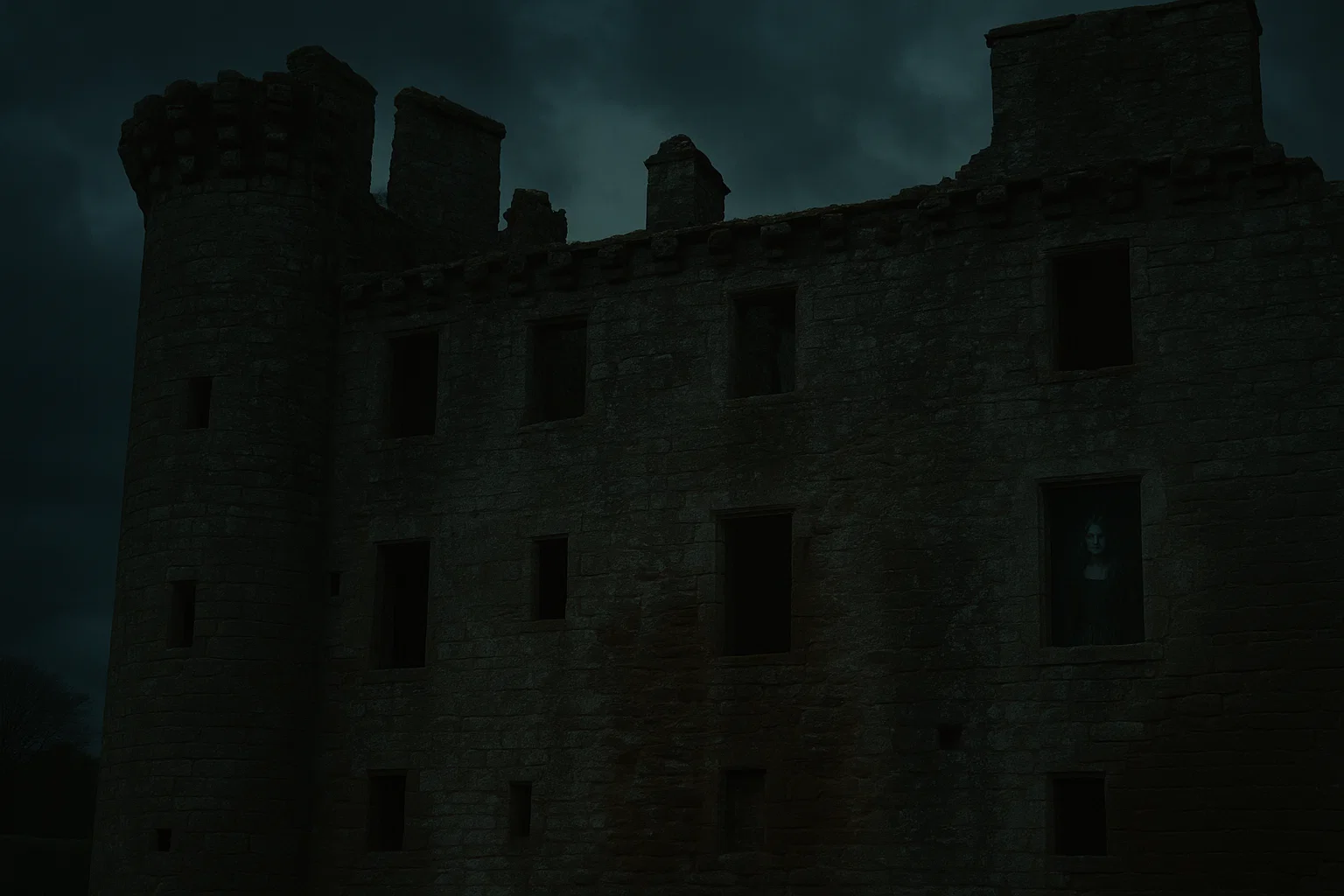
In the wetlands of Dumfries and Galloway stands Scotland’s only triangular, moated castle, home to the mysterious Green Lady of Caerlaverock.
However, this alleged ghost is more than just a simple apparition. It reflects a unique mix of local history and environmental factors that have intrigued researchers for years. What makes the green lady of Scotland different is how the entity seems to cross the castle’s boundaries, appearing again and again, especially when storms bring sudden drops in air pressure.
Summary
Overview
| Attribute | Details |
| Name | Green Lady of Caerlaverock; alternatively known as the Grey Lady or the Spectral Sentry. |
| THC Scale | L-1 [See the THC Scale Explanation]. |
| Location / Origin | Caerlaverock Castle, Dumfries, Dumfries and Galloway, DG1 4RU, Scotland. |
| Classification | Residual. |
| History | The castle suffered devastating multi-generational sieges, most notably by Edward I in 1300 and by the Covenanters in 1640. |
| Casualties & Deaths | Hundreds of battlefield casualties across multiple historical sieges; no modern injuries or deaths are directly attributed to the entity itself. |
| Lunar / Seasonal Cycle | Slight increase in reported activity during late autumn and winter, matching severe regional coastal depressions. |
| Associated Entities | Phantom medieval soldiers, disembodied cries of battle, the Redcap goblin of local folklore, and the “Good Samaritan” phantom of the nearby coastal Merse. |
| Manifestations | Visual (translucent green and grey apparitions drifting past stone masonry), Environmental (localized drops in temperature). |
| First reported sighting | Sporadic accounts date back to the early 19th-century romantic rediscovery of the ruins. |
| Recent reported sighting | Unverified reports from visitors and regional paranormal research groups during twilight tours. |
| Threat Level | 1/10 (harmless) [See the Threat Level Explanation]. |
| HCR | 4/10 (leans authentic) [See the Hoax Confidence Rating Explanation]. |
| Access Status | Yes. The site is managed by Historic Environment Scotland; standard operating hours apply, and trespassing laws are strictly enforced outside official opening times. |
What Is the Green Lady of Caerlaverock Haunting?
The Green Lady of Caerlaverock is considered a residual haunting, meaning it is thought to be a replay of past events rather than an active ghost that interacts with people. It’s like a recording of old distress, left behind in the castle’s stones and environment.
Interestingly, paranormal investigators still debate whether the Green Lady of Caerlaverock is the well-known Green Lady or the Lady in Grey, which is common in Scottish border castles. Unlike ghosts that seem to interact with people or equipment, this entity always follows the same paths through the castle’s ruins.
People who have seen the Green Lady describe her as a see-through, female shape glowing in green or grey, moving quietly past the upper windows. These sightings often happen when the weather changes quickly, especially during strong coastal storms. Some believe the castle’s iron-rich red sandstone helps store energy from the environment, making these appearances more likely.
Who Is the Green Lady of Caerlaverock?
To understand where the Green Lady of Caerlaverock legend comes from, it helps to look at the castle’s violent history. The Maxwell family built Caerlaverock in the 1270s to defend the Scottish border from English attacks. Its unusual triangular shape soon made it the center of many conflicts.
One of the most famous events happened in July 1300, when King Edward I of England attacked with a huge army. Inside the castle, only 60 Scottish defenders led by Sir Eustace Maxwell stood against them. The castle was bombarded for days by siege engines like the Warwolf, with boulders smashing the walls and arrows and boiling pitch flying everywhere.
When the defenders finally surrendered, the English were amazed at how such a small group had held out. Some stories say King Edward spared the survivors, but other records suggest many were hanged from the very walls they had tried to protect.
Over the centuries, the castle suffered even more damage. The Maxwell family, who were Catholic and loyal to Mary, Queen of Scots, faced many attacks from English Protestant forces in the 1500s. The worst came in 1640, during the Wars of the Three Kingdoms, when Robert Maxwell defended the castle for King Charles I. After thirteen weeks under siege by the Covenanters, the defenders gave up.
To make sure the castle could never be used as a stronghold again, the Covenanters tore down the southern wall and its towers, leaving the inner Nithsdale Lodging open to the weather. The violent change turned a lively palace into a ruin, and many believe this trapped the site’s emotional and physical scars in the stone, setting the stage for the haunting.
You may also enjoy:
What Is a Poltergeist? Definition, Manifestations, and History
January 20, 2026
The Japanese Kappa Monster: A Dark Obsession With Humans
September 9, 2025
The Demon Megaera: Serpents, Blood, and Divine Vengeance
September 1, 2025
Buné: Demon King of Riches and Necromancy
August 12, 2025
Green Lady of Caerlaverock Sightings
Reports of the Green Lady of Caerlaverock have followed a clear pattern, especially as the castle changed from a ruin to a heritage site. In the 1800s and early 1900s, sightings were rare and mostly came from local workers, gamekeepers, or visitors wandering the marshy edges of the estate.
In recent decades, there has been a small but clear increase in strange reports, which matches the rise in visitors and guided tours, suggesting that having more people around may somehow make these ghostly events more likely to happen.
| Date | Witness | Description of the event |
| Autumn 1884 | Local Gamekeeper | Report of a silent, grey-green feminine figure walking along the outer edge of the water-filled moat before vanishing into the reeds. |
| August 1923 | Visiting Antiquarian | Observation of a distinct, cold fog localized inside the ruined Nithsdale Lodging, accompanied by a faint feminine silhouette in the window. |
| June – September 1991 | Seasonal Heritage Warden | Repeated loggings of a recurring “cold vector” drifting across the floor of the Nithsdale Lodging, showing an exact, rapid temperature drop. |
| October 2011 | Historical Re-enactor | Sensation of intense, localized cold spots and a brief visual sighting of a green-hued drapery passing through a solid stone doorway. |
| November 2018 | Twilight Tour Visitor | A digital photograph capturing an anomalous, translucent green form near the foundations of the demolished southern curtain wall. |
The Antiquarian’s Observation (August 1923)
In late summer 1923, an independent antiquarian was surveying the inner courtyard when he experienced something unusual. While sketching the Renaissance carvings, he felt a sudden cold spot that made his breath visible, even though the weather was mild. Looking up, he saw a clear, semi-transparent woman in long, shimmering grey-green clothes near a second-story window.
The account is important because the witness noticed that the entity did not react to him at all. She stared out over the marsh, as if watching something far away, and did not look at him or move in response to his presence. The ghost faded away after about forty-five seconds.
The Warden Diary Log (June – September 1991)
Some of the best information about strange events at the castle comes from a heritage warden’s notes in the summer of 1991. Instead of seeing a ghost, the warden recorded a frequent cold spot that moved across the stone floor of the Nithsdale Lodging during his closing rounds.
The log is especially trustworthy because the warden used a digital thermometer to track the cold spot over several weeks. Each time, the temperature dropped by exactly 4.2°C in just 90 seconds, no matter the weather or whether there were any drafts.
The warden also noticed the air felt thick and heavy, and while he rarely saw a full ghostly shape, the cold spot moved steadily across the hall as if someone was walking. These detailed notes go beyond tourist stories and offer real evidence of strange energy shifts inside the castle.
The Re-enactor’s Encounter (October 2011)
A more recent detailed report came from an autumn educational event at the castle. A historical re-enactor, used to the usual drafts and sounds of old stone buildings, was getting equipment from the ground floor near the gatehouse. As it got dark, he suddenly felt a cold draft moving against the wind and heard a low hum that made him feel anxious and on edge.
When he turned toward the spiral staircase, he saw a quick flash of green out of the corner of his eye. Looking directly, he caught a three-second glimpse of a flowing, emerald-green dress moving through a blocked doorway. Later, he checked the room and found nothing that could have caused the draft or the strange sight.
The sudden anxiety he felt is a common sign of infrasound exposure, which often happens when strong winds move through old stone arches and make people feel uneasy without knowing why.
You may also enjoy:
St. James Hotel Haunting: Civil War Ghosts, Outlaws, and Tragic Spirits
September 22, 2025
Halphas Demon in Ars Goetia – Rank, Powers, and Lore
August 11, 2025
Who Is the Demon Gäap? Powers, Rituals, and Origins
August 21, 2025
Types of Werewolves Ranked by Power and Origin
June 10, 2025
Theories
Residual Stone Tape Theory
The well-known “Stone Tape” theory, made popular by researchers in the 1900s, suggests that some types of stone can record strong emotions or events during times of trauma. Caerlaverock Castle is built from iron-rich, porous red sandstone.
According to this theory, the trauma from the sieges in 1300 and 1640 was like an energy broadcast, and the iron in the stone acted like a magnetic tape, soaking up the fear and sadness. When certain conditions are right, the stone “plays back” these memories, appearing as the Green Lady to people today.
Infrasound and Environmental Priming
A scientific explanation says these ghostly events are caused by sound waves and how they affect people’s bodies. The castle sits on the edge of the windy Caerlaverock National Nature Reserve, where strong coastal winds hit the triangular stone ruins.
Studies show that wind moving through the castle’s towers, stairwells, and windows can create infrasound—sound waves too low for us to hear. Infrasound can make people breathe faster, feel as if someone is nearby, see things out of the corner of their eye, and feel sudden chills, which could explain the sightings without any supernatural cause.
Geoelectric and Piezoelectric Activity
Another theory says the castle’s location creates a special geoelectric field. A deep, wet moat surrounds Caerlaverock and sits next to salty marshes, so its foundations are always in contact with changing water levels and salt.
Tidal changes and the mineral-rich soil can create small underground electrical currents. When these pass through the iron-rich sandstone, they can cause spikes in electromagnetic fields. These fields can affect the human brain and sometimes cause people to see vivid images, like the Lady in Grey.
The 1994 “Curtain Wall” Magnetometer Discrepancy
In the mid-1990s, researchers studying the castle’s foundations found a strange magnetic anomaly. Normally, the iron-rich sandstone has a predictable magnetic level, but scans along the destroyed southern wall showed sudden, sharp spikes that didn’t match the rest of the area.
According to records preserved in the 1994 Dumfries and Galloway Archaeological Monograph Series, these fluctuations were rapid and alternated between positive and negative poles, concentrating precisely where the Covenanters violently dismantled the structural masonry in 1640.
The data support the Stone Tape and geoelectric theories. Instead of blaming a ghost, it suggests that the energy from the wall’s violent destruction changed the way iron particles are arranged in the foundation stones.
When the water level in the moat changes, the salt interacts with the unstable magnetic area, which can create small changes in electromagnetic fields that might cause nearby people to experience minor effects on the brain or see things that seem supernatural.
The 2003 Infrasound Resonance Mapping
A detailed sound survey in the early 2000s provided the first scientific explanation for the feelings of fear and the strange movements people reported in the ruins.
Researchers found that the castle’s unique triangular shape acts as a powerful sound amplifier. A 2003 study from the University of Edinburgh showed that the hollow rooms and open gun-ports in the gatehouse work like a giant Helmholtz resonator. During strong autumn storms, air inside these spaces vibrates at a low frequency of 16.4 Hz, which people can’t hear.
The sound data matches physical reactions that people often attribute to the paranormal. The human eye naturally resonates at about 18 Hz, so when people are exposed to infrasound around 16-17 Hz, their eyes can vibrate slightly. The brain may then see gray, flickering shapes or moving shadows at the edge of vision.
Being exposed to a sound around 16.4 Hz for a long time can make people breathe faster, feel cold, and get anxious, showing that the spooky feeling in the gatehouse comes from the way the old architecture and the weather work together, not from anything supernatural.
The Micro-Climate Portal
Another, more speculative theory claims that the castle’s shape acts as an environmental lens. Its unique triangular design, the only one in Britain, creates distinctive airflow and temperature patterns within the courtyard.
The layout is thought to trap cool, damp air from the moat, making a unique micro-climate inside the castle. Supporters of this idea believe that the environment lets static electricity build up, which sometimes shows up as glowing shapes that seem to move around the grounds.
You may also enjoy:
The Demon Ammit: Crocodile-Headed Devourer of the Dead
October 2, 2025
Who Is Abezethibou? The Fallen Angel of the Red Sea
August 13, 2025
Fouke Monster 2024: New Sightings Shake Locals
July 7, 2025
Auvergne Werewolf: Real Curse or Witch Hunt?
June 19, 2025
Green Lady of Caerlaverock vs Similar Hauntings
| Name | Location | Type of Haunting | Activity Level |
| The Green Lady of Crathes | Banchory, Aberdeenshire | Residual / Intelligent | 8/10 (very active) |
| Lilias Drummond | Fyvie Castle, Aberdeenshire | Intelligent | 7/10 (very active) |
| The Grey Lady of Falkland | Falkland Palace, Fife | Residual | 4/10 (occasional) |
| The Ell-Maid | Dunstaffnage Castle, Argyll | Intelligent | 5/10 (occasional) |
| Green Jean | Castle of Park, Aberdeenshire | Residual | 4/10 (occasional) |
| The Grey Lady of Glamis | Glamis Castle, Angus | Residual | 6/10 (occasional) |
| The Green Lady of Caerphilly | Caerphilly, Wales | Residual | 5/10 (occasional) |
| The Pink Lady of Stirling | Stirling Castle, Stirling | Residual | 3/10 (dormant) |
| Green Jean of Pinkie | Pinkie House, East Lothian | Intelligent | 6/10 (occasional) |
| The Lady in Black | Edinburgh Castle, Edinburgh | Residual | 7/10 (very active) |
| The White Lady of Bertha | Crathes Castle, Aberdeenshire | Residual | 2/10 (dormant) |
| The Green Lady of Ashintully | Ashintully Castle, Perthshire | Poltergeist | 6/10 (occasional) |
| The Green Lady of Ballindalloch | Ballindalloch Castle, Banffshire | Intelligent | 5/10 (occasional) |
| The Nursemaid of Dalkeith | Dalkeith Palace, Midlothian | Residual | 4/10 (occasional) |
My Opinion
After looking at the history and environment of Caerlaverock Castle, I don’t find strong evidence for an active, intelligent ghost. Still, the many similar reports are hard to ignore. Since there are no signs of the Green Lady of Caerlaverock interacting with people or objects, I think this is a passive haunting.
My theory combines physical science with the idea of environmental recording. I believe the castle’s triangular shape and the high iron content in its red sandstone create a special local environment.
When strong storms cross the Solway Firth, the changes in air pressure and fast winds move through the ruins, which creates powerful infrasound waves and activates the hidden electric charge in the damp, salty stone walls.
The mix of factors can make people’s brains more sensitive and cause small temperature changes, and what they see in the courtyard’s damp air. The ghost is real in a way, but it’s an echo created by the castle’s design and the weather—a physical reminder of Scotland’s violent border history.
You may also enjoy:
Utukku: The Faceless Shadow Demon of Mesopotamia
October 1, 2025
Strzyga: The Bloodthirsty Demon of Slavic Folklore
September 11, 2025
The Nandi Bear: Africa’s Terrifying “Brain-Eating” Cryptid
November 11, 2025
Who Is the Demon Amy (Avnas) in the Ars Goetia?
April 28, 2025
Sources
- Coventry, Martin. The Castles of Scotland: A Comprehensive Reference and Gazetteer to More Than 2700 Castles and Fortified Cities. 3rd ed., Goblinshead, 2000. Internet Archive.
- Fraser, William. The Book of Carlaverock: Memoirs of the Maxwells, Earls of Nithsdale, Lords Maxwell & Herries. Privately printed, 1873. Internet Archive.
- Nicolas, Nicholas Harris, editor and translator. The Siege of Carlaverock in the XXVIII Edward I. A.D. MCCC; with the Arms of the Earls, Barons, and Knights, Who Were Present on the Occasion; with a Translation, a History of the Castle, and Memoirs of the Personages Commemorated by the Poet. J.B. Nichols, 1828. Internet Archive.
- National Records of Scotland (NRS). GD220: Papers of the Duke of Montrose and the Maxwell Family (Nithsdale Muniments). General Register House, Edinburgh, Scotland.
- Sagor, Shahidul Islam. Architectural Acoustics By Marshall Long. Academia.edu.
- Discovery and Excavation in Scotland. New Series, vol. 9, Archaeology Scotland, 2008. Archaeology Scotland.
- Infrasound. Psi Encyclopedia, Society for Psychical Research. Accessed 21 May 2026.
- Sharon A. Hill. The ‘Stone Tape Theory’ of Hauntings: A Geological Perspective. SharonAHill.com, 2017. Academia.edu.
- British Geological Survey (BGS). GeoIndex Mineral and Lithology Database: Locharbriggs and Dumfries Red Sandstone Susceptibility Layouts. Murchison House, Edinburgh, Scotland.
- Mühlhans, Jörg H. Low Frequency and Infrasound: A Critical Review of the Myths, Misbeliefs and Their Relevance to Music Perception Research. Musicae Scientiae, vol. 21, no. 3, 2017, pp. 267-286. Sage Journals.