Fort Morgan sits at the very tip of a narrow Alabama peninsula, where the Gulf of Mexico meets Mobile Bay, and for well over a century, visitors and staff have insisted that not everyone who died within its brick walls ever truly left. Long before “ghost hunting” became a genre of television, soldiers stationed here were already trading stories about disembodied footsteps in the casemates and a weeping that seemed to rise from the old cells at night.
What turns a 19th-century military fort into one of the most talked-about haunted sites on the Gulf Coast, and how much of that reputation is rooted in documented, verifiable history rather than campfire exaggeration? The answer requires separating three centuries of war, imprisonment, and death from the folklore that grew up around them.
Summary
Key Takeaways
| Attribute | Details |
|---|---|
| Name | Fort Morgan Haunting; also referred to as the Fort Morgan Ghosts or the Mobile Point Haunting |
| THC Scale | L-4 [See the THC Scale Explanation] |
| Location / Origin | Fort Morgan State Historic Site, 51 AL-180, Gasque, Baldwin County, Alabama (approx. 30.228°N, 88.023°W), at the mouth of Mobile Bay |
| Classification | Residual, Intelligent |
| History | Mass detention and death of Muscogee (Creek) families during forced removal (1836–1837); Civil War siege and Battle of Mobile Bay (August 1864); a prisoner’s suicide in the old barracks (1917) |
| Casualties & Deaths | 100+ confirmed historical deaths at and around the site (93 Muscogee Creek deaths in 1836–1837, multiple Civil War siege and battle casualties in 1864, 1 suicide in 1917) + 0 deaths directly attributed to the haunting itself |
| Associated Entities | The Weeping Prisoner (tied to the 1917 barracks suicide), the Grieving Woman, unidentified apparitions of Civil War-era soldiers |
| Manifestations | Auditory (crying, screaming, footsteps), Visual (apparitions of soldiers and a woman), Physical (reported touch), Environmental (cold spots, oppressive heaviness) |
| First reported sighting | Anecdotal reports trace back to the early-to-mid 20th century, following the 1917 barracks incident |
| Threat Level | 2/10 (harmless) [See the Threat Level Explanation] |
| HCR | 4/10 (Leans authentic) [See the Hoax Confidence Rating Explanation] |
| Access Status | Yes; open year-round as a public state historic site with paid admission, self-guided tours, and scheduled evening events |
What Is the Fort Morgan Haunting?
The “Fort Morgan haunting” refers to a cluster of long-standing ghost stories and reported paranormal experiences tied to Fort Morgan, a pentagonal masonry fortification at Mobile Point, Baldwin County, Alabama.
Unlike many reputedly haunted sites where the backstory is thin or invented after the fact, Fort Morgan’s haunted reputation is unusually well anchored in real, documented tragedy: the fort was garrisoned, besieged, and used as a place of confinement across four separate American wars and one forced removal of Native Americans, and dozens of people are known to have died on the property from combat, disease, exposure, and at least one recorded suicide.
The haunting is not a single legend but a layered set of them, most of which point to specific parts of the fort:
- A weeping or crying sound reported in the old barracks and cell block, tied to a prisoner’s suicide by hanging in 1917.
- Screams and disembodied voices reported near a room where a Civil War-era ammunition explosion killed several soldiers.
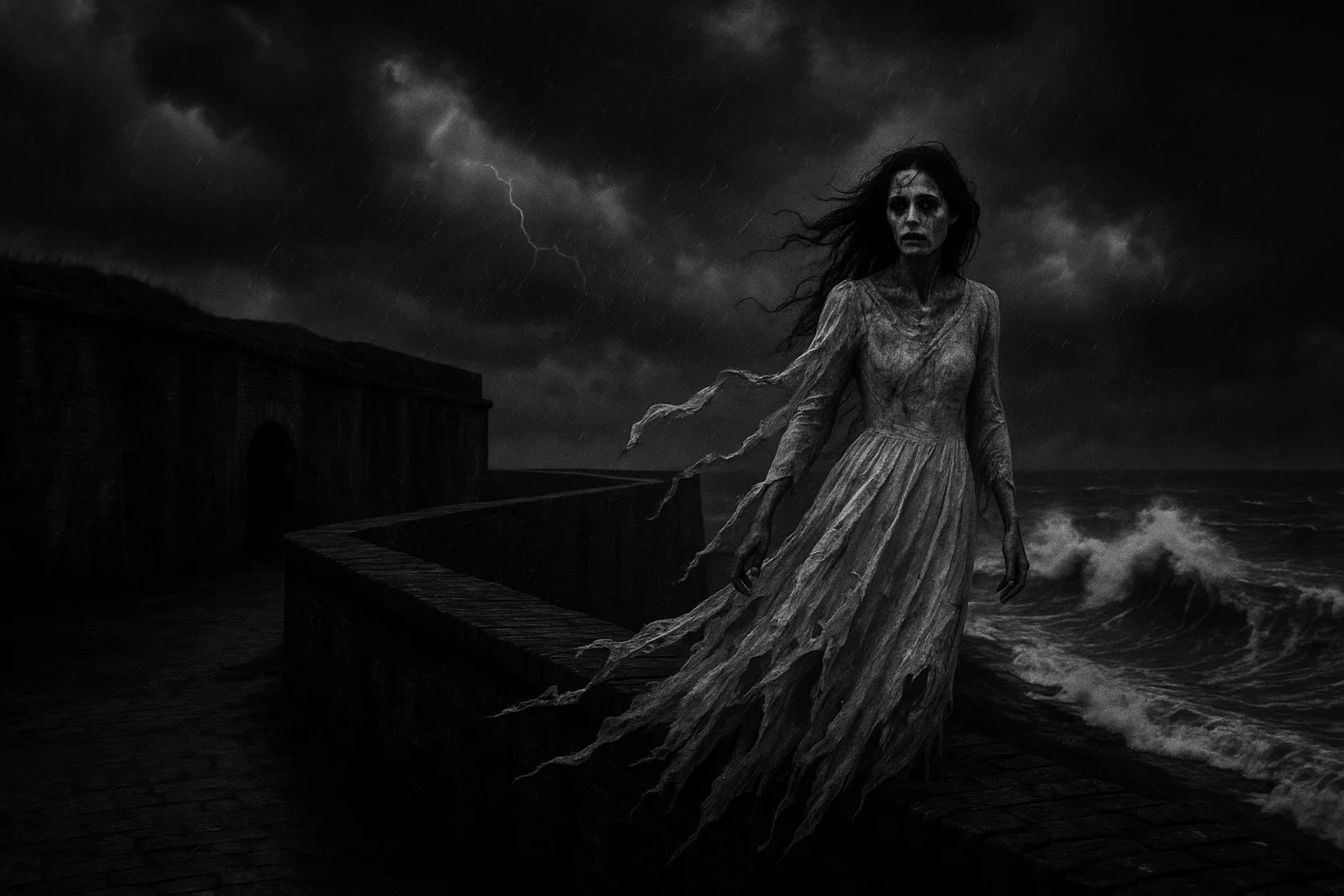
- The apparition of a young woman, said to have been the victim of an assault sometime in the 19th century, reportedly seen wandering the grounds and casemates.
- Sightings of figures in old-style military uniforms in the fort’s corridors and gun batteries, generally attributed to soldiers who served or died there between 1834 and 1946.
What sets Fort Morgan apart from a typical roadside “haunted house” is scale and documentation: this was an active military post for 112 years, it changed hands violently during the Civil War, and it was the site of a mass detention of Muscogee (Creek) families in 1836–1837 that killed dozens through disease and exposure rather than combat — a chapter of the fort’s history that is often left out of ghost-story retellings even though it may be the single deadliest episode ever to occur on the property.
A Fort Built on a Graveyard of Failed Contracts
Fort Morgan’s construction history is itself an uneasy one. The site had already seen bloodshed before the current fort existed: an earlier, much smaller earth-and-log fortification called Fort Bowyer stood on the same point and was attacked twice by British forces during the War of 1812, including a September 1814 assault by four Royal Navy warships and a combined force of British Royal Marines and Creek warriors, which the small American garrison repelled.
After the war, the United States moved to fortify its southern coastline permanently under what was known as the “Third System” of coastal defense. The design for the new masonry fort at Mobile Point came from Simon Bernard, a French military engineer who had previously served under Napoleon before emigrating to the United States.
Construction proved cursed almost from the start. The first contractor, Benjamin Hopkins of Vermont, died of yellow fever within a year of breaking ground in 1819, having built almost nothing. His replacement, Samuel Hawkins, died in 1821 before accomplishing any further progress. The U.S. Army Corps of Engineers finally took direct control of the project under Captain René DeRussy, who fell ill himself in 1825 and handed the work to Lieutenant Cornelius Ogden. Ogden finally completed the fort in March 1834 — fifteen years after ground was first broken.
The physical toll of that construction fell heavily on enslaved African American laborers, whose skilled masonry work produced a fortification later described by military historians as one of the finest examples of masonry fort architecture in the New World. The fort consumed more than 40 million bricks, many of them fired at kilns along the nearby Fish River and shipped in by water because the peninsula had no roads capable of hauling such loads.
The Army contracted directly with local slaveholders for this labor, alongside free white workmen, to complete the ten-sided citadel, brick barracks, and arched casemates that still stand today. The finished fort was named for Daniel Morgan, the Revolutionary War general famous for his victory at the Battle of Cowpens, and received its first official garrison — Company B of the 2nd U.S. Artillery under Captain F. S. Belton — in March 1834.
The Forgotten Deaths of the 1836 Creek Removal
One of the least-told chapters of Fort Morgan’s history, and arguably the most tragic, took place only three years after construction finished. During the Creek War of 1836 (also called the Second Creek War), the U.S. military rounded up thousands of Muscogee (Creek) people from the Alabama interior as part of the broader forced removal that would come to be known as the Trail of Tears.
While Creek warriors were sent south to fight in the Seminole conflict in Florida, their families — the elderly, women, and children — were transported by steamboat to Mobile Point and held on the grounds around the nearly abandoned fort, whose garrison had left the year before.
Roughly 2,500 Muscogee people were confined at Fort Morgan in 1836 and 1837, camped along the beach outside the fort’s walls rather than inside it, under conditions that period accounts describe as brutal: little access to fresh water and prolonged exposure to the sun and coastal weather. Ninety-three of them died there — not from battle, but from disease and exposure — before the survivors were finally moved on toward Indian Territory in present-day Oklahoma.
According to accounts of the removal, when the Creek families were finally marched away from Fort Morgan in 1837, some carried away handfuls of soil scraped from the top layer of the fort’s grounds, a detail that has survived in oral history even though it rarely appears in modern ghost-tour retellings of the site. This episode predates the fort’s most famous battle by nearly three decades. It is the highest concentrated death toll ever recorded on the property.
Civil War Bloodshed and the Battle of Mobile Bay
Fort Morgan’s most famous chapter began on January 3, 1861, when Colonel John B. Todd and four companies of Alabama state volunteers seized the fort from its small federal caretaker detachment — eight days before Alabama formally seceded from the Union.
Confederate forces spent the next three years reinforcing the position; by December 1861 the garrison had swelled to roughly 1,596 men, and soldiers built trenches and redoubts east of the fort to guard against a land assault. Many of the fort’s thirty-five cannons, however, were aging smoothbore guns that could not match the range or power of the U.S. Navy’s newer rifled artillery — a mismatch that would prove decisive.
That mismatch came to a head on August 5, 1864, during the Battle of Mobile Bay. Union Rear Admiral David Farragut led his fleet directly past Fort Morgan’s guns and through a minefield of underwater “torpedoes” protecting the bay’s entrance, reportedly issuing the order that made him famous: “Damn the torpedoes, full speed ahead.” The Union fleet lost only a single ship crossing the minefield.
Once past the fort, Farragut’s ships defeated the small Confederate naval squadron waiting inside the bay, and Union land forces then laid siege to Fort Morgan itself, bombarding it for nearly three weeks. Confederate Brigadier General Richard L. Page, commanding the garrison, finally surrendered on August 23, 1864, along with 581 men — the last Confederate stronghold on Mobile Bay to fall.
It is from this bombardment that one of the fort’s specific ghost stories originates: visitors and staff have long reported hearing men screaming from a particular room where an ammunition explosion during the siege is said to have killed several soldiers instantly. Unlike some fort hauntings, this story is tied to a documented type of Civil War casualty — accidental magazine and ordnance explosions were a genuine and common hazard inside besieged coastal forts of the period, where gunpowder was stored in confined masonry rooms under constant bombardment.
The human cost of that single morning offshore is often left out of Fort Morgan retellings entirely, even though it happened within sight of the fort’s walls. The Union ironclad USS Tecumseh, leading Farragut’s column past Fort Morgan’s guns, cut across the minefield and struck a torpedo around 7:40 a.m. The ship rolled onto its side and went under in roughly a minute, dragged down by the weight of its own armor.
Of the vessel’s 114-man crew, only about 21 survived; Commander Tunis Craven, the ship’s captain, reportedly died at the escape ladder after stepping aside to let his pilot climb out first. The battle’s broader toll was similarly lopsided: Farragut’s fleet suffered several hundred casualties compared with fewer than fifty among Confederate sailors, and when Fort Morgan and Fort Gaines ultimately fell, Union forces took roughly 1,500 Confederate prisoners between the two forts.
The wreck of the Tecumseh still lies on the floor of Mobile Bay within view of the fort and is itself listed on the National Register of Historic Places — making the waters directly off Fort Morgan as much a graveyard as the fort’s own walls.
Discover More Hauntings:
Malaga Inn Haunting: Why Room 007 Terrifies Guests to This Day
September 22, 2025
The Rocky Hill Castle Haunting: Ghosts, Chains, and Curses
September 18, 2025
6 Real Haunted Houses in Arkansas with Chilling True Stories
October 8, 2025
The Weeping Man of the Old Barracks
Fort Morgan’s most frequently repeated ghost story concerns the fort’s old barracks and cell block, which by the early 20th century were being used to hold prisoners under military detention. In 1917 — the year the United States entered World War I and the fort was reactivated for coastal defense — a prisoner held in that section of the fort died by suicide, hanging himself in his cell.
Visitors and staff in the decades since have repeatedly reported hearing a man crying or weeping late at night in that same area, along with unexplained footsteps and a sensation of being touched while walking through the old cell block.
Of all the reported phenomena at Fort Morgan, this is the one most consistently tied to a specific, datable event rather than vague folklore, which is part of why it remains the story most often repeated by tour guides and paranormal investigators alike.
The Grieving Woman of the Grounds
The most frequently sighted apparition at Fort Morgan, according to those who work and lead tours at the site, is not a soldier at all but a young woman. Local accounts describe her as the victim of a violent assault sometime during the 19th century, whose spirit is said to still wander the fort’s grounds and casemates, seemingly searching for her attacker.
Unlike the barracks haunting, this story lacks a single documented incident tied to a name or date, which places it closer to oral tradition than confirmed history — but it has persisted long enough, and been reported by enough independent visitors over the decades, that fort staff treats it as one of the site’s defining legends. Reports connected to this figure tend to involve a fleeting glimpse of a woman in period dress near the casemates at dusk, rather than any direct interaction.
Later Wars and a Century of Continuous Use
What makes Fort Morgan unusual among American Civil War-era forts is that its military service did not end with the Confederacy’s surrender. The Corps of Engineers had repaired the battle-damaged fort by 1867. Still, it and the rest of the nation’s coastal defenses were then largely neglected for nearly three decades.
That changed in the 1890s, when the federal Endicott Board — convened under Secretary of War William Endicott during the Cleveland administration — recommended a nationwide program of modern concrete gun batteries. Between 1895 and 1904, Fort Morgan received five new Endicott-era batteries mounting 19 guns and mortars, the most advanced coastal artillery of the era.
The first of these, Battery Bowyer, carried four 8-inch breech-loading guns on “disappearing carriages” that could retract behind a concrete parapet after firing, and it was operational in time to see service during the Spanish-American War in 1898. A dedicated torpedo casemate was also built (and later modernized) to house the firing station for electrically detonated naval mines strung across the mouth of the bay — meaning that, for decades, Fort Morgan personnel could remotely detonate underwater minefields from a bunker still standing on the property today.
Fort Morgan’s old brick citadel and Endicott batteries remained in service through World War I. The post was briefly deactivated afterward before being reactivated for more than two years during World War II, when a temporary battery of 155mm guns on mobile mounts was added to the site between 1942 and 1944 as part of the Harbor Defense of Mobile.
The fort was finally turned back over to the State of Alabama after the war in 1946, closing out 112 years of continuous or intermittent military use — service spanning the era of muzzle-loading cannon all the way to World War II coastal artillery.
That extraordinarily long service life is one reason historians point to Fort Morgan as having accumulated more layers of death, injury, and human suffering than most single-conflict battlefields: soldiers, prisoners, and detainees died there across more than a century of occupation, from disease and exposure as much as from combat.
The fort was designated a National Historic Landmark in 1960 and added to the National Register of Historic Places in 1966. It is now maintained as a state historic site by the Alabama Historical Commission.
Fort Morgan vs Other Haunted Forts
| Name | Location | Type of Haunting | Activity Level |
|---|---|---|---|
| Fort Warren | Georges Island, Boston Harbor, Massachusetts | Intelligent, Residual | 7 (very active) |
| Fort Mifflin | Philadelphia, Pennsylvania | Intelligent, Shadow People | 8 (very active) |
| Fort Delaware | Delaware City, Delaware | Residual, Intelligent | 7 (very active) |
| Fort Monroe | Hampton, Virginia | Intelligent, Residual | 6 (occasional) |
| Fort Macon | Atlantic Beach, North Carolina | Residual | 5 (occasional) |
| Fort Moultrie | Sullivan’s Island, South Carolina | Residual, Intelligent | 5 (occasional) |
| Fort Sumter | Charleston, South Carolina | Residual | 3 (dormant) |
| Fort Jefferson | Dry Tortugas, Florida | Residual, Intelligent | 6 (occasional) |
| Fort Gaines | Dauphin Island, Alabama | Intelligent, Residual | 6 (occasional) |
| Fort Point | San Francisco, California | Residual | 5 (occasional) |
| Fort Adams | Newport, Rhode Island | Intelligent | 6 (occasional) |
| Fort Niagara | Youngstown, New York | Intelligent | 6 (occasional) |
| Fort Snelling | St. Paul, Minnesota | Residual, Intelligent | 5 (occasional) |
| Castillo de San Marcos | St. Augustine, Florida | Intelligent, Residual | 7 (very active) |
Visiting Fort Morgan
Fort Morgan is located at the western end of Alabama State Route 180, roughly 23 miles west of Gulf Shores, at the mouth of Mobile Bay in Baldwin County. The site is open to the public year-round as a state historic site, with a museum, self-guided tours through the casemates and citadel ruins, and scheduled living-history programming that draws on the fort’s full 130-plus years of military use — from the War of 1812 era through World War II.
For those interested in the site’s darker history, the most historically grounded starting points are the old barracks tied to the 1917 suicide and the casemates associated with the Civil War siege, both of which remain among the best-preserved sections of the fort and the most frequently cited locations for unexplained activity.
My Take
Having gone through Fort Morgan’s actual documented history rather than just its ghost lore, I don’t think its haunted reputation is an accident, but I also don’t think every reported footstep or cold draft needs a supernatural explanation. A few things stand out to me.
First, the timeline genuinely is unusual. Most “most haunted” claims attach themselves to a single tragedy or a vague, undocumented past. Fort Morgan instead has a paper trail: a fifteen-year construction project that killed multiple contractors before it even opened, a mass detention of Muscogee families that killed 93 people through disease and neglect rather than violence, a Civil War siege and naval battle that killed or wounded hundreds within a few hundred yards of the walls, and a documented 1917 suicide in a specific, identifiable room.
When a site has that much verified death concentrated in one small footprint of land, it’s not surprising that it also accumulates a dense layer of folklore — the stories didn’t need to be invented from nothing, because the underlying grief and violence were real.
That said, a fort like this is also close to a perfect environment for what researchers who study “haunted” locations generally point to as mundane explanations. Old masonry structures like Fort Morgan’s casemates and arched corridors are effectively long stone tunnels, and tunnels do strange things to sound: footsteps, wind, and distant voices can carry, echo, and distort in ways that are genuinely difficult for the ear to place, especially at night when other ambient noise drops away.
Coastal forts are also subject to constant infrasound — very low-frequency vibration generated by wind, waves, and even ship traffic on the Gulf and Mobile Bay — which some researchers have linked to sensations of unease, a feeling of “being watched,” or even peripheral visual disturbances in people exposed to it, without any need for a ghost to be present.
Add in near-total darkness, damp salt air, temperature differentials between the thick brick walls and the humid Gulf air (which can produce genuine cold spots with no paranormal cause), and visitors who already arrive expecting a haunted experience, and you have a setting where ordinary sensory input is easily reinterpreted as something more.
I also think expectation and suggestion do real work here. Visitors walking into the “old barracks” already primed with the story of the 1917 hanging are more likely to interpret an ambiguous sound as crying rather than, say, wind moving through a doorway or the acoustic quirks of a 190-year-old brick corridor.
That’s not an accusation that anyone is lying — it’s simply how human perception and memory tend to work under low light, high anticipation, and an unfamiliar acoustic environment. Pareidolia, the same mental tendency that makes us see faces in clouds or wood grain, applies just as easily to sound and shadow as it does to photographs.
Where I land is somewhere in the middle. I don’t think Fort Morgan’s reputation is manufactured or overblown relative to its history — the death toll here, across war, disease, and imprisonment, is real and substantial, and that alone makes it a place worth treating with some solemnity rather than pure spectacle.
At the same time, I think most individual reports of footsteps, voices, and cold spots are better explained by the fort’s acoustics, its exposed coastal environment, and the psychology of visiting a place already marketed as haunted than by an actual haunting in the literal sense.
The apparitions with the least documentation behind them — like the wandering young woman — are the ones I’d treat most skeptically, precisely because they lack the kind of specific, datable event that anchors the barracks story. Whether or not you believe anything lingers in Fort Morgan’s walls, the fort doesn’t need ghosts to be one of the most historically significant, and genuinely somber, places on the Alabama coast.
Discover More Hauntings:
The Whaley House Haunting: America’s Most Terrifying Ghost Story
October 23, 2025
The Complete List of All Haunted Places in Arizona
October 7, 2025
What Are the 14 Types of Hauntings? Everything You Need to Know
September 4, 2025
What Is Residual Ghost Energy?
September 4, 2025
Who Is the Red Lady of Huntingdon College?
May 14, 2025
Gwodz Road Haunting: Alabama’s Most Terrifying Ghost Story
September 17, 2025
Sources
- Tony Cornell. (2002). Investigating the Paranormal. New York: Helix Press.
- Cardeña, Etzel. (2018). The Experimental Evidence for Parapsychological Phenomena: A Review. American Psychologist. 73. 663-677. 10.1037/amp0000236. ResearchGate.
- Alabama Historical Commission. History of Fort Morgan. Alabama Historical Commission.
- A Tale of Two Forts on Mobile Bay: Fort Gaines and Fort Morgan. The Army Historical Foundation. Accessed July 22, 2026.
- Mühlhans, Jörg H. Low Frequency and Infrasound: A Critical Review of the Myths, Misbeliefs and Their Relevance to Music Perception Research. Musicae Scientiae, vol. 21, no. 3, 2017, pp. 267-286. Sage Journals.
- Forts Morgan and Gaines. Encyclopedia of Alabama. Accessed July 22, 2026.
- Battle of Mobile Bay. Encyclopedia of Alabama. Accessed July 22, 2026.
- Roberts, Robert B. Encyclopedia of Historic Forts: The Military, Pioneer, and Trading Posts of the United States. Macmillan, New York, 1988, 10th printing, ISBN 0-02-926880-X.
- Forgotten Monitor: The Story of the USS Tecumseh. American Battlefield Trust. Accessed July 22, 2026.
- Mobile Bay. American Battlefield Trust. Accessed July 22, 2026.
- WKRG News 5. Spirits Bring Haunted Life Back to Fort Morgan. WKRG, 31 Oct. 2019.
- Sharon A. Hill. The ‘Stone Tape Theory’ of Hauntings: A Geological Perspective. SharonAHill.com, 2017. Academia.edu.
- Haunted Frequency. The Higgs Center for Theoretical Physics, University of Edinburgh, 31 Oct. 2021.
- de Boer JN, Linszen MMJ, de Vries J, et al. Auditory hallucinations, top-down processing and language perception: a general population study. Psychological Medicine. 2019;49(16):2772-2780. doi:10.1017/S003329171800380X.
- Gonan S., Vallortigara G. and Chiandetti C. (2024). When sounds come alive: animacy in the auditory sense. Front. Psychol. 15:1498702. doi: 10.3389/fpsyg.2024.1498702.