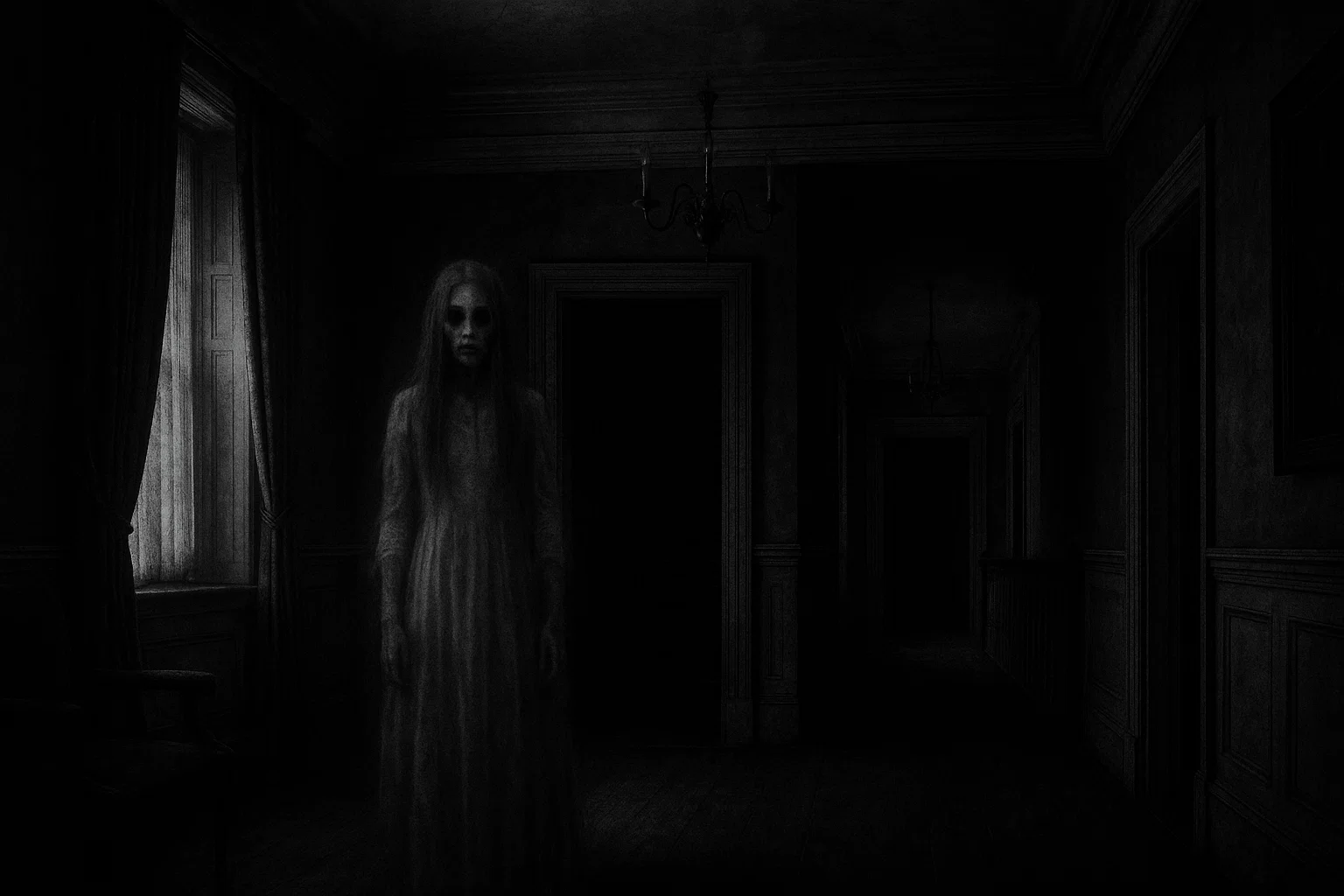
The ghost of Cedarhurst Mansion, believed to be the spirit of sixteen-year-old Sally Carter, often appears through clear physical and sound disturbances inside the old brick house. Unlike most local legends that fade with time, this ghost became famous after a well-documented event in which it correctly predicted that its own distant gravestone had fallen during a violent midnight storm.
Summary
Key Takeaways
| Attribute | Details |
| Name | Sally Carter; The Ghost of Cedarhurst; The Cedarhurst Apparition. |
| THC Scale | L-3 [See the THC Scale Explanation]. |
| Location / Origin | 400 Northampton Drive (Intersection of Whitesburg Drive and Drake Avenue), Huntsville, Madison County, Alabama, USA. |
| Classification | Intelligent, Interactive. |
| History | Constructed in 1823 by Stephen Ewing. Sally Carter arrived to visit her sister, Mary Carter Ewing, in the autumn of 1837. She contracted a rapid, terminal illness and succumbed on November 28, 1837, just three weeks prior to her sixteenth birthday. |
| Casualties & Deaths | 4 confirmed historical deaths at the site (Sally Carter in 1837, followed shortly by the tragic deaths of the Ewings’ three young daughters from whooping cough); 0 deaths or physical injuries directly attributed to the entity. |
| Manifestations | Auditory (disembodied footsteps, youthful female laughter), Visual (full-body translucent female apparitions), Physical (manipulation of door locks, displacement of heavy ashtrays, flipping of wall light switches, tearing of bed linens). |
| First reported sighting | Circa 1887 (recounted by an elderly female guest who experienced an auditory staircase encounter during the Davis family residency). |
| Recent reported sighting | Circa November 2020 (reported by neighborhood residents and visitors experiencing anomalous kinetic door activity within the private complex). |
| Threat Level | 2/10 (harmless) [See the Threat Level Explanation]. |
| HCR | 3/10 (Probably authentic) [See the Hoax Confidence Rating Explanation]. |
| Access Status | Private. The mansion currently serves as the private clubhouse for the Cedarhurst Homeowners Association. It is a strictly gated community with private security, and trespassing laws are rigorously enforced. |
What or What Is the Ghost of Cedarhurst Mansion?
Researchers classify the strange activity at this historic plantation as an Intelligent manifestation. Instead of being a mindless Residual loop that just repeats past events, the ghost at Cedarhurst Mansion seems aware of its surroundings and reacts to visitors.
Locals know the main ghost as “Sally Carter,” a teenager who died in an upstairs bedroom. Most of the activity happens on the upper floor, where she spent her last hours. The ghost often moves objects, throws heavy glass ashtrays, flips light switches, and even pulls bed covers off sleeping guests.
One unusual trigger for these ghostly events seems to be tobacco smoke. For seven years, a long-term guest who stayed in the room where Sally died noticed that ashtrays would fly and break against the walls only when he smoked heavily, which suggests that the ghost has a strong dislike for certain smells left by people.
Cedarhurst Mansion Haunted History
To fully comprehend the dark history of Cedarhurst Mansion, one must examine the tangible architectural changes and sequential family tragedies that defined the Huntsville estate throughout the nineteenth century.
The property began on December 13, 1823, when Stephen Saunders Ewing—a prominent Virginia-born banker, planter, and director of the State Bank—purchased the land from Carlisle Davis.
Built between 1825 and 1828, the mansion followed a neoclassical, Federal style. It was made in two main parts: the four front rooms have thick brick walls nineteen inches thick, while the back sections have walls fifteen inches thick.
The mansion’s dark reputation began in late November 1837. Sixteen-year-old Sally Carter came to visit her older sister, Mary Huston “Polly” Carter Ewing. Soon after arriving, Sally became seriously ill with a high fever. Without good medical care at the time, she got worse and died in an upstairs bedroom on November 28, 1837, just three weeks before her sixteenth birthday.
After Sally died, more tragedy struck the family. Soon after she was buried in the plantation cemetery, the Ewings’ three young daughters caught whooping cough and died one after another. These sudden losses left the estate in a state of lasting grief.
Mary Ewing died in 1865. On December 12 that year, facing financial and emotional stress after the Civil War, Stephen Ewing sold the 350-acre plantation to Robert C. Brickell, who later became Chief Justice of the Alabama Supreme Court, and left Alabama for Mississippi.
Over the next hundred years, the mansion changed hands many times, with families like the Doyles, Tardys, Davises, Hugheses, and Gwins living there, but none stayed for generations. By the mid-1900s, the old graveyard had fallen into disrepair and had become a target for vandals, grave robbers, and thrill-seekers.
The troubled history led to a disturbing event in December 1982. Developers got legal approval to dig up the family cemetery and move the remains to an unknown, unmarked spot in Maple Hill Cemetery to make room for new homes.
When forensic teams dug up the plantation graveyard, they found the remains of Mary Ewing and her children. But according to records, Sally Carter’s brick-lined grave and coffin were completely empty, making her final resting place a mystery.
You may also enjoy:
Who Is Oriens? The Forgotten Infernal King
August 26, 2025
Futakuchi-onna: The Terrifying Two-Mouthed Woman of Japanese Folklore
September 10, 2025
Is Cadborosaurus the Real Sea Serpent of the Pacific Northwest?
November 6, 2025
Pan: From Forest God to Christian Demon
August 26, 2025
The Ghost of Cedarhurst Mansion Sightings
Looking at the historical records, the strange events at the estate have stayed much the same for over a hundred years.
While ghostly footsteps were rare after the Civil War, reports always increase when new people move in or when the house is being repaired, which suggests that changes in the house trigger more ghostly activity.
| Date | Witness | Description of the event |
| Circa 1887 | Anonymous young female guest | Heard heavy, deliberate footsteps ascending the main staircase on a bright, clear day. Upon fleeing down the back stairs in terror, she confirmed with the homeowner that no living person was on the upper level. |
| Winter 1919 | Charles Thornton (17-year-old guest) | Awoke during a violent midnight thunderstorm to see a full-body visual apparition of a beautiful teenage girl claiming to be Sally Carter, who stated her headstone had been toppled by the storm and requested it be uprighted. |
| Circa 1940s | Anonymous seven-year tenant | Experienced repetitive physical manipulation of items in the upstairs bedroom, including heavy glass ashtrays being thrown into the air and shattered whenever he smoked. |
| Circa 1970s | Anonymous female guest | Repeatedly awoke in the designated upstairs bedroom to find the heavy bed linens violently snatched off her body by an unseen force, accompanied by the flipping of light switches. |
| Circa 1990s | On-duty estate security guard | Heard heavy footsteps upstairs during a night shift. After losing her cash rounds on the lawn, her failing flashlight was physically guided by an unseen presence to illuminate the lost money, followed by disembodied female laughter. |
| Summer 2000 | Visiting adolescent grandchild of a resident | While showering alone in an upstairs bathroom with all doors explicitly shut, the sliding internal door and two heavy wooden hallway doors were simultaneously and silently thrown wide open. |
The Thornton Visitation of 1919
In the winter of 1919, the Thornton family held a big reunion, filling every guest room in the mansion. Since the house was packed, seventeen-year-old Charles Thornton, a student from Dothan, Alabama, had to sleep on a cot in the upstairs hallway, right outside the room where Sally Carter had died eighty-two years earlier.
That night, a fierce winter storm hit the estate, with strong winds and lightning shaking the old glass windows. When the storm ended at dawn, the family found Charles on the front porch, shaking and refusing to go back inside.
He said that during the worst part of the storm, he saw a clear, ghostly image of a young girl at the end of his cot. The ghost said she was Sally Carter and gave him a clear message: “The storm has blown down my gravestone. Please place it upright again.”
At breakfast, the Thornton family laughed at Charles’s story but agreed to check the old family cemetery. To their shock, Sally’s gravestone had really snapped and was lying in the mud. For reasons lost to history, they left the stone as it was. Charles packed up and left Huntsville that afternoon, never to return.
The Security Guard Encounter
In the late twentieth century, before the estate became part of the suburbs, a security guard was hired to watch the empty mansion at night. While checking the ground floor, she clearly heard the heavy sound of bare feet walking on the upstairs floor.
When she went upstairs to check, the footsteps stopped, but her flashlight started flickering on and off as if something was draining its power. Feeling a sudden chill, she ran outside and accidentally dropped her cash earnings in the dark grass.
After an hour of searching with a dead flashlight, the guard gave up. When she returned to the guard shack, her flashlight suddenly turned on at full power. The beam lit up the exact spot where her missing cash was stacked. When she whispered her thanks, she heard a clear, cheerful laugh from a young woman echoing from the dark porch.
The Gated Clubhouse Incidents (2000)
In the summer of 2000, a strong and focused ghostly event happened on the upper floor of the old building, which was now a private clubhouse for the nearby townhouse community. A firsthand account from a teenager visiting their grandmother at 51 Northampton Drive describes what happened.
After an evening swim, the witness used the upstairs bathroom next to the main community room. They made sure to close and lock three barriers: a sliding partition and two heavy hallway doors.
While showering alone in the empty building, the witness didn’t hear any footsteps or noises. But when they stepped out, they found that the sliding divider and both hallway doors had been silently thrown wide open.
After quickly checking the area, the witness saw that the upper floor was empty and the main doors downstairs were still locked from the inside. This shows that the ghost’s habit of moving doors and barriers continued even after the 1982 cemetery exhumation, adapting to the new layout of the clubhouse.
Sally Carter and the Dead Children’s Playground
An interesting part of Cedarhurst folklore is its connection to the Dead Children’s Playground, a hidden park in a limestone quarry at Maple Hill Cemetery. Maple Hill, started in 1822 by LeRoy Pope, is Alabama’s oldest and largest cemetery, covering almost 100 acres and holding over 80,000 graves.
The playground, officially called Maple Hill Park but known as the Dead Children’s Playground, is right next to large burial areas for children, including many unmarked graves from the deadly 1918 flu pandemic. Local parapsychologists have long noticed a “convergence phenomenon” between the playground and Cedarhurst, especially after the events of December 1982.
When developers dug up the old Ewing cemetery to make way for new townhouses, Sally Carter’s empty grave meant her marker was moved to an unknown spot in Maple Hill Cemetery. Instead of giving her spirit a new home, local spiritualists say this move broke up her energy.
Stories from locals and security logs show a clear pattern: on nights when the Cedarhurst clubhouse is quiet, people often see a ghost matching Sally’s description—a see-through teenage girl in a nineteenth-century dress—at the playground between 10:00 PM and 3:00 AM.
Witnesses say she acts like a caring or protective entity among the smaller child-like spirits said to haunt the park. The playground is famous worldwide for strange events, especially when the swings move wildly together on calm nights with no wind.
The park is surrounded on three sides by thick limestone cliffs from the old quarry, which act as a huge environmental conductor. Some parapsychologists believe the limestone holds and boosts Sally Carter’s energy, pulling her spirit from the mansion to join the other young spirits from Huntsville’s past.
Theories
The African Juju Telekinetic Imprint
The most case-specific physical theory arises directly from the startling 1982 exhumation discovery, where forensic workers found Sally Carter’s casket completely devoid of a skeleton, containing an African Juju bag and a strand of pearls instead.
Historical documentation notes that as Sally lay dying in her upstairs bedroom in 1837, the estate’s enslaved laborers gathered beneath her window, playing drums and singing traditional East African songs to comfort her.
According to this theory, the strong emotions from the ritual, along with the Juju bag placed in the grave, created a local psychokinetic field. Instead of a typical haunting, the ghostly activity in the mansion—like ashtrays flying or doors slamming—is a result of this original ritual.
The Juju bag might have acted as a spiritual anchor, trapping some of Sally’s energy in the house’s woodwork. At the same time, her body was secretly taken from the coffin before burial for reasons we don’t know.
You may also enjoy:
The 16 Most Haunted Places in Alabama
September 17, 2025
The Demon Furfur – Powers, Weaknesses, and Sigil Meaning
August 11, 2025
Nicotine-Triggered Psychical Aversion
A very unusual part of the Cedarhurst haunting is how the ghost reacts to tobacco smoke. In the mid-1900s, a long-term guest in Sally’s old room often found his heavy glass ashtrays flipped, broken, or dumped on the floor, but only when he smoked a lot.
Some parapsychologists think that intelligent ghosts can keep strong dislikes for certain things from their life. Old records say Sally Carter had a serious illness that affected her lungs.
According to the theory, when thick nicotine smoke fills her old room, it acts as a trigger. The smoke upsets the energy in the room, causing the ghost to react violently as if trying to clear the air.
The 1919 Atmospheric Gravitational Lock
The most famous event in the Cedarhurst story happened during a bad winter storm in 1919. Charles Thornton, a young guest, saw a full-body ghost of Sally Carter, who told him her gravestone had just been knocked over by the wind, which suggests a strong link between the gravestone’s condition and the ghost’s ability to appear in the mansion.
The theory proposes that the upright gravestone acted like a grounding rod or antenna for the mansion’s energy. When the storm broke the stone, it disrupted the balance between the graveyard and the house.
Breaking the stone suddenly released stored energy in the upstairs hallway, causing the ghost to appear and communicate exactly what had happened to her gravestone.
Architectural Modification
Looking at the estate’s history, reports of ghost sightings and strange activity go up a lot during times when the house is being changed. Big disturbances happened in the early 1900s when some of the front columns were cut down, and again in the 1980s during the townhouse renovations.
The structural resonance theory claims that old, solid buildings with thick brick walls absorb stress over time. When people hammer walls, cut wood, or alter the building’s structure, the sound and energy patterns in the rooms change.
For a haunting like this, changes to the building are a major energy disruptor. Renovations stir up old energy, which seems to “wake up” the ghost and cause more poltergeist activity for a while.
The Missing Mass
The biggest mystery at the estate is the empty casket found during the 1982 move to Maple Hill Cemetery. Since the brick vault was sealed, the missing skeleton can’t be explained by normal decay, which would have left bones behind.
The displacement theory suggests that Sally Carter’s body was never buried in the graveyard or was taken out right after the funeral. It says the ghostly focus on the mansion is because her real remains are hidden somewhere in the house—maybe under the floorboards or inside the thick brick walls from 1825.
The ghost’s refusal to leave the mansion and its focus on the fake grave marker may be its way of trying to get people to look for her real remains hidden inside the house.
Sally Carter vs Other Similar Ghosts
| Name | Location | Type of Haunting | Activity Level |
| The Drish House | Tuscaloosa, Alabama, USA | Intelligent / Residual | 8/10 (very active) |
| The Myrtles Plantation | St. Francisville, Louisiana, USA | Intelligent | 9/10 (very active) |
| Whaley House | San Diego, California, USA | Residual | 7/10 (very active) |
| The Bell Witch Cave | Adams, Tennessee, USA | Poltergeist / Intelligent | 9/10 (very active) |
| Lizzie Borden House | Fall River, Massachusetts, USA | Residual / Intelligent | 8/10 (very active) |
| Sorrel-Weed House | Savannah, Georgia, USA | Intelligent | 8/10 (very active) |
| The Stanley Hotel | Estes Park, Colorado, USA | Residual | 7/10 (very active) |
| Farnsworth House | Gettysburg, Pennsylvania, USA | Intelligent | 8/10 (very active) |
| Winchester Mystery House | San Jose, California, USA | Residual | 5/10 (occasional) |
| Villisca Axe Murder House | Villisca, Iowa, USA | Intelligent / Poltergeist | 9/10 (very active) |
| The Kehoe House | Savannah, Georgia, USA | Residual | 6/10 (occasional) |
| McPike Mansion | Alton, Illinois, USA | Intelligent | 8/10 (very active) |
| Oak Alley Plantation | Vacherie, Louisiana, USA | Residual | 6/10 (occasional) |
| The Lemp Mansion | St. Louis, Missouri, USA | Intelligent / Poltergeist | 9/10 (very active) |
My Takeaway
After reviewing the historical records, engineering reports, and witness accounts, I find the evidence of something strange at the estate very convincing.
Fake hauntings usually get more dramatic over time. Still, here, the ghost’s actions—like moving doors, flipping light switches, and reacting to tobacco smoke—have stayed the same for three centuries, even with different families living there.
My own theory is different from the usual stories. I think the mansion works like an accidental environmental battery. The old brickwork, iron window fixtures, and limestone basement create a grid that soaked up the intense energy from the four young deaths in the late 1830s.
The 1919 gravestone event can’t be dismissed as a group fantasy; the young witness had no way of knowing the stone had broken during the storm. The evidence suggests that even though Sally Carter’s remains were moved to Maple Hill Cemetery in 1982, her energy is still tied to the clubhouse, making this one of the best examples of local intelligent energy in North America.
You may also enjoy:
Who Is Vual in Demonology? Powers, Lore, and Origins
August 12, 2025
What Is Igopogo, the Monster of Lake Simcoe?
May 20, 2025
Was Jacques Roulet Really a Werewolf? The Case File
June 10, 2025
Sources
- Alabama Department of Archives and History. State Department Documents and Post-Civil War Land Transfer Registries, 1865–1900. Montgomery, AL.
- Stephen Saunders Ewing. Huntsville History Collection. Historic Huntsville Foundation, 2012.
- Hauck, Dennis William. Haunted Places: The National Directory: Ghostly Abodes, Sacred Sites, UFO Landings, and Other Supernatural Locations. Penguin Books, 1996. Internet Archive.
- Windham, Kathryn Tucker. Jeffrey Introduces 13 More Southern Ghosts. Strode Publishers, 1971. Internet Archive.
- Tony Cornell. (2002). Investigating the Paranormal. New York: Helix Press.
- Sharon A. Hill. The ‘Stone Tape Theory’ of Hauntings: A Geological Perspective. SharonAHill.com, 2017. Academia.edu.