The Edmund King House haunting is one of the oldest and most frequently discussed ghost legends in Alabama, centered on a brick-and-stucco plantation home built in 1823 that now sits at the physical and spiritual heart of the University of Montevallo campus.
For two centuries, students, staff, cheerleaders at summer camps, paranormal investigators, and even the university’s own archivist have described footsteps that stop the instant a bedroom door is opened, the clink of coins with no source, and a lantern-carrying entity wandering the grounds where an orchard once stood.
What makes the King House different from most “haunted college building” stories is the paper trail behind it. Unlike many ghost legends that exist only as campfire talk, this one can be traced back through a formal state historical marker, a 1913 college yearbook, a 1915 scrapbook held by the Alabama Department of Archives and History, and a 1982 book by one of Alabama’s most respected folklorists.
That documentation reveals something most retellings leave out: the ghost story of Edmund King did not start as a Halloween horror story. It began as coded storytelling by the people he once enslaved.
Summary
Key Takeaways
| Attribute | Details |
|---|---|
| Name | Edmund King House (also known as King House, Mansion House, and the King Mansion) |
| THC Scale | L-3 [See the THC Scale Explanation] |
| Location / Origin | University of Montevallo campus, Montevallo, Shelby County, Alabama (approx. 33°6.3′ N, 86°51.742′ W) |
| Classification | Intelligent, Residual |
| History | Built 1823 by slaves for planter Edmund King; King died in 1863; house sold to the Alabama Girls’ Technical Institute in 1908; earliest recorded ghost accounts date to 1913 |
| Casualties & Deaths | No deaths are confirmed to have happened inside King House itself. Several members of the King family died elsewhere in Montevallo during the 1840s–1860s (see History). No deaths or injuries have ever been documented as directly caused by the haunting. |
| Associated Entities | Unverified reports from paranormal investigation teams describe additional presences in the parlor — an unidentified young woman, a young man, an adolescent boy, and a figure resembling a Union soldier — though none have been independently confirmed as distinct, named entities |
| Manifestations | Auditory (coin-clinking sounds, footsteps, bed creaking), Visual (a lantern-carrying figure, bobbing lights near the orchard site and cemetery), Physical (a single unverified report of a hand felt on a visitor’s shoulder), Environmental (anecdotal claims of rapid battery drain during ghost-hunting sessions) |
| First reported sighting | 1913 (earliest written account, recorded in the college yearbook Technala; oral tradition among formerly enslaved King family workers likely predates this) |
| Recent reported sighting | 2023 (student and staff accounts collected by campus publications) |
| Threat Level | 2/10 (harmless) [See the Threat Level Explanation] |
| HCR | 6/10 (Leans fabricated) [See the Hoax Confidence Rating Explanation] |
| Access Status | Yes, with restrictions — King House is an active university building on an open campus. Exterior and grounds are publicly viewable during daylight hours; interior access is limited to official university tours and scheduled events. |
What Is the Edmund King House Haunting?
The Edmund King House haunting refers to the belief that the spirit of Edmund King (1782–1863), the wealthy planter who built the home, still occupies the house he constructed on what is now the University of Montevallo campus in Montevallo, Alabama.
According to the legend, King’s ghost is bound to the property because of a fortune in gold coins he supposedly buried somewhere on the grounds to keep it out of the hands of Union soldiers during the Civil War. He has never stopped searching for it.
The core reported phenomena fall into three consistent categories, repeated across decades of separate accounts:
- Sounds: the sound of coins clinking together, footsteps and creaking floorboards in the upstairs bedroom (thought to be King pacing as he did in old age), and noises inside the walls that stop the moment someone touches or opens the bedroom door.
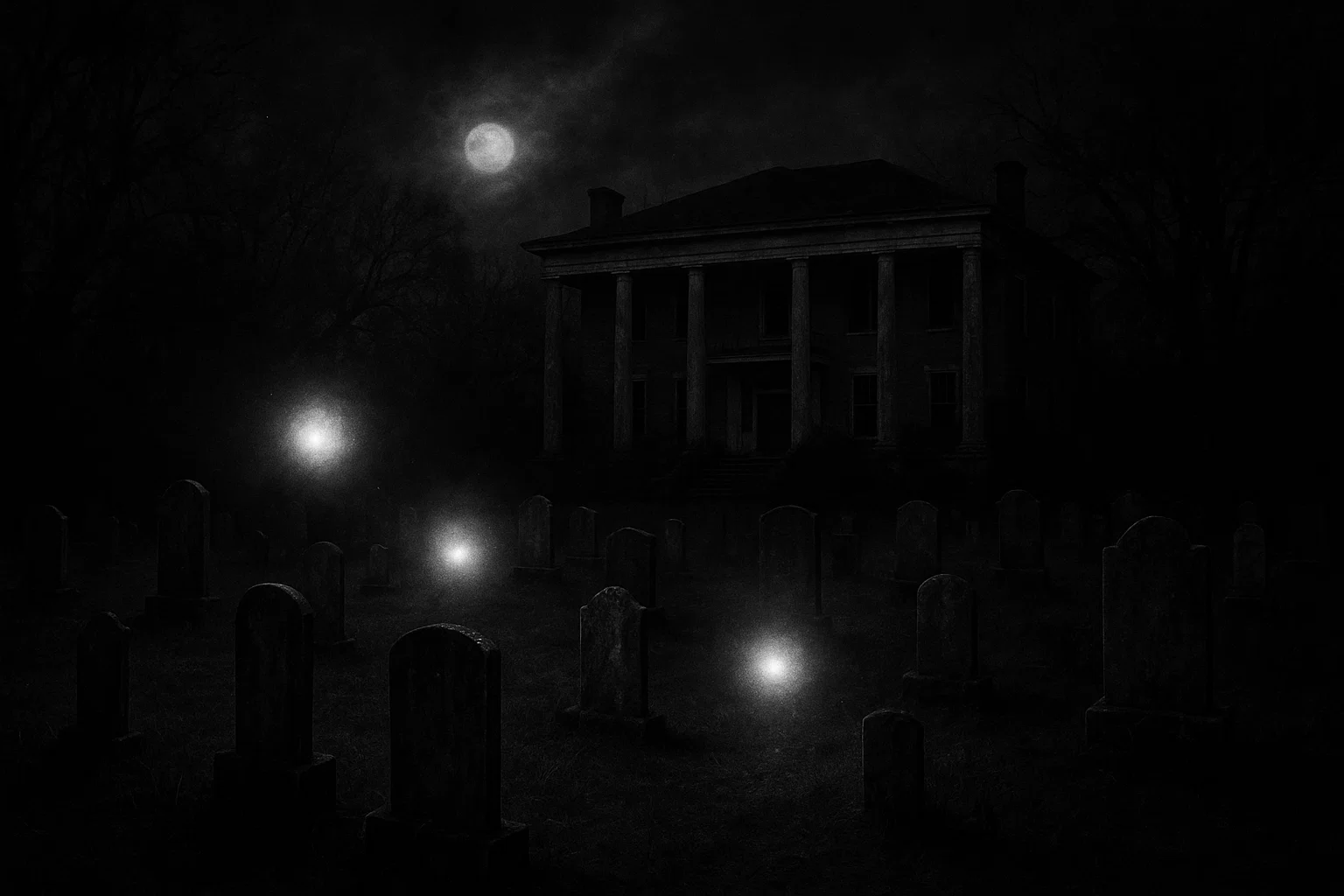
- Visual sightings: a man carrying a lantern and a shovel seen walking the grounds at night, an entity glimpsed in an upstairs window appearing to count money, and small bobbing or floating lights reported near the old orchard site and in the adjacent King family cemetery.
- Physical sensations: visitors and staff describing sudden cold spots, a hand felt on the shoulder with no one present, and a general “unnerving” feeling inside the house after dark, reported by university staff who have worked in the building for years.
Unlike many campus ghost stories that are pure invention, the King House haunting has an unusually well-documented origin. The earliest surviving written versions do not come from students telling scary stories — they come from formerly slaves who lived and worked on the King property and were interviewed by two Alabama College students in 1913, decades before the haunting became campus lore. That distinction matters, and it’s the reason the legend has survived, mutated, and been retold for more than a century.
Who Was Edmund King? The Man Behind the Legend
Edmund King was born in 1782 in Virginia. He first settled as a planter in Georgia in the unsettled years following the American Revolution before deciding to move his family further west in search of stability.
In 1817, William Weatherford — known as Red Eagle, a leader of the Creek Nation — guided King to the area of central Alabama that would become Montevallo. King first built a log cabin on the land before constructing the permanent brick residence in 1823.
The house he built was, by the standards of frontier Alabama in the 1820s, extraordinary. It was the first brick house built in that section of the state and the first local home to have glass windowpanes, a detail commemorated on a historical marker erected at the site in 1932 by King’s descendants and the Alabama Writers’ Conclave. The crispness of its brickwork and refinement of detail were unusual enough for the period that architectural surveyors later flagged the house as an anomaly for rural middle Alabama construction of that decade.
King became one of the leading citizens of the area: a successful planter, a merchant, a promoter of the railroad line that connected Selma to Montevallo in 1853, and a devout Baptist who supported Howard College and regularly wrote for a Baptist newspaper.
His wealth, like that of most large planters in the antebellum Black Belt, was built substantially on the forced, unpaid labor of the people he enslaved — at points, historical research indicates he held as many as fifty slaves at one time.
King was married twice. His first wife, Nancy Ragan King, died in 1842. His second wife, Susan D. King, died in 1850. Several of his children died young or under tragic circumstances, deaths that are woven directly into the ghost lore. His seventh child with Nancy, Lylleton King, was killed in a hunting accident in 1848 when he was accidentally shot by his own brother, Nathaniel.
Nathaniel himself later died of tuberculosis in 1863, the same year his father died. Family records describe Edmund King’s own death as the result of a prolonged decline in health — what one account describes as digestive failure — rather than a sudden or violent event.
After King’s death, the property passed through several private owners before the Alabama Girls’ Technical Institute — the forerunner of the University of Montevallo — purchased the house and 43.40 acres of surrounding land from the Nabors family in 1908.
The Edmund King House was individually listed on the National Register of Historic Places on January 14, 1972. A major restoration, backed by a $40,000 U.S. Department of Housing and Urban Development grant, was completed in 1973–1974, returning the exterior to its original appearance.
You may also enjoy:
Eloko: The Tiny Forest Cryptids That Kill Without Warning
February 3, 2026
Andhaka: The Blind Demon Who Challenged Lord Shiva
November 13, 2025
Who Is the Red Lady of Huntingdon College?
May 14, 2025
The Buried Gold Legend — and Why the Timeline Doesn’t Add Up
The centerpiece of the modern ghost story is that Edmund King buried a stash of gold coins somewhere on his property to hide it from advancing Union troops, and that his restless spirit continues combing the grounds at night, lantern and shovel in hand, still hunting for the treasure he can never find.
There is a well-documented historical problem with this version of events: Edmund King died in 1863. Union forces did not occupy the Montevallo area, and King House itself was not used as headquarters by Yankee troops until later in the war. The university’s own archivist has confirmed publicly that King died roughly two years before Union soldiers arrived in the area, meaning the man the legend describes as burying gold to protect it from Yankee raiders was already dead by the time any such raid could have happened.
This contradiction doesn’t kill the story — if anything, it’s part of what makes the King House haunting an unusually interesting case study. The legend appears to be a later embellishment layered onto an older, more consistent motif that predates any mention of Union soldiers: a wealthy, greedy plantation owner who obsessively hoards and hides money, unable to rest even in death because of his attachment to wealth.
Voices from Uncle Ben, Aunt Julia, and Uncle Frank
The single most information-rich and least reported layer of the King House legend comes from a set of interviews that almost no general audience has seen. In 1913, two students at what was then Alabama College traveled into Montevallo’s Black community to collect ghost stories, publishing three interviews, verbatim in dialect, in that year’s college yearbook, the Technala.
Their subjects were three elderly members of the first-freed generation, remembered today only as Uncle Ben, Aunt Julia, and Uncle Frank — individuals who had themselves been enslaved on or near the King plantation.
A related scrapbook page, assembled around 1915 by a faculty member believed to be Louesa Jane Keys and now preserved by the Alabama Department of Archives and History, corroborates that Uncle Ben lived on Asheville Road near the campus and was locally famous for his ghost stories.
Uncle Ben told the students a wandering, almost tall-tale version of the legend involving a wealthy enslaver he called “Massa Will Brown,” found dead in his bed with his throat cut, his money supposedly buried on the property.
In Ben’s telling, no family could keep the haunted plantation for more than a single night until a newly arrived wife confronted the ghost directly, learned the identity of his murderers, saw them convicted, and inherited a pot of gold as a reward — a plot with details that, as Ben surely knew, didn’t logically hold together.
Researchers of African American folklore who have studied the interview describe this as an example of “signifying”: using an exaggerated, entertaining story to quietly mock wealthy enslavers for a white audience, all while appearing to simply tell a scary tale.
Aunt Julia, who would have been in her mid-eighties at the time of the 1913 interview if she was the same Julia once owned by Edmund King, described the King family cemetery — “dat little lean, slim place of er graveyard behin’ de old house” — as the site where people reported hot gusts of air, doors that slammed shut on their own, rattling chains, and groaning sounds.
In particular, Julia herself disavowed any belief in “hants,” framing the entire account as something other people claimed, not something she witnessed.
In 1982, celebrated Alabama folklorist Kathryn Tucker Windham retold the same story in her book Jeffrey’s Latest 13: More Alabama Ghosts, but reversed the roles: in Windham’s version, it is Julia who believes in the ghost out of grief for her “master,” while the white mistress of the house dismisses her superstition and sends her back to the kitchen — a remarkable inversion of the original 1913 account, in which the skepticism belonged to Julia herself.
Uncle Frank, who had been enslaved directly by Edmund King and then, after King’s death in 1863, was claimed as property by King’s youngest son, gave the most detailed first-hand account.
Frank described hearing a “clink-clink-clink-ity-clink” sound from an upstairs bedroom late at night, unmistakably, to his ear, the sound of coins being counted, even after investigating with a lamp and finding no one there. He attributed the haunting to King’s fear of losing wealth he had hidden around the house, telling his interviewers plainly that he knew the difference between banging shutters and clinking dollars.
Frank also originated a detail still repeated on campus tours today: that King’s ghost has haunted the property “ever since he fell out of that peach tree and deceased to live” — a folk account of King’s death by falling from one of his own orchard trees, which directly contradicts the King family’s own record of a slow death from declining health.
Many read this “signifying” story of a stumbling, falling master as a form of coded commentary on the moral failings of plantation wealth, delivered through humor rather than open confrontation, at a time when direct criticism of a white family would have been dangerous.
These interviews carry a grim historical footnote that rarely appears in retellings of the haunting: records show that in 1863, Uncle Frank, along with his wife and some of their children, was sold to Frank King for $3,570 — equivalent to roughly $87,385 in today’s dollars.
The ghost story he told about a man obsessed with counting and guarding his money was recounted by someone who had, within living memory, been priced and sold as part of that same man’s estate.
Kathryn Tucker Windham and the Story’s Popularization
The King House legend reached a much wider Alabama audience through Kathryn Tucker Windham, a journalist and storyteller whose ghost story collections helped define the modern Southern haunted-house genre.
Windham’s 1982 book, Jeffrey’s Latest 13: More Alabama Ghosts, retold the King House haunting under the title “The Ghosts at Montevallo’s Mansion House” — “Mansion House” being the name the King family’s own enslaved workers reportedly used for the residence. It was largely through Windham’s retelling that the story of King’s ghost searching for buried gold, counting coins in an upstairs window, and wandering the orchard with a lantern was fixed into the version now told on campus ghost tours.
You may also enjoy:
What Is Átahsaia, the Cannibal Demon of Zuni Mythology?
November 4, 2025
The Loveland Frog Mystery: Real Cryptid or Local Hoax?
September 25, 2025
July 1, 2026
Is the Shetani a Demon, a Spirit, or Something Else Entirely?
November 12, 2025
Modern Sightings and Paranormal Investigations
The King House haunting did not stay confined to the 1910s or the 1980s. Reports have continued into the current era of campus life:
In the early 1980s, a group of girls attending a cheerleading camp hosted at the university reported seeing a man matching descriptions of King’s ghost; one attendee, identified in later interviews as Gina Helms, recalled that while she personally did not see the entity, her fellow campers were “scared to death” by what they saw. University staff members who worked in buildings near King House have separately said they’ve witnessed things they could not explain, without offering further detail.
With the rise of amateur and professional ghost-hunting equipment, King House became a specific destination for paranormal investigation teams from around the country. A university staff member who oversaw building access for a period of years hosted somewhere between twelve and fifteen different investigation teams during her tenure.
She described watching one team burn through 138 batteries in a single overnight investigation, a detail she attributed to the theory that spirits draw energy from electrical sources, air, and even people in the room.
Investigators who conducted repeated sessions in the house reportedly reached a consistent conclusion: that the downstairs parlor was the most active location in the building, populated by as many as five distinct presences, including an elderly man believed to be King himself, a young woman, a young man, an adolescent boy, and a Union soldier reportedly seen crouched in a corner of the room.
Other reported incidents describe visitors standing outside the house at night and looking into the windows, only to feel an unexplained hand on the shoulder with no one nearby; people sitting in the downstairs parlor who have described hearing the distinct creak of a bed and footsteps crossing the floor above, consistent with King’s habit, late in life, of rising from bed and pacing his bedroom; and repeated claims that noises inside the house cease the instant someone opens the door to investigate them.
The King Family Cemetery
A short distance from the house itself, tucked between two campus buildings, sits the King family cemetery — the same “little lean, slim place of er graveyard” described by Aunt Julia in 1913. Edmund King, his two wives, and several of his children are buried there, including Lylleton King, killed in the 1848 hunting accident, and his brother Nathaniel, who died of tuberculosis in 1863.
Visitors to the cemetery, both historically and in recent years, have reported the same category of phenomena described at the house: small bobbing or floating lights moving among the headstones after dark, sounds attributed to King’s ghost still searching the grounds near where his family is laid to rest.
Separating Fact from Folklore
Several elements of the King House story are independently verifiable historical fact: the 1823 construction date, King’s 1817 arrival guided by William Weatherford, the deaths and burial dates of his wives and sons, the 1908 sale of the property to the Alabama Girls’ Technical Institute, and the house’s 1972 National Register listing are all documented in university records, historical markers, and archival sources.
Other elements are demonstrably folklore rather than history. The claim that King buried gold to protect it from Union troops cannot be reconciled with the timeline of his 1863 death, which predates the Union occupation of the area. The story that King died falling from a peach tree contradicts family accounts describing a gradual decline in health, and appears instead to be a piece of coded storytelling from formerly enslaved narrators rather than a literal historical claim.
What can be said with confidence is that the haunting’s core details — an obsession with hidden wealth, a figure who paces and counts coins, lights near the graveyard — were already circulating as oral tradition among King’s former enslaved workforce as early as 1913, and likely well before that interview was ever recorded.
Edmund King House vs Other Haunted Locations
| Name | Location | Type of Haunting | Activity Level |
|---|---|---|---|
| Sturdivant Hall | Selma, Alabama | Intelligent | 7 (very active) |
| Gaineswood | Demopolis, Alabama | Intelligent, Residual | 5 (occasional) |
| Bragg-Mitchell Mansion | Mobile, Alabama | Intelligent | 4 (occasional) |
| Sloss Furnace | Birmingham, Alabama | Intelligent, Poltergeist | 8 (very active) |
| Bryce Hospital (Old Bryce) | Tuscaloosa, Alabama | Residual, Intelligent | 7 (very active) |
| Pickens County Courthouse | Carrollton, Alabama | Residual | 6 (occasional) |
| Waverley Mansion | West Point, Mississippi | Intelligent | 6 (occasional) |
| Rowan Oak | Oxford, Mississippi | Residual, Intelligent | 4 (occasional) |
| Myrtles Plantation | St. Francisville, Louisiana | Intelligent, Residual | 8 (very active) |
| Oak Alley Plantation | Vacherie, Louisiana | Residual | 4 (occasional) |
| Barnsley Gardens | Adairsville, Georgia | Intelligent | 5 (occasional) |
| Winchester Mystery House | San Jose, California | Intelligent, Poltergeist | 7 (very active) |
| Whaley House | San Diego, California | Intelligent | 8 (very active) |
| Lemp Mansion | St. Louis, Missouri | Intelligent | 7 (very active) |
| Ohio University (Wilson Hall and others) | Athens, Ohio | Intelligent, Poltergeist | 7 (very active) |
| University of Georgia (Old College) | Athens, Georgia | Residual | 4 (occasional) |
Visiting Edmund King House Today
The Edmund King House still stands at the center of the University of Montevallo campus in Montevallo, Alabama, roughly 35 miles south of Birmingham, and functions today as a campus landmark and event space rather than a private residence. It is part of the University of Montevallo Historic District, added to the National Register of Historic Places in 1978, and remains a standard stop on campus history and ghost tours.
The adjacent King family cemetery is also accessible on campus grounds, situated near Hill House and Harman Hall. Because the house is an active university building rather than a publicly operated tourist attraction, visiting hours and interior access are limited to official university events and scheduled tours.
You may also enjoy:
Who Is the Demon Valefor, the Treacherous Duke of Hell?
August 12, 2025
The Lobizon Legend: Werewolf, Curse, or Cryptid?
May 17, 2025
What Is a Banshee and Why Does It Scream Before Death?
December 9, 2025
Who Was Apep, the Ancient Demon of Darkness?
August 16, 2025
Sources
- Baker, Joseph & Bader, Christopher. (2014). A social anthropology of ghosts in twenty-first-century America. Social Compass. 61. 569-593.
- Goldstein, Diane E., et al. Haunting Experiences: Ghosts in Contemporary Folklore. Utah State University Press, 2007. JSTOR.
- Powell, Lewis O., IV. Southern Spirit Guide’s Haunted Alabama: A Gazetteer to Ghostlore, Legends, and Haunted Places in the Heart of Dixie. Southern Spirit Press, 2017.
- King House, Montevallo, Alabama. National Park Service. U.S. Department of the Interior.
- Hauck, Dennis William. Haunted Places: The National Directory: Ghostly Abodes, Sacred Sites, UFO Landings, and Other Supernatural Locations. Penguin Books, 1996. Internet Archive.