The Bragg-Mitchell Mansion haunting has made this Greek Revival showpiece on Springhill Avenue one of the most talked-about paranormal sites in Mobile, Alabama. Behind its towering white columns and century-old oaks, the 13,000-square-foot house museum carries more than a century and a half of family triumphs, wartime losses, and quiet tragedy — the kind of history that keeps ghost hunters, wedding guests, and history buffs alike wondering what really lingers inside its walls.
Long before it became a popular venue for tours and weddings, the mansion was home to a prominent judge, a Confederate general, and several families whose fortunes rose and fell within its rooms.
Today, docents, brides, and even air-conditioning repairmen have reported experiences they can’t quite explain. Here’s what is actually known about the mansion’s history and the ghost stories tied to it.
Summary
Key Takeaways
| Attribute | Details |
|---|---|
| Name | Bragg-Mitchell Mansion (also known as the Bragg–Mitchell House and the Judge John Bragg House) |
| THC Scale | L-3 [See the THC Scale Explanation] |
| Location / Origin | 1906 Springhill Avenue, Mobile, Alabama, USA |
| Classification | Intelligent, Residual |
| History | Civil War-era destruction of the Bragg family’s Lowndes County plantation by Wilson’s Raiders (1865); a legendary forbidden romance between “the lady” and an enslaved man on the property (undated); the deaths of Judge John Bragg (1878) and later owner William H. Pratt (1883) |
| Associated Entities | The Lady in the window, a phantom cat, and a male apparition identified alternately as Judge John Bragg or his brother, General Braxton Bragg |
| Manifestations | Auditory (voices, a conversation-like murmur), Visual (the lady’s apparition, a male apparition, a phantom cat), Physical (a service elevator reported to move on its own, lights switching back on, doors opening and closing). Olfactory and Environmental (EMF/cold spots): Not documented |
| First reported sighting | The phantom cat was first referenced in a local newspaper article in the 1970s |
| Threat Level | 1/10 (harmless) [See the Threat Level Explanation] |
| HCR | 5/10 (Neutral) [See the Hoax Confidence Rating Explanation] |
| Access Status | Yes. Open to the public Tuesday through Friday for guided historic tours; weekends are generally reserved for private events such as weddings. |
What Is the Bragg-Mitchell Mansion Haunting?
The Bragg-Mitchell Mansion haunting refers to a collection of reported paranormal phenomena at the historic house museum located at 1906 Springhill Avenue in Mobile, Alabama. Unlike many “haunted house” legends built on a single dramatic event, the mansion’s reputation has accumulated gradually over decades, through frequent accounts from staff, tour guides, and visitors rather than one documented tragedy.
The most consistently repeated reports include the following:
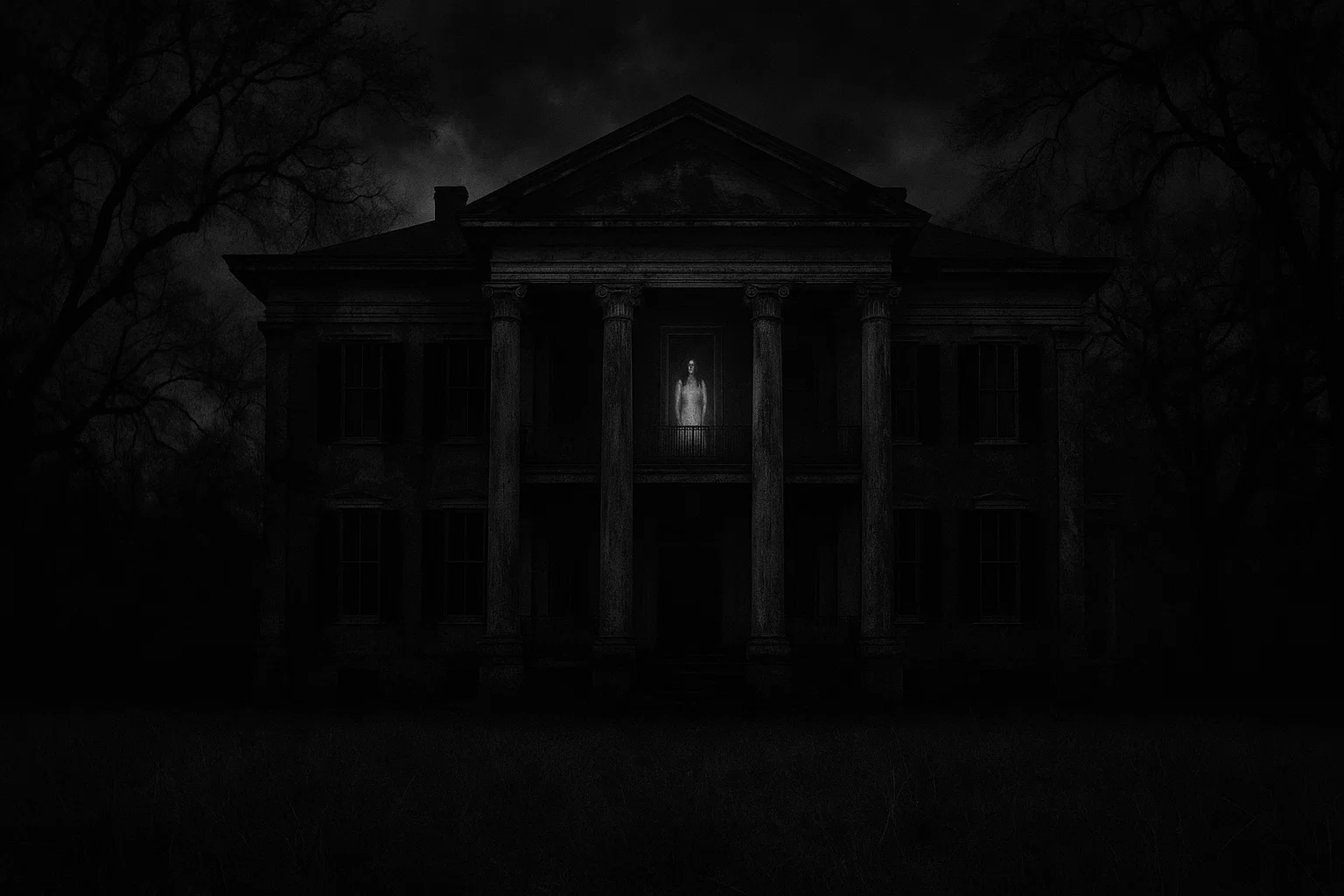
- A female apparition, known simply as “the lady,” seen staring from an upstairs window toward the field behind the house
- A phantom cat, first mentioned in a news article in the 1970s, that has startled guests and staff for decades
- A gray, male entity believed by some to be Judge John Bragg and by others to be his brother, Confederate General Braxton Bragg
- A service elevator that reportedly moves between floors on its own despite no mechanical malfunction
- Strange voices and the sound of a lively conversation heard by staff when no one else was present
- Lights that turn back on shortly after being switched off, and doors that open or close without explanation
No scientific investigation has confirmed paranormal activity at the mansion, and the property’s own management has remained largely ambivalent about promoting it as a “haunted” attraction, even as the stories have circulated in local newspapers, ghost-tour circuits, and books on Mobile’s paranormal history for decades.
What sets the Bragg-Mitchell Mansion apart from many similar claims elsewhere is that the reports are tied to specific, verifiable people who actually lived and died on the property — Judge John Bragg, his wife Mary Frances Hall Bragg, and General Braxton Bragg among them — which is part of why the legends have had such staying power.
The History of Bragg-Mitchell Mansion
The land the mansion sits on has a documented history stretching back to 1829, when Lewis Judson, the first president of the Bank of Mobile, purchased roughly 25 acres bounded by Three Mile Creek and Spring Hill Road. Judson defaulted on a $38,389 mortgage, and the Planters and Merchants Bank took over the property in 1841.
On May 10, 1855, Judge John Bragg purchased the land at what is now 1906 Spring Hill Avenue for $7,500 and began construction of the mansion that still stands today. Bragg was born near Warrenton, North Carolina, graduated from the University of North Carolina at Chapel Hill in 1824, was admitted to the bar in 1830, and moved to Mobile in 1836 to practice law. He was appointed judge of Alabama’s 10th Judicial Circuit in 1842 and later served in the 32nd United States Congress.
He and his wife, Mary Frances Hall, whom he married in 1847, split their time between the new mansion and her family’s cotton plantation in Lowndes County, using the Springhill Avenue home primarily during Mobile’s social season, which ran from Thanksgiving through Mardi Gras.
The house was built in the Greek Revival style, with sixteen fluted Doric-style columns wrapping a three-sided veranda, along with bracketed cornice details that reflect some Italianate influence — a combination historians sometimes call “bracketed Greek Revival.”
The precise identity of the builder remains uncertain, since no official construction records survive; the design is most often attributed to John Bragg’s brother, architect Alexander J. Bragg, though early government documentation mistakenly credited a different builder entirely.
During the Civil War, Mrs. Bragg sent much of the family’s furniture and belongings to the Lowndes County plantation for safekeeping. That decision proved disastrous: Union forces under Wilson’s Raiders destroyed the plantation along with everything inside it, a loss from which Mrs. Bragg reportedly never fully recovered, even though the Springhill Avenue mansion itself survived the war undamaged.
John Bragg’s brother, General Braxton Bragg — a Confederate commander associated with battles at Perryville, Chickamauga, and Stones River — was a frequent guest at the mansion during his brother’s lifetime and lived there for a short period after the war while overseeing construction of jetties at the mouth of Mobile Bay, before relocating to Texas, where he died in 1876.
After Judge Bragg died in 1878, the property passed to his children, who sold it to William H. Pratt in 1880 for $6,000. Pratt, president of the Bank of Mobile, died suddenly in 1883, and nearly all of his possessions were auctioned off to settle his debts.
The house then passed through the Upham, Davis, and Wingate families before A.S. Mitchell purchased it in 1931 for $20,000. The Mitchell family lived in and maintained the mansion until 1965. It is largely due to their stewardship that the house survived intact into the modern era.
The property stood vacant for several years afterward. In the late 1970s, the A.S. Mitchell Foundation donated the mansion to the Explore Center, originally intending it to become an interactive science museum. That plan changed, and the science museum was, in the end, built elsewhere as the Gulf Coast Exploreum. At the same time, the mansion itself was restored to its antebellum appearance.
The Bragg-Mitchell Mansion was added to the National Register of Historic Places on September 27, 1972, and following a $3 million restoration, it reopened to the public as a house museum in 1987. It remains one of the most photographed buildings in Mobile and is now used for historic tours, weddings, and private events.
You may also enjoy:
The Mysterious Almas Cryptid: 600 Years of Sightings
July 20, 2026
Who Is Malphas? The Great President of Hell
August 25, 2025
The Ghost of “The Lady” in the Window
The best-known Bragg-Mitchell Mansion ghost story centers on an unnamed female apparition, referred to simply as “the lady.” According to the legend, she fell in love with an enslaved man on the property — a relationship forbidden in the antebellum South. Both are believed to have died without the relationship being resolved, and her spirit is now said to return to an upstairs window, gazing out over the field behind the mansion as though still watching for him.
Visitors and staff have reported seeing this entity at the window for decades, and the story has become the mansion’s signature haunting, referenced in nearly every account of the property’s paranormal reputation.
No historical documentation identifies the woman by name or confirms the events described in the legend; it survives purely as oral tradition passed down through Mobile’s ghost-tour and local history circles.
The Phantom Cat of Bragg-Mitchell Mansion
Alongside the lady’s apparition, the mansion is associated with a phantom cat. This detail has appeared in local reporting since at least the 1970s, when it was first mentioned in a newspaper article. Guests and staff members have described startling encounters with a cat that appears and then vanishes without explanation.
Not every staff member who has worked at the mansion has personally experienced the phenomenon. Virginia McKean, who managed the mansion for two years, told author Elizabeth Parker — in Parker’s book on Mobile’s haunted history — that she had never encountered the ghost cat herself, despite its reputation.
The story nonetheless persists as one of the mansion’s most recognizable legends, often paired with the tale of the lady in the window as if the two spirits were connected. However, no account explains why a cat would be tied to her story specifically.
Judge Bragg’s Ghost and Other Reported Encounters
Beyond the lady and the phantom cat, several tour guides and docents claim to have encountered a gray, male apparition on the property.
Accounts differ on his identity: some staff believe the entity is Judge John Bragg himself, watching over the home he built, while other reports — including one docent who saw a man striding across the parking lot while preparing the house for wedding photographs — describe the entity as resembling General Braxton Bragg, who lived on the property for a period after the Civil War.
Other reported incidents at the mansion include a service elevator that some staff and visitors say moves between floors on its own, despite no identified mechanical fault, along with an unsettling sense of an unseen presence while riding in it.
Staff have also described hearing what sounded like a lively, real conversation in an empty room, with individual words indistinguishable, but the exchange vivid enough to convince the listener that living people were present.
Additional accounts include lights switching back on shortly after being turned off and an air-conditioning technician who reported being locked inside the attic under circumstances he could not explain.
Bragg-Mitchell Mansion vs Other Haunted Historic Homes
The Bragg-Mitchell Mansion’s blend of an antebellum pedigree, a recurring female apparition, and a resident family “guardian” ghost is a pattern shared by many other historic house museums and former plantation homes across the American South.
| Name | Location | Type of Haunting | Activity Level |
|---|---|---|---|
| Oakleigh House Museum | Mobile, Alabama, USA | Intelligent, Residual | 6/10 (occasional) |
| Richards DAR House | Mobile, Alabama, USA | Intelligent | 6/10 (occasional) |
| Mobile Carnival Museum (Bernstein-Bush House) | Mobile, Alabama, USA | Poltergeist | 6/10 (occasional) |
| Kate Shepard House | Mobile, Alabama, USA | Intelligent, Residual | 4/10 (occasional) |
| Malaga Inn | Mobile, Alabama, USA | Poltergeist | 5/10 (occasional) |
| Battle House Renaissance Hotel | Mobile, Alabama, USA | Intelligent | 5/10 (occasional) |
| Sorrel-Weed House | Savannah, Georgia, USA | Intelligent, Poltergeist | 7/10 (very active) |
| Boone Hall Plantation | Mount Pleasant, South Carolina, USA | Residual | 6/10 (occasional) |
| The Myrtles Plantation | St. Francisville, Louisiana, USA | Intelligent, Residual | 7/10 (very active) |
| Nottoway Plantation | White Castle, Louisiana, USA (main house destroyed by fire in 2025) | Residual, Intelligent | 5/10 (occasional) |
| Monmouth Historic Inn | Natchez, Mississippi, USA | Intelligent | 6/10 (occasional) |
| Waverley Mansion | West Point, Mississippi, USA | Intelligent | 7/10 (very active) |
| The Hermitage | Hermitage (Nashville), Tennessee, USA | Residual, Intelligent | 6/10 (occasional) |
Visiting the Bragg-Mitchell Mansion Today
The Bragg-Mitchell Mansion continues to operate as a house museum at 1906 Springhill Avenue in Mobile, offering guided historic tours on the hour during the week.
The mansion’s fourteen rooms include double parlors, a fifty-foot ballroom, a dining room, and upstairs bedrooms furnished with period antiques, including pieces original to the Bragg and Mitchell families. On weekends, the property is generally reserved for weddings and private events rather than public tours.
Management has historically taken a measured approach to the mansion’s paranormal reputation, neither promoting it heavily as a ghost-tour destination nor denying that staff and visitors have reported unusual experiences over the years.
The mansion’s primary identity remains that of a preserved antebellum landmark and one of the most photographed buildings in Mobile — its ghost stories are simply one layer of a much longer, well-documented history that stretches from Judge Bragg’s original 1855 purchase to its present life as a museum and event venue.
You may also enjoy:
What Is a Satyr, the Lust-Driven Monster of the Wild?
November 14, 2025
Sources
- Parker, Elizabeth. Mobile Ghosts: Alabama’s Haunted Port City. Apparition Publishing, 2001.
- Sagor, Shahidul Islam. Source Book of American Architecture 500 Notable Buildings from the 10th Century to the Present. Academia.edu.
- Gamble, Robert. Historic Architecture in Alabama: A Guide to Styles and Types, 1810–1930. University of Alabama Press, 1990.
- Doy Leale McCall Rare Book and Manuscript Library. University of South Alabama.