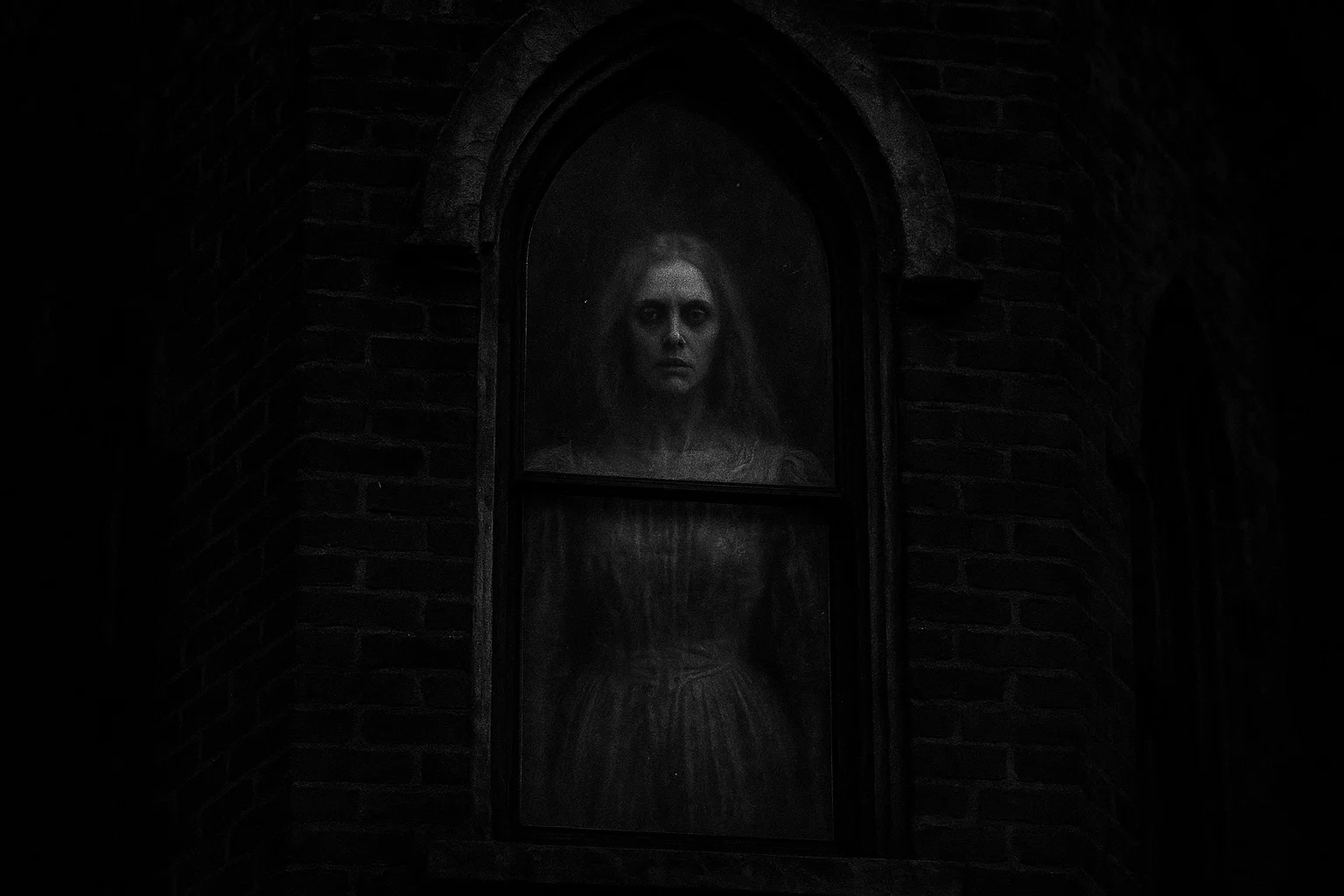
Kenworthy Hall sits down a private drive off Alabama Highway 14, two miles outside Marion, and for more than a century locals have insisted that a young woman never left it. Behind the brownstone-trimmed windows of its four-story tower, generations of Alabamians have described a lingering presence tied to war, heartbreak, and a house that sat empty and forgotten for decades.
But what actually happened inside those brick walls to spawn one of Alabama’s most long-lasting ghost legends — and how much of it can be traced to real history rather than campfire embellishment?
Summary
Quick Facts
| Attribute | Details |
|---|---|
| Name | Kenworthy Hall Ghost; also called the Carlisle Hall spirit. Some tellings name her Anne Carlisle. |
| THC Scale | L-1 [See the THC Scale Explanation] |
| Location / Origin | Fourth-floor tower room of Kenworthy Hall, near Marion, Perry County, Alabama; origin tied to a fiancé’s death in the Civil War (1861–1865) |
| Classification | Residual |
| History | Built 1858–1860 for Edward Kenworthy Carlisle; a family fiancé reportedly killed in Civil War combat (1861–1865); the family’s fortune collapsed after the war, and the house sat vacant and vandalized for much of the 1950s |
| Casualties & Deaths | No confirmed deaths recorded at the property itself. The legend centers on a fiancé’s death on a Civil War battlefield away from the house. |
| Manifestations | Visual — a young woman reportedly seen at the tower window. No documented auditory, olfactory, physical, or environmental activity. |
| First reported sighting | Some stories trace to the house’s vacant periods in the early-to-mid 1900s, first published in 1969 |
| Threat Level | 1/10 (harmless) [See the Threat Level Explanation] |
| HCR | 6/10 (Leans fabricated) [See the Hoax Confidence Rating Explanation] |
| Access Status | Private — privately owned residence, not visible from the highway, and not open for public tours |
What Is the Kenworthy Hall Haunting?
The Kenworthy Hall haunting centers on the apparition of a young woman said to occupy the fourth-floor tower room of the mansion, watching and waiting for a lover who never came home from the Civil War.
The legend was first put into print by Alabama folklorist Kathryn Tucker Windham, who recorded a local version of the story in a short piece titled “The Faithful Vigil at Carlisle Hall,” published in her 1969 book 13 Alabama Ghosts and Jeffrey, co-written with Margaret Gillis Figh.
In Windham’s telling and in the oral tradition that fed it, the ghost is a young woman connected to the Carlisle family — some retellings name her Anne Carlisle — whose betrothed was killed in a Civil War battle. One strand of the story has that she spent her remaining years keeping vigil at the tower window, scanning the road for his return.
A separate, older strand of the same legend claims she took her own life on the home’s spiral staircase the moment she learned of his death, and that it is her restless spirit, not a patient one, that remains. Both versions trace back to the same source material and the same house, but they diverge on what actually happened to the woman at the center of the story — a reminder that oral folklore rarely survives with a single, fixed ending.
What matters for understanding the haunting itself is this: the story did not originate as a tourist attraction or a modern paranormal-investigation claim. It grew organically out of a specific, documented period in the house’s real history — the decades when Kenworthy Hall stood empty and deteriorating. Neighbors began filling the silence with explanations for the crumbling, unlit mansion at the end of the drive.
The Real History of Kenworthy Hall
Kenworthy Hall — also historically known as the Carlisle-Martin House, Carlisle Hall, and the Edward Kenworthy Carlisle House — was built between 1858 and 1860 for Edward Kenworthy Carlisle, a wealthy cotton factor who had settled in Perry County as a young man.
His mother’s family had been cotton planters in the area, and Carlisle himself built his fortune buying and selling cotton on behalf of other planters. He married Lucinda Wilson Walthall in 1841, and by 1858, secure in his status as one of the region’s leading men, he commissioned a country house grand enough to match it.
For the design, Carlisle turned to Richard Upjohn, a New York architect internationally known for his ecclesiastical work — including Trinity Church in Manhattan — and for a handful of ambitious residential commissions in the Northeast, most importantly the Edward King House in Newport, Rhode Island.
Kenworthy Hall is the only surviving residential example of Upjohn’s asymmetrical Italian villa style built specifically to suit a hot, humid Southern climate and a plantation-based way of life. Upjohn adapted his Northeastern villa formula with a wide cross hall behind the main entrance, a detached kitchen, and a full-width rear porch — practical concessions to Alabama heat that had no equivalent in his New England work.
Carlisle’s correspondence with Upjohn shows a client insistent on the finest materials and construction available. Special brownstone trim was shipped down from New York even as the final plans were still being revised by mail.
Finding skilled labor for such an ambitious build proved difficult in rural Perry County until Carlisle secured the services of master mason Philip Bond in November 1858. Bond estimated the brickwork alone would take until June 1859 to finish. The Carlisle family finally moved into their new home in 1860 — just one year before the Civil War began.
The war itself did not immediately ruin Carlisle. His cotton trading firm, Carlisle and Humphries, actually saw profits rise during the Union naval blockade. It was the aftermath that broke him: by 1867, his taxable property had fallen to less than $20,000, and Kenworthy Hall itself was valued at a mere $9,000 — a fraction of what it had cost to build less than a decade earlier.
That collapse in fortune, common to plantation-economy families across the postwar South, is the backdrop against which the ghost legend would later take root.
Architectural Details That Give the Legend Its Setting
Part of what makes the Kenworthy Hall story so durable is the house itself — a genuinely unusual structure whose physical layout lends itself naturally to a tale of solitary watching and waiting.
The house is built entirely of brick, including its interior walls, and its original standing-seam terne metal roof survives to this day. It contains a partial basement, three separate stairways, three large hallways, seven major rooms on the first floor, six on the second, a sprawling attic, and — critically for the legend — both a third-floor and a fourth-floor tower room.
All 64 of the house’s windows carry brownstone tops and sills, most with rounded or arched crowns, and the four-story tower itself features a second-floor balcony under its own small metal roof.
Surviving ancillary structures that still contribute to the property’s historic designation include a detached two-room brick kitchen, a brick smokehouse, a partially buried brick water cistern, and a brick-and-wood well house. The estate even had its own private gas plant to light the home’s interior — an extravagant amenity for a rural Alabama property in 1860.
The fourth-floor tower room, reached by a spiral stair and sitting well above the rest of the house, offered a genuine, unobstructed view down the long approach road — the same road any returning soldier would have to travel.
That vantage point is precisely where local tradition places the waiting ghost, and it is not hard to see why: architecturally, it is the one room in the house actually built for looking out and watching for someone’s return.
Kathryn Tucker Windham and “The Faithful Vigil at Carlisle Hall”
The woman most responsible for preserving the Kenworthy Hall legend in print was not a paranormal investigator but a journalist and folklorist. Kathryn Tucker Windham grew up in Thomasville, Alabama, and spent much of her adult life in Selma as a freelance writer, photographer, and radio commentator, with regular appearances on NPR’s All Things Considered.
Her first ghost-story collection, 13 Alabama Ghosts and Jeffrey, gathered thirteen regional legends — including “Death Lights in the Tower” from the Old Drish Place in Tuscaloosa, “The Red Lady of Huntingdon College” in Montgomery, “The Unquiet Ghost at Gaineswood” in Demopolis, and “The Faithful Vigil at Carlisle Hall” — and wove genuine Alabama history into each retelling. The book takes its subtitle from Jeffrey, a household spirit Windham said had taken up residence in her own Selma home starting in October 1966.
Windham was known for a specific philosophy about her material, often repeating the idea that a good ghost story does not require the listener to actually believe in ghosts. That approach is evident in “The Faithful Vigil at Carlisle Hall”: it functions as much as a piece of local-color history about a family ruined by war as it does a conventional scare story, using the Carlisle family’s real economic collapse as the emotional foundation for the haunting that followed.
Decades of Vacancy
The timeline of Kenworthy Hall’s ownership after the Carlisles is central to understanding how the ghost story actually formed. Lucinda Carlisle increasingly used the house only as a summer residence before giving it to her surviving child, Augusta Carlisle Jones, in 1899.
Lucinda died in 1912, and Augusta sold the property in 1914. What followed was a long stretch of instability: the house passed through a series of owners and fell into general decline, losing both of its original porches along the way.
Kenworthy Hall stood completely vacant for much of the 1950s, and it was during this period that the house suffered its worst damage. Vandals mutilated the ornamental plasterwork, broke numerous marble mantels, and destroyed much of the original stained glass — though the Historic American Buildings Survey had fortunately documented the interior back in 1934, preserving a photographic and architectural record of what was being lost.
It was specifically during these long stretches of vacancy, with the mansion dark and unattended along a rural highway, that neighboring communities began circulating the stories of a haunting that Windham would later commit to print.
This pattern is worth noting because it distinguishes Kenworthy Hall from many “haunted house” stories that are largely modern inventions built around no verifiable history. Here, the sequence is reversed and well documented: a real family’s real financial ruin, followed by a real, decades-long period of abandonment and vandalism, produced the conditions in which a ghost legend could plausibly take shape and spread by word of mouth well before it was ever written down.
Restoration
Kenworthy Hall’s fortunes eventually turned. In 1957, Karen Klassen of Birmingham purchased the house along with 19 surrounding acres for $4,000 and spent the next decade working to restore it.
In 1967, the Martin family acquired the property and devoted roughly thirty years to further restoration work. Their efforts helped earn the house a listing on the National Register of Historic Places in 1990, and in the summer of 1997 the Historic American Buildings Survey returned to prepare new measured drawings and photographs of the property.
The Martins both died not long after this second wave of documentation, and their heirs sold Kenworthy Hall in 2001. Three years later, in 2004, the property — along with several of its surviving outbuildings — was designated a National Historic Landmark, one of the highest levels of federal historic recognition in the United States.
Today the house remains a privately owned residence rather than a publicly operated museum, and it is not visible from Highway 14, sitting instead at the end of its own private driveway.
Kenworthy Hall Ghost vs Other Ghosts
| Name | Location | Type of Haunting | Activity Level |
|---|---|---|---|
| The Ghost of the Angry Architect | Rocky Hill Castle, Courtland, Lawrence County, Alabama | Intelligent | 3 (dormant) |
| Death Lights in the Tower | Old Drish Place (Drish House), Tuscaloosa, Alabama | Residual | 4 (occasional) |
| The Specter in the Maze at Cahaba | Cahaba, Dallas County, Alabama | Residual (orb/light phenomenon) | 3 (dormant) |
| The Unquiet Ghost at Gaineswood | Gaineswood, Demopolis, Alabama | Intelligent | 4 (occasional) |
| The Red Lady | Huntingdon College (Pratt Hall), Montgomery, Alabama | Intelligent | 5 (occasional) |
| The Ghost of John McGee Parkman | Sturdivant Hall, Selma, Alabama | Intelligent | 4 (occasional) |
| Sweetwater Mansion Spirits | Florence, Alabama | Intelligent / Poltergeist | 5 (occasional) |
| Chloe and the Myrtles Plantation Spirits | St. Francisville, Louisiana | Intelligent | 8 (very active) |
| Annie Palmer, the “White Witch of Rose Hall” | Rose Hall Great House, Montego Bay, Jamaica | Intelligent | 7 (very active) |
| The Octagon House Ghosts | Washington, D.C. | Intelligent / Residual | 5 (occasional) |
| Oak Alley Plantation Spirits | Vacherie, Louisiana | Residual / Intelligent | 4 (occasional) |
| Belle Grove Plantation Ghosts | King George County, Virginia | Intelligent | 5 (occasional) |
| The Beauregard-Keyes House Haunting | New Orleans, Louisiana | Intelligent / Poltergeist | 6 (occasional) |
Is Kenworthy Hall Still Considered Haunted Today?
Kenworthy Hall continues to appear on statewide lists of reportedly haunted Alabama locations, alongside other Windham-documented sites such as the Red Lady of Huntingdon College and Sturdivant Hall in Selma, which is allegedly haunted by its second owner, John McGee Parkman, who died attempting to escape Cahaba Prison in 1867.
The core of the modern reputation, however, still rests almost entirely on the same nineteenth-century-rooted legend that Windham recorded in 1969, rather than on any large body of independently verified contemporary paranormal investigation.
As a private residence with limited public access, Kenworthy Hall has not been the subject of the kind of ongoing, publicly documented ghost-hunting activity associated with fully public attractions elsewhere in Alabama, and any specific claims about recent encounters at the house should be weighed with that limited access in mind.
What can be said with confidence is that Kenworthy Hall occupies a distinctive place in Alabama folklore: a National Historic Landmark whose architecture, ownership history, and connection to one of the state’s most respected folklorists together explain both why the ghost story exists and why it has proven so durable — regardless of what, if anything, actually walks its fourth-floor tower room today.
You may also enjoy:
The Demon Ammit: Crocodile-Headed Devourer of the Dead
October 2, 2025
The Complete List of All Haunted Places in Arizona
November 18, 2025
The Demon Div: The Terrifying Horned Demon of Chaos
October 3, 2025
Phenex: The Fiery Demon Marquis of Hell
August 26, 2025
Sources
- Historic American Buildings Survey, creator, and Richard Upjohn. Kenworthy Hall, State Highway 14 (Greensboro Road), Marion, Perry County, AL. Library of Congress, 1933. Accessed 13 July 2026.
- Windham, Kathryn Tucker, and Margaret Gillis Figh. Thirteen Alabama Ghosts and Jeffrey. University of Alabama Press, 1969.
- Sharon A. Hill. The ‘Stone Tape Theory’ of Hauntings: A Geological Perspective. SharonAHill.com, 2017. Academia.edu.
- Cardeña, Etzel. (2018). The Experimental Evidence for Parapsychological Phenomena: A Review. American Psychologist. 73. 663-677. 10.1037/amp0000236. ResearchGate.