The face in the courthouse window has haunted a small Alabama town for nearly 150 years, staring down from a single pane of glass that no amount of scrubbing, weather, or time has ever managed to clear. Long after the people connected to its origin have passed into history, the image remains — drawing historians, skeptics, and paranormal enthusiasts to a quiet town square in the west Alabama countryside.
What exactly is this mark, why has it survived so long, and how much of the story behind it is fact rather than folklore?
Summary
Key Takeaways
| Attribute | Details |
|---|---|
| Name | The Face in the Courthouse Window; also known as the Pickens County Courthouse Face, the “Lightning Portrait,” and the Henry Wells Legend |
| THC Scale | L-1 [See the THC Scale Explanation] |
| Location / Origin | Pickens County Courthouse, 20 Phoenix Ave. / Courthouse Square, Carrollton, Alabama 35447 (approx. 33°15′43″N, 88°5′42″W); the image itself originates in the north garret window on the building’s third floor |
| Classification | Residual, Curse |
| History | The second Pickens County Courthouse burned on November 16, 1876, in a suspected arson. Freedman Henry Wells was accused, shot while resisting arrest, and died of his wounds in early 1878. Local legend holds that his face was etched into a garret window pane during a mob confrontation shortly before his death. |
| Casualties & Deaths | At least 15 documented lynchings occurred in Pickens County between 1877 and 1917, several in the courthouse square, plus the death of Henry Wells from gunshot wounds sustained during his 1878 arrest — Wells is the alleged victim behind the legend, not one of its casualties. 0 deaths or injuries have been documented as caused by the face/entity itself. |
| Manifestations | Visual only — a static, discolored face-like image permanently visible in a single windowpane. No auditory, olfactory, physical, or environmental (EMF spikes, cold spots) activity has been reliably documented at the site; paranormal investigators who have examined the window report inconclusive findings. |
| First reported sighting | Not precisely dated. The oral legend is said to date to shortly after the garret windows were installed in 1878; the earliest known published account appears in Kathryn Tucker Windham’s “13 Alabama Ghosts and Jeffrey” (1969). |
| Recent reported sighting | Ongoing — the image remains visible today and was most recently the subject of regional news coverage in late 2025. |
| Threat Level | 1/10 (harmless) [See the Threat Level Explanation] |
| HCR | 6/10 (Leans fabricated) [See the Hoax Confidence Rating Explanation] |
| Access Status | Yes — the courthouse is an active Pickens County government building in Carrollton, Alabama. The window is visible year-round from the town square, marked by a directional arrow, with mounted binoculars provided across the street. Interior access is limited since the building is in daily use; guided tours are occasionally available by advance arrangement. |
What Is the Face in the Pickens County Courthouse Window?
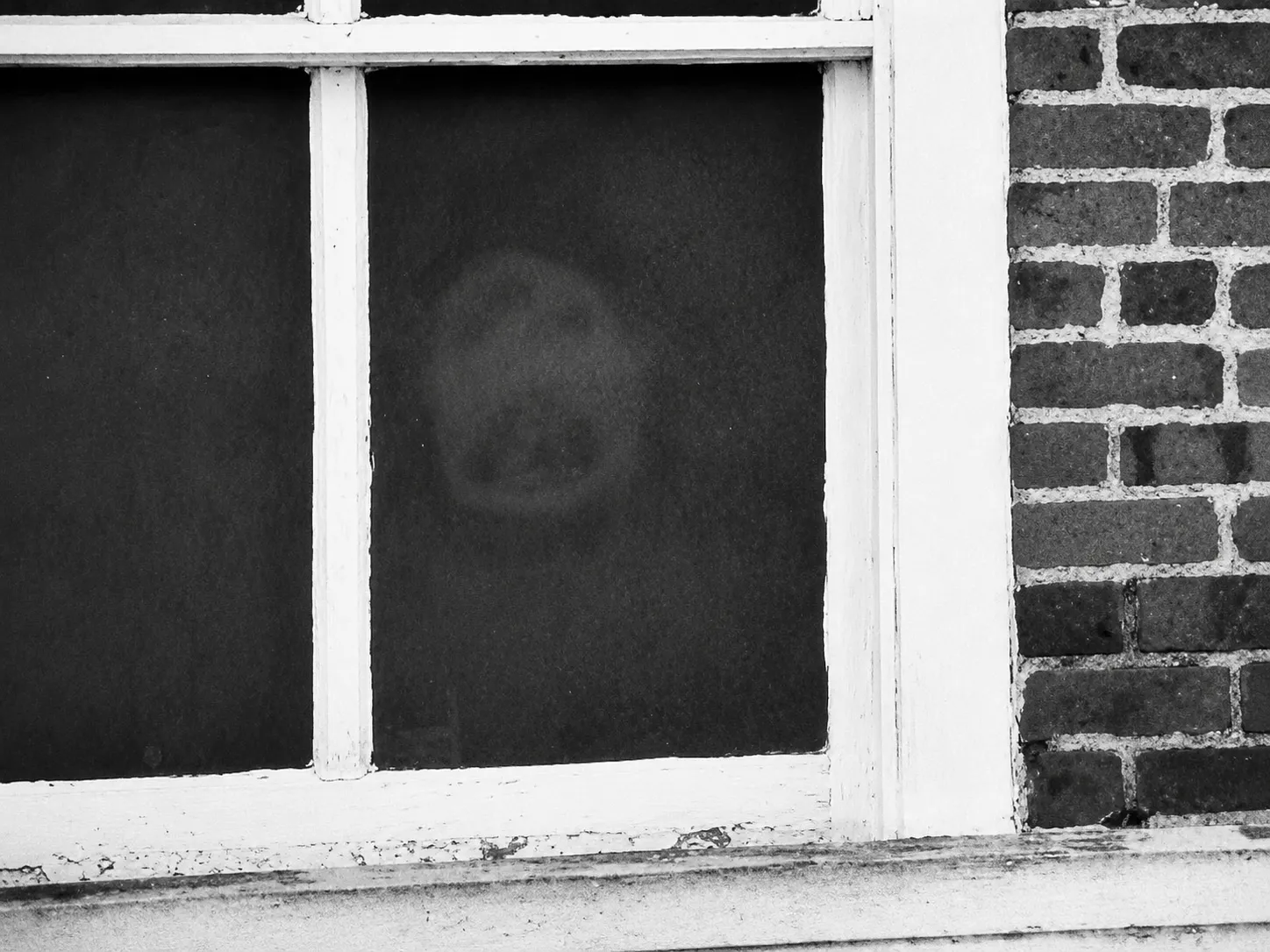
The Pickens County Courthouse face is a discolored, human-like image embedded in a small pane of glass in an upper garret window of the historic Pickens County Courthouse in Carrollton, Alabama.
Visible from the street below — and pointed out by a metal arrow mounted on the courthouse wall — the mark resembles the outline of a face pressed against glass, most clearly seen at certain angles and times of day.
Local legend attributes the image to Henry Wells, a freedman accused of burning down an earlier version of the courthouse in 1876. According to the most widely told version of the story, Wells was hiding in the courthouse garret when a lynch mob gathered outside in January 1878.
As he peered through the window and a thunderstorm broke overhead, lightning is said to have struck near the glass and permanently “etched” his terrified expression into the pane. The Pickens County Courthouse face has been reproduced in books, newspaper features, and television segments for decades, and the pane itself has never been successfully cleaned or replaced.
Historians who have examined court records and period newspapers note that the timeline in the popular legend does not line up neatly with documented events — a discrepancy explored in detail later in this article. Regardless of its true origin, the face in the courthouse window remains one of the most photographed and discussed unexplained images in the American South.
The Courthouse Itself: A Building Rebuilt Twice
The Pickens County Courthouse standing in Carrollton today is actually the third courthouse to occupy the site. The first was burned on April 5, 1865, when Union cavalry under General John T. Croxton passed through Carrollton during the closing weeks of the Civil War as part of Wilson’s Raid, shortly after burning facilities at the University of Alabama in Tuscaloosa.
Carrollton residents rebuilt, and a second courthouse stood for roughly a decade until it, too, burned down — on November 16, 1876, in a fire suspected from the start to have been the work of an arsonist. Construction on the third and current courthouse began soon afterward and continued into 1878.
According to reporting in the local newspaper, the West Alabamian, windows for the building’s main courtroom were being installed on February 20, 1878, with the garret windows — including the pane now associated with the ghostly image — added only in the weeks that followed.
The Legend of Henry Wells
The story most commonly told about the Pickens County courthouse face centers on Henry Wells, a formerly enslaved man living in the Providence Beat area near Carrollton. In the wake of the November 1876 courthouse fire, suspicion fell on Wells and an associate, Bill Burkhalter, after stolen merchandise from an earlier robbery was reportedly found among their belongings.
Burkhalter was arrested in early January 1878 near Tuscaloosa and, under questioning, implicated Wells in the courthouse burning. When authorities located and confronted Wells, he attempted to flee and was shot twice by police.
He was captured, and according to newspaper accounts from the period — including a February 6, 1878 report in the Georgia-based Daily Inquirer describing him as a “notorious colored outlaw” who had “confessed” to the arson — Wells died of his wounds soon after.
The popular legend goes further, describing Wells as trapped in the courthouse garret by an armed mob, shouting his innocence and vowing to haunt the town before a bolt of lightning struck the window and left his likeness burned into the glass.
Variations of the tale, some of which substitute the name Burkhalter for Wells or add additional mob violence at a hanging tree, have circulated for generations and have even been referenced in publications like Ripley’s Believe It or Not and in Kathryn Tucker Windham’s classic regional ghost-story collection.
You may also enjoy:
Complete Guide to Texas Bigfoot Sightings (1837–2025)
August 8, 2025
Who Is Lucifuge Rofocale in Demonology?
August 25, 2025
What Is the Mazomba—Africa’s Lost Dinosaur or an Unknown Rhino?
November 11, 2025
The Demon Ammit: Crocodile-Headed Devourer of the Dead
October 2, 2025
Does the Legend Match the Historical Record?
This is where the story of the Pickens County courthouse face becomes genuinely complicated. Researchers who have cross-referenced circuit court minutes, county records, and period newspapers have identified several inconsistencies between the popular legend and the documented timeline.
Most importantly, the West Alabamian’s own reporting shows that the courthouse’s main windows were not installed until February 20, 1878 — and the garret windows, where the face supposedly appeared, were installed even later.
Wells was shot during his capture in early January or February 1878 (accounts differ slightly, with county court records pointing to a February date) and died of his injuries shortly afterward. That means Wells could not have been standing at a garret window that had not yet been built.
Historians studying the courthouse’s past have proposed that the legend may actually be a conflation of two separate incidents. The first involved Nathaniel T. Pierce, a white man who was dragged from the Carrollton jail by an armed mob on the night of September 26, 1877, and lynched along the road outside town — an episode described in graphic detail by the local press at the time.
The second involved Wells himself, whose confession to the arson was almost certainly obtained through coercion and physical abuse rather than freely given. Over time, community memory appears to have merged elements of these two tragedies into a single, more dramatic narrative: an innocent man, cornered by a mob, whose final defiant words were burned into glass by a bolt of lightning.
What is not in dispute is the broader context in which these events took place. Pickens County recorded a documented total of 15 lynchings of African Americans between 1877 and 1917, the fifth-highest total of any county in Alabama, according to a 2015 study of racial terror lynchings.
Among the most brutal was a mass lynching on September 14, 1893, when a white mob stormed the county jail and shot five Black residents — Paul Archer, Will Archer, Emma Fair, Ed Guyton, and Paul Hill — to death in their cells over the alleged burning of a cotton gin, without any trial ever taking place. Another man, Joe Floyd, had been lynched in Carrollton just two weeks before that.
The face in the courthouse window, whatever its literal cause, has persisted in local memory in part because it symbolizes this much larger and well-documented history of racial violence in the Reconstruction-era South.
Possible Explanations for the Pickens County Courthouse Face
Setting aside the supernatural framing, several natural explanations have been proposed for how a face-like image could form on 19th-century window glass and persist for well over a century.
Glass imperfections. Hand-blown and early machine-rolled window glass from the 1870s frequently contained streaks, bubbles, and mineral impurities. Under specific lighting conditions and viewing angles, such flaws can create shadow patterns that the eye interprets as facial features.
Pareidolia. The human brain is highly attuned to recognizing faces, a tendency known as pareidolia, which causes people to perceive facial patterns in clouds, wood grain, water stains, and — as in this case — flawed glass. Once a community agrees that an image resembles a face, that interpretation tends to become self-reinforcing for later viewers.
Keraunography. Some accounts point to a folk phenomenon sometimes called “lightning printing” or keraunography, in which an object’s silhouette is said to be burned or imprinted onto a nearby surface during a lightning strike.
A similar story is told about an 1873 lightning strike at Chennuggee Ridge, Alabama, in which a woman’s image was reportedly left on a window pane. However, there is no accepted scientific mechanism by which lightning could produce a detailed, durable image of a human face on glass, and no controlled study has ever reproduced the effect.
None of these explanations has been definitively proven for the Pickens County Courthouse face specifically, largely because the window has never been removed for laboratory analysis — a fact that has only added to its mystique.
You may also enjoy:
Satanachia: Demon General of Hell’s Legions
August 28, 2025
Haagenti: The Demon of Alchemy and Transformation
August 21, 2025
Children Vanished: The Werewolf of Eschenbach Case
June 18, 2025
The Courthouse Survives
The pane containing the face in the courthouse window has come close to disappearing more than once. Locals have described repeated attempts over the decades to wash, scrub, and even treat the glass with solvents in hopes of removing the image, none of which succeeded.
A more serious threat arose in 2001, when the aging courthouse was slated for demolition and replacement with a modern facility. During this period, the window containing the face was reportedly covered with a sheet of plywood spray-painted with a smiley face.
A public preservation campaign pushed back against the demolition plan, and the historic courthouse has instead been renovated over time as funding has become available, preserving both the building and its famous window.
In 1974, the Alabama Historical Association placed a historic marker at the courthouse, recounting the story of Henry Wells and the legend of the face in the window, cementing its place in official state history while acknowledging its status as folklore.
In 2020, the William G. Pomeroy Foundation and the Alabama Folklife Association also recognized the tale with a dedicated historic marker describing “The Face in the Window” as one of Alabama’s best-known legends.
The Face in the Courthouse Window vs. Other Haunted Courthouses
The Pickens County courthouse face is unusual, but it is not the only American civic building with a legend attached to violent 19th- and early 20th-century history.
| Name | Location | Type of Haunting | Activity Level |
|---|---|---|---|
| The Lightning Portrait of Clay’s Ferry | Clay’s Ferry, Kentucky | Residual (lightning-imprint legend) | 2/10 (dormant) |
| The Turret Window Bather | Russellville, Kentucky | Residual (lightning-imprint legend) | 2/10 (dormant) |
| Old Presidio County Courthouse | Marfa, Texas | Intelligent, Shadow People | 4/10 (occasional) |
| Union County Courthouse (Hannah Ogden Caldwell) | Elizabeth, New Jersey | Intelligent | 4/10 (occasional) |
| Union County Courthouse (Blackjack Ketchum hanging site) | Clayton, New Mexico | Residual | 3/10 (dormant) |
| Lake County Courthouse (“The Grand Old Lady”) | Crown Point, Indiana | Intelligent, Residual | 5/10 (occasional) |
| Davenport City Hall (former jail) | Davenport, Iowa | Residual | 3/10 (dormant) |
| Jackson County 1859 Jail & Marshal’s Home Museum | Independence, Missouri | Intelligent, Residual | 5/10 (occasional) |
| Whaley House (former San Diego County courthouse) | San Diego, California | Intelligent, Poltergeist | 7/10 (very active) |
| Caddo Parish Courthouse | Shreveport, Louisiana | Intelligent | 5/10 (occasional) |
| Pioneers Museum (former El Paso County Courthouse) | Colorado Springs, Colorado | Intelligent | 4/10 (occasional) |
| Licking County Historic Jail | Newark, Ohio | Intelligent, Poltergeist | 6/10 (occasional) |
| Sussex County Old Courthouse | Georgetown, Delaware | Intelligent | 3/10 (dormant) |
| Posey County Courthouse Square | Mt. Vernon, Indiana | Residual, Crisis Apparition | 3/10 (dormant) |
Visiting the Pickens County Courthouse Today
The Pickens County Courthouse still stands in the town square of Carrollton, Alabama, roughly 35 miles west of Tuscaloosa, and continues to function as an active government building.
A reflective arrow mounted on the exterior wall points visitors toward the correct garret window, and mounted binoculars have been installed across the street at what locals consider the best vantage point for viewing the image from ground level.
Because the courthouse remains in daily use for county business, interior access is limited. However, guided tours and special paranormal-themed events are occasionally organized by local historical and tourism groups. Handcuffs said to have been used on Henry Wells are reportedly displayed inside the building as part of its local history exhibits.
Visitors researching the Pickens County Courthouse face are encouraged to check with Pickens County or Carrollton town offices in advance for current tour availability, since access can vary depending on court schedules and building renovations.
Nearly a century and a half after the courthouse fire that started it all, the face in the courthouse window continues to attract attention from folklorists, historians, ghost-story enthusiasts, and casual travelers passing through west Alabama.
Part of its staying power comes from simple visual evidence. Unlike many ghost stories that rely entirely on eyewitness testimony, this one offers a physical object that visitors can see for themselves, photograph, and debate.
But the deeper reason the story has survived is its connection to a real and painful chapter of American history. The Pickens County courthouse face sits at the intersection of a documented arson case, a coerced confession, a wrongful-death shooting, and a broader regional pattern of racial terror lynchings that claimed at least 15 lives in the county between 1877 and 1917.
Whether lightning ever struck that garret window or not, the image has become a lasting, physical reminder of that history — one that local storytellers, historians, and visitors continue to reckon with more than 140 years later.
You may also enjoy:
12 Haunted Places in Arkansas You Should Never Visit Alone
October 8, 2025
Who Is Samael? The Angel of Death in Demonology
August 27, 2025
The Demon Div: The Terrifying Horned Demon of Chaos
October 3, 2025
Sources
- Windham, Kathryn Tucker, and Margaret Gillis Figh. 13 Alabama Ghosts and Jeffrey. University of Alabama Press, 1969.
- Brown, Alan. The Face in the Window and Other Alabama Ghost Lore. University of Alabama Press, 1996.
- McNeil, W. K., editor. Ghost Stories from the American South. August House, 1985.
- Spaeth, Frank, editor. Phantom Army of the Civil War and Other Southern Ghost Stories. Llewellyn Publications, 1997.
- McKissack, Patricia. The Dark-Thirty: Southern Tales of the Supernatural. Knopf, 1992.
- Norman, Michael, and Beth Scott. Haunted Heritage: A Definitive Collection of North American Ghost Stories. Tom Doherty Associates, 2002.
- Pirvulescu, Sergiu. (2021). The existence of paranormal phenomena. ResearchGate.
- Hauck, Dennis William. Haunted Places: The National Directory. Sacramento, Calif.: Athanor Press, 1994.
- Baker, Joseph & Bader, Christopher. (2014). A social anthropology of ghosts in twenty-first-century America. Social Compass. 61. 569-593.