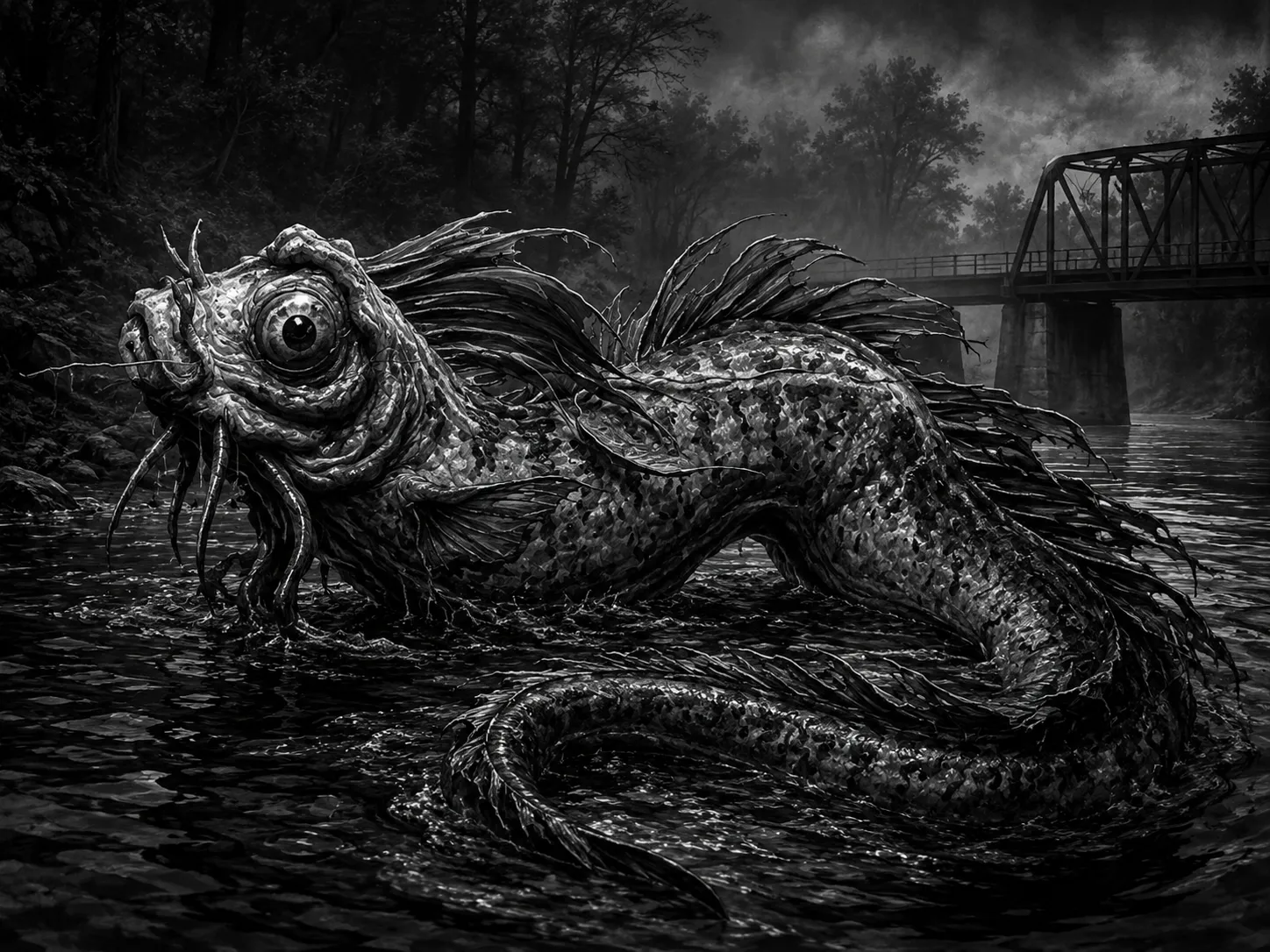
The Coosa River Monster is a legendary lake creature linked to Alabama’s Coosa River. The most important sightings happened in the summer of 1877 near Gadsden. For over a century, people have described seeing an animal with a horse-like head, a long neck protruding from the water, bright eyes, and a body that moves through the water in sections, much like a half-submerged log moving with intent.
Unlike many American lake monsters that became famous through tourism or roadside attractions, the Coosa Monster’s main sightings are based on real 19th-century newspaper reports, accounts from named local people, and an Indigenous serpent tradition that existed long before the English name appeared.
Another part of the legend appeared in the mid-1900s, when divers building new hydroelectric dams on the river claimed to see huge catfish on the riverbed. Today, the Coosa Monster is mostly a piece of northeast Alabama folklore, remembered by local historians and small-town newspapers rather than by any formal cryptozoology groups.
Summary
Coosa River Monster Infobox
| Attribute | Details |
|---|---|
| Name | Coosa River Monster |
| Aliases | Coosa Monster; Coosa River Sea Serpent; “Monster of the Coosa” |
| Ancestry | 19th-Century Frontier Newspaper Folklore, layered atop older Muscogee Creek and Cherokee horned-serpent mythology (the Uktena tradition) |
| Species | Aquatic serpent (folk classification); most likely explained by a known native fish species |
| CCI Score | 2/10 (Almost certainly misidentification) [See the Cryptid Credibility Index] |
| Threat Level | 🟢 Harmless (Safe to track; essentially a ghost story) |
| Height / Weight | Length: 15–20 ft (4.6–6 m) estimated; Weight: unconfirmed — the leading fish candidate (lake sturgeon) can reach roughly 300 lb (136 kg) |
| Physical Traits | Horse-like head and neck, large glaring eyes, vivid red tongue, dark scaled body with raised “knots” along the back, pale underbelly, large fins, no limbs |
| Habitat | Slow-moving river channels, deep pools, and reservoir backwaters of the Coosa River; Ridge-and-Valley foothill terrain in northeast Alabama and northwest Georgia |
| Core Sighting Corridor | Coosa River between Rome, Georgia, and Gadsden, Alabama (Etowah, St. Clair, and Calhoun counties) |
| Time Active | Daytime — nearly every recorded sighting occurred in full daylight |
| Diet | Unconfirmed; older folklore implies carnivorous behavior, though the leading fish-based explanations are largely bottom-feeding omnivores |
| Movement | Swims via serpentine undulation; no limbs or land movement ever reported |
| First Sighting | 1816 (St. Clair County frontier account, Ten Islands) |
| Last Notable Sighting | 1960s (Neely-Henry Dam construction, Ohatchee, Alabama) |
| Sighting Frequency | Rare (11–50 sightings) |
| Evidence | Eyewitness testimony and 19th- and 20th-century newspaper reporting only; no photographs, footprints, or physical specimens |
| Rational Explanations | Native lake sturgeon (historic Coosa population); giant blue or flathead catfish; decomposing vegetation lifted by gas-bubble mats; inherited Cherokee/Creek horned-serpent (Uktena) imagery shaping perception |
| Status | Dormant folklore; no sightings reported in recent decades, preserved today as regional historical legend rather than an actively pursued cryptid |
Who or What Is the Coosa River Monster?
Cryptozoology fans usually put the Coosa River Monster in the general category of “lake monster” or “aquatic serpent,” along with Scotland’s Loch Ness Monster, Vermont’s Champ, and Lake Erie’s Bessie.
What makes it different from many other lake monsters is its setting. The Coosa River is a real, well-mapped waterway stretching 280 miles (450 kilometers). It starts where the Etowah and Oostanaula Rivers meet in Rome, Georgia. It flows southwest through several Alabama counties before joining the Tallapoosa River near Wetumpka to form the Alabama River. Most reports of the creature come from the same area, especially around Gadsden and along the stretch of the river heading northeast toward Rome.
The name itself does not mean anything monstrous. Coosa is an English version of Kvse (pronounced kü-shē), which was the name of the Coosa, or Kusa, people. They were a leading Muscogee Creek “Upper Town” nation that controlled much of what is now east Tennessee and north Georgia during the 1500s when the Spanish arrived.
Spanish chroniclers from the Hernando de Soto and Tristán de Luna expeditions wrote the name as Coça, Cosa, and Coza. The Cherokee, who lived near and later absorbed the Coosa towns, called them Ani’-Gusa, meaning “the Coosa people.”
The river, and later the cryptid, simply took the name of the nation that once lived along its banks. There is no connection between the word “Coosa” and any word for serpent, monster, or water-spirit. That imagery comes only from the sighting reports and from older, separate regional myths discussed below.
By the late 1800s, local newspapers were already calling the creature the “Coosa River Sea Serpent” or just “the monster of the Coosa.” This language remained even after the legend changed in the 20th century, when a new version focused on giant catfish during the river’s dam-building period.
You may also enjoy:
Swiatek: Murder, Cannibalism, and a Wolf’s Curse
June 18, 2025
The Complete List of All Haunted Places in Connecticut
December 2, 2025
Rokurokubi Legends: Women Who Transformed Into Night Demons
September 9, 2025
Coosa River Monster Mythology
Before any English-language newspaper named the creature, the Coosa Valley was already part of a much older world of myths. The river and its branches were home to Muscogee (Creek) and Cherokee communities until they were forced out in the 1830s.
Historian Dale Cox notes that both groups “often told of seeing monstrous serpents and other creatures in the river” long before settlers reported their own sightings in the 1800s. The story is part of a much broader and well-documented Southeastern Indigenous belief in the horned water-serpent.
The Cherokee called the creature the Uktena, or “the Keen-Eyed.” The name comes from a creation story recorded by ethnographer James Mooney in his 1900 book Myths of the Cherokee. In the story, the Sun sent a sickness to punish people, so the spiritual Little People turned a man into a horned serpent and sent him to kill the Sun. He failed, became jealous when a rattlesnake succeeded instead, and was banished to remote mountain passes and deep river pools.
Mooney described the Uktena as a creature as thick as a tree trunk, with horns and a sparkling, crystal-like crest. Its scales glowed “like sparks of fire.” Similar horned-serpent beings appear in the stories of the Creek, Choctaw, Chickasaw, and Yuchi. These legends are part of the broader Southeastern Ceremonial Complex from late prehistoric Mississippian culture, a regional religious tradition shared by many groups.
These serpent-beings had important symbolic roles. They marked dangerous waters—like deep pools, fast currents, and places where someone might drown—as spiritually forbidden, which was a stronger warning than just mentioning the risks.
They also represented the unpredictable force of storms and floods. Through the Uktena’s legendary crystal (the Ulun’suti), these stories taught a lesson about forbidden knowledge: power that could heal or destroy, but only for those willing to risk everything to find it.
By the early 1800s, the Muscogee and Cherokee had been forced out of the Coosa Valley, and much of the memory of their serpent-spirits was left with them. But within a few decades, English-speaking settlers living along the river began sharing their own monster stories. The earliest is more of a frontier tall tale than a real eyewitness account: a letter from 1816 describes settlers in St. Clair County near the Ten Islands stretch of the Coosa killing a sickly “sea monster” found half-beached on the riverbank.
When they cut it open, the story goes, they found the remains of a Native man, his canoe, a deer, a bow and arrows, and a rifle. According to the tale, the rifle was what finally made the creature sick. There is no description of what the monster looked like in this account. It sounds much more like a piece of campfire folklore than a real field report, and it marks the transition between older Indigenous serpent stories and the more detailed newspaper sightings that came later.
What Does the Coosa River Monster Look Like?
The most consistent physical description of the Coosa River Monster comes directly from the cluster of 1877 sightings, and it is remarkably specific for 19th-century folklore.
Witnesses described a head and neck resembling a horse’s, raised three to four feet clear of the water’s surface, with large, prominent, “popeyed” eyes and a mouth that gaped open to reveal a startlingly vivid red tongue.
People rarely saw the whole body. Instead, they caught glimpses of a long back as the creature moved, dipping below and rising above the water like a swimmer’s shoulders breaking the surface in steady strokes. Several 1877 accounts agreed it was fifteen to twenty feet long, with dark skin—black or deep green—covered in scales and a noticeably pale or white belly.
One lesser-known detail, mentioned specifically in the raftsmen’s 1877 account but largely absent from later popular retellings of the legend, is that the creature’s back was said to carry large, raised knots or protuberances running along its spine.
Most modern accounts of the Coosa Monster focus on its horse-like head and fiery tongue, often leaving out this detail. However, the knots along its back might be the most important clue in all the reports. A smooth, reptilian serpent usually wouldn’t have a knotted or plated back. Still, a heavily armored fish with bony plates would. Several 1877 reports also mention “large fins,” which don’t fit a serpent but make sense if the creature was a fish.
No report from any time describes the creature with legs, arms, or any other limbs. In every account, the Coosa River Monster moves only by swimming. This puts it clearly in the “long-necked aquatic serpent” group of cryptids, not in the multi-humped sea-serpent or plesiosaur-like categories seen with some other famous lake monsters.
Habitat
The Coosa River flows through the Ridge-and-Valley and Appalachian Plateau regions of northwest Georgia and northeast Alabama. The area is made up of rolling, forested foothills, which are very different from the flat coastal plain that many people picture when they think of Alabama’s rivers. Starting in Rome, Georgia, the river travels about 280 miles through Cherokee, Etowah, St. Clair, Calhoun, Talladega, Shelby, Coosa, Chilton, and Elmore counties before joining the Alabama River near Wetumpka.
Today, much of the river’s lower and middle sections have been turned into a series of reservoirs by Alabama Power. These include Weiss Lake, H. Neely Henry Lake, Logan Martin Lake, Lay Lake, Mitchell Lake, and Jordan Lake. As a result, there are now long stretches of deep, slow-moving, often murky water that look very different from the free-flowing river described in the 1877 stories.
The upper part of the river is lined with mixed pine and hardwood Piedmont forests. Farther downstream, near Talladega and Shelby counties, the land shifts to bottomland hardwoods and becomes more agricultural and suburban. The river is home to many native fish, such as channel, blue, and flathead catfish, largemouth and spotted bass, and—most importantly for the story—a historic population of lake sturgeon.
Looking at the ecology of the area changes how we see the legend compared to most online stories. Many casual articles about Alabama river monsters blame the alligator gar. Still, this fish’s native range in Alabama is almost entirely limited to the Mobile-Tensaw Delta system—Baldwin, Clarke, Escambia, Mobile, and Monroe counties—which is several hundred kilometers south of the Coosa’s route through Etowah and St. Clair counties.
Blaming the gar for the 1877 Gadsden-area sightings would mean the fish was far outside its known range. The American alligator is also not a good fit. Its historic home is in coastal and southern Alabama. Although it has moved north in recent years, this has mostly happened along the Tennessee River, not the Coosa.
The lake sturgeon is by far the best ecological match, and the fit is unusually close. Historical records show adult lake sturgeon living in the Coosa River in Shelby, St. Clair, and Talladega counties—the same area as the 1877 sightings.
This ancient, slow-growing fish can reach eight feet long and 300 pounds. It has rows of bony armor plates and often basks near the surface in slow-moving parts of the river. This matches witness reports of a “knotted” back, “large fins,” and a creature that drifted rather than fled when seen.
You may also enjoy:
Is the Richards DAR House Haunting Evidence of Intelligent Spirits?
September 22, 2025
Samigina: The Demon Who Speaks With the Dead
August 27, 2025
Coosa River Monster Sightings
Over the past two centuries, the Coosa River has produced a modest but unusually well-documented series of monster reports. While it doesn’t have as many sightings as Loch Ness, it has more than most local American river cryptids. The biggest group of sightings happened in May and June of 1877, when at least six named witnesses saw something along the river between Rome, Georgia, and Gadsden, Alabama.
A second wave of reports came in the 1950s and 1960s, around the time several hydroelectric dams were built along the river. These stories shifted the legend from serpents to giant catfish.
In both time periods, some details stayed the same: a head or neck held above the water at an odd angle, a body seen only in parts as it dipped in and out of the water, and newspaper editors who made a point of saying the witnesses were trustworthy and sober.
Marcus L. Foster (Ball Play Creek, Etowah County, 1877)
The most detailed and frequently cited sighting of the entire legend belongs to Marcus L. Foster, a respected Etowah County citizen and son-in-law of local businessman R.B. Kyle. According to the Gadsden Times of June 8, 1877, Foster was setting bank hooks for catfish near the mouth of Ball Play Creek when his attention was drawn to what looked, at a distance, like a person standing in a slowly drifting boat along the far bank.
As Foster paddled closer, the creature seemed to transition. At first, it looked like a woman standing waist-deep in the water. When he got within about fifty yards, though, it turned into something else entirely: a snake-like creature with a horse-shaped head and neck rising three or four feet above the water, large glaring eyes, and an open mouth with a tongue described as fiery red. The creature did not seem afraid. It stared at Foster as it drifted past, until he gave up on his hooks and quickly paddled to the opposite bank.
The Gadsden Times went out of its way to describe Foster as “an entirely trustworthy and reliable gentleman,” noting that the improbability of his own story had made him reluctant to repeat it. His account was quickly joined by others: a Mrs. Martin, who described a frightening encounter near the same stretch of river back in 1862, and separate sightings near Rome, Georgia, reported by Judge Lemuel Standifer and Captain J.M. Elliott.
The Gadsden Raftsmen (Gadsden, Alabama, 1877)
About three weeks after Foster’s report, the Montgomery Advertiser, quoting the Gadsden Times of July 3, 1877, described an encounter with a group of raftsmen working the river about two miles above Gadsden. The creature came straight toward their raft. The men threw sticks at it, but, as they said, “it didn’t seem to care,” and it kept drifting alongside them without reacting.
Witnesses said the creature had a white belly and large bumps along its back. One young man on the raft was so scared that the others had to hold him to stop him from jumping into the river. This story, which came out two weeks after Foster’s, helped turn the 1877 sightings into a real local sensation instead of just one unusual story.
Green Rasbury and John Burgess (Mouth of Wills Creek, 1877)
During the same summer, two different witnesses, Green Rasbury and John Burgess, each said they saw a large, dark creature near where Wills Creek flows into the Coosa. They described it splashing from one bank to the other before it disappeared under the water.
Their stories fit the pattern of that summer’s other sightings: a long, scaly body, about fifteen to twenty feet long, moving powerfully through the water. Local newspapers took these reports seriously and even told parents to keep their children away from the riverbank for the rest of the summer.
Dam Construction Divers (Ohatchee, Alabama, 1960s)
A different part of the legend appeared during the building of the Neely-Henry Dam near Ohatchee, Alabama, in the mid-20th century, when Alabama Power was building many hydroelectric projects along the Coosa. Divers working on the riverbed during construction came back with stories of giant catfish, described as “as large as a man,” swimming along the muddy bottom.
Unlike the 1877 stories, these accounts describe a fish-shaped animal instead of a serpent. They are part of a wider regional folklore about “monster catfish” that became linked to almost every big dam project on Alabama’s rivers during this time, rather than to the older serpent stories.
Evidence & Investigations
No physical evidence has ever been found for the Coosa River Monster in about two hundred years of reports. There are no photos, bodies, captured animals, or confirmed casts of footprints or scales. Also, no university, state wildlife agency, or cryptozoology group has ever done a dedicated search or scientific study for the creature. This is very different from Loch Ness, where there have been many submarine and sonar searches over the years.
The closest thing to a genuine on-the-ground investigation on record dates to June 1882, when an unnamed newspaper reporter took a rowboat onto the Coosa near Gadsden’s Broad Street wharf specifically to look into continuing rumors of the river monster.
While on the water, he saw a “huge black mass” slowly rise from the depths about a mile and a half upstream. He described it as “a thrilling one and well calculated to alarm anyone.” But when he got closer, he found that it was just a floating pile of rotting leaves and river weeds, lifted by gas from decay on the riverbed. This is the only documented field test of a Coosa Monster sighting, and it led to a completely ordinary explanation.
Other than this one event in 1882, all the evidence comes from eyewitness stories reported in 19th- and 20th-century newspapers. The trustworthiness of these witnesses was supported by local editors rather than by any independent or scientific checks.
Theories
Lake Sturgeon
Of all proposed explanations, the lake sturgeon fits the 1877 sighting cluster most precisely. Confirmed historical records place adult lake sturgeon in exactly the stretch of the Coosa running through St. Clair, Shelby, and Talladega counties — the same general corridor as Foster’s, the raftsmen’s, and the Wills Creek sightings.
The lake sturgeon is an ancient, slow-growing fish that can reach eight feet long and weigh 300 pounds. It has rows of bony plates that could explain why witnesses described “knots” along the creature’s back. Its habit of basking and drifting slowly near the surface in calm water also matches the relaxed behavior that several witnesses in 1877 described.
The lake sturgeon disappeared from Alabama waters by the early to mid-20th century due to overfishing, habitat loss, and dams that blocked their spawning runs. Only recently has the species been reintroduced through a Georgia-Alabama stocking program that started around 2000. Now, stocked fish are being found as far south as Weiss Lake and Lake Mitchell.
Giant Catfish
The reports from the 1950s and 1960s, which happened during dam construction at Ohatchee and other places, suggest a different and more ordinary explanation: very large blue and flathead catfish. These fish can really grow to record sizes in the deep, food-rich reservoirs created when Alabama Power’s dams turned fast-moving rivers into slow, nutrient-filled lakes.
Divers working underwater near dam structures often have almost no visibility and must rely on narrow headlamp beams. This makes it easy for them to overestimate the size of any large fish that suddenly appears nearby. This effect has led to similar “giant catfish” stories at dam sites all over the American South, not just on the Coosa.
You may also enjoy:
The 9 Most Haunted Hotels in Arkansas You Can Still Visit
October 8, 2025
Altamaha-ha: The Creepy Cryptid Lurking in Georgia’s Waters
September 25, 2025
What Is an Androsphinx and Why Was It Feared in Ancient Egypt?
January 27, 2026
The Redmont Hotel Haunting: What Actually Happened in Room 409
September 19, 2025
Incubus: Demon of Lust and Nightmares
August 22, 2025
Decomposing Vegetation and Gas-Bubble Mats
The only Coosa Monster sighting that was directly investigated in the field was the 1882 newspaper reporter’s rowboat trip near Gadsden. It led to a clear, testable, and ordinary explanation: a mat of rotting leaves and weeds, lifted to the surface by methane and other gases from decay on the riverbed.
On a calm stretch of river, a mass like this can rise slowly and unexpectedly. For a moment, it can look like the dark, humped back of an animal before it settles or breaks apart. This is a well-known phenomenon on slow-moving Southeastern rivers and gives a natural explanation for at least some “monster” sightings, separate from the repeated serpent-shaped reports of 1877.
Other Similar Cryptids
| Cryptid | Danger Level | Details |
|---|---|---|
| Loch Ness Monster (Nessie) | 🕊️ LOW. No verified attacks have been recorded; encounters are limited to fleeting glimpses of a hump or wake before the creature submerges and disappears. | Loch Ness is famously so deep and peat-darkened that it is often said to hold more fresh water than every lake in England and Wales combined, giving any hypothetical resident ample room to hide. |
| Champ | 🕊️ LOW. Reported only to surface, raise a serpentine head, or create a wake before retreating; no injuries have ever been attributed to it. | The 1977 Mansi photograph, taken by a tourist who said the creature surfaced just yards from her stepchildren wading in shallow water, remains one of the most scrutinized and least conclusively debunked lake-monster images on record. |
| Ogopogo | ⚠️ MEDIUM. An 1855 settler account claimed the creature dragged his horses underwater while he tried to ford the lake, though modern sightings describe it as elusive rather than aggressive. | Generations before the name “Ogopogo” existed, the Syilx people left small animal offerings near Squally Point to ensure safe passage across the lake — the exact stretch of shoreline where the highest concentration of modern sightings still occurs. |
| Caddy (Cadborosaurus) | 🕊️ LOW. Limited to surfacing near boats or basking at a distance; a 1933 witness who shot at it claimed only to have wounded it, with no retaliation recorded. | On two separate occasions, in 1968 and 1991, fishermen claimed to have actually hauled a live Caddy-like animal aboard their boats — and both times released it back into the water rather than keeping it as proof. |
| White River Monster (“Whitey”) | 🕊️ LOW. Despite more than 100 sightings recorded during its 1937 peak, witnesses consistently described it as docile, with no attack or property damage ever reported. | When a landowner sought permission to dynamite the river eddy where the creature was last seen, hoping to kill it for good, local authorities denied the request, and the animal beloved locally as “Whitey” was left undisturbed. |
| Altamaha-ha (“Altie”) | 🕊️ LOW. Witnesses describe large wakes and brief surfacing; no documented attacks on people or boats across roughly two centuries of reports. | The legend predates European colonization and traces to Lower Muscogee Creek tradition, but its modern home port of Darien, Georgia, was founded by Highland Scots recruited from a town that borders the original Loch Ness. |
| Storsjöodjuret | 🕊️ LOW. No injuries have ever been attributed to it across nearly 400 years of recorded sightings; it is consistently described as shy and reclusive. | From 1986 to 2005, Storsjöodjuret was an officially protected species under Swedish law, making it briefly illegal to harm a creature whose existence has never been confirmed. |
| Bessie (South Bay Bessie) | 🕊️ LOW. Witnesses describe brief glimpses of a long, dark back breaking the surface, and one 1817 crew that fired muskets at it reported no visible effect; no verified attack on a person has ever been confirmed. | A widely repeated claim that Bessie killed three people in a 1992 attack traces back entirely to a single tabloid story in the Weekly World News, not to any verified incident. |
| Mokele-mbembe | 🩸 SEVERE. Local accounts describe it overturning canoes and killing those aboard by biting and striking with its tail, though it reportedly does not eat its victims. | Villagers near Lake Tele are said to have once killed and eaten a Mokele-mbembe, after which everyone who had tasted its meat allegedly died — a detail that, true or not, has discouraged any repeat attempt. |
| Bunyip | 🩸 SEVERE. Aboriginal traditions describe it dragging people — especially women — into billabongs and swamps to drown and devour them. | Some naturalists suggest the legend preserves a folk memory of Diprotodon, a bear-sized extinct marsupial that wallowed in the same billabongs the Bunyip is said to haunt, long after the animal itself vanished from the continent. |
Is the Coosa River Monster Real?
The most interesting thing about the Coosa River Monster is not whether it is “real” as an undiscovered species—it almost certainly is not—but how closely the best explanation matches the original reports, especially compared to how other Alabama river monster stories are usually dismissed.
Most general articles quickly blame alligator gar or alligators for almost any Southern river monster story, without checking if those animals actually live near the area. In this case, they do not. Gar are found in the Mobile Delta, far to the south, and alligators’ northward range in Alabama follows the Tennessee River, not the Coosa.
The lake sturgeon, on the other hand, is confirmed to have lived in the exact counties where the 1877 witnesses were. Its bony, plated body matches the most overlooked detail in the whole case—the “knots” on the creature’s back, which most stories leave out in favor of the more dramatic horse-head and red-tongue image.
There is an ironic twist in the timeline. The species most likely to explain the 1877 sightings had already disappeared from Alabama’s waters by the time the legend came back in the 1950s and 1960s as a catfish story.
In other words, the most likely “monster” left the river just as the legend changed shape. Only in the last twenty years, thanks to a Georgia–Alabama reintroduction program, has anything like Marcus Foster’s 1877 creature returned to swim in the same waters.
It is also worth noting what the Coosa River Monster never became. It never drew a sonar search, a research grant, a tourist statue, or a TV special. The legend stayed just as big as a few small-town newspapers and some dedicated local historians made it—no bigger, no smaller.
That lack of fame has two effects. There was never enough commercial reason to exaggerate the story, so the surviving accounts are unusually close to their original newspaper versions. But there was also never enough attention to give any sighting real scrutiny, except for the one 1882 rowboat investigation.
If we look at the evidence honestly, it does not support the idea of a group of unknown giant serpents living quietly in a heavily dammed, often fished, and well-mapped Alabama river for two hundred years.
What the evidence does support is almost as interesting: real, repeated encounters with one of the strangest and rarest fish ever found in Alabama’s waters. Ordinary people, who did not have modern words like “extirpated relict sturgeon population,” used the only word they knew for something large, scaly, and ancient moving through the water. They called it a monster. It was probably something almost as remarkable.
You may also enjoy:
Is the Richards DAR House Haunting Evidence of Intelligent Spirits?
September 22, 2025
The Dark Demon Seth: God of Chaos in Egyptian Mythology
October 2, 2025
Minos: The Tyrant King of Crete and His Dark Mythological Legacy
September 9, 2025
Sources
- Rossi, Lorenzo. (2015). A Review of Cryptozoology: Towards a Scientific Approach to the Study of “Hidden Animals”. 10.1007/978-3-319-22246-2_26.
- Schembri, Elise. Cryptozoology as a pseudoscience: beasts in transition. Studies by Undergraduate Researchers at Guelph Vol. 5, No. 1, Fall 2011, 5-10.
- Hill, Sharon A. Cryptozoology and Pseudoscience. Skeptical Inquirer, Jan. 2011.
- Mooney, James. Myths of the Cherokee. Government Printing Office, 1900. Internet Archive.
- Alligator Gar. Encyclopedia of Alabama, Alabama Humanities Alliance, 14 Sept. 2023.
- Lake Sturgeon (Acipenser fulvescens). U.S. Fish and Wildlife Service, U.S. Department of the Interior.
- Alligator Gar (Atractosteus spatula) – Species Profile. Nonindigenous Aquatic Species Database, U.S. Geological Survey.
- Bousfield, Edward L. & Leblond, Paul H. (2000). Cadborosaurus: Survivor from the Deep. Heritage House Publishing.