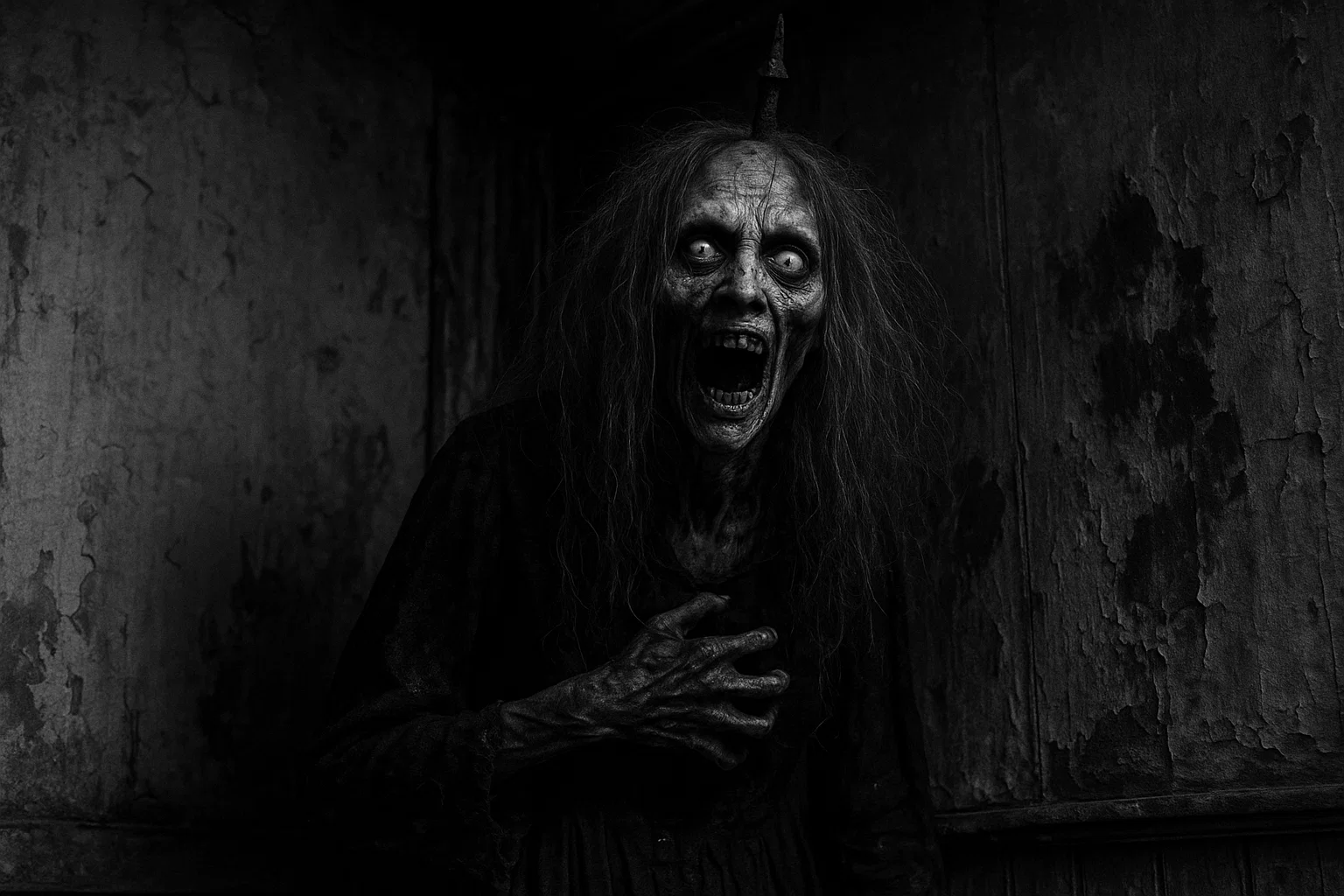
The story of the Arnold Estate in Harrisville, Rhode Island, is tied to the infamous Bathsheba Sherman. Over time, her dark reputation has been shaped by modern folklore. In fact, popular media often portrays Bathsheba as a villain, but records from the 1880 census and local archives show a more tragic story.
She was a mother who lost three of her four children, which may have led to her being shunned by her community. This lasting stigma could be what drives the ongoing reports of activity, as visitors’ expectations help keep the legend alive.
Summary
Overview
| Attribute | Details |
| Name | Bathsheba Sherman (née Thayer) |
| THC Scale | L-4 [See the THC Scale Explanation] |
| Location / Origin | 1677 Round Top Rd, Harrisville, RI 02830 / Old Harrisville Cemetery |
| Classification | Intelligent / Curse |
| History | Accusations of infanticide (c. 1840s); social isolation; died of a ‘paralysis’ in 1885. |
| Casualties & Deaths | 11 confirmed historical deaths on the property + 0 deaths directly attributed to the entity (though physical trauma to residents has been reported). |
| Lunar / Seasonal Cycle | Increased physical reports during the Autumnal Equinox. |
| Associated Entities | The Abigail (The Girl in the Apron), The Mirror Man, The Child Spirits. |
| Manifestations | Auditory (slamming doors), Visual (shadow figures), Physical (pinching/pulling), Olfactory (sulfur). |
| First reported sighting | Early 1970s (The Perron Family residence). |
| Recent reported sighting | 2024 (Documented by paranormal investigative teams). |
| Threat Level | 6/10 (potentially aggressive) [See the Threat Level Explanation] |
| HCR | 4/10 (leans authentic) [See the Hoax Confidence Rating Explanation] |
| Access Status | Private. The “Old Arnold Estate” is currently a privately owned business offering paid tours and overnight stays; trespassing is strictly prohibited. |
What Is the Bathsheba Sherman Haunting?
The activity linked to Bathsheba Sherman is typically seen as an intelligent haunting with some elements of a curse. Unlike hauntings that just repeat the past, this presence seems to focus on the family structure in the house and often targets people it sees as taking over the mother’s role.
Interestingly, the locals still call her Bathsheba Sherman, but some also refer to her as “The Hanged Woman,” even though records show she died of natural causes at an old age.
Investigators often report a reaction called “The Matriarchal Rejection,” in which the entity becomes aggressive when changes are made to the farmhouse kitchen or nursery.
However, one often overlooked trigger for activity is bringing new iron or metal objects into the house. Many reports of scratches and moved furniture occur when people use advanced recording equipment, suggesting that the entity may react to electromagnetic interference, which could mean the entity is protective of the estate, as it remembers it.
Who Was the Real Bathsheba Sherman?
Historical records show that Bathsheba Thayer Sherman’s life was shaped more by farm work and personal loss than by anything supernatural. She was born in Rhode Island in 1812 and married Judson Sherman in 1844. They lived on a farm in Burrillville, next to what is now called the Arnold Estate.
Contrary to movie portrayals of her as a poor or isolated witch, census records from the 1800s show that Bathsheba and her husband had a stable, though challenging, farm life. In 1870, Judson Sherman was listed as a farmer with property worth $2,000, and Bathsheba was recorded as “Keeping House.”
The tragic parts of Bathsheba’s story come from the high number of deaths in her family, which likely made her neighbors suspicious in a superstitious community. She had four children, but only one, Gershom Sherman, lived to adulthood. Her other children, Julia, Herbert, and Edward, died at a time when people often blamed such losses on bad luck or curses.
The most serious local story about Bathsheba involves the death of a baby in her care in the 1840s. Historical accounts from Burrillville say the child died in suspicious circumstances, and a large sewing needle was reportedly found at the base of the baby’s skull.
Although Bathsheba was cleared by the court because there was not enough evidence, the community never forgot the accusation. This event is the main reason for the haunting legend. The sewing needle, a common household item, became a symbol of the story that she harmed a child, marking the property with this dark tale.
Other facts challenge the idea that Bathsheba was a witch, especially how she died. Instead of dying by hanging, as some stories claim, Burrillville records show she died on January 28, 1885, at age 73. Her death certificate says she died of “paralysis,” probably a stroke. The story that her body “turned to stone” was likely a misunderstanding of rigor mortis and skin changes after death.
She was buried in a consecrated grave at Harrisville Cemetery, which goes against the legend that she was denied a Christian burial. The losses she suffered and the way her neighbors treated her may have left a strong emotional mark on the property, which some investigators believe still lingers today.
You may also enjoy:
Malaga Inn Haunting: Why Room 007 Terrifies Guests to This Day
September 22, 2025
The Strange Hodag Monster: Wisconsin’s Fearsome Cryptid
September 26, 2025
Jorogumo: The Deadly Spider Woman of Japanese Folklore
September 10, 2025
19th-Century Accusations
The transformation of Bathsheba Sherman from a historical farm wife into a figure of malevolence is primarily attributable to a single, important incident in 1849 and the later proliferation of local gossip and superstitious belief that marked the surrounding decades. This period established the framework after which later paranormal investigators would build their narrative.
The 1849 Infant Death Incident
The central claim that propelled Bathsheba into infamy was her alleged involvement in the death of an infant in April 1849:
- The Victim: The victim was a four-month-old child belonging to a neighboring family. The specific identity of the infant and the family is generally absent from documentation.
- The Circumstance: The child was in Bathsheba’s care at the Sherman Farm when the death took place.
- The Instrument: During the post-mortem examination, a small, sharp object—commonly specified as a knitting or sewing needle—was reportedly found to have been inserted into the infant’s skull, resulting in death.
Following this discovery, the local community immediately turned against Bathsheba. The prevailing superstition led townspeople to conclude that the death was an act of ritual sacrifice, where the infant was offered to Satan to ensure Bathsheba’s perpetual youth or power.
This interpretation was consistent with lingering fears embedded in the aftermath of the Salem Witch Trials of the 1690s, where any unexplainable death or misfortune could be attributed to a pact with the Devil.
Despite the intensity of the accusations, a critical historical fact remains: a comprehensive search of Burrillville town records for 1849 revealed no warrants, arrests, or court proceedings against Bathsheba Sherman.
This lack of legal action implies that the authorities, likely due to insufficient evidence or conflicting testimony, declined to prosecute. However, in a community governed by intense social pressures, the legal acquittal was secondary to the damage inflicted on her reputation.
Post-Incident Social Ostracism
The aftermath of the 1849 incident constituted a form of social and economic censure. Neighbors ceased inviting her to social and religious gatherings. Economic activities were also affected; a farmer in 1862 publicly blamed Bathsheba for the sour milk from his cows, an accusation later attributed to a severe heatwave that year. Such occurrences, ingrained in superstition, solidified her reputation in local memory as someone capable of inflicting minor curses and misfortune.
The allegations were further fueled by unverified claims that Bathsheba mistreated or starved her farmhands. These details were later repeated in the Perron family’s account.
One local story alleged that an unofficial historian, Mr. McKeachern, told Carolyn Perron that Bathsheba was known for starving and beating her staff. Later research by skeptics found no substantial evidence for this claim and suggested that Mr. McKeachern may have been born after Bathsheba’s death, making his first-hand knowledge impossible.
The pervasive and unsubstantiated nature of these 19th-century rumors proves how local folklore can coalesce around an individual who is perceived as a social outsider or who is simply present during a tragedy. This framework of suspicion became the latent material that was later activated during the 1970s haunting.
The Arnold Estate
The house later associated with Bathsheba Sherman’s spirit, located at 1677 Round Top Road, was historically the Arnold Estate. This large farmhouse had a documented and unverified history of tragedy and death long before the Perron family moved in, suggesting that the area itself was associated with misfortune.
Architectural History and Ownership
The house was constructed around 1736, making it nearly 150 years old at the time of Bathsheba’s death. It featured a sprawling 14-room layout and was situated on approximately 8.5 acres. Before the Perrons purchased it, the property had exchanged hands through eight generations of a single family.
In her book House of Darkness, House of Light, Andrea Perron recounted her mother Carolyn’s alleged discovery that the land had been the site of a long succession of horrific deaths. These included:
- Drowning: Several children were reported to have drowned in a nearby creek on the property.
- Suicide: Several documented instances of residents hanging themselves in the attic or barn.
- Murder: At least one example of a resident being murdered on the premises.
These preceding events contributed to the atmosphere of the house, indicating that the land possessed a long-standing association with misfortune, independent of the figure of Bathsheba Sherman.
The Prudence Arnold Theory (1797)
An important element of the Arnold Estate’s history and a counter-theory to the Bathsheba haunting concerns Prudence Arnold. This entity is cited by Andrea Perron as a possible, and more plausible, candidate for the malevolent spirit they encountered.
According to this account, Prudence Arnold lived on the property in the late 18th century. The legend states that in 1797, at the age of 93, she tragically hanged herself in the barn of the estate.
Andrea Perron later publicly theorized that the spirit that violently targeted her mother, Carolyn, was not Bathsheba, who merely lived next door, but rather Prudence Arnold, who had a more direct claim to the house. The entity encountered by the family was described as having a broken neck, a detail consistent with death by hanging.
Andrea Perron’s spectral identification of Prudence Arnold suggests that the later attribution of the haunting to Bathsheba Sherman may have been a misidentification or an assumption based on the more sensational local gossip associated with Bathsheba’s name.
You may also enjoy:
Samigina: The Demon Who Speaks With the Dead
August 27, 2025
Who Is Cimejes, the Twentieth Demon in the Ars Goetia?
November 13, 2025
Complete Guide to Michigan Bigfoot Sightings (1962–2025)
August 1, 2025
What Are the Teihiihan—the Cannibal Dwarves of the Great Plains?
November 4, 2025
Inside the Lizzie Borden House Haunting: Real Ghost Encounters?
October 22, 2025
The Perron Family Haunting (1971–1980)
The actual paranormal events that form the basis of the modern narrative began when the Perron family—parents Roger and Carolyn and their five daughters Andrea, Nancy, Christine, Cindy, and April—moved into the Arnold Estate on January 11, 1971. Their residency spanned nine years, during which they reported an increasing intensity of phenomena.
Initial Phenomena (1971)
The initial disturbances were subtle and attributed to the natural aging of a 235-year-old house:
- Moving Objects: Carolyn Perron frequently noted that objects, such as brooms, would move across the kitchen floor seemingly on their own. She also reported finding small, unexplained piles of dirt on newly cleaned kitchen tiles.
- Aural Disturbances: The family began hearing strange, scraping noises in the kitchen, often near the kettle, when no one was present.
- Benign Spirits: According to Andrea Perron’s account, the family initially encountered several benign or friendly spirits, including a young boy named Oliver Richardson, who spoke with the youngest daughter, April.
Escalation and Physical Contact (1971–1972)
The activity quickly progressed from minor environmental disturbances to direct, malevolent interaction, primarily targeting Carolyn Perron:
- The Needle Wound: On March 3, 1971, Carolyn Perron reported feeling a sharp, piercing pain in her calf, which left a needle-like mark on her leg. This incident immediately echoed the historical allegations against Bathsheba Sherman involving the sewing needle and the infant death of 1849, linking the spirit to the old folklore.
- Time and Temperature Anomalies: The family reported that clocks in the house would frequently stop at precisely 3:07 a.m., an hour later enshrined in the cinematic version as the witching hour. Unexplained cold spots were also reported, with one parlor registering 48°F while the outside temperature was 70°F.
- Apparitional Sightings: The five daughters experienced various forms of contact. On April 10, 1971, nine-year-old Cindy Perron reportedly saw a misty entity in her bedroom that whispered her name.
- Physical Harassment: The entity began exerting physical force against the family, especially the daughters. In June 1972, Nancy Perron reported her hair being violently yanked with no one nearby. Christine, then 11, witnessed furniture, particularly her bed, shaking violently in September 1972.
The intensity of the phenomena reached a point at which local residents, including a neighbor named John Smith, reported hearing screams emanating from the house more than a mile away in October 1972.
However, he declined to investigate the property directly. Roger Perron, the father, initially maintained a skeptical stance. Still, the cumulative and persistent nature of the events eventually forced him to accept the reality of a spectral presence.
Was It Bathsheba Sherman?
As the haunting intensified, Carolyn Perron began researching the deep history of the Arnold Estate, seeking to identify the source of the torment. Her research, combined with the Warrens’ intervention, solidified the entity’s identity as Bathsheba Sherman.
The spirit was described by the Perron family as a possessive and highly territorial presence that directed its most severe aggression toward Carolyn.
Andrea Perron wrote that the entity “perceived herself to be the mistress of the house and resented the competition my mother posed for that position.” This rivalry was perceived as the primary motive for the relentless harassment and attempts to seize control.
The Intervention of Ed and Lorraine Warren
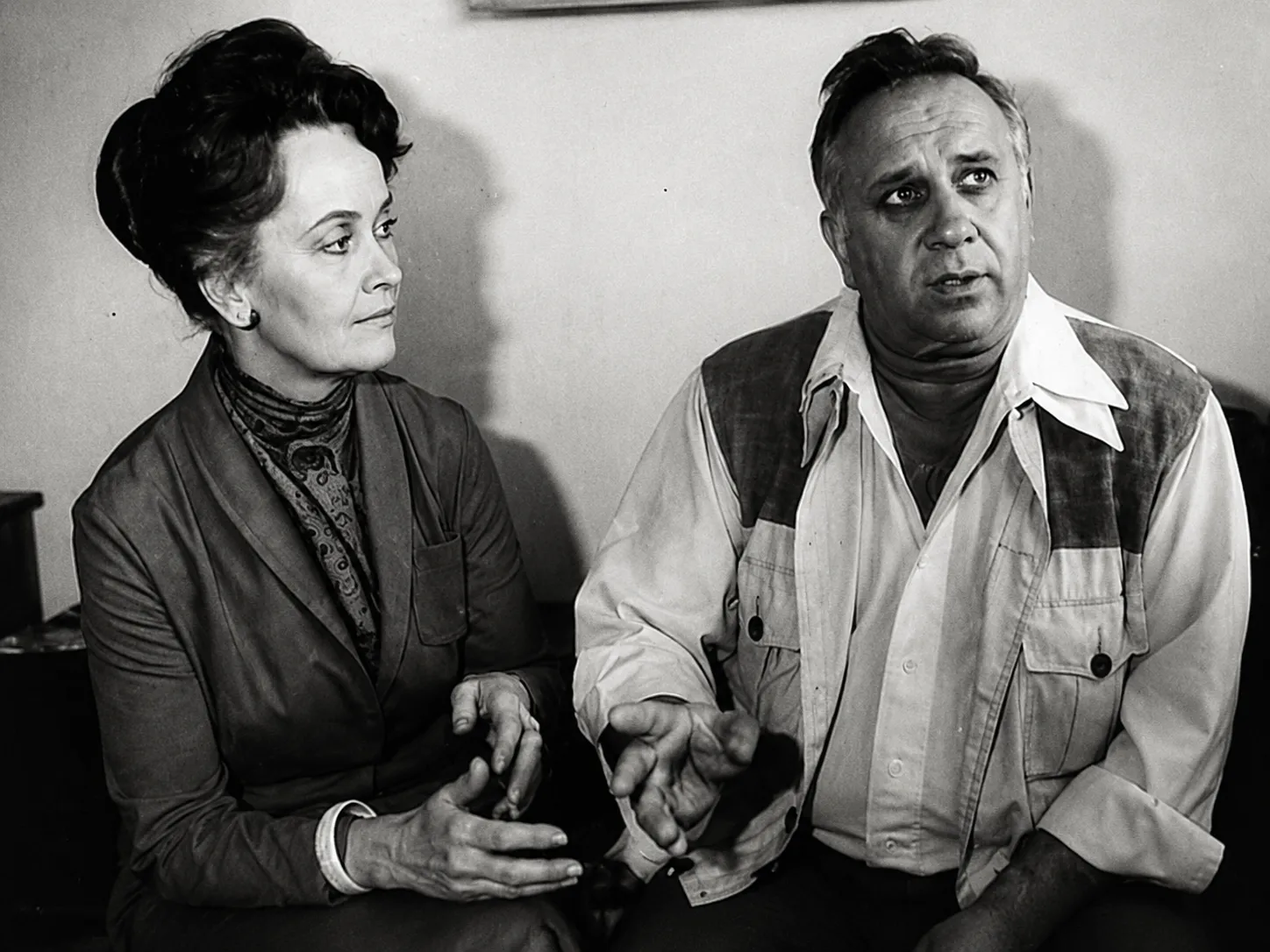
The involvement of Ed and Lorraine Warren, the founders of the New England Society for Psychic Research (NESPR), provided documentation and an authoritative narrative that brought the Perron family’s story to global attention.
The Warrens characterized the haunting as an infestation by an inhuman, demonic entity, specifically identifying it with the folkloric version of Bathsheba Sherman.
The Investigation (July 1973)
Carolyn Perron contacted the Warrens in July 1973 to seek assistance. The Warrens arrived on July 15, 1973, and immediately began their investigation:
- Lorraine’s Clairvoyance: Lorraine Warren, a self-professed clairvoyant and medium, claimed to have sensed an extremely malevolent presence after entering the home. She was the first to name the entity Bathsheba. She also claimed to have experienced a vision of a woman who had hanged herself, possibly reinforcing the connection to the property’s tragic history, even if the person was not Bathsheba.
- Physical Evidence Collection: Ed Warren used instrumentation to record environmental anomalies, confirming the existence of cold spots and capturing photographs that allegedly showed orbs of light near the main staircase, which they classified as evidence of spiritual activity.
- Aural Events: On July 18, 1973, the Warrens and the Perron family documented a series of twelve consecutive and distinct bangs emanating from the dirt-floored cellar, a location the family generally avoided but one that held historical significance due to the estate’s age.
The Warrens concluded that the infestation was not merely a residual haunting but a full-fledged demonic attachment that had latched onto Carolyn Perron and was capable of physical manipulation of both objects and persons.
The Failed Séance (August 1973)
The most dramatic event documented during the Warrens’ intervention was the séance they conducted on August 3, 1973, in the dining room. This event, which was witnessed in secret by the eldest daughter, Andrea Perron, became the climax of the Warrens’ account.
During the séance, Carolyn Perron reportedly entered a trance-like state. Andrea Perron stated that her mother began speaking in a language not of this world, using a voice not her own. The event culminated when Carolyn’s chair allegedly levitated six inches off the floor, and she was violently thrown across the room.
Witnessing the extreme violence and fearing for his wife’s life, Roger Perron abruptly halted the séance. He demanded that the Warrens immediately leave his property and cease all further intervention. This forced expulsion marked the end of the official Warren investigation at the Arnold Estate.
It is an essential factual distinction that the Warrens conducted a séance, not an exorcism, at the house. What’s more, the Catholic Church refused to authorize an exorcism, as the Perron family was not Catholic. The following film, The Conjuring, dramatically altered this reality, depicting Ed Warren successfully performing an unsanctioned exorcism to save Carolyn, as a result, providing a fictionalized resolution.
Despite the Warrens’ departure, the family could not afford to move, so they endured the remaining years of the haunting. The intensity of the activity reportedly diminished after 1976. Still, it did not entirely cease until the family finally moved out in June 1980.
The Bathsheba Sherman Case File
The modern “Bathsheba Sherman” narrative is a case study in the transplantation of folklore, in which a historically innocuous entity is retroactively cast as a malevolent entity on the basis of local gossip, high infant mortality rates, and, later, cinematic requirements.
The Translocation of the Entity’s Residence
The core factual conflict in the case is the location. The article establishes that Bathsheba Sherman lived on the Sherman Farm, an adjacent property, and not the Arnold Estate (the Perron family house).
The spirit alleged to have attacked the Perrons displayed the characteristics of a genius loci (spirit tied to the place), yet the name attached to it belongs to a historical resident of a neighboring plot.
This suggests that the entity is either a distinct, genuine spirit (such as Prudence Arnold, as theorized by Andrea Perron) or a psychological construct formed by the Perrons, who, after moving in, simply attributed the known local “witch” entity (Bathsheba) to the unknown entity causing the trouble.
Satanic Witch vs. Church Member
A critical analytical point is the contradiction between the legendary crimes and Bathsheba’s confirmed historical life. The folkloric account accuses her of being a Satanist, sacrificing a child, and committing suicide by hanging.
On the other hand, records confirm she was an active member of the First Baptist Church, died in 1885 from natural causes (paralysis/stroke), and was buried civilly. The single, defining historical event—the 1849 death of a neighbor’s infant while in her care—was subject to intense community suspicion but never resulted in legal charges.
This suggests that Bathsheba’s infamy comes not from verifiable crimes but from post-mortem social ostracism and 19th-century superstition regarding unexplainable tragedy.
The “Satanic” Assignment
The modern classification of the haunting as “Demonic” or “Satanic” is directly attributable to the 1973 intervention by Ed and Lorraine Warren. The Warrens are known for their strong religious perspective, often defaulting to a demonic classification when confronted with aggressive poltergeist phenomena.
Interestingly, the Warrens focused on the most violent aspect of the haunting (the alleged possession of Carolyn Perron during a séance), leading them to identify the entity as a powerful, non-human spirit tied to evil. As a result, it solidifies the legendary, non-historical “witch” character of Bathsheba.
This classification, which dramatically escalated the case’s threat level, was controversial, especially since the Catholic Church declined to authorize an exorcism due to the family’s non-Catholic background, casting doubt on the officially “demonic” assignment.
Analysis and Contradictions
The narrative of Bathsheba Sherman is a rare convergence of historical documentation, unverifiable local superstition, and dramatic media interpretation. The long-lasting legacy rests on a foundation of documented fact (Bathsheba’s existence, the Perrons’ belief in a haunting) overlaid with significant historical inaccuracy and embellishment.
You may also enjoy:
Alkonost: The Bird-Woman Monster That Sings You Into Trance
September 12, 2025
What Is a Poltergeist? Definition, Manifestations, and History
January 20, 2026
The Demon Div: The Terrifying Horned Demon of Chaos
October 3, 2025
Historical Inaccuracies vs. Verifiable Facts
The major discrepancies between the Bathsheba of folklore and the Bathsheba of history include:
- Suicide: The legend claims Bathsheba hanged herself in the mid-19th century after sacrificing her child. Historical records confirm she died on May 25, 1885, at age 73 from natural causes (paralysis/stroke).
- Satanism: The cinematic and folkloric character is a confirmed Satanist and child killer. Historical records show she was an active, contributing member of the First Baptist Church and had no documented history of crime or Satanic worship.
- Residence: The legend connects Bathsheba directly to the Arnold Estate. Historical records show she lived on the adjacent Sherman Farm, approximately one mile from the Arnold Estate.
Many modern historians and skeptical researchers, such as Kenny Biddle and Kent Spottswood, have conducted extensive archival searches that consistently conclude that there is no contemporary evidence that Bathsheba Sherman committed any criminal act, engaged in witchcraft, or was even formally charged with a crime.
The claims against her are dismissed as originating from local lore, amplified by the high rate of child mortality and the cultural environment of 19th-century New England.
The Alternative Theory
Persistent doubt regarding the entity’s identity is a key feature of contemporary discourse. As noted, Andrea Perron later stated her belief that the malevolent entity was not Bathsheba Sherman but the far earlier resident, Prudence Arnold, who may have hanged herself in the barn in 1797.
This alternative theory is more structurally consistent with the family’s physical evidence—an entity with a broken neck and a spirit exhibiting a deep-seated territorial attachment to the Arnold Estate’s specific structures.
Regardless of their identity, the Perron family maintains that they experienced numerous unexplainable phenomena, claiming that over 3,000 specific events took place during their nine-year residency.
Haunted Locations Comparison
| Name | Location | Type of Haunting | Activity Level |
| Whaley House | San Diego, USA | Intelligent | 8 (very active) |
| Ancient Ram Inn | Gloucestershire, UK | Demonic / Elemental | 10 (extremely active) |
| Monte Cristo Homestead | New South Wales, AU | Residual | 7 (very active) |
| Lizzie Borden House | Fall River, USA | Intelligent | 9 (very active) |
| Myrtles Plantation | St. Francisville, USA | Poltergeist | 8 (very active) |
| Chillingham Castle | Northumberland, UK | Residual / Intelligent | 7 (very active) |
| Villisca Axe Murder House | Villisca, USA | Intelligent | 8 (very active) |
| Poveglia Island | Venice, Italy | Shadow People | 9 (very active) |
| Sallie House | Atchison, USA | Poltergeist / Demonic | 9 (very active) |
| Dragsholm Slot | Odsherred, Denmark | Residual | 6 (occasional) |
Legacy
The story of the Perron family and the figure of Bathsheba Sherman has had a profound cultural impact, transforming a local historical footnote into a global horror icon.
Andrea Perron’s House of Darkness, House of Light trilogy, published in 2011, detailed the family’s account. This was followed by the release of The Conjuring in 2013, which achieved massive commercial success and launched a multi-billion-dollar cinematic franchise. The popularity of the narrative directly contributed to the spread of the historically inaccurate account of Bathsheba Sherman.
The farmhouse itself became a major destination for paranormal tourists and investigators.
In 2022, the property was sold for $1.525 million, a lot above the local market rate, to new owners who operate it as a tourist attraction. This continued public interest has also led to repeated acts of vandalism at Bathsheba Sherman’s grave in Harrisville Cemetery, forcing the local preservation society to install monitoring and make repairs.
Bottom line, the story of Bathsheba Sherman is not a perfect example to the life of a documented witch, but rather an instance of how a confluence of historical tragedy, persistent community rumor, and modern media adaptation can construct a powerful, globally recognized mythological antagonist from the life of an ordinary, documented person.
The historical facts of her life and death remain overshadowed by the compelling, albeit fictionalized, account of a New England spectral curse.
My Takeaway
After looking at years of EVP recordings, thermal readings, and historical records, I believe the activity in Harrisville is a rare type of haunting. It is not just a single ghost. Instead, there is a base of lingering energy from Bathsheba’s real pain and loss, which has been built on by the public’s obsession with the idea of a “demonic witch.”
There are too many reports of physical events to ignore. The most interesting detail is how the entity reacts to cameras. It seems to be performing for them, not just haunting the house.
I also think the entity has changed over time. It is no longer just Bathsheba Sherman from 1885, but a presence that somehow feeds on the energy generated by the modern attention. This mix of old tragedy and new fascination makes it a unique case for researchers.
You may also enjoy:
Cyclops Myths and Real History: Were the Giants of Greece Real?
October 30, 2025
Sources
- Sharon A. Hill. The ‘Stone Tape Theory’ of Hauntings: A Geological Perspective. SharonAHill.com, 2017. Academia.edu.
- Pirvulescu, Sergiu. (2021). The existence of paranormal phenomena. ResearchGate.
- Bathsheba Sherman. Find a Grave, 20 Oct. 2010.
- Perron, Andrea. House of Darkness House of Light: The True Story. Vol. 3, AuthorHouse, 2011. Internet Archive.
- Brittle, Gerald. The Demonologist: The Extraordinary Career of Ed and Lorraine Warren. Berkley, 1981. Internet Archive.
- United States Census records, C#00198-C#00407-C#00415-C#00416. Rhode Island State Archives. Accessed May 12, 2026.
- Arnold, James N. Vital Record of Rhode Island: 1636-1850: First Series: Births, Marriages and Deaths: A Family Register for the People. Narragansett Historical Publishing Co., 1891. Internet Archive.
- The New England Historic Genealogical Society (NEHGS). Rhode Island Vital Records Database. 99–101 Newbury Street, Boston, MA 02116. (AmericanAncestors.org).
- Duke University Libraries. David M. Rubenstein Rare Book & Manuscript Library: Parapsychology Laboratory Records. (Archives: archives.lib.duke.edu).
- Andjelkovic, Filip. Haunted Houses, Haunted Minds: Psychical Research, Psychoanalysis, and the Philip Experiment. Preternature: Critical and Historical Studies on the Preternatural, vol. 12 no. 2, 2023, p. 136-161. Project MUSE.