The hierarchy of Hell is one of history’s most interesting and detailed imagined systems (classifications). For over a thousand years, theologians, poets, occultists, and monarchs have tried to map, categorize, and define it as a dark reflection of divine order.
From Dante Alighieri’s frozen pit to Jacques Collin de Plancy’s bureaucratic cabinet, the infernal hierarchy has never had one agreed-upon form. Each era has altered the overall hierarchy of Hell to reflect its own fears, politics, and moral concerns.
Some systems rank demons by the seriousness of the sins they represent. Others sort them by political rank, military structure, or the psychological torments they cause. Together, these classifications and hierarchies show that mapping Hell is really about exploring the darker side of human nature.
So, who were these demons, and how did thinkers over the centuries try to bring order to the idea of evil?
Summary
A History of Infernal Order
The idea that Hell is an organized world governed by a ranked order of demonic beings did not appeared fully formed from any single religious text or practice. It developed gradually, shaped by the convergence of Abrahamic theology, ancient Near Eastern mythology, and the social structures of the societies that produced these texts.
For example, the early Christian texts, influenced by Jewish apocalyptic literature and the Hebrew Bible, described demonic forces in loose terms: as a rebellious enemy, a group of fallen angels, or a place of punishment for the wicked. Only when medieval thinkers and the Church began organizing theology did the idea of a structured infernal hierarchy become a serious topic.
The main reason for creating hierarchies of Hell is theological. If God rules a perfectly ordered Heaven with ranks of angels (Seraphim, Cherubim, Thrones, and Dominions), then evil must have its own dark counterpart. The idea of mirroring led to some of the first attempts to classify demons.
By the 11th century, the Byzantine philosopher Michael Psellus had already proposed a taxonomy of six demon types based on the elements they inhabited. Over the following three centuries, philosophers (such as Thomas Aquinas) further entrenched the idea that demons, as fallen angels, retained a form of hierarchical order inherited from their pre-fall angelic ranks.
The 15th century was a turning point. Two important texts appeared about fifty years apart: the anonymous English Lollard pamphlet The Lanterne of Light (c. 1409–1415), which first matched a named demon to each of the seven deadly sins, and Alfonso de Spina’s Fortalitium Fidei (c. 1459), which classified demons by their behavior instead of rank. These works set up two key ways to organize the infernal hierarchy: by moral roles (demons as patrons of vice) and by function (demons as agents of harm).
The 16th and 17th centuries saw a surge in demonological writings, partly fueled by the witch trials that swept across Europe. In 1533, the German Renaissance magus Heinrich Cornelius Agrippa published his monumental De Occulta Philosophia, inverting the angelic hierarchy into nine orders of evil spirits. In 1589, Peter Binsfeld systematized and popularized the seven deadly sins pairing pioneered by the Lanterne.
In 1597, King James VI of Scotland — who would later commission the King James Bible — wrote his Daemonologie as a practical handbook for magistrates prosecuting witches. And in the 17th century, the anonymous grimoire known as the Ars Goetia (the Lesser Key of Solomon) organized 72 named demons into a strict feudal nobility, complete with ranks, titles, and legion counts.
Literature made its own monumental contributions, too. Dante Alighieri’s Inferno, completed around 1320, remains perhaps the single most influential artistic vision of Hell’s moral geography. John Milton’s Paradise Lost (1667) reimagined Hell as a dark political empire, lending fallen angels a tragic grandeur that continues to shape how writers depict the infernal realm.
The 19th century brought a new tone: the satirical and bureaucratic. Jacques Collin de Plancy’s Dictionnaire Infernal (1818) organized Hell as a constitutional monarchy with ministries, ambassadors, and a secret police — a sardonic comment on the bloated state apparatuses of post-revolutionary Europe. And in the 20th century, Anton LaVey’s The Satanic Bible (1969) stripped all of these supernatural frameworks away entirely, recasting the four Crown Princes of Hell as psychological archetypes representing facets of human nature and the natural elements.
Dante Alighieri’s Inferno (c. 1308–1320)
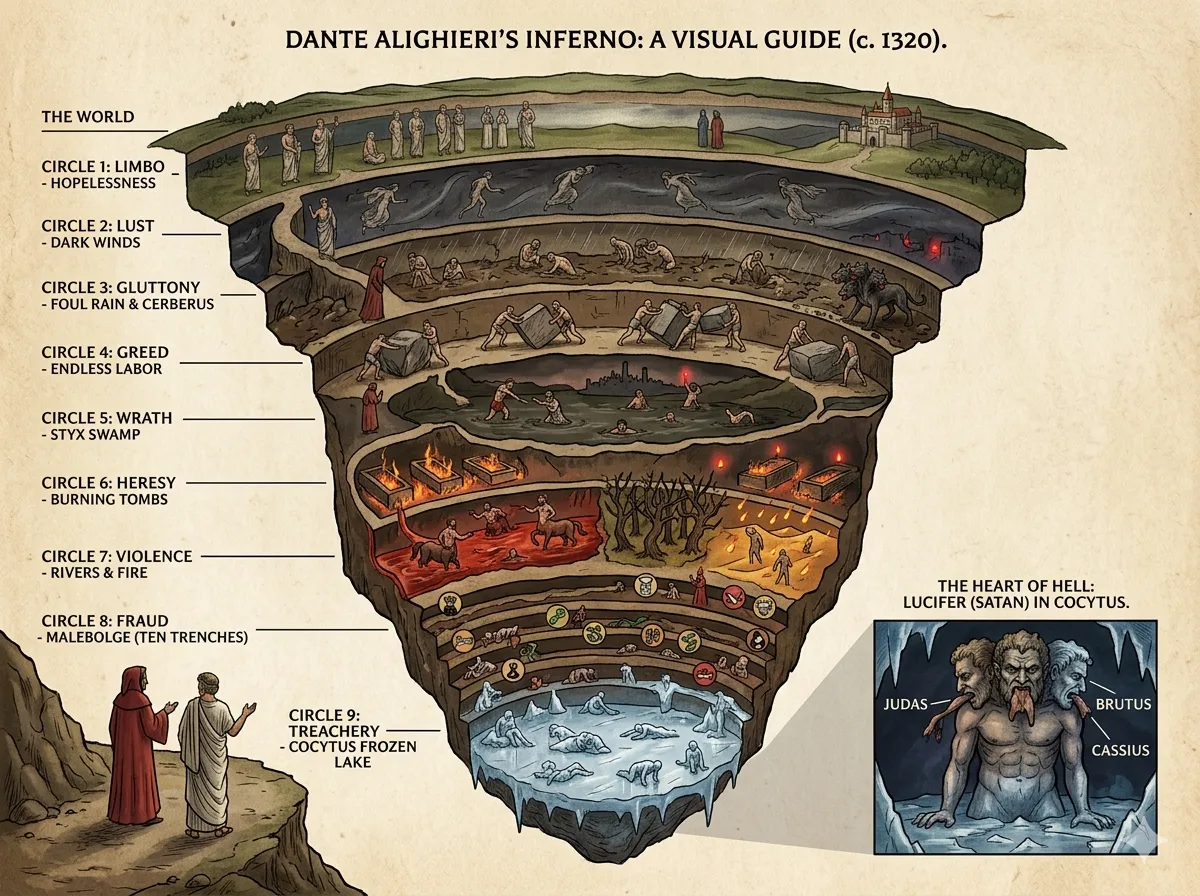
Among all the literary depictions of Hell, Dante Alighieri’s Inferno is the most influential. Written in Italian between 1308 and 1320, the Inferno tells the story of Dante’s journey through Hell, guided by the Roman poet Virgil. Together, they travel through nine circles, each representing a deeper level of sin and punishment, all the way to the very bottom.
Dante did not set out to write a formal study of demons like later occult scholars. Still, the structure he created is one of the most carefully developed hierarchies of Hell in Western literature, based on moral theology and Aristotle’s philosophy as interpreted by Thomas Aquinas.
Dante’s Hell is organized around the concept of contrapasso, in which each punishment reflects (or reverses) the sin that caused it. The hierarchy is also based on how seriously each sin goes against reason, community, and divine love. As souls move closer to the center of the Earth, their sins become more intentional and harmful.
The upper circles deal with lack of self-control, while the lower circles punish malice, violence, and betrayal. The structure makes Dante’s Hell both a moral argument and a powerful story setting.
At the very bottom of Hell, frozen in a lake of ice, is Lucifer. He is not a powerful ruler, but a weeping, three-headed beast trapped in ice. His huge wings keep the lake frozen. Dante’s Lucifer symbolizes the idea of evil that has lost all power: the one who aimed highest has fallen the lowest, and his suffering keeps Hell at its coldest.
The Nine Circles of Dante’s Hell:
| Circle | Sin & Description |
|---|---|
| Circle 1 — Limbo | The outermost circle houses unbaptized infants and virtuous pagans — figures like Homer, Socrates, and Virgil himself — who are denied Heaven not through sin but through historical accident. They suffer no active torment, only the ache of eternal separation from God. |
| Circle 2 — Lust | The lustful are blown endlessly by a howling storm, a contrapasso for souls who allowed passion to override reason. Among those Dante encounters here are the tragic figures of Paolo and Francesca. |
| Circle 3 — Gluttony | The gluttonous lie in a foul slush of rain, hail, and filth, guarded by the three-headed dog Cerberus, who tears at them perpetually. The sludge embodies the degradation of the physical excesses they indulged in life. |
| Circle 4 — Greed | Hoarders and spendthrifts are condemned to push great weights at one another from opposite directions, endlessly colliding without progress — a literalization of their disordered relationship with material wealth. |
| Circle 5 — Wrath & Sloth | The wrathful fight each other on the surface of the river Styx, while the sullen (the slothful) lie submerged in its muddy depths, gurgling unintelligible laments. |
| Circle 6 — Heresy | Heretics are sealed inside open, flaming tombs. The fire burns eternally without consuming, a punishment for those who denied the immortality of the soul. |
| Circle 7 — Violence | Divided into three sub-rings: the violent against others (submerged in the River of Blood/Phlegethon), suicides (transformed into gnarled trees whose leaves are torn by Harpies), and the violent against God, Nature, and Art (blasphemers, sodomites, and usurers on a burning plain of sand beneath a rain of fire). |
| Circle 8 — Fraud (Malebolge) | Called Malebolge (Evil Ditches), this vast funnel-shaped stone structure contains ten separate trenches (bolge), each housing a different category of fraudster: panderers whipped by demons, flatterers immersed in excrement, simonists buried headfirst in stone holes with burning feet, false prophets with their heads twisted backward, corrupt politicians boiling in pitch, hypocrites in leaden cloaks, thieves attacked by serpents, sowers of discord split open, and counterfeiters wracked by disease. |
| Circle 9 — Treachery (Cocytus) | The final and deepest circle is a frozen lake called Cocytus. Divided into four sub-regions (Caina, Antenora, Ptolomea, and Judecca), it imprisons traitors in ice at varying depths depending on the severity of their betrayal — against family, homeland, guests, or lords. At the absolute center, Lucifer chews on history’s three greatest traitors: Judas Iscariot (in the central, most punishing mouth), and Brutus and Cassius (in his other two mouths), betrayers of Julius Caesar. |
Dante’s vision of Hell is more than just a list of demons; it is a detailed moral map of human failure. Its brilliance is in the design: as you go deeper, Hell becomes colder, which is the opposite of how Hell is usually imagined.
In Dante’s Hell, fire and heat are found in the upper levels, which are linked to passion and weakness. The deepest parts are frozen and represent complete abandonment, where even feeling is gone. This way of mapping Hell made Dante’s version the main reference for later ideas about Hell in Western culture.
Alfonso de Spina’s Fortalitium Fidei (c. 1459)
The Fortalitium Fidei (Fortress of the Faith) was written by Alfonso de Spina, a Spanish Franciscan friar and Catholic preacher, around 1459. It was first printed in Nuremberg in 1485. De Spina also served as a superior at the House of Studies of the Friars Minor.
This ambitious theological work is divided into five books. The first addresses those who denied Christ’s divinity, the second targets heretics, the third focuses on Jews, the fourth on Muslims, and the fifth (which is most relevant here) deals with the fight against the devil and his demons. The Fortalitium Fidei was published anonymously, but today most researchers agree that de Spina wrote it.
De Spina’s work on classifying demons is important for several reasons. The Fortalitium Fidei is seen as one of the first printed books to discuss witchcraft and demonology systematically. It likely influenced the thinking that led to the Spanish Inquisition.
Another key point is that de Spina’s way of classifying demons is very different from earlier systems. Instead of ranking demons by power or linking them to specific sins, he grouped them by their actions—what they do to people. His approach creates a practical system based on how demons operate and who they target.
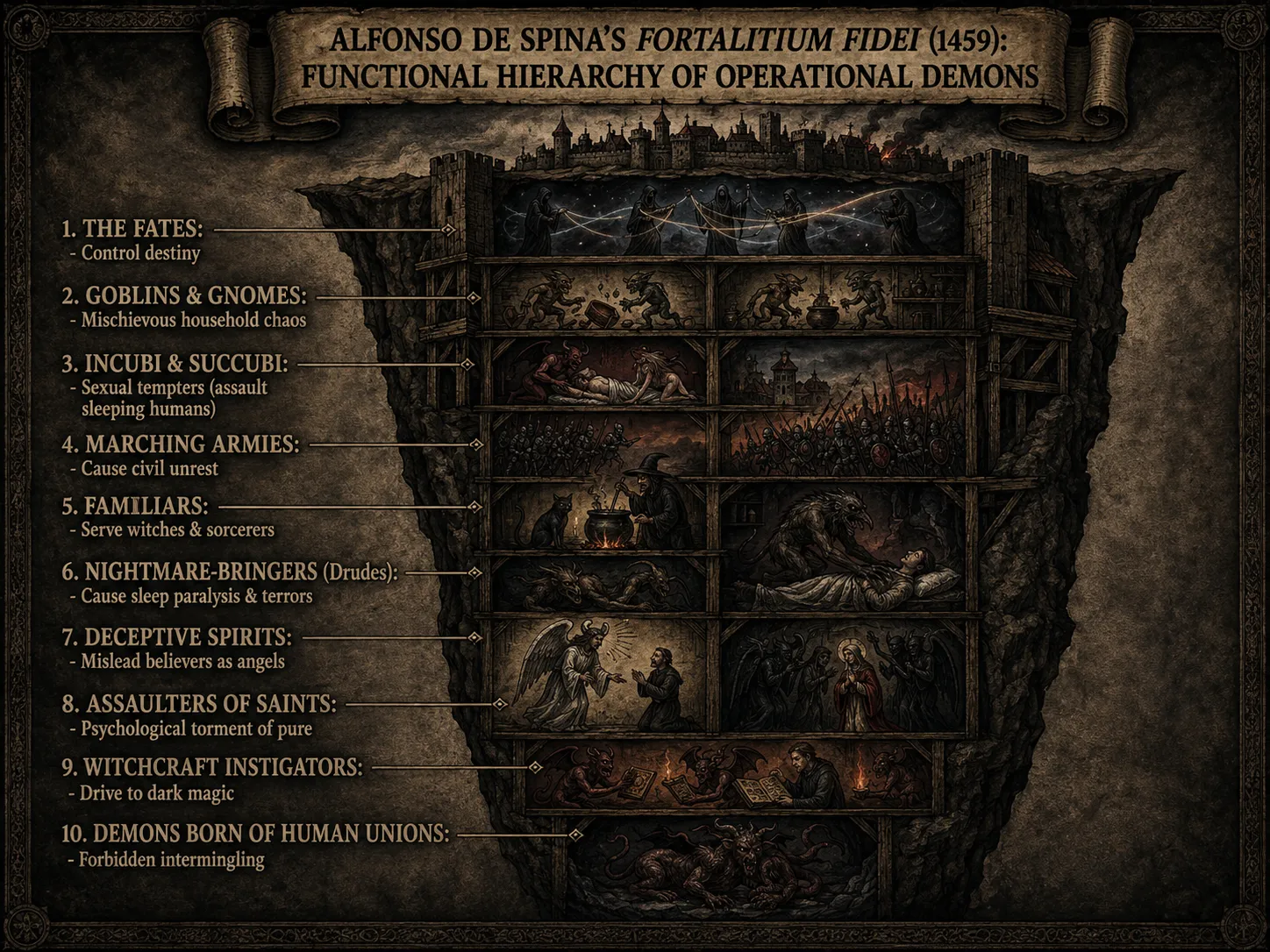
De Spina described ten different types of demons, a unique system that incorporates ideas from theology, European folklore, and classical demonology. Some types, like incubi and succubi, have strong roots in both Christian and Talmudic traditions. Others — like Drudes (who bring nightmares) — come from German folk beliefs.
The mix of sources shows that the Fortalitium was meant to be more than just academic theology. De Spina wanted it to serve as a practical guide for preachers, confessors, and inquisitors dealing with all kinds of popular supernatural beliefs.
The Ten Categories of Demons According to De Spina:
| Category | Description |
|---|---|
| The Fates (Destiny Manipulators) | Demons that interfere with human destiny — spirits believed to control fate and manipulate the course of individual lives, drawing on both classical mythology (the Moirai and Parcae) and popular belief in predestination. |
| Goblins and Mischievous Spirits | Lower-tier spirits associated with household chaos and minor malice — the imps, gnomes, and goblins of European folk tradition, responsible for petty disturbances, broken objects, and unexplained noises. |
| Incubi and Succubi | Sexual demons that assault sleeping humans — the male incubus preying on women, the female succubus preying on men. De Spina engaged extensively with the theological question of whether such unions could produce offspring, a question that would resurface repeatedly in later demonological literature. |
| Marching Armies (Legions) | Vast, organized demonic forces that travel in formation and incite civil unrest, wars, riots, and large-scale social catastrophes. These are the demons of collective destruction rather than individual temptation. |
| Familiars | Demons that enter service pacts with individual witches and sorcerers, typically taking the form of animals. They execute specific curses and magical tasks on behalf of their human masters and receive payment in the form of blood or devotion. |
| Nightmare-Bringers (Drudes) | Spirits drawn from German folklore, responsible for terrifying dreams, suffocating presences on sleeping bodies, and what we would now call sleep paralysis. The Drude tradition was one of the most widely distributed supernatural beliefs in medieval Central Europe. |
| Deceptive Spirits | High-tier demons capable of disguising themselves as holy entities, angels of light, or even the souls of deceased saints. Their primary function is theological deception — misleading the faithful away from orthodox belief by mimicking the divine. |
| Assaulters of Saints | Demons specifically tasked with targeting the spiritually devout — holy hermits, monks, and mystics. These represent an elite tier of psychological tormentors who see in the saintly a more worthy prey, as described in the hagiographic tradition of the Temptation of Saint Anthony. |
| Witchcraft Instigators | Spirits whose primary function is to drive humans into the practice of dark magic — to seduce the susceptible into making demonic pacts, engaging in ritual magic, or becoming the very witches that the Fortalitium elsewhere discusses prosecuting. |
| Demons Born of Forbidden Unions | Entities that result from spiritual or physical intermingling between humans and demons (i.e., the offspring of incubi and succubi, known in other traditions as cambions). De Spina engaged seriously with the theological and biological mechanisms by which such beings could exist. |
In De Spina’s classification, there are no supreme demons, princes, or kings of Hell. Instead, each category is based on what the demons do, not on who they are.
You may also enjoy:
Satanachia: Demon General of Hell’s Legions
August 28, 2025
Lamia: The Child-Devouring Demon of Greek Mythology
November 13, 2025
Is Detroit Cursed by the Nain Rouge?
May 20, 2025
Ghoul: The Original Monster Worse Than Zombies
February 18, 2026
Mastema: The Angel of Hostility Who Tested the Faithful
September 29, 2025
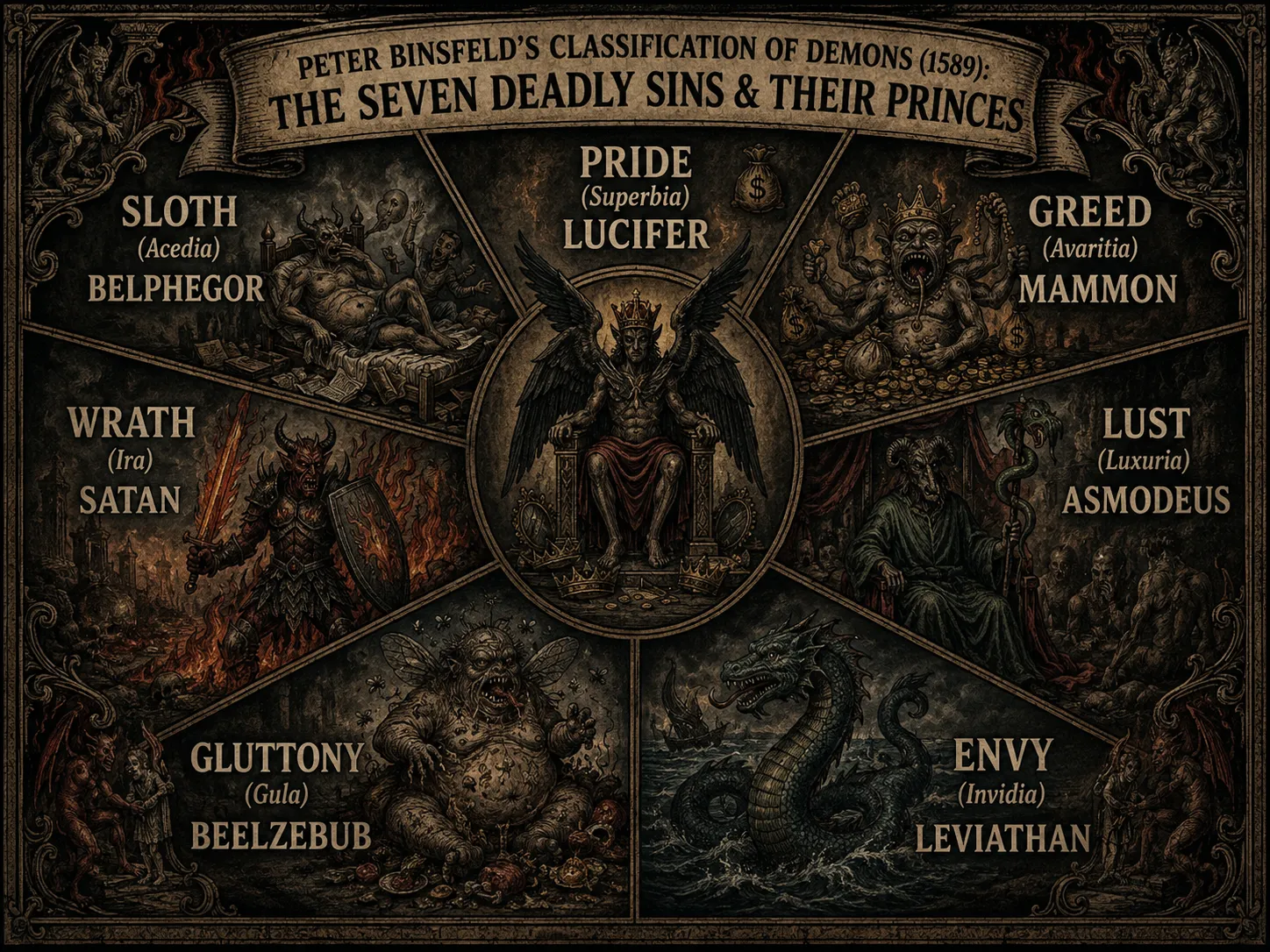
Peter Binsfeld’s Classification of Demons (1589)
Peter Binsfeld (c. 1545–1598) was a German Catholic bishop and theologian, known as one of the most active witch hunters of the late 1500s. As Auxiliary Bishop of Trier, he led witch trials between 1587 and 1593 that resulted in the execution of several hundred people, making it one of the largest witch panics in German history.
His most influential demonological text, Tractatus de Confessionibus Maleficorum et Sagarum (Treatise on the Confessions of Evildoers and Witches), was first published in 1589 and drew directly on the confessions he had extracted from those he prosecuted.
In his treatise, Binsfeld introduced a classification of demons that built on and improved the earlier system from the anonymous English Lollard text, The Lanterne of Light, written about 180 years before. Like that text, Binsfeld’s system organized the top demons of Hell according to the seven deadly sins. Each of the Seven Princes of Hell represented and tempted people with a specific major vice.
Unlike the Lanterne, Binsfeld’s system became widely known across Europe. It was translated into several languages and reprinted many times over the next two centuries. His way of matching specific demons to specific sins is the version most people today recognize as the Seven Princes of Hell.
Binsfeld’s approach was more than just a way to organize demons. It was also psychological and practical. By saying that each major vice had its own demon in charge, he gave priests and magistrates a clear way to connect every sin to a specific demon, which made spiritual battles feel more real and focused.
In Binsfeld’s view, the seven deadly sins were not just personal weaknesses—they were the areas controlled by real supernatural beings trying to win over human souls.
The Seven Princes of Hell According to Binsfeld:
| Prince of Hell | Deadly Sin & Domain |
|---|---|
| Lucifer | Pride — The original and highest sin: the arrogant self-exaltation that led to the Fall itself. Lucifer is the first among the Princes in rank and in malice, the prototype of pride as a cosmic force of rebellion against divine authority. |
| Mammon | Greed (Avarice) — The obsessive accumulation and worship of wealth. Mammon’s name is drawn directly from the Aramaic and appears in the Gospel of Matthew (6:24): ‘You cannot serve both God and Mammon.’ He embodies the idolatry of material possession. |
| Asmodeus | Lust — The corruption and weaponization of sexual desire. Asmodeus appears in the deuterocanonical Book of Tobit as a demon who kills the seven successive husbands of Sarah before being subdued by the Archangel Raphael. Binsfeld identified him as the supreme patron of lechery. |
| Leviathan | Envy — The resentment and malice toward others’ goodness. Leviathan, the great sea monster of the Hebrew Bible (Job 41), was identified in the tradition of this period as the demon of corrosive spiritual envy — the sin that poisons the soul from within. |
| Beelzebub | Gluttony — The sin of excessive consumption, whether of food, drink, or material pleasure. Beelzebub, whose name means ‘Lord of the Flies,’ is one of the most frequently named high demons in the Christian tradition and appears throughout the New Testament as a name for the prince of devils. |
| Satan | Wrath — The abandonment of reason to blind, destructive rage. Binsfeld distinguished Satan from Lucifer, treating them as separate demonic princes: Lucifer governing the sin of pride, and Satan governing the sin of wrath and vindictive violence. |
| Belphegor | Sloth (Accidie) — Spiritual and physical laziness, the failure to engage with divine life, duty, or moral growth. Belphegor, whose origins lie in the Moabite deity Baal-Peor condemned in the Book of Numbers, was identified by Binsfeld as the demonic patron of slothfulness and willful stagnation. |
Binsfeld also believed that many demons besides the seven Princes tempted people to sin. He wrote about Lilith and her children, the incubi and succubi, as agents of lust, adding to Asmodeus’s area with many other sexual tempters. His detailed ranking showed Hell’s hierarchy as more than just a list of rulers—it was a network of demons, each focused on a particular human weakness.
John Milton’s Paradise Lost (1667)
John Milton’s Paradise Lost, published in London in 1667, is a major work of English literature. This 12-book epic poem aims to ‘justify the ways of God to men’ by telling the story of Satan’s fall, the war in Heaven, the creation of the world, and the temptation and expulsion of Adam and Eve from Eden.
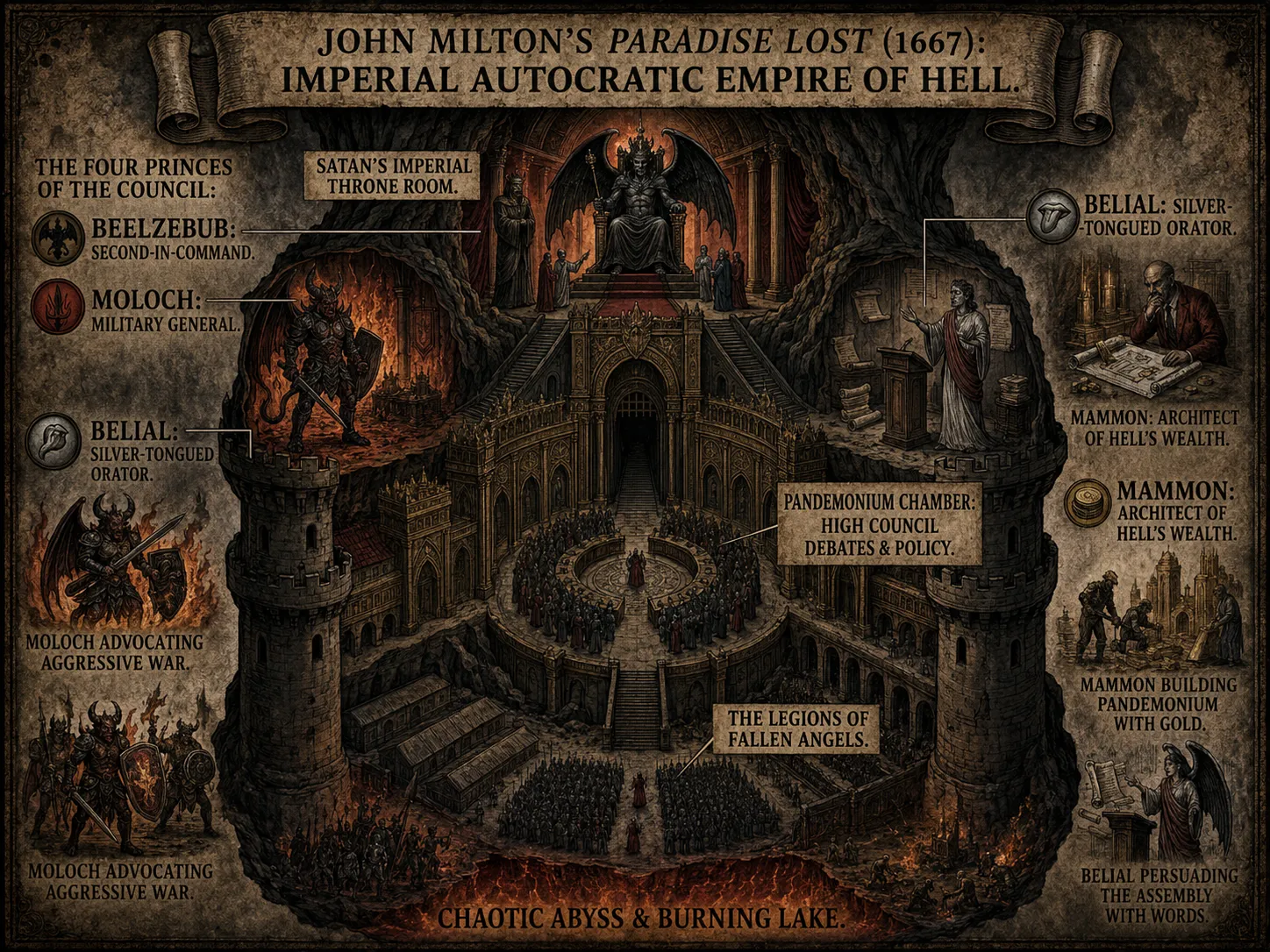
For understanding Hell’s hierarchy, Books I and II are most important. In these, Satan gathers his defeated followers and holds a council in Pandemonium, the new capital of Hell, to plan their next move against God.
Milton’s version of Hell’s hierarchy is not a formal theological system or a demonology manual. Instead, it is a political allegory told through epic poetry. Some consider it the most politically complex vision of Hell ever written. Milton had worked as a senior official in Oliver Cromwell’s government and saw its collapse, so he understood politics firsthand.
Milton’s Hell is like a twisted version of a Roman empire or a corrupt Renaissance court. It is ruled by a charismatic leader, empty speeches, and slow-moving institutions. Satan is at the top, but he shares power with a council of strong lieutenants, each representing a different kind of temptation for power.
In Milton’s view, Hell centers on Pandemonium, a word he invented from Greek roots meaning ‘all demons.’ In Book I, it is called ‘the High Capital of Satan and his Peers.’ Pandemonium is a huge, impressive palace built by the fallen angel Mulciber, who was once Heaven’s architect and is linked to the Roman god Vulcan.
Mammon collected gold from deep within Hell to build Pandemonium. Inside its grand council chamber, thousands of fallen angels discuss policies, argue about strategies, and go through the motions of government. Milton describes Hell with clear irony, since all this impressive organization only leads to destruction.
The Hierarchy of Hell According to Milton:
| Infernal Figure | Role & Character |
|---|---|
| Satan | The supreme emperor of Hell — its undisputed military commander, political ruler, and most terrifyingly eloquent orator. Milton’s Satan is one of literature’s most complex villains: genuinely magnificent in his defiance, genuinely tragic in his self-deception, and entirely destructive in his purpose. He alone volunteers to cross the void between Hell and Earth to corrupt humanity. |
| Beelzebub | Satan’s direct second-in-command, described in Book I as ‘next him in power, and next in crime.’ Beelzebub is less independently courageous than Satan — he would have surrendered to God had Satan not rallied him — but he is politically shrewd. In the council of Pandemonium, it is Beelzebub who rises to propose the plan that Satan has secretly already decided upon: the corruption of God’s new creation, humanity. |
| Moloch | The most militaristic of the fallen angels, Moloch argues in the council for immediate, open war against Heaven. Described as the most blunt and brutal of the speakers, he is consumed by a fury that prefers annihilation to submission. Milton draws on Moloch’s biblical identity as a god to whom children were sacrificed. |
| Belial | The most eloquent and intellectually gifted of the fallen angels, Belial uses his rhetorical brilliance to argue for passive adaptation to Hell — not from wisdom, but from sheer slothfulness. He is, in Milton’s words, ‘a Spirit more lewd / Fell not from Heaven, or more gross to love / Vice for itself.’ His beautiful speech serves only comfortable cowardice. |
| Mammon | The most materially obsessed of the fallen angels — described as always walking with his gaze fixed downward, searching the ground for precious metals even in Heaven. In the council, Mammon argues for making the best of Hell: mining its resources, constructing grand works, and competing with Heaven through earthly splendor rather than open war. His proposal receives enthusiastic support until Beelzebub rises. |
| Mulciber | The master architect of Pandemonium, who designed the halls of Heaven before his fall. Milton describes him with a famous digressive legend: Mulciber was thrown from Heaven by Zeus in classical mythology but, in Milton’s revision, was thrown by God. He represents the corruption of creative and technical genius in the service of Hell. |
| Pandemonium | Not a demon but the capital city of Hell itself — a gleaming golden palace rising instantaneously from the burning soil of Hell. Its council chamber houses the entire assembly of fallen angels, who can shrink themselves to fit within its walls. The name was invented by Milton and has since entered English as a common noun meaning uproar or chaos. |
Milton’s view of Hell’s hierarchy is important because he does not show the demons as just evil or contemptible. Each council member in Pandemonium—Moloch, Belial, Mammon, Beelzebub—represents a familiar political type: the warmonger, the pessimist, the materialist, and the manipulator.
Milton’s Hell is filled not with monsters, but with beings who were once great and have fallen. Its hierarchy is based on the corruption of noble qualities, not just on sin. The focus on how power can corrupt is a big reason why Paradise Lost is still important in Western culture, even as its theology has faded. The poem explores how even the most talented minds can find ways to justify their own downfall.
You may also enjoy:
Domovoi: The Creepy Household Spirit
September 11, 2025
Complete Guide to Vermont Bigfoot Sightings (1861–2025)
August 8, 2025
Is the Richards DAR House Haunting Evidence of Intelligent Spirits?
September 22, 2025
The Legend of Umibozu: Japan’s Most Frightening Ocean Yokai
September 10, 2025
The Ars Goetia / The Lesser Key of Solomon (17th Century)
The Ars Goetia is the first and most well-known part of the Lemegeton Clavicula Salomonis (or the Lesser Key of Solomon). This anonymous grimoire was put together in the 17th century and is based on earlier magical texts, including the 16th-century Pseudomonarchia Daemonum by Johann Weyer, a German physician.
The Ars Goetia is part of the Solomonic magic tradition. It tells how King Solomon, using a ring with a divine seal, summoned and trapped 72 powerful demons in a brass vessel to help build the Temple of Jerusalem.
After the Temple was finished, Solomon sealed the vessel and threw it into a deep lake. Later, Babylonian priests found and opened it, releasing the demons. The Ars Goetia records Solomon’s knowledge so that magicians could summon and control these spirits.
What sets the hierarchy of Hell proposed in the Ars Goetia from other demonological systems is the way it treats Hell as a functioning feudal state, complete with a formal, bureaucratic nobility. The hierarchy does not include moral or theological judgments—there are no links to sins or cosmic stories.
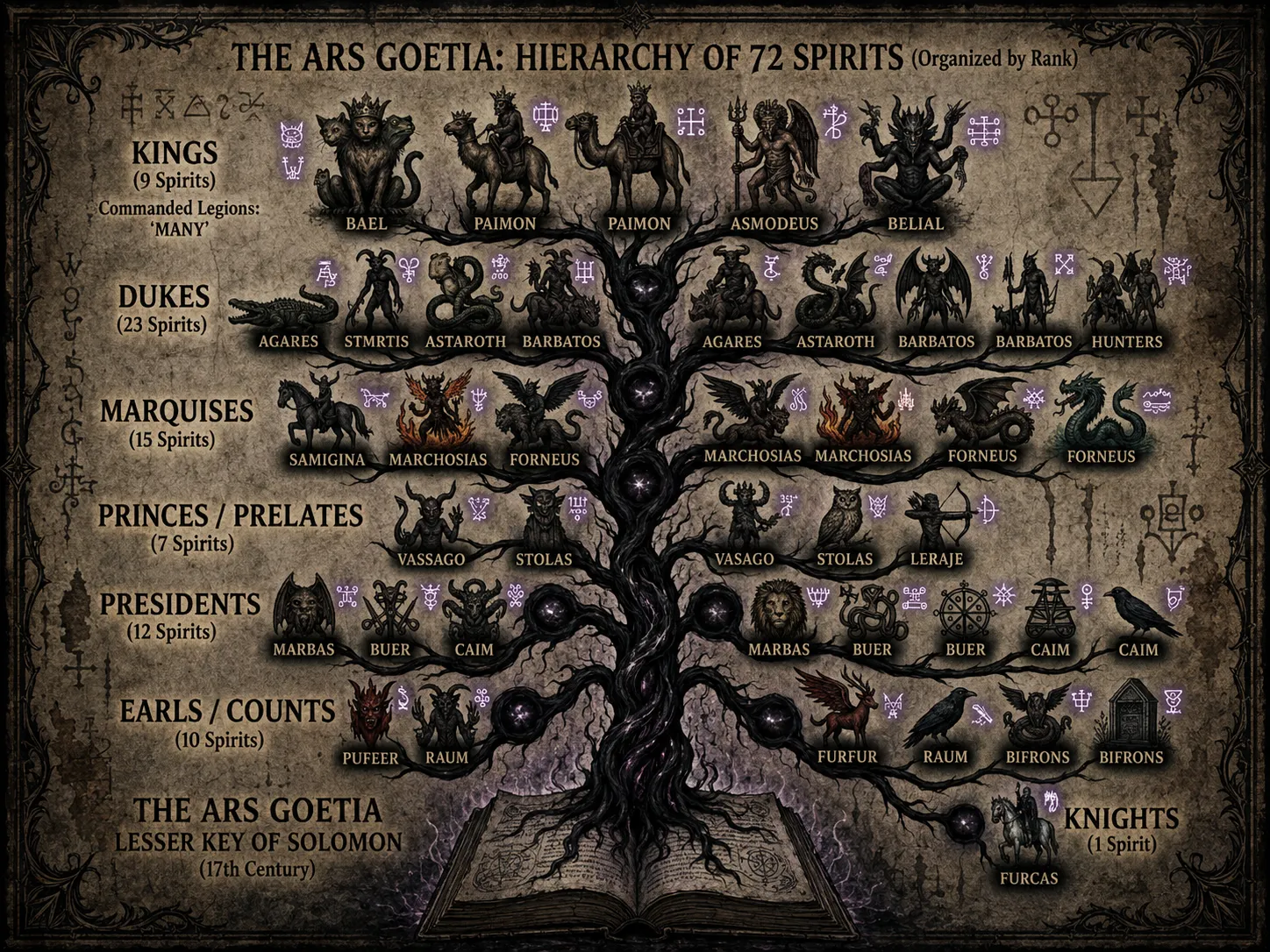
Each of the 72 demons is given a specific European noble rank, a set number of lesser spirits to command, a unique seal for summoning, and a clear list of supernatural powers. The ranks also match astrological bodies: Kings with the Sun, Marquises with the Moon, Presidents with Mercury, Dukes with Venus, Earls or Counts with Mars, Princes with Jupiter, and the only Knight with Saturn.
The text usually lists 72 demons, though some versions have between 69 and 72. The ranking system forms a clear feudal pyramid, and some demons have more than one title, such as Prince and Count or King and President, which shows a complex, layered hierarchy of Hell.
The Seven Ranks of Hell’s Nobility in the Ars Goetia:
| Rank | Details & Notable Entities |
|---|---|
| 9 Kings | The absolute highest tier of the Goetic hierarchy. Notable kings include Bael (the first listed, commanding 66 legions, capable of making his summoner invisible), Paimon (commanding 200 legions, a great king obedient to Lucifer), Asmodeus (commanding 72 legions), Purson, Beleth, Vine, Belial, Zagan, and Balam. Kings are associated with the Sun and are often depicted crowned, in monstrous hybrid forms. |
| 23 Dukes | The largest rank by number, Dukes are high-level administrators of Hell’s domains. Notable Dukes include Agares (the first listed Duke, commanding 31 legions), Astaroth (commanding 40 legions, heavily associated with knowledge and secrets), and Barbatos (commanding 30 legions, able to understand the language of animals). Dukes are associated with Venus. |
| 7 Princes / Prelates | Spiritual governors of Hell’s territories. Notable Princes include Vassago (benevolent in nature, a prince who discovers hidden things and predicts the future) and Stolas (a prince who appears as an owl and teaches astronomy and the properties of herbs and stones). Princes are associated with Jupiter. |
| 15 Marquises | Elite figures associated with the Moon, Marquises are often connected with knowledge, combat, and the guardianship of Hell’s borders. Notable Marquises include Samigina (who teaches the liberal arts), Amon (who commands 40 legions and can reconcile friends and foes), and Marchosias (a great and strong marquis who commands 30 legions). |
| 12 Presidents | Uniquely, Presidents are associated with Mercury — the planet of intellect, communication, and science. This gives Presidents a distinct intellectual function: they specialize in philosophy, logic, mechanical sciences, and healing. Notable Presidents include Marbas (who teaches mechanical arts and cures diseases), Buer (who teaches philosophy, logic, and herbal knowledge), and Glasya-Labolas. |
| 10 Earls / Counts | Associated with Mars, the planet of war and blood, Earls/Counts are deeply connected to violence, natural forces, and destructive powers. Notable Earls include Furfur (who commands storms, lightning, and thunder), Raum (who steals treasures from kings’ houses), and Ronove (who commands 19 legions and teaches languages and rhetoric). |
| 1 Knight | The sole Knight in the Ars Goetia is Furcas (also known as Purson in some manuscripts), associated with Saturn. He commands only 20 legions — far fewer than most Kings — but governs specialized domains of philosophy, logic, astrology, palmistry, and the knowledge of herbs and precious stones. |
The Ars Goetia’s hierarchy is remarkable because it is thorough and does not try to moralize. It is more like a bureaucratic list than a theological argument. Each demon is a specialist with a clear role: some grant wealth, others teach science, some uncover hidden things, and others sow love or hatred between people.
The feudal structure mirrors the society of the grimoire’s creators, who pictured Hell as a large, organized state with the same ranks and rules as European aristocracy. The Ars Goetia has had a huge impact on later occult writings, modern fantasy, and popular culture. Its 72 demons are still some of the most referenced in Western demonology.
The Lanterne of Light (c. 1409–1415)
The Lanterne of Light is a short English religious tract written sometime between 1409 and 1415. Its author is unknown, but the work is usually linked to the Lollard movement, a reform-minded Christian group in late medieval England inspired by Oxford theologian John Wycliffe (c. 1320–1384).
Wycliffe questioned papal authority, the doctrine of transubstantiation, and corruption among the clergy. The institutional Church regarded the Lollards as heretics and sought to suppress them, yet their writings continued to circulate in manuscript throughout England during the 15th century.
The Lanterne of Light is fascinating in the history of demonology because it is the first known text to systematically link a named, high-ranking demon to each of the seven deadly sins. The approach was new at the time. Earlier medieval theologians had connected demons to certain sins, and some Church Fathers had matched specific demons with particular vices.
However, the Lanterne was the first to create a full seven-part list, naming a specific demonic prince for each sin and presenting it as an organized system. This set the stage for Peter Binsfeld, who would later formalize and popularize the idea in 1589. Today, most people know this system through Binsfeld’s version.
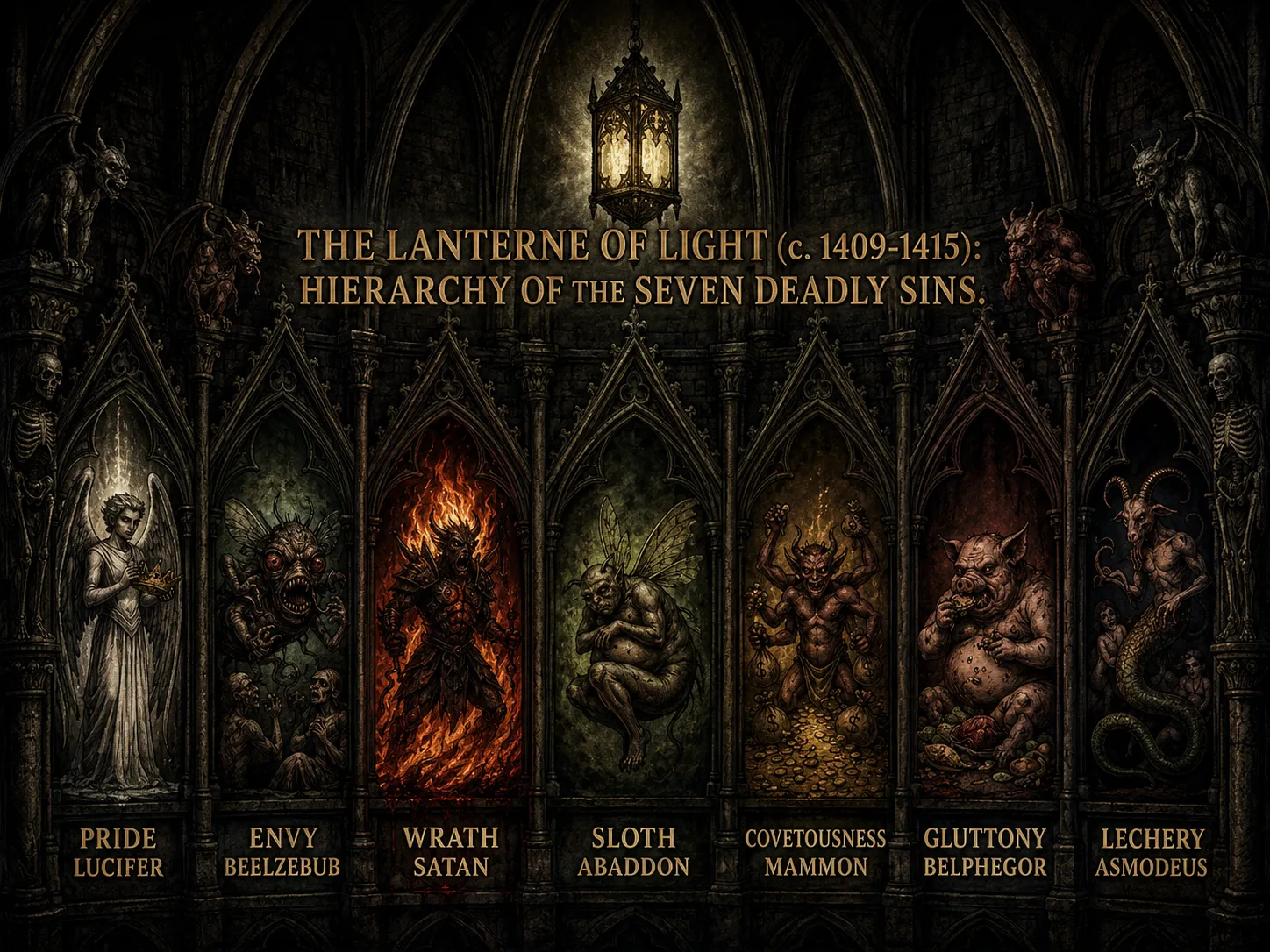
It’s important to note that the Lanterne’s list is not the same as Binsfeld’s. In the Lanterne, Beelzebub is linked to Envy instead of Leviathan. Abaddon is connected to Sloth instead of Belphegor. Belphegor is tied to Gluttony instead of Beelzebub. These differences show that the associations were not yet fixed. They were still developing, as the tradition spread through handwritten manuscripts where variations between copies were common, and the system was still taking shape.
The Lanterne was written in Middle English and its original passage listing the seven demonic princes reads in part: ‘The first is Lucifer that reigns in his malice over the children of pride; the second is called Beelzebub that lords over the envious; the third devil is Satan, and wrath is his lordship; the fourth is called Abaddon, the slothful be his retinue; the fifth devil is Mammon and has with him the avaricious; the sixth is called Belphegor, that is the god of gluttons; the seventh devil is Asmodeus, that leads with him the lecherous.’
The Seven Deadly Princes According to The Lanterne of Light:
| Demon | Deadly Sin |
|---|---|
| Lucifer | Pride — The first and supreme among the demonic princes, Lucifer governs the sin of pride. This assignment, which Binsfeld would later preserve, reflects the ancient theological tradition in which Lucifer’s rebellion against God was itself the archetypal act of pride — the original and defining sin. |
| Beelzebub | Envy — Notably, the Lanterne assigns Beelzebub to Envy rather than Gluttony (as Binsfeld would later do). This reflects a different theological tradition in which Beelzebub, as the ‘Lord of the Flies,’ embodied the corrosive, pestilential quality of envy. |
| Satan (Sathanas) | Wrath — The Lanterne, like Binsfeld, distinguishes between Lucifer and Satan as two separate demonic princes, with Lucifer governing Pride and Satan governing the explosive, destructive rage of Wrath. |
| Abaddon | Sloth (Accidie) — Perhaps the most striking difference from Binsfeld’s later list. The Lanterne assigns Sloth to Abaddon — the angel of the abyss mentioned in the Book of Revelation (9:11) as the king of the bottomless pit. Binsfeld would later replace Abaddon with Belphegor for this sin. |
| Mammon | Greed (Avarice) — Mammon governs the sin of covetousness and material obsession in both the Lanterne and Binsfeld’s later system, reflecting the word’s direct biblical meaning as an idol of wealth. |
| Belphegor | Gluttony — The Lanterne’s Belphegor governs Gluttony rather than Sloth. Binsfeld later reversed this, assigning Gluttony to Beelzebub and reassigning Belphegor to Sloth. |
| Asmodeus | Lust (Lechery) — The assignment of Asmodeus to Lust is consistent between the Lanterne and Binsfeld’s system, reflecting Asmodeus’s long-established association with sexual desire rooted in the Book of Tobit. |
The Lanterne of Light‘s continuing impact is not only its list but also its new idea: that Hell is ruled by specialized leaders, each in charge of a specific area of human vice.
This idea lasted a long time. It became part of the wider theological culture and was used by later poets and preachers. For example, the 17th-century Water Poet John Taylor included the list in his popular verse. The idea reached its most famous form in Binsfeld’s widely read 1589 treatise. The Lanterne shows that even anonymous, overlooked religious texts can have a big impact on the history of ideas.
You may also enjoy:
Orthrus: The Two-Headed Hellhound of Greek Mythology
December 4, 2025
Is the Gaineswood Plantation Haunting Real or Just Southern Folklore?
September 18, 2025
Rokurokubi Legends: Women Who Transformed Into Night Demons
September 9, 2025
What Is Redcap? The Bloodthirsty Goblin of Scottish Folklore
February 5, 2026
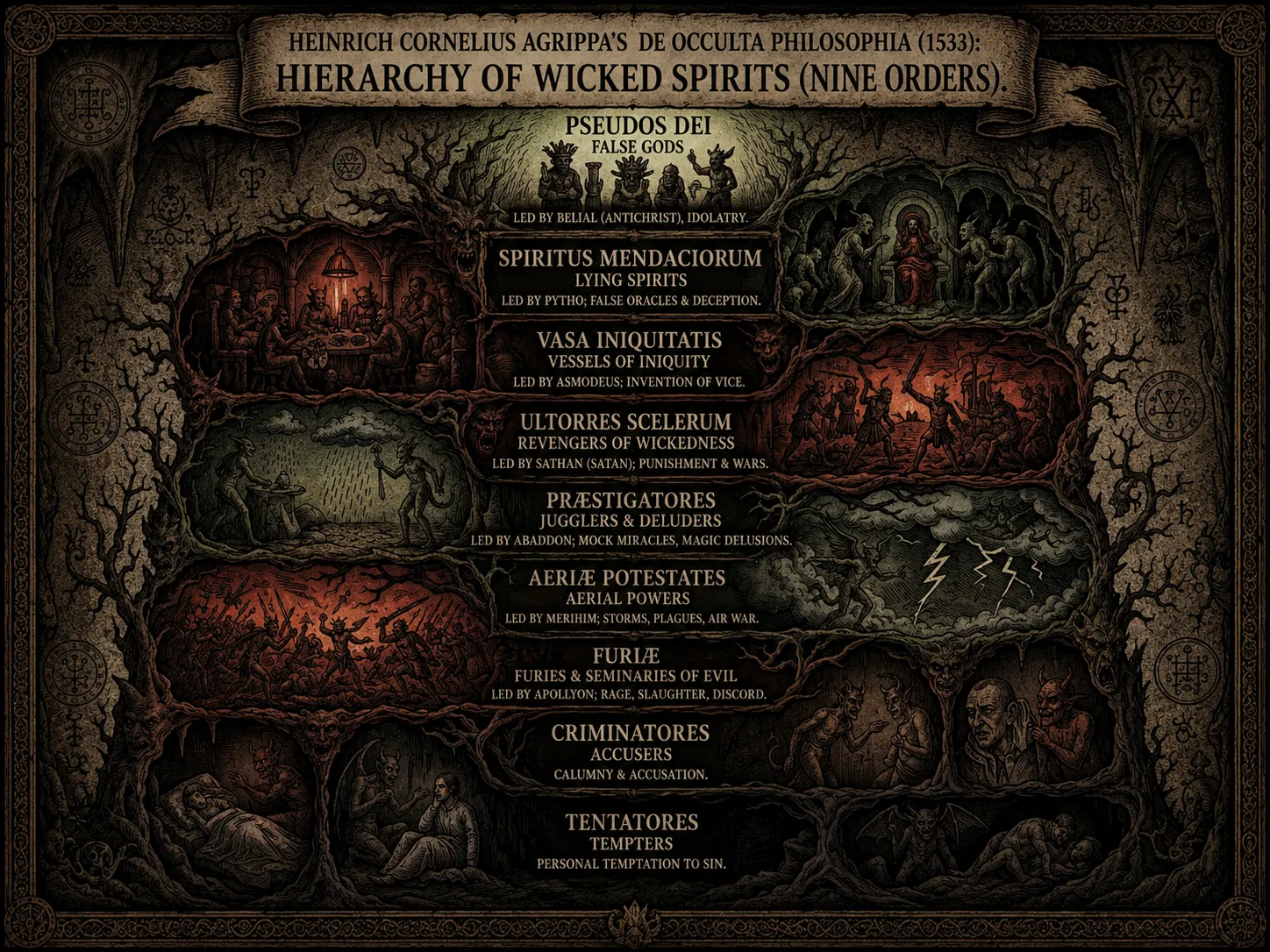
Heinrich Cornelius Agrippa’s De Occulta Philosophia (1533)
Heinrich Cornelius Agrippa von Nettesheim (1486–1535) was one of the most celebrated and controversial intellectuals of the Northern European Renaissance. Born near Cologne and educated at the University of Cologne at the age of thirteen, he went on to work as a soldier, physician, lawyer, and archivist for the Holy Roman Emperor Charles V.
His main work, De Occulta Philosophia Libri Tres (Three Books of Occult Philosophy), was first drafted around 1509 or 1510 and dedicated to the abbot Johannes Trithemius. Agrippa revised and expanded it for almost twenty years before it was finally published in 1533, just two years before his death.
De Occulta Philosophia is one of the most thorough and ambitious works of Renaissance esoteric philosophy. It brings together ideas from Kabbalah, Hermeticism, Neoplatonism, astrology, natural magic, and Christian theology, combining them into a unified theory of occult knowledge.
The book was quickly condemned as heretical by the Dominican Inquisitor Conrad Köllin of Ulm. It was banned in Venice, Milan, and Rome in 1554. Despite this, it continued to circulate widely and greatly influenced later occultists, scholars, and natural philosophers, including John Dee.
In his work, Agrippa devotes a major section to classifying evil spirits. His method is just as ambitious and carefully structured as the rest of the book.
He used the Christian tradition of angelic hierarchies, which lists nine orders of angels as described by Pseudo-Dionysius the Areopagite: Seraphim, Cherubim, Thrones, Dominions, Virtues, Powers, Principalities, Archangels, and Angels. He also created a matching demonic hierarchy with nine orders of evil spirits.
Each order is defined not by rank or political role, but by the type of spiritual deception or harm it causes to people. Each is a dark mirror of one of the nine angelic orders and has its own demonic leader.
The Nine Orders of Evil Spirits According to Agrippa:
| Order | Leader & Function |
|---|---|
| Order 1: False Gods | Led by Beelzebub. The highest order of evil spirits, these are demonic beings that demand worship as gods, driving human beings into idolatry and the worship of false deities. Beelzebub, as the ‘Lord of the Flies’ and one of the foremost powers of Hell, governs this order of cosmic spiritual usurpation. |
| Order 2: Spirits of Lies | Led by Pytho (Python). These spirits specialize in mimicking prophets and divine oracles, twisting the truth, corrupting religious prophecy, and leading diviners and seers into false visions. Their function is to corrupt the channels of legitimate divine communication. |
| Order 3: Vessels of Iniquity | Led by Belial. These are the inventors and architects of vices, wicked arts, dark philosophies, and corrupted knowledge. Belial, whose Hebrew name means ‘worthless’ or ‘without a master,’ governs entities that design the intellectual and cultural infrastructure of evil. |
| Order 4: Revengers of Wickedness | Led by Asmodeus. Cruel spirits who drive human beings to criminal acts and then serve as the executors of punishment — both divine punishment inflicted on sinners and the demonic torment they suffer. This order bridges the domains of incitement and retribution. |
| Order 5: Jugglers and Deluders | Led by Satan. These spirits produce false miracles, counterfeit magic, illusions, and theatrical deceptions designed to mislead the faithful by mimicking authentic supernatural events. Satan here governs the domain of spiritual fraud and theatrical imitation of divine power. |
| Order 6: Aerial Powers | Led by Merihim (a demon of pestilence found in other late medieval texts). These spirits have control over the natural world — they can stir up storms, cause lightning, bring plagues, and manipulate atmospheric phenomena. They represent evil’s capacity to weaponize nature itself. |
| Order 7: Furies | Led by Apollyon (identified with Abaddon in the Book of Revelation). These are the demons of war, discord, and large-scale devastation — the sowers of conflict between nations, the incendiaries of civil wars, and the spirits that fuel humanity’s most destructive collective impulses. |
| Order 8: Accusers and Inquisitors | Led by Astaroth. These spirits function as demonic prosecutors — they expose human sins and failures with the specific goal of driving individuals to suicidal despair. Astaroth, here depicted as a deeply cynical and intellectually penetrating entity, governs the particular cruelty of amplifying human guilt beyond the point of recovery. |
| Order 9: Tempters and Ensnarers | Led by Mammon. The lowest order, these are the spirits most immediately engaged with daily human life. They entangle people in the ordinary, materialistic sins of everyday existence — greed, petty vice, mundane selfishness — ensuring that Hell maintains a constant supply of souls through the accumulation of small compromises rather than dramatic falls. |
Agrippa’s nine-order system is one of the most philosophically complex infernal hierarchies ever made. By basing it on the reversed angelic hierarchy, he gave it a theological unity that simpler or feudal systems did not have.
Each order of evil is a twisted version of a matching order of good. For example, the Seraphim are closest to God and burn with divine love, while the False Gods are farthest from God and burn with selfish ambition. The system has strongly influenced later Western esoteric traditions, including 19th-century ceremonial magic and Kabbalistic demonology.
King James I’s Daemonologie (1597)
Daemonologie — full title: Daemonologie, In Forme of a Dialogue, Divided into Three Books — was written and published in 1597 by James VI of Scotland, who in 1603 would become James I of England and commission the translation that bears his name, the King James Bible.
The book is a philosophical essay presented as a Socratic dialogue between two characters, Philomathes and Epistemon, who discuss whether witchcraft, sorcery, and demonic activity are real. James wrote it to directly challenge Reginald Scot’s The Discoverie of Witchcraft (1584), which argued that belief in witches was just superstition.
James’s interest in demonology was personal. In 1590, as he returned from Denmark with his new wife Anne, his fleet faced severe storms. This led to the North Berwick witch trials, in which James served as judge and interrogator. The accused, including Agnes Sampson, confessed under torture to using witchcraft to cause the storms against his ship.
James became convinced that there was a real demonic plot against him. His belief inspired both Daemonologie and his later support for witch-hunting after he became king of England. The book is also seen as a main source for the supernatural parts of Shakespeare’s Macbeth (c. 1606).
Unlike most other infernal hierarchies mentioned here, James did not focus on Hell’s political structure or on linking demons to specific sins. As a magistrate, or at least a king who wanted his magistrates to be informed, he needed a practical way to classify how demons affected people’s lives.
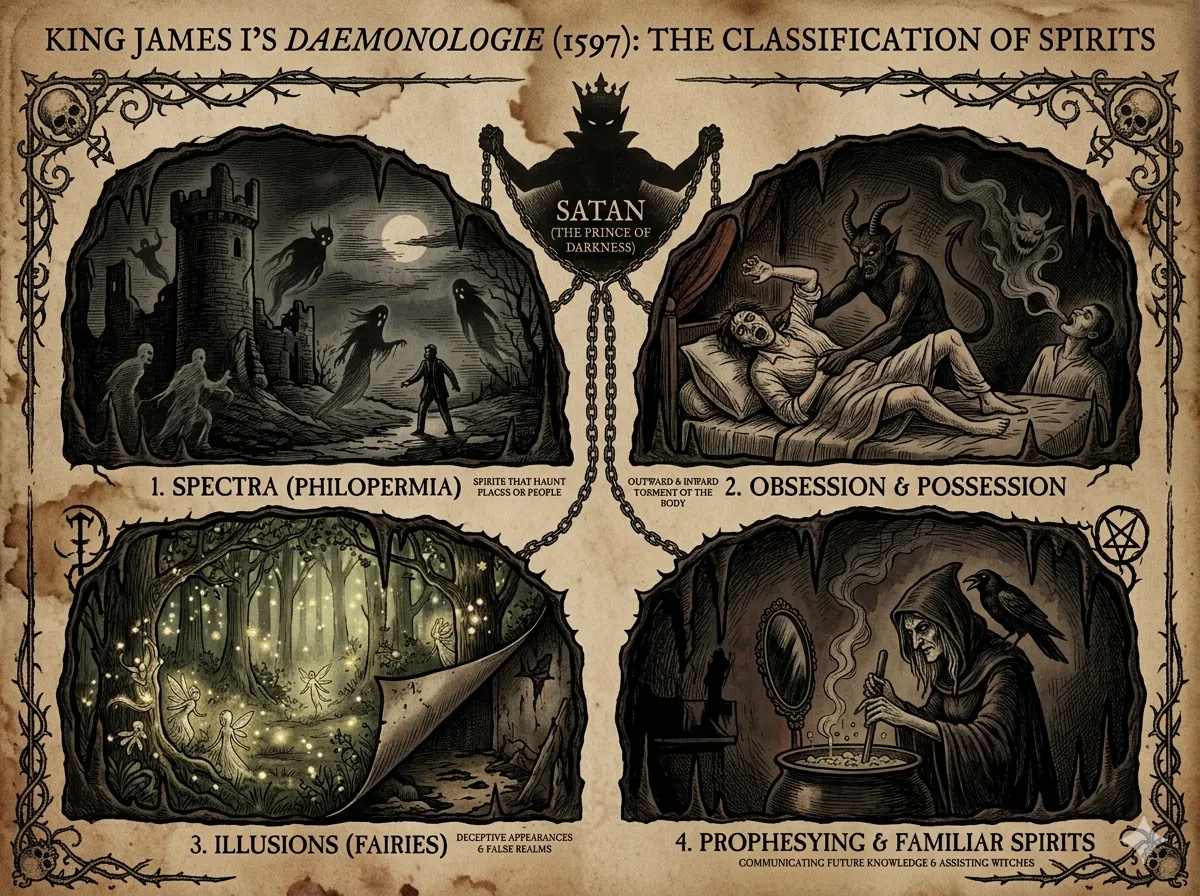
His four categories are based on how demons attack, making Daemonologie more of a guide to supernatural threats than a theological or occult work.
The Four Operational Classes of Demons According to James VI & I:
| Class | Description & Characteristics |
|---|---|
| Spectra (Philopermia / Place-Haunters) | Apparitions that attach themselves to specific locations — abandoned houses, ruins, solitary places — and terrorize whoever dwells there or passes through. James used the Latin term ‘spectra’ for these entities, which correspond to what we would now call traditional ghosts or poltergeists: place-bound spirits that create noise, move objects, produce visions, and generally harass the living within their territory without directly possessing or following any individual. |
| Obsession and Possession (Body-Attackers) | A two-stage form of demonic attack on individual persons. ‘Obsession’ (from the Latin obsidere, to besiege) describes the external harassment of a specific person — demons that follow their target through life, ruining their reputation, causing accidents, and tormenting them from outside the body. ‘Possession’ describes the far graver stage, in which a demon enters the body directly and overrides the person’s free will, speaking through their voice, controlling their actions, and effectively displacing their soul from within. James engaged extensively with the theological and judicial implications of possession, including the question of moral responsibility for acts committed while possessed. |
| Illusions and Fairies (Sense-Deceivers) | Deceptive spirits that operate primarily through the warping of human perception. James categorized fairies, nature spirits, and similar entities under this heading — not because he took them literally as creatures of folklore, but because he understood them as demonic deceptions: spirits that manufactured false experiences of magical kingdoms, prophetic encounters, and supernatural gifts to lead humans into false belief, spiritual pride, and ultimately demonic bondage. This categorization reflects James’s Reformed Protestant theology, in which any supernatural experience not clearly originating from God was presumptively demonic in origin. |
| Prophesying and Familiar Spirits (Pact-Makers) | Low-tier demons that enter into binding pacts with specific human beings — witches — taking the form of animal companions (familiars) and executing specific curses, hexes, and acts of malice in exchange for devotion, blood, or spiritual submission. James devoted particular attention to this category, as it was the operational category most directly relevant to the prosecution of witches: the relationship between witch and familiar, its nature, its terms, and the spiritual consequences for the witch were all questions with direct legal and theological implications in the North Berwick trials and afterward. |
James’s Daemonologie was reprinted in 1603 after he acceded to the English throne, and it played a direct role in reinforcing the legal and cultural infrastructure of witch-hunting in Britain.
The notorious witch-hunter Matthew Hopkins, who orchestrated a wave of executions between 1645 and 1647 that resulted in the deaths of an estimated 300 people, studied the Daemonologie as a practical guide.
You may also enjoy:
Rakshasa: The Demon That Shape-Shifts Into Your Worst Fear
August 27, 2025
What Is the Nurikabe Yokai? The Haunted Barrier That Traps Travelers
September 9, 2025
Ghost Orb Color Meaning: What Each Color Means and Why
January 5, 2026
Jacques Collin de Plancy’s Dictionnaire Infernal (1818)
Jacques Albin Simon Collin de Plancy (1793–1881) was a French writer, occultist, and demonologist born in Plancy-l’Abbaye in the Champagne region of France, the nephew of the revolutionary politician Georges-Jacques Danton. The Dictionnaire Infernal (Infernal Dictionary) was first published in Paris in 1818 to considerable success and was revised and reprinted six times between 1818 and its final, most famous edition in 1863.
The 1863 edition included 69 illustrations by artist Louis Le Breton showing what the described demons looked like. These images were so vivid and influential that they became the main visual reference for demons in Western culture, appearing in everything from 19th-century Gothic literature to modern fantasy art.
The Dictionnaire Infernal‘s hierarchy of Hell is especially interesting because of the author’s own intellectual journey. When de Plancy first published the book in 1818, he was an atheist and rationalist like Voltaire. He created the dictionary to mock and list what he saw as the absurd superstitions of earlier times.
By 1830, however, he had converted to Roman Catholicism and became a devout believer. He revised his book in later editions to treat the demons as real and dangerous, not just as old superstitions. The 1863 edition, made with French priest Jacques Paul Migne, shows a sincere Catholic view of demonology instead of rationalist satire.
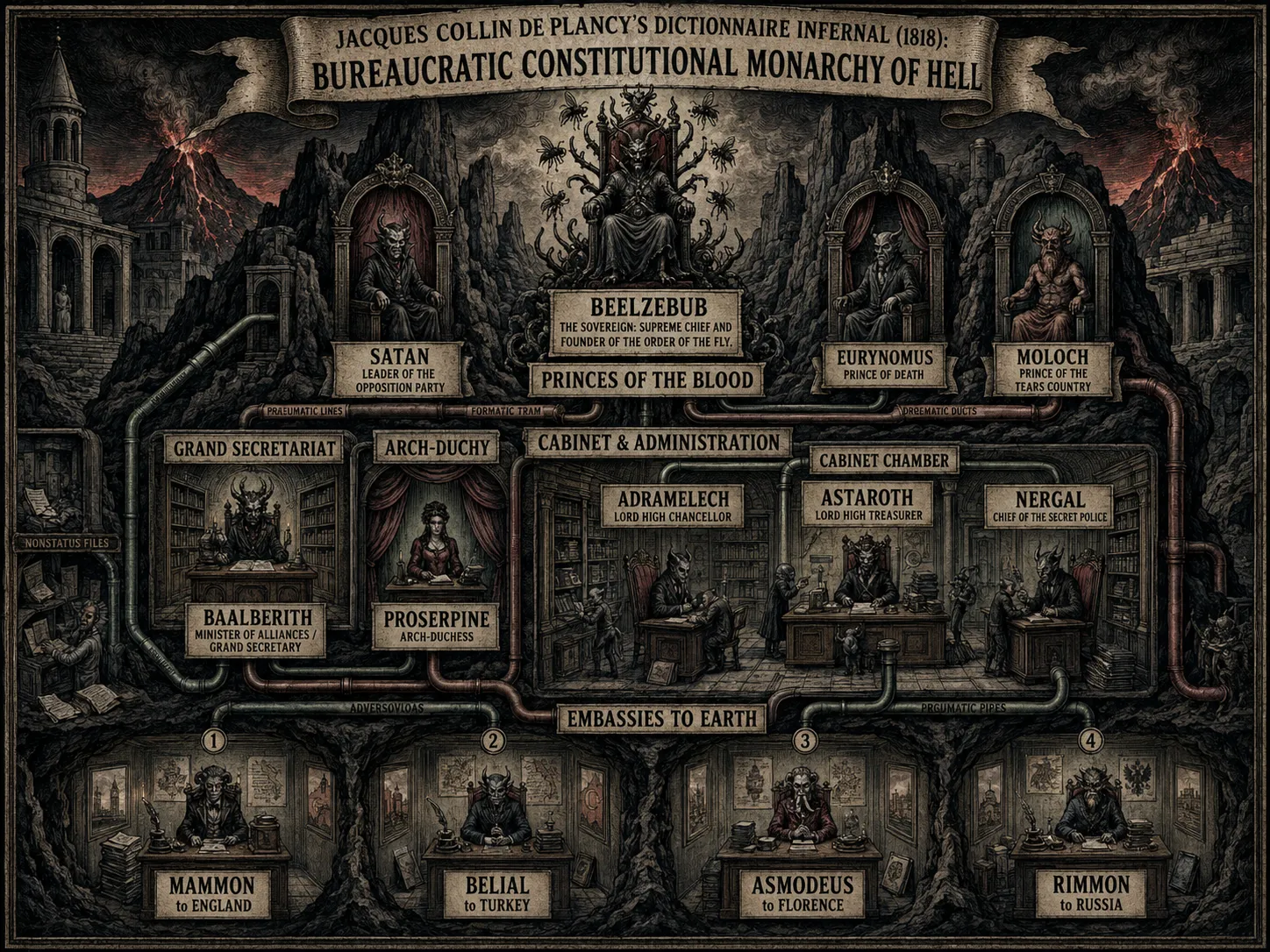
De Plancy’s idea of Hell’s organization reflects the time in which he lived. Writing after the French Revolution and during the rise of large European bureaucracies, he pictured Hell as an overgrown constitutional monarchy, complete with a cabinet, secret police, ambassadors, orders of nobility, and even a loyal opposition.
This is probably the most openly political and satirical version of Hell ever created. It mirrors the post-revolutionary European states de Plancy knew, with all their grand ideas, intrigue, and basic inefficiency.
The Governmental Structure of Hell According to De Plancy:
| Position | Occupant & Description |
|---|---|
| Supreme Sovereign | Beelzebub rules as the Supreme Chief of Hell’s Empire and is the founder and grand master of Hell’s highest noble order, the Order of the Fly — a sardonic parallel to the great chivalric orders of European monarchies such as the Order of the Golden Fleece. In particular, de Plancy’s Hell distinguishes between Beelzebub (the sovereign) and Satan (a rival), placing them in a relationship of political competition rather than identity. |
| Princes of the Blood | The highest-ranking royals after Beelzebub, with their own personal domains: Satan serves as the Leader of Hell’s Opposition Party (an explicitly parliamentary reference), Eurynomus has the title of Prince of Death and Governor of the tombs, and Moloch holds the title of Prince of the Land of Tears, the infernal country of grief and lamentation. |
| Grand Dignitaries | Baalberith (also known as Baal-Berith in biblical tradition) is Hell’s Master of Alliances and Grand Secretary, managing Hell’s treaties and diplomatic correspondence. Proserpine (the classical goddess of the underworld, recast as a demon) holds the title of Arch-Duchess of Evil Spirits. |
| The Cabinet (Ministers of State) | Adramelech serves as Lord High Chancellor of Hell, Astaroth as Lord High Treasurer, and Nergal (the ancient Mesopotamian god of plague) as Chief of Hell’s Secret Police — responsible for surveillance, intelligence, and the suppression of dissent. |
| Ambassadors to Earth | A remarkable innovation in de Plancy’s system: specific high-ranking demons are assigned as resident ambassadors tasked with corrupting particular human nations. Mammon is Hell’s Ambassador to England, Belial to Turkey, Asmodeus to Florence (Italy), and Rimmon (another ancient Near Eastern deity) to Russia. This diplomatic corps reflects de Plancy’s satirical commentary on the great powers of his era. |
| Other Notable Positions | Uphir is Hell’s Physician, responsible for the physical ailments of the demonic court. Ukobach serves as the Official Keeper of Hell’s fires — specifically the inventor of the art of frying, according to de Plancy — one of many sardonic, low-ranking offices that give the Dictionnaire its unique satirical flavor. |
The Dictionnaire Infernal has a unique place in the history of infernal hierarchies. It is both a satirical political commentary, a serious reference to demonology, and a lasting artistic achievement. The 69 illustrations by Louis Le Breton have influenced visual culture far beyond the book’s text.
Almost every modern image of demons like Astaroth, Bael, Asmodeus, or Beelzebub is based, directly or indirectly, on Le Breton’s artwork. De Plancy’s idea of Hell as a government has also been used and reused in everything from 20th-century horror stories to modern animated shows.
Anton LaVey’s The Satanic Bible (1969)
Anton Szandor LaVey (1930–1997) was an American occultist, musician, and author. He founded the Church of Satan in San Francisco on April 30, 1966, choosing Walpurgisnacht for its special meaning in occult traditions.
His most important book, The Satanic Bible, was published in 1969 by Avon Books. It has been printed over thirty times and sold more than a million copies worldwide. The book is the foundation of LaVeyan Satanism, a philosophy LaVey described as atheistic, individualistic, and focused on celebrating life. It asserts the importance of the self over what he saw as the restrictive moralism of traditional religion.
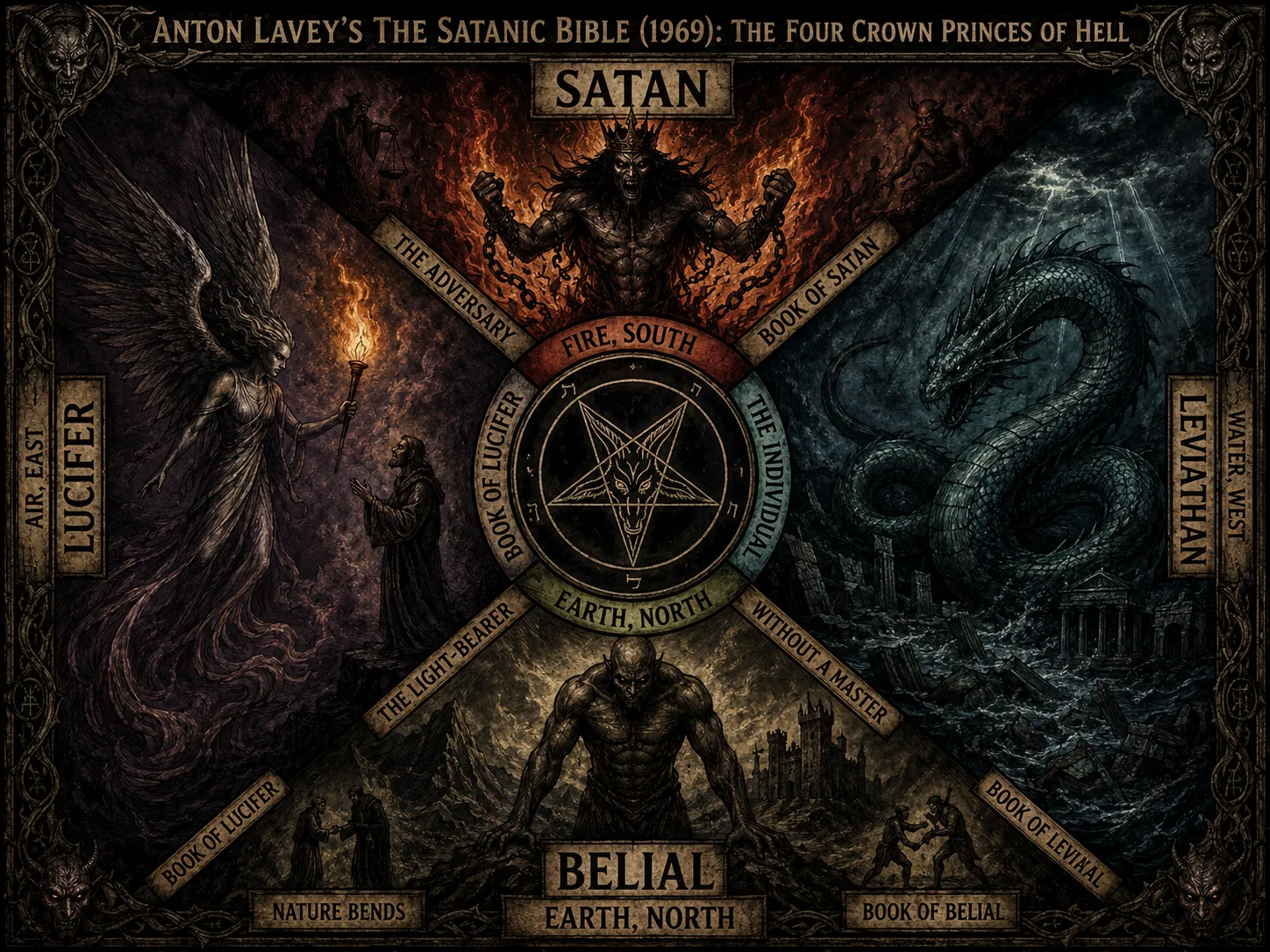
The Satanic Bible is divided into four books, each named after one of the Four Crown Princes of Hell: The Book of Satan, The Book of Lucifer, The Book of Belial, and The Book of Leviathan.
LaVey based his structure partly on The Book of the Sacred Magic of Abramelin the Mage, an important grimoire first published in English in 1898 by S.L. MacGregor Mathers, where these four are the main chiefs of Hell. However, LaVey removed the supernatural elements and instead presented the four princes as powerful philosophical and psychological symbols.
LaVey’s hierarchy of Hell is the most different from earlier systems. There is no court, cabinet, noble ranks, seven deadly sins, or nine circles. Instead, there are four figures, seen not as real supernatural beings but as parts of a philosophical system. They represent the natural world, the human mind, and the directions of the compass.
This makes LaVey’s system both the simplest and the most modern in its philosophy among all the infernal hierarchies discussed here. His version of Hell is really a set of symbols for understanding human experience.
The Four Crown Princes of Hell According to LaVey’s The Satanic Bible:
| Crown Prince | Element, Direction & Significance |
|---|---|
| Satan | Element: Fire. Direction: South. Satan, whose Hebrew name means ‘Adversary’ or ‘Accuser,’ represents the unfiltered realization of the physical, carnal self — the life force itself, understood as inherently good and worthy of celebration rather than suppression. In LaVey’s system, where the element of Fire and the direction of the South (traditionally associated with heat and vitality in Western magical tradition) are involved, Satan is not a rebel against God but the embodiment of unapologetic human nature. The Satanic Bible itself is structured around four books, with The Book of Satan opening the work. |
| Lucifer | Element: Air. Direction: East. Lucifer, whose name derives from the Latin for ‘Light Bearer’ (lux, light; fero, to carry), represents intellectual enlightenment, reason, independence of thought, and the rejection of received dogma. Air and East are associated in Western magical tradition with intellect, communication, and the dawn — the rising of light. LaVey’s Lucifer is not the fallen angel of Christian theology but the classical figure of the morning star: a symbol of the human capacity for independent reason and the refusal of intellectual submission. |
| Belial | Element: Earth. Direction: North. Belial, whose Hebrew name is translated in The Satanic Bible as ‘Without a Master’ (though more commonly translated as ‘worthless’ in scholarly contexts), represents pragmatic self-reliance, groundedness, and physical survival. Earth and North are associated with solidity, the material world, and the darkness of self-sufficiency. LaVey’s Belial embodies the principle that a human being owes ultimate allegiance to no external authority — divine, social, or demonic — but only to the demands of their own genuine nature and survival. |
| Leviathan | Element: Water. Direction: West. Leviathan, the great sea serpent of the Hebrew Bible (Job 41, Isaiah 27), represents the subconscious mind, emotional depth, the allure of the unknown, and the churning, ungovernable depths of human desire. Water and West are associated in Western magical tradition with the unconscious, dreams, endings, and the depths that lie beneath rational consciousness. LaVey’s Leviathan is the principle of emotional authenticity and the acknowledgment of humanity’s deep, irrational interior life. |
It is also important to mention that The Satanic Bible includes a long list of ‘Infernal Names’—seventy-seven beings from demonological traditions worldwide—used at the start of Satanic rituals.
These names are not arranged in a hierarchy; instead, they are called together as a symbolic way to bring the whole infernal tradition into the ritual. The Four Crown Princes, however, are the main pillars of the system, each ruling one part of the ritual space and one part of the Satanic worldview.
LaVey’s role in the history of infernal hierarchies is to finish a journey that started with Dante’s moral map of Hell over 600 years ago. Dante saw Hell as a place of cosmic justice, where people were punished for breaking divine and moral laws. LaVey, on the other hand, saw Hell as a philosophical idea—a symbolic space to celebrate everything that traditional religion condemned.
By removing the supernatural elements, LaVey also removed any claim to objectivity. His Four Crown Princes are not meant to describe a real underworld, but instead serve as a statement about what it means to live a complete human life.
Whether people find the idea freeing or unsettling, its boldness and clarity have made The Satanic Bible a lasting part of the long and unusual history of how people have tried to describe the structure of darkness.
What Every Hierarchy of Hell Reveals
When viewed together, these ten systems create a surprisingly consistent record of cultural history. Over six centuries and across three continents, each attempt to organize Hell’s hierarchy shows what mattered most to its creator at that time and place.
Dante’s moral circles reflect the ethical ideas of medieval Scholastic theology. De Spina’s categories show the Church’s worries about heresy and superstition. Binsfeld’s seven princes represent the psychological battles of the Counter-Reformation witch trials. Milton’s council of demons highlights the political disappointment of a 17th-century republican.
The Ars Goetia’s noble ranks turn early modern Europe’s social order into infernal terms. De Plancy’s bureaucratic monarchy pokes fun at the big government systems of post-revolutionary France. Finally, LaVey’s four elemental princes remove all supernatural elements to show Hell as a reflection of the fully developed human mind.
The infernal hierarchy has never stayed the same. It has always been a changing debate about what evil is, how the universe is ordered, and how human weakness relates to supernatural forces.
What remains in every system—from the frozen ninth circle of Cocytus to the elemental directions in LaVeyan rituals—is the basic human need to bring order to darkness, to name what scares us, and to try to map what cannot be mapped.
You may also enjoy:
What Is a Satyr, the Lust-Driven Monster of the Wild?
November 14, 2025
Adrammelech in the Bible: Child Sacrifices and Idolatry
September 30, 2025
Ifrit: The Demon Born of Fire and Chaos
August 22, 2025
Demon Foras: Secrets of the Ars Goetia
August 21, 2025
Who or What Is the Owlman of Mawnan Church?
November 5, 2025
Orthrus: The Two-Headed Hellhound of Greek Mythology
December 4, 2025
Sources
- Alighieri, Dante. The Divine Comedy of Dante: The Inferno. Translated by Marvin Richardson Vincent, C. Scribner’s Sons, 1904. Internet Archive.
- Spina, Alphonsus de. Fortalitium fidei. Antonius Koberger, 1494. Internet Archive.
- Summers, Montague. The history of witchcraft and demonology. Project Gutenberg, 28 Oct. 2025. Originally published by Alfred A. Knopf, 1926.
- De Laurence, L. W. The Lesser Key of Solomon, Goetia. Project Gutenberg, 7 Nov. 2023. Originally published by De Laurence, Scott & Co., 1916.
- Henson, Mitch, and Jeff Wellman, editors. Lemegeton: The Complete Lesser Key of Solomon. Metatron Books, 1999. Internet Archive.
- Trithemius, Johannes. Steganographia: Hoc Est: Ars Per Occultam Scripturam Animi Sui Voluntatem Absentibus Aperiendi Casu. Published by Ioannis Alberti, 1608. Internet Archive.
- Weyer, Johann. Pseudomonarchia Daemonum. Edited and translated by Joseph H. Peterson, digital edition, 2000. Twilit Grotto: Esoteric Archives.
- Collin de Plancy, Jacques. Dictionnaire infernal: répertoire universel des êtres, des personnages, des livres, des faits et des choses qui tiennent aux esprits. 6th ed., Henri Plon, 1863. Internet Archive.
- Porter, John. A Book of the Offices of Spirits: The Occult Virtue of Plants and Some Rare Magical Charms & Spells (Liber Officiorum Spirituum). Translated by Frederick Hockley, Teitan Press, 2011. Internet Archive.
- Milton, John. Paradise Lost. Cassell, Petter, Galpin & Co., 1866. Internet Archive. Originally published in 1667.
- Clymer, R. Swinburne. The Grand Grimoire. The Philosophical Publishing Co., 1910. Internet Archive.
- Scot, Reginald. The Discoverie of Witchcraft. Edited by Brinsley Nicholson, Elliot Stock, 1886. Internet Archive. Reprint of the 1584 edition.
- Reed, Jennifer. Christian Demonology | Origin, Demons & Importance. Study.com. Accessed 20 Mar. 2026.
- Bane, Theresa. Encyclopedia of Demons in World Religions and Cultures. McFarland & Company, 2012. Internet Archive.
- Barrett, Francis. The Magus, or Celestial Intelligencer; Being a Complete System of Occult Philosophy. Printed for Lackington, Allen and Co., 1801. Internet Archive. Including works by Johannes Trithemius.
- Guiley, Rosemary Ellen. The Encyclopedia of Demons and Demonology. Visionary Living, Inc., 2009. Internet Archive.