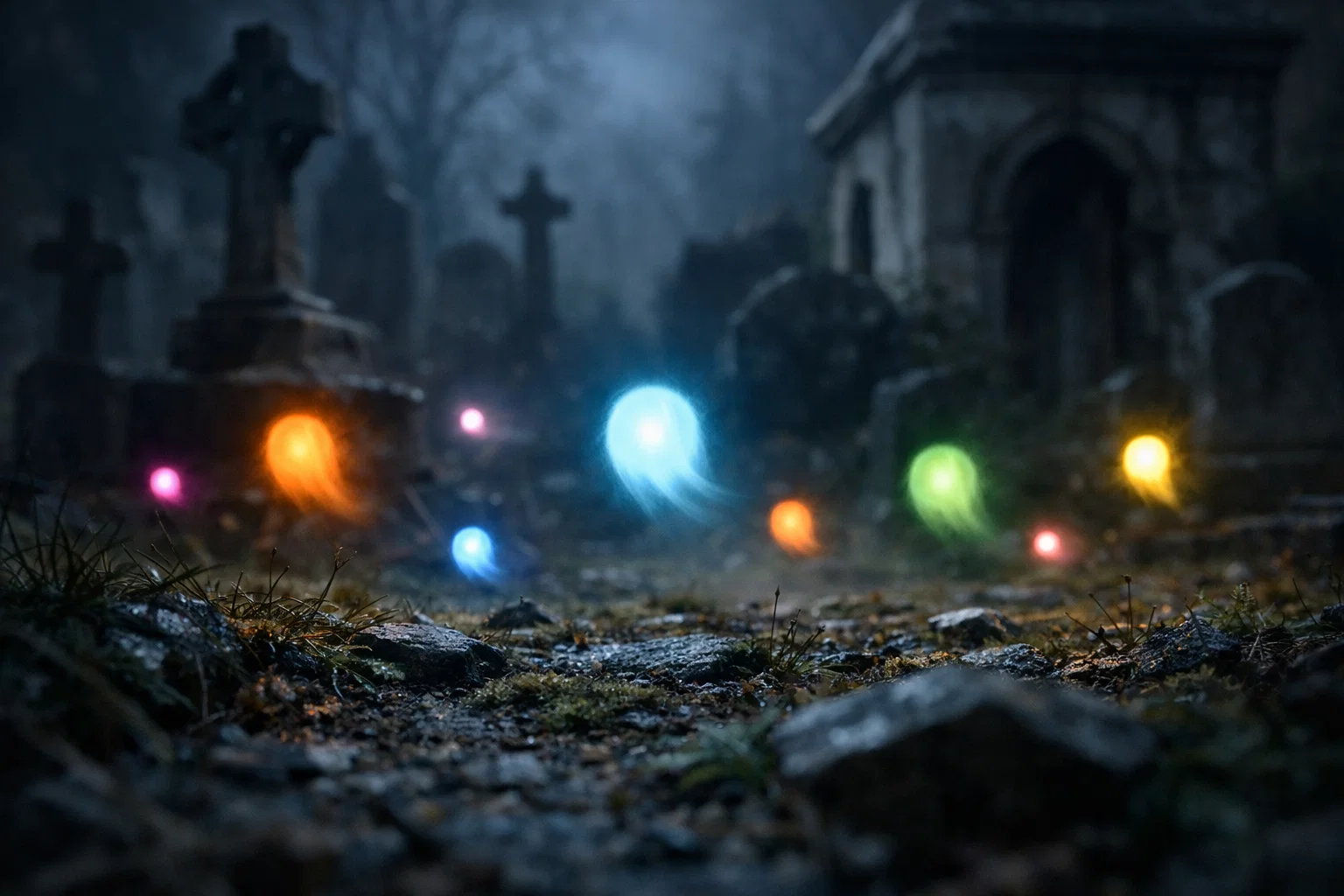
Ghost orb color is the detail most paranormal investigators check first the moment a strange sphere of light shows up in a photograph or on a night-vision camera.
A white orb, a red one, and a black one are treated as three completely different events in the paranormal community — one a consoling sign, another a warning, another a reason to leave the room. But before any of that folklore can make sense, there’s a more basic question worth answering: why do orbs even come in different colors in the first place, and is there a real explanation behind it, or is it all interpretation?
Summary
Why Do Some Ghost Orbs Have Different Colors?
There are two separate explanations for why orb color varies, and understanding both is essential before assigning any meaning to what was captured.
The first explanation is optical and photographic, and it’s the one supported by physical evidence. Most orbs captured on camera are a form of backscatter, also called near-camera reflection: light from a flash or infrared illuminator bounces off an out-of-focus particle — dust, pollen, moisture, or a small insect — sitting close to the lens.
Because the object is too close to be in focus, the camera renders it as a soft, round shape rather than a sharp speck. On their own, these particles are almost always colorless, so the “pure” backscattered orb is typically depicted by the sensor as white or pale gray. Color enters the picture through a handful of separate mechanisms.
A colored ambient light source — a red exit sign, a blue LED, a yellow porch light — will tint any nearby backscatter orb to match its color. Chromatic aberration, a lens imperfection that splits light into fringes of color at the edges of bright objects, can add faint rainbow edges to an orb.
High-resolution digital sensors can also register Moiré patterns, fine overlay patterns created when a repeating detail in the orb’s texture is close to the resolving limit of the sensor, and these patterns frequently appear as concentric rings of color inside the orb.
Finally, a camera’s automatic white balance can shift color across an entire image, including any orbs in frame, if there’s no true white reference point in the shot. None of these mechanisms are tied to intent or emotion — they’re consequences of optics, sensor resolution, and lighting variables.
The second explanation is the one paranormal researchers and spiritual practitioners rely on, and it has no scientific backing but a long tradition behind it. In this system, an orb’s color is thought to reflect the vibrational frequency, aura, or emotional residue of the entity producing it.
The idea borrows heavily from two older belief systems: the aura, a colored energy field said to surround living things and reflect their emotional or physical state, and the chakra system, a set of seven energy centers from Hindu and yogic tradition that are each linked to a specific color — red for the root chakra, orange for the sacral chakra, yellow for the solar plexus, green for the heart, blue for the throat, indigo for the third eye, and violet or white for the crown.
Paranormal investigators who use the model treat an orb’s color the way a color psychologist treats a mood board: as a symbolic shorthand rather than a literal, provable signal.
White Orbs
White is by far the most commonly reported orb color, both because it’s the “default” appearance of a plain backscatter artifact and because, in paranormal folklore, it’s considered the baseline form spiritual energy takes before it “specializes” into another color.
In spiritual and paranormal traditions, white is tied to purity, protection, and high-frequency positive energy. A white orb is commonly interpreted as a guardian presence, an angelic visitor, or the spirit of someone gentle or innocent in life.
Because white sits at the top of the chakra system as the color of the crown chakra, some practitioners treat a white orb as a sign that the surrounding space carries a strong spiritual or divine presence rather than the character of one specific ghost.
White orbs are frequently reported at religious sites, during moments of communal gathering, or around people going through emotionally significant events such as a birth or a loss. Investigators who put stock in orb color note that a white orb is rarely treated as a bad sign — even skeptics who dismiss the paranormal explanation acknowledge that white is simply what an unlit dust particle looks like on camera, which is part of why it shows up so often.
Black Orbs
Black orbs are the color most consistently linked to negative or threatening energy across paranormal traditions. They’re also the rarest to document, since a true black orb behaves opposite to how light-based artifacts normally work. Instead of glowing, it appears to absorb light, showing up as a dark void rather than a bright circle.
This visual behavior is part of why black orbs unsettle investigators more than any other color: a conventional backscatter artifact cannot easily produce a true “hole” of darkness, so a convincingly documented black orb is treated by believers as harder to explain away.
In paranormal folklore, a black orb is associated with heavy, low-vibration, or outright malicious energy. Some investigators connect black orb sightings to locations with a documented history of violence, tragedy, or extended suffering, treating the color as an environmental imprint rather than proof of an active entity.
Others associate it more directly with what ghost-hunting culture calls a “shadow” presence. Because of this reputation, a black orb sighting is one of the few color reports that regularly comes with a practical recommendation attached: proceed with caution, and leave if the environment starts to feel physically or emotionally distressing.
You may also enjoy:
Ose: The Insanity Inducing Demon of the Ars Goetia
September 1, 2025
Children Vanished: The Werewolf of Eschenbach Case
June 18, 2025
What to Do If Your House Is Haunted: 11 Steps to Take Back Control
September 5, 2025
What Is the Nurikabe Yokai? The Haunted Barrier That Traps Travelers
September 9, 2025
Dullahan: The Irish Death Rider That Cannot Be Escaped
February 2, 2026
Red Orbs
Red orbs sit at an interesting crossroads in paranormal interpretation because the color’s everyday associations — anger, danger, aggression — don’t fully align with how it’s typically read in ghost-hunting circles.
Instead, red is most frequently tied to the root chakra, the energy center associated with survival, physical grounding, and protection. A red orb is commonly interpreted as a protective or watchful presence: a spirit that was a caretaker, guardian, or someone with a strong protective instinct in life.
That said, the shade matters in most interpretive frameworks. A bright or clear red is generally read as protective or “grounding” energy, sometimes described as guarding a person or location. A darker, murkier red is more often associated with unresolved agitation, restlessness, or emotional residue from a difficult death or a traumatic event tied to the location.
Red orbs are frequently reported at sites associated with historical conflict, such as former battlegrounds, which practitioners attribute to the intensity of the emotional and physical events that took place there.
Orange Orbs
Orange orbs carry one of the more consistently positive interpretations throughout paranormal sources. Tied to the sacral chakra — the energy center linked to creativity, connection, and social bonds — orange is associated with warmth and friendliness, and a feeling of belonging. Investigators who track orb color rarely treat an orange sighting as a cause to concern.
An orange orb is commonly interpreted as the presence of a spirit who was a caregiver, healer, or simply a sociable, well-liked person during their life. It’s frequently reported in family homes, during reunions, and at other gatherings with a strong emotional or group atmosphere.
Some practitioners describe orange orbs as energizing rather than simply observational, regarding them as a spirit actively contributing a sense of comfort or creative energy to the people nearby, rather than only watching from a distance.
Yellow Orbs
Yellow occupies a dual role in orb folklore, making it one of the more subtle colors to interpret. Linked to the solar plexus chakra, the seat of personal power, confidence, and intellect, yellow is associated, on the one hand, with mental sharpness, curiosity, and logical thinking, and, on the other, with caution or a need to pay closer attention to one’s surroundings.
A bright, vivid yellow is generally read as a positive, intelligent presence. Some traditions describe it as a “muse” energy, drawn to people who are deep in thought, studying, or working through a complex decision.
A pale or washed-out yellow, by contrast, is more often treated as a mild warning sign, prompting the observer to be more alert rather than alarmed. Unlike red or black, yellow rarely carries a strongly negative connotation even in its warning form; it functions more like a suggestion than an omen.
Green Orbs
Green is almost universally associated with healing across paranormal and spiritual traditions, tied directly to the heart chakra and its connection to love, empathy, and physical well-being. A green orb is one of the most consistently reassuring sightings a person can report, particularly if it appears during a period of illness, recovery, or emotional difficulty.
Green orbs are frequently linked to spirits who worked in caregiving roles during their lives — nurses, doctors, or family caretakers — as well as to what some traditions call nature spirits or elemental energies rather than human ghosts.
This is part of why green orbs are so often reported in gardens, forests, and other nature-rich environments, as well as in hospitals and other places where restoration is actively underway. Some practitioners also report that pets and animals seem to react visibly — perking up or staring at a fixed point — during a documented green orb sighting, though this remains anecdotal.
Blue Orbs
Blue is the color most commonly associated with communication, truth, and calm in paranormal traditions, and is tied to the throat chakra. A blue orb is typically interpreted as a spirit or energy attempting to communicate — either to deliver a message, offer comfort, or guide the observer toward clarity on a decision or situation they’re facing.
Shade plays a meaningful role in how blue is interpreted. A light or pale blue is generally read as tranquil and calming, often associated with a peaceful, non-threatening presence. A darker or deeper blue is more frequently tied to protection and wisdom, with some practitioners describing it as the signature of what’s called a spirit guide — a presence believed to offer direction rather than simply observing.
Blue orbs are commonly reported around people engaged in reflective or communicative work, such as teaching, counseling, writing, or meditation.
You may also enjoy:
The Strange Hodag Monster: Wisconsin’s Fearsome Cryptid
September 26, 2025
Demon Naberius Explained: Origins, Powers, and Myths
August 26, 2025
What Is an Androsphinx and Why Was It Feared in Ancient Egypt?
January 27, 2026
Is the Kali Oka Plantation Haunting Real?
May 13, 2025
What Is a Poltergeist? Definition, Manifestations, and History
January 20, 2026
Purple and Violet Orbs
Purple and violet orbs are less frequently reported than warmer colors, and in most paranormal systems that rarity is treated as significant in itself. Tied to the crown chakra — the energy center associated with higher consciousness and spiritual insight — purple is linked to intuition, psychic development, and heightened spiritual awareness.
A purple orb sighting is often interpreted as a sign that the observer is undergoing spiritual growth or gaining new insight, rather than as a message from a specific person who has passed.
Some traditions describe these orbs as visiting from a “higher plane” rather than being earth-bound like other spirit types. They’re more commonly reported in places associated with study, reflection, or ceremony, such as libraries, temples, and quiet historic buildings. Witnesses who report a purple orb frequently describe a persistent sensation of calm or reverence as opposed to fear.
Pink Orbs
Pink is consistently interpreted as the color of love, comfort, and emotional tenderness, functioning as a softer variant of red’s protective energy rather than a color tied to a specific chakra center. A pink orb is one of the sightings most often associated with the presence of a child spirit or a profoundly loved family member, and it’s frequently reported by people who are actively grieving.
Because of this association, pink orbs are commonly reported in nurseries, at family gatherings, and around major life events such as weddings or the arrival of a new baby. In most interpretive frameworks, a pink orb is treated as a deliberate gesture of comfort — a way for a spirit to reassure someone that they are still emotionally present, even if physically gone.
Gold Orbs
Gold is treated as one of the rarest and most significant orb colors across paranormal traditions, generally reserved for the highest tier of spiritual meaning. It’s associated with divine protection, blessing, and prosperity, and sightings are often described as carrying a distinct feeling of purpose or intelligence rather than passive drifting.
Gold orbs are commonly linked in folklore to angelic presences or highly evolved spiritual entities rather than ordinary human ghosts. Some accounts describe gold orbs as appearing during moments of intense personal significance — near-death experiences, profoundly emotional turning points, or events witnesses describe as profoundly spiritual.
Because gold is documented so infrequently compared to white, blue, or red, a sighting of a gold orb is typically treated by paranormal researchers as the most noteworthy entry in an investigation’s photo log.
Silver Orbs
Silver orbs are distinguished from white by their metallic quality. They are tied in folklore to wisdom, guidance, and intellectual or spiritual strength rather than pure protection. Silver’s association with the moon in many spiritual traditions also connects it to intuition, reflection, and calm insight.
One of the more distinctive silver-orb beliefs links the color to the concept of the “silver cord,” an idea found in various esoteric and occult traditions that describes a subtle connective link between the physical body and the astral or spiritual self during states such as deep sleep or meditation.
Because of this connection, some practitioners interpret a silver orb not as the spirit of a deceased person, but as the traveling astral energy of a living person during sleep or deep meditation — a clearly different category from most other orb colors, which are almost always attributed to the deceased or to non-human spiritual entities.
Brown Orbs
Brown orbs are consistently associated with earth-bound or grounding energy. Unlike most other colors on this list, they’re the color most usually linked to residual hauntings rather than active, conscious spirits. A residual haunting, in paranormal terminology, refers to an environment that appears to replay an impression of a past event rather than hosting an intelligent, interactive presence — closer to a recording than a visitor.
This idea connects to the Stone Tape Theory, a real (though scientifically unproven) concept in paranormal research suggesting that certain environments, particularly those with mineral-rich stone or brick, can “record” emotionally intense events and later “play them back” under the right conditions.
Brown orbs fit neatly into this system and are frequently reported in old buildings, basements, mines, and other locations with heavy stone or earth construction. While brown is not typically considered dangerous, its association with heaviness and residual energy means investigators often approach a sighting of a brown orb with more caution than they would a white or green one.
Gray Orbs
Gray sits in a deliberately ambiguous position in orb folklore — neither clearly positive like white or green, nor clearly negative like black. It’s most often associated with spirits described as confused, low on energy, or caught in a transitional state between one plane of existence and another.
Some paranormal traditions borrow language from the Tibetan Buddhist concept of the bardo, a transitional state described in Buddhist teaching as occurring between death and rebirth, to explain gray orb sightings, framing the gray tone as visual evidence of a spirit that hasn’t fully “arrived” anywhere yet.
Gray orbs are commonly reported in transitional physical spaces as well — train stations, old hotels, and hospitals — locations some practitioners describe as naturally attracting spirits who are themselves in a kind of limbo.
A gray orb sighting is rarely treated as a warning sign the way black is. Still, it’s frequently interpreted as a request for acceptance, prayer, or assistance from whatever presence produced it.
You may also enjoy:
Who Is Malphas? The Great President of Hell
August 25, 2025
Is Batsquatch Real? The Mount St. Helens Mystery
May 20, 2025
The Dark Demon Seth: God of Chaos in Egyptian Mythology
October 2, 2025
What Is the Agogwe? The Mysterious Hairy Dwarf of East Africa
November 10, 2025
What Orb Size, Brightness, and Movement Add to the Meaning
Color isn’t the only factor paranormal investigators weigh when interpreting an orb — size, brightness, and movement are treated as equally important modifiers.
A larger orb is generally interpreted as carrying more energy or spiritual significance than a small one, and some traditions specifically connect orb size to the perceived “evolution” or strength of the entity producing it.
Brightness works similarly: a vivid, saturated color is typically read as a strong, clear, and intentional presence, while a washed-out version of the same color is more often attributed to residual or weakening energy rather than an active, conscious spirit.
Movement is the modifier most frequently cited as separating a “true” spirit orb from an ordinary photographic artifact. Orbs that appear to move with apparent purpose — changing direction around furniture, approaching a person, or beating rhythmically rather than drifting randomly — are treated by paranormal investigators as more convincing evidence than a static or randomly drifting orb, which is far more likely to be a genuine dust or insect artifact.
Are Ghost Orb Color Meanings Scientifically Proven?
No. No scientific data supports the idea that an orb’s color relates to a specific spiritual meaning, entity type, or emotional state. Paranormal investigator Joe Nickell and skeptic Michael Shermer have both pointed to mundane, well-documented causes — dust, pollen, insects, and moisture reflecting a camera’s flash — as the source of the overwhelming majority of orb photographs, a conclusion backed by the technical explanation of backscatter photography.
The color variations themselves are attributable to camera-specific features such as lens quality, sensor resolution, ambient lighting, and white balance settings rather than to any property of the object being photographed.
That doesn’t mean the folklore is meaningless to the people who use it. Color-based orb interpretation functions the same way a great deal of symbolic and spiritual practice does: as a shared, internally consistent language to understand emotionally significant experiences, even without empirical proof behind it.
Anyone documenting orb sightings for genuinely investigative purposes is generally advised to first rule out the usual explanations — dust, insects, lens condition, and light sources — before treating a colored orb as evidence of anything unexplained.
Summary of Ghost Orb Color Interpretations
| Orb Color | Ghost Orb Meaning | Spirit Type / Intent |
|---|---|---|
| White | Purity, protection, high-frequency energy | Guardian spirits, angelic presences, innocent souls |
| Black | Negative or heavy energy, danger | Malevolent entities, shadow presences, warning signs |
| Red | Protection, grounding, restlessness (if dark) | Protective or watchful spirits, agitated or traumatic energy |
| Orange | Warmth, friendliness, belonging | Caregivers, healers, sociable spirits |
| Yellow | Intellect and caution | Alert or “muse” energy, mild warning presence |
| Green | Healing, nature, emotional restoration | Caregiver spirits, nature or elemental energy |
| Blue | Communication, truth, calm | Spirit guides, peaceful or protective communicators |
| Purple/Violet | Intuition, psychic insight, spiritual growth | Higher-plane visitors, teachers, non-earthbound entities |
| Pink | Love, comfort, emotional tenderness | Child spirits, loved family members |
| Gold | Divine blessing, prosperity | Angelic or highly evolved spiritual entities |
| Silver | Guidance, wisdom, intuition | Messengers, astral energy of living people |
| Brown | Grounding, residual energy | Earth-bound spirits, environmental imprints |
| Gray | Confusion, transition | Lost or weakened spirits, transitional presences |
In the end, whether ghost orb color is read as a genuine spiritual signal or as an artifact of dust, lighting, and camera optics comes down to which explanation a person finds more convincing.
Both readings can be held at once: understanding the physical mechanics of why an orb appears a certain color doesn’t erase the long tradition of meaning attached to those colors — it just means any interpretation is best made with both sides of the picture in view.
You may also enjoy:
Complete Guide to Oklahoma Bigfoot Sightings (1942–2025)
August 5, 2025
Do Residual Hauntings Fade Over Time?
September 4, 2025
Sources
- Heinemann, Klaus, and Miceal Ledwith. The Orb Project. Beyond Words Publishing, 2007.
- Nickell, Joe. Adventures in Paranormal Investigation. University Press of Kentucky, 2007.
- Nickell, Joe. Camera Clues: A Handbook for Photographic Investigation. University Press of Kentucky, 2005.
- Steenhuisen-Siemonsma, Mara J. Orbs and Spiritual Experiences: In an Orbital Shape of Mind. Culture and Cosmos, vol. 26.
- Sharon A. Hill. The ‘Stone Tape Theory’ of Hauntings: A Geological Perspective. SharonAHill.com, 2017. Academia.edu.
- Stolow, Jeremy. The Long History of the Human Aura.