James Dean’s car has been the subject of macabre fascination for nearly seven decades, ever since a silver Porsche 550 Spyder nicknamed “Little Bastard” carried the young Hollywood star to his death on a lonely California highway in 1955.
What followed was a string of crashes, injuries, fires, and a final disappearance so strange that the car’s fate remains unsolved to this day. Was it really a curse, or just a remarkable run of coincidence dressed up by a Hollywood showman? Here is everything that is actually known about James Dean’s car, the “Little Bastard” curse, and the mystery that still surrounds it.
Summary
Key Takeaways
| Attribute | Details |
|---|---|
| Name | James Dean’s Porsche 550 Spyder, chassis No. 550-0055 — widely known by its nickname “Little Bastard” |
| Object Type | 1955 Porsche 550 Spyder, a mid-engine racing roadster |
| Origin / Creation | Built by Porsche in 1955; purchased by James Dean on September 21, 1955, just nine days before his death |
| Current Location | Unknown — the wrecked chassis reportedly vanished in 1960 during transport from Miami to Los Angeles and has never been recovered |
| Current Owner | Unknown. The car’s last documented custodian was George Barris, who had loaned it to the Los Angeles chapter of the National Safety Council before it disappeared |
| Death Toll | 2 confirmed (James Dean, 1955; Troy McHenry, 1956) + additional injuries and one alleged death popularly attributed to the legend but never independently corroborated |
| Type of Curse / Haunting | Cursed Object, Bad-Luck Curse, Fatal Curse, Jinxed Item |
| Manifestations | A fatal head-on collision; a second fatal crash 11 months later involving salvaged parts; an unexplained fire in storage; tire blowouts alleged by Barris but unverified; the wreck’s eventual disappearance |
| Most Recent Incident | 1960 — the wrecked chassis disappeared in transit and has not resurfaced since; no further incidents have been reported in over six decades |
| Threat Level | 1/10 (harmless) [See the Threat Level Explanation] |
| Can the Public View It? | No — the original wreck is missing and its location is unknown. A separate, verified piece (the original transaxle) is privately owned and displayed in a Las Vegas museum |
| Hoax Confidence Rating | 7/10 (Probably a hoax) [See the Hoax Confidence Rating Explanation] |
What Is the Curse of James Dean’s Porsche 550 Spyder?
The “curse of Little Bastard” refers to a string of accidents, injuries, and strange events that allegedly followed James Dean’s wrecked Porsche 550 Spyder after his fatal crash on September 30, 1955.
According to the legend, the car and its salvaged parts brought misfortune to nearly everyone who touched them: two racing drivers crashed using components taken from the wreck, one of them fatally; the car reportedly caught fire while in storage; a pair of its tires allegedly blew out simultaneously on another vehicle; and the mangled chassis itself vanished without a trace in 1960 while being shipped across the country, never to be seen again.
The legend was built almost entirely by one man: George Barris, a Hollywood car customizer known as the “King of the Kustomizers,” who bought the wreck after the crash and spent years promoting its supposedly cursed reputation through car shows, interviews, and his own books. Several core elements of the story are independently documented and verifiable — most notably the deadly 1956 race involving parts from Dean’s car and a fire in the garage where the wreck was stored.
Other elements, including the death of an unnamed truck driver and several injuries described only by Barris, have never been corroborated by named witnesses, police reports, or other independent sources.
Porsche historian Lee Raskin, after decades of dedicated research into Dean’s life and death, has stated that he considers many of the more elaborate curse stories to be fabrications that originated with Barris and were repeated uncritically by journalists for decades afterward.
In short, parts of the curse legend are true and documented. Other parts are unverifiable folklore that grew around a genuinely tragic and strange chain of events.
You may also enjoy:
Types of Werewolves Ranked by Power and Origin
June 10, 2025
Is the Kali Oka Plantation Haunting Real?
May 13, 2025
Who Is Astaroth, the Great Duke of Decay?
May 8, 2025
Who Was James Dean, and Why Did He Buy the Porsche 550 Spyder?
James Dean was a 24-year-old American actor who had completed only three film roles — East of Eden, Rebel Without a Cause, and Giant — before his death. He was also a serious amateur road racer on the Southern California club circuit, competing in Sports Car Club of America (SCCA) events between race weekends and film shoots.
Warner Bros. had barred Dean from motorsport activities while he filmed Giant during the summer of 1955, worried about the studio’s investment in its rising star. As filming wrapped, Dean wasted no time. On September 21, 1955, he traded in his Porsche 356 Super Speedster, plus roughly $3,800 in cash, for a brand-new factory Porsche 550 Spyder — chassis number 550-0055 — from Competition Motors in Hollywood, the U.S. Porsche distributor run by Johnny von Neumann.
The Porsche 550 Spyder was Porsche’s first purpose-built racing car, produced from 1953 to 1956 with only about 90 examples ever made. It was a tiny, mid-engined roadster weighing roughly 590 kilograms (about 1,300 pounds), powered by a 1.5-liter, air-cooled flat-four engine designed by Ernst Fuhrmann that produced around 110 horsepower and could reach a top speed of roughly 140 mph. Its light weight and superb handling let it beat far larger and more powerful cars, earning the model the nickname “giant killer” among racers of the era.
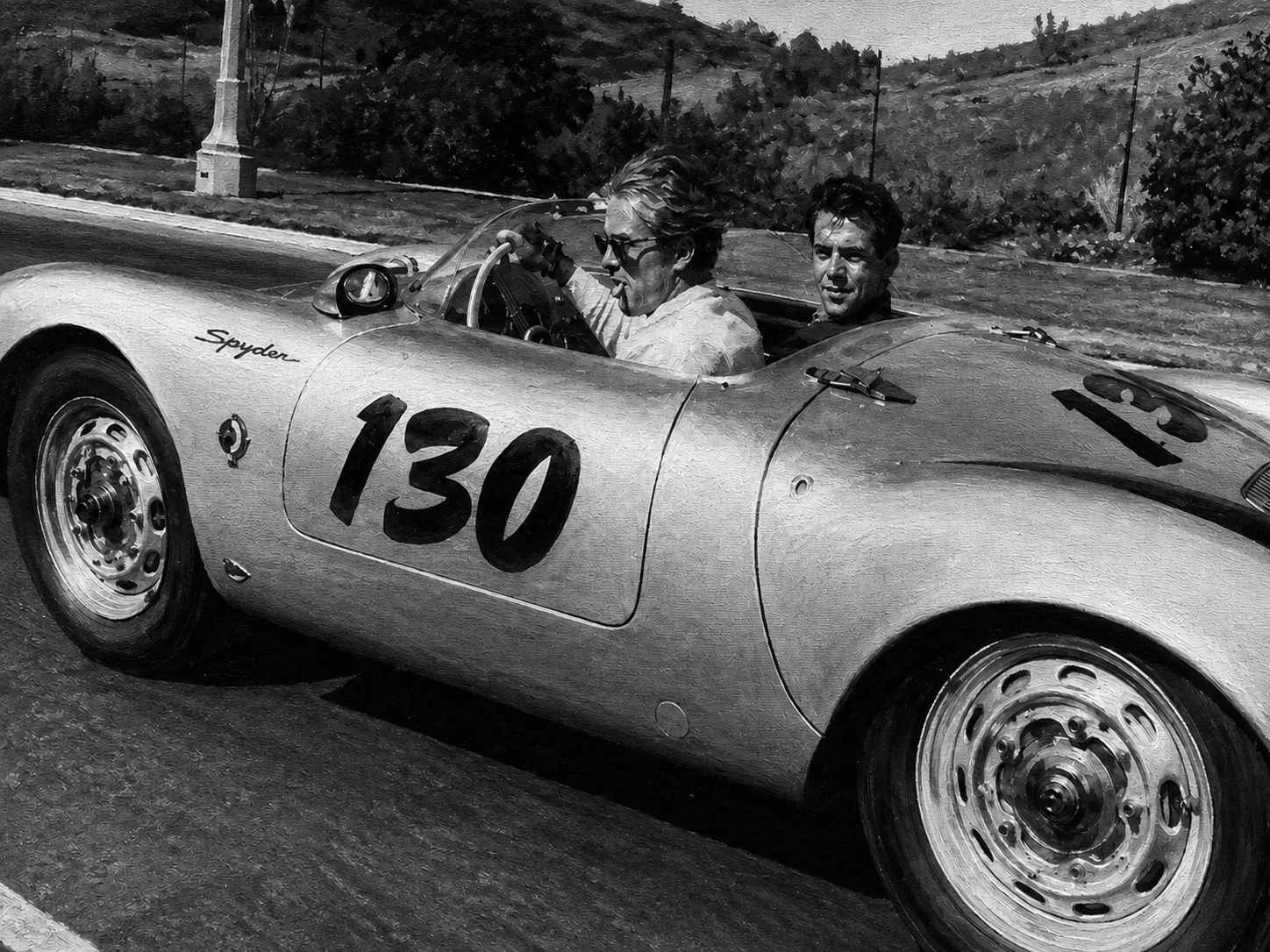
Dean had the car customized by pinstriper Dean Jeffries, who painted the racing number “130” on the hood, doors, and rear deck lid, along with the name “Little Bastard” in script across the rear cowl.
Accounts differ slightly on the nickname’s origin: some say it referred to a jab Jack Warner once made at Dean during a dispute on the Warner Bros. lot. At the same time, stunt driver Bill Hickman — a friend who rode along with Dean on the day of the crash — claimed he personally introduced the nickname for Dean, who in turn called Hickman “big bastard.”
The Fatal Crash That Killed James Dean
Dean bought the Porsche just nine days before his death, intending to break in its engine on the drive to a road race in Salinas, California, scheduled for October 1–2, 1955.
On the afternoon of September 30, 1955, Dean set out from Los Angeles with Porsche factory mechanic Rolf Wütherich riding alongside him. Friend and stunt driver Bill Hickman, along with photographer Sanford Roth, followed behind in a station wagon towing an empty trailer meant for the Spyder.
Along the route, a California Highway Patrol officer stopped Dean for speeding near Bakersfield. Hours later, at around 5:45 p.m. near the town of Cholame on what was then Highway 466 (now State Route 46), a 23-year-old college student named Donald Turnupseed was driving a 1950 Ford Tudor sedan in the opposite direction. Turnupseed turned left across the highway directly into Dean’s path. The two cars collided almost head-on.
James Dean was killed almost instantly from a broken neck and severe internal injuries. Wütherich was thrown from the cockpit and survived, though seriously injured. Turnupseed escaped with only minor injuries. A coroner’s inquest held in San Luis Obispo on October 11, 1955, ruled Dean’s death an accident and found no criminal wrongdoing on Turnupseed’s part.
Remarkably, despite the violence of the crash, the Porsche’s engine remained largely intact — a detail that would set the next chapter of the car’s story in motion.
Alec Guinness’s Eerie Premonition
One of the most chilling details connected to the “Little Bastard” legend involves British actor Alec Guinness. About a week before the crash, Guinness met James Dean outside a Los Angeles restaurant, where Dean proudly showed off his new Porsche.
According to Guinness’s own diary, later published, he had an immediate and unsettling reaction to the car, later writing that the vehicle looked sinister to him and that, almost without meaning to, he heard himself telling Dean: “If you get in that car you will be found dead in it by this time next week.” Dean died seven days later.
Guinness’s account is one of the few elements of the story with a clear, documented, first-person source, since he recorded it himself rather than relying on secondhand retellings. It remains one of the eeriest and most frequently cited pieces of the curse legend.
You may also enjoy:
The Chain of Misfortune: What Happened to the Wreckage
After the crash, Dean’s insurance company declared the Porsche a total loss and paid a settlement to his father, Winton Dean. The wrecked car was then sold through a Burbank salvage yard to Dr. William F. Eschrich, a Southern California physician and amateur racer.
Eschrich installed the Porsche’s surviving Type 547 engine into his Lotus IX race car, and he loaned other mechanical parts — including suspension components — to fellow racer and physician Dr. Troy McHenry.
Almost exactly eleven months after Dean’s death, at the 1956 Pomona sports car races, both men crashed in the same event while using components salvaged from “Little Bastard.” McHenry’s Porsche struck the only tree on the track, and he was killed instantly.
Eschrich’s car rolled while negotiating a turn, and he was seriously injured but survived. This double crash — independently documented through period racing reports and interviews — is the single most solidly verified tragedy connected to the curse legend, and McHenry is generally regarded as the only confirmed fatal victim of it.
The remaining body and chassis of the Porsche, stripped of its drivetrain, were acquired by George Barris for a reported $2,500. Rather than rebuild the car as he had promised, Barris found the frame too badly mangled to restore and instead loaned the wreck to the Los Angeles chapter of the National Safety Council, which used it as a touring road-safety exhibit warning young drivers about the dangers of speed. From roughly 1957 to 1959, the wreck toured car shows, cinema lobbies, and bowling alleys across the country.
In March 1959, while the car was in storage in Fresno, California, it reportedly caught fire under mysterious circumstances. The blaze caused only minor damage — two melted tires and some singed paint — and, fortunately, did not spread to other vehicles stored nearby. This fire is one of the better-documented and corroborated events in the curse’s history.
Around the same period, Barris claimed that a pair of tires sold separately from the wreck blew out simultaneously on a customer’s car, causing that driver to crash. However, no named victim or independent record of this incident has ever surfaced.
George Barris and the Birth of the “Curse” Legend
While some misfortunes connected to “Little Bastard” are verifiable, the broader, more elaborate curse mythology — stories of mechanics suffering unexplained wounds, a truck driver crushed to death while transporting the car, the wreck falling on a student during an exhibit, and thieves injuring themselves trying to steal parts from it — trace back almost entirely to George Barris himself.
Barris promoted these stories for decades, including in his own 1974 book “Cars of the Stars,” and gave numerous interviews reinforcing the car’s sinister reputation. Investigators and biographers who later tried to verify the more dramatic claims found that key details, such as the names of supposed victims, were never specified and could not be independently confirmed.
Lee Raskin, author of the biographies “James Dean: At Speed” (2005) and “James Dean: On the Road to Salinas” (2015), has spent years researching Dean’s life and racing career and has publicly stated that he considers most of the embellished curse stories to be fabrications created or exaggerated by Barris to maintain public interest in the wreck — and, by extension, in Barris’s own traveling exhibit and business.
This does not mean nothing strange happened. It means that a genuinely unusual run of bad luck — a fatal crash using salvaged parts, a mysterious fire, and an eventual disappearance — was deliberately amplified into a far more sensational “curse” narrative for commercial and publicity purposes.
The Mysterious Disappearance of “Little Bastard”
The strangest and least resolved chapter of the story is the fate of the wreck itself.
After its safety-tour years, the chassis and body were reportedly being transported from an exhibition in Miami back to Los Angeles around 1960, said to have been shipped in a sealed boxcar by rail. According to the most commonly repeated version of events, when the boxcar arrived in Los Angeles, it was found intact and still sealed — but the Porsche itself was gone.
No verified sighting, sale record, or physical trace of the original wreck has surfaced since. A $1 million reward for credible information about its whereabouts, offered in 2005 around the 50th anniversary of Dean’s death, went unclaimed.
Several institutions have claimed to possess small fragments allegedly taken from the car before it disappeared, including a chunk of aluminum reportedly removed from near the broken windscreen. At the same time, the wreck sat in a garage in Cholame, but none of these claims has been definitively authenticated as belonging to chassis 550-0055.
Raskin has suggested an alternative, far less mystical explanation: that by 1960 the wrecked Porsche had simply lost its novelty value as American pop culture moved on to the muscle-car era, and that Barris may have deliberately allowed the car to “disappear,” using the mystery itself as a way of keeping the legend — and public interest in it — alive indefinitely.
Is the Curse Real?
Taken as a whole, the documented record supports a more grounded explanation than a supernatural curse.
The verifiable facts are these: Dean died in a road accident with no evidence of mechanical failure in the Porsche; salvaged drivetrain parts from his wrecked car were present in a separate crash eleven months later that killed one racer and injured another; the wrecked body of the car caught fire once while in storage; and the wreck eventually disappeared from the historical record entirely.
Each of these events has a plausible, non-supernatural explanation from 1950s amateur motorsport, inadequate fire safety in storage facilities, and the commercial incentives of a publicity-savvy car customizer.
What pushed the story from “unlucky car” to full-blown “curse” was the deliberate storytelling of George Barris, amplified over decades by magazines, television specials, and word of mouth, with details growing more dramatic each time they were retold.
Researchers who have gone back to primary sources — police reports, period racing publications, and firsthand witness accounts — have been able to confirm only a handful of the legend’s most famous claims, while the rest remain unverifiable folklore.
You may also enjoy:
The Enfield Poltergeist Case: Fact, Hoax, or Something More?
October 21, 2025
The 9 Most Haunted Hotels in Arkansas You Can Still Visit
October 8, 2025
Ittan-momen: The Flying Cloth Yokai That Strangles Victims
September 10, 2025
Is The Anguished Man Painting Truly Cursed?
May 26, 2025
James Dean’s Cursed Car vs Other Famous Cursed Objects
| Name | Type of Curse | Death Toll (Attributed) | Activity Level |
|---|---|---|---|
| Annabelle Doll | Demonic Attachment | No deaths confirmed; said in popular accounts to be linked to feelings of dread and minor incidents among those who handled it | 3/10 (dormant) |
| Robert the Doll | Spirit Attachment | No deaths confirmed; owners have anecdotally blamed the doll for accidents and bad luck | 4/10 (occasional) |
| Dybbuk Box | Dybbuk Attachment | No deaths confirmed; successive owners have reported nightmares, illness, and unexplained smells | 5/10 (occasional) |
| The Crying Boy Painting | Bad-Luck Curse | No deaths confirmed; popularly linked to a series of unexplained house fires in the UK in the 1980s | 3/10 (dormant) |
| Hope Diamond | Financial Ruin Curse, Bad-Luck Curse | Several deaths and financial ruin popularly attributed to past owners across multiple centuries (figures vary widely by retelling) | 2/10 (dormant) |
| Busby’s Stoop Chair | Fatal Curse | Multiple deaths popularly attributed to anyone who sits in the chair since the 18th century (exact figures vary by source) | 2/10 (dormant) |
| The Basano Vase | Fatal Curse | Multiple deaths attributed across owners since the 16th century in popular retellings (exact figures vary by source) | 2/10 (dormant) |
| Myrtles Plantation Mirror | Spirit Attachment | No deaths directly attributed to the mirror itself; tied to a broader haunted-plantation legend | 4/10 (occasional) |
| The Unlucky Mummy (British Museum) | Bad-Luck Curse | No deaths confirmed; popularly but inaccurately linked to the sinking of the Titanic and other disasters | 2/10 (dormant) |
| The Koh-i-Noor Diamond | Bloodline Curse, Familial Curse Carrier | Misfortune popularly attributed to a long line of male owners throughout its history; no confirmed deaths tied specifically to the gem | 2/10 (dormant) |
| The Anguished Man | Demonic Attachment | No deaths confirmed; owner has reported sounds, shadows, and a feeling of being watched | 5/10 (occasional) |
| Tutankhamun’s Tomb Artifacts | Familial Curse Carrier, Fatal Curse | Several deaths among expedition members and associates in the years following the 1922 tomb opening are popularly attributed to the “Curse of the Pharaohs,” though researchers attribute most to natural causes | 1/10 (dormant) |
The Astonishing Value of “Cursed” Little Bastard Parts Today
Despite — or perhaps because of — its grim reputation, surviving fragments connected to James Dean’s Porsche have become extraordinarily valuable collector’s items.
The most significant confirmed example is the car’s original four-speed transaxle, which had been stored for roughly three decades before resurfacing.
Verified by Porsche through factory documentation matching it to chassis 550-0055, the transaxle sold at a Bring a Trailer auction on May 29, 2021, for a final price of $382,000 ($387,000 including fees). The winning bidder was later revealed to be Zak Bagans, host of the television series “Ghost Adventures,” who put the transaxle on display in his Haunted Museum in Las Vegas as one of its centerpiece “cursed” artifacts.
The broader Porsche 550 Spyder model has itself become one of the most valuable cars of its era among collectors, independent of the Dean connection.
Surviving, unrelated examples of the model have sold at auction for several million dollars, reflecting the car’s rarity — only around 90 were ever built — and its genuine racing pedigree, which included class wins at events such as the Mille Miglia, the Targa Florio, and the 24 Hours of Le Mans.
Frequently Asked Questions
What was the name of James Dean’s cursed car?
James Dean’s car was a 1955 Porsche 550 Spyder, chassis number 550-0055, nicknamed “Little Bastard.” The nickname and the racing number “130” were painted onto the car by pinstriper Dean Jeffries shortly before Dean’s death.
How did James Dean die in his Porsche?
James Dean died on September 30, 1955, when his Porsche 550 Spyder collided almost head-on with a Ford Tudor sedan driven by a student, Donald Turnupseed, near Cholame, California. Dean was killed almost instantly from a broken neck and severe internal injuries; his mechanic passenger, Rolf Wütherich, survived with serious injuries.
Who said James Dean would die in his car?
British actor Alec Guinness reportedly told Dean, about a week before the crash, that the Porsche looked sinister and that Dean would be found dead in it within a week if he drove it. Guinness recorded this premonition in his own diary, and Dean died almost exactly seven days later.
What happened to the parts of James Dean’s wrecked Porsche?
The engine was installed in a Lotus IX race car owned by Dr. William Eschrich, while other components, including suspension parts, were loaned to racer Dr. Troy McHenry. Both men crashed in the same 1956 race at Pomona; McHenry was killed, and Eschrich was injured. The remaining body and chassis were acquired by customizer George Barris, who used them in a traveling road-safety exhibit before the wreck disappeared in 1960.
Is the curse of James Dean’s Porsche real?
There is no scientific or independently verified evidence of a supernatural curse. A genuine string of unusual and tragic events did occur — including the fatal 1956 race and a fire while the wreck was in storage — but much of the more elaborate curse mythology originated with George Barris, who promoted it for publicity, and several of its claims have never been corroborated by named witnesses or independent records.
Where is James Dean’s Porsche 550 Spyder now?
The whereabouts of the original wrecked chassis remain unknown. It reportedly disappeared in 1960 while being shipped by rail from an exhibition in Miami back to Los Angeles, and despite a $1 million reward offered in 2005, it has never been recovered.
How much did the transaxle from James Dean’s car sell for?
The original four-speed transaxle from Dean’s Porsche 550 Spyder, verified by Porsche documentation, sold at auction on Bring a Trailer in May 2021 for $382,000 ($387,000 with fees). It was purchased by television personality Zak Bagans for display in his Haunted Museum.
How many Porsche 550 Spyders were made?
Porsche built approximately 90 examples of the 550 Spyder between 1953 and 1956, making it one of the rarest models in the company’s history and a highly sought-after collector’s car independent of its association with James Dean.
You may also enjoy:
Rahab: Leviathan’s Twin and the Forgotten Demon Prince
September 30, 2025
The Complete List of All Haunted Places in Colorado
November 19, 2025
Tanuki Yokai: The Mischievous Spirit with Disturbing Powers
September 9, 2025
Bigfoot: What Are We Still Missing?
July 8, 2025
The Nandi Bear: Africa’s Terrifying “Brain-Eating” Cryptid
November 11, 2025
Sources
- Barris, George, and Jack Scagnetti. Cars of the Stars. Jonathan David Publishers, 1974.
- Guinness, Alec. Blessings in Disguise. Random House, 1985.
- Raskin, Lee. James Dean: At Speed. David Bull Publishing, 2005.
- Raskin, Lee. James Dean: On the Road to Salinas. Stance & Speed, 2015.
- Beath, Warren Newton. The Death of James Dean. Grove Press, 1986. Internet Archive.
- $1M Offered for James Dean Death Car. CNN, 30 Aug. 2005.